Chapter 14 — Dividing Polynomials and Equivalent Quadratic Forms
Standard: A.EO.2 (d, e)
A.EO.2 — verbatim. The student will perform operations on and factor polynomial expressions in one variable. Students will demonstrate the following Knowledge and Skills: a) Determine sums and differences of polynomial expressions in one variable, using a variety of strategies, including concrete objects and their related pictorial and symbolic models. b) Determine the product of polynomial expressions in one variable, using a variety of strategies, including concrete objects and their related pictorial and symbolic models, the application of the distributive property, and the use of area models. The factors should be limited to five or fewer terms. c) Factor completely first- and second-degree polynomials in one variable with integral coefficients. After factoring out the greatest common factor (GCF), leading coefficients should have no more than four factors. d) Determine the quotient of polynomials, using a monomial or binomial divisor, or a completely factored divisor. e) Represent and demonstrate equality of quadratic expressions in different forms.
By the end of this chapter you will be able to:
- Divide a polynomial by a monomial, term by term, using the quotient law from Chapter 10 (A.EO.2d)
- Divide a polynomial by a binomial with an area model and symbolically, then check by multiplying the quotient by the divisor (A.EO.2d)
- Divide by a completely factored divisor by cancellation, and state the domain restriction the cancellation forces (A.EO.2d)
- Rewrite by completing the square, as an expression rewrite — not as a method for solving equations (A.EO.2e)
- Write one quadratic in standard form, factored form, and vertex form, and prove the three are the same expression by expanding (A.EO.2e)
- Say what each form reveals about the expression — the constant and leading coefficient, the inputs that make it zero, and the least or greatest value — without graphing a parabola (A.EO.2e)
Lessons: 14.1 Dividing by a Monomial · 14.2 Dividing by a Binomial · 14.3 Completely Factored Divisors and Domain Restrictions · 14.4 Equivalent Quadratic Forms
Why this chapter matters. Chapter 12 taught you to multiply polynomials, and Chapter 13 taught you to factor them. Division is the third operation, and it is the same product picture read as "one side and the area are known; find the other side." That skill is what lets you simplify a ratio of polynomials when a factor is shared. The second half of the chapter is different in look but the same in spirit: one quadratic expression can be written three ways, and A.EO.2e asks you to demonstrate that the three writings are equal. Expanding proves it. Completing the square produces the vertex form. Factored form comes from Chapter 13. None of that requires a parabola — the graph of a quadratic function is Chapter 16 — and none of it solves an equation. Solving by completing the square is Chapter 15.
Scope note. A.EO.2d limits divisors to a monomial, a binomial, or a completely factored divisor. No item in this chapter divides by an unfactored trinomial, and no item asks for polynomial long division beyond what an area model or cancellation can finish. A.EO.2e asks for equality of quadratic expressions in different forms. The three forms this chapter uses are standard , factored , and vertex . Completing the square appears here as an expression rewrite that produces vertex form; using it to solve is A.EI.3 in Chapter 15. Nothing here graphs a parabola, names an axis of symmetry, or describes a transformation of — those are A.F.2 in Chapter 16. Factoring a polynomial from scratch is Chapter 13; this chapter uses factored form when it is already in hand or when equality needs proving by expanding.
Conventions this chapter fixes.
- A quotient is the result of a division. In , the polynomial is the dividend, is the divisor, and is the quotient.
- Every cancellation carries a domain restriction. Canceling a factor from numerator and denominator is valid only for , because the original expression is undefined at . The simplified expression and the original agree everywhere the original exists; they do not agree at the hole. Reporting the restriction is part of the answer.
- A monomial divisor with forces . The chapter states that restriction whenever the divisor contains a variable power.
- Vertex form is an algebraic rewriting. The number is the least value of the expression when , and the greatest value when ; it is reached at . That claim is about the expression's values, not about a drawn curve.
- Proving two forms equal means expanding until both match, or rewriting one into the other by completing the square. Evaluating both at a few inputs is useful evidence and a fine use of technology, but it is not a proof — agreement at seven inputs does not rule out disagreement at an eighth.
- Item numbering runs straight through the chapter, from 1 in Lesson 14.1 to 110 at the end of the review. It does not restart at each lesson.
Calculator note. Algebra 1 has no no-calculator standards, and the Desmos Virginia calculator is available for the entire End-of-Course test. Use it here the way Chapter 12 does: pick an allowed input, evaluate the original expression and your quotient (or both quadratic forms), and confirm the numbers agree. For a division with a restriction, never choose the forbidden input — the original expression does not exist there. For equality of forms, a table of matching outputs is strong evidence; expanding is the proof.
Lesson 14.1 — Dividing by a Monomial
One dividend, one fraction per term
A.EO.2d begins with the simplest allowed divisor: a monomial. The procedure is the quotient law from Chapter 10, applied once per term.
Each separate division divides the coefficients and subtracts the exponents. The three quotients are , , and , so
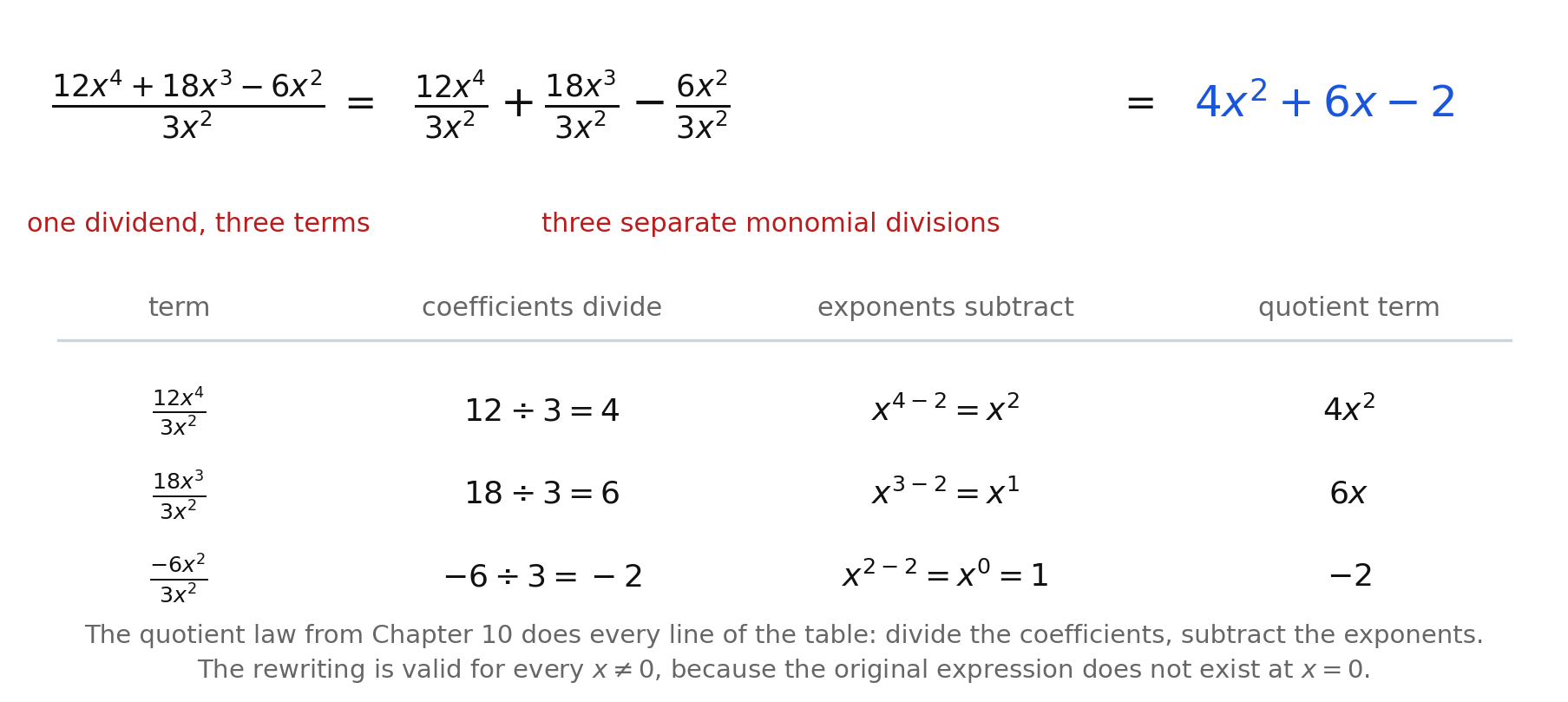
Read the figure one row at a time.
- Coefficients divide: , , .
- Exponents subtract: , , . An exponent of means the variable disappears and the term is a constant.
- The rewriting is valid for every , because the original expression has in the denominator and does not exist at .
The procedure in full
- Write the dividend as a sum of separate fractions, one for each term, all with the same monomial denominator.
- Divide the coefficients in each fraction, signs included.
- Subtract the exponents on the variable in each fraction, reading a bare as .
- State the restriction forced by the divisor: if the divisor contains with , then .
The same work in reverse is Chapter 12's monomial multiplication. Checking means verifying
which it does, for every — and the original division is defined for every .
Signs and missing terms
Carry each sign with its term. In the middle term is , so the second fraction is . Writing the middle term as if it were positive is the single most common error in this lesson.
A dividend may skip a power. has no or term, and that is fine — write two fractions, not five. The quotient is , for .
Worked examples
Example 1 — The figure's division
Divide by , and state the restriction.
Split into three fractions. Coefficients: , , . Exponents: , , .
Answer: , for .
Example 2 — A linear monomial divisor
Divide by .
Answer: , for .
Example 3 — A negative leading term
Divide by .
Answer: , for .
Example 4 — Checking by multiplying back
Check Example 2 by multiplying by .
Answer: The product recovers the dividend, so the quotient is correct wherever the original exists.
Example 5 — A constant monomial
Divide by .
A constant divisor imposes no variable restriction. Each coefficient simply divides by .
Answer: . (No restriction from the divisor.)
Guided practice
- Use the monomial-divisor figure. Write the three separate fractions it shows for .
- In that same figure, complete the first row of the table: coefficients divide, exponents subtract, quotient term.
- In that same figure, why does the third row produce the constant rather than a power of ?
- In that same figure, state the restriction and explain why it is required.
- Divide by , showing one fraction per term, and state the restriction.
- Check your answer to item 5 by multiplying the quotient by .
Independent practice
- Divide. State the restriction when the divisor contains a variable. a) b) c) d)
- Divide. a) b) c) d)
- Divide and state the restriction.
- Divide and state the restriction.
- Reasoning. Explain why and are not identical as expressions, even though they agree at every .
- Error analysis. A student writes . Identify the error and give the correct quotient.
- Error analysis. A student writes . Identify the error and give the correct quotient with its restriction.
- Check by multiplying back. Show the product.
- Application. The volume of a rectangular box is cubic centimeters, and its height is centimeters. Write an expression for the area of the base, and state any restriction must obey for the model to make sense.
- Evaluate both and at . Confirm they agree, and explain why you may not check at .
- Divide and simplify the signs carefully.
- Write a monomial dividend, a monomial divisor, and their quotient so that the quotient is , with restriction .
- Divide .
- Reasoning. Why does dividing a polynomial by a constant monomial require no restriction of the form , while dividing by does?
Exit ticket 14.1
- Divide and state the restriction.
- Divide .
- Check your answer to item 22 by multiplying the quotient by .
- Explain, in one sentence, why the quotient law subtracts exponents rather than dividing them.
Lesson 14.2 — Dividing by a Binomial
Division as a missing side
Chapter 12 filled an area model forwards: two sides given, the interior cells the product. Division runs the same grid backwards. The total area is the dividend, one side is the divisor, and the missing side is the quotient.
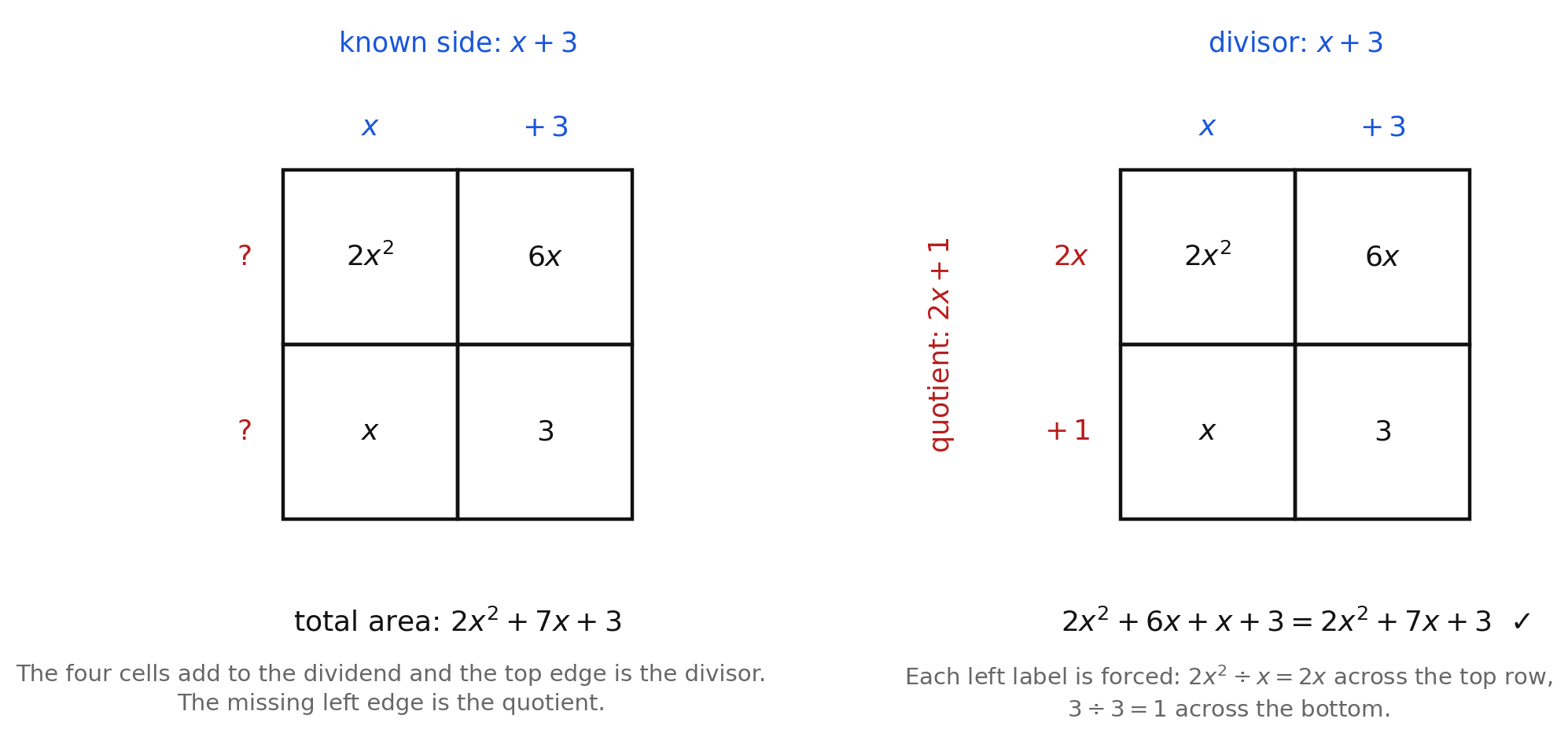
The figure sets up . The top edge is already labeled and . The four cells add to the dividend: . Each left label is forced by dividing a cell by the top label above it:
- Top row:
- Bottom row:
So the quotient is . The check is Chapter 12 run forwards:
The multiply-back check
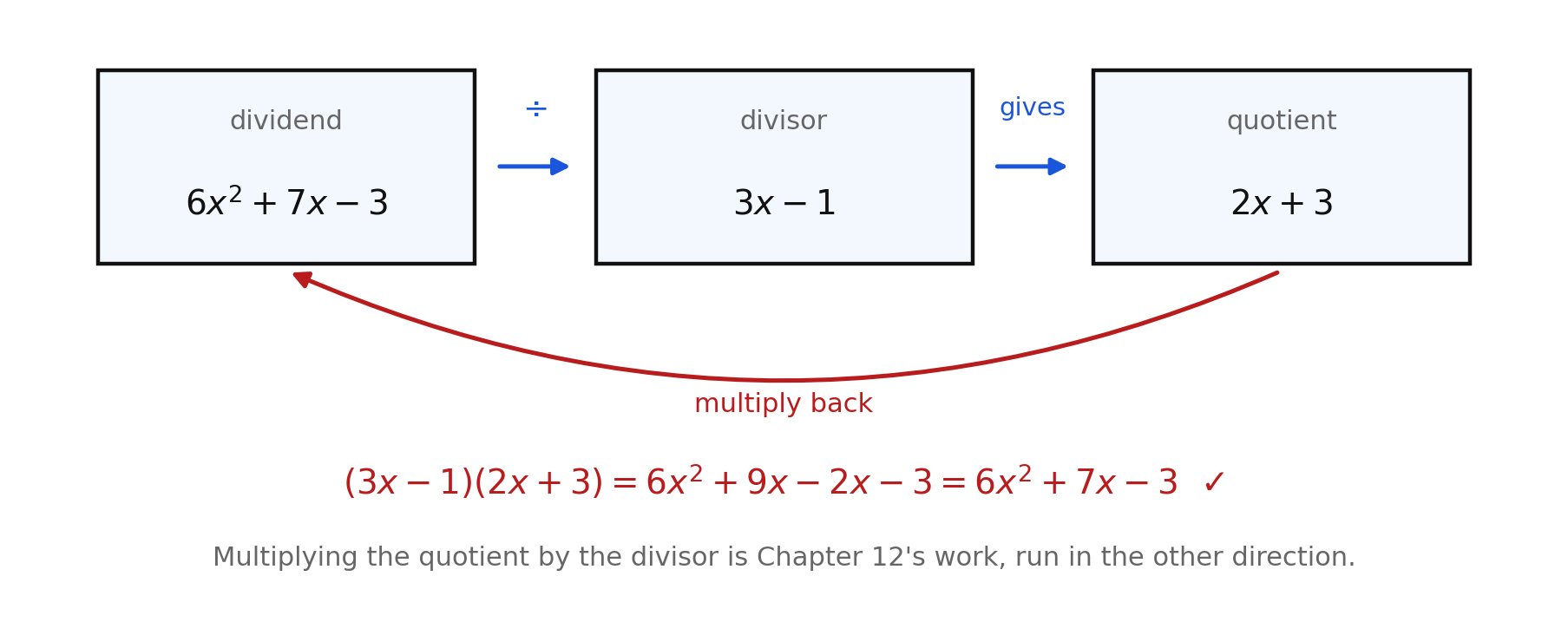
Every binomial division in this chapter gets the same self-check. For :
If the product recovers the dividend, the quotient is correct wherever the divisor is not zero. The restriction here is , because the original expression is undefined when .
Finding the quotient without a picture
When the dividend is a quadratic and the divisor is linear, the quotient is linear. You can find it by asking what binomial times the divisor recovers the dividend — which is Chapter 13's factoring, read as division — or by filling the area model. Both routes are allowed; both end at the multiply-back check.
For :
- The factors of are , so the quotient is , for .
- Or fill the area model: top edge and ; left edge forced as and ; cells , , , .
Worked examples
Example 1 — The area-model figure
Use the area-model figure to divide by .
Left labels: and .
Answer: , for .
Example 2 — Multiply back
Check Example 1 by multiplying .
Answer: , matching the dividend.
Example 3 — A leading coefficient other than 1
Divide by , and state the restriction.
The quotient is , because .
Answer: , for .
Example 4 — Difference of squares
Divide by .
, so the quotient is .
Answer: , for .
Example 5 — Blank area models
The blank area-model figure poses three divisions. Find each quotient.
- , for
- , for
- , for
Answer: ; ; , each with its restriction.
Guided practice
- Use the area-model figure. Name the divisor on the top edge and the four cells that add to the dividend .
- In that same figure, explain how the left-edge labels and are forced.
- Use the multiply-back figure. Write the product and confirm it recovers .
- Divide by using an area model or by factoring, and state the restriction.
- Divide by , and state the restriction.
- Why must the restriction for be rather than ?
Independent practice
- Divide. State the restriction. a) b) c) d)
- Divide. a) b) c) d)
- Divide and check by multiplying back.
- Divide and state the restriction.
- Use the blank area-model figure. Fill all three models: write the top-edge labels, the left-edge quotient, and the four cells for each.
- In the blank area-model figure, check the middle model by adding the four cells and confirming they total .
- Application. A rectangular garden has area square meters and width meters. Write an expression for its length, and state any restriction.
- Application. A store's weekly revenue is dollars when it sells cases of an item. Expand the revenue into a single polynomial. Then divide that polynomial by and state the restriction.
- Error analysis. A student claims . Identify the error, give the correct quotient, and show the multiply-back check.
- Error analysis. A student divides by and gets . Multiply back and show why that quotient is wrong; then give the correct one.
- Divide .
- Divide .
- Check by multiplying .
- Reasoning. Explain why an area model for division needs the cells to add to the dividend, not multiply to it.
- Evaluate both and at . Confirm they agree.
- Divide and state the restriction.
Exit ticket 14.2
- Divide and state the restriction.
- Divide and check by multiplying back.
- Using an area model or factoring, divide .
- Why does multiplying the quotient by the divisor check a division?
Lesson 14.3 — Completely Factored Divisors and Domain Restrictions
Cancellation is not optional about its restriction
A.EO.2d's third allowed divisor is a completely factored one. When a factor appears in both the numerator and the denominator, it cancels — and the cancellation is valid only where that factor is not zero.
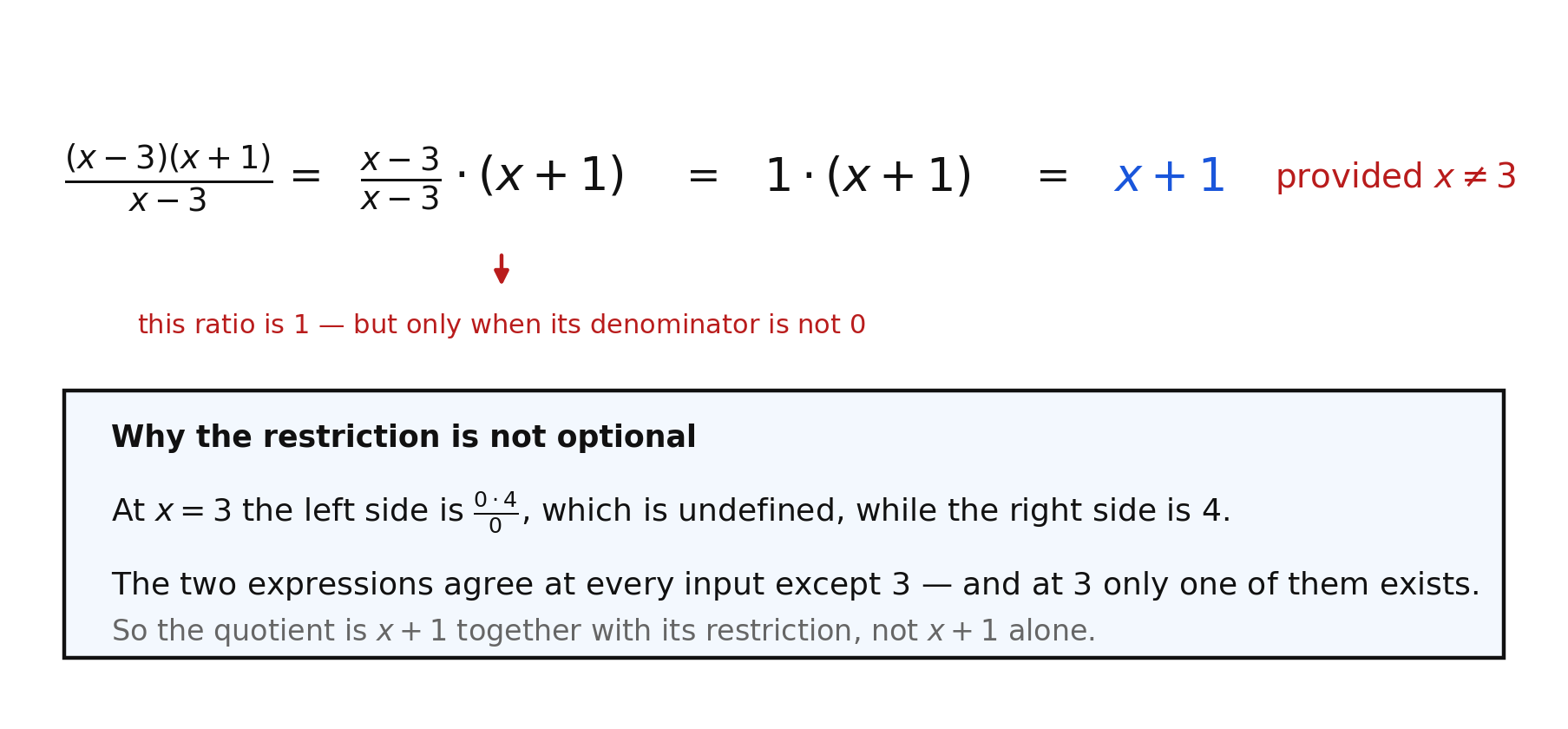
The figure walks through
At the left side is , which is undefined, while the right side is . The two expressions agree at every input except , and at only one of them exists. So the quotient is together with its restriction, not alone.
What "completely factored" allows
The divisor may be a single binomial factor, or a product of factors already written out. You may cancel any factor that appears in both, and you must record a restriction for each canceled factor.
You do not expand the numerator or the denominator first. Expanding would hide the common factors and turn a one-step cancellation into a harder division.
Connecting back to Lesson 14.2
Every binomial quotient from Lesson 14.2 can be rewritten this way once the dividend is factored. for . Cancellation and the area model are two readings of the same fact.
Worked examples
Example 1 — The cancellation figure
Simplify and state the restriction.
Cancel , which requires .
Answer: , for .
Example 2 — A shared binomial with a coefficient
Simplify .
Answer: , for .
Example 3 — Two factors canceled
Simplify .
Answer: , for and .
Example 4 — A squared factor
Simplify .
One factor of cancels, leaving one factor of .
Answer: , for .
Example 5 — Why the restriction matters numerically
Show that and disagree in status at , even though they agree at .
At : left side , right side . At : left side undefined, right side .
Answer: They agree at ; at only the simplified expression exists.
Guided practice
- Use the cancellation figure. Write the four steps it shows from to .
- In that same figure, why is equal to only when ?
- In that same figure, evaluate both sides of the claimed equality at and at . What happens at each?
- Simplify and state the restriction.
- Simplify and state both restrictions.
- Rewrite by factoring the numerator first, then canceling. State the restriction.
Independent practice
- Simplify. State every restriction. a) b) c) d)
- Simplify. a) b) c) d)
- Factor the numerator, then simplify .
- Factor the numerator, then simplify .
- Reasoning. A student simplifies to and stops. Explain what is missing from the answer and why it matters.
- Error analysis. A student cancels the in and writes . Identify the error. (You may not cancel a term across a sum.)
- Error analysis. A student writes . Identify the error and give the correct simplified form with its restriction.
- Evaluate and at and at . Confirm agreement, and explain why is not an allowed check.
- Application. A company's profit density is modeled by dollars per unit when it produces hundred units. Simplify the expression and state the production level at which the model is undefined.
- Simplify .
- Connect to Lesson 14.2: write by factoring the numerator as , then cancel.
- Reasoning. Why does A.EO.2d insist the divisor be completely factored before you cancel, rather than allowing you to cancel pieces of an unfactored trinomial?
- Simplify .
- Write an original rational expression whose simplified form is with restriction .
Exit ticket 14.3
- Simplify and state the restriction.
- Simplify .
- Factor, then simplify .
- Explain why the simplified form and the original expression are not the same at the restricted input.
Lesson 14.4 — Equivalent Quadratic Forms
One expression, three writings
A.EO.2e asks you to represent and demonstrate equality of quadratic expressions in different forms. This chapter uses three:
| Form | Looks like | What it reveals |
|---|---|---|
| Standard | the leading coefficient and the constant term | |
| Factored | the inputs and that make the expression | |
| Vertex | the input at which the expression reaches its least value (when ) or its greatest value (when ) |
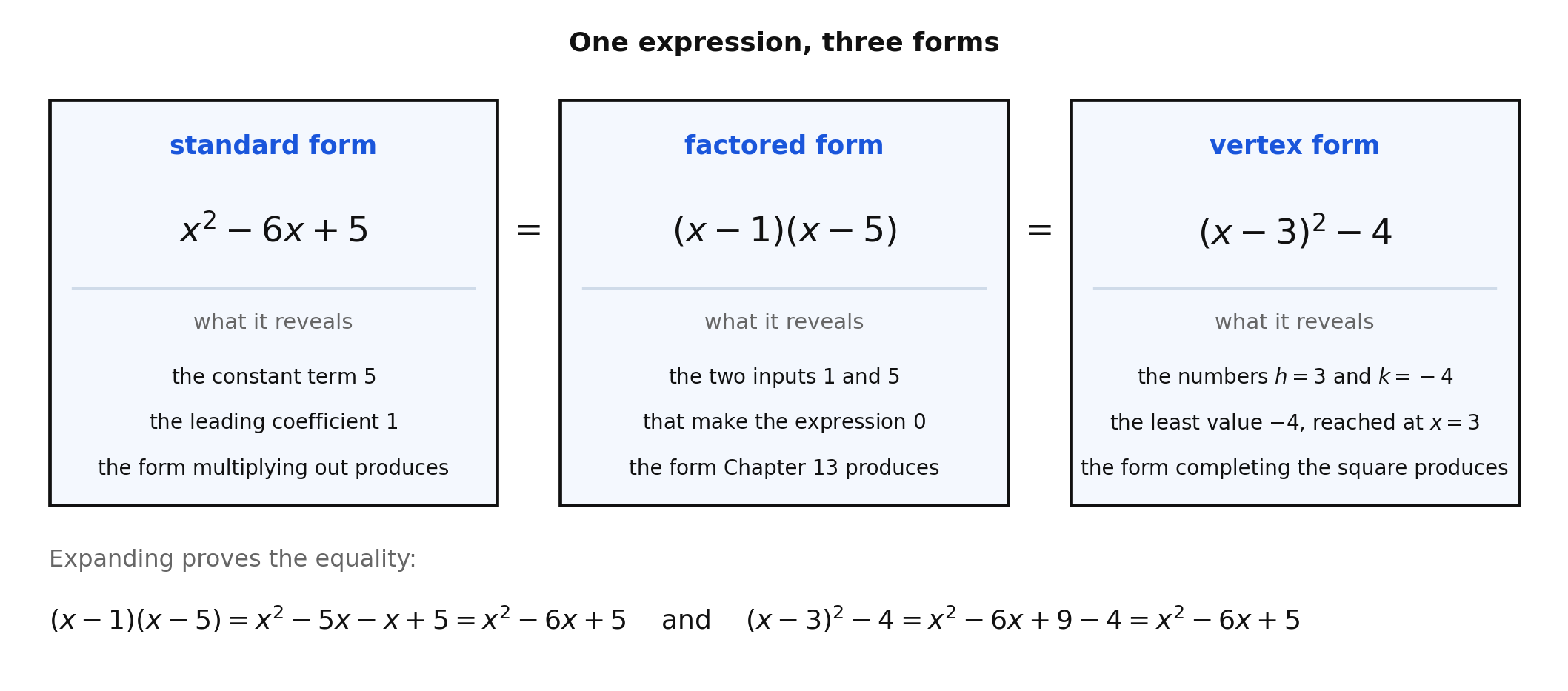
The figure puts , , and side by side. Expanding proves the equality:
No parabola is required. The three writings are the same expression because algebra says so.
Completing the square produces vertex form
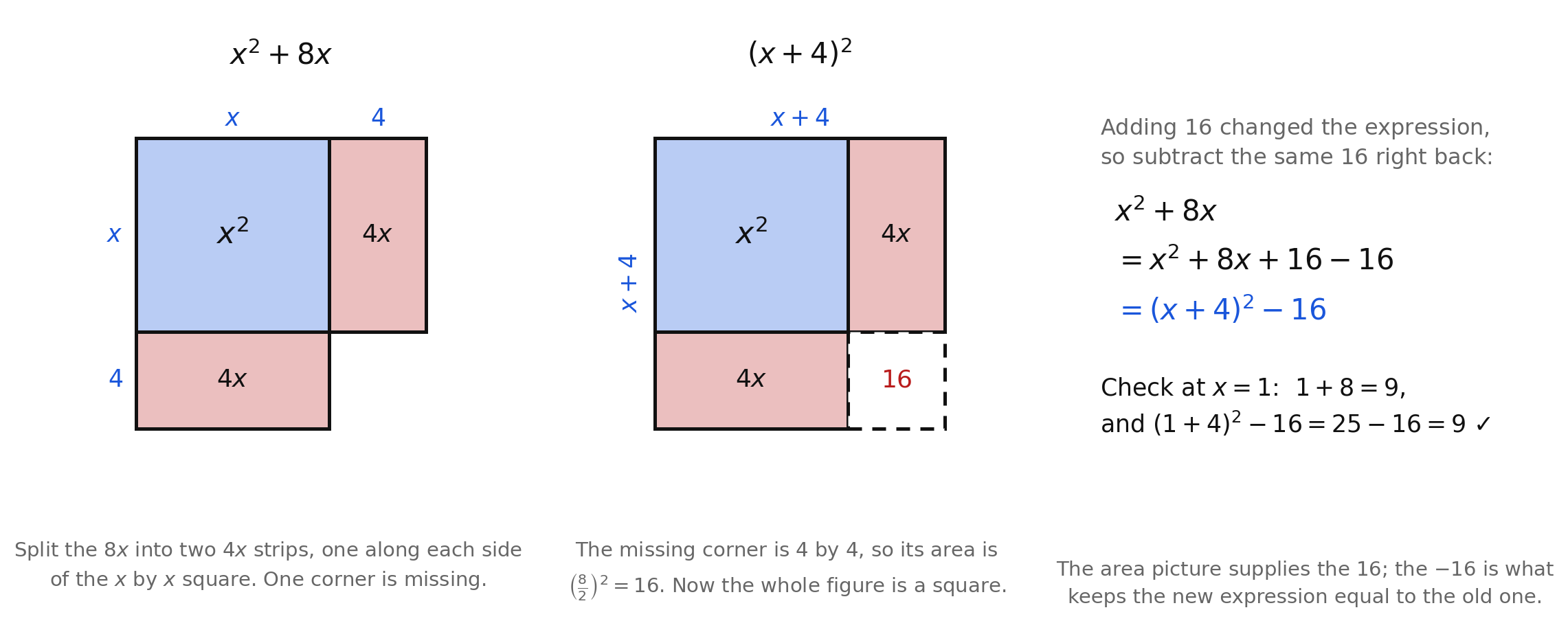
To rewrite in vertex form:
- Split the middle term into two equal strips of .
- Add the missing corner so the figure becomes a square, .
- Subtract the same corner immediately, so the value of the expression does not change.
For :
The area picture supplies the ; the is what keeps the new expression equal to the old one. Check at : , and .
For a full quadratic , complete the square on and carry along:
This chapter never sets the expression equal to zero and solves. Completing the square as a solution method is Chapter 15.
Tables give evidence; expanding gives proof
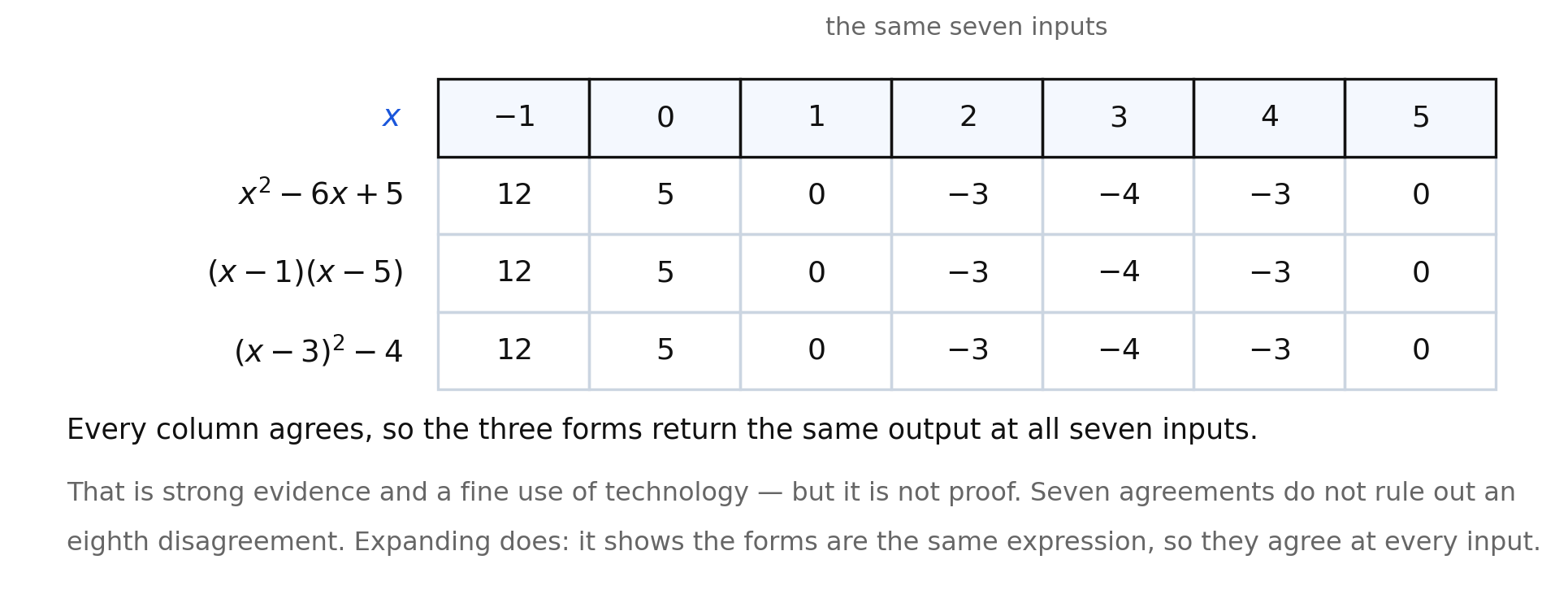
The table evaluates all three forms of at . Every column agrees. That is strong evidence and a fine use of technology — but it is not proof. Seven agreements do not rule out an eighth disagreement. Expanding does: it shows the forms are the same expression, so they agree at every input.
Worked examples
Example 1 — Completing the square on
Rewrite in vertex form.
Half of is ; .
Answer:
Example 2 — A negative middle term
Rewrite in vertex form.
Half of is ; .
Answer:
Example 3 — Full quadratic to vertex form
Rewrite in vertex form.
Answer:
Example 4 — Proving equality by expanding
Show that and both equal .
Answer: and , as in the three-forms figure.
Example 5 — What each form reveals
For , state what each form reveals.
Answer: Standard reveals leading coefficient and constant . Factored reveals the expression is at and at . Vertex reveals the least value is , reached at .
Guided practice
- Use the completing-the-square figure. How is the missing corner's area computed for , and why is written after ?
- Use the three-forms figure. Write the three expressions it shows, and expand the factored form to standard form.
- In that same figure, expand the vertex form to standard form.
- Use the table figure. At , what output do all three forms give, and what does that output tell you about the vertex form?
- Rewrite by completing the square.
- Rewrite by completing the square.
- Rewrite by completing the square.
- Show by expanding that .
Independent practice
- Rewrite each by completing the square. a) b) c) d)
- Use the blank completing-the-square frames. Fill all three: the corner added and the vertex form.
- Rewrite each quadratic in vertex form. a) b) c) d)
- Expand each to standard form, proving equality. a) b) c) d)
- For , write the factored form and the vertex form, then expand both to prove they match the standard form.
- Use the blank three-form panels. For , fill standard, factored, and vertex forms, note what each reveals, and write the expansion that proves equality.
- Application. A ball's height, in feet, seconds after being thrown is modeled by the expression . Rewrite by factoring out and completing the square on , then combine the constant. What is the greatest value of the height expression, and at what is it reached? (Do not solve an equation; read and from vertex form.)
- Build a table for , , and at . Confirm the three rows agree, then expand to prove equality.
- Reasoning. Why is a table of matching outputs evidence but not proof that two forms are equal?
- Error analysis. A student rewrites as and stops. Identify the error and give the correct vertex form.
- Error analysis. A student claims and are equal because both involve and . Expand the second expression and show they are not equal; then give the correct vertex form.
- For , expand to standard form. Then state the least value of the expression and the input at which it occurs.
- Write in all three forms and say what each reveals.
- Reasoning. Vertex form reveals a least or greatest value of an expression. Explain how you know, from alone with , that the least value is at — without drawing a parabola.
Exit ticket 14.4
- Rewrite in vertex form.
- Rewrite in all three forms.
- Expand and to prove both equal .
- What does the vertex form reveal that the standard form does not?
Chapter 14 Review
Vocabulary. dividend · divisor · quotient · monomial divisor · binomial divisor · completely factored divisor · domain restriction · cancellation · area model · multiply-back check · standard form · factored form · vertex form · completing the square · equivalent forms
A.EO.2 d and e ask for two different skills, so this review is organized by both. Part A is monomial division, Part B is binomial division and the multiply-back check, Part C is cancellation with restrictions, Part D is completing the square and the three forms, and Part E mixes them.
Part A — Monomial divisors
- Divide and state the restriction.
- Divide .
- Check your answer to item 101 by multiplying the quotient by .
Part B — Binomial divisors
- Divide and state the restriction.
- Divide and check by multiplying back.
- Divide using an area model or by factoring.
Part C — Completely factored divisors
- Simplify and state the restriction.
- Simplify and state both restrictions.
Part D — Equivalent quadratic forms
- Rewrite in factored form and in vertex form, then expand both to prove equality with the standard form.
- Rewrite by completing the square. State the least value of the expression and the input at which it occurs.
Standards coverage check — Chapter 14
| Knowledge and Skill | Where it is taught | Where it is practiced | Where it is used in context |
|---|---|---|---|
| A.EO.2d — determine the quotient of polynomials using a monomial divisor | 14.1 (term-by-term split; quotient law; restriction ) | 1–24; 101–103 | 15 |
| A.EO.2d — determine the quotient using a binomial divisor | 14.2 (area model; multiply-back check) | 25–50; 104–106 | 37, 38 |
| A.EO.2d — determine the quotient using a completely factored divisor | 14.3 (cancellation with stated restrictions) | 51–74; 107–108 | 65 |
| A.EO.2e — represent quadratic expressions in standard, factored, and vertex forms | 14.4 (completing the square; three-forms panel; what each reveals) | 75–88, 94–100; 109–110 | 89 |
| A.EO.2e — demonstrate equality of those forms | 14.4 (expanding as proof; tables as evidence) | 76–78, 82, 86–88, 90–91, 99; 109 | 90 |
Supporting items: 11, 20, 30, 44, 61, 68, 74, 91, and 96 are reasoning prompts aimed at the claims most often taken on faith — why a restriction is part of the answer, why expanding proves equality, and why vertex form reveals a least value algebraically. Items 12, 13, 39, 40, 62, 63, 92, and 93 are error analyses aimed at the most common defects: dropping a sign, dividing exponents, canceling terms across a sum, and forgetting to subtract the corner when completing the square.
Boundaries respected. Every divisor in this chapter is a monomial, a binomial, or a completely factored expression — never an unfactored trinomial. Completing the square is used only to rewrite expressions into vertex form; no item solves by completing the square, by the quadratic formula, or by the zero product property — that is A.EI.3 in Chapter 15. No item graphs a parabola, names an axis of symmetry, or describes a transformation of — that is A.F.2 in Chapter 16. Factoring a polynomial from scratch is practiced only when a numerator must be factored in order to cancel; the full factoring skill is A.EO.2c in Chapter 13. Every domain restriction created by a cancellation or a variable divisor is stated with the answer.
Answer keys for every item in this chapter are in Appendix A.