Chapter 15 — Solving Quadratic Equations
Standard: A.EI.3 (a, b, c)
A.EI.3 — verbatim. The student will represent, solve, and interpret the solution to a quadratic equation in one variable. Students will demonstrate the following Knowledge and Skills: a) Solve a quadratic equation in one variable over the set of real numbers with rational or irrational solutions, including those that can be used to solve contextual problems. b) Determine and justify if a quadratic equation in one variable has no real solutions, one real solution, or two real solutions. c) Verify possible solution(s) to a quadratic equation in one variable algebraically, graphically, and with technology to justify the reasonableness of answer(s). Explain the solution method and interpret solutions for problems given in context.
By the end of this chapter you will be able to:
- Put a quadratic equation into standard form and name , , and with their signs (A.EI.3a)
- Say what a solution (also called a root, or a zero of the related function) is, and find it by square roots, by factoring, by completing the square, and by the quadratic formula (A.EI.3a)
- Leave irrational solutions in simplest radical form, and give a useful decimal when a context asks for one (A.EI.3a)
- Determine and justify whether an equation has two real solutions, one real solution, or no real solutions, using the discriminant and the graph of (A.EI.3b)
- Choose a sensible method for a given equation, rather than reaching for the formula every time (A.EI.3a)
- Verify a candidate solution three ways — algebraically, graphically, and with technology — and treat a disagreement as information (A.EI.3c)
- Explain the method you used and interpret solutions in context, rejecting a root that is physically meaningless with a stated reason (A.EI.3c)
Lessons: 15.1 Standard Form and What a Solution Means · 15.2 Solving by Square Roots · 15.3 Solving by Factoring · 15.4 Completing the Square · 15.5 The Quadratic Formula and the Discriminant · 15.6 Choosing a Method, Contexts, and Three-Way Verification
Why this chapter matters. Chapters 12 through 14 taught you to build, factor, and rewrite quadratic expressions. This chapter asks the question those skills were preparing for: when is the expression equal to zero? The answer is a number — or two numbers, or none — and that number is what a height equation, an area equation, or a break-even equation is really asking for. Four different methods will produce it. The point of the chapter is not to memorize four recipes; it is to know which recipe fits, to check the answer three ways, and to say what the answer means when the variable is a time, a width, or a price.
Scope note. This chapter solves quadratic equations in one variable, over the set of real numbers. When the discriminant is negative the honest answer is no real solutions — complex and imaginary numbers are out of scope and never appear. Factoring expressions is A.EO.2c in Chapter 13, and completing the square as an expression rewrite (with vertex form) is A.EO.2e in Chapter 14; both are used here as solving tools. Simplest radical form is A.EO.4 in Chapter 11. Quadratic functions — the parabola's vertex, axis of symmetry, domain and range, and transformations — are A.F.2 b, c, d, and g in Chapter 16. Graphs appear in this chapter only to verify algebraic solutions and to show why two, one, or zero real solutions look the way they do on the -axis. No item asks you to transform a parabola or name its axis of symmetry.
Conventions this chapter fixes.
- A quadratic equation in standard form is with . Every term lives on one side; the other side is .
- A solution (or root) of is a real number for which . The same number is a zero of the related function , and an -intercept of its graph. Three words, one number.
- The discriminant is . Its sign decides the count: positive means two real solutions, zero means one real solution (a repeated root), and negative means no real solutions.
- Irrational answers stay in simplest radical form unless a context asks for a decimal approximation. is reported as , not left unsimplified, and not replaced by when the exact value is available.
- In a context, every algebraically valid root is tested for reasonableness. A negative time after a throw, or a negative width of a rectangle, is rejected with a stated reason. Rejecting it is part of the answer, not an optional remark.
- Verify means three independent checks when A.EI.3c is in play: substitute into the original equation, confirm the graph meets the -axis at that input, and confirm with technology (graphing calculator or graphing site). A disagreement among the three is information, not an accident.
- Item numbering runs straight through the chapter, from 1 in Lesson 15.1 to 132 at the end of the review. It does not restart at each lesson.
Calculator note. Algebra 1 has no no-calculator standards, and A.EI.3c names technology by name. Use a graphing calculator or graphing site the way this volume always does: to confirm a result you already produced. Entering and reading the zeros at and is a good habit. What technology cannot do alone is leave in exact form — that is still your job.
Lesson 15.1 — Standard Form and What a Solution Means
Every term on one side, zero on the other
A quadratic equation is an equation whose highest power of the variable is . Before any method in this chapter can start, the equation has to be written in standard form:
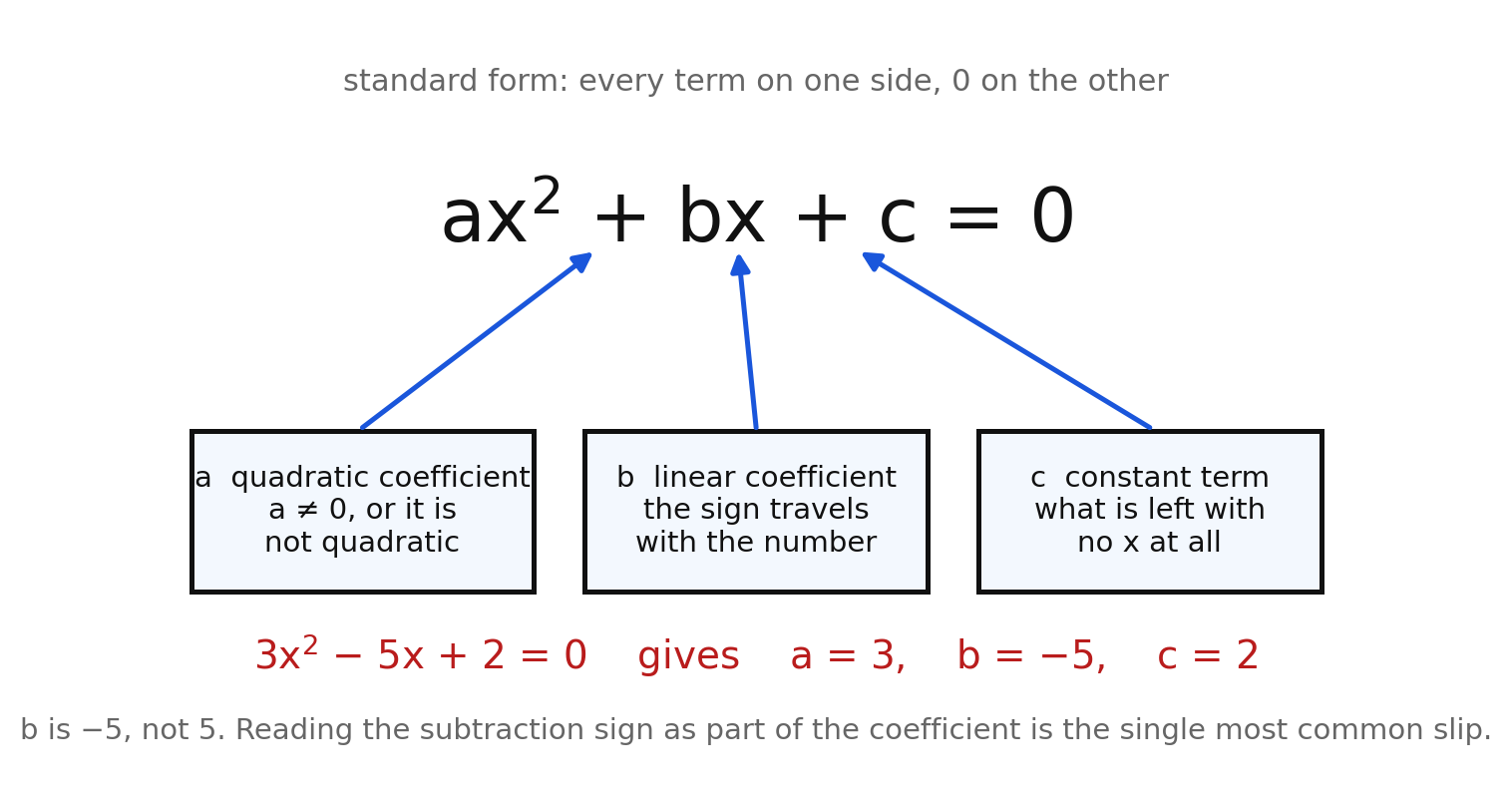
The figure names the three coefficients and the one trap that produces most of the errors in the chapter: the sign travels with the number. In , the middle coefficient is , not . Reading the subtraction as part of is not optional decoration — later, when you plug into , the wrong sign flips the whole discriminant.
If the equation arrives as or as , move every term to one side first. Standard form is not a preference; the zero-product property, completing the square as a solving method, and the quadratic formula all assume the right side is .
A solution is a number that makes the equation true
A solution of is a real number that turns the left side into . The same number is called a root of the equation, and a zero of the related function . On the graph, it is an -intercept — a place where the curve meets the -axis.
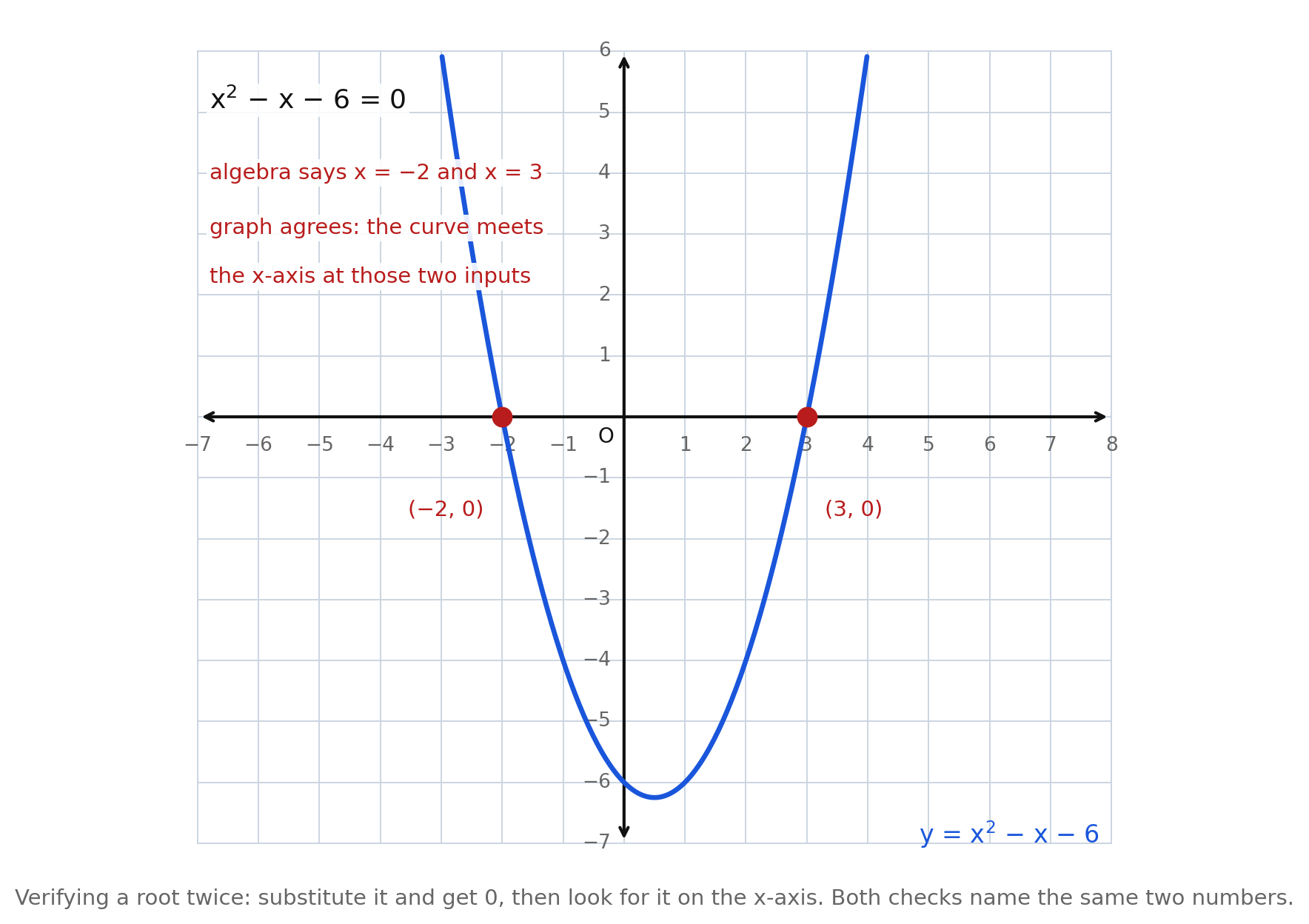
The figure solves two ways at once. Algebra (factoring, or any other method) produces and . The graph of meets the -axis at exactly those two inputs. Substitute to confirm:
Both checks name the same two numbers. That agreement — algebra saying the value, the graph showing the intercept — is the verification habit A.EI.3c will demand for the rest of the chapter.
How many solutions can there be?
A quadratic equation over the real numbers has two real solutions, one real solution, or no real solutions. There is no fourth option, and there is never an imaginary answer in this course. Lesson 15.5 will justify the three counts with the discriminant; for now, notice that a U-shaped curve can cross the -axis twice, touch it once, or miss it entirely — and those three pictures are exactly the three counts.
Worked examples
Example 1 — Naming , , and
Identify , , and in .
Answer: , , . The minus sign is part of .
Example 2 — Writing standard form
Write in standard form, and name , , and .
Subtract and from both sides: .
Answer: , , .
Example 3 — Testing a candidate
Is a solution of ?
✓.
Answer: Yes.
Example 4 — A candidate that fails
Is a solution of ?
✗.
Answer: No. Looking at the figure, is nowhere near either intercept.
Example 5 — Reading solutions from a graph
The graph of meets the -axis at and . What are the solutions of ?
Answer: and . The -coordinates of the intercepts are the solutions.
Guided practice
- Use the standard-form figure. For , name , , and , and say in one sentence why is not .
- Write each equation in standard form, then name , , and . a) b) c)
- Use the verification figure. Name the two solutions of , and say what feature of the graph names them.
- Verify both solutions of by substituting into the original equation.
- Is a solution of ? Show the substitution.
- Explain in one or two sentences why a solution of is the same number as an -intercept of .
Independent practice
- Identify , , and . a) b) c) d) (after writing it in standard form if needed)
- Write each in standard form and name the coefficients. a) b) c) (first expand, then identify)
- Test whether each number is a solution of . a) b) c) d)
- The graph of meets the -axis at and . Give the solutions of , and verify one of them by substitution.
- Reasoning. A student says is already in standard form because it has an . Explain the error, write the equation in standard form, and name , , and .
- Error analysis. A student reads , , from . Identify the error and give the correct coefficients.
- Application. A ball's height in feet after seconds is modeled by . Write the equation that asks when the ball hits the ground (), in standard form, and name , , and . Do not solve yet.
- Reasoning. Explain why cannot be in if the equation is to be quadratic.
- Sketch on a coordinate plane (or use technology), read the -intercepts, and write the solutions of .
- Technology. Enter on a graphing calculator or graphing site. Use the zero or root feature to confirm the solutions from the verification figure. Name the window you used.
Exit ticket 15.1
- Write in standard form and name , , and .
- Is a solution of ? Show the work.
- The graph of meets the -axis at and . What are the solutions of ?
- In one sentence, say what it means to verify a solution algebraically and what it means to verify it graphically.
Lesson 15.2 — Solving by Square Roots
Isolating a square, then taking both roots
When a quadratic equation has no -term — that is, when — the cleanest method is to isolate the squared expression and take square roots of both sides.
A real number whose square is is either or , so
That is not optional. Squaring erases a sign, so taking a square root has to put both possibilities back.
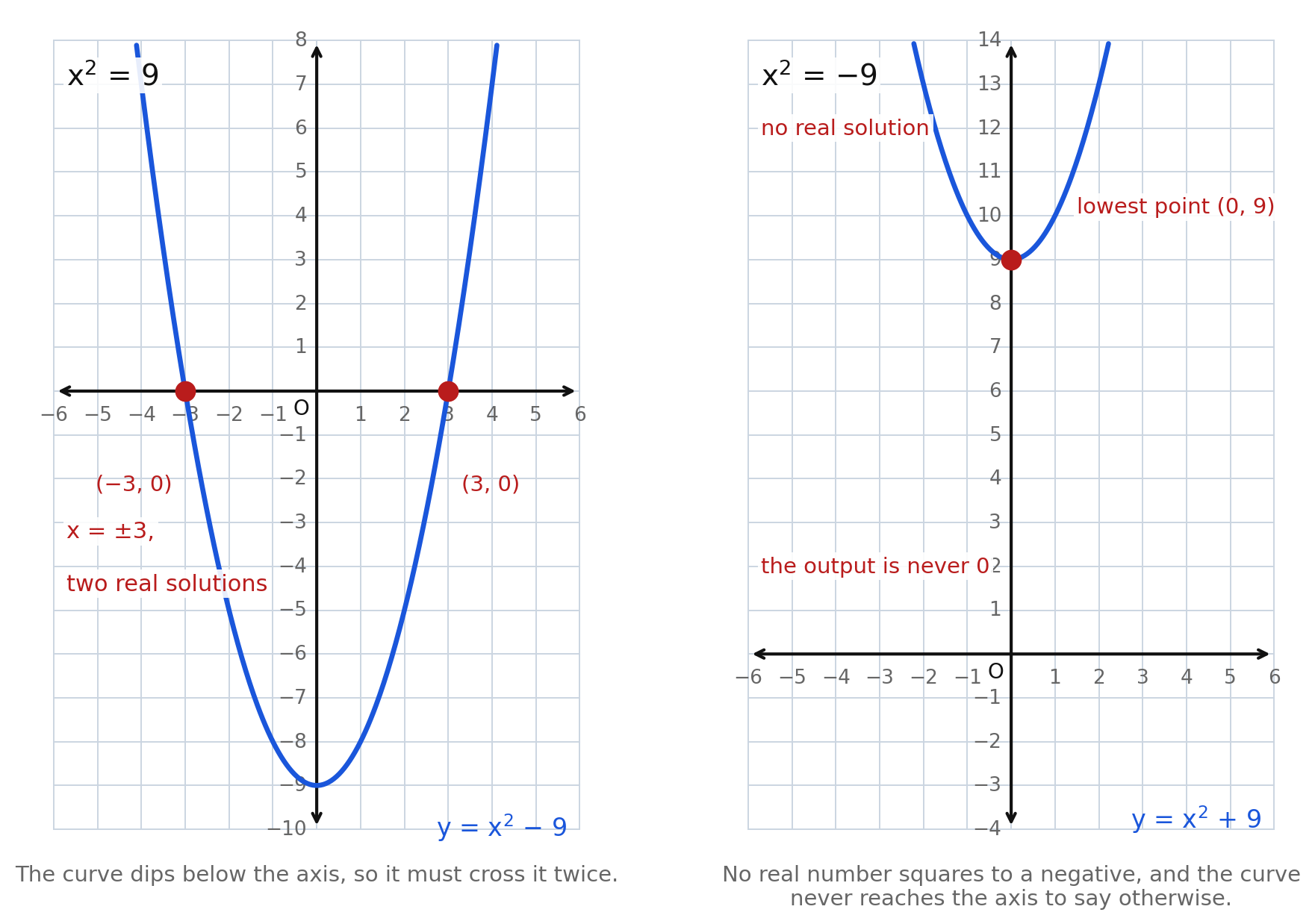
The left panel shows as the graph of crossing the axis twice. The right panel shows as , whose lowest point is — the output is never . No real number squares to a negative, so the honest answer is no real solutions. This chapter never invents an imaginary number to fill the gap.
The method, written out
- Isolate the squared expression on one side.
- If the other side is negative, stop: no real solutions.
- If the other side is zero, there is one real solution (the expression under the square equals ).
- If the other side is positive, take square roots of both sides, writing , then solve the two resulting linear equations.
The same steps work when the squared piece is a binomial: becomes , so or .
Worked examples
Example 1 — A pure square
Solve .
.
Answer: or .
Example 2 — A coefficient in front
Solve .
, so , and .
Answer: or .
Example 3 — A shifted square
Solve .
. So gives , and gives .
Answer: or .
Example 4 — No real solutions
Solve .
. The right side is negative.
Answer: No real solutions.
Example 5 — Check both
Solve , then verify both solutions in the original equation.
, so or . Check: ✓ and ✓.
Answer: or .
Guided practice
- Use the two-cases figure. For , give both solutions and say what the left graph shows. For , state the conclusion and say what the right graph shows.
- Solve .
- Solve .
- Solve .
- Solve .
- Solve , and justify the count of real solutions in one sentence.
Independent practice
- Solve. a) b) c) d)
- Solve. a) b) c) d)
- Solve, and state when there are no real solutions. a) b) c) d)
- Solve .
- Reasoning. A student solves and reports only . Identify the error and give the complete solution set.
- Error analysis. A student writes and concludes that has only the solution . Explain the mistake using the definition of absolute value or the symbol.
- Application. The area of a square patio is square feet. Write an equation for the side length , solve it, and reject any value that cannot be a length, with a reason.
- Verify both solutions of by substitution into the original equation.
- Technology. Graph and . For each, say whether the graph meets the -axis and how that matches the algebraic conclusion for and .
- Solve . Leave answers in simplest radical form.
Exit ticket 15.2
- Solve .
- Solve .
- Solve .
- Why does have no real solutions when ? Answer in one sentence that a classmate could use.
Lesson 15.3 — Solving by Factoring
A product is zero only when a factor is zero
If a quadratic factors cleanly over the integers, the fastest solving method is the zero product property:
If , then or (or both).
That property is true only when the product equals zero. It is not true for other right-hand sides.
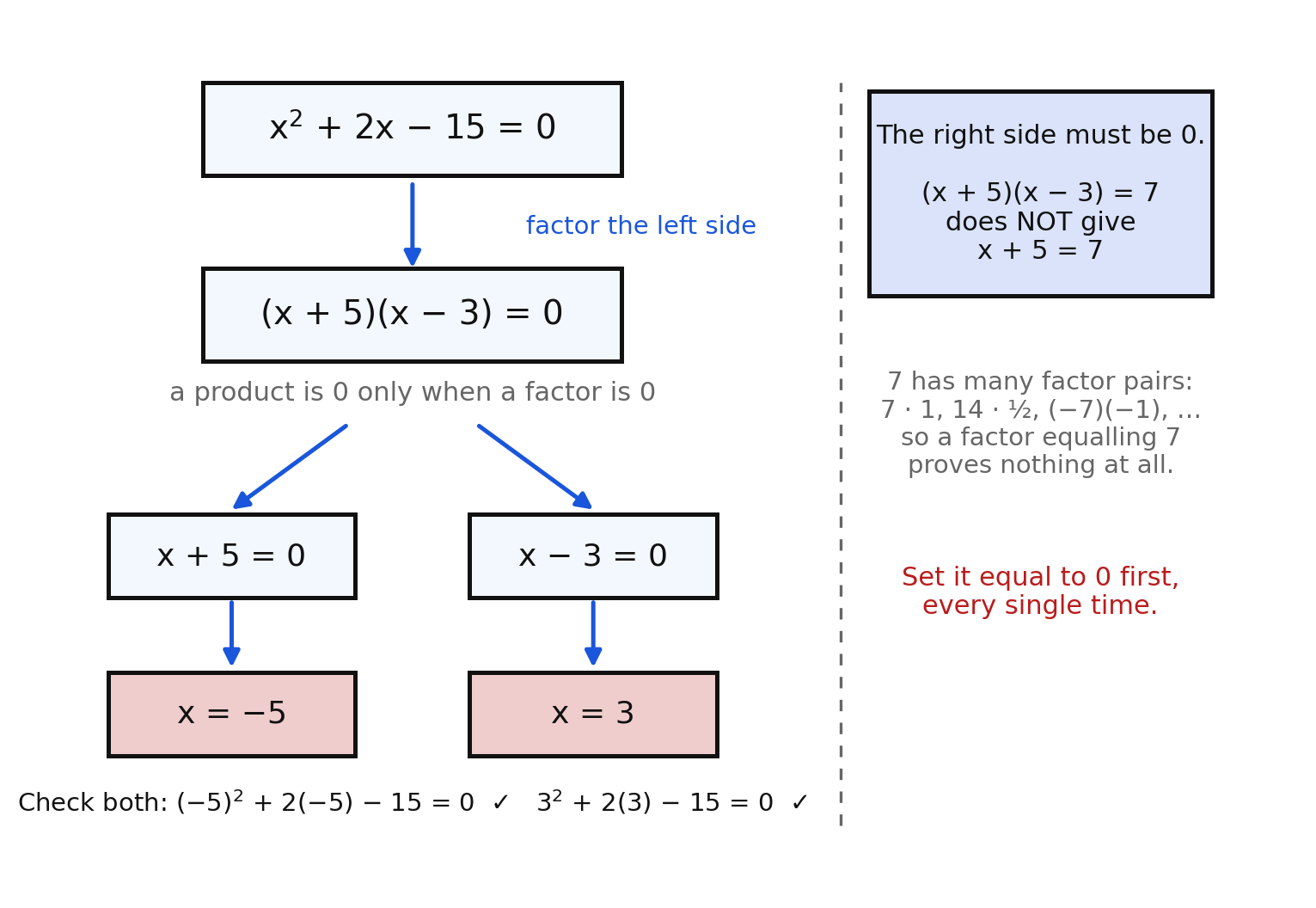
The figure solves by factoring to , then branching. Each factor set equal to zero is an ordinary linear equation. Both solutions check in the original. The right panel names the classic error: leaving a nonzero right side and "solving" a factor equal to . Seven has many factor pairs, so that move proves nothing.
The method, written out
- Write the equation in standard form (right side ).
- Factor the left side completely (Chapter 13).
- Set each factor equal to zero.
- Solve the resulting linear equations.
- Check each solution in the original equation.
If the quadratic does not factor over the integers, do not force it — move to completing the square or the quadratic formula.
Worked examples
Example 1 — Monic trinomial
Solve .
, so or .
Answer: or .
Example 2 — Opposite signs
Solve .
, so or .
Answer: or .
Example 3 — Leading coefficient not 1
Solve .
, so or . Thus or .
Answer: or .
Example 4 — Difference of squares
Solve .
, so or . (Square roots give the same pair.)
Answer: or .
Example 5 — The nonzero trap
A student factors as and writes . Why is that wrong, and what should the student do first?
Answer: The zero product property requires a product equal to , not . Subtract first: , then factor or use another method.
Guided practice
- Use the zero-product figure. Factor , write the two branches, and give both solutions.
- Check both solutions from item 41 in the original equation.
- In the figure's warning panel, explain in your own words why does not give .
- Solve by factoring.
- Solve by factoring.
- Solve by factoring.
Independent practice
- Solve by factoring. a) b) c) d)
- Solve by factoring. a) b) c) d)
- First write in standard form, then solve by factoring. a) b) c)
- Error analysis. A student solves by writing or . Identify the error, repair the equation into standard form, and solve correctly by factoring or another appropriate method.
- Reasoning. Why must the equation be set equal to zero before the zero product property applies? Give a one-sentence answer and a one-line counterexample with a nonzero right side.
- Application. The product of two consecutive integers is . Write a quadratic equation, solve by factoring, and list both pairs.
- Solve by factoring. How many distinct real solutions are there? Justify.
- Verify both solutions of by substitution.
- Technology. Graph and confirm the zeros match the solutions from the factoring figure.
- Factor and solve .
Exit ticket 15.3
- Solve by factoring.
- Solve by factoring.
- Write in standard form and solve by factoring.
- State the zero product property in one sentence, including the requirement that the product equal zero.
Lesson 15.4 — Completing the Square
Building a perfect square on purpose
Some quadratics do not factor over the integers, but still have neat real solutions. Completing the square rewrites as a perfect square plus a constant, so the square-root method can finish the job. Chapter 14 used the same rewrite to move between standard form and vertex form; here the rewrite is a solving tool.
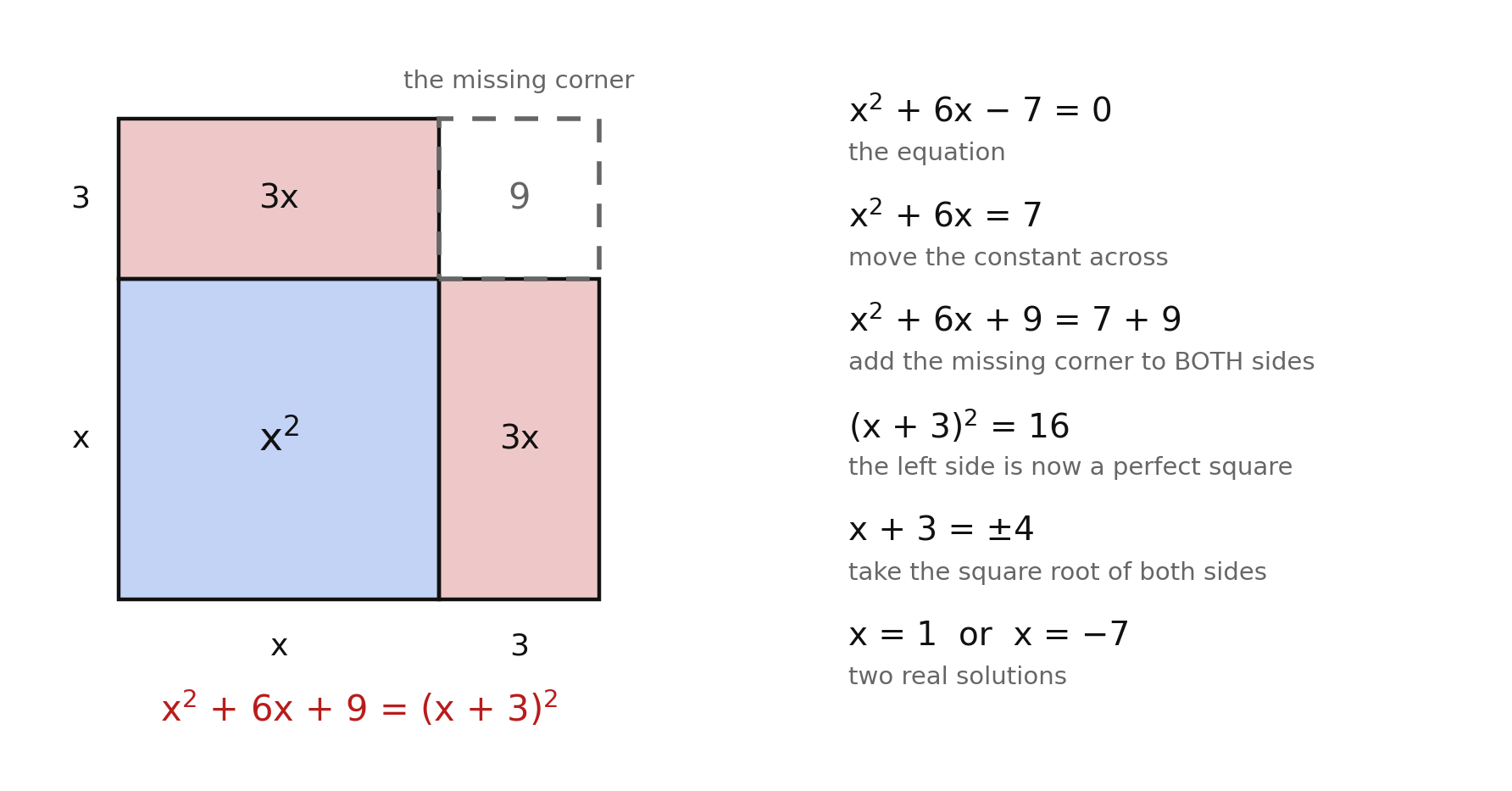
The figure shows as a square of side with two -by- rectangles. The missing corner has area , and adding it to both sides of the equation produces . For :
The method when
- Move the constant so .
- Take half of and square it: .
- Add that square to both sides.
- Write the left side as .
- Take square roots (with ) and solve.
When is even, is an integer and the arithmetic stays clean — which is why the method-choice flow in Lesson 15.6 prefers completing the square when and is even. When , divide through by first (or prefer the quadratic formula).
Worked examples
Example 1 — Matching the figure
Solve by completing the square.
As above: , so or .
Answer: or .
Example 2 — Even
Solve by completing the square.
. Half of is , and . So , , . Thus or .
Answer: or .
Example 3 — Irrational solutions
Solve by completing the square. Leave answers in simplest radical form.
. Half of is , and . So , and .
Answer: or .
Example 4 — Verify
Check in .
✓.
Answer: Verified.
Guided practice
- Use the completing-the-square figure. Explain what the dashed corner represents, and why is added to both sides of the equation.
- Copy the six algebraic steps in the figure for , and confirm both solutions by substitution.
- Solve by completing the square.
- Solve by completing the square.
- Solve by completing the square.
- For , compute and write the perfect-square trinomial.
Independent practice
- Solve by completing the square. a) b) c) d)
- Solve by completing the square. Leave irrational answers in simplest radical form. a) b) c)
- Solve by completing the square.
- Reasoning. Why is completing the square especially convenient when and is even? What goes wrong (or gets messier) when is odd?
- Error analysis. A student solving adds to the left side only, writes , and continues. Identify the error and finish the problem correctly.
- Application. A rectangle's length is meters more than its width , and its area is square meters. Write an equation, complete the square to solve, and reject any impossible width with a reason.
- Verify both solutions of by substitution.
- Rewrite by completing the square (as an expression), then set the rewrite equal to zero and solve. Confirm you match the figure's solutions.
- Technology. Graph and confirm the zeros are and .
- Solve by completing the square.
Exit ticket 15.4
- Solve by completing the square.
- Solve by completing the square; simplest radical form.
- What perfect-square trinomial completes ?
- In one sentence, connect the "missing corner" in the area figure to the number .
Lesson 15.5 — The Quadratic Formula and the Discriminant
One formula for every quadratic
Every quadratic equation with is solved by the quadratic formula:
The formula is completing the square, done once in general and then reused. It always works — including on equations that factor and on equations with no real solutions (where the formula itself reports that fact).
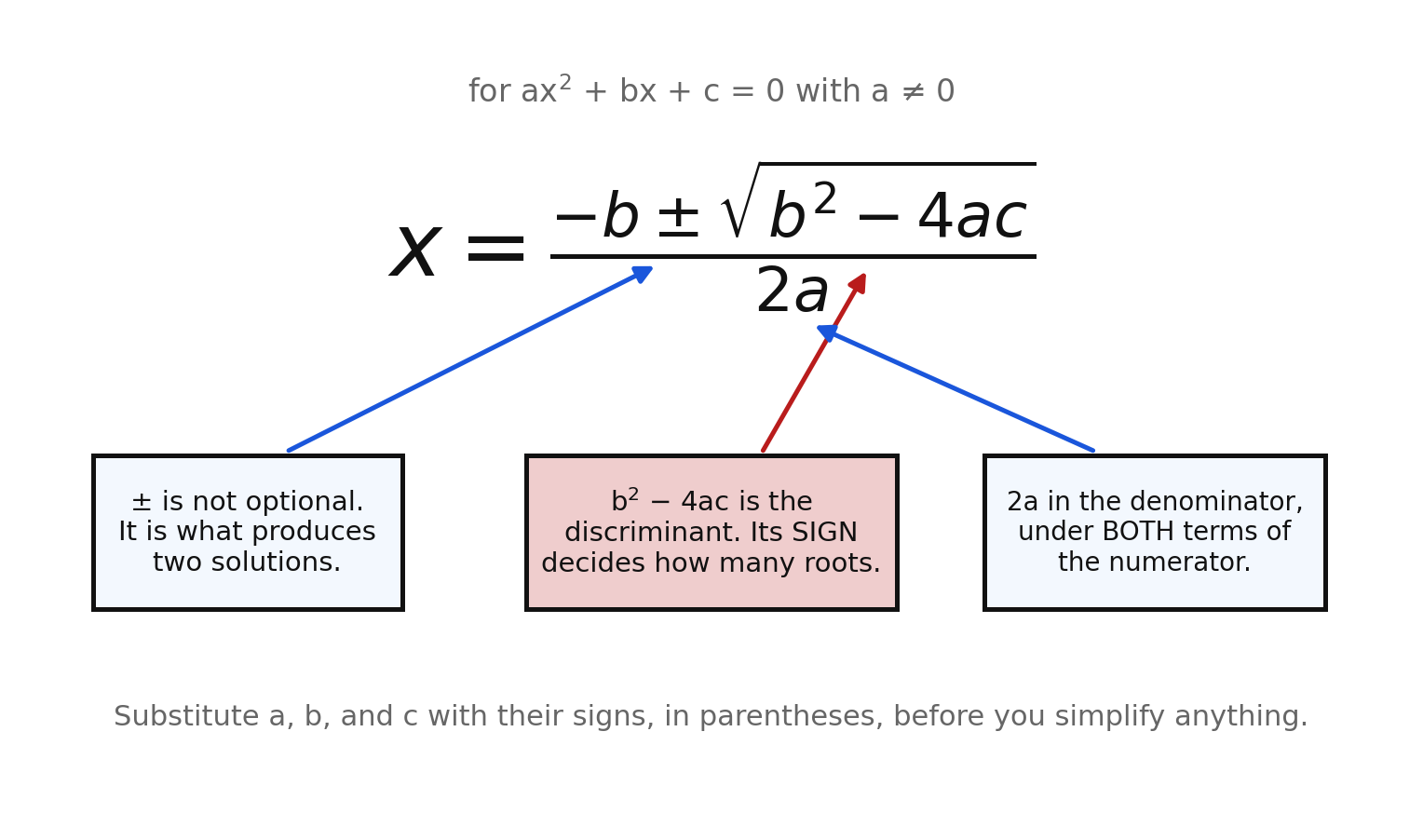
Three reminders from the figure:
- The produces two candidates when the discriminant is positive.
- is the discriminant; its sign decides how many real roots exist.
- The sits under both pieces of the numerator — not under the radical alone.
Substitute , , and with their signs, in parentheses, before simplifying anything.
The discriminant decides the count
The expression under the radical, , is the discriminant.
| Discriminant | Real solutions | Graph of |
|---|---|---|
| two distinct real solutions | crosses the -axis twice | |
| one real solution (repeated) | touches the -axis once | |
| no real solutions | misses the -axis entirely |
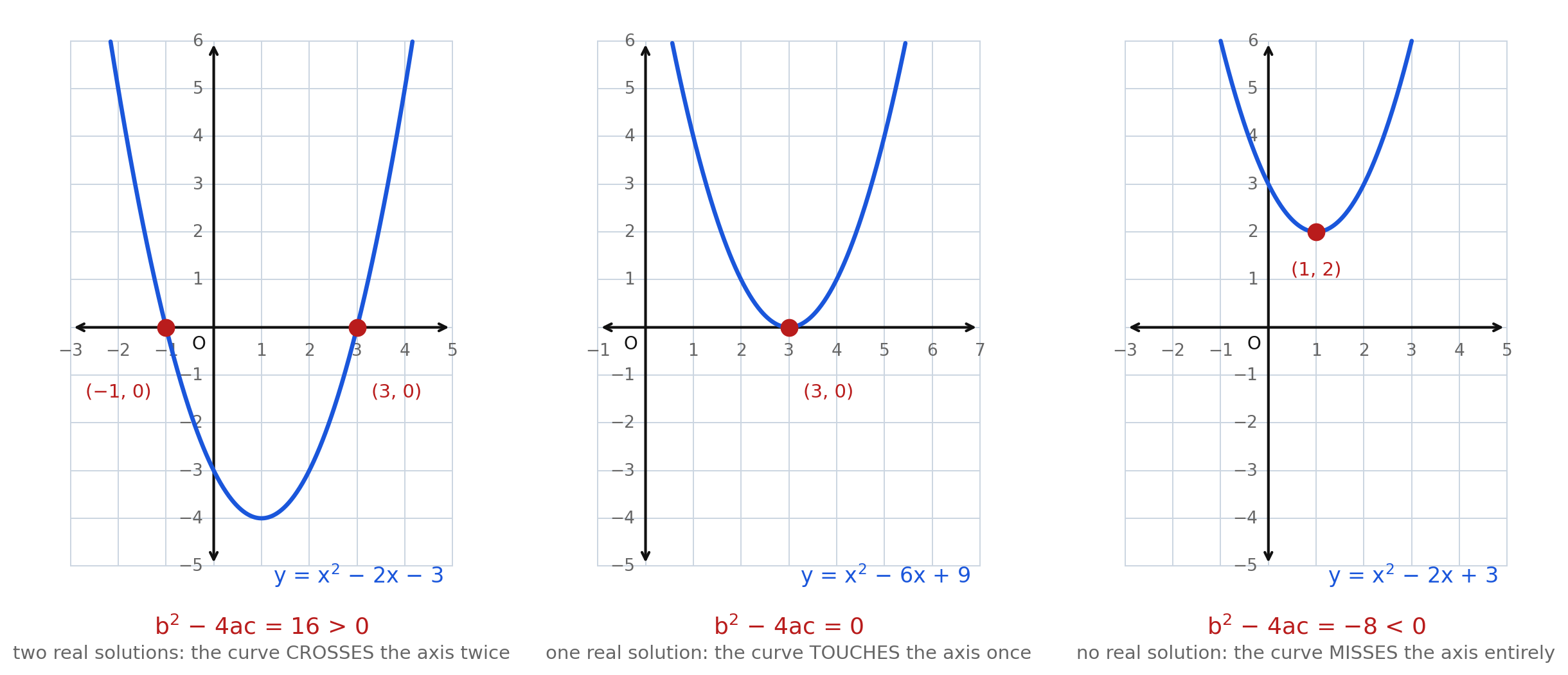
Bullet (b) asks you to determine and justify. Computing determines the count; naming the matching graph behavior — crosses, touches, or misses — is the justification. When , stop and write no real solutions. Do not continue into imaginary numbers.
Irrational roots: exact first, decimal for the graph
When is positive but not a perfect square, the solutions are irrational. Leave them in simplest radical form. A decimal is for reading a graph or answering a context that asks "about how many," not a replacement for the exact answer.
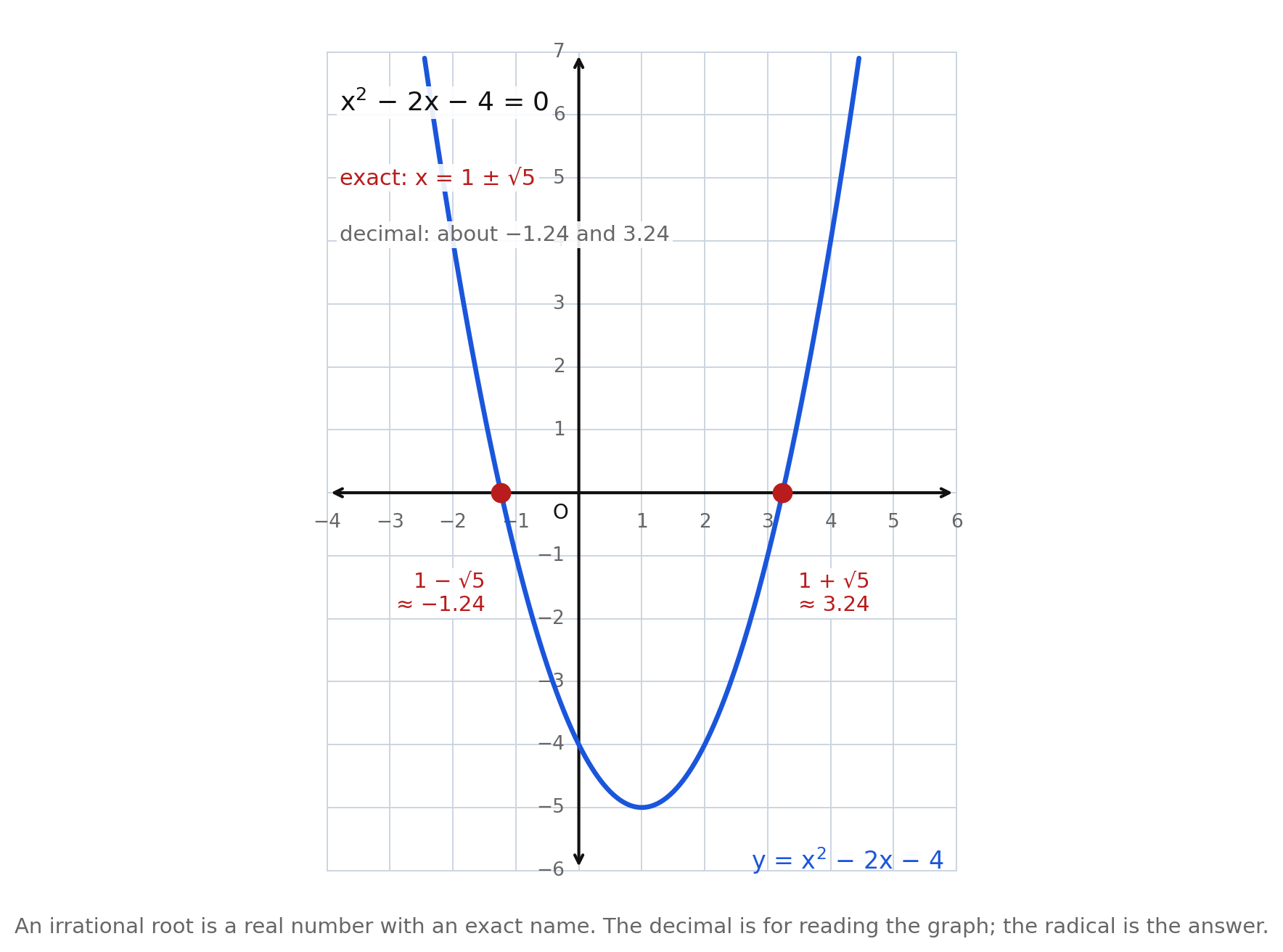
For , the formula gives . The exact names are and ; the decimals and only help you see where the curve meets the axis.
Worked examples
Example 1 — Two rational solutions
Solve using the quadratic formula.
, , . .
So or .
Answer: or .
Example 2 — Discriminant zero
For , compute and solve.
. One real solution: .
Answer: (one real solution). The graph touches at .
Example 3 — No real solutions
For , compute .
.
Answer: No real solutions. The graph of never meets the -axis.
Example 4 — Irrational pair
Solve . Leave answers in simplest radical form.
, so .
Answer: or .
Example 5 — Justify the count without solving
Without finding the roots, determine how many real solutions has, and justify.
.
Answer: No real solutions, because the discriminant is negative (and the related parabola misses the -axis).
Guided practice
- Use the formula-anatomy figure. Name the three labeled parts and, in your own words, what each reminder is warning you not to forget.
- For , compute and solve with the formula. Confirm the solutions match the left panel of the discriminant figure.
- For , compute and solve. Match the middle panel.
- For , compute and state the conclusion. Match the right panel.
- Solve using the formula. Simplest radical form.
- Use the irrational-roots figure. Write the exact solutions of and their decimal approximations to the hundredths place.
Independent practice
- Solve using the quadratic formula. a) b) c) d)
- Compute and state the number of real solutions — without solving fully unless and you want the roots. a) b) c) d)
- Solve. Simplest radical form where needed. a) b) c) d)
- Reasoning. Explain how the discriminant justifies the three panels of the discriminant figure without naming the roots.
- Error analysis. A student treats as in and writes . Identify the error and give the correct solutions.
- Application. A rectangular garden has area square meters and length meters more than its width . Write a quadratic equation, use the formula (or factoring), and reject any impossible width with a reason.
- Determine and justify the number of real solutions of .
- Solve and explain why there is only one distinct real solution.
- Technology. For , use a graphing tool to approximate the zeros. Confirm they match to the hundredths place.
- Verify in using exact arithmetic (expand and simplify).
Exit ticket 15.5
- Solve using the quadratic formula.
- Compute for and state the number of real solutions with justification.
- Solve in simplest radical form.
- In one sentence each: what does , , and tell you about the graph meeting the -axis?
Lesson 15.6 — Choosing a Method, Contexts, and Three-Way Verification
Which method first?
All four methods can solve many of the same equations. Efficiency still matters.
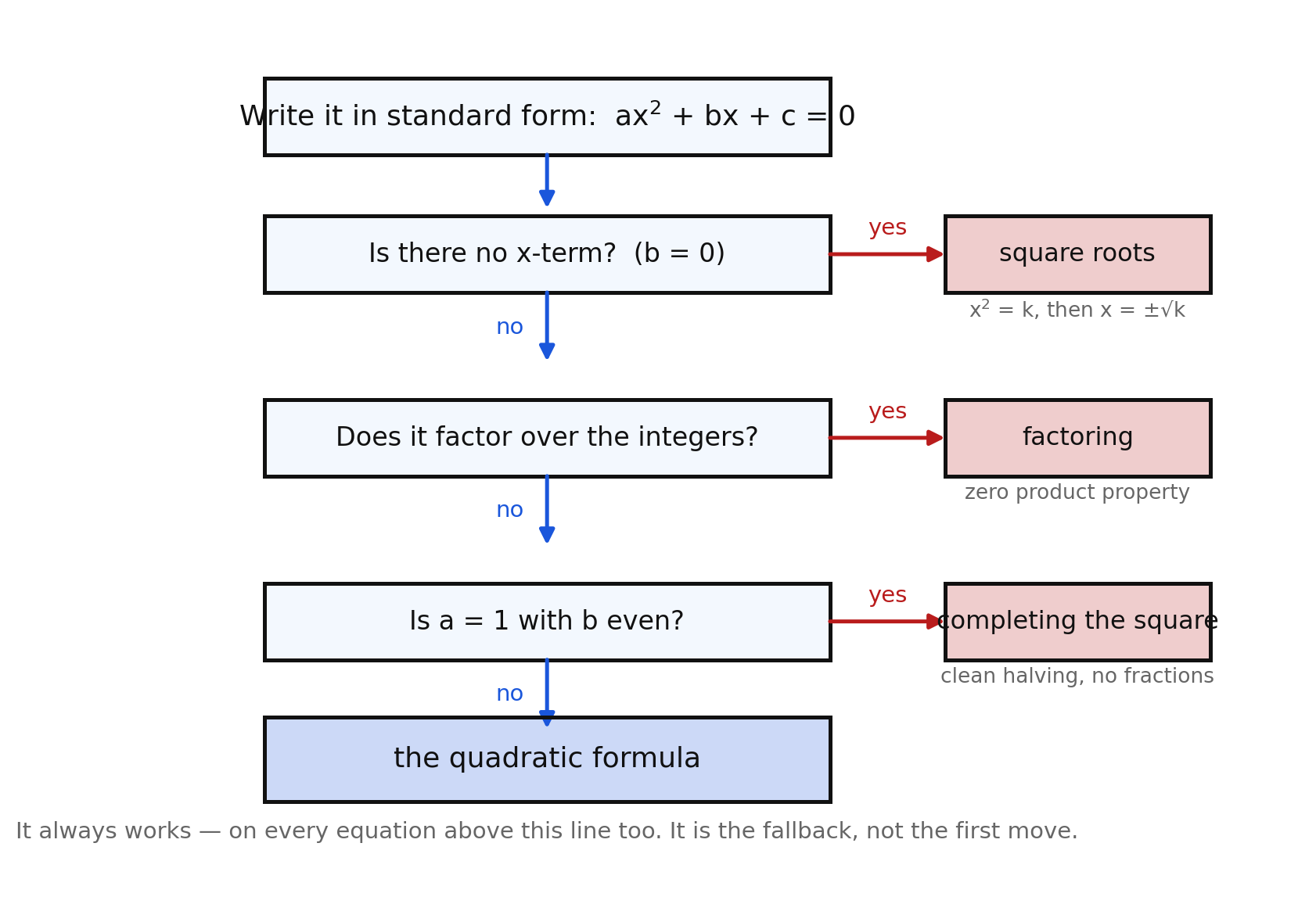
Read the flow as a preference order, not a law:
- No -term ()? Square roots.
- Factors over the integers? Factoring and the zero product property.
- with even? Completing the square stays fraction-free.
- Otherwise? The quadratic formula — the fallback that always works, including on every equation above it in the chart.
Naming why you chose a method is part of explaining your solution, which A.EI.3c requires.
Context: both roots can be true, and only one can make sense
Algebra does not know what a variable means. A projectile equation can produce a negative time that makes the height equation true and still cannot be a moment after the throw.
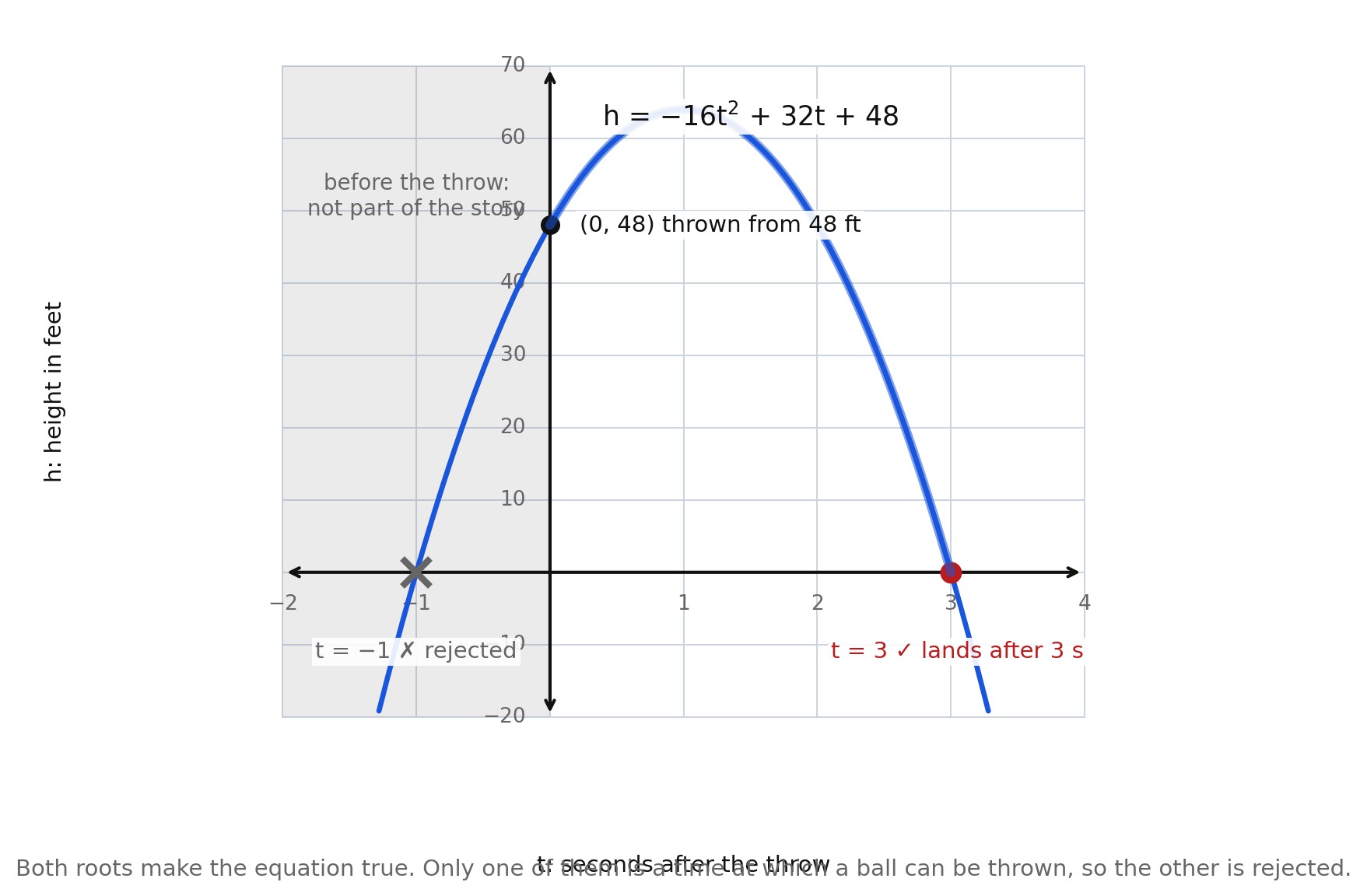
Solving gives and . Both satisfy the equation. Only is a time at which the ball can land after being thrown from feet at . The root is rejected because it is before the throw — not part of the story. Stating that reason is required, not optional.
The same discipline applies to lengths, widths, prices that cannot be negative, and counts of people. Reject with a stated reason.
Verify three ways
A.EI.3c asks for verification algebraically, graphically, and with technology.
- Algebraically: substitute each kept solution into the original equation and show you get .
- Graphically: confirm the related parabola meets the -axis at those inputs (sketch or read a given graph).
- With technology: enter , use the zero/root/intersect feature, and confirm the same values (exact or approximate for irrationals).
The blank grids are for practice sketches: plot a few points or mark intercepts to confirm that algebra and the picture agree.
Worked examples
Example 1 — Choosing
Which method would you try first on ? On ? On ?
Answer: Square roots (or difference of squares / factoring) for the first; completing the square or factoring for the second (, even); quadratic formula or factoring for the third.
Example 2 — Projectile
Using the projectile figure, solve , interpret, and reject with a reason.
Divide by : , , so or .
Answer: The ball lands at seconds. Reject because time after the throw cannot be negative.
Example 3 — Three-way check
Verify for three ways.
Algebra: ✓. Graph: the verification figure shows the intercept . Technology: the zero feature reports .
Answer: All three agree.
Guided practice
- Use the method-choice figure. For each equation, name the method the flow points to and why. a) b) c) d)
- Use the projectile figure. State both algebraic roots of , which one is kept, and the reason the other is rejected.
- Verify in the projectile equation by substitution.
- On one of the blank grids, sketch carefully enough to show both -intercepts, and label them.
- Solve by any method. Then describe how you would confirm the answers with technology.
- Explain. In two or three sentences, say why the quadratic formula is "the fallback, not the first move."
Independent practice
- Choose a method and solve. Name the method. a) b) c) d)
- Application. A ball is thrown upward from a -foot platform with the height model . When does it hit the ground? Reject any impossible time with a reason, and verify the kept solution algebraically.
- Application. The width of a rectangle is meters and the length is meters. The area is square meters. Solve, interpret, and reject any impossible root with a reason.
- Determine and justify the number of real solutions of . Then confirm with a sketch or technology that the graph misses the -axis.
- Solve in simplest radical form. Approximate both roots to the hundredths place and mark them on a blank grid using the irrational-roots figure as a guide.
- Verify three ways. For , verify both solutions algebraically, describe the graphical check, and describe the technology check.
- Error analysis. A student solves a projectile problem, gets and , and reports both as times of flight. What did the student forget?
- Reasoning. Give one reason you might choose factoring over the quadratic formula even though the formula always works.
- Revenue from selling items is modeled by . For what is revenue ? Solve, interpret in context, and reject any impossible value with a reason.
- Solve . Name the method, and leave answers in simplest radical form.
Exit ticket 15.6
- Name the first method you would try on , and solve.
- A garden's area equation produces and . Which value is kept, and why is the other rejected?
- List the three verification modes A.EI.3c requires.
- Solve and justify the result without using complex numbers.
Chapter 15 Review
Vocabulary. quadratic equation · standard form · coefficient · solution · root · zero · -intercept · square root method · zero product property · completing the square · quadratic formula · discriminant · simplest radical form · no real solutions · verify algebraically · verify graphically · verify with technology · interpret · reject (extraneous / physically meaningless root)
A.EI.3 a, b, and c ask three different kinds of question, so this review is organized by bullet. Part A solves equations with rational or irrational roots (bullet a), Part B determines and justifies the solution count (bullet b), and Part C verifies, explains, and interprets in context (bullet c).
Part A — Solving over the real numbers
- Solve by square roots.
- Solve by factoring.
- Solve by completing the square.
- Solve using the quadratic formula.
- Solve in simplest radical form.
- Choose a method and solve . Name the method.
Part B — Determining and justifying the count
- Compute for , state the number of real solutions, and justify with both the discriminant and the graph behavior.
- Compute for , state the number of real solutions, and justify.
- Compute for , state the number of real solutions, and find them.
Part C — Verifying, explaining, and interpreting
- Verify both solutions of algebraically and describe graphical and technology checks.
- Application. Using , find when the ball hits the ground. Reject the impossible root with a stated reason, and explain the method you used.
- Application. A rectangle has area square feet and length feet more than its width. Write and solve a quadratic equation. Interpret the answer in a sentence, rejecting any impossible root with a reason. Then describe how you would verify with technology.
Standards coverage check — Chapter 15
| Knowledge and Skill | Aspect | Where it is taught | Where it is practiced | Where it is interpreted in context |
|---|---|---|---|---|
| A.EI.3a — solve a quadratic equation over the real numbers with rational or irrational solutions, including contextual problems | Square roots | 15.2 | 21–40; 121 | 33 |
| A.EI.3a | Factoring / zero product | 15.3 | 41–60; 122 | 52, 109, 115 |
| A.EI.3a | Completing the square | 15.4 | 61–80; 123 | 72 |
| A.EI.3a | Quadratic formula | 15.5 | 81–100; 124, 125 | 92 |
| A.EI.3a | Method choice | 15.6 (flow) | 101, 106, 107, 116, 117, 126 | 108, 131 |
| A.EI.3a | Irrational / simplest radical form | 15.5 (fig8); 15.2 item 36 | 36, 68, 69, 85, 86, 89, 99, 111, 116, 125, 126 | — |
| A.EI.3b — determine and justify zero, one, or two real solutions | Discriminant and graph crossings | 15.5 (fig7); preview in 15.1–15.2 | 26, 29, 39, 53, 82–84, 88, 90, 93, 94, 98, 100, 110, 120, 127–129 | 110 |
| A.EI.3c — verify algebraically, graphically, and with technology; explain method; interpret in context | Verify algebraically | 15.1; 15.6 | 4, 5, 9, 18, 34, 42, 54, 62, 73, 96, 103, 112, 130 | 108, 131 |
| A.EI.3c | Verify graphically | 15.1 (fig1); 15.6 (fig11) | 3, 15, 16, 35, 55, 75, 95, 104, 111, 112, 130 | — |
| A.EI.3c | Verify with technology | 15.1; 15.6 | 16, 35, 55, 75, 95, 105, 112, 130, 132 | 132 |
| A.EI.3c | Explain the method | 15.6 | 106, 107, 114, 117, 126, 131 | 131 |
| A.EI.3c | Interpret / reject meaningless roots | 15.6 (fig9) | 33, 72, 92, 102, 108, 109, 113, 115, 118, 131, 132 | 33, 72, 92, 108, 109, 115, 131, 132 |
Supporting items: 1, 2, 7, 8, 11, 12, 14, 17 fix standard form and the sign of ; 6, 10, 19, 20 fix the root / zero / -intercept vocabulary; 31, 32, 50, 51, 71, 91, 113 are error analyses aimed at the chapter's most common failures — dropping a root, using zero product on a nonzero right side, adding the completing-the-square constant to one side only, mishandling , and keeping a physically impossible time.
Boundaries respected. Every equation is in one variable and solved over the real numbers; a negative discriminant is reported as no real solutions, never as a complex pair. Graphs are used to verify zeros and to show the three discriminant cases; no item teaches parabola transformations, vertex form as a graphing topic, axis of symmetry, or domain and range of a quadratic function — those are Chapter 16. Completing the square appears here as a solving method (Chapter 14 remains the home of expression equivalence and vertex form). Factoring is used to solve equations, not to factor expressions as an end in itself (Chapter 13).
Answer keys for every item in this chapter are in Appendix A.