Chapter 16 — Quadratic Functions
Standard: A.F.2 (b, c, d, g)
A.F.2 — verbatim. The student will investigate, analyze, and compare characteristics of functions, including quadratic, and exponential functions, and model quadratic and exponential relationships. Students will demonstrate the following Knowledge and Skills: b) Given an equation or graph, determine key characteristics of a quadratic function including -intercepts (zeros), -intercept, vertex (maximum or minimum), and domain and range (including when restricted by context); interpret key characteristics as related to contextual situations, where applicable. c) Graph a quadratic function, , in two variables using a variety of strategies, including transformations and , where is limited to rational values. d) Make connections between the algebraic (standard and factored forms) and graphical representation of a quadratic function. g) For any value, , in the domain of , determine of a quadratic or exponential function. Determine given any value in the range of of a quadratic function. Explain the meaning of and in context.
By the end of this chapter you will be able to:
- Name the vertex, axis of symmetry, and opening direction of a parabola from its equation or its graph, and say whether the vertex is a maximum or a minimum (A.F.2b)
- Find the -intercepts (zeros) and the -intercept of a quadratic function, algebraically and from a graph (A.F.2b)
- State the domain and range of a quadratic function, including when a context cuts them down (A.F.2b)
- Interpret every one of those characteristics in a real situation, with units (A.F.2b)
- Graph a quadratic using transformations of the parent limited to (vertical shift) and (vertical stretch, shrink, or reflection), with rational (A.F.2c)
- Connect standard form and factored form to the same graph, and say what each form hands you for free (A.F.2d)
- Evaluate at a given input, and recover every that produces a given output, explaining both in context (A.F.2g)
Lessons: 16.1 Vertex, Axis, and Opening · 16.2 Intercepts, Zeros, and the Vertex Formula · 16.3 Domain and Range, Including Context · 16.4 Transformations and · 16.5 Standard Form, Factored Form, and the Graph · 16.6 Evaluating and Finding
Why this chapter matters. Chapter 15 asked when a quadratic expression equals zero. This chapter asks what the related function looks like and what it tells you. The zeros are still there — they are the -intercepts of the parabola — but now they sit beside a vertex that is a highest or lowest point, a -intercept that starts a story, and a domain and range that may be cut down by the situation. Those characteristics are what a height model, a revenue model, or an arch model actually report. Learning to read them off an equation and off a graph is the skill A.F.2b demands; graphing by the two named transformations, connecting two algebraic forms to one picture, and evaluating or solving complete the chapter.
Scope note. This chapter studies quadratic functions. Transformations are limited exactly as A.F.2c states: and , with rational. Horizontal shifts of the parent are not taught as a transformation rule here; when a vertex is off the -axis, find it with the vertex formula or from factored form, then plot. Exponential functions are A.F.2 e, f, and g in Chapter 17. Comparing linear, quadratic, and exponential families is A.F.2h in Chapter 18. Solving quadratic equations as an end in itself was Chapter 15; this chapter uses those solving skills to find zeros and to recover from . Completing the square as an expression rewrite (vertex form) was Chapter 14; vertex form may appear as a reading aid, but the graphing strategies this chapter practices are the two A.F.2c names plus plotting from characteristics.
Conventions this chapter fixes.
- A quadratic function is written or with . Its graph is a parabola.
- An intercept is a point: the -intercept is ; each -intercept is . A zero is a number: the -coordinate of an -intercept. Chapter 15 fixed the three-name habit (zero / root / -intercept); this chapter keeps it.
- The vertex is the turning point . If , the parabola opens up and the vertex is a minimum. If , it opens down and the vertex is a maximum.
- The axis of symmetry is the vertical line . For , and .
- Domains and ranges of continuous graphs are described in words or with inequalities such as or , as in Chapters 4 and 5. Interval notation is never required.
- Item numbering runs straight through the chapter, from 1 in Lesson 16.1 to 126 at the end of the review. It does not restart at each lesson.
Calculator note. Algebra 1 has no no-calculator standards, and the Desmos Virginia Graphing Calculator is available for the entire End-of-Course test. Use technology the way this volume always does: to confirm a vertex, intercept, or evaluation you already produced. Entering and reading the minimum at is a good habit. What technology cannot do alone is explain what that minimum means in a story — that is still your job.
Lesson 16.1 — Vertex, Axis, and Opening
The shape is a parabola
A quadratic function has the form
Its graph is a parabola — a smooth U-shaped curve. The sign of decides which way the U faces.
- If , the parabola opens upward.
- If , the parabola opens downward.
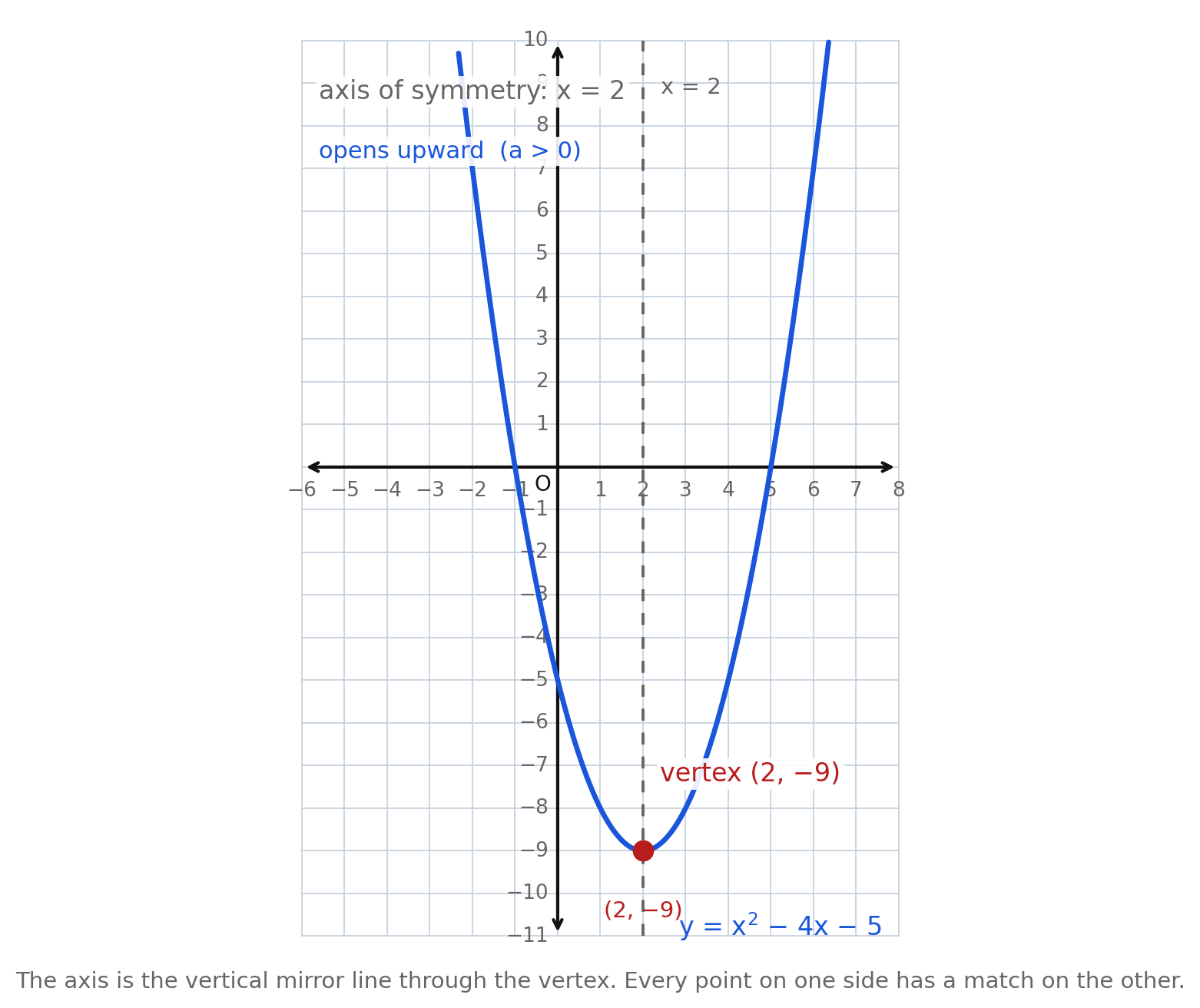
The figure shows . The leading coefficient is , so the curve opens up. The lowest point on the curve is the vertex . The dashed vertical line through that point is the axis of symmetry, . Every point on one side of the axis has a mirror match on the other side — that is what "symmetry" means here.
Minimum or maximum
The vertex is never just a point; it is either a floor or a ceiling.
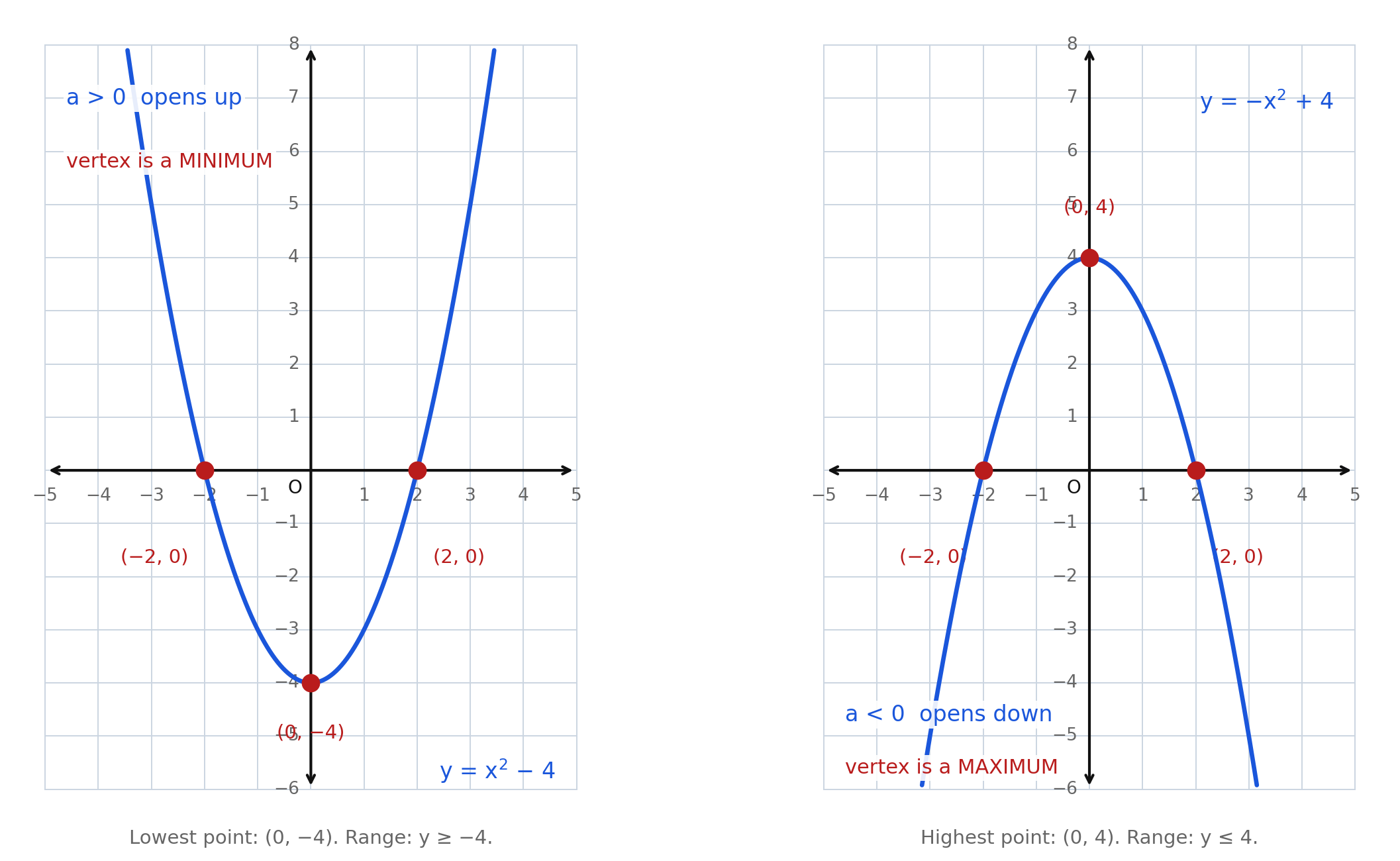
- Opens up (): the vertex is a minimum. The output never goes below .
- Opens down (): the vertex is a maximum. The output never goes above .
The left panel of the figure never drops below . The right panel never rises above . That single fact will decide the range in Lesson 16.3.
The parent quadratic
Every parabola in this chapter is related to the parent function
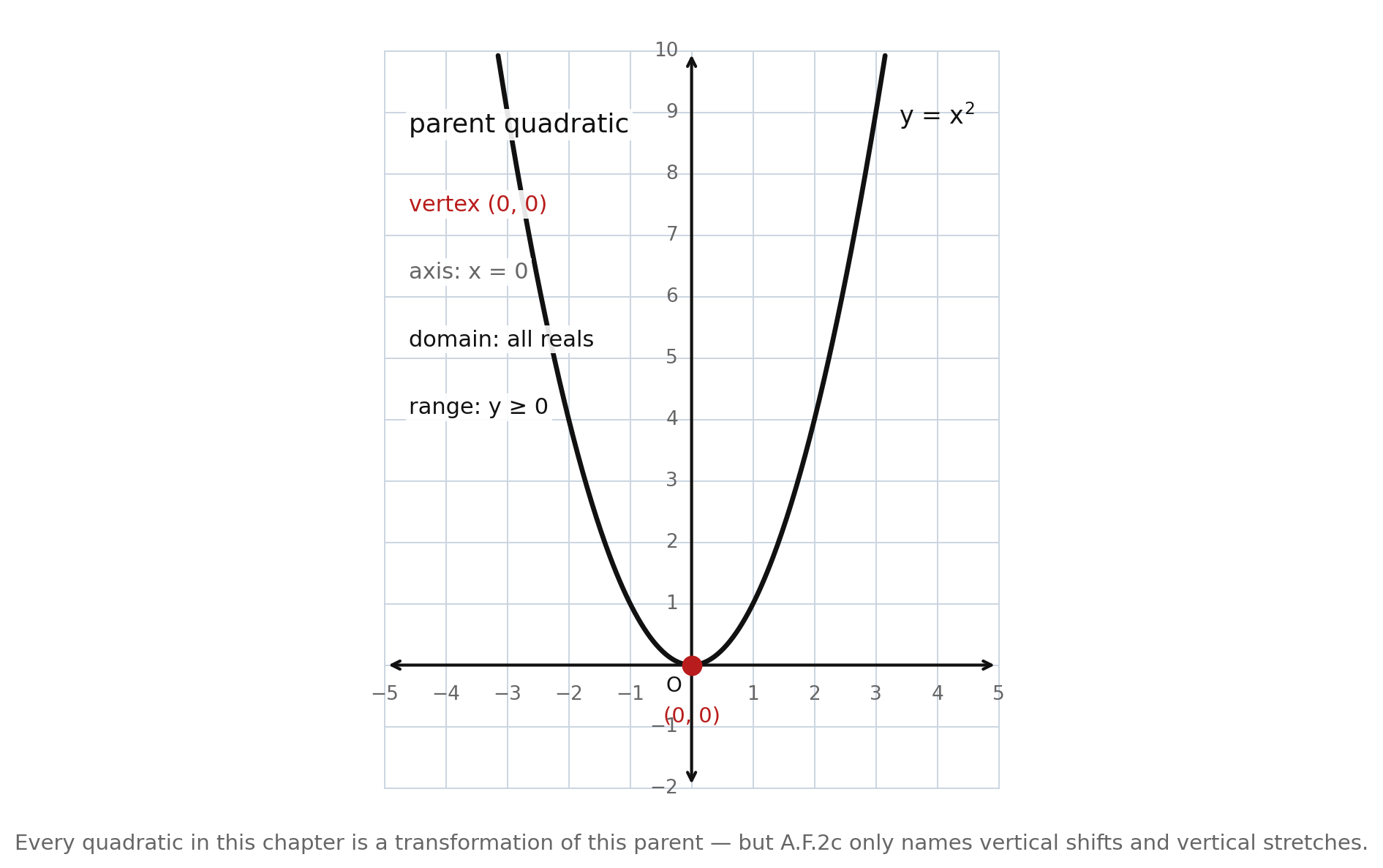
The parent opens up, has vertex , axis , domain all real numbers, and range . Lesson 16.4 will move and stretch this parent using the two transformations A.F.2c allows. For now, treat it as the reference picture: when a quadratic looks "taller," "wider," "higher," or "upside down," you are comparing it to .
Worked examples
Example 1 — Opening and vertex type
Does open up or down? Is its vertex a max or a min?
, so the parabola opens down.
Answer: Opens down; the vertex is a maximum.
Example 2 — Reading the figure
Using the vertex-and-axis figure, name the vertex and the axis of symmetry of .
Answer: Vertex ; axis .
Example 3 — Parent characteristics
Give the vertex, axis, domain, and range of .
Answer: Vertex ; axis ; domain all real numbers; range .
Example 4 — Max versus min from a picture
Using the opens-up / opens-down figure, which function has a maximum, and what is it?
Answer: has a maximum of at the vertex .
Example 5 — Axis as a mirror
The vertex of a parabola is and the point lies on the curve. Name another point that must also lie on the curve.
The axis is . The input is units right of , so its mirror is units left: . The output stays .
Answer: .
Guided practice
- Use the vertex-and-axis figure. Name the equation, the vertex, and the axis of symmetry.
- Does that parabola open up or down? How do you know from the equation?
- Use the opens-up / opens-down figure. For , is the vertex a max or a min? What are its coordinates?
- For in that same figure, is the vertex a max or a min? What are its coordinates?
- Use the parent figure. State the vertex, axis, domain, and range of .
- Explain in one sentence why the axis of symmetry of a parabola is a vertical line through the vertex.
Independent practice
- For each function, say whether it opens up or down, and whether the vertex is a max or a min. a) b) c) d)
- A parabola has vertex and passes through . Name another point on the parabola, and explain.
- Sketch from memory (or use technology), then mark the vertex and the axis.
- Reasoning. Why can a quadratic function never open "sideways"? Connect your answer to the definition .
- Error analysis. A student says has a minimum at because the vertex is the "bottom." Identify the error.
- The graph of is shown in the vertex-and-axis figure. Name one pair of points that are mirrors across the axis (you may read approximate grid points if needed, or compute and ).
- Application. A ball's height is modeled by . Without finding the vertex yet, say whether the height has a maximum or a minimum, and why.
- Compare and . How are the graphs related, and what happens to the vertex?
- Technology. Enter on a graphing calculator or graphing site. Confirm the vertex at and the axis . Name the window you used.
- Explain why cannot be if the graph is to be a parabola.
Exit ticket 16.1
- Does open up or down? Is the vertex a max or a min?
- The vertex of a parabola is and . Write the equation of the axis of symmetry, and say whether is a maximum or a minimum value.
- Give the vertex and axis of the parent .
- In one sentence, say what the axis of symmetry does for the graph.
Lesson 16.2 — Intercepts, Zeros, and the Vertex Formula
Every characteristic A.F.2b names
A.F.2b asks for five characteristics of a quadratic, given an equation or a graph:
- -intercepts (zeros)
- -intercept
- vertex (and whether it is a max or a min)
- domain
- range
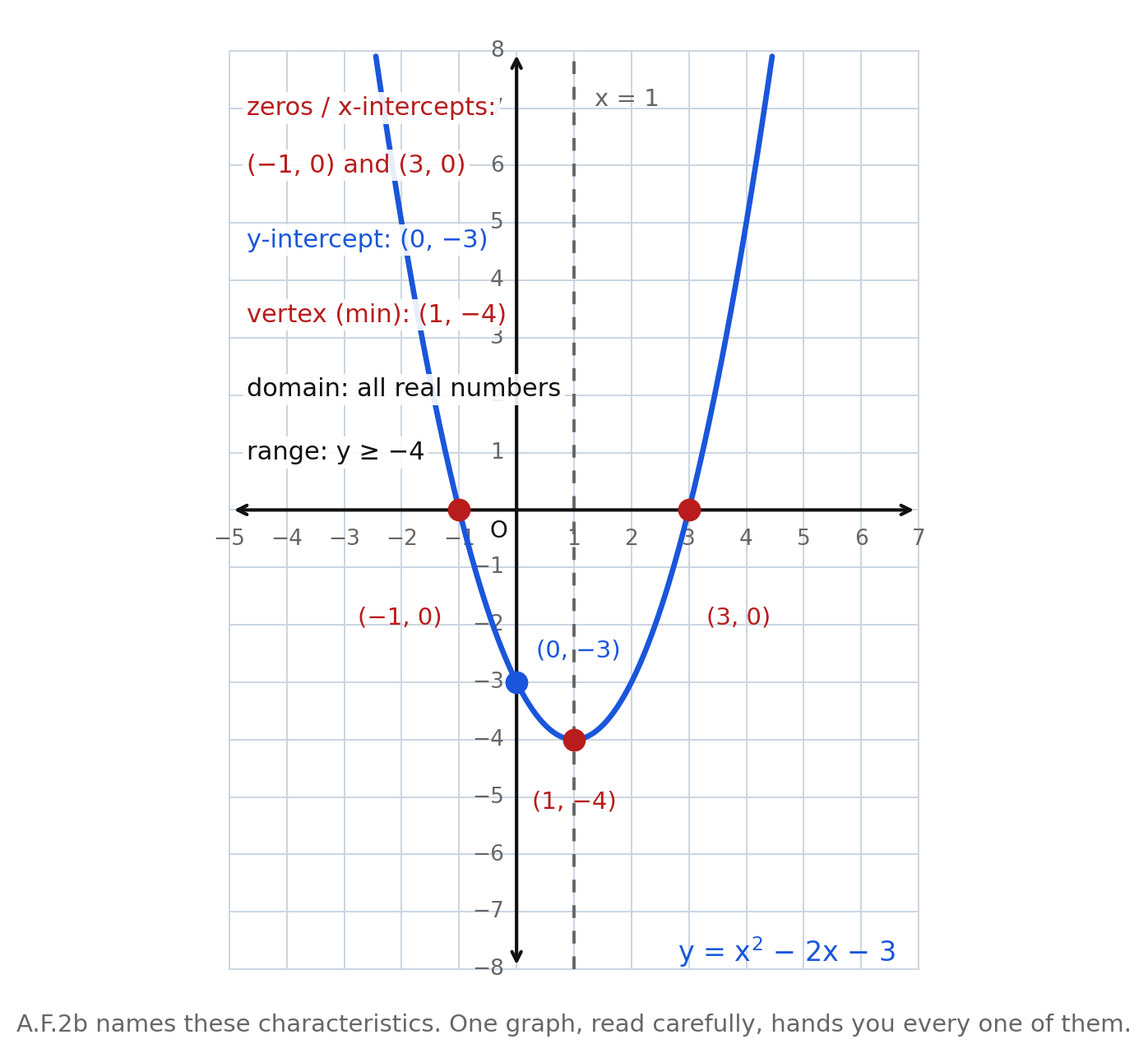
The figure packs all five onto at once. Read it top to bottom: zeros at and ; -intercept ; vertex (minimum) ; domain all real numbers; range . One careful look at a graph can hand you the whole list. The rest of this lesson shows how to get the same list from the equation alone.
Finding the pieces from
| Characteristic | How to find it |
|---|---|
| -intercept | Evaluate at : the point is . |
| Zeros / -intercepts | Solve (factor, square roots, or the quadratic formula — Chapter 15). |
| Axis | where . |
| Vertex | where . Then read max or min from the sign of . |
For :
- -intercept: .
- Zeros: , so and .
- Axis: , so .
- Vertex: , so , a minimum because .
That matches the figure exactly. Algebra and the graph are required to agree.
Worked examples
Example 1 — -intercept
Find the -intercept of .
.
Answer: .
Example 2 — Zeros by factoring
Find the zeros of .
, so or .
Answer: Zeros and ; -intercepts and .
Example 3 — Vertex formula
Find the vertex of .
, .
Answer: , a minimum.
Example 4 — No real zeros
Find the zeros of .
has no real solutions (Chapter 15). The graph never meets the -axis.
Answer: No real zeros; no -intercepts.
Example 5 — Reading a graph
Using the all-characteristics figure, name the zeros, -intercept, and vertex of .
Answer: Zeros and ; -intercept ; vertex .
Guided practice
- Use the all-characteristics figure. List the zeros, -intercept, vertex, domain, and range of .
- For , show the algebra that produces and .
- Find the -intercept of .
- Find the zeros of by factoring, and write the -intercepts as points.
- Find the vertex of . Say whether it is a max or a min.
- Explain the difference between a zero and an -intercept, using as the example.
Independent practice
- For each function, find the -intercept. a) b) c)
- Find the zeros and -intercepts. a) b) c)
- Find the axis and vertex. State max or min. a) b) c)
- Use the all-characteristics figure. Verify each labeled feature by algebra: zeros by factoring, -intercept by evaluating at , vertex by the formula.
- Reasoning. A parabola has zeros at and . Where is the axis of symmetry? Explain without finding , , or .
- Error analysis. A student finds for and gets . Identify the error and give the correct .
- Application. Revenue in dollars from selling items is . Find the -intercept and interpret it. Then find the vertex and interpret the maximum revenue.
- Find all key characteristics of using the opens-up / opens-down figure and algebra.
- Technology. Enter . Use the zero and minimum features to confirm the figure. Report the values.
- A quadratic has vertex and -intercept . Could it be ? Check both claims.
Exit ticket 16.2
- Find the -intercept and zeros of .
- Find the vertex of . Is it a max or a min?
- A parabola has -intercepts and . What is the axis of symmetry?
- In one sentence, say how the vertex formula is related to the axis of symmetry.
Lesson 16.3 — Domain and Range, Including Context
The default answers
For an unrestricted quadratic :
- Domain: all real numbers. Every real input produces an output.
- Range: depends on the vertex and the opening.
- If (opens up, minimum ): range is .
- If (opens down, maximum ): range is .
That is the same habit Chapter 5 used for lines, adapted to a curve with a floor or a ceiling. The all-characteristics figure already showed it: has domain all reals and range .
When a story cuts the domain down
An equation accepts every real input. A situation usually does not.
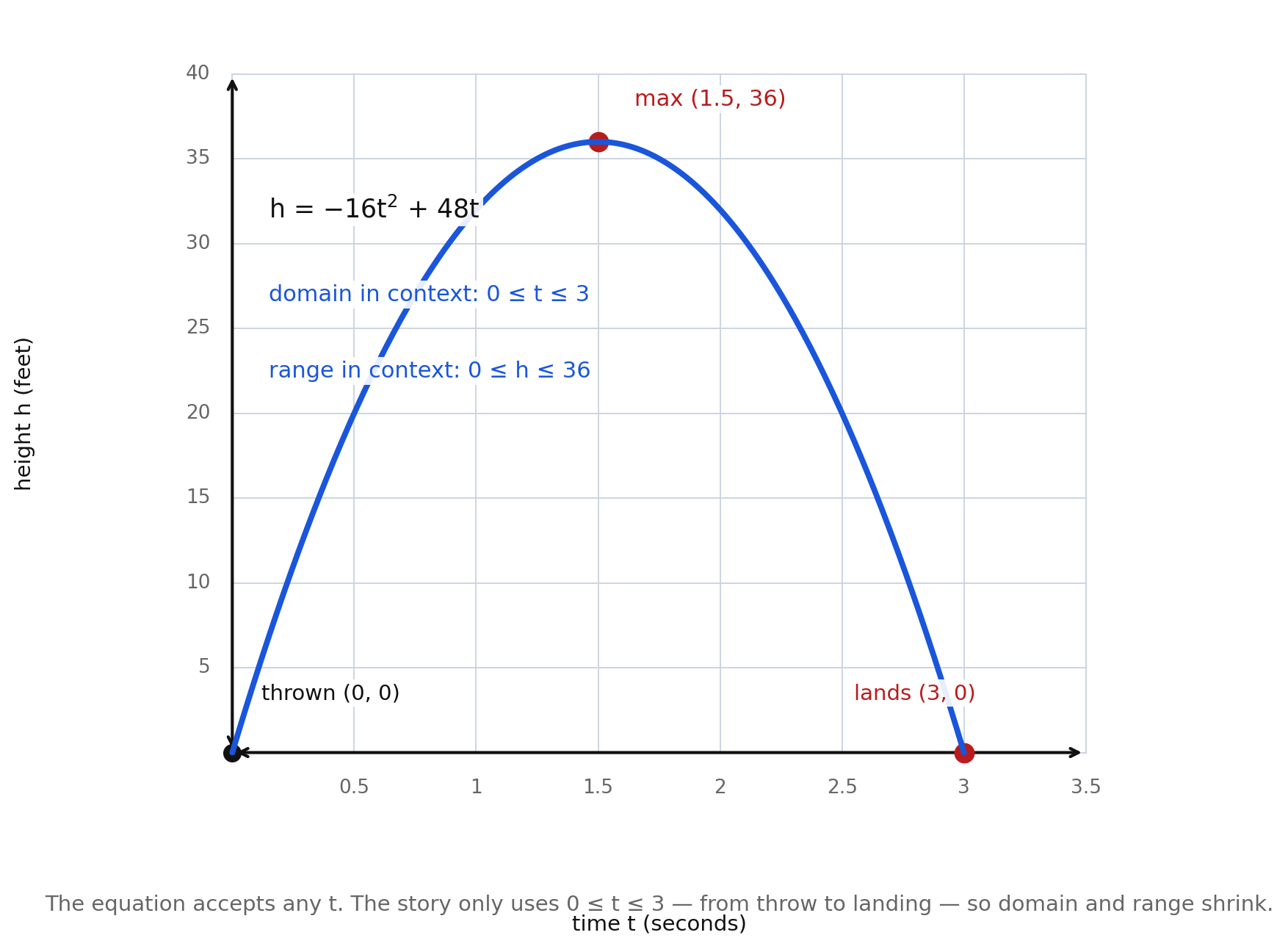
A ball thrown from ground level with
reaches a maximum of feet at seconds and lands at seconds. The equation would accept or . The story only runs from throw to landing:
- Domain in context: (seconds)
- Range in context: (feet)
Both endpoints are included: the throw and the landing are real moments, and ground level is a real height.
The habit is the same as in Chapter 5. Ask the equation for the domain and you get all real numbers. Ask the situation, and you get the truth.
Worked examples
Example 1 — From the equation
Give the domain and range of .
Vertex , .
Answer: Domain: all real numbers. Range: .
Example 2 — Opens down
Give the domain and range of .
Vertex , .
Answer: Domain: all real numbers. Range: .
Example 3 — Context
Using the projectile figure, state the domain and range of in context, with units.
Answer: Domain seconds; range feet.
Example 4 — Why the equation differs
What domain would the equation have, ignoring the story?
Answer: All real numbers. The story, not the algebra, cuts it to .
Example 5 — Interpreting the vertex in context
What does the point mean for the ball?
Answer: At seconds after the throw, the ball reaches its maximum height of feet.
Guided practice
- Give the domain and range of from the all-characteristics figure.
- Give the domain and range of from the opens-up / opens-down figure.
- Use the projectile figure. State the domain and range in context, with units.
- In that same figure, what do the points , , and mean in the story?
- Explain why the domain of the projectile equation is all real numbers, while the domain in context is not.
- Give the domain and range of from the parent figure.
Independent practice
- Give the domain and range of each (unrestricted) function. a) b) c) d)
- Application. A ball's height in feet is . Using the projectile figure, interpret the domain, range, and vertex in one sentence each, with units.
- Application. An arch is modeled by for , with in meters along the ground and in meters of height. Find the vertex, then give the domain and range in context.
- Reasoning. Why is the range of an upward-opening parabola never "all real numbers"?
- Error analysis. A student says the range of is because "height cannot be negative." Identify the error. (The function is not a height model.)
- A revenue function models dollars of revenue from items sold, for . Find the vertex, then give domain and range in context.
- Compare the domain and range of (unrestricted) with the domain and range of the same equation restricted to .
- Technology. Graph with a window that shows . Confirm the maximum near .
- Sketch and shade the region of the plane that represents its range.
- Explain. In two sentences, say how context can change the domain of a quadratic without changing the equation.
Exit ticket 16.3
- Give the domain and range of .
- Give the domain and range of .
- Using the projectile figure, write the domain in context and explain what each endpoint means.
- Why does an unrestricted quadratic always have domain all real numbers?
Lesson 16.4 — Transformations and
What A.F.2c allows
A.F.2c asks you to graph a quadratic using a variety of strategies, including the transformations
with limited to rational values. Starting from the parent , those two moves are a vertical shift and a vertical stretch / shrink / reflection.
Horizontal shifts are not on the A.F.2c list. When a vertex is not on the -axis, use the vertex formula or factored form (Lessons 16.2 and 16.5), then plot — do not invent a horizontal-shift rule for this standard.
Vertical shifts:
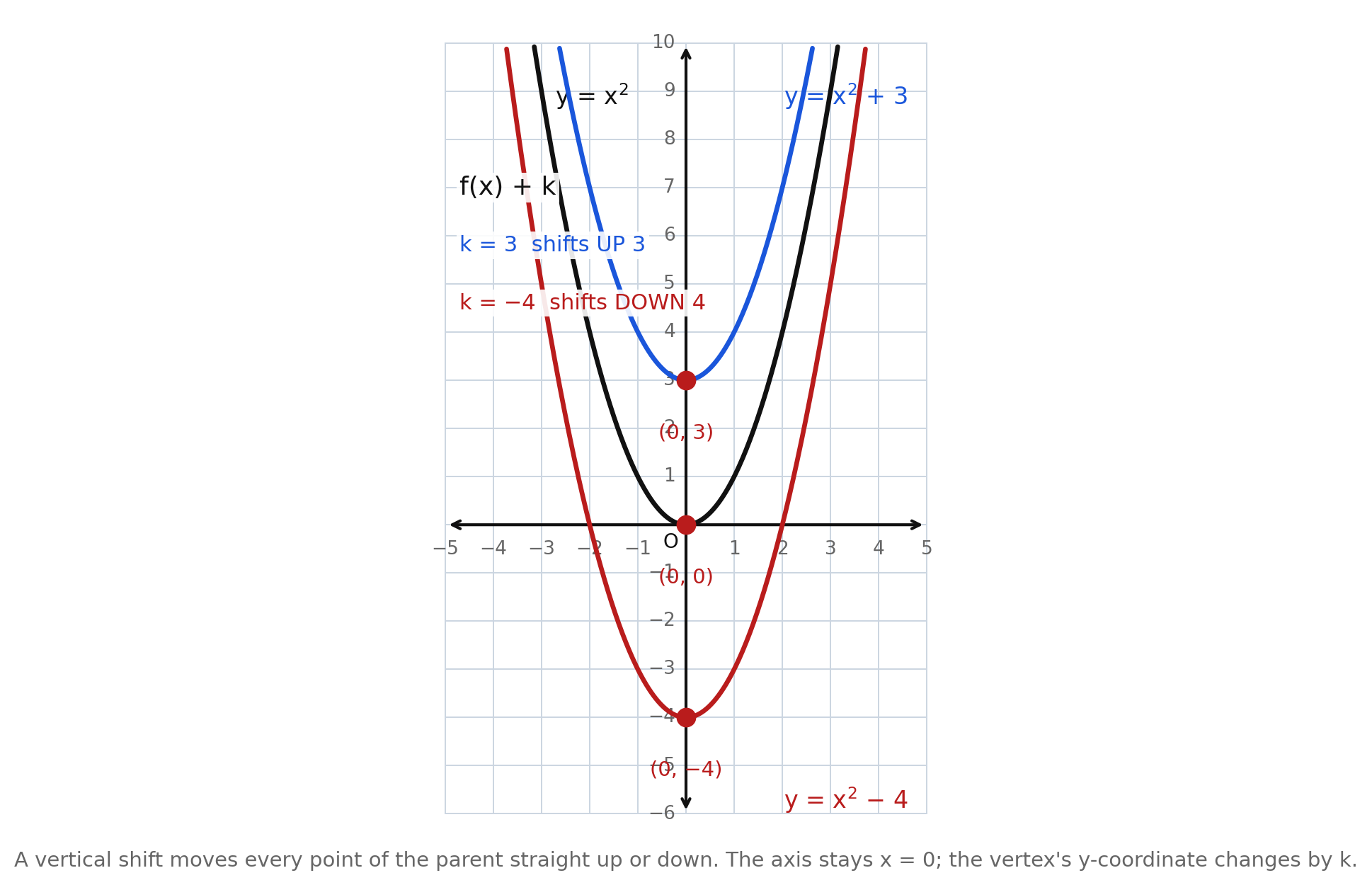
Adding a constant moves every point of the parent straight up or down.
- shifts the parent up . Vertex becomes .
- shifts the parent down . Vertex becomes .
The axis stays . The shape does not change — only the height of the vertex.
Vertical stretches, shrinks, and reflections:
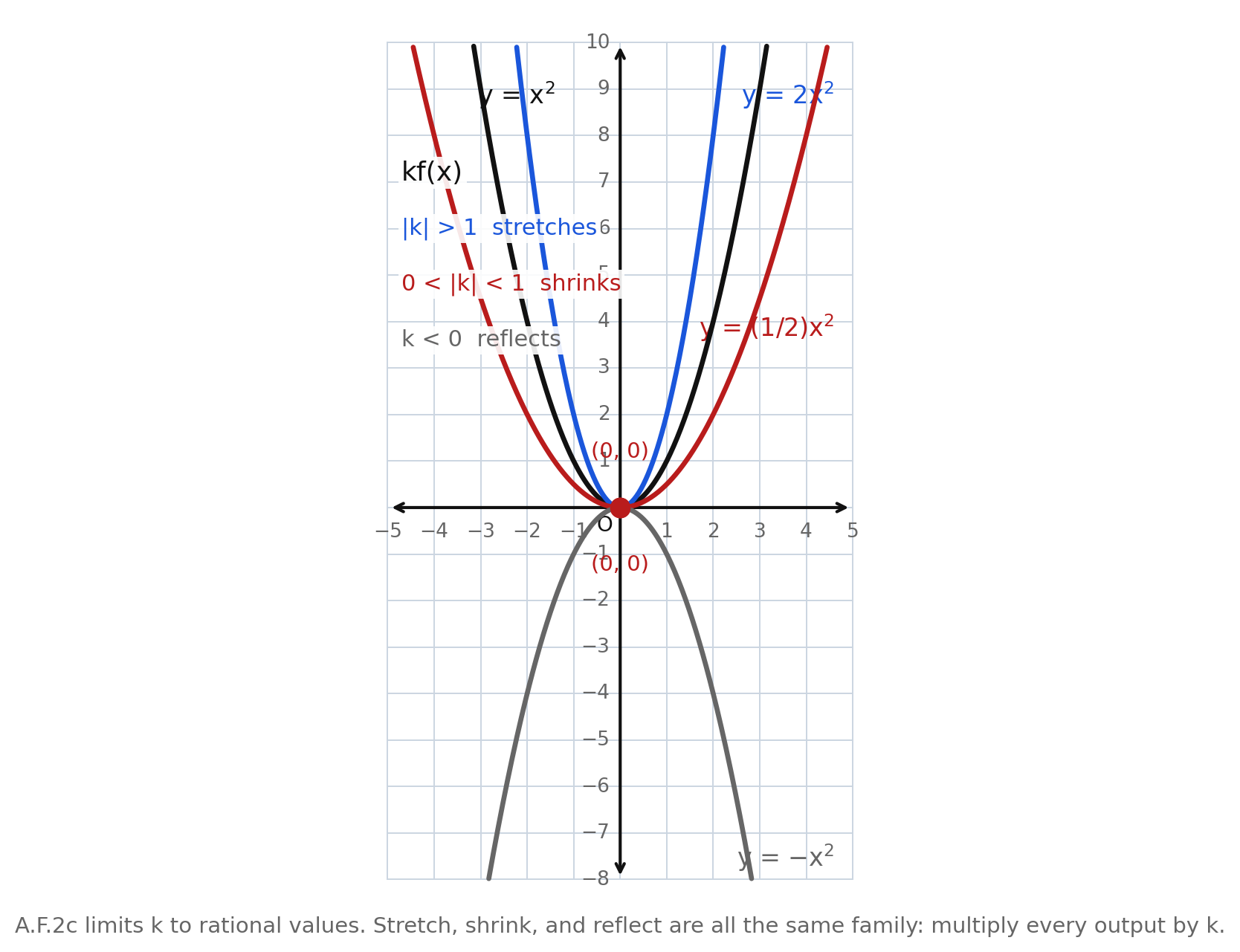
Multiplying by a rational scales every output.
- : stretch (narrower). Example: .
- : shrink (wider). Example: .
- : reflect across the -axis (opens down). Example: .
The vertex of stays at . Combining a stretch with a shift gives , still covered by the two named moves applied in sequence.
Graphing strategies this lesson practices
- From the parent by transformations when the equation is .
- From characteristics when : find vertex, intercepts, then sketch (Lesson 16.2).
- With technology to confirm either sketch.
The blank grids are for practice sketches in the workbook and independent practice.
Worked examples
Example 1 — Shift
Describe how to obtain from , and give the new vertex.
Answer: Shift up . Vertex .
Example 2 — Stretch
Describe how to obtain from . Is the graph narrower or wider?
Answer: Multiply outputs by (stretch). Narrower.
Example 3 — Reflect and shift
Describe as transformations of the parent, and give the vertex.
Reflect across the -axis, then shift up .
Answer: Vertex , a maximum. (Matches the opens-down panel of figure 3.)
Example 4 — Rational shrink
Compare to the parent at .
Parent: . Transformed: . The point moves to .
Answer: Every output is halved; the graph is wider.
Example 5 — When transformations alone are not enough
Can you graph using only and applied to ?
No. Those two moves keep the axis at . This parabola has axis . Use the vertex formula and intercepts instead (figure 1).
Answer: Use characteristics (or technology), not parent transformations alone.
Guided practice
- Use the vertical-shift figure. Describe how and come from the parent, and name each vertex.
- Use the vertical-stretch figure. Match each equation , , and to stretch, shrink, or reflect.
- Starting from , describe the transformations that produce .
- Starting from , describe the transformations that produce .
- On a blank grid, sketch and . Label the vertices.
- Explain why is not an A.F.2c transformation of the parent in this chapter's sense, even though it is a quadratic.
Independent practice
- Describe each as a transformation of , and give the vertex. a) b) c) d)
- Graph each on a blank grid (or with technology, then sketch). a) b) c)
- Reasoning. How can you tell from the equation whether the graph is narrower or wider than the parent?
- Error analysis. A student says is the parent shifted left . Identify the error, and give the correct vertex using the formula.
- Application. A mirror is shaped like with distances in feet. Compared with , is this mirror wider or narrower? What is its vertex?
- Graph by finding the vertex and intercepts (use figure 1 as a check), not by parent transformations.
- For , list the transformation sequence from the parent and confirm the range is .
- Technology. Graph , , and in the same window. Describe what you see.
- Write an equation for a parabola that is the parent reflected and shifted down .
- On a blank grid, sketch . Mark the vertex and -intercept.
Exit ticket 16.4
- Describe how to obtain from .
- Describe how to obtain from . Is it wider or narrower?
- Give the vertex of . Is it a max or a min?
- Why can and alone not produce from the parent?
Lesson 16.5 — Standard Form, Factored Form, and the Graph
Two writings, one curve
A.F.2d asks you to connect the algebraic representations — standard form and factored form — to the graphical representation of a quadratic.
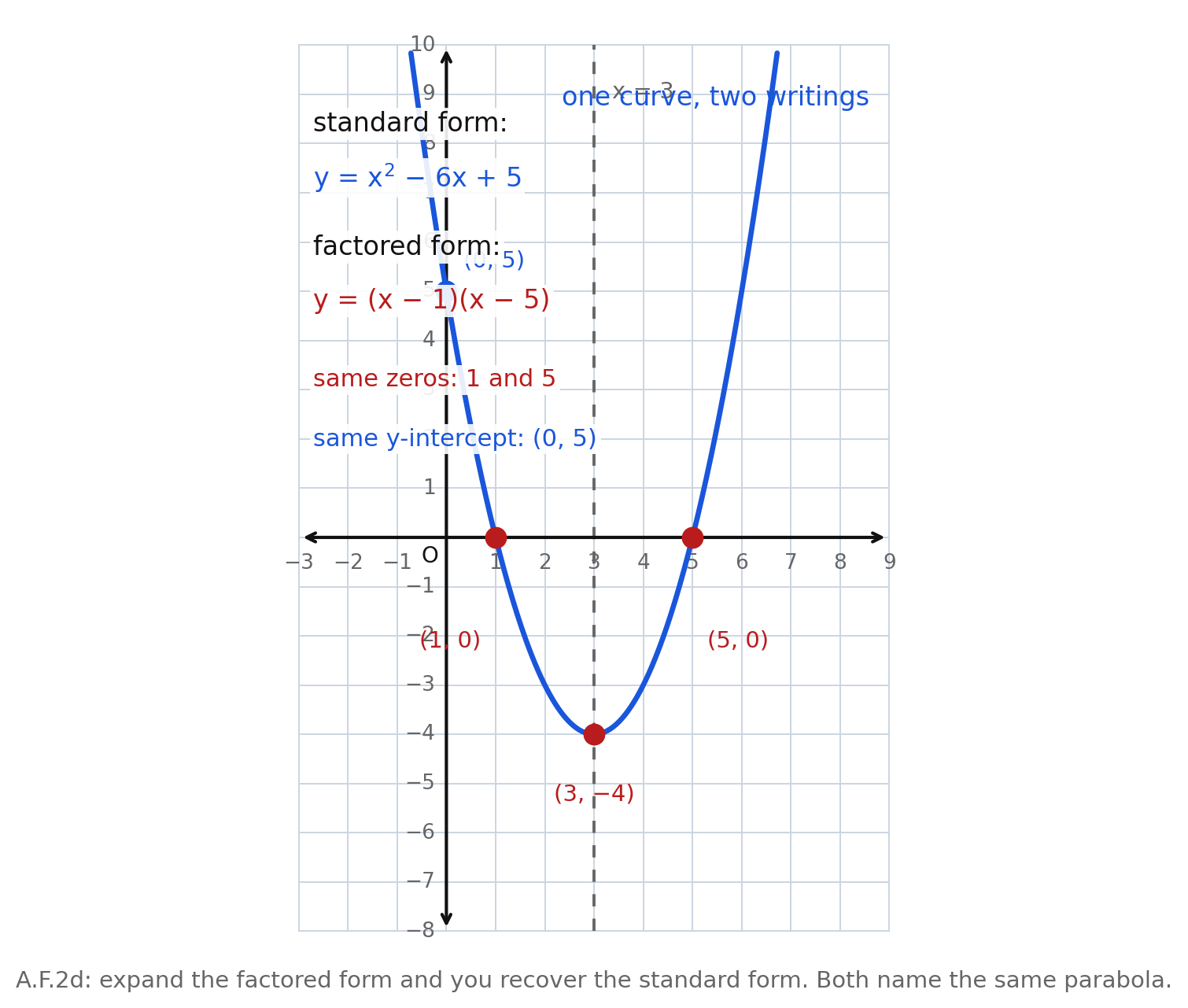
The figure shows one curve with two writings: and . Expand the factored form:
and you recover the standard form. Factor the standard form and you recover the factored form. Both name the same zeros, the same -intercept, and the same vertex.
What each form hands you for free
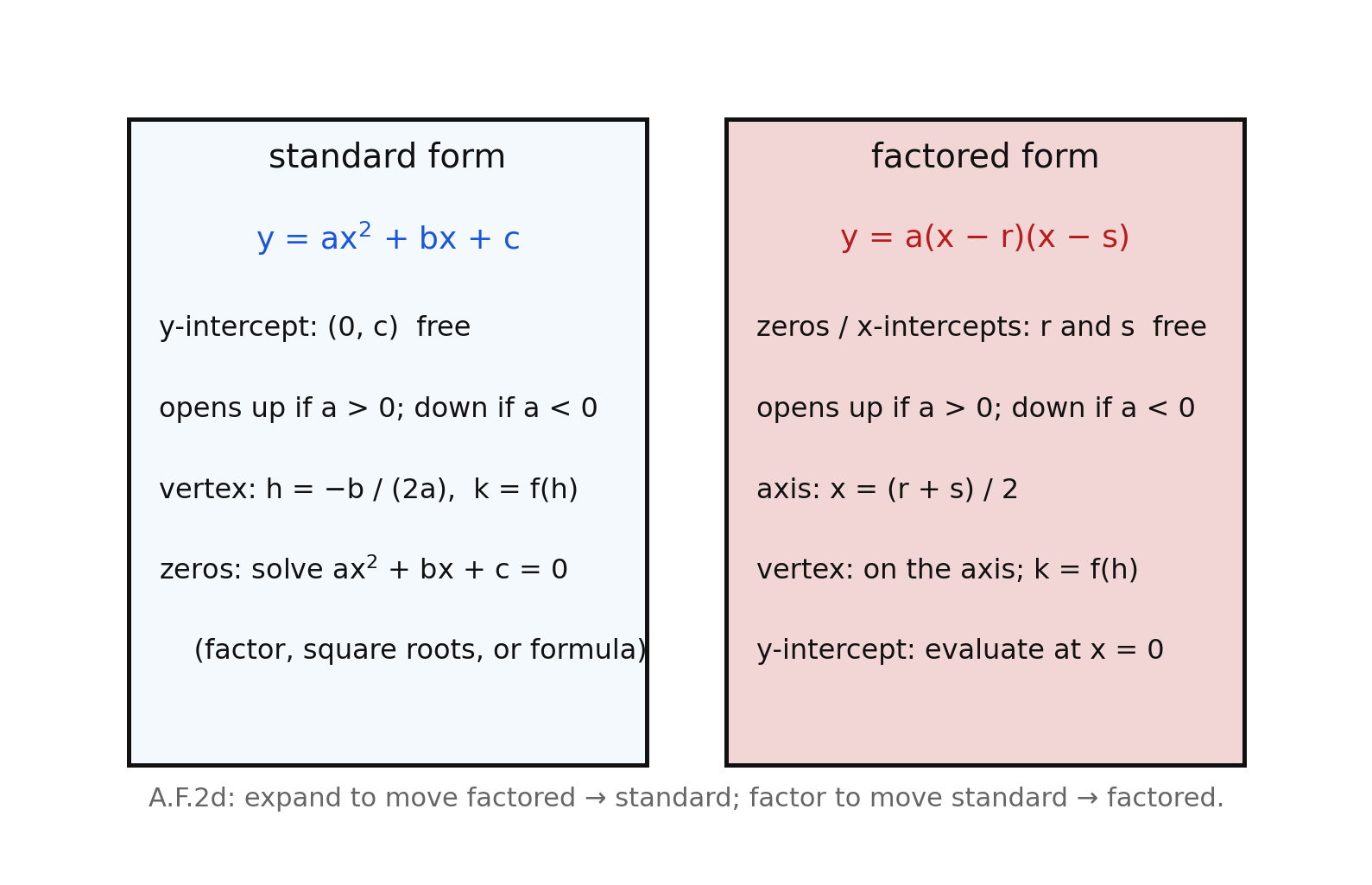
| Need | Prefer |
|---|---|
| -intercept quickly | Standard — read |
| Zeros / -intercepts quickly | Factored — read and |
| Opening direction | Either — read the sign of |
| Axis / vertex | Factored: axis is ; standard: |
Chapter 14 proved the forms are equal by expanding. This lesson uses that equality to read the graph.
Worked examples
Example 1 — From factored to graph
For , name the zeros, axis, and -intercept.
Zeros and . Axis . -intercept: , so .
Answer: Zeros , ; axis ; -intercept . (Matches figure 8.)
Example 2 — From standard to factored
Write in factored form.
.
Answer: .
Example 3 — Vertex from factored form
Find the vertex of .
Axis . .
Answer: , a minimum.
Example 4 — Leading coefficient not
For , name the zeros and opening direction.
Zeros and . , so opens down (maximum at the vertex).
Answer: Zeros and ; opens down.
Example 5 — Matching forms to features
Which form makes the -intercept of obvious? Which makes the zeros obvious?
Answer: Standard makes obvious. Factored makes zeros and obvious.
Guided practice
- Use the standard-and-factored figure. Write both forms of the graphed quadratic, and list the zeros and -intercept.
- Expand and confirm it matches the standard form in the figure.
- Use the forms-reference figure. For standard form, what is "free"? For factored form, what is "free"?
- Given , find the zeros, axis, -intercept, and vertex.
- Write in factored form, then name the zeros from that form.
- Explain in one or two sentences why expanding and factoring are reverse operations for connecting the two forms to one graph.
Independent practice
- For each factored form, name zeros, axis, -intercept, and vertex. a) b) c)
- Write each in factored form (over the integers), then graph by characteristics on a blank grid. a) b) c)
- Reasoning. A graph crosses the -axis at and and crosses the -axis at . Write a factored form with that matches the zeros, then check whether the -intercept is . If not, adjust .
- Error analysis. A student writes as . Expand to show the error, and give the correct factorization.
- Application. A rectangular garden has width meters and length meters, so area . Write in standard form, find the vertex, and interpret the maximum area in context.
- Connect (figure 2) to factored form, and verify the zeros match the graph.
- For , how do the zeros compare with figure 8? How does the vertex's -coordinate change?
- Technology. Enter both and on the same graph. Confirm they coincide.
- Write a quadratic in standard form that has zeros and and -intercept .
- On a blank grid, sketch . Label zeros, -intercept, and vertex.
Exit ticket 16.5
- Write in factored form.
- From , name the zeros and the axis of symmetry.
- Find the vertex of .
- Which form hands you the -intercept for free? Which hands you the zeros for free?
Lesson 16.6 — Evaluating and Finding
Two directions on the same curve
A.F.2g (quadratic half) asks two related skills:
- Given in the domain, determine .
- Given a value of in the range, determine (every input that works).
- Explain what and mean in context.
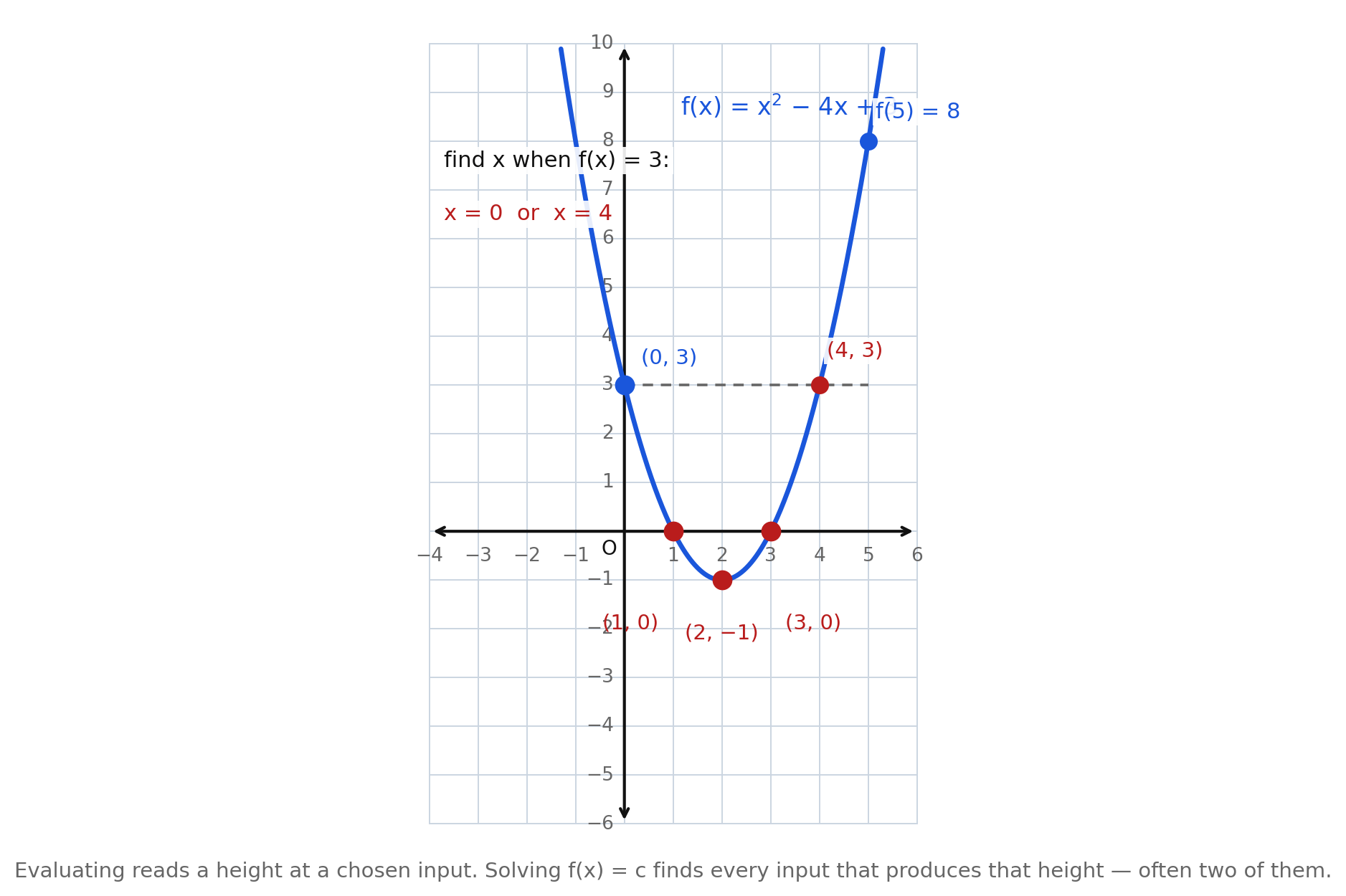
Evaluating reads a height at a chosen input: . Solving finds every input at that height. From the figure — or from algebra —
so or . A horizontal line through a height on a parabola often meets the curve twice. That is expected, not a mistake.
In context
If is height in feet after seconds, then:
- means "after seconds, the height is feet."
- Solving means "when is the height feet?" — and there may be two times, one on the way up and one on the way down.
Reject a solution that the story cannot use (negative time, and so on), with a stated reason — the same discipline as Chapter 15.
Worked examples
Example 1 — Evaluate
For , find and .
, .
Answer: ; .
Example 2 — Find
Solve for .
Answer: or .
Example 3 — Find with two irrational answers
For , solve .
.
Answer: or .
Example 4 — Context
Using , find and explain. Then solve and interpret.
: at second, the height is feet.
.
Answer: or seconds — once going up, once coming down — the height is feet.
Example 5 — Output not in range
Does ever equal ?
The minimum is . The range is , so is not an output.
Answer: No real ; is not in the range.
Guided practice
- Use the evaluating figure. Find from the graph and by substitution.
- Using that same figure, solve and mark both inputs.
- For , find (the vertex height) and .
- Solve for that same . How do the solutions relate to the -intercepts?
- Using , find and explain what it means.
- Explain in one or two sentences why solving for a quadratic can give two answers.
Independent practice
- Let . a) Find , , and . b) Solve . c) Solve .
- Let . a) Find and . b) Solve . c) Solve .
- Application. Using and the projectile figure, find and explain. Then solve and interpret both solutions in context.
- Application. Revenue dollars from items. Find and explain. Then find every for which , and interpret.
- Reasoning. Why does fail to equal for any real ? Connect your answer to the vertex.
- Error analysis. A student solves for and reports only . What did the student miss?
- Solve for . Confirm one solution with the evaluating figure.
- Technology. For , use a table or trace feature to confirm and the two inputs for .
- A ball's height is . Find and explain. Solve and interpret; reject any impossible time with a reason.
- On a blank grid, sketch , draw the line , and mark the intersection inputs.
Exit ticket 16.6
- For , find .
- Solve for that same .
- Using , explain what means in a sentence.
- Why can a quadratic have two solutions while a linear has at most one?
Chapter 16 Review
Vocabulary. quadratic function · parabola · parent function · vertex · axis of symmetry · maximum · minimum · opens up · opens down · zero · -intercept · -intercept · domain · range · context restriction · vertical shift · vertical stretch / shrink / reflection · standard form · factored form · evaluate · solve
A.F.2 b, c, d, and g (quadratic) ask different kinds of question, so this review is organized by bullet.
Part A — Key characteristics (A.F.2b)
- For , list zeros, -intercept, vertex (max or min), domain, and range.
- For in the projectile context, give domain and range in context and interpret the vertex.
Part B — Graphing and transformations (A.F.2c)
- Describe as transformations of , and give the vertex.
- Graph on a blank grid by transformations, and graph by characteristics. Say which strategy you used for each.
Part C — Standard and factored forms (A.F.2d)
- Write in factored form. Show that both forms give the same zeros and the same -intercept, matching figure 8.
Part D — Evaluate and recover (A.F.2g)
- For , find and solve . Then, for , explain what each solution of means in context.
Standards coverage check — Chapter 16
| Knowledge and Skill | Aspect | Where it is taught | Where it is practiced | Where it is interpreted in context |
|---|---|---|---|---|
| A.F.2b — key characteristics from equation or graph | Vertex / axis / max vs min | 16.1 (fig1, fig3, fig5) | 1–20, 25, 29, 34, 38, 121 | 13, 33, 48, 122 |
| A.F.2b | Zeros / -intercepts / -intercept | 16.2 (fig2) | 21–40, 121 | 33, 109 |
| A.F.2b | Domain and range | 16.3 (fig2, fig4) | 41–60, 121, 122 | 43, 44, 48, 49, 52, 59, 122 |
| A.F.2b | Interpret in context | 16.3 (fig4); 16.6 | 13, 33, 48, 49, 52, 91, 105, 109, 110, 115, 122, 126 | 48, 49, 91, 109, 110, 122, 126 |
| A.F.2c — graph using strategies including and | Vertical shift / stretch / reflect | 16.4 (fig5–fig7, fig10) | 61–80, 123, 124 | 71 |
| A.F.2c | Graph by characteristics when | 16.4; 16.2 | 72, 76, 124 | — |
| A.F.2d — connect standard and factored forms to the graph | Expand / factor; read features | 16.5 (fig8, fig11) | 81–100, 125 | 91 |
| A.F.2g — determine ; for quadratic, determine given ; explain in context | Evaluate / solve / explain | 16.6 (fig9) | 101–120, 126 | 105, 109, 110, 115, 119, 126 |
Supporting items: 6, 10, 16, 20, 26, 31, 40, 45, 50, 56, 60, 66, 69, 80, 86, 100, 106, 111, 120 are reasoning items aimed at the chapter's structural ideas — axis as mirror, why , zero versus intercept, midpoint axis from two zeros, context versus equation domain, and why A.F.2c transformations cannot move the axis. Error analyses 11, 32, 51, 70, 90, 112 target the most common failures: calling a maximum a minimum, dropping the sign in , treating a non-context graph as a height, inventing a horizontal shift, mis-factoring, and dropping one solution of .
Boundaries respected. Transformations are limited to and with rational ; no item teaches a horizontal-shift transformation rule for the parent. Exponential functions are never introduced (Chapter 17). Family comparison of linear, quadratic, and exponential is never asked (Chapter 18). Solving quadratic equations is used as a tool for zeros and for , not re-taught as Chapter 15's end goal. Vertex form may appear as a reading aid from Chapter 14, but the graphing strategies practiced are A.F.2c's two named moves plus plotting from characteristics.
Answer keys for every item in this chapter are in Appendix A.