Chapter 17 — Exponential Functions
Standard: A.F.2 (e, f, g)
A.F.2 — verbatim. The student will investigate, analyze, and compare characteristics of functions, including quadratic, and exponential functions, and model quadratic and exponential relationships. Students will demonstrate the following Knowledge and Skills: e) Given an equation or graph of an exponential function in the form (where is limited to a natural number), interpret key characteristics, including -intercepts and domain and range; interpret key characteristics as related to contextual situations, where applicable. f) Graph an exponential function, , in two variables using a variety of strategies, including transformations and , where is limited to rational values. g) For any value, , in the domain of , determine of a quadratic or exponential function. Determine given any value in the range of of a quadratic function. Explain the meaning of and in context.
By the end of this chapter you will be able to:
- Recognize an exponential function in the form with a natural number, and name as the -intercept and as the growth factor (A.F.2e)
- Build a table of integer powers and see that each step multiplies by , using the laws of exponents from Chapter 10 (A.F.2e, A.F.2f)
- State the domain, range, and -intercept of from its equation or its graph, and name the horizontal asymptote (A.F.2e)
- Interpret those characteristics in a real situation — what the intercept starts at, what inputs the story allows, what outputs can actually occur (A.F.2e)
- Graph by table-and-plot and by recognizing the growth pattern (A.F.2f)
- Graph the transformations and with rational, and say what each does to the intercept and the asymptote (A.F.2f)
- Evaluate for an exponential function from the equation or the graph, and explain what and mean in context (A.F.2g)
- State honestly that recovering from a given for an exponential requires logarithms and is not required by A.F.2g for this family (A.F.2g)
Lessons: 17.1 The Form · 17.2 -Intercept, Domain, and Range · 17.3 Graphing and Transformations · 17.4 Exponential Models in Context · 17.5 Evaluating for Exponential Functions
Why this chapter matters. Chapter 10 taught you what means — a count of factors when is a whole number, a reciprocal when is negative, and the value when is zero. This chapter puts that same into a function: the input is the exponent, the output is the power, and the graph is the curve that grows by a constant factor rather than by a constant amount. Populations that double, file sizes that multiply by three each archive, and bacteria that split on a fixed schedule are all the same picture. Chapter 18 will set this family beside linear and quadratic ones; this chapter owns the exponential family alone.
Scope note. This chapter works inside the form with a natural number — that is, — because A.F.2e says so. Fractional bases such as (decay) are out of scope here. Transformations are limited to and with rational, which is exactly A.F.2f. Quadratic geometry — vertex, axis of symmetry, -intercepts of a parabola — is A.F.2 b, c, and d in Chapter 16 and does not appear here. Comparing linear, quadratic, and exponential side by side is A.F.2h in Chapter 18; this chapter may point forward once, but it does not teach that comparison. Bullet g asks you to determine for an exponential (and for a quadratic, taught in Chapter 16). The same bullet asks you to recover from for a quadratic only. For exponentials, recovering needs logarithms, which Algebra 1 does not teach — so this chapter evaluates carefully and never asks you to solve for .
Conventions this chapter fixes.
- An exponential function is written or , with a natural number and . The number is the initial value and the -coordinate of the -intercept; the number is the growth factor.
- A natural number in this volume means a positive integer: . So , , and are legal; and are not.
- The -intercept is the point , because by Chapter 10, so .
- For and , the domain of is all real numbers and the range is . The curve approaches the horizontal asymptote but never reaches it.
- After a vertical shift , the asymptote moves to and the range becomes when . After a vertical stretch , the asymptote stays where it was and the -intercept becomes .
- Item numbering runs straight through the chapter, from 1 in Lesson 17.1 to 120 at the end of the review. It does not restart at each lesson.
Calculator note. Algebra 1 has no no-calculator standards, and the Desmos Virginia calculator is available for the entire End-of-Course test. Use it here to confirm: enter , read from the table, and check that the graph passes through . What a calculator cannot do for you in this chapter is invent a logarithm to recover — and the standard does not ask for that.
Lesson 17.1 — The Form
A new kind of growth
A linear function grows by adding the same amount each time the input increases by 1. An exponential function grows by multiplying by the same factor each time the input increases by 1.
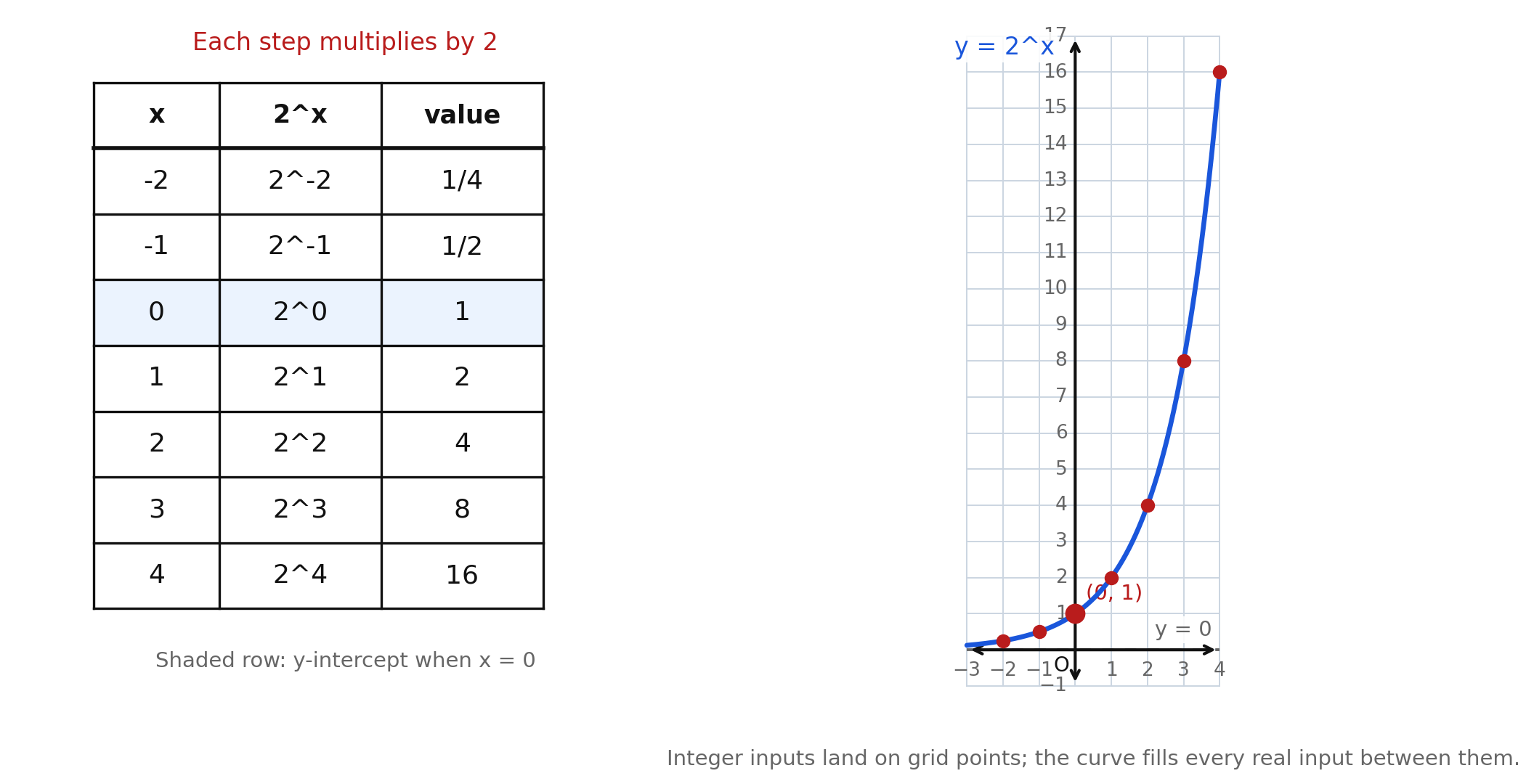
The figure shows . Read the table down the value column: , , , , , , . Each entry is twice the one above it. That is the entire definition of the growth pattern: when increases by , the output is multiplied by .
Chapter 10 already forced every entry in that table. came from the zero-exponent law; and came from the negative-exponent law; was three factors of . The new idea is not the arithmetic — it is treating the exponent as an input and drawing the continuous curve that passes through those points.
Naming and
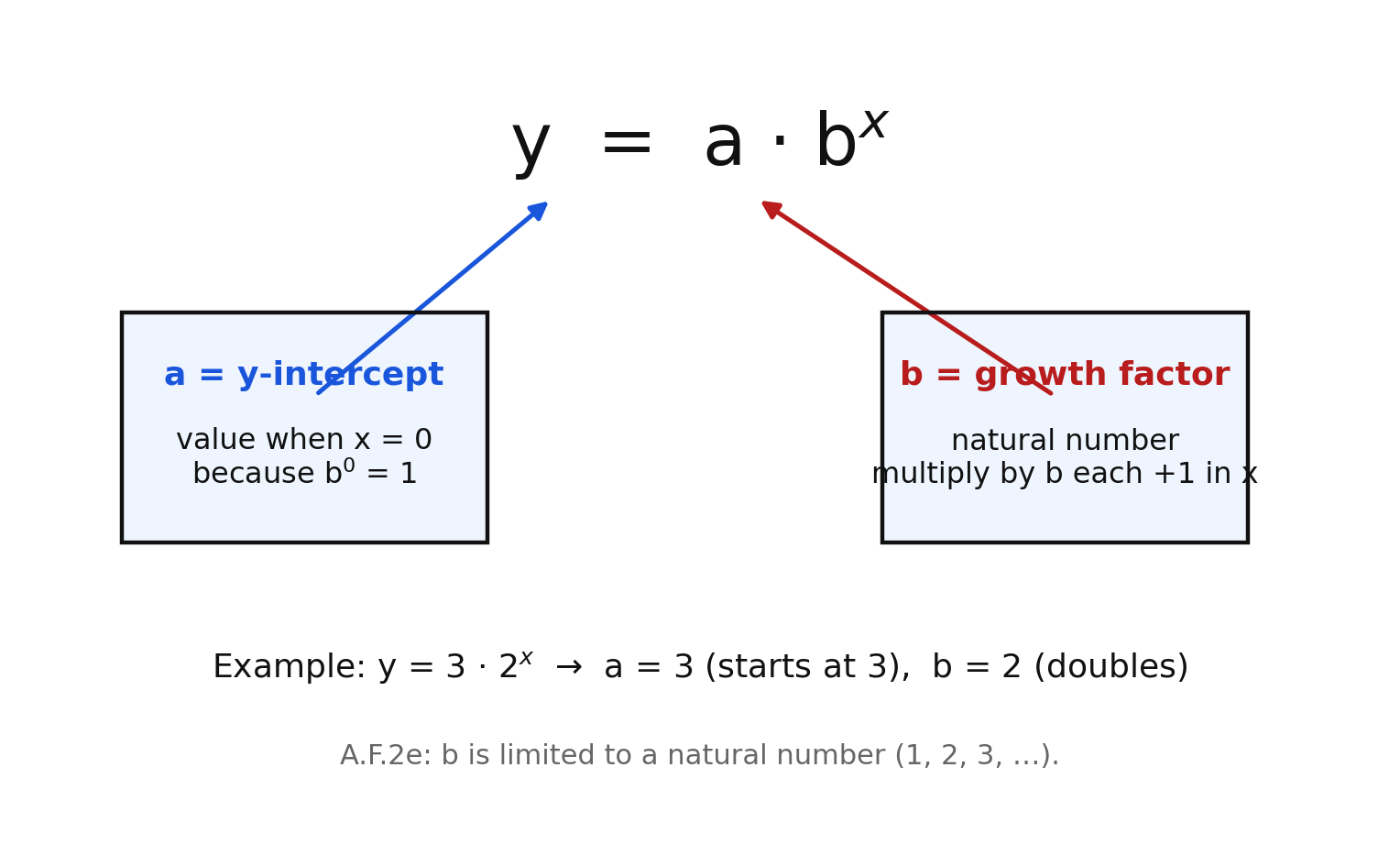
The standard writes every exponential in this chapter as
with two fixed roles:
- is the -intercept — the output when . Because , you get , so the intercept is the point .
- is the growth factor — the number you multiply by each time increases by . A.F.2e limits to a natural number.
In , the intercept is and every step multiplies by . In , the intercept is and every step multiplies by .
What the natural-number limit means
Because must be a natural number, this chapter is about growth (or the constant case ), not about decay. A model that halves each hour would need , which is not a natural number and is therefore out of scope. When , the function is the horizontal line , since for every real . When and , the graph rises as increases.
Worked examples
Example 1 — Reading and
In , what are and ? What is the -intercept?
Answer: , . The -intercept is .
Example 2 — The growth pattern
Complete the next three outputs for after : at , , and .
Each step multiplies by : , , .
Answer: , , .
Example 3 — Using a negative exponent
Find for .
.
Answer: .
Example 4 — Is it exponential?
Is an exponential function in the form ?
No. The input is multiplied by and then is added — that is linear. An exponential has the input in the exponent.
Answer: No.
Example 5 —
Describe .
Since for every real , the function is the horizontal line .
Answer: The constant function , with -intercept .
Guided practice
- Use the growth table-and-graph figure. For , what is the shaded row, and what point on the graph does it name?
- In that same figure, by what factor does each value multiply when increases by ?
- Use the anatomy figure. In , what does name, and what does name?
- For , give , , and the -intercept as an ordered pair.
- Evaluate using Chapter 10, then find for .
- Explain. Why must for the -intercept of to equal ?
Independent practice
- Identify and , and give the -intercept. a) b) c) d)
- Complete each table for one more row by multiplying by the growth factor. a) : b) :
- Evaluate. a) at b) at c) at d) at
- Application. A culture starts with cells and doubles every hour: . Give , , and . Then find .
- Reasoning. Explain why is not exponential, even though it contains a and an .
- Error analysis. A student says the -intercept of is , because . Identify the error and give the correct intercept.
- Which of these fit the form with a natural number? For each that does, name and . a) b) c) d)
- Build a table for at . Use Chapter 10 for the negative exponent.
- Reasoning. If every step of a table multiplies by , and the value at is , write the equation .
- Confirm with technology: enter and read the table at . Do the values match the growth figure?
Exit ticket 17.1
- In , give , , and the -intercept.
- Find and for .
- Explain in one sentence what the growth factor tells you about consecutive outputs.
- Why is outside the scope of A.F.2e?
Lesson 17.2 — -Intercept, Domain, and Range
Three characteristics A.F.2e names
A.F.2e asks for three things from an equation or a graph: the -intercept, the domain, and the range. For an unrestricted exponential with and , the answers are short and always the same shape.
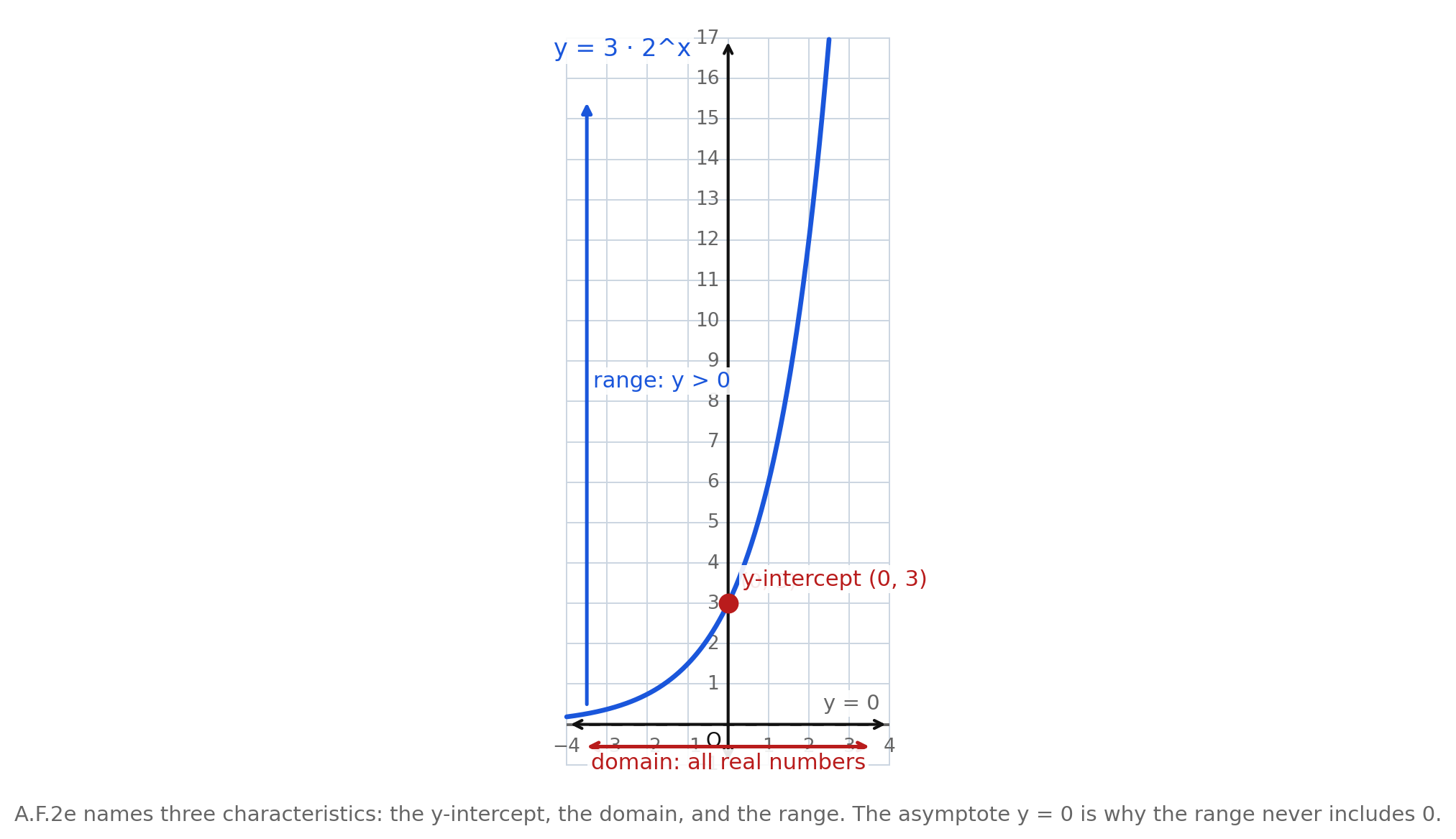
- -intercept: . Here , so .
- Domain: all real numbers. Every real input produces an output; the arrowheads (and the continuous curve) say so.
- Range: . The curve stays strictly above the -axis.
Why the range never includes zero
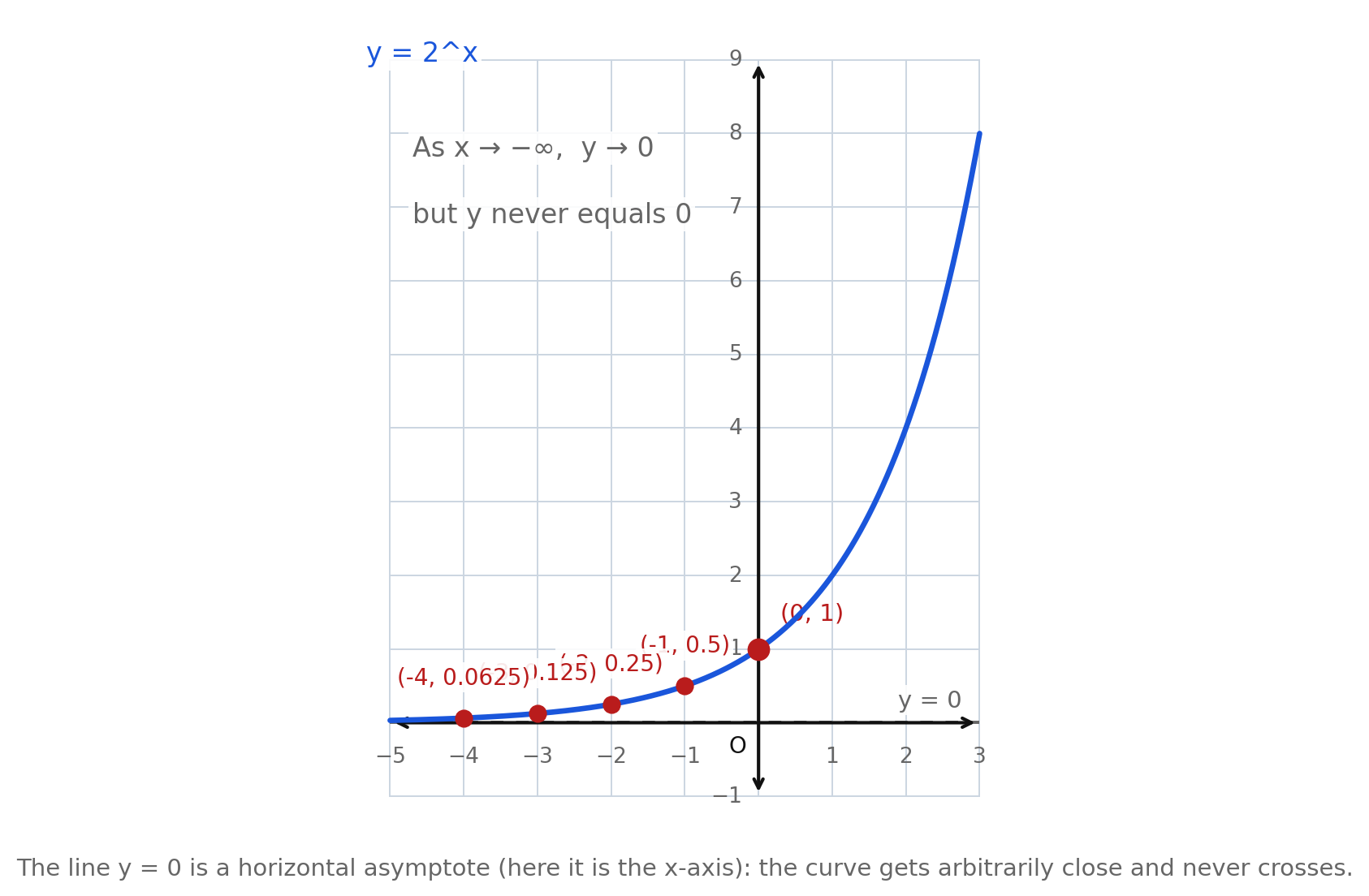
The line is a horizontal asymptote. As decreases through , , , , the outputs , , , get closer to and never arrive. That is why the range is , not . A student who writes "all real numbers" for the range of is describing a line, not this curve.
Reading characteristics from the equation alone
You do not need a graph to answer A.F.2e's three questions for with :
| Characteristic | From the equation |
|---|---|
| -intercept | |
| Domain | all real numbers |
| Range |
The graph confirms the same three facts and makes the asymptote visible.
When a situation cuts the domain down
An equation accepts every real input. A story usually does not. If is hours since a culture was started, then , and the domain in context is no longer all real numbers. The range in context is then the outputs the story can actually produce — typically when growth starts at with . Lesson 17.4 develops that habit in full; for now, notice that "domain of the equation" and "domain of the model" are different questions.
Worked examples
Example 1 — From the equation
Give the -intercept, domain, and range of .
Answer: Intercept ; domain all real numbers; range .
Example 2 — From the graph
The characteristics figure shows . Read the intercept and the range off the picture.
Answer: Intercept ; range (strictly above the asymptote ).
Example 3 — The asymptote
Does the graph of ever meet the line ?
Answer: No. The line is a horizontal asymptote; outputs approach but never equal .
Example 4 —
Give the domain and range of .
Answer: Domain all real numbers; range the single value (a horizontal line).
Example 5 — Context preview
A model counts cells after hours, starting at . Give the domain in context.
Answer: hours. Negative time is before the culture started.
Guided practice
- Use the characteristics figure. State the -intercept, domain, and range of .
- In that same figure, why does the range arrow start just above rather than on it?
- Use the asymptote figure. List the four labeled points with negative , and say what pattern their -coordinates follow.
- Give the -intercept, domain, and range of from its equation alone.
- Give the -intercept, domain, and range of .
- Explain. Why is the domain of always all real numbers, even when is negative?
Independent practice
- For each function, give the -intercept, domain, and range. a) b) c) d)
- Match each description to or . a) -intercept , asymptote b) -intercept , asymptote
- Application. A rumor model counts people who have heard a story after days. Give the -intercept and say what it means in the story.
- Reasoning. A student says the range of is all real numbers because the domain is. Identify the error.
- Error analysis. A student writes the -intercept of as , not as a point. What does A.F.2e expect, and why?
- From the asymptote figure, estimate and by continuing the pattern, and confirm with Chapter 10.
- Sketch from memory: mark the intercept, draw the asymptote, and show the growth direction.
- Confirm with technology: graph , and verify that the table gives and that no table value is .
- Give one reason the range of (, ) cannot include negative numbers.
- Reasoning. If a context restricts to , what happens to the domain and to the range compared with the unrestricted equation?
Exit ticket 17.2
- Give the -intercept, domain, and range of .
- What is the horizontal asymptote of , and why does it matter for the range?
- Read the intercept off the characteristics figure for , and state it as an ordered pair.
- Explain why writing "range: " for is incorrect.
Lesson 17.3 — Graphing and Transformations
Strategy: table, plot, connect
A.F.2f asks you to graph an exponential using a variety of strategies. The most reliable hand strategy is the one Chapter 10 already paid for.
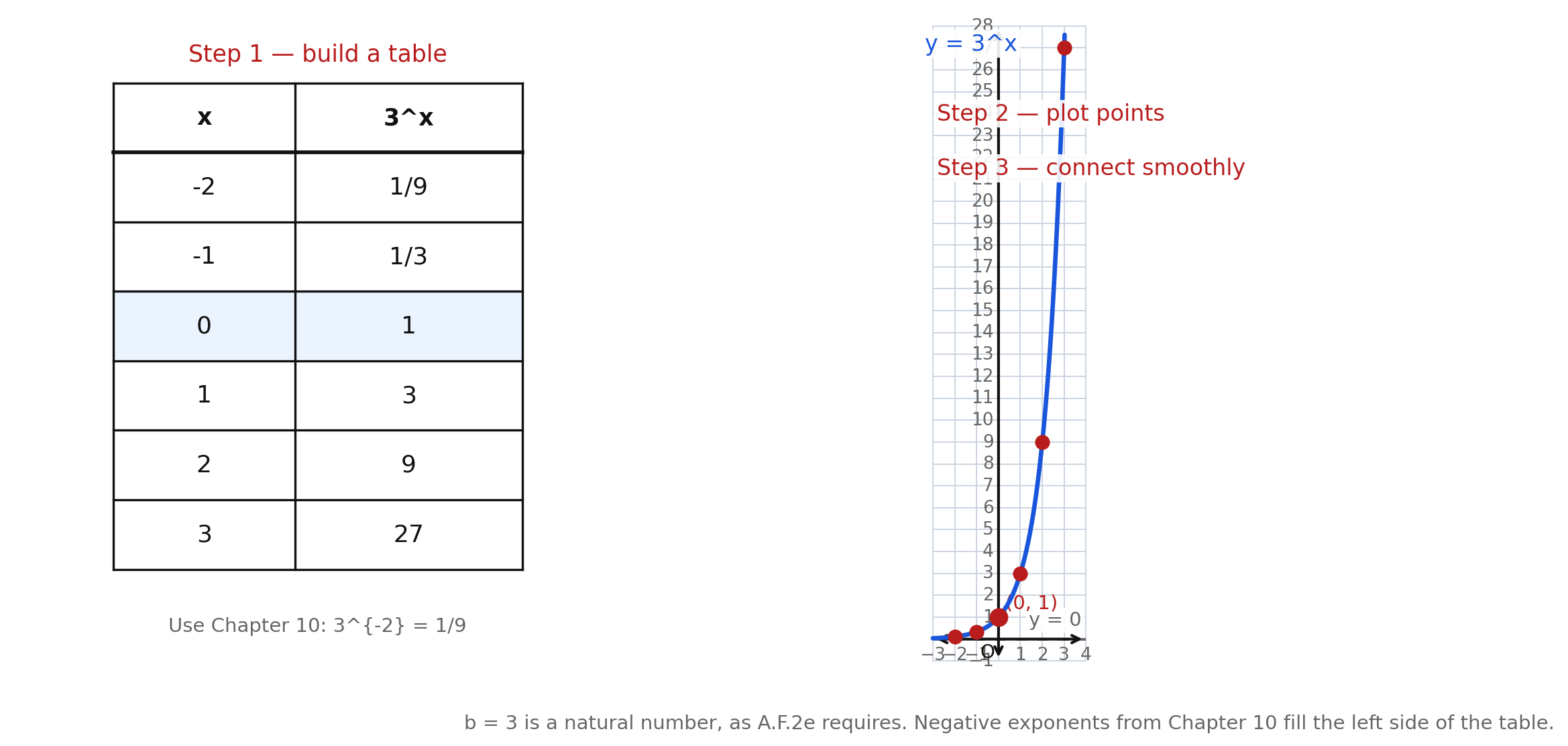
- Build a table of several integer inputs, including negatives, zero, and positives.
- Plot the points on a grid scaled to fit the largest output you need.
- Connect smoothly, approaching the asymptote on the left and rising on the right.
Negative exponents are not a special case — they are Chapter 10. is an ordinary table entry.
Transformation
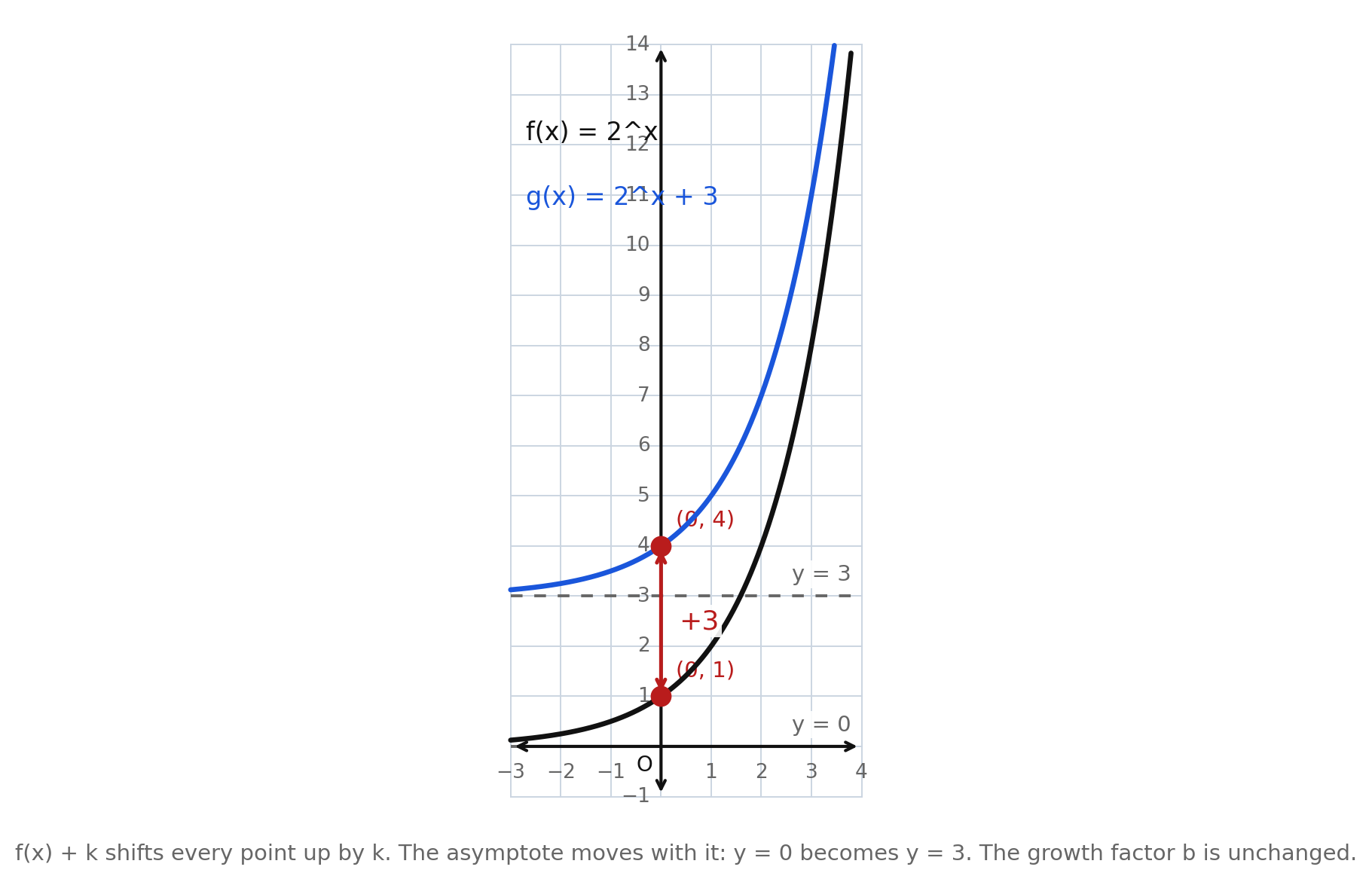
If , then shifts every point up by 3. Two consequences matter:
- The -intercept moves from to .
- The asymptote moves from to . The range becomes .
The growth factor is unchanged: consecutive outputs still multiply by , then sit three units higher.
Transformation
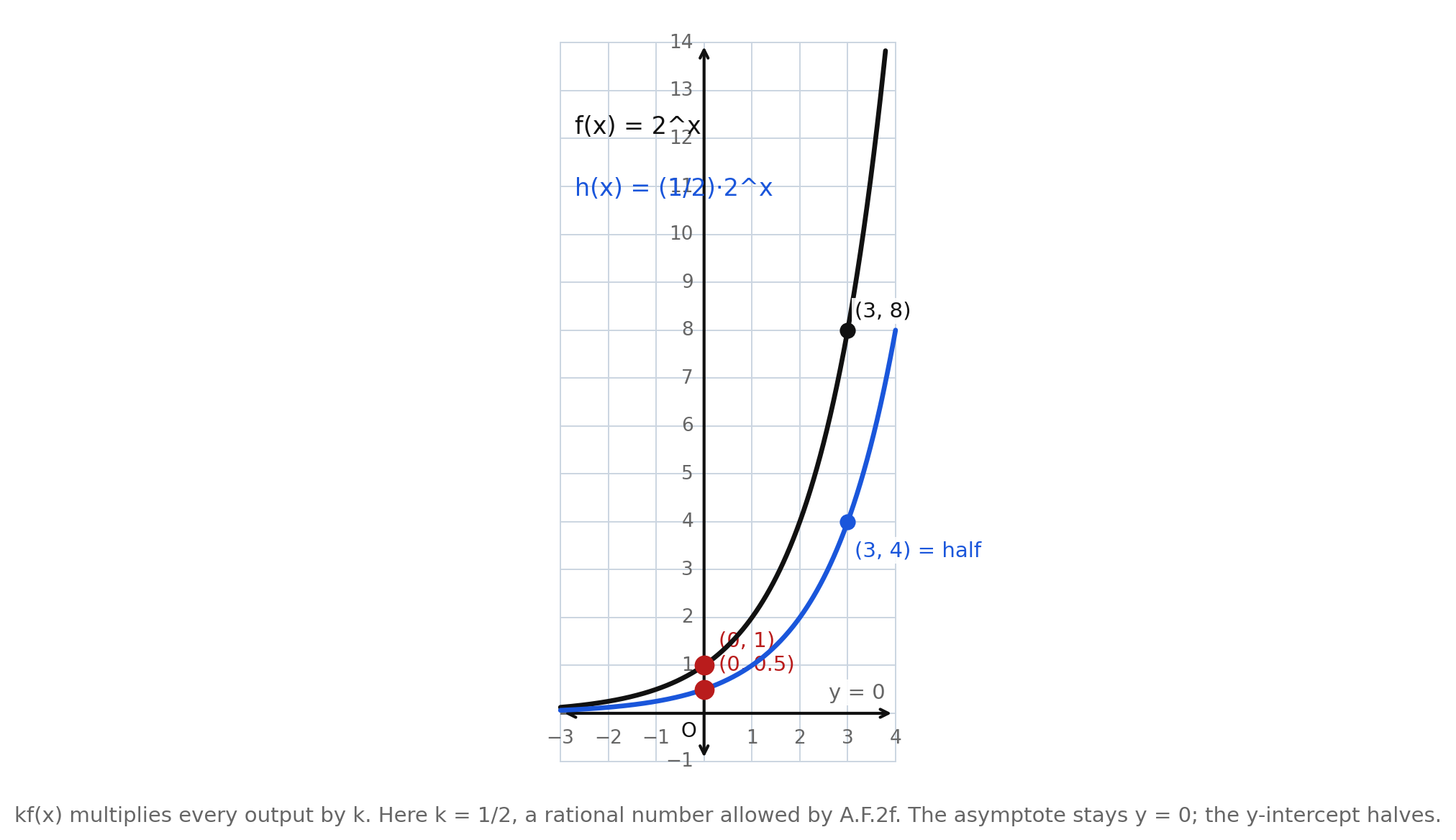
If , then multiplies every output by . A.F.2f allows any rational .
- The -intercept moves from to .
- The asymptote stays .
- At , the parent gives and the stretch gives — exactly half.
Notice that can also be rewritten as , but you do not need that rewrite to graph it: multiply outputs by and plot.
Blank grids for practice
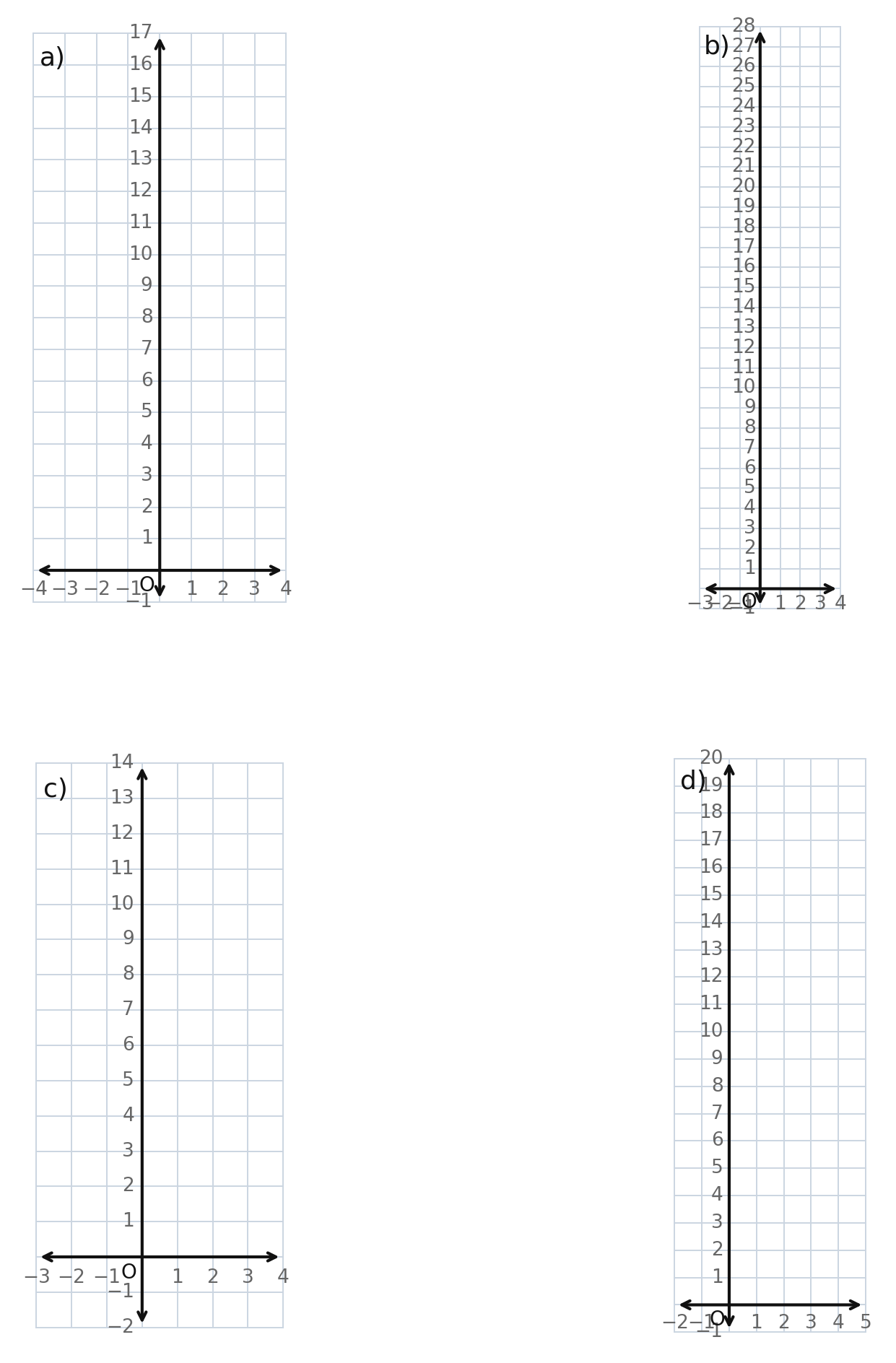
The workbook uses these grids for hand graphing. Choose the window that fits your largest table value.
Worked examples
Example 1 — Graphing from a table
Make a table for at and describe the graph.
Values: , , , , . Plot and connect; asymptote ; intercept .
Answer: Rising curve through those points, approaching on the left.
Example 2 — A vertical shift
Compared with , what are the intercept and asymptote of ?
Answer: Intercept ; asymptote ; range .
Example 3 — A vertical stretch
If , write for , and give the new -intercept.
Answer: ; intercept .
Example 4 — Combining with the form
Show that is already in the form , and name and .
Answer: , .
Example 5 — What does not change
Under and under , which feature — growth factor or asymptote — stays put in which case?
Answer: keeps the growth factor and moves the asymptote. keeps the asymptote (for the parent ) and multiplies the intercept by .
Guided practice
- Use the table-and-graph figure for . Copy the table values, and name the -intercept.
- In that same figure, what Chapter 10 fact fills in the entry?
- Use the shift figure. Give the intercept and asymptote of .
- Use the stretch figure. Give and explain why it is half of .
- Graph on blank grid (a) by plotting at least five points.
- Explain. Why does adding move the asymptote, while multiplying by does not?
Independent practice
- Make a table and graph. a) on grid (a) b) on grid (b)
- For , write the equation and give the intercept and asymptote of each. a) b) c) d)
- Match. a) Same asymptote , intercept halved b) Asymptote moved to , intercept moved up by to either or , where .
- Application. A sensor reading is modeled by . After calibration, the display shows . What does the do to the graph, and what is the new asymptote?
- Reasoning. Explain why with would reflect the graph across the -axis. (Still a legal rational ; the range would become for the parent .)
- Error analysis. A student shifts up by but leaves the asymptote drawn on the -axis. What is wrong, and how do you fix it?
- Graph on grid (c), marking both the new intercept and the new asymptote.
- Graph on grid (c), marking and .
- Confirm with technology: graph and on the same axes. Does the vertical gap look constant?
- Rewrite as with , and state .
- Reasoning. Why does A.F.2f limit to rational values in the transformations it names? (State the limit; you do not need a historical reason.)
- On grid (d), graph for .
Exit ticket 17.3
- List the three steps of the table-plot-connect strategy.
- For , give the equation, intercept, and asymptote of and of .
- Using the stretch figure, explain what does to every output.
- Why is plotting for a Chapter 10 skill as much as a graphing skill?
Lesson 17.4 — Exponential Models in Context
Reading a story as
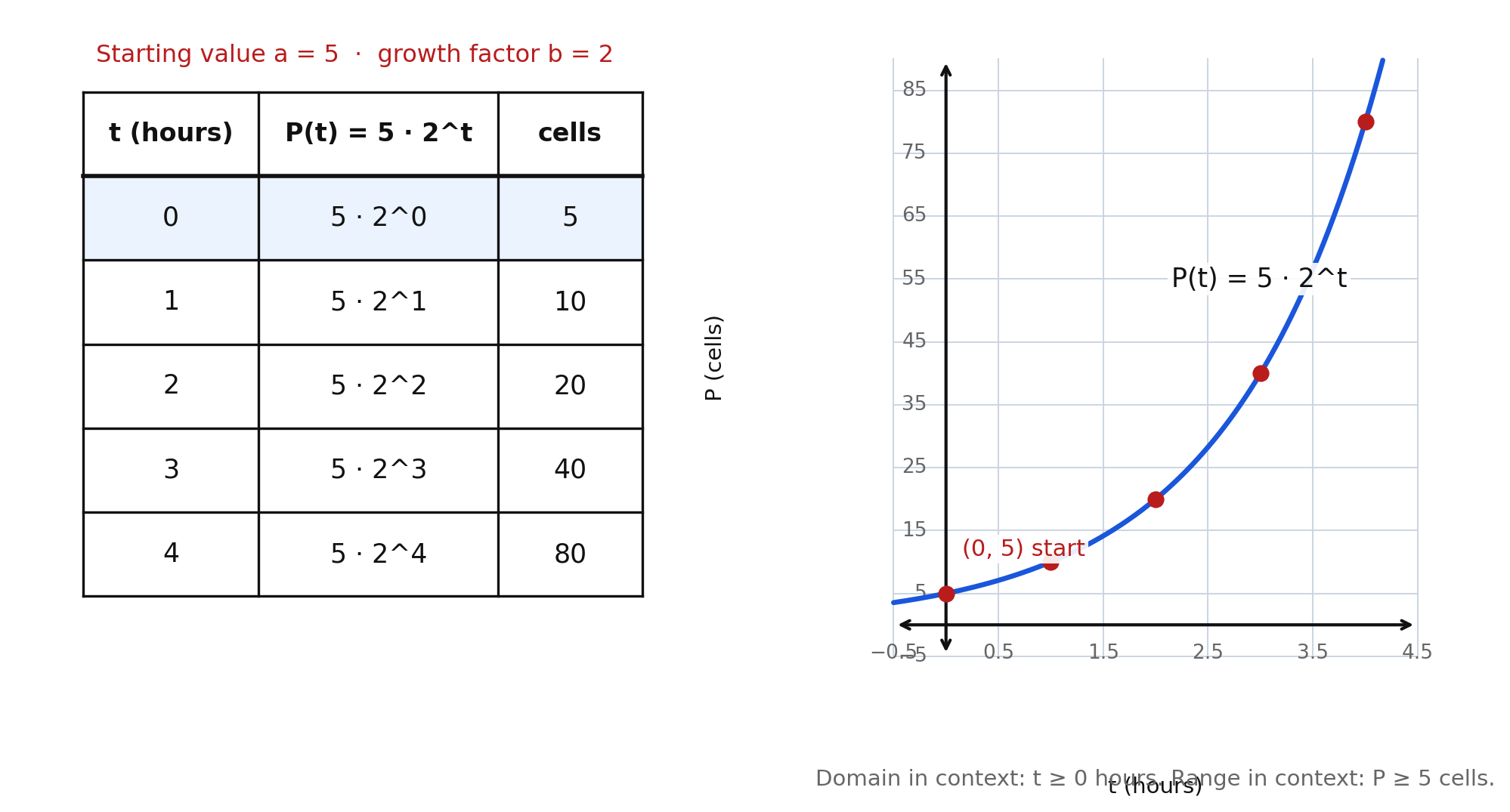
A culture starts with cells and doubles every hour:
- is the starting population — the value at , shown as on the graph.
- is the doubling factor — each hour multiplies the count by .
- Domain in context: hours (time since the culture began).
- Range in context: cells (the population never drops below its start under this model).
The unrestricted equation would accept and report a fractional cell count; the story does not.
Interpreting characteristics with units
A.F.2e asks you to interpret characteristics as related to contextual situations. That means every answer carries units and a sentence about the story:
| Characteristic | In the bacteria model |
|---|---|
| -intercept | At hours, there are cells |
| Domain | Hours since the culture started; no negative time |
| Range | Cell counts the model actually produces for |
| Growth factor | The population doubles each hour |
Other growth contexts
The same template fits many stories, as long as is a natural number:
- Archive sizes: megabytes after compression generations (triples each time).
- Tournament brackets: teams remaining after rounds of doubling from a single champion working backward — or, more naturally, would be decay and is out of scope; instead use growth from a seed: players needed so that rounds produce a winner.
- Chain letters / rumors: people after days if each person tells three new people.
Worked examples
Example 1 — Reading the bacteria figure
From the figure, give , , and the domain in context.
Answer: cells; cells; domain hours.
Example 2 — Interpreting the intercept
In , what does the intercept mean if is megabytes and is generations?
Answer: At generation , the archive is megabytes.
Example 3 — Domain versus equation
Why is the domain of as an equation different from the domain in the bacteria story?
Answer: The equation allows every real ; the story only models .
Example 4 — Growth factor in words
In , say in one sentence what means.
Answer: Each day, the number of people who have heard the rumor triples.
Example 5 — Out of scope
A medicine decays by half each day: . Is this model inside A.F.2e?
Answer: No. The base is not a natural number.
Guided practice
- Use the bacteria figure. Give , , and the ordered-pair intercept.
- From that figure, what are and ?
- State the domain and range in context for the bacteria model, with units.
- Write one sentence interpreting the growth factor in the bacteria story.
- For megabytes, interpret the intercept and the growth factor.
- Explain. Why does the bacteria graph start at rather than showing negative hours?
Independent practice
- A lab sample follows cells after hours. a) Give the intercept and its meaning. b) Find . c) Give the domain in context.
- Application. An image file starts at MB and triples at each export setting: . Complete a table for , and interpret .
- Application. A rumor spreads by people after days. How many people after days? What does the intercept mean?
- Reasoning. Why is "range: all real numbers" wrong for the bacteria model even though it is wrong for the unrestricted equation for a different reason?
- Error analysis. A student writes the domain of in context as all real numbers, "because exponentials always have domain all reals." Fix the answer.
- Which models fit A.F.2e's natural-number base? a) b) c) d)
- Invent a one-sentence story for with in days and in insects, and interpret the intercept.
- Using the bacteria figure, explain why the range in context is rather than .
- Confirm with technology: graph and read through from the table. Match the figure.
- Reasoning. If a culture triples every hour starting from cells, write and state and .
- A display of counts visitors (in hundreds) plus a baseline staff of . What transformation is this, and what is the asymptote?
- Application. Use . After how many whole hours does the model first exceed cells? (Evaluate; do not solve an equation with logs — check and .)
Exit ticket 17.4
- For the bacteria model, interpret in one sentence with units.
- Give the domain and range in context for .
- A model counts organisms. Interpret and .
- Why is a half-life model with base outside this chapter's standard?
Lesson 17.5 — Evaluating for Exponential Functions
What A.F.2g asks — and what it does not
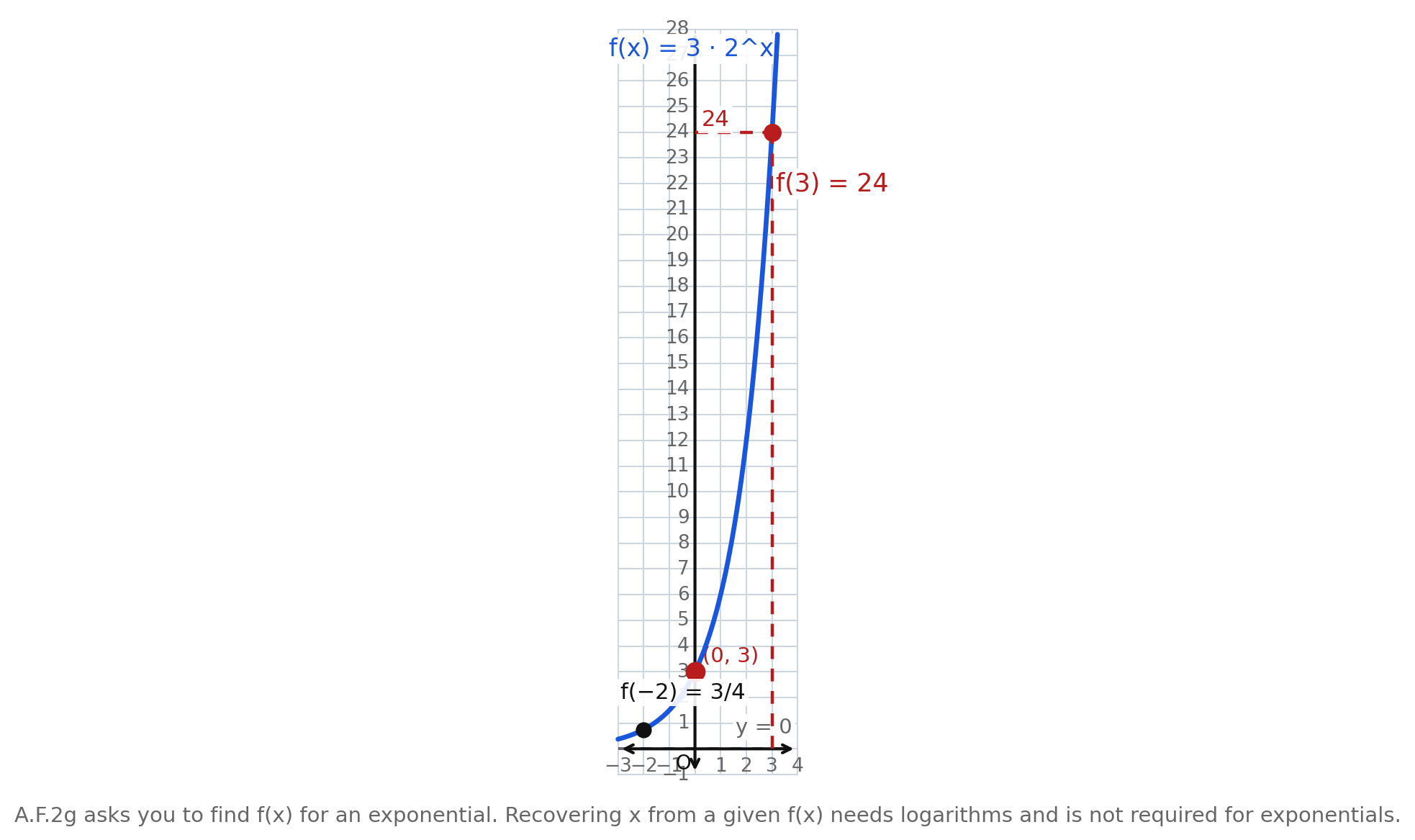
A.F.2g has two directions, and they are not symmetric across families:
- Given , find — for a quadratic or exponential function.
- Given , find — for a quadratic function only.
So in this chapter you learn to evaluate an exponential at an input, from the equation or from the graph, and to explain what the pair means in a story. You do not solve for by a logarithm. (You may notice that works, because you already know — recognizing a familiar power is fine; inventing a log to undo an unfamiliar one is not required.)
Evaluating from the equation
For :
Put negative inputs in parentheses in your own writing when it helps: , not . Chapter 10 supplies every negative-exponent evaluation.
Evaluating from the graph
On the figure, start at on the horizontal axis, travel up to the curve, then across to the vertical axis to read . The dashed guides are the graphical version of substitution. The same picture run the other way — starting at on the -axis to recover — is exactly the direction A.F.2g does not require for exponentials.
Meaning in context
If cells after hours, then means: after hours, the culture has cells. Both the input and the output need units and a sentence. That is the "explain the meaning of and in context" half of A.F.2g.
Worked examples
Example 1 — Substitute
Find for .
.
Answer: .
Example 2 — Negative input
Find for .
.
Answer: .
Example 3 — From the graph
Using the evaluation figure, read and confirm algebraically.
Answer: ; check .
Example 4 — Meaning
For , explain in context.
Answer: After hours, there are cells.
Example 5 — Honest limit
A student wants such that . What can this course say?
Answer: A.F.2g does not require recovering that for an exponential. Technology can approximate it; Algebra 1 does not ask for an exact logarithmic solution.
Guided practice
- Use the evaluation figure. Read off the graph, then confirm with the equation .
- On that same figure, confirm algebraically.
- Find , , and for .
- Find for .
- For the bacteria model , explain what means.
- Explain. Quote the part of A.F.2g that limits "determine given " to quadratic functions.
Independent practice
- Evaluate. a) at b) at c) at d) at
- Evaluate using Chapter 10 for negatives. a) at b) at c) at
- Application. cells. Find , , and , and explain in a sentence.
- Application. MB. Find and explain both and in context.
- Using the evaluation figure, describe in words the path from up to the curve and over to .
- Reasoning. Why is recognizing that when allowed, while solving by logs is not required?
- Error analysis. A student writes for . Identify two errors.
- Confirm with technology: for , use a table to read , , and . Match the figure.
- If , find and . Which transformation produced the ?
- Reasoning. Explain why evaluating never requires undoing an exponent, while recovering from for an exponential always would.
- Give approximately for using technology (to the nearest hundredth), and note that non-integer inputs are still in the domain.
- For people, explain the meaning of and after computing .
Exit ticket 17.5
- Find for .
- Find for .
- Using the bacteria model, explain with units.
- State in one or two sentences what A.F.2g requires for exponentials and what it deliberately leaves to later courses.
Chapter 17 Review
Vocabulary. exponential function · · natural number · initial value · growth factor · -intercept · domain · range · horizontal asymptote · table-plot-connect · transformation · · · evaluate · context restriction
A.F.2 e, f, and g (exponential half) ask different things, so this review is organized to match. Part A is bullet e — characteristics and context. Part B is bullet f — graphing and transformations. Part C is bullet g — evaluating and explaining meaning, without recovering by logarithms.
Part A — Characteristics and context (A.F.2e)
- Use the anatomy figure. In , name the roles of and , and state the natural-number limit on .
- Use the characteristics figure. Give the -intercept, domain, and range of .
- Use the asymptote figure. Explain why the range of is and not .
- Use the bacteria figure. Interpret the intercept, state the domain and range in context, and find .
- Give the -intercept, domain, and range of each. a) b) c)
Part B — Graphing and transformations (A.F.2f)
- Use the table-and-graph figure for . List the table values shown, and name the three graphing steps.
- Use the shift figure. For , give the intercept and asymptote, and say what stayed the same as the parent.
- Use the stretch figure. For , give and the intercept.
- For , write equations for and , and give each intercept and asymptote.
- On a blank grid, sketch for integer from to .
Part C — Evaluating (A.F.2g, exponential)
- Use the evaluation figure. Read and confirm for .
- Evaluate. a) at b) at and
- Application. For , find and , and explain both values in context with units.
- Reasoning. Explain why this chapter teaches for exponentials but does not teach recovering from for exponentials. Quote the standard's split between families.
Standards coverage check — Chapter 17
A.F.2 e, f, and g (exponential) have sharp limits — natural-number bases, rational in two named transformations, and evaluation without logarithmic recovery of — so coverage is broken out bullet by bullet.
| Knowledge and Skill | Focus | Where it is taught | Where it is practiced |
|---|---|---|---|
| A.F.2e — interpret -intercept, domain, and range of ( natural) | form ; and ; growth tables | 17.1 (Figures 1, 9) | 1–20; 107 |
| A.F.2e — continued | characteristics from equation and graph; asymptote | 17.2 (Figures 2, 3) | 21–40; 108, 109, 111 |
| A.F.2e — contextual interpretation | units; domain/range in a story; growth factor in words | 17.4 (Figure 4) | 63–84; 110, 119 |
| A.F.2f — graph exponential functions | table-plot-connect; integer powers including negatives | 17.3 (Figures 7, 10) | 41–42, 45, 47, 58; 112, 116 |
| A.F.2f — transformations and , rational | shift moves asymptote; stretch scales intercept | 17.3 (Figures 5, 6) | 43–44, 48–57, 59–62; 113–115 |
| A.F.2g — determine for exponential; explain meaning in context | substitute; read graph; contextual sentences | 17.5 (Figure 8) | 85–106; 117–120 |
| A.F.2g — boundary | recovering from for exponentials is not required (logs) | 17.5 (scope note; Figure 8 caption) | 90, 96, 100, 106, 120 |
Contexts. Items 10, 29, 50, 63–84, 89, 93, 94, 102, 110, and 119 put exponentials into cells, files, rumors, sensors, and organisms. Calculator confirmation appears in items 16, 34, 55, 77, 98, and 101.
Reasoning and error analysis. Items 6, 11, 12, 19, 20, 26, 30, 31, 35, 36, 40, 46, 51, 52, 57, 62, 68, 72, 73, 84, 90, 96, 97, 100, 106, and 120 ask for explanations or error diagnoses. The load-bearing honesty items about logs are 90, 96, 100, 106, and 120.
Boundaries respected. Every base in this chapter is a natural number. No item uses a fractional growth factor or teaches exponential decay. Transformations are only and with rational . No item asks for the vertex or axis of a parabola (Chapter 16), and no item runs a three-family comparison (Chapter 18) beyond a single forward pointer in the opener. No item requires logarithms or asks students to solve for as a required skill — recognizing a familiar power is allowed; undoing an unfamiliar one is not.
Answer keys for every item in this chapter are in Appendix A.