Chapter 15 — Dilations in the Coordinate Plane
Standard: 7.MG.4 — The student will apply dilations of polygons in the coordinate plane.
By the end of this chapter you will be able to:
- Given a preimage in the coordinate plane, identify the coordinates of the image of a polygon that has been dilated (7.MG.4a)
- Sketch the image of a dilation of a polygon (7.MG.4b)
- Identify and describe dilations in context, including scale drawings and graphic design (7.MG.4c)
Lessons: 15.1 What a Dilation Does · 15.2 Coordinates of a Dilated Polygon · 15.3 Sketching a Dilation · 15.4 Dilations in the World
This chapter runs on Chapter 13. A dilation is the coordinate-plane machine that builds a similar figure. Everything Chapter 13 said about similar figures — congruent corresponding angles, proportional corresponding sides, a scale factor greater than 1 for an enlargement and between 0 and 1 for a reduction — is true of every dilation in this chapter. What is new here is that the figure sits on a grid, so you can compute the image exactly instead of measuring it.
Two bounds hold everywhere in this chapter, because the standard sets them. The scale factor is always one of , , , , or . The center of the dilation is always the origin. Every problem in this chapter states the scale factor and confirms the center, and you should expect that of any dilation problem you are given.
Lesson 15.1 — What a Dilation Does
A transformation that changes size
A transformation is a rule that moves every point of a figure to a new location. You have met transformations that slide, flip, and turn a figure without changing its size. A dilation is different: it is the transformation that resizes a figure while keeping its shape.
The figure you start with is the preimage. The figure you end up with is the image. We name image points with prime marks: the image of point is , read "A prime."
Two pieces of information define a dilation.
- The center of dilation is the fixed point everything is measured from. In this chapter it is always the origin, .
- The scale factor, written , is the number every distance from the center gets multiplied by. In this chapter is always , , , , or .
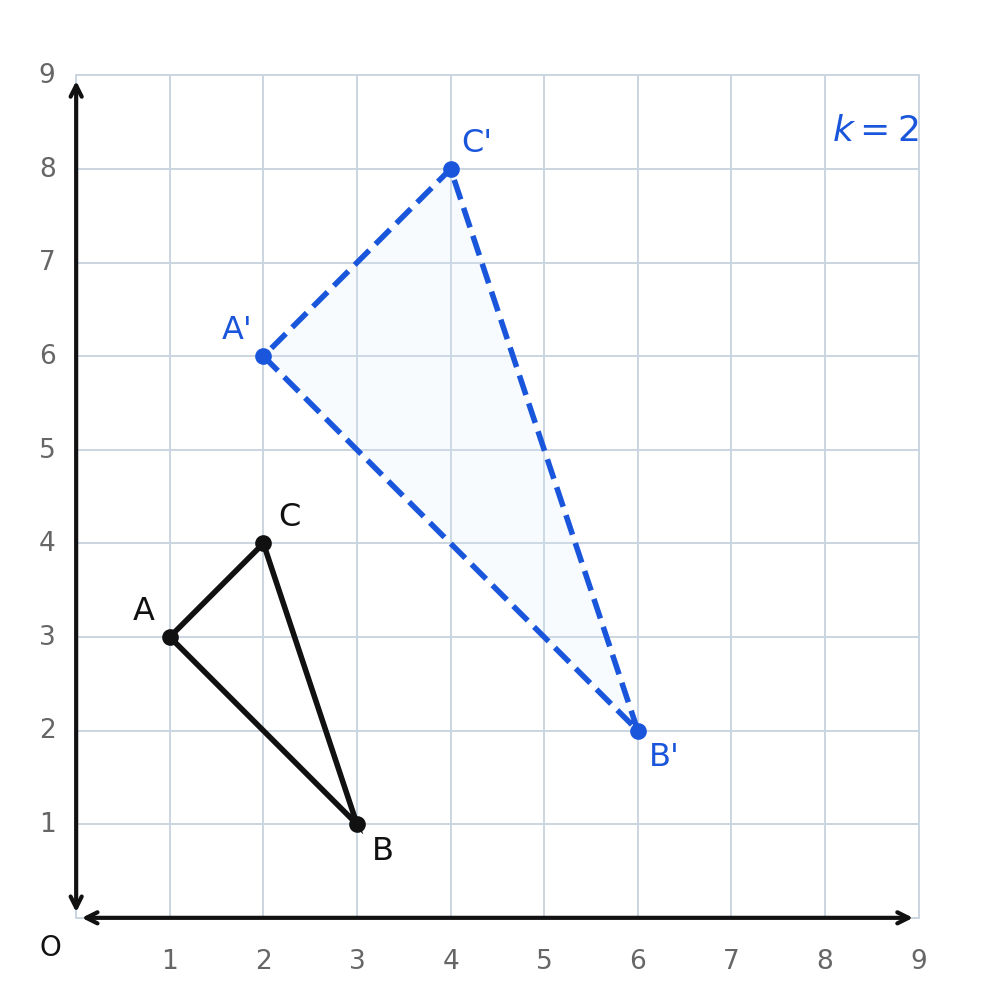
Throughout this chapter, the preimage is drawn with a solid outline and the image with a dashed blue outline, so you can always tell which figure is which.
In the figure above, has vertices , , and . Under a dilation with centered at the origin, the image is with vertices , , and . Every coordinate doubled.
The rule, and why it works
A dilation centered at the origin with scale factor sends the point to the point :
That is the entire computational content of this chapter. It is worth understanding why such a short rule is enough.
Start at the origin and draw the ray through a preimage vertex. The definition of a dilation says the image vertex lies on that same ray, at a distance from the origin equal to times the original distance. So the image point keeps the same direction from the origin and only changes how far out along that direction it sits.
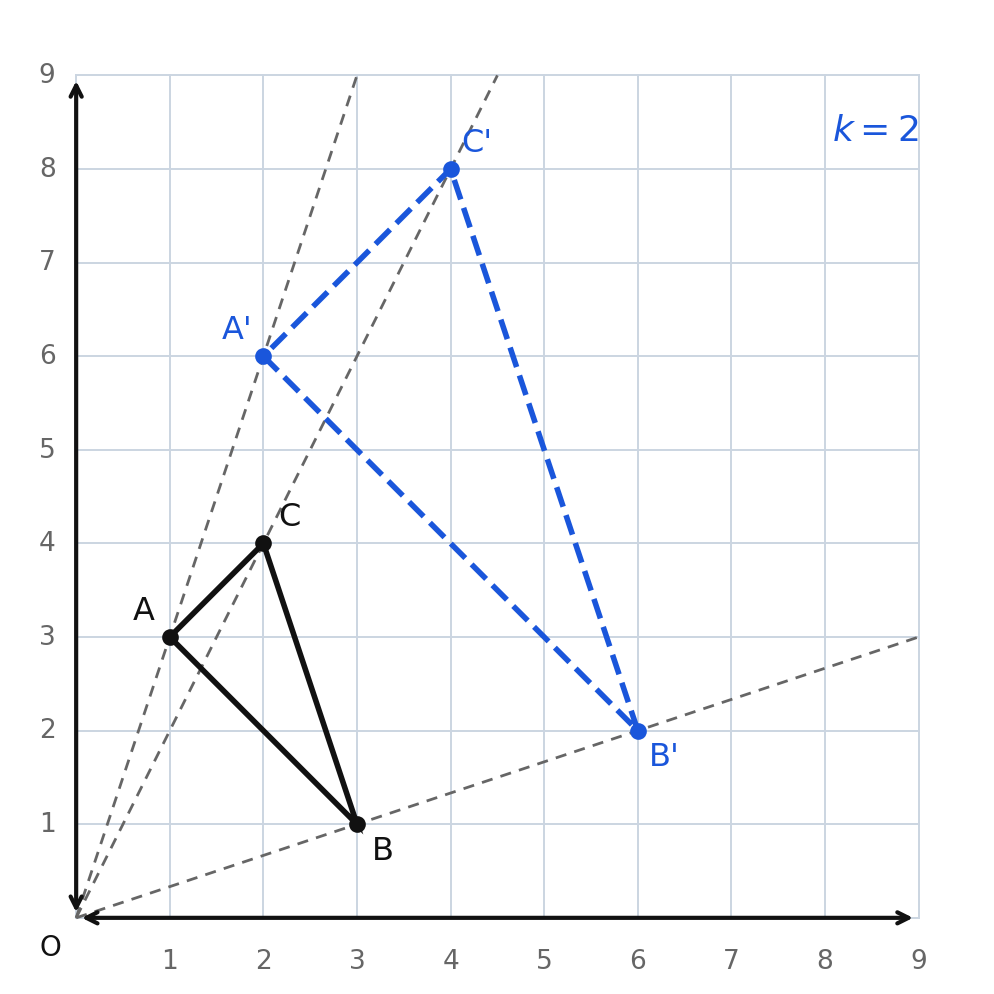
Multiplying both coordinates by the same number is exactly what stays on the ray. Look at and its image . Going from the origin to , you move right 3 and up 1. Going from the origin to , you move right 6 and up 2 — the same direction, run and rise both doubled, so the two points sit on one straight line through the origin. The distance from the origin doubled, because the whole trip doubled.
If you multiplied only the -coordinate, the point would slide off the ray and the figure would be stretched in one direction, which is not a dilation at all. Both coordinates, same factor, every time.
Enlargements and reductions
The size of tells you which way the figure moves.
- If , every point moves farther from the origin and the image is larger than the preimage. This is an enlargement. In this chapter the enlargements are , , and .
- If , every point moves closer to the origin and the image is smaller than the preimage. This is a reduction. In this chapter the reductions are and .
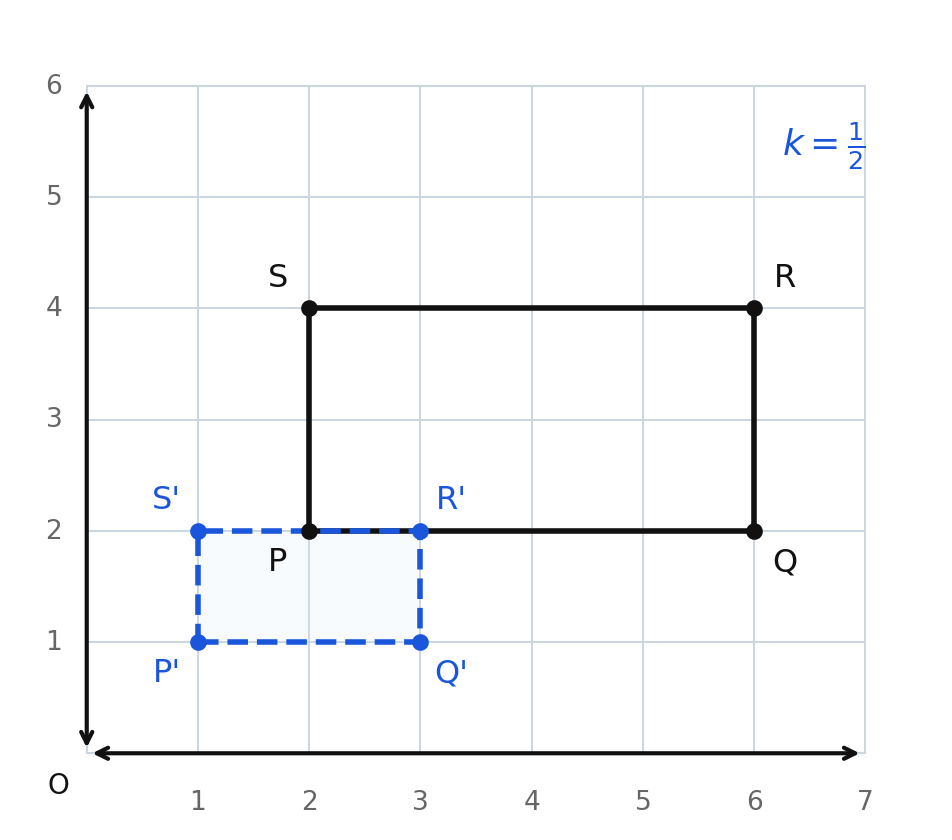
Rectangle above has , , , and . With , halving every coordinate gives , , , and . The image is a rectangle with the same shape, half as long and half as tall, sitting closer to the origin.
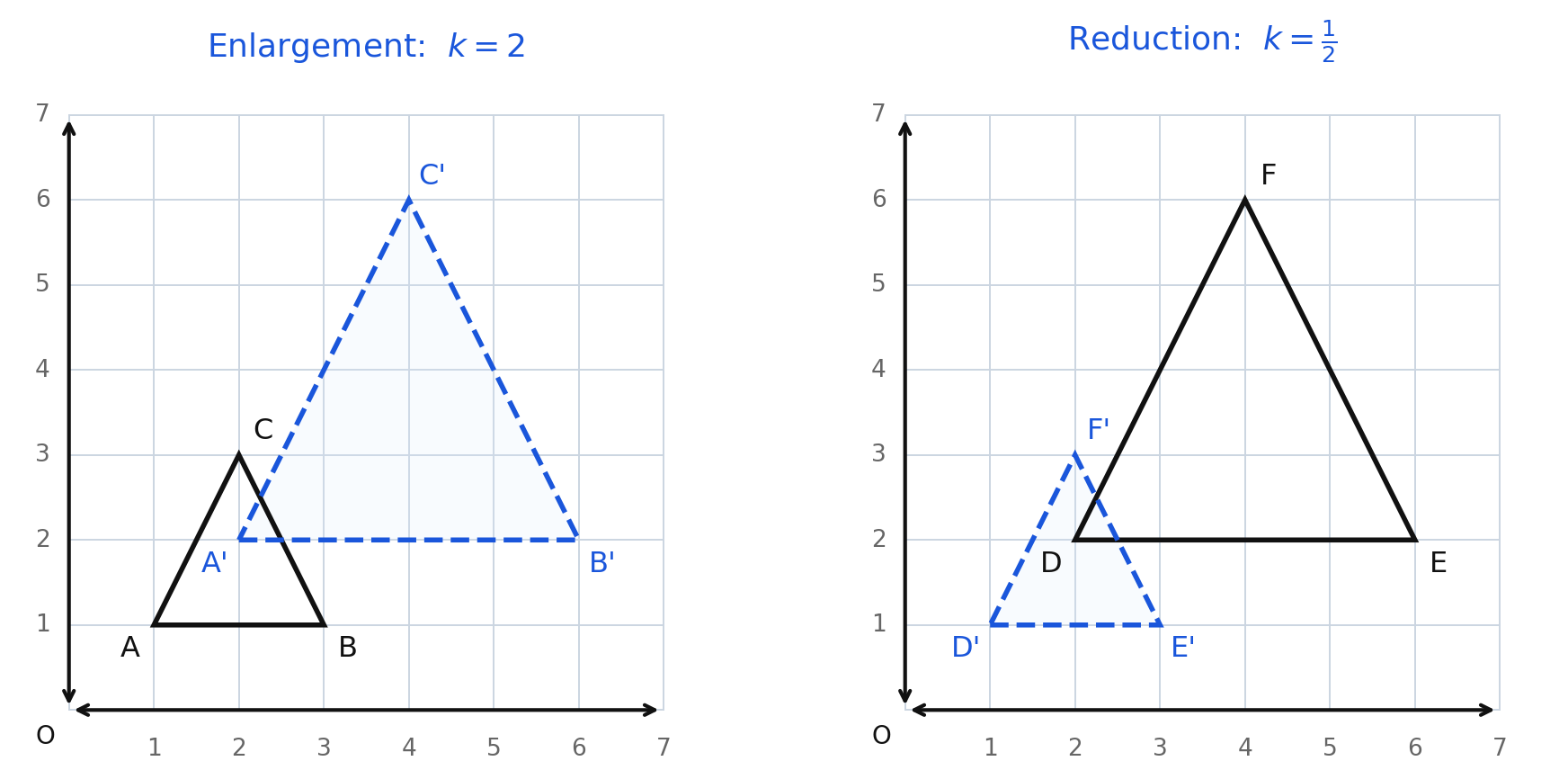
Notice that enlargement and reduction are two directions along the same road. Dilating by and then by returns you to where you started, because .
The one point that never moves
The origin is the only point a dilation centered at the origin leaves alone. Substituting into the rule gives for any . Every other point moves, because only when or .
This is worth remembering as a check: if a preimage vertex sits at the origin, its image sits at the origin too.
What is preserved and what changes
A dilation is the machine that manufactures the similar figures of Chapter 13, so the list of what it preserves should look familiar.
Preserved:
- Angle measures. Every angle of the image is congruent to the matching angle of the preimage.
- Shape. The image is similar to the preimage: .
- Parallel and perpendicular relationships between sides.
Changed:
- Side lengths. Every side of the image is times the matching side of the preimage.
- Distance from the origin. Every point's distance from the center is multiplied by .
That combination — angles fixed, lengths multiplied by one common factor — is precisely the definition of similarity you wrote down in Lesson 13.1. A dilation always produces a similar figure, and the scale factor of the dilation is the scale factor of the similarity.
Enrichment: perimeter and area. Since every side length is multiplied by , the perimeter is multiplied by as well — it is just a sum of side lengths. Area behaves differently. A rectangle by has area ; dilated by it becomes by , with area , and . Area is multiplied by , because both dimensions grow. This is a good thing to understand, but it is not one of the skills this chapter asks you to master.
Worked examples
Example 1 — Enlarging a triangle by a factor of 2
has vertices , , and . Find the image under a dilation with scale factor centered at the origin.
Multiply both coordinates of each vertex by .
Answer: , ,
Example 2 — Reducing a rectangle by a factor of one half
Rectangle has , , , and . Find the image under a dilation with scale factor centered at the origin.
Multiply both coordinates of each vertex by , which is the same as halving them.
Every coordinate was even, so every image coordinate is a whole number and lands on a grid intersection.
Answer: , , ,
Example 3 — Enlargement or reduction?
Classify each scale factor as producing an enlargement or a reduction: , , , .
Compare each factor to . Factors greater than push points away from the origin; factors between and pull them in.
Answer: is an enlargement; is a reduction; is an enlargement; is a reduction.
Example 4 — What the dilation does to angles and sides
A right triangle has legs of length and , a hypotenuse of length , and angles measuring , , and . It is dilated by a factor of about the origin. Describe the image.
Side lengths are multiplied by the scale factor:
Angle measures are unchanged.
Answer: The image is a right triangle with sides , , and and the same angle measures , , and . The image is similar to the preimage, .
Example 5 — Checking that the image lies on the ray
Point is at . Its image under a dilation with centered at the origin is . Show that and lie on the same ray from the origin.
From the origin to you go right and up . From the origin to you go right and up . Compare the directions by writing each as a ratio of rise to run:
Answer: The ratios are equal, so both points sit on the same line through the origin, on the same side of it. is simply times as far out along that ray.
Guided practice
- has , , . Dilate by a factor of centered at the origin. Multiply each coordinate by and give , , and .
- Rectangle has , , , . Dilate by a factor of centered at the origin and give the four image vertices.
- Classify each scale factor as an enlargement or a reduction: a) b) c) d)
- A triangle has angles measuring , , and . It is dilated by a factor of centered at the origin. What are the three angle measures of the image? Explain in one sentence.
- Complete the rule: a dilation centered at the origin with scale factor sends the point to ____________.
Independent practice
- Dilate each point by a factor of centered at the origin. a) b) c)
- Dilate each point by a factor of centered at the origin. a) b) c)
- has , , . Find the image under a dilation with scale factor centered at the origin.
- Quadrilateral has , , , . Find the image under a dilation with scale factor centered at the origin.
- A point at has image under a dilation centered at the origin. What is the scale factor? How do you know?
- Application. A rectangular sticker is laid out on a design grid with corners at , , , and , where each unit is one centimeter. The design is dilated by a factor of about the origin to make a window decal. Give the four image corners, and state the width and height of the decal.
- Reasoning. Explain why the origin is the only point that does not move under a dilation centered at the origin. Use the rule in your explanation.
Exit ticket 15.1
- Find the image of under a dilation with scale factor centered at the origin.
- has , , . Find the image under a dilation with scale factor centered at the origin.
- Is a dilation with scale factor an enlargement or a reduction? Explain what happens to each point's distance from the origin.
- Explain why the image of a polygon under a dilation is always similar to the preimage. Name what stays the same and what changes.
Lesson 15.2 — Coordinates of a Dilated Polygon
Organize the work in a table
When a polygon has four or five vertices, doing the arithmetic in your head invites mistakes. A three-column table keeps it honest: the preimage vertex, the multiplication written out, and the image vertex.
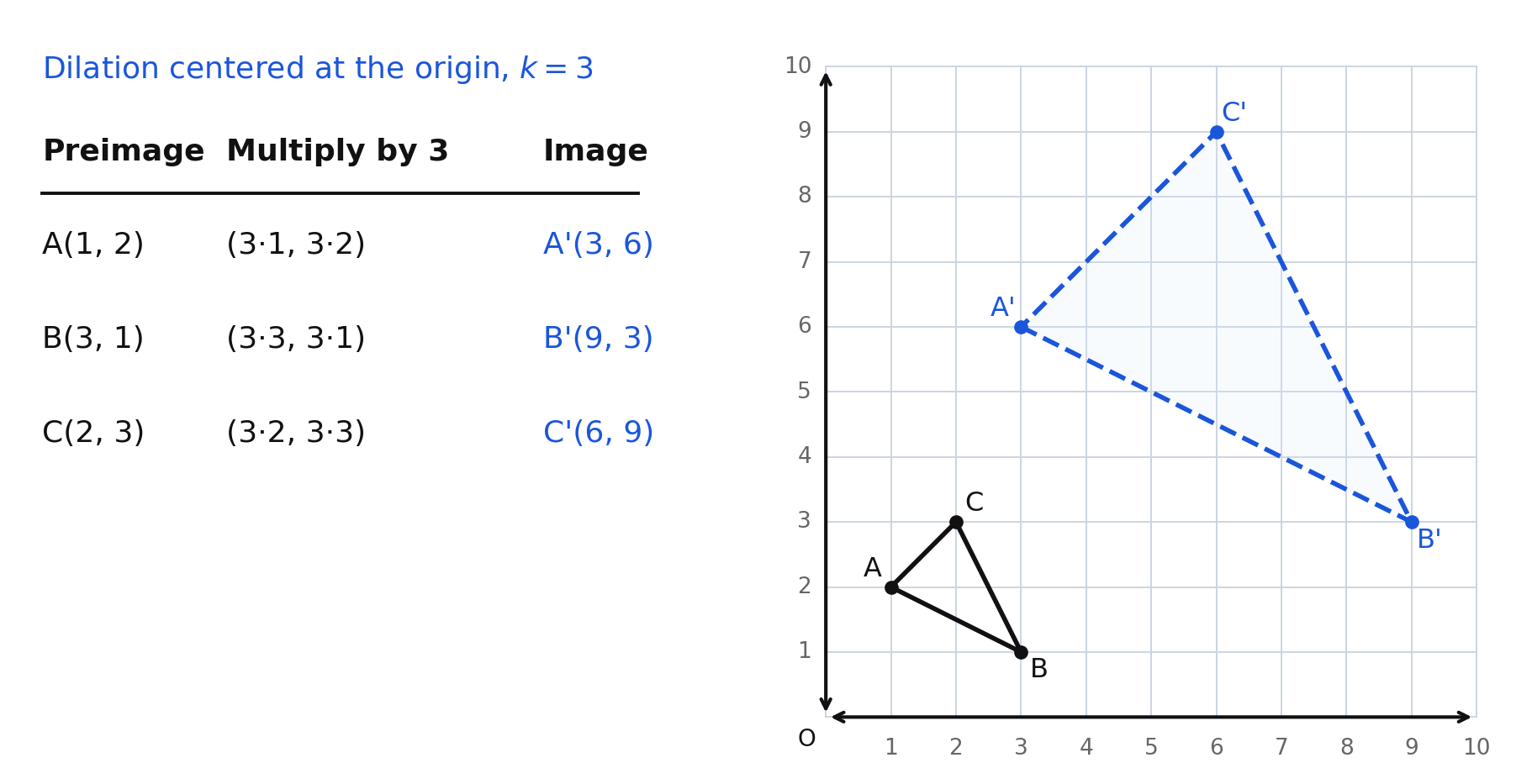
| Preimage | Multiply by | Image |
|---|---|---|
Writing the middle column out is not busywork. It is where sign errors get caught, and it gives a reader something to check.
Negative coordinates follow the same rule
Nothing changes when a vertex sits in a different quadrant. Multiply both coordinates by and keep the signs straight. Since is always positive in this chapter, a dilation never moves a point into a different quadrant. A point in Quadrant III has an image in Quadrant III; a point on an axis has an image on the same axis.
For example, with :
If an image lands in a different quadrant than its preimage, you have made a sign error. That is a fast, reliable check.
Fractional scale factors and grid-friendly coordinates
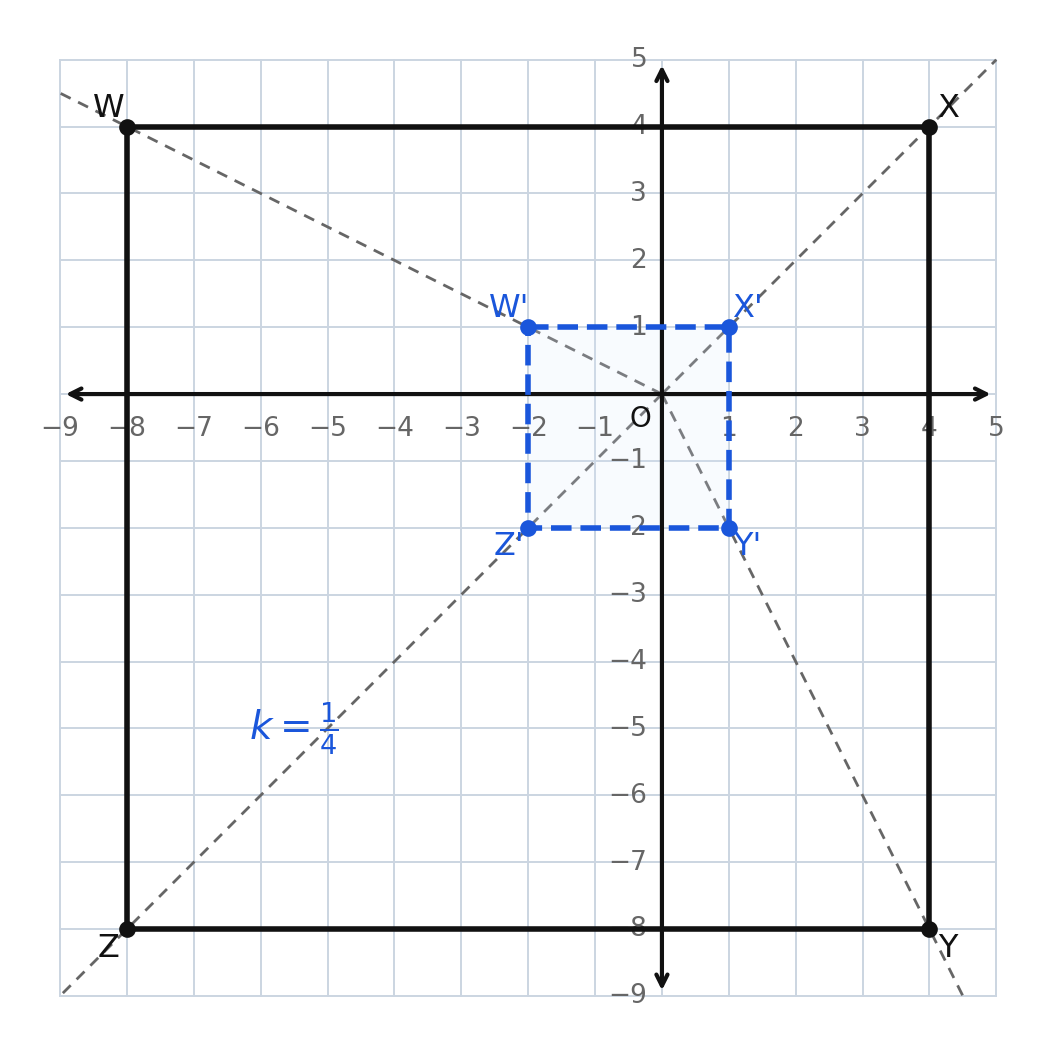
When or , the image coordinates come out as whole numbers only when the preimage coordinates cooperate.
- For , halving a coordinate gives a whole number when the coordinate is even.
- For , taking a fourth of a coordinate gives a whole number when the coordinate is a multiple of 4.
In the figure, , , , and are all multiples of , so with the image vertices , , , and all land exactly on grid intersections where you can plot them.
This is not a rule of mathematics — it is a rule of convenience. The point dilated by really does land at , and that is a perfectly good point. It simply sits between grid lines, which makes it awkward to plot and to read. Problems in this chapter are built so that fractional factors give you whole numbers.
Working backward
Two questions run the rule in reverse.
Finding the scale factor. If you know a preimage vertex and its image, divide a coordinate of the image by the matching coordinate of the preimage. From to :
Both coordinates must give the same answer. If they disagree, the figure was not dilated — it was stretched.
Finding the preimage. If you know the image and the scale factor, divide instead of multiply. If came from a dilation with , then is at .
Worked examples
Example 1 — A table for a triangle,
has , , and . Find the image under a dilation with scale factor centered at the origin.
| Preimage | Multiply by | Image |
|---|---|---|
Answer: , ,
Example 2 — Negative coordinates,
has , , and . Find the image under a dilation with scale factor centered at the origin.
Each image sits in the same quadrant as its preimage, which is the check passing.
Answer: , ,
Example 3 — A fractional factor,
Quadrilateral has , , , and . Find the image under a dilation with scale factor centered at the origin.
Every coordinate is a multiple of , so every quarter is a whole number.
Answer: , , ,
Example 4 — Finding the scale factor
A dilation centered at the origin sends to . Find the scale factor.
Divide each image coordinate by the matching preimage coordinate.
Both agree, so a single factor did the work.
Answer:
Example 5 — Working backward to the preimage
A dilation with scale factor centered at the origin produced the image point . Find the preimage point .
Undo the multiplication by dividing by .
Check: . It matches.
Answer:
Guided practice
Complete the table for a dilation with scale factor centered at the origin.
Preimage Multiply by Image has , , . Find the image under a dilation with scale factor centered at the origin.
has , , . Find the image under a dilation with scale factor centered at the origin.
A dilation centered at the origin sends to . Find the scale factor, showing both divisions.
A dilation with scale factor centered at the origin produced the image point . Find the preimage point .
Independent practice
- Find the image of each point under a dilation with scale factor centered at the origin. a) b) c)
- Quadrilateral has , , , . Find the image under a dilation with scale factor centered at the origin.
- Quadrilateral has , , , . Find the image under a dilation with scale factor centered at the origin.
- has , , . Find the image under a dilation with scale factor centered at the origin.
- A dilation centered at the origin sends to . Find the scale factor and state whether it is an enlargement or a reduction.
- Application. A graphic designer's icon is drawn on a grid with corners at , , , and . To place it on a poster, the icon is dilated by a factor of about the origin. Give the four image corners and state how the side length changed.
- Reasoning. A student dilates by a factor of centered at the origin, gets , and concludes that the answer must be wrong because it does not land on a grid intersection. Is the student's arithmetic wrong? Explain, and state what a preimage coordinate must look like for to give whole-number image coordinates.
Exit ticket 15.2
- Find the image of under a dilation with scale factor centered at the origin.
- has , , . Find the image under a dilation with scale factor centered at the origin.
- A dilation centered at the origin sends to . Find the scale factor.
- Explain why both coordinates must be multiplied by the same scale factor, and describe what the image would look like if only the -coordinate were multiplied.
Lesson 15.3 — Sketching a Dilation
The routine
Sketching a dilation is four steps, and doing them in order keeps the drawing accurate.
- First, plot the preimage and label its vertices.
- Then, multiply every coordinate by and write the image coordinates down before you draw anything.
- Next, plot the image points and label them with primes.
- Finally, connect the image vertices in the same order as the preimage.
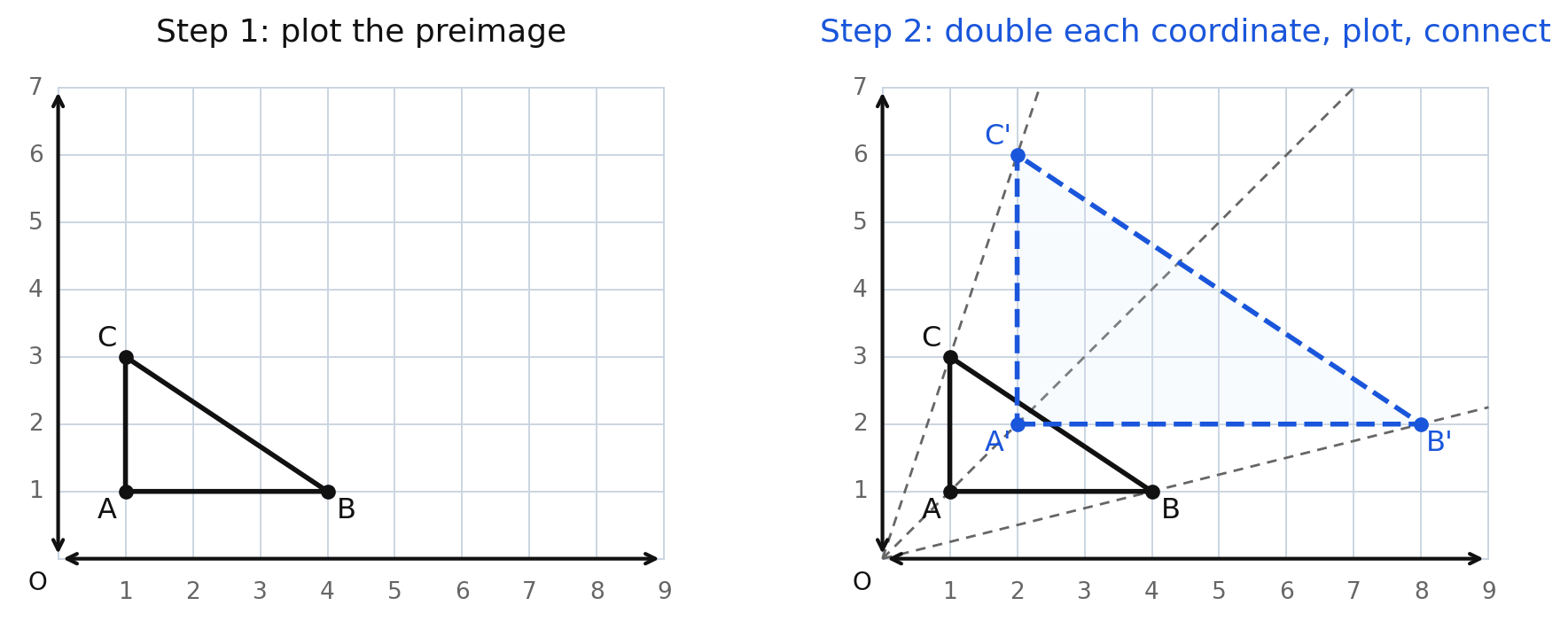
That last step matters more than it sounds. If the preimage runs around the figure, the image must run in the same order. Connecting them in a different order produces a crossed figure that is not the image of anything.
Choose the grid before you draw
The most common wasted effort in this lesson is starting a sketch on a grid that is too small. Decide the size first.
For an enlargement, multiply the largest coordinate you will need by . A preimage whose coordinates reach , dilated by , produces image coordinates reaching , so the grid must run to at least in that direction.
For a reduction, the image is always inside the region the preimage already occupies, so a grid that fits the preimage will fit the image too.
Also check the signs. If any preimage vertex has a negative coordinate, the grid needs that side of the axis.
Check with a ray
Here is the check that catches almost every plotting error. Lay a straightedge from the origin through a preimage vertex. The matching image vertex must lie on that same line, on the same side of the origin. If , the origin, and are not in a straight line, something is misplotted.
In the figure above, and both lie on the line through the origin with a rise-to-run ratio of to . and both lie on the line with ratio to . and both lie on the line with ratio to .
A second, quicker check: for an enlargement, the image should completely surround the preimage's position relative to the origin, and for a reduction it should nest inside. If your reduction came out bigger than your preimage, you multiplied when you should have divided.
Worked examples
Example 1 — Sketching an enlargement,
Sketch the image of with , , under a dilation with scale factor centered at the origin.
Double each coordinate:
The largest image coordinate is , so a grid running from to in each direction is enough. Plot , , and connect them in that order.
Answer: , ,
Example 2 — Sketching a reduction,
Sketch the image of rectangle with , , , under a dilation with scale factor centered at the origin.
Halve each coordinate. Every coordinate is even, so every result is a whole number.
The grid needs to reach on the left and up, which the preimage already required.
Answer: , , ,
Example 3 — A quarter-size image
Sketch the image of quadrilateral with , , , under a dilation with scale factor centered at the origin.
Every coordinate is a multiple of .
Answer: , , ,
Example 4 — A triangle spanning several quadrants
Sketch the image of with , , under a dilation with scale factor centered at the origin.
The grid must run from to horizontally and to vertically at minimum.
Answer: , ,
Example 5 — Sizing the grid first
A polygon has vertices whose coordinates are all between and . It will be dilated by a factor of centered at the origin. How large must the grid be?
Every coordinate gets multiplied by , so an extreme value of becomes and becomes .
Answer: The grid must run from at least to in both directions.
Guided practice
- Sketch the image of with , , under a dilation with scale factor centered at the origin. List the image vertices, then draw.
- Sketch the image of rectangle with , , , under a dilation with scale factor centered at the origin.
- Sketch the image of with , , under a dilation with scale factor centered at the origin.
- Sketch the image of quadrilateral with , , , under a dilation with scale factor centered at the origin.
- On your sketch for item 33, draw the ray from the origin through and continue it. Does it pass through ? Explain what that confirms.
Independent practice
- Sketch the image of with , , under a dilation with scale factor centered at the origin.
- Sketch the image of quadrilateral with , , , under a dilation with scale factor centered at the origin.
- Sketch the image of with , , under a dilation with scale factor centered at the origin.
- Sketch the image of with , , under a dilation with scale factor centered at the origin.
- Sketch the image of quadrilateral with , , , under a dilation with scale factor centered at the origin.
- Application. A designer draws a triangular logo on a grid where each unit is one centimeter, with vertices at , , and . The two legs measure cm and cm and the slanted side measures cm. The logo is dilated by a factor of about the origin for a window decal. Sketch the image, give its three vertices, and give the three side lengths of the decal.
- Reasoning. A figure has vertices whose coordinates all lie between and , and it will be dilated by a factor of centered at the origin. Explain how large the grid must be and why checking this before you draw saves time.
Exit ticket 15.3
- Sketch the image of with , , under a dilation with scale factor centered at the origin.
- Sketch the image of with , , under a dilation with scale factor centered at the origin.
- Sketch the image of the square with vertices , , , under a dilation with scale factor centered at the origin.
- Explain how drawing a ray from the origin through a preimage vertex helps you check that you plotted the image vertex correctly.
Lesson 15.4 — Dilations in the World
Where dilations actually show up
Once you know what a dilation is, you start seeing them everywhere something is resized without being distorted.
- Scale drawings. A floor plan, a map, or a blueprint is a reduction of a real object. A model kit is a reduction of a real car. Chapter 13 called the number that relates them the scale factor; a dilation is that same relationship performed on a grid.
- Graphic design. Dragging a corner handle to resize a logo, exporting an icon at four times its size, or blowing a design up for a banner are all dilations. Designers work in vector graphics precisely because a vector shape can be dilated by any factor and stay sharp.
- Photography and screens. Zooming in on a photo, projecting a slide, and printing an enlargement all multiply every length by the same factor.
Describing a dilation in context
A complete description of a dilation in context answers three questions.
- What is the scale factor? Divide a new measurement by the matching original measurement.
- Is it an enlargement or a reduction? Compare the factor to .
- What is the center? In this chapter, the origin — which on a design grid is usually the corner the artwork is anchored to.
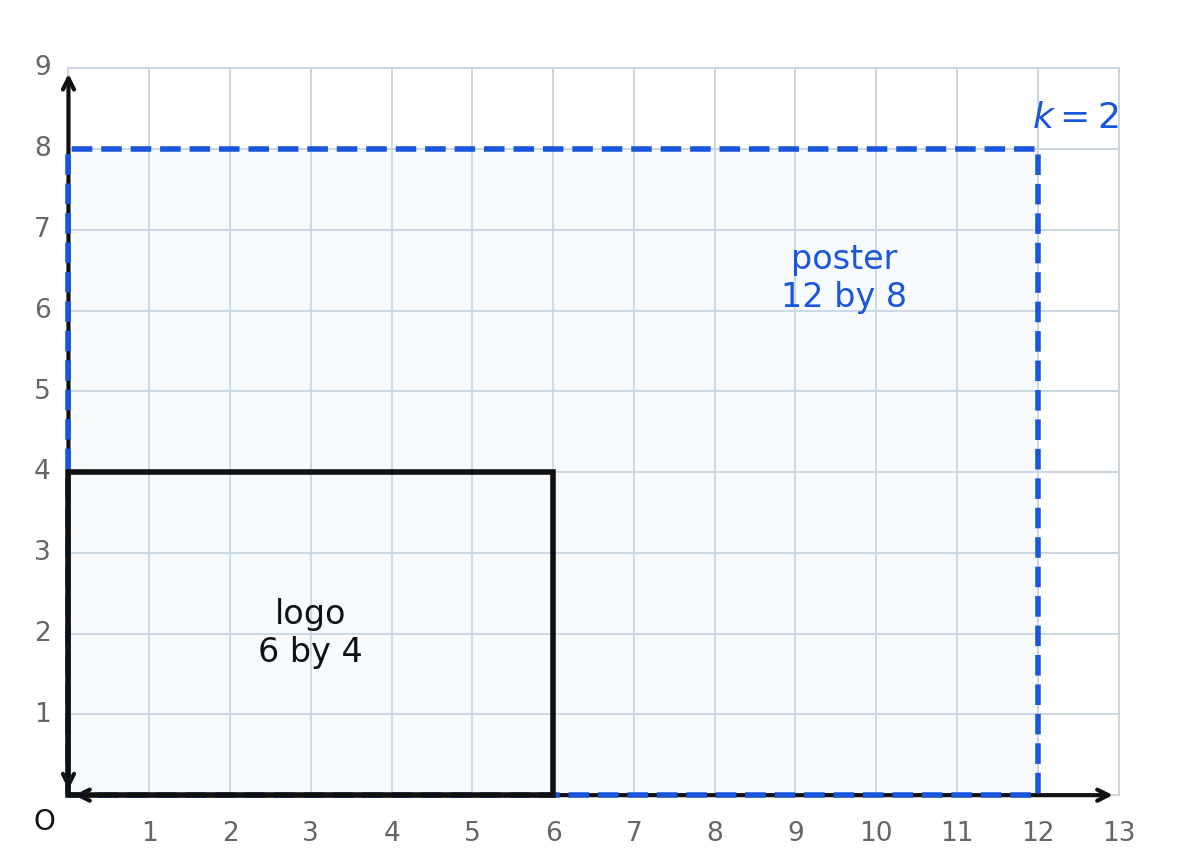
A cm by cm logo enlarged to cm by cm has scale factor , confirmed by . Because , it is an enlargement. Both measurements had to give the same factor for this to be a dilation at all.
The test that separates a dilation from a stretch
This is the most useful idea in the lesson. Compute the ratio for every dimension. If the ratios agree, the resize is a dilation. If any ratio disagrees, it is a distortion, not a dilation.
An in by in photo resized to in by in gives
The ratios disagree, so this is not a dilation. The photo has been stretched more horizontally than vertically, and faces in it would look wrong. This is exactly the failed-similarity test from Lesson 13.1, now stated in the language of resizing.
Dragging a corner handle in design software keeps the ratios equal. Dragging a side handle changes only one dimension, which is why it distorts the image.
Lengths, perimeter, and area in context
Because every length is multiplied by , the perimeter of a design is multiplied by too. A cm by cm logo has perimeter cm; the doubled version is cm by cm with perimeter cm, exactly twice as much. If you are buying trim to edge a sign, doubling the sign doubles the trim.
Area is the exception worth knowing. The original logo covers square centimeters and the enlargement covers square centimeters, which is , or . Doubling a design does not double the ink; it quadruples it.
Worked examples
Example 1 — Identifying a dilation in a photo enlargement
A in by in photo is enlarged so that the print measures in by in. Is this a dilation? Give the scale factor and classify it.
Compare each pair of matching measurements:
Answer: Yes, it is a dilation with scale factor . Since , it is an enlargement.
Example 2 — A resize that is not a dilation
An in by in photo is resized to in by in. Is this a dilation?
Answer: No. The two ratios disagree, so the photo was stretched more in one direction than the other. The result is not similar to the original.
Example 3 — A logo on a design grid
A logo is drawn on a design grid with corners at , , , and . It is dilated by a factor of about the origin for a banner. Give the image corners and describe the change in words.
Multiply every coordinate by :
Answer: , , , . The logo grew from units wide and units tall to units wide and units tall — four times as long in every direction, with the corner at the origin staying put and all angles unchanged.
Example 4 — A scale drawing reduction
A building outline is plotted on a grid with corners at , , , and . To fit the drawing on a smaller page, it is dilated by a factor of about the origin. Give the image corners and classify the dilation.
Answer: , , , . Because , this is a reduction — the same scale-drawing idea from Lesson 13.6, done on a coordinate grid.
Example 5 — Perimeter and area of an enlargement
A rectangular sign design is ft by ft. It is dilated by a factor of . Find the new dimensions, the new perimeter, and the new area, and compare each to the original.
New dimensions: ft and ft.
Original perimeter: ft. New perimeter: ft, and .
Original area: square feet. New area: square feet, and .
Answer: ft by ft; perimeter ft, which is times the original; area square feet, which is times the original.
Guided practice
- A in by in photo is enlarged by a factor of . Give the new dimensions and state whether this is an enlargement or a reduction.
- A px by px icon is reduced by a factor of . Give the new dimensions and classify the dilation.
- Which of these resizes is a dilation? Show the ratios for each. a) by becomes by b) by becomes by
- A design triangle has vertices , , and , with side lengths , , and . It is dilated by a factor of about the origin. Give the image vertices and the three new side lengths.
- A rectangle measures units by units. It is dilated by a factor of about the origin. Find the original perimeter and the new perimeter.
Independent practice
- A in by in photo is enlarged by a factor of . Give the new dimensions.
- A cm by cm poster is reduced by a factor of . Give the new dimensions.
- Decide whether each resize is a dilation. Show the ratios, and where it is a dilation, give the scale factor. a) by becomes by b) by becomes by c) by becomes by
- A logo is drawn on a design grid with corners at , , , and . The designer needs it at half size for a business card. Give the image corners for a dilation with scale factor about the origin, and describe the change in words.
- The outline of a park is plotted on a grid with corners at , , , and . It is dilated by a factor of about the origin to make a large trailhead sign. Give the image corners.
- Application. A sticker design is cm wide and cm tall. It is enlarged by a factor of about the origin. Find the new width and height, the original and new perimeters, and the original and new areas. State what number the area was multiplied by.
- Reasoning. A student widens an in by in image to in by in by dragging its side handle, and calls the result a dilation. Explain why it is not, using ratios, and describe what the image looks like as a result.
Exit ticket 15.4
- A in by in photo is enlarged by a factor of . Give the new dimensions.
- A px by px icon is reduced by a factor of . Give the new dimensions.
- Is a resize from by to by a dilation? Show the ratios and explain.
- Describe one dilation you have seen outside of math class. State what the preimage and image were, and whether it was an enlargement or a reduction.
Chapter 15 Review
Vocabulary. transformation · dilation · preimage · image · prime notation · center of dilation · scale factor · enlargement · reduction · similar
Part A — Coordinates of a dilated image (7.MG.4a)
- Find the image of under a dilation with scale factor centered at the origin.
- Find the image of under a dilation with scale factor centered at the origin.
- Find the image of under a dilation with scale factor centered at the origin.
- Find the image of under a dilation with scale factor centered at the origin.
- has , , . Find the image under a dilation with scale factor centered at the origin.
- Quadrilateral has , , , . Find the image under a dilation with scale factor centered at the origin.
- A dilation centered at the origin sends to . Find the scale factor.
Part B — Sketching a dilation (7.MG.4b)
- Sketch the image of with , , under a dilation with scale factor centered at the origin.
- Sketch the image of with , , under a dilation with scale factor centered at the origin.
- Sketch the image of with , , under a dilation with scale factor centered at the origin.
- Sketch the image of quadrilateral with , , , under a dilation with scale factor centered at the origin.
- Sketch the image of the rectangle with vertices , , , under a dilation with scale factor centered at the origin.
- On your sketch for item 72, draw the ray from the origin through and extend it. State whether it passes through and explain what that tells you.
Part C — Dilations in context (7.MG.4c)
- A in by in photo is enlarged by a factor of . Give the new dimensions and classify the dilation.
- A mm by mm icon is reduced by a factor of . Give the new dimensions and classify the dilation.
- Is a resize from by to by a dilation? Show the ratios.
- A logo is drawn on a grid with corners at , , , and . Give the image corners under a dilation with scale factor about the origin, and describe the change in words.
- Explain how a scale drawing from Chapter 13 is related to a dilation. Name what plays the role of the scale factor.
Part D — Mixed application and reasoning
- Application. A banner design measures in by in. It is enlarged by a factor of about the origin. Give the new dimensions, the original perimeter, and the new perimeter.
- Application. A park outline is plotted on a grid with corners at , , , and . It is dilated by a factor of about the origin to fit on a brochure. Give the image corners and classify the dilation.
- Reasoning. Explain why the rule produces a genuine dilation. Use the idea of the ray from the origin through a vertex in your explanation.
- Reasoning. Explain why the origin is the only point that stays put under a dilation centered at the origin.
- Reasoning. A student dilates by a factor of centered at the origin and gets . Did the student make an arithmetic error? Explain, and state what would have to be true of the preimage coordinates for the image to land on grid intersections.
- Reasoning. A rectangle measures units by units. It is dilated by a factor of about the origin. Describe what happens to its angle measures, its side lengths, its perimeter, and its area, giving the numbers in each case.
Standards coverage check — Chapter 15
| Knowledge and Skill | Where it is taught | Where it is practiced |
|---|---|---|
| 7.MG.4a — given a preimage in the coordinate plane, identify the coordinates of the image of a dilated polygon; scale factors limited to , , , , or ; center at the origin | 15.1, 15.2 | Items 1, 2, 6–10, 13, 14, 17–26, 29–31; Review Part A, items 65–71 |
| 7.MG.4b — sketch the image of a dilation of a polygon; scale factors limited to , , , , or ; center at the origin | 15.3 | Items 33–42, 44–48; Review Part B, items 72–77 |
| 7.MG.4c — identify and describe dilations in context, including scale drawings and graphic design | 15.1, 15.3, 15.4 | Items 11, 27, 43, 49–64; Review Part C, items 78–82, and Part D, items 83–84 |
Supporting reasoning about what a dilation preserves and changes — angle measures, similarity, and the ray from the origin — appears in items 3, 4, 5, 12, 15, 16, 28, 32, and Review Part D, items 85–88.
Every scale factor used in this chapter is , , , , or , and every dilation is centered at the origin, as the standard requires. Preimage coordinates for the fractional factors are chosen so that all image coordinates are integers: even coordinates for , and multiples of for .
Answer keys for every set in this chapter are in Appendix A.