Chapter 14 — Quadrilaterals and Their Properties
Standard: 7.MG.3 — The student will compare and contrast quadrilaterals based on their properties and determine unknown side lengths and angle measures of quadrilaterals.
By the end of this chapter you will be able to:
- Compare and contrast the properties of parallelograms, rectangles, squares, rhombuses, and trapezoids, including their parallel and perpendicular sides and diagonals, the congruence of their angle measures, side lengths, and diagonal lengths, and their lines of symmetry (7.MG.3a)
- Sort and classify quadrilaterals as parallelograms, rectangles, trapezoids, rhombuses, and squares using those same properties (7.MG.3b)
- Determine an unknown angle measure in a quadrilateral from a diagram, using properties of quadrilaterals (7.MG.3c)
- Determine an unknown side length in a quadrilateral from a diagram, using properties of quadrilaterals (7.MG.3d)
Lessons: 14.1 The Five Named Quadrilaterals and Their Properties · 14.2 Sorting and Classifying Quadrilaterals · 14.3 Finding Unknown Angle Measures · 14.4 Finding Unknown Side Lengths
A note on the word trapezoid. Textbooks disagree about what a trapezoid is. Some say "at least one pair of parallel sides," which would make every parallelogram a trapezoid. This book uses the exclusive definition: a trapezoid has exactly one pair of parallel sides. Under that definition no parallelogram is a trapezoid, and no trapezoid is a parallelogram. Every item in this chapter and every answer in the key follows that definition. If a teacher or a test uses the other convention, only the answers to the subset questions change, and this note tells you exactly which ones.
Lesson 14.1 — The Five Named Quadrilaterals and Their Properties
The parts of a quadrilateral
A quadrilateral is a closed figure with four straight sides. It has four vertices (corners), four sides, and four interior angles. It also has two diagonals — segments joining opposite vertices. In quadrilateral , the diagonals are and .
Four words describe almost everything you will say about these shapes.
- Two sides are parallel () when they run in the same direction and never meet, no matter how far you extend them.
- Two sides are perpendicular () when they meet at a angle.
- Two segments are congruent () when they have the same length. Two angles are congruent when they have the same measure.
- A line of symmetry is a line you could fold the figure across so that the two halves land exactly on top of each other.
Diagrams tell you these facts with markings rather than words. Matching hash marks mean congruent segments. Matching arrowheads mean parallel sides. A small square in a corner means a right angle.
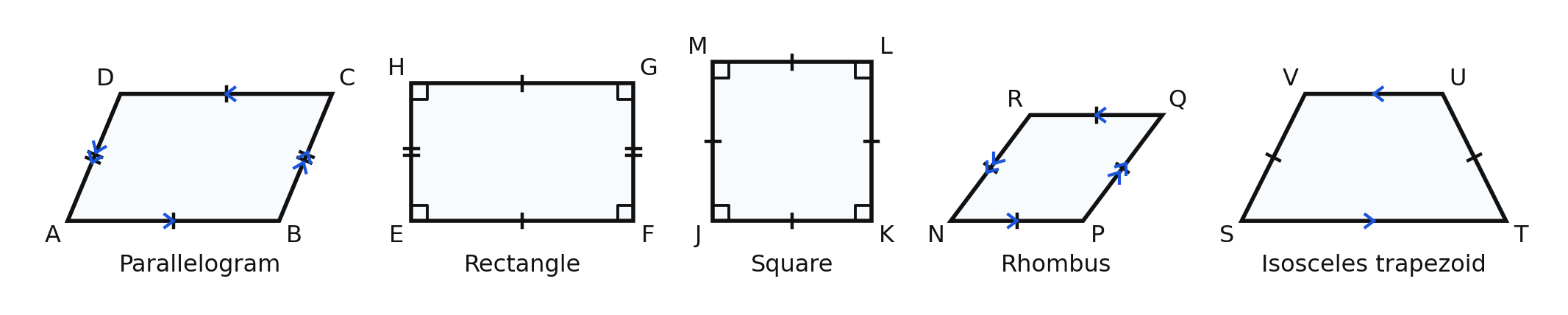
The five named quadrilaterals
A parallelogram is a quadrilateral with both pairs of opposite sides parallel. That single requirement forces several other facts to be true: opposite sides are congruent, and opposite angles are congruent. In parallelogram above, and , so and , and and .
A rectangle is a parallelogram with four right angles. Because every angle is , each pair of adjacent sides is perpendicular: , and so on around the figure. A rectangle keeps everything a parallelogram has — opposite sides parallel and congruent — and adds the right angles.
A rhombus is a parallelogram with four congruent sides. A rhombus does not have to have right angles. In rhombus , all four sides carry a single hash mark, but the corners are tilted.
A square is a quadrilateral with four congruent sides and four right angles. Notice that this makes a square a rectangle (it has the four right angles) and also a rhombus (it has the four congruent sides). Lesson 14.2 takes that idea apart carefully.
A trapezoid is a quadrilateral with exactly one pair of parallel sides. The parallel sides are the bases; the other two are the legs. A trapezoid in general has no congruent sides and no congruent angles. Two special kinds come up often. An isosceles trapezoid has congruent legs, and then its two base angles at each base are congruent as well. A right trapezoid has two right angles. Figure above is an isosceles trapezoid: , and the legs and carry matching hash marks.
What the diagonals tell you
Diagonals are not decoration. They are one of the sharpest tools for telling these shapes apart, because each family has its own diagonal signature.
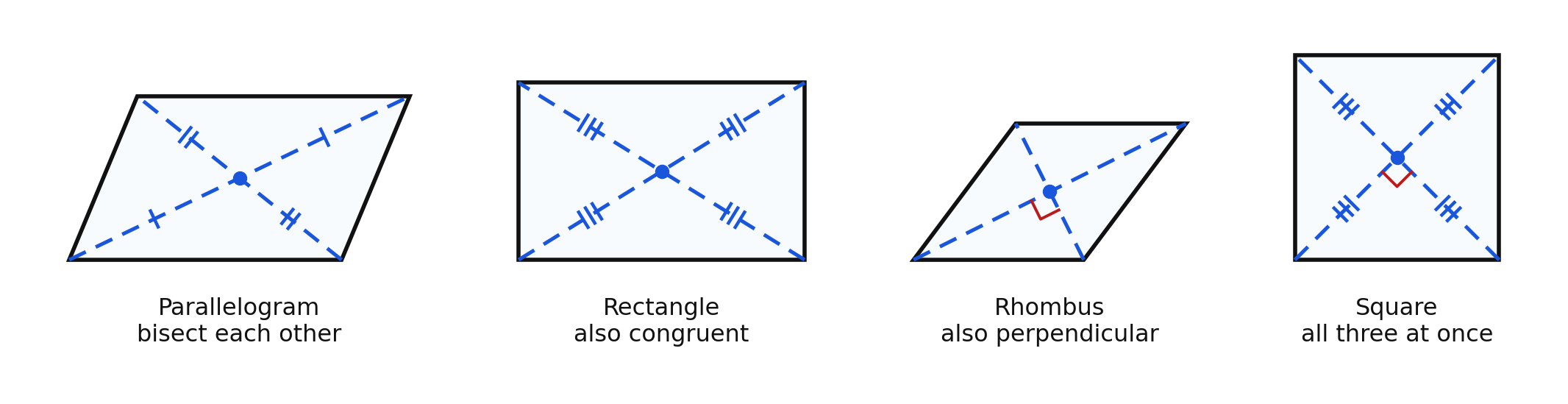
- In every parallelogram, the diagonals bisect each other. To bisect is to cut into two congruent pieces. The two diagonals cross at their shared midpoint, so each one is split into two congruent halves. In the parallelogram above, the single hash marks on one diagonal's halves and the double hash marks on the other diagonal's halves say exactly that.
- In a rectangle, the diagonals are also congruent. The two diagonals have the same length. Combined with bisecting, that means all four half-diagonals are congruent, which is why all four carry triple hash marks in the figure.
- In a rhombus, the diagonals are also perpendicular. They cross at a angle.
- In a square, all three facts hold at once: the diagonals bisect each other, they are congruent, and they are perpendicular.
Be careful not to over-claim. A parallelogram's diagonals bisect each other, but they are not generally congruent and not generally perpendicular. Look at the leftmost picture above: one diagonal is visibly longer than the other, and they cross at a slant. A trapezoid's diagonals do not even bisect each other, though an isosceles trapezoid does have congruent diagonals.
Lines of symmetry
Symmetry is the property students most often guess at instead of checking. Fold each figure, in your head or on paper, and count only the folds that actually work.
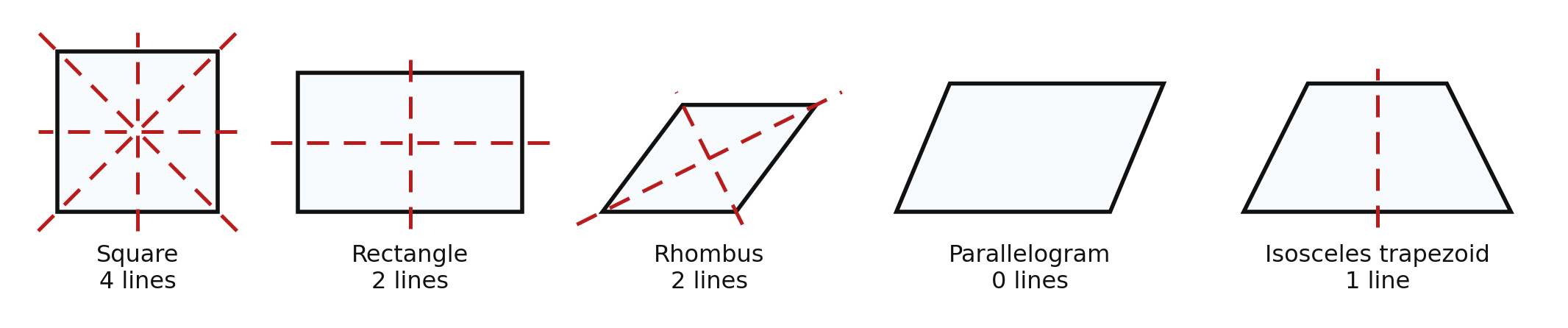
| Figure | Lines of symmetry | Where they are |
|---|---|---|
| Square | both midlines and both diagonals | |
| Rectangle that is not a square | the two midlines only | |
| Rhombus that is not a square | the two diagonals only | |
| Parallelogram that is neither | none | |
| Isosceles trapezoid | the midline between the two bases | |
| Trapezoid that is not isosceles | none |
The two middle rows are worth staring at. A rectangle folds across its midlines but not across its diagonals — fold a sheet of paper corner to corner and the edges will not line up. A rhombus is the opposite: it folds across its diagonals but not across its midlines. A square does both, which is why it gets four.
A general parallelogram has none at all. It looks balanced because you can spin it a half turn and land back on itself, but rotating is not folding, and only folding counts here.
Worked examples
Example 1 — Reading the markings on a parallelogram
In parallelogram in the gallery figure, name the pairs of parallel sides and the pairs of congruent sides.
The single arrowheads sit on and ; the double arrowheads sit on and . The single hash marks sit on and ; the double hash marks sit on and .
Answer: and ; and
Example 2 — Perpendicular sides
Which pairs of sides of rectangle are perpendicular, and which pairs are parallel?
Every angle of a rectangle is a right angle, so each side is perpendicular to both sides that touch it. Opposite sides never touch, and they are parallel.
Answer: Perpendicular: , , , . Parallel: and .
Example 3 — Diagonals of a rhombus
The diagonals of rhombus meet at point . What is , and what can you say about and ?
A rhombus is a parallelogram, so its diagonals bisect each other: is the midpoint of , making . A rhombus also has perpendicular diagonals, so the angle at the crossing is a right angle.
Answer: , and
Example 4 — Counting lines of symmetry
How many lines of symmetry does a rectangle that is not a square have? A rhombus that is not a square?
A rectangle folds across the two lines through the midpoints of opposite sides. It does not fold across a diagonal, because the two halves are different shapes. A rhombus folds across its two diagonals but not across its midlines.
Answer: Each has , but they are different lines: midlines for the rectangle, diagonals for the rhombus.
Example 5 — A property that does not carry over
A student says, "The diagonals of a parallelogram are congruent, because opposite sides are congruent." Is that right?
Opposite sides being congruent does not force the diagonals to match. In the parallelogram in the diagonals figure, the diagonals bisect each other but one is clearly longer than the other. Congruent diagonals happen only when the parallelogram is a rectangle.
Answer: No. In a parallelogram the diagonals bisect each other, but they are congruent only if the parallelogram is a rectangle (including a square).
Guided practice
- In parallelogram in the gallery figure, name the two pairs of parallel sides and the two pairs of congruent sides.
- In rectangle , how many right angles are there, and which sides are congruent to which?
- In square , list three properties you can read directly from the markings.
- In rhombus , are all four sides congruent? Are all four angles congruent? Explain the difference.
- In isosceles trapezoid , name the one pair of parallel sides and the pair of congruent legs.
Independent practice
Copy the table and complete it with yes or no for each figure. Use "no" to mean "not always."
Figure Diagonals bisect each other Diagonals congruent Diagonals perpendicular Parallelogram Rectangle Rhombus Square State the number of lines of symmetry for each: a square; a rectangle that is not a square; a rhombus that is not a square; a parallelogram that is neither; an isosceles trapezoid.
Which of the five named quadrilaterals always have four right angles?
Which of the five named quadrilaterals always have four congruent sides?
The diagonals of a rhombus meet at point . Find at , and explain which property gives you that measure.
Application. A carpenter builds a window frame she intends to be a rectangle. She measures the two diagonals and gets in and in. What does that tell her about the frame, and which property is she using?
Reasoning. Explain why a parallelogram that is neither a rectangle nor a rhombus has no lines of symmetry, even though its opposite sides are congruent.
Exit ticket 14.1
- Which of the five named quadrilaterals always have perpendicular diagonals?
- How many lines of symmetry does a rectangle that is not a square have, and where are they?
- True or false: in every parallelogram, the diagonals are congruent. If false, correct the statement.
- Explain the difference between saying two sides are parallel and saying two sides are congruent, and name a quadrilateral in which both are true of the same pair of sides.
Lesson 14.2 — Sorting and Classifying Quadrilaterals
One shape, several correct names
A square is a square. It is also a rectangle, also a rhombus, also a parallelogram, and also a quadrilateral. All five names are correct at the same time, because each one describes a set of requirements the square satisfies.
That is why "what shape is this?" is a bad question and this book never asks it. Instead you will be asked for the most specific name — the name with the most requirements that the figure still meets — or for all the names that apply.
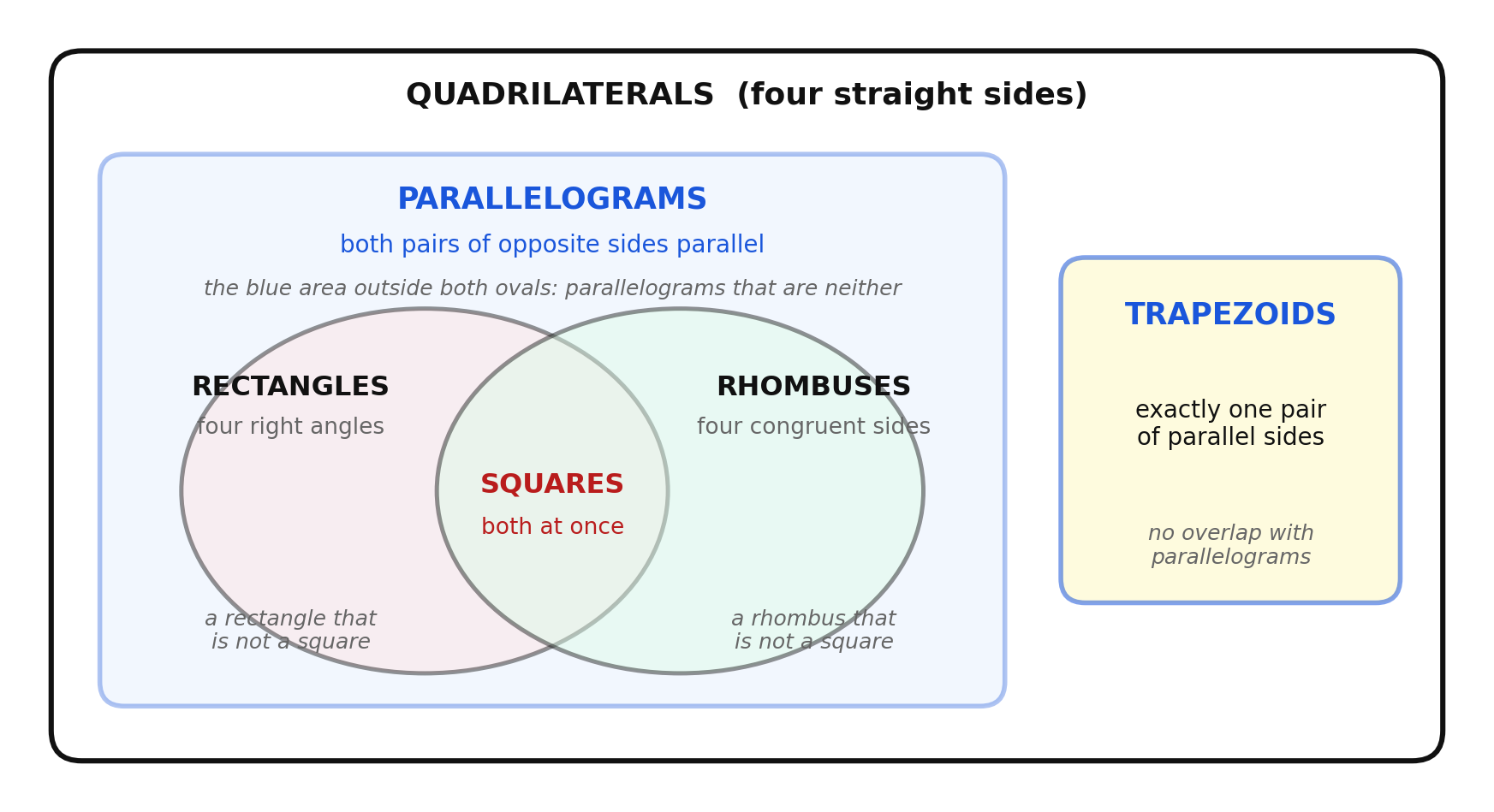
Read the diagram from the outside in. Every figure inside a region has every property of every region that contains it.
- Every parallelogram, rectangle, rhombus, and square is a quadrilateral.
- Every rectangle, rhombus, and square is a parallelogram, because each of them has both pairs of opposite sides parallel.
- Every square is a rectangle (it has four right angles) and every square is a rhombus (it has four congruent sides). The squares are exactly the overlap of those two ovals.
- A parallelogram is not necessarily a rectangle, and not necessarily a rhombus. Plenty of parallelograms live in the blue area outside both ovals.
- A rectangle is not necessarily a rhombus, and a rhombus is not necessarily a rectangle. A by rectangle has no four congruent sides; a tilted rhombus has no right angles.
Trapezoids sit outside the parallelogram box entirely. In this book a trapezoid has exactly one pair of parallel sides, and a parallelogram has two pairs, so nothing can be both. That is why the trapezoid box in the diagram does not touch the others.
Sorting by properties
When you are handed a list of properties instead of a picture, work down the list of requirements in order.
- Are both pairs of opposite sides parallel? If no, it is not a parallelogram. If it has exactly one pair, it is a trapezoid.
- If yes, does it have four right angles? That makes it a rectangle.
- Does it have four congruent sides? That makes it a rhombus.
- Both? Square.
- Neither? Then "parallelogram" is already the most specific name.
Diagonals and symmetry give you the same information in a different form, which is useful because a diagram may show you the diagonals rather than the sides.
| What the diagonals do | Most specific name |
|---|---|
| Bisect each other; not congruent, not perpendicular | Parallelogram (not a rectangle or rhombus) |
| Bisect each other and are congruent, but not perpendicular | Rectangle (not a square) |
| Bisect each other and are perpendicular, but not congruent | Rhombus (not a square) |
| Bisect each other, congruent, and perpendicular | Square |
Lines of symmetry sort the same way: lines means square, midlines means a rectangle that is not a square, diagonals means a rhombus that is not a square, line means an isosceles trapezoid, and lines means a parallelogram that is neither or a trapezoid that is not isosceles.
Saying it carefully
Watch the difference between these two sentences:
- "Every square is a rectangle." True. A square meets every requirement for being a rectangle.
- "Every rectangle is a square." False. A by rectangle has four right angles but not four congruent sides.
A statement like this is only about requirements, so you settle it by checking requirements — never by how the picture looks. And one counterexample is a complete disproof. To show that "every parallelogram is a rhombus" is false, a single parallelogram with sides , , , finishes the job.
Worked examples
Example 1 — Most specific name from a list of clues
A quadrilateral has both pairs of opposite sides parallel, four right angles, and side lengths , , , . Give its most specific name.
Opposite sides parallel makes it a parallelogram. Four right angles makes it a rectangle. It does not have four congruent sides, since , so it is not a rhombus and not a square.
Answer: Rectangle
Example 2 — All the names that apply
List every name from this chapter's list that applies to a square: quadrilateral, parallelogram, rectangle, rhombus, trapezoid.
A square has four sides, both pairs of opposite sides parallel, four right angles, and four congruent sides. It has two pairs of parallel sides, not exactly one, so under this book's definition it is not a trapezoid.
Answer: Quadrilateral, parallelogram, rectangle, and rhombus — but not trapezoid
Example 3 — Checking a subset claim
Is every rhombus a rectangle?
A rhombus must have four congruent sides but is not required to have right angles. A rhombus with angles , , , has four congruent sides and no right angle, so it is not a rectangle.
Answer: No. Only a rhombus that also has four right angles — that is, a square — is a rectangle.
Example 4 — Naming from the diagonals
The diagonals of a quadrilateral bisect each other and are congruent, but they are not perpendicular. Give the most specific name.
Bisecting each other makes it a parallelogram. Congruent diagonals add "rectangle." If it were a square the diagonals would also be perpendicular, and they are not.
Answer: Rectangle (and specifically not a square)
Example 5 — Naming from symmetry
A quadrilateral has exactly one line of symmetry, and exactly one pair of parallel sides. Give the most specific name.
Exactly one pair of parallel sides makes it a trapezoid. The single line of symmetry runs between the two bases, which happens exactly when the legs are congruent.
Answer: Isosceles trapezoid
Guided practice
- True or false, with a reason: every square is a rectangle.
- True or false, with a reason: every rectangle is a square.
- True or false, with a reason: every rhombus is a parallelogram.
- Using the definition of trapezoid stated in this chapter, is a parallelogram a trapezoid? Explain in one sentence.
- A quadrilateral has four congruent sides and four right angles. Give its most specific name.
Independent practice
- Give the most specific name for each figure. a) Both pairs of opposite sides parallel, four right angles, sides , , , b) Four congruent sides, no right angles c) Exactly one pair of parallel sides, congruent legs d) Both pairs of opposite sides parallel; diagonals bisect each other but are neither congruent nor perpendicular
- List every name from this list that applies to a square: quadrilateral, parallelogram, rectangle, rhombus, trapezoid.
- Which figures from this chapter have exactly two lines of symmetry? For each one, say where those two lines are.
- The diagonals of a quadrilateral bisect each other and are perpendicular, but they are not congruent. Give the most specific name.
- The diagonals of a quadrilateral bisect each other and are congruent, but they are not perpendicular. Give the most specific name.
- Application. A floor tile has four congruent sides. Its two diagonals cross at a right angle, and one diagonal is longer than the other. Give the tile's most specific name, and explain which two clues rule out "square."
- Reasoning. Marisol says, "A rhombus is never a rectangle." Explain when she is right and when she is wrong, and give a specific example for each case.
Exit ticket 14.2
- A quadrilateral has four right angles and sides , , , . Give its most specific name.
- Is every parallelogram a rhombus? If not, give a counterexample with side lengths.
- Using this book's definition, can a quadrilateral be both a trapezoid and a parallelogram? Explain.
- Explain why asking for the most specific name is a fairer question than asking "what shape is this?"
Lesson 14.3 — Finding Unknown Angle Measures
Why the four angles add to
You already know that the three angles of a triangle add to . That one fact gives you the quadrilateral fact for free.
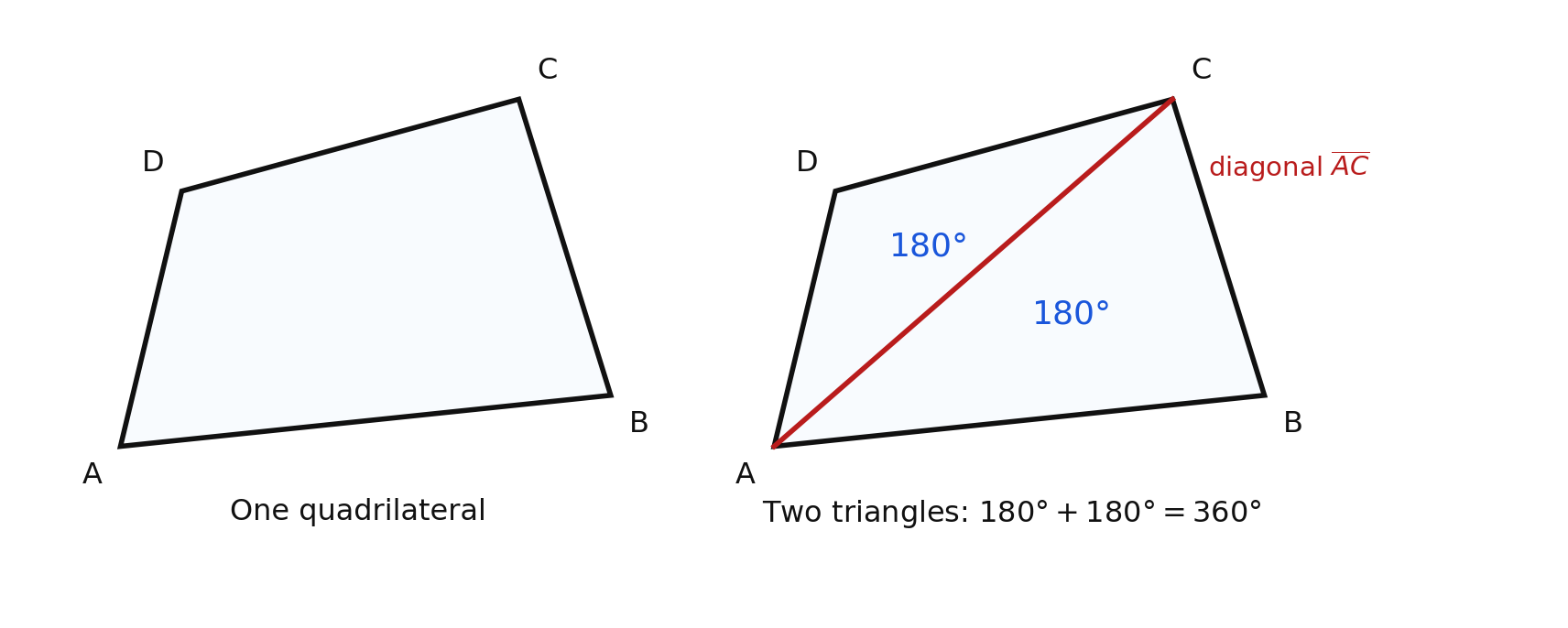
Draw one diagonal, say . It cuts the quadrilateral into two triangles that do not overlap and together cover the whole figure. Every one of the quadrilateral's four angles is either an angle of one of those triangles or is split between the two of them, and no extra angle is created. So the quadrilateral's angle total is just the two triangle totals added:
That reasoning did not depend on the shape being special, so it holds for every quadrilateral:
Knowing any three angles therefore determines the fourth. Subtract the three you know from .
Parallelograms give you more
In a parallelogram you often get all four angles from just one, because of two extra facts.
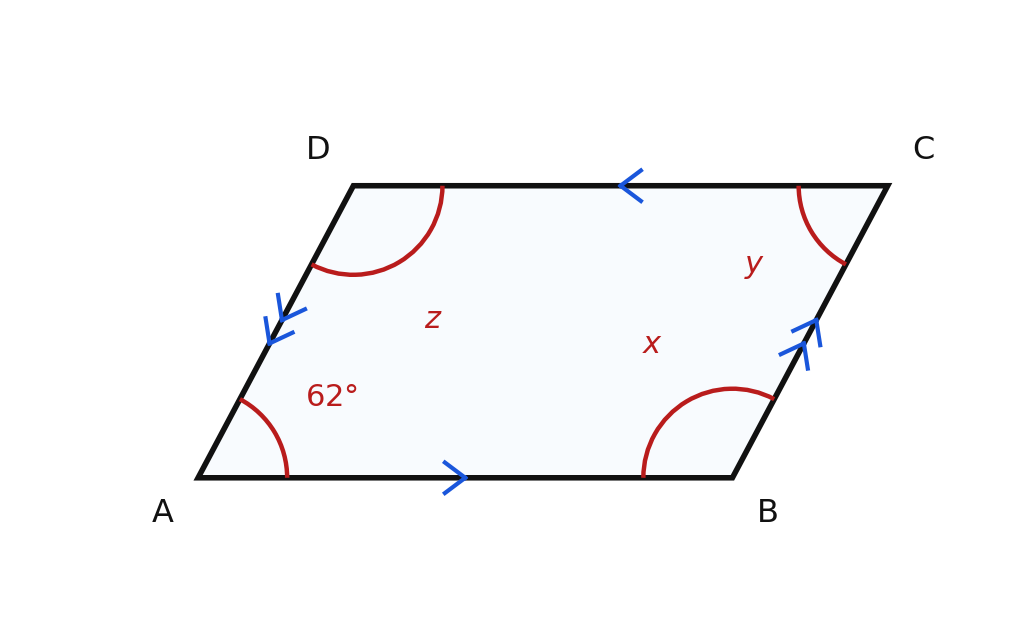
- Opposite angles are congruent. and .
- Consecutive angles are supplementary. Two angles that share a side add to . So , and the same for every other neighboring pair.
Both facts come from the parallel sides. Since and crosses both of them, and are interior angles on the same side of that crossing line, which makes them supplementary.
In the figure, . Then
Check the total: . It works.
Rectangles and squares are the easy case: every angle is , and .
Trapezoids
A trapezoid has one pair of parallel sides, so it gets one piece of the parallelogram machinery: the two angles on the same leg are supplementary, because that leg crosses both parallel bases.
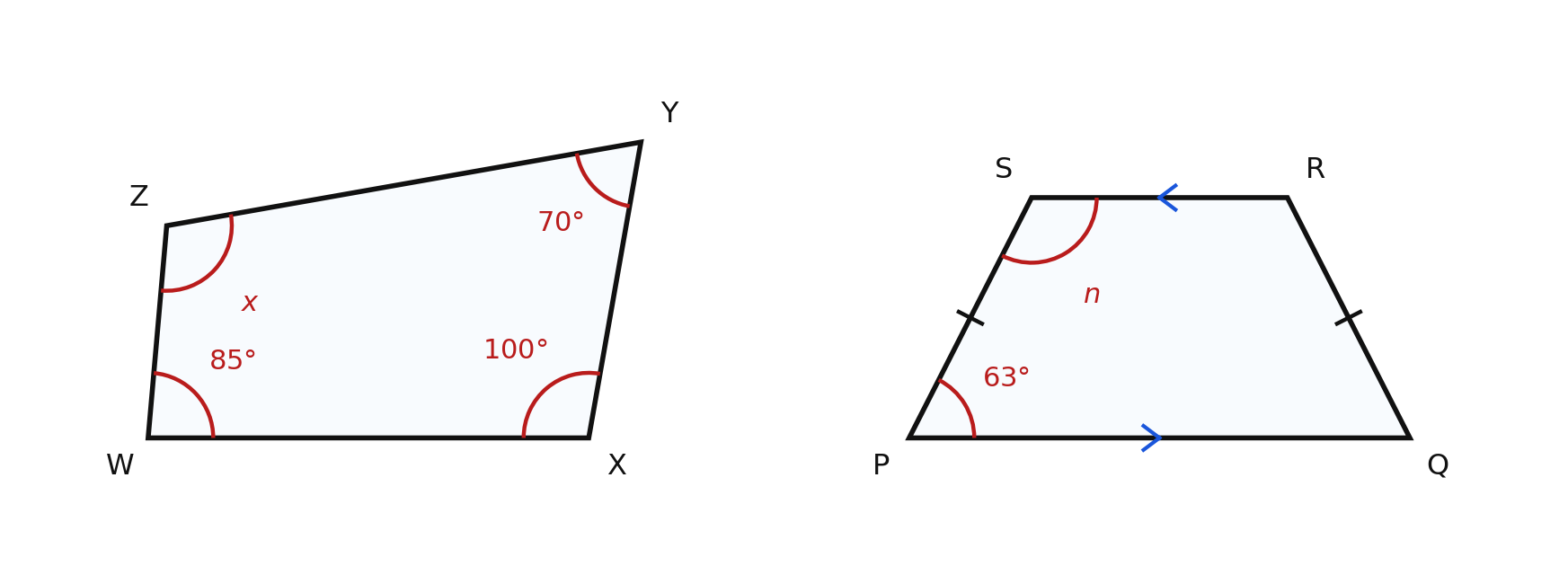
In isosceles trapezoid above, and the leg crosses both, so
Because this trapezoid is isosceles, its two base angles at each base are congruent as well: and . Once again the four add to .
A short habit that prevents errors
Whatever route you take, finish by adding all four measures. If the total is not exactly , something is wrong, and you have caught it before it costs you the problem.
Worked examples
Example 1 — The fourth angle of a general quadrilateral
In quadrilateral , , , and . Find .
The four angles add to :
Check: .
Answer:
Example 2 — All four angles of a parallelogram from one
In parallelogram , . Find , , and .
Consecutive angles are supplementary, so is the supplement of :
Opposite angles are congruent, so and .
Check: .
Answer: , ,
Example 3 — An isosceles trapezoid
In isosceles trapezoid , and . Find , then and .
The leg crosses the two parallel bases, so and are supplementary:
The trapezoid is isosceles, so the base angles at each base are congruent: and .
Check: .
Answer: , ,
Example 4 — An equation from consecutive angles
In parallelogram , and . Find and both angle measures.
and share side , so they are consecutive and therefore supplementary:
Substitute back: and .
Check: , and the full parallelogram gives .
Answer: , ,
Example 5 — A right trapezoid
A trapezoid has two right angles and a third angle of . Find the fourth angle.
Answer:
Guided practice
- In quadrilateral in the figure, , , and . Find .
- In parallelogram in the figure, . Find , , and , and name the property you used for each.
- In isosceles trapezoid in the figure, . Find , then find and .
- Three angles of a quadrilateral measure , , and . Find the fourth.
- One angle of a parallelogram measures . Find the other three, and give the parallelogram's most specific name.
Independent practice
- Find the missing angle measure in each quadrilateral. a) , , , and b) , , , and c) , , , and
- In parallelogram , . Find , , and .
- In parallelogram , and . Find , , and .
- One angle of a rhombus measures . Find the other three angle measures, and explain why a rhombus follows the same angle rules as any parallelogram.
- In an isosceles trapezoid, one base angle measures . Find the other three angle measures.
- Application. The side panel of a skateboard ramp is a right trapezoid: it has two right angles where the vertical post meets the ground and the deck, and the sloped front makes an angle of with the ground. Find the measure of the fourth angle.
- Reasoning. Explain why one angle measure is enough to determine all four angles of a parallelogram, but one angle measure tells you almost nothing about a general quadrilateral.
Exit ticket 14.3
- Three angles of a quadrilateral measure , , and . Find the fourth.
- In parallelogram , . Find , , and .
- In an isosceles trapezoid, one base angle measures . Find the two angles at the other base.
- Explain, using two triangles, why the four angles of any quadrilateral add to .
Lesson 14.4 — Finding Unknown Side Lengths
Which sides a property lets you copy
Finding an unknown length is a matter of knowing which pairs of segments a property promises are congruent, and then reading the length across.
- In a parallelogram, opposite sides are congruent. If , then automatically.
- In a rhombus or a square, all four sides are congruent. One side gives you all four, so it also gives you the perimeter.
- In a rectangle, opposite sides are congruent (a rectangle is a parallelogram), and the two diagonals are congruent.
- In an isosceles trapezoid, the legs are congruent. The two bases have no reason to match, and generally do not.
- In any parallelogram — including rectangles, rhombuses, and squares — the diagonals bisect each other. So each half-diagonal equals the other half of the same diagonal.
When the diagram labels a side with an expression such as , set that expression equal to the length of its congruent partner and solve the equation, exactly as in Chapter 10.
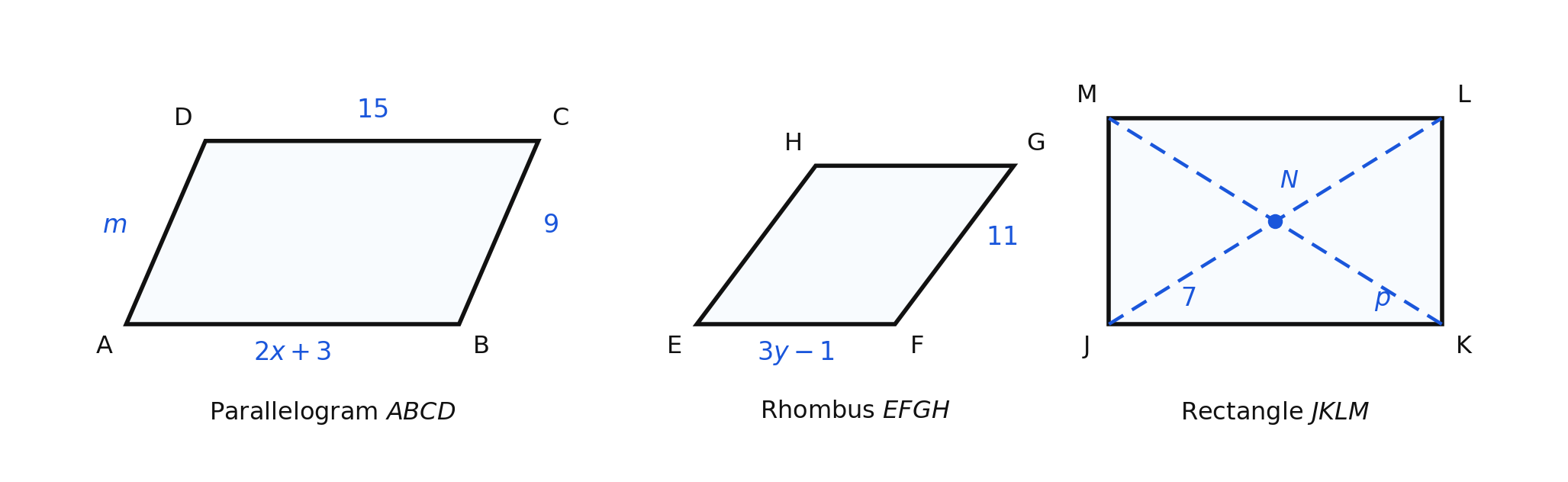
In parallelogram , and are opposite sides, so they are congruent:
And is opposite , so with no equation needed at all.
Half-diagonals
The diagonal picture deserves a second look, because it is where most mistakes happen. In rectangle , the diagonals meet at . Two properties are in play at once.
- The diagonals bisect each other, so and .
- The diagonals are congruent, so .
Put those together and all four half-diagonals are congruent. Since , we get , and each full diagonal measures .
That last step is the one to watch: a half-diagonal is half of the diagonal. If a problem gives you and asks for , you must double it.
Perimeter
Once you know which sides are congruent, perimeter is addition.
- Square with side : perimeter .
- Rhombus with side : perimeter .
- Parallelogram or rectangle with sides and : perimeter .
- Isosceles trapezoid with bases and and leg : perimeter .
Worked examples
Example 1 — An equation from opposite sides
In parallelogram , , , and . Find and .
Opposite sides of a parallelogram are congruent, so :
Check: . And is opposite , so .
Answer: and
Example 2 — All four sides of a rhombus
In rhombus , and . Find , the length of every side, and the perimeter.
All four sides of a rhombus are congruent, so :
Check: . Every side measures , so the perimeter is
Answer: , each side is , and the perimeter is
Example 3 — Half-diagonals in a rectangle
In rectangle , the diagonals meet at with and . Find and the length of each diagonal.
The diagonals of a rectangle bisect each other and are congruent, so all four half-diagonals are congruent:
Answer: ; each diagonal measures
Example 4 — A half-diagonal with a variable
In parallelogram , the diagonals meet at with and . Find and the length of .
The diagonals of a parallelogram bisect each other, so :
Then , and is made of both halves:
Answer: and
Example 5 — Perimeter of an isosceles trapezoid
An isosceles trapezoid has bases of and , one leg measuring , and the other leg measuring . Find and the perimeter.
The legs of an isosceles trapezoid are congruent:
Both legs measure , so the perimeter is
Answer: and the perimeter is
Guided practice
- In parallelogram in the figure, and . Find , then find using .
- In rhombus in the figure, and . Find and the perimeter.
- In rectangle in the figure, . Find and the length of diagonal .
- A parallelogram has sides measuring and . Find its perimeter.
- A square has a perimeter of . Find the length of one side.
Independent practice
- In parallelogram , and . Find and .
- In a rhombus, one side measures and another side measures . Find and the perimeter.
- The diagonals of parallelogram meet at , with , , and . Find , then find and .
- In rectangle , diagonal and diagonal . Find , then find the length of one half-diagonal.
- An isosceles trapezoid has legs measuring and , and bases measuring and . Find and the perimeter.
- Application. A garden gate is built as a rectangle, with a diagonal brace running corner to corner. The builder measures that brace at in and needs to cut a second brace along the other diagonal. How long should it be, and which property tells you so?
- Reasoning. Explain why knowing one side length of a rhombus is enough to find its perimeter, while knowing one side length of a parallelogram is not.
Exit ticket 14.4
- In parallelogram , and . Find .
- A rhombus has a side measuring . Find its perimeter.
- The diagonals of rectangle meet at with . Find .
- In parallelogram , only is labeled, with . Explain which property lets you conclude that as well.
Chapter 14 Review
Vocabulary. quadrilateral · vertex · diagonal · parallel · perpendicular · congruent · line of symmetry · parallelogram · rectangle · rhombus · square · trapezoid · isosceles trapezoid · base · leg · bisect · supplementary · perimeter
Part A — Comparing and contrasting properties (7.MG.3a)
- Which of the five named quadrilaterals always have both pairs of opposite sides parallel?
- Which of the five named quadrilaterals always have four congruent sides?
- Which of the five named quadrilaterals always have four right angles?
- For each of parallelogram, rectangle, rhombus, and square, state whether the diagonals always bisect each other.
- Which of those four always have congruent diagonals?
- Which of those four always have perpendicular diagonals?
- Give the number of lines of symmetry for each: a square; a rectangle that is not a square; a rhombus that is not a square; a parallelogram that is neither; an isosceles trapezoid.
- Name two properties that every rhombus has but a general parallelogram does not.
Part B — Sorting and classifying (7.MG.3b)
- A quadrilateral has four congruent sides and four right angles. Give its most specific name.
- A quadrilateral's diagonals bisect each other and are congruent; its sides measure , , , . Give its most specific name.
- A quadrilateral has exactly one pair of parallel sides and congruent legs. Give its most specific name.
- List every name from this list that applies to every square: quadrilateral, parallelogram, rectangle, rhombus, trapezoid.
- True or false, with a reason: every parallelogram is a rectangle.
- True or false, with a reason: every square is a rhombus.
- Using this book's definition of trapezoid, is a rectangle a trapezoid? Explain.
- A quadrilateral's diagonals bisect each other and are perpendicular but are not congruent. Give its most specific name.
Part C — Unknown angle measures (7.MG.3c)
- Three angles of a quadrilateral measure , , and . Find the fourth.
- In parallelogram , . Find , , and .
- In an isosceles trapezoid, one base angle measures . Find the other three angle measures.
- Two consecutive angles of a parallelogram measure and . Find and both angle measures.
- One angle of a rhombus measures . Find the other three angle measures.
- A right trapezoid has two right angles and a third angle of . Find the fourth angle.
Part D — Unknown side lengths (7.MG.3d)
- In parallelogram , and . Find .
- In a rhombus, one side measures and another measures . Find and the perimeter.
- The diagonals of parallelogram meet at with and . Find and .
- In rectangle , diagonal and the diagonals meet at . Find and .
- An isosceles trapezoid has legs measuring and , with bases of and . Find and the perimeter.
Part E — Mixed application and reasoning
- Application. A quilt block is a rhombus with a side of in and one angle of . Find the perimeter of the block and all four of its angle measures.
- Application. A window is framed as a rectangle. The installer measures one diagonal at in. What should the other diagonal measure, and what would it mean if the measurement came out as in instead?
- Reasoning. Explain why every square is a rectangle but not every rectangle is a square.
- Reasoning. A student claims that any quadrilateral with two pairs of congruent sides must be a parallelogram. Give a counterexample with side lengths and explain what the student overlooked.
- Reasoning. Suppose all you can see of a quadrilateral is its two diagonals and how they cross. Describe how you could tell a rectangle, a rhombus, and a square apart from that information alone.
Standards coverage check — Chapter 14
| Knowledge and Skill | Where it is taught | Where it is practiced |
|---|---|---|
| 7.MG.3a — compare and contrast properties of parallelogram, rectangle, square, rhombus, and trapezoid | 14.1 | Items 1–16; Review Part A, items 65–72 |
| 7.MG.3a i — parallel/perpendicular sides and diagonals | 14.1 | Items 1, 2, 5, 6, 10, 13, 16; Review items 65, 68, 70 |
| 7.MG.3a ii — congruence of angle measures, side lengths, and diagonal lengths | 14.1 | Items 1, 2, 3, 4, 5, 6, 8, 9, 11, 15; Review items 66, 67, 69, 72 |
| 7.MG.3a iii — lines of symmetry | 14.1 | Items 7, 12, 14; Review item 71 |
| 7.MG.3b — sort and classify quadrilaterals based on their properties | 14.2 | Items 17–32; Review Part B, items 73–80 |
| 7.MG.3b i — sorting by parallel/perpendicular sides and diagonals | 14.2 | Items 20, 22, 25, 26, 27, 31; Review items 74, 75, 79, 80 |
| 7.MG.3b ii — sorting by congruence of angles, sides, and diagonals | 14.2 | Items 17, 18, 19, 21, 22, 23, 26, 28, 29, 30; Review items 73, 76, 77, 78 |
| 7.MG.3b iii — sorting by lines of symmetry | 14.2 | Item 24; Review item 71 and item 96 |
| 7.MG.3c — determine an unknown angle measure in a quadrilateral from a diagram | 14.3 | Items 33–48; Review Part C, items 81–86, and item 92 |
| 7.MG.3d — determine an unknown side length in a quadrilateral from a diagram | 14.4 | Items 49–64; Review Part D, items 87–91, and items 92, 93 |
Teacher note on the trapezoid convention. This chapter uses the exclusive definition of trapezoid — exactly one pair of parallel sides — and applies it consistently in every item and in the answer key. Under this convention, no parallelogram, rectangle, rhombus, or square is a trapezoid, which is what items 20, 23, 31, 76, and 79 depend on. If your division's materials use the inclusive definition ("at least one pair"), those five items are the only ones whose answers change; every angle and side computation in the chapter is unaffected.
Answer keys for every set in this chapter are in Appendix A.