Chapter 13 — Similar Figures and Scale Drawings
Standard: 7.MG.2 — The student will solve problems and justify relationships of similarity using proportional reasoning.
By the end of this chapter you will be able to:
- Identify corresponding congruent angles of similar quadrilaterals and triangles using geometric markings (7.MG.2a)
- Identify corresponding sides of similar quadrilaterals and triangles (7.MG.2b)
- Write similarity statements using symbols (7.MG.2c)
- Write proportions relating the lengths of corresponding sides (7.MG.2d)
- Recognize and justify whether two quadrilaterals or triangles are similar, using the ratios of corresponding side lengths (7.MG.2e)
- Solve a proportion to determine a missing side length (7.MG.2f)
- Determine unknown angle measures in a similar quadrilateral or triangle (7.MG.2g)
- Apply proportional reasoning to solve problems in context, including scale drawings (7.MG.2h)
Lessons: 13.1 What Similarity Means · 13.2 Corresponding Angles and Sides · 13.3 Writing Similarity Statements · 13.4 Proportions from Corresponding Sides · 13.5 Finding a Missing Side Length · 13.6 Scale Drawings
This chapter runs on Chapter 5. Everything here is proportional reasoning applied to geometry. If setting up or solving a proportion feels shaky, reread Lessons 5.2 and 5.3 before you start. The geometry in this chapter tells you which proportion to write; Chapter 5 tells you how to solve it.
Lesson 13.1 — What Similarity Means
Two conditions, not one
You have seen pictures of the "same shape at a different size" your whole life: a photo enlarged for a poster, a model car, a map. Mathematics makes that idea exact, and the exact version has two requirements, not one.
Two polygons are similar when both of these are true:
- Corresponding angles are congruent. Matching corners have equal measures.
- Corresponding sides are proportional. Every pair of matching sides has the same ratio.
The symbol for similarity is . We write and read it "triangle is similar to triangle ."
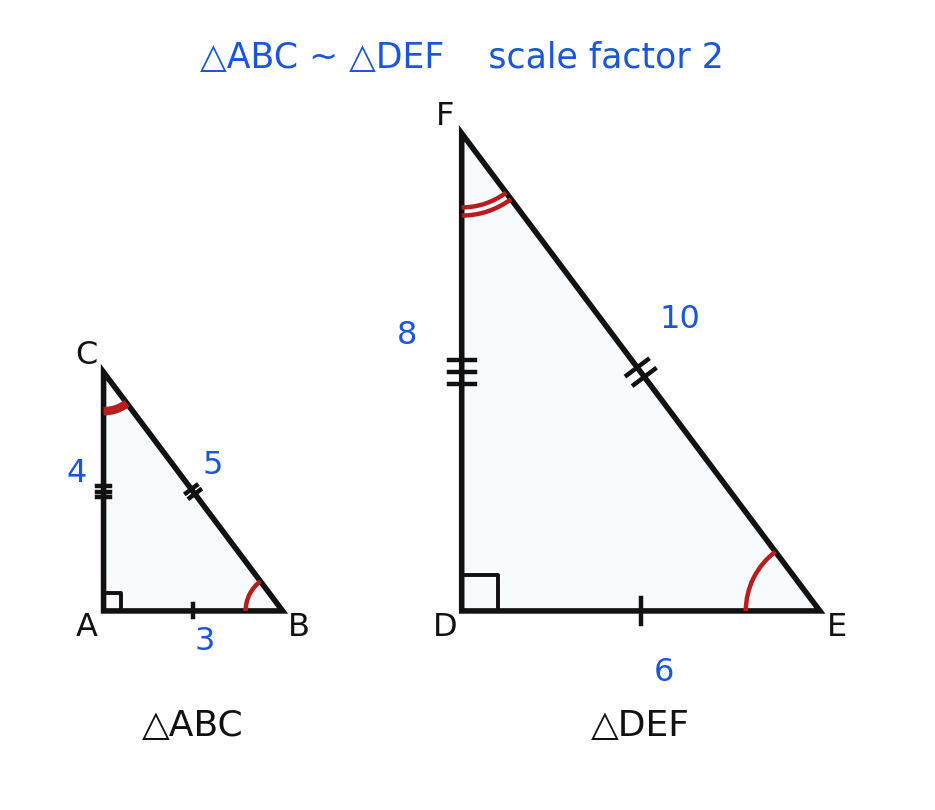
Look at the two triangles above. Every angle in the small triangle has a matching angle of the same measure in the large one. And every side of the large triangle is exactly twice the matching side of the small one:
All three ratios agree, so the sides are proportional. Both conditions hold, so the triangles are similar.
A note on the markings. In this chapter, matching arcs on two angles mean those angles are congruent — equal in measure. Matching hash marks on two sides mean those sides correspond, not that they are equal. Corresponding sides of similar figures are proportional, and they are only equal when the scale factor is 1.
The scale factor
The common ratio has a name. The scale factor is the number you multiply every side of one figure by to get the matching side of the other.
Going from the small triangle to the large one, the scale factor is : multiply , , and by 2 to get , , and .
Going the other direction, from large to small, the scale factor is : multiply , , and by to get , , and .
Both statements describe the same pair of figures. That is why you should always say which direction you mean: "the scale factor from to is 2." A scale factor greater than 1 produces an enlargement; a scale factor between 0 and 1 produces a reduction.
Notice what the scale factor does not change. It stretches or shrinks lengths, and it leaves every angle measure exactly alone. That is the whole reason a scaled photo still looks like the original.
Congruence is the special case
Two figures are congruent when they have exactly the same size and shape — matching angles congruent and matching sides equal in length.
Congruence is similarity with a scale factor of . Every pair of congruent figures is similar. Not every pair of similar figures is congruent, because the scale factor is usually something other than 1.
Why "same shape, different size" is not enough
Here is the trap. Consider two rectangles, one by and one by .
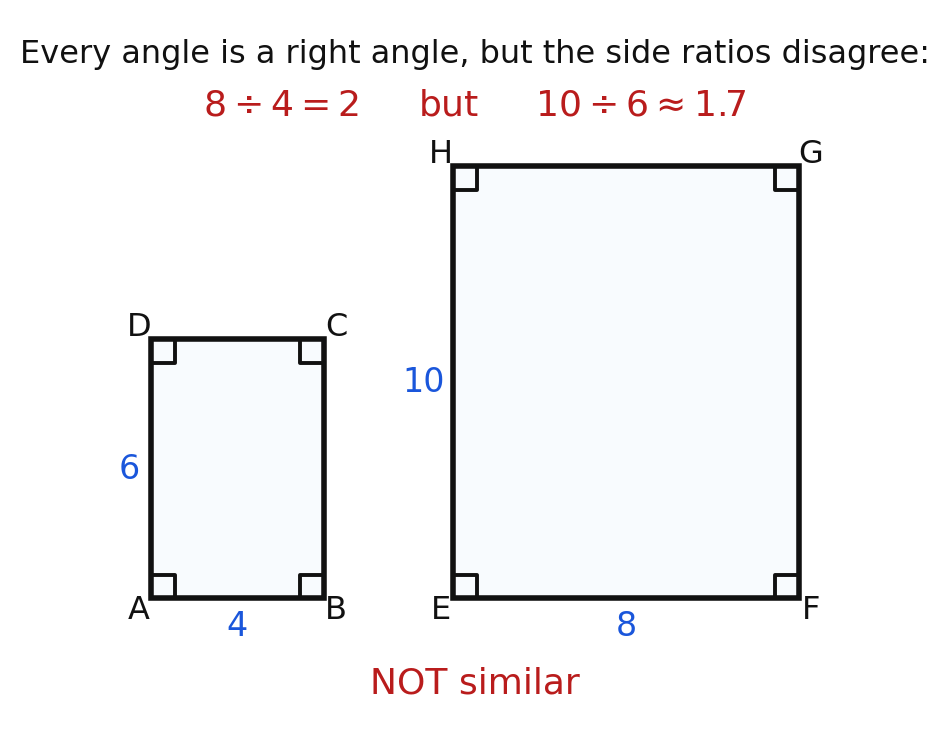
Every angle in both rectangles is a right angle, so the angle condition is satisfied. But check the sides:
The ratios disagree, so the sides are not proportional and the rectangles are not similar. The second rectangle is not a scaled copy of the first — it has been stretched more in one direction than the other. If you enlarged the first rectangle on a photocopier, you could never land on the second.
The opposite failure also happens. A square with side and a rhombus with side whose angles measure and have all four side ratios equal to , but their angles are nowhere near congruent, so they are not similar either. Both conditions have to be checked. Neither one alone is enough.
Worked examples
Example 1 — Checking both conditions
A triangle has sides , , and a second triangle has sides , , , with corresponding angles congruent as shown in the figure above. Are they similar? What is the scale factor?
Compare the matching sides:
All three ratios equal 2, and the corresponding angles are congruent.
Answer: Yes, they are similar. The scale factor from the small triangle to the large one is .
Example 2 — The scale factor in the other direction
For the same two triangles, what is the scale factor from the large triangle to the small one?
Now divide the small sides by the large ones: , , .
Answer: . The two scale factors, and , are reciprocals, which is what you should expect from a pair of figures described from opposite ends.
Example 3 — Congruent angles are not enough
Is a by rectangle similar to an by rectangle?
All eight angles are right angles, so the angle condition holds. Check the sides:
Answer: No. Since , the corresponding sides are not proportional.
Example 4 — Similarity with a scale factor of 1
Two triangles both have sides , , , with corresponding angles congruent. Are they similar? Are they congruent?
Each ratio is .
Answer: They are similar with scale factor , and because the scale factor is 1 they are also congruent.
Example 5 — Using a fractional scale factor
A quadrilateral has sides , , , . A similar quadrilateral is built with a scale factor of . Find its side lengths.
Multiply each side by :
Answer: , , ,
Guided practice
- One triangle has sides , , and a similar triangle has sides , , . Write the three ratios of corresponding sides, then state the scale factor from the smaller triangle to the larger one.
- For the same pair, what is the scale factor from the larger triangle to the smaller one?
- Is a by rectangle similar to an by rectangle? Show the two ratios that settle it.
- Two triangles each have sides , , , with corresponding angles congruent. Are they similar? Are they congruent? Give the scale factor.
- Complete the sentence: similar figures have corresponding angles that are ________ and corresponding sides that are ________.
Independent practice
- Decide whether each pair is similar. If it is, give the scale factor from the first figure to the second. Show the ratios you used. a) Triangles with sides , , and , , b) Triangles with sides , , and , , c) A square with side and a square with side
- A triangle has sides , , and . A similar triangle is built with a scale factor of . Find its three side lengths.
- A triangle has sides , , and . A similar triangle is built with a scale factor of . Find its three side lengths.
- Quadrilateral has sides , , , . Quadrilateral is similar to it with a scale factor of . List the sides of , then state the scale factor from back to .
- Is a by rectangle similar to a by rectangle? Justify your answer with the ratios and give the scale factor.
- Application. A photograph is inches wide and inches long. It is enlarged so that the new width is inches. If the enlargement is similar to the original, what must the new length be? Show the scale factor you used.
- Reasoning. Jamal says, "Any two rectangles are similar, because all of their angles are right angles." Give a specific counterexample with side lengths, and name the condition Jamal forgot to check.
Exit ticket 13.1
- Triangles with sides , , and , , have congruent corresponding angles. Are they similar? Give the scale factor from the first to the second.
- A triangle has sides , , . Find the sides of a similar triangle built with a scale factor of .
- Is a by rectangle similar to a by rectangle? Show the ratios.
- Explain why "same shape, different size" is not a complete definition of similar.
Lesson 13.2 — Corresponding Angles and Sides
Matching the parts
Before you can compare two figures, you have to know which part of one goes with which part of the other. Corresponding parts are the parts that occupy matching positions in two figures.
Geometric markings are how a diagram tells you the matching. In and in the figure from Lesson 13.1:
- and both carry a right-angle square, so .
- and both carry a single arc, so .
- and both carry a double arc, so .
The symbol is read "is congruent to." For angles, congruent means equal in measure.
Once the angles are matched, the sides follow automatically, because each side sits between two vertices:
| Side of | Between | Corresponding side of |
|---|---|---|
| and | ||
| and | ||
| and |
A bar over two letters, like , names the segment joining those points. Written without the bar, means the length of that segment.
There is a second, equally useful way to match sides: corresponding sides lie opposite corresponding angles. In , the side opposite is . In , the side opposite is . Since , we get , which agrees with the table. Use whichever route is faster for the diagram in front of you.
Quadrilaterals work the same way
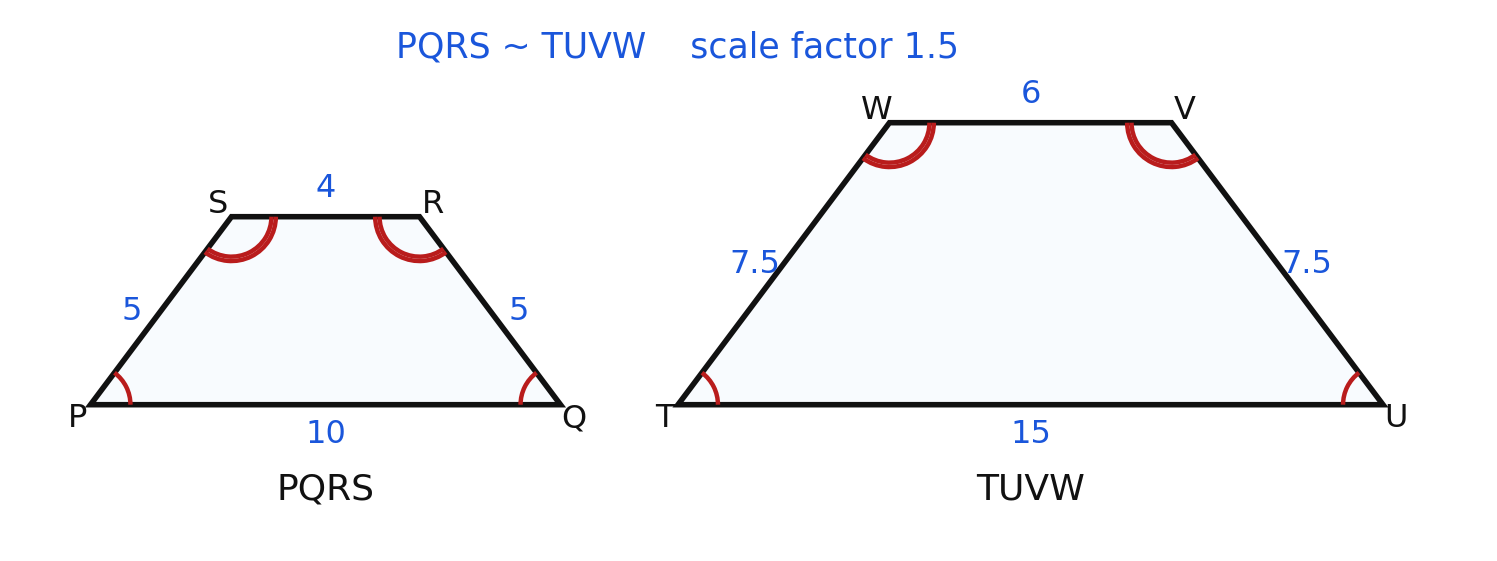
In these two trapezoids, and carry single arcs, and carry single arcs, and carry double arcs, and and carry double arcs. So the correspondence is , , , , and the sides pair off as , , , and .
Checking the side ratios confirms it: , , , and .
Angle measures carry across
Scaling changes lengths. It does not change angles. That single fact does a lot of work.
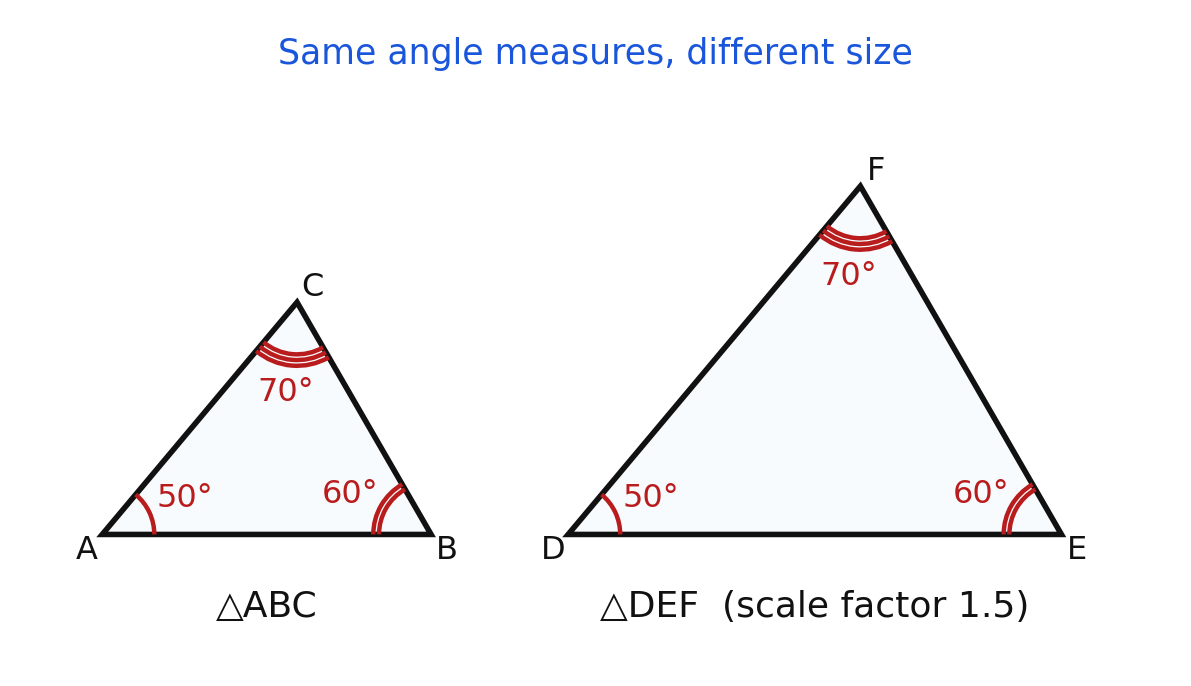
If you know the angle measures in one figure, you know them in every figure similar to it, no matter the size. And because the angle measures inside a triangle always add to , knowing two of them is enough to find the third:
The notation is read "the measure of angle ."
For quadrilaterals, the four angle measures always add to , so knowing three of them determines the fourth.
Worked examples
Example 1 — Reading markings for angles
Using the markings in the figure of and from Lesson 13.1, list the three pairs of corresponding congruent angles.
The right-angle squares match, the single arcs match, and the double arcs match.
Answer: , ,
Example 2 — Listing corresponding sides
For the same two triangles, list the three pairs of corresponding sides.
Each side is named by its two endpoints, and each endpoint has a partner.
Answer: , ,
Example 3 — Using the "opposite" rule
In , which side of is opposite , and which side of corresponds to it?
The side opposite is . Since , the corresponding side is the one opposite , which is .
Answer: ; it corresponds to
Example 4 — Corresponding parts of quadrilaterals
Quadrilateral quadrilateral . Name the angle corresponding to and the side corresponding to .
Read the statements in order: , , , .
Answer: ; and corresponds to
Example 5 — Finding unknown angle measures
In , and . Find all six angle measures.
In , the three angles add to :
Corresponding angles are congruent, so has the same three measures in the matching positions.
Answer: , , , , ,
Guided practice
- In the marked figure of and , name the angle of congruent to .
- In the same figure, name the side of corresponding to .
- For quadrilateral quadrilateral , name the angle corresponding to and the side corresponding to .
- In , and . Find , , , and .
- If , complete each statement: ________ and corresponds to ________.
Independent practice
- Given , list all three pairs of corresponding angles and all three pairs of corresponding sides.
- Given quadrilateral quadrilateral , name the angle corresponding to and the side corresponding to .
- In , and . Find , and then find , , and .
- Quadrilateral quadrilateral , with , , and . Find , then find all four angle measures of .
- True or false: in , corresponds to . If it is false, name the correct corresponding side.
- Application. A sailmaker cuts two similar triangular sails, one with vertices , , and one with vertices , , , marked so that , , and . Which side of the second sail corresponds to ? If and , find .
- Reasoning. Explain why knowing just two angle measures in one of two similar triangles is enough to determine all six angle measures in both triangles.
Exit ticket 13.2
- In , name the angle corresponding to .
- In , name the side corresponding to .
- In , and . Find .
- Explain how matching arcs drawn on two angles tell you which parts of two figures correspond.
Lesson 13.3 — Writing Similarity Statements
The order of the letters is the information
A similarity statement is not just a sentence saying two figures are similar. It is a compact table of the correspondence, and the table lives in the order of the letters.
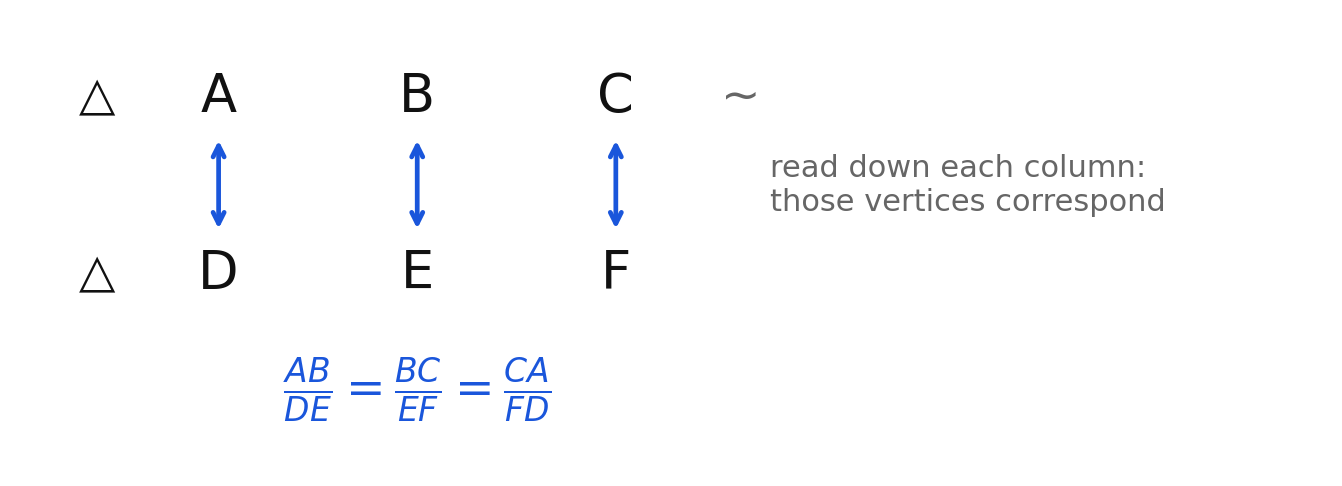
When you write
you are claiming all of this at once:
- , ,
- , ,
Line the two names up one above the other and read down each column. First letter with first letter, second with second, third with third. That is the whole rule, and it is worth writing the two names stacked whenever a problem gets confusing.
Because the order carries meaning, and make different claims. The first says ; the second says . At most one of them matches a given diagram, so getting the order right is not a style preference.
Writing a statement from markings
Given a marked diagram or a list of congruent angle pairs, the recipe is short.
- First, pick any vertex of the first figure and write it down.
- Then, write the vertex of the second figure whose angle is congruent to it, in the same position.
- Continue around the first figure in order — clockwise or counterclockwise, but do not skip around — writing each partner in the matching position.
For example, given , , and , write .
The same statement, written more than one way
You may start at any vertex, as long as you move around both figures in the same direction and keep the partners lined up. From you can also write
All three say exactly the same thing, because in each one the columns still read –, –, –.
What you may not do is shuffle one name without shuffling the other. claims , which is a different and probably false statement.
Quadrilaterals
The same rule governs four-letter statements. means , , , . Notice that quadrilateral names are written without the triangle symbol; just list the vertices in order around the figure.
Worked examples
Example 1 — From a marked diagram
The marked triangles from Lesson 13.1 show , , and . Write the similarity statement.
Each partner sits in the matching position.
Answer:
Example 2 — From a list of congruent angles
Given , , and , write the similarity statement.
Write , , in order, and put each partner underneath.
Answer:
Example 3 — Rewriting the same statement
Rewrite so that it begins with .
Move around both triangles in the same direction, starting one vertex later: , , pairs with , , .
Answer:
Example 4 — A quadrilateral statement
Two similar trapezoids are marked so that , , , and . Write the similarity statement.
Answer:
Example 5 — Catching a wrong order
A diagram shows , , and . A student writes . Is that correct?
Line up the student's statement: it claims . The diagram says . The letters are in the wrong order.
Rebuild it: pairs with , pairs with , pairs with .
Answer: No. The correct statement is .
Guided practice
- Given , , and , write the similarity statement.
- Given , , and , write the similarity statement.
- Rewrite so that it begins with .
- Two trapezoids are marked so that , , , and . Write the similarity statement.
- Given , name the angle congruent to and the side corresponding to .
Independent practice
- Write the similarity statement for each set of congruent angle pairs. a) , , b) , ,
- Given , , , and , write the similarity statement for the two quadrilaterals.
- Given , write two other correct forms of the same statement.
- A student writes , but the markings show , , and . Write the correct similarity statement.
- Given with and , state the ratio of corresponding sides from to as a fraction in lowest terms.
- Application. Two similar triangular pennants are made. The first has vertices , , ; the second has vertices , , . The pattern shows , , and . Write the similarity statement.
- Reasoning. A classmate writes only "these two triangles are similar" without naming the vertices in order. Describe exactly what information is lost, and give an example of a question you could not answer without it.
Exit ticket 13.3
- Given , , and , write the similarity statement.
- Given , name the side corresponding to .
- Rewrite so that it begins with .
- Explain why and say different things about which angles are congruent.
Lesson 13.4 — Proportions from Corresponding Sides
Turning a similarity statement into equations
The similarity statement tells you which sides correspond. The proportional-sides condition then turns that pairing into equations you can actually compute with.
If , then
Every one of those fractions equals the scale factor from to . Written the other way up,
gives the scale factor from to . Both are correct. What matters is the discipline you learned in Lesson 5.2: the same figure's side goes in the same position on both sides of the equation.
Any two of those equal ratios form a proportion. From you may write
Pick whichever pair contains the length you are looking for and two lengths you already know.
What you may not write is . Here is being compared with , which is not its partner. The equation is not describing the figures anymore, and it will hand you a wrong number that looks perfectly reasonable.
For a quadrilateral , the same logic gives four equal ratios:
Justifying similarity from the ratios
Turn the idea around and you get a test. To decide whether two figures are similar, compute the ratio of each pair of corresponding sides and see whether all of them agree.
- If every ratio is the same number, the sides are proportional. For triangles, that is enough on its own to guarantee the angles match too, so the triangles are similar.
- If even one ratio disagrees, the figures are not similar. One disagreement is a complete answer; you do not have to check the rest.
For quadrilaterals, proportional sides alone are not enough — you also need the angle condition, which is exactly what the square-and-rhombus example in Lesson 13.1 showed. A square with side and a rhombus with side have all four ratios equal to , but a angle is not congruent to a angle.
Write your justification the way a mathematician would: show the ratios, say whether they agree, and then state the conclusion. "Not similar" with no ratios shown is not a justification.
Worked examples
Example 1 — Writing the equal ratios
Given , write the statement that all three pairs of corresponding sides are proportional.
Answer:
Example 2 — Checking a proportion with numbers
For the -- and -- triangles with , verify that .
Substitute: , , , .
Cross multiply to check: and .
Answer: The cross products agree, so the proportion is true.
Example 3 — Justifying that two triangles are similar
One triangle has sides , , . Another has corresponding sides , , . Are they similar?
Answer: Yes. All three ratios equal , so the corresponding sides are proportional and the triangles are similar with scale factor .
Example 4 — A pair that fails
Quadrilateral has sides , , , and quadrilateral has corresponding sides , , , . Are they similar?
Answer: No. The first three ratios equal , but the last equals , so the sides are not proportional. For to be similar to , its fourth side would have to be .
Example 5 — Congruent angles are still not enough
Justify, using ratios, why a by rectangle is not similar to an by rectangle.
Answer: Since , corresponding sides are not proportional, so the rectangles are not similar even though all their angles are congruent.
Guided practice
- Given , write the three equal ratios of corresponding sides.
- One triangle has sides , , ; a second has corresponding sides , , . Compute the three ratios and state whether the triangles are similar.
- Quadrilateral has sides , , , ; quadrilateral has corresponding sides , , , . Compute the four ratios and state whether the quadrilaterals are similar.
- Show with ratios that a by rectangle is not similar to an by rectangle, and explain why congruent angles alone were not enough.
- Given , write a proportion that uses only , , , and .
Independent practice
- Decide whether each pair of figures is similar. Show every ratio you compute. a) Triangles with corresponding sides , , and , , b) Triangles with corresponding sides , , and , , c) Quadrilaterals with corresponding sides , , , and , , ,
- Given , write the three equal ratios of corresponding sides.
- Given with , , and , write a proportion you could use to find , and state the scale factor from to .
- For , a student writes . Explain the error and write a correct proportion using those same four segments.
- Quadrilateral has , , , and . Quadrilateral is similar to it with a scale factor of . List the four side lengths of .
- Application. A rectangular pool measures ft by ft. A scale model of the pool measures in by in. Compute the two ratios of model length to actual length and state whether the model has the same shape as the pool.
- Reasoning. A square has side . A rhombus has side and angles measuring and . Show that all four ratios of corresponding sides are equal, then explain why the two figures are still not similar and which condition fails.
Exit ticket 13.4
- Given , write the three equal ratios of corresponding sides.
- Triangles with corresponding sides , , and , , : similar or not? Show the ratios.
- Triangles with corresponding sides , , and , , : similar or not? Show the ratios.
- Explain why proportional sides alone do not guarantee that two quadrilaterals are similar.
Lesson 13.5 — Finding a Missing Side Length
The whole method in one sentence
If two figures are similar and you know three of the four lengths in a pair of corresponding-side ratios, write the proportion and solve it.
That is it. The geometry supplies the proportion; Chapter 5 supplies the solving.
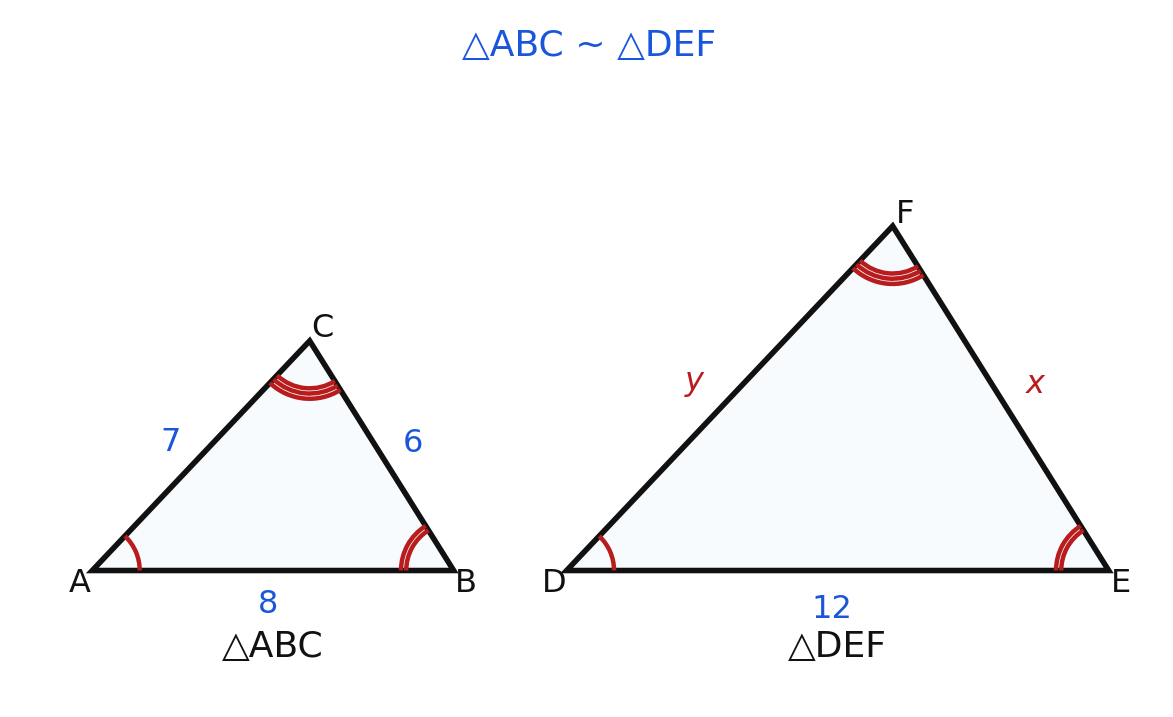
In the figure, with , , , and . To find , which is , pair with and use the pair you already know completely, with :
A useful shortcut: multiply by the scale factor
Once you know the scale factor, every remaining side is one multiplication away. In the figure, the scale factor from to is
So and , matching the proportion above and answering both unknowns at once. When a problem asks for several missing sides, find the scale factor first.
Checks that catch mistakes
Two quick checks are worth the seconds they cost.
Does the size move the right way? If you are scaling up, every image side must come out longer than its partner. If your answer came out shorter, your proportion was upside down.
Do the cross products agree? Substitute your answer back and multiply. In the example, and . They match.
When the answer is not a whole number
Nothing forces a similar figure to have whole-number sides. If , then and , which is not exact as a decimal. When a problem needs rounding it will say so, and you should round only at the very last step.
Worked examples
Example 1 — Solving the proportion
with , , and . Find .
Check: and .
Answer:
Example 2 — The same problem with the scale factor
Solve Example 1 using the scale factor instead.
Answer: , the same answer by a shorter route
Example 3 — Finding a side in the smaller figure
with , , and . Find .
Here is the smaller figure, and is indeed less than , which is the direction check passing.
Answer:
Example 4 — A quadrilateral
Quadrilateral quadrilateral with , , and . Find .
Answer:
Example 5 — An answer that must be rounded
with , , and . Find to the nearest tenth.
Round only now.
Answer:
Example 6 — Similar triangles in a shadow problem
A person ft tall casts a shadow ft long. At the same moment a flagpole casts a shadow ft long. The two height-and-shadow triangles are similar. How tall is the flagpole?
Heights on top, shadows on the bottom, on both sides:
Answer: The flagpole is ft tall.
Guided practice
- with , , and . Find . Show the proportion and the solve.
- For the same two triangles, . Find .
- with , , and . Find .
- Quadrilateral quadrilateral with , , and . Find .
- with and . Find the scale factor from to .
Independent practice
- Solve for the missing length in each pair of similar figures. a) , , , . Find . b) , , , . Find . c) , , , . Find .
- with a scale factor of from to . If , , and , find , , and .
- In the figure for this lesson, with , , , and . Find and .
- with , , and . Find to the nearest tenth.
- Quadrilateral quadrilateral with , , and . Find .
- Application. A person ft tall casts a ft shadow at the same time a flagpole casts a ft shadow. The height-and-shadow triangles are similar. Find the height of the flagpole.
- Reasoning. Explain why finding a missing side in similar figures is the same skill as solving a proportion from Chapter 5, and describe how you decide which two ratios to set equal to each other.
Exit ticket 13.5
- with , , and . Find .
- with , , and . Find .
- with and . Find the scale factor from to , written as a decimal.
- with , , and . Find to the nearest tenth.
Lesson 13.6 — Scale Drawings
What a scale drawing is
A scale drawing is a drawing that is similar to the real object it represents. Floor plans, maps, blueprints, and model kits are all scale drawings. Because the drawing is similar to the real thing, every length in the drawing is the matching real length multiplied by the same number.
The scale is the statement that tells you that number. It is usually written as an equation between two measurements:
Read as "one inch on the drawing represents six feet in real life." It is not claiming that an inch equals six feet; it is stating a correspondence between drawing lengths and actual lengths.
A scale written as a ratio like has no units attached, which means it works in any unit you like: one inch of model for every twelve inches of real object, or one centimeter for every twelve centimeters.
Setting up the proportion
Every scale-drawing question is a proportion, and the setup discipline is the same as always: drawing lengths in the same position on both sides, actual lengths in the same position on both sides.
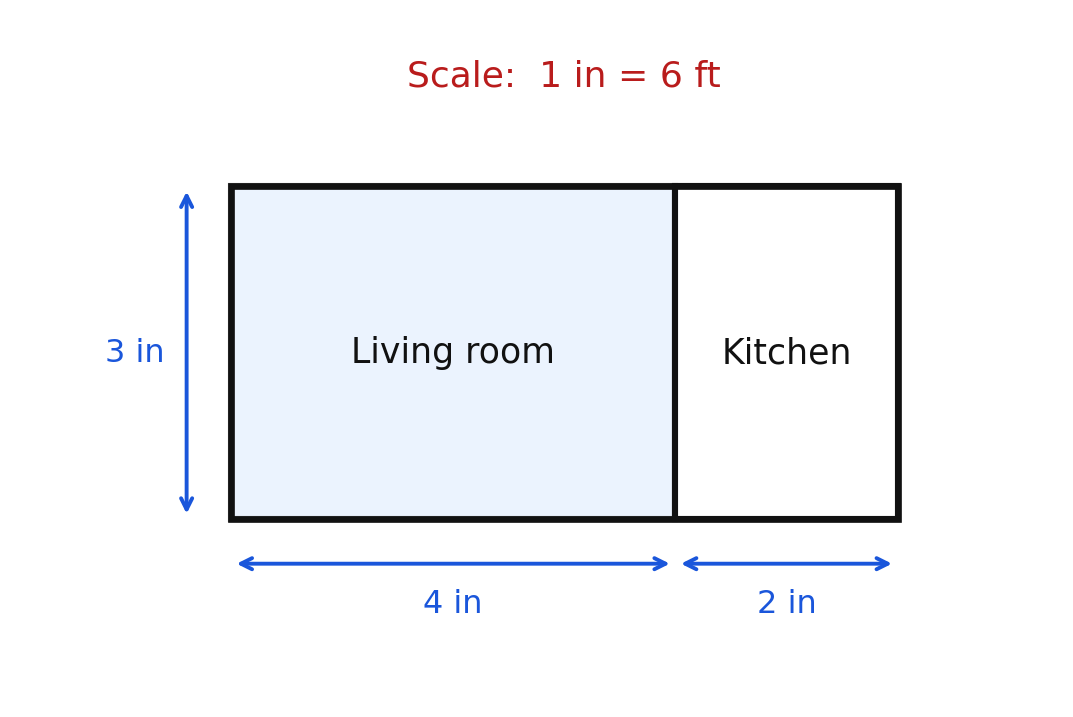
The living room on this plan measures in by in. At the stated scale, its actual length is
and its actual width is ft. The real living room is ft by ft.
The proportion runs backward just as well. If a hallway is actually ft long, its length on this plan is
Check the direction. Going from a drawing length to an actual length on a shrunken plan, the number gets bigger. Going from actual to drawing, it gets smaller. If your answer moved the wrong way, you set the proportion up upside down.
Scales on a grid
Some scale drawings replace the stated scale with a grid, where each square stands for a fixed real length.
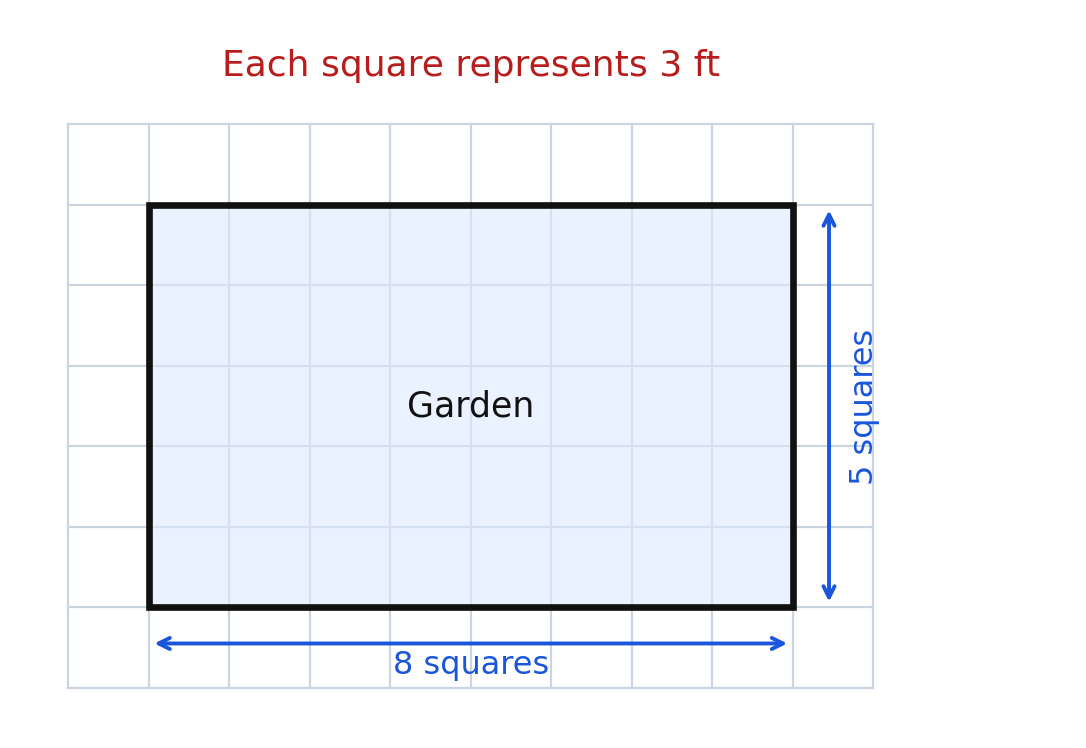
The garden here is squares long and squares wide, and each square represents ft. So the garden is
Counting squares is just multiplying by the scale, one square at a time.
Making your own scale drawing
To draw something too big for the paper, choose a scale, divide each real measurement by it, and draw the results.
A room ft by ft at a scale of becomes
A in by in rectangle fits comfortably on a page. Always write the scale on the drawing — without it, the drawing carries no measurements at all.
Worked examples
Example 1 — Drawing length to actual length
A floor plan uses the scale . A wall measures in on the plan. How long is the actual wall?
Answer: ft
Example 2 — Actual length to drawing length
On the same plan, a hallway is actually ft long. How long is it on the plan?
Answer: in
Example 3 — A map
A map uses the scale . Two towns are in apart on the map. How far apart are they in reality?
Answer: mi
Example 4 — A grid drawing, including area
On a grid where each square represents ft, a rectangular garden is squares by squares. Find its actual dimensions and its actual area.
Answer: ft by ft, with an area of square feet
Example 5 — A ratio scale
A model chair is built at a scale of . The real chair is in tall. How tall is the model?
Answer: in
Guided practice
- A floor plan uses the scale . A wall measures in on the plan. Find the actual length.
- On the same plan, a hallway is actually ft long. Find its length on the plan.
- A map uses the scale . Two towns are in apart on the map. Find the actual distance.
- On a grid where each square represents ft, a room is squares by squares. Find its actual dimensions.
- A model is built at a scale of . The real chair is in tall. Find the height of the model.
Independent practice
- A floor plan uses the scale . a) A bedroom measures in by in on the plan. Find its actual dimensions. b) A closet is in wide on the plan. Find its actual width.
- A map uses the scale . Two cities are cm apart on the map. Find the actual distance.
- A drawing uses the scale . A room is actually ft long. Find its length on the drawing.
- A model car is built at a scale of . The real car is in long. Find the length of the model.
- Use the floor plan figure from this lesson and its stated scale to find the actual dimensions of the living room and of the kitchen.
- Application. A garden is ft by ft. You are making a scale drawing at . Give the dimensions of the rectangle you should draw.
- Reasoning. A student says that a map scale of means the map is bigger than the land it shows, because 1 is smaller than 50. Explain the error and state what the scale actually means.
Exit ticket 13.6
- A plan uses the scale . A wall measures in on the plan. Find the actual length.
- A map uses the scale . Two points are cm apart. Find the actual distance.
- A model is built at a scale of . A real desk is in wide. Find the width of the model.
- Explain why the scale must be stated on every scale drawing.
Chapter 13 Review
Vocabulary. similar · corresponding parts · congruent · scale factor · enlargement · reduction · similarity statement · proportion · scale drawing · scale
Part A — Corresponding congruent angles and markings (7.MG.2a)
- Using the markings in the figure of and from Lesson 13.1, list the three pairs of corresponding congruent angles.
- Using the markings in the figure of trapezoids and , list the four pairs of corresponding congruent angles.
- Two triangles are marked so that and each carry a double arc. State what that tells you and write it in symbols.
Part B — Corresponding sides (7.MG.2b)
- Given , name the side corresponding to .
- Given , name the side corresponding to .
- In the trapezoid figure, name the side of corresponding to , and give both of their lengths.
Part C — Similarity statements (7.MG.2c)
- Given , , and , write the similarity statement beginning with .
- Given , , , and , write the similarity statement for the two quadrilaterals.
- Rewrite so that it begins with .
Part D — Proportions from corresponding sides (7.MG.2d)
- Given , write the three equal ratios of corresponding sides.
- Given , write a proportion relating , , , and .
- Given with , , and , write a proportion for and state the scale factor from to .
Part E — Justifying similarity with ratios (7.MG.2e)
- Triangles with corresponding sides , , and , , : are they similar? Show all three ratios.
- Quadrilaterals with corresponding sides , , , and , , , : are they similar? Show all four ratios.
- Rectangles measuring by and by : are they similar? Justify with the ratios.
Part F — Missing side lengths (7.MG.2f)
- with , , and . Find .
- with , , and . Find .
- with , , and . Find to the nearest tenth.
Part G — Unknown angle measures (7.MG.2g)
- with and . Find all six angle measures.
- Quadrilateral quadrilateral with , , and . Find and all four angle measures of .
Part H — Scale drawings (7.MG.2h)
- A floor plan uses the scale . A room measures in by in on the plan. Find its actual dimensions.
- A map uses the scale . Two cities are cm apart on the map. Find the actual distance.
Part I — Mixed application and reasoning
- Application. A student ft tall casts a ft shadow. At the same moment a tree casts a ft shadow. The two triangles are similar. Find the height of the tree.
- Application. A blueprint uses the scale . A rectangular deck measures in by in on the blueprint. Find the deck's actual dimensions and its actual area.
- Reasoning. Explain why a by rectangle and an by rectangle are not similar, even though every one of their angles is congruent to every other.
- Reasoning. Explain why the order of the letters in a similarity statement matters, using and as your example.
Standards coverage check — Chapter 13
| Knowledge and Skill | Where it is taught | Where it is practiced |
|---|---|---|
| 7.MG.2a — identify corresponding congruent angles of similar quadrilaterals and triangles through geometric markings | 13.1, 13.2 | Items 17, 19, 21, 22, 23, 26, 27, 29, 32; Review Part A, items 97–99 |
| 7.MG.2b — identify corresponding sides of similar quadrilaterals and triangles | 13.2 | Items 18, 19, 21, 22, 23, 25, 26, 27, 30, 31, 37, 46; Review Part B, items 100–102 |
| 7.MG.2c — write similarity statements using symbols | 13.3 | Items 33–36, 38–41, 43, 44, 45, 47, 48; Review Part C, items 103–105 |
| 7.MG.2d — write proportions expressing relationships between lengths of corresponding sides | 13.4 | Items 49, 53, 55, 56, 57, 61; Review Part D, items 106–108 |
| 7.MG.2e — recognize and justify similarity using ratios of corresponding side lengths | 13.1, 13.4 | Items 1–16; 50, 51, 52, 54, 58, 59, 60, 62, 63, 64; Review Part E, items 109–111, and item 121 |
| 7.MG.2f — solve a proportion to determine a missing side length | 13.5 | Items 65–80; Review Part F, items 112–114 |
| 7.MG.2g — determine unknown angle measures in a similar quadrilateral or triangle | 13.2 | Items 20, 24, 25, 27, 28, 31; Review Part G, items 115–116 |
| 7.MG.2h — apply proportional reasoning in context, including scale drawings | 13.5, 13.6 | Items 75, 81–96; Review Part H, items 117–118, and Part I, items 119–120 |
All scale factors used in this chapter have denominators no greater than 12 and decimals no smaller than tenths, and all similar figures are limited to triangles and quadrilaterals, as the standard requires.
Answer keys for every set in this chapter are in Appendix A.