Chapter 12 — Volume and Surface Area: Prisms and Cylinders
Standard: 7.MG.1 — The student will investigate and determine the volume formula for right cylinders and the surface area formulas for rectangular prisms and right cylinders and apply the formulas in context.
By the end of this chapter you will be able to:
- Develop the formula for the volume of a right cylinder and use it to solve problems, including problems in context (7.MG.1a)
- Develop the surface area formulas for rectangular prisms and right cylinders using nets and two-dimensional diagrams, and use them to solve problems in context (7.MG.1b)
- Decide whether a problem about a rectangular prism or a right cylinder is asking for volume or for surface area (7.MG.1c)
- Describe how the volume of a rectangular prism changes when one measured attribute is multiplied by , , , 2, 3, or 4 (7.MG.1d)
- Describe how the surface area of a rectangular prism changes when one measured attribute is multiplied by or 2 (7.MG.1e)
Lessons: 12.1 Volume of a Right Cylinder · 12.2 Surface Area of a Rectangular Prism (and Nets) · 12.3 Surface Area of a Right Cylinder · 12.4 Volume or Surface Area? Deciding from the Problem · 12.5 How Changing One Dimension Changes the Volume · 12.6 How Changing One Dimension Changes the Surface Area
Two conventions for this whole chapter, stated once and followed everywhere.
Pi. Every answer that contains is given twice: first exactly, written in terms of , and then approximately, using . So a volume of cm is reported as " cm, or about cm." The exact form is the honest answer; the approximation is the one you can picture. Because is itself an approximation of , every decimal answer in this chapter is an approximation, which is why the word about belongs in front of it.
Units. Volume is always reported in cubic units (cm, in, ft, m) and surface area is always reported in square units (cm, in, ft, m). A number without its unit is not an answer.
Lesson 12.1 — Volume of a Right Cylinder
What volume measures
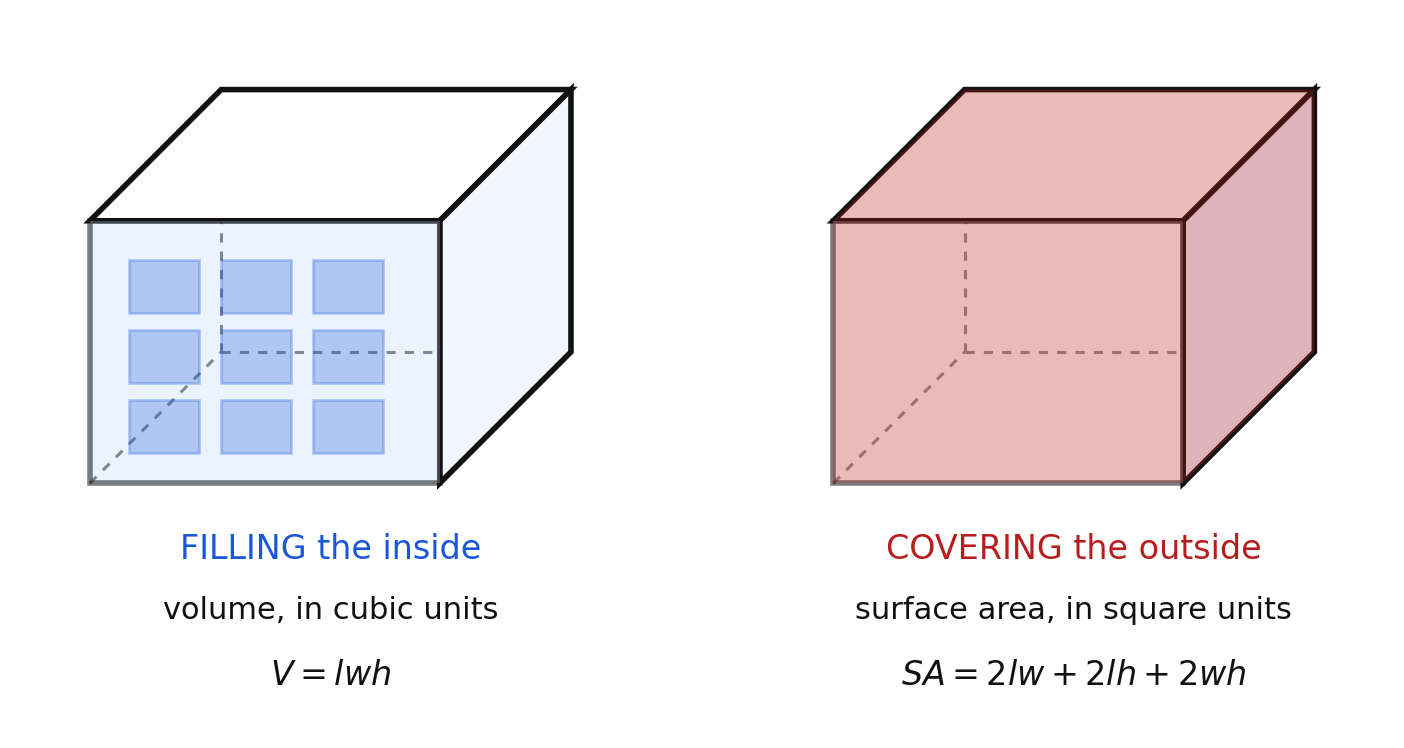
Volume is the amount of space inside a solid — how much it holds if you fill it. We measure volume by counting how many unit cubes fit inside. A unit cube is one unit long, one unit wide, and one unit tall, and its volume is one cubic unit.
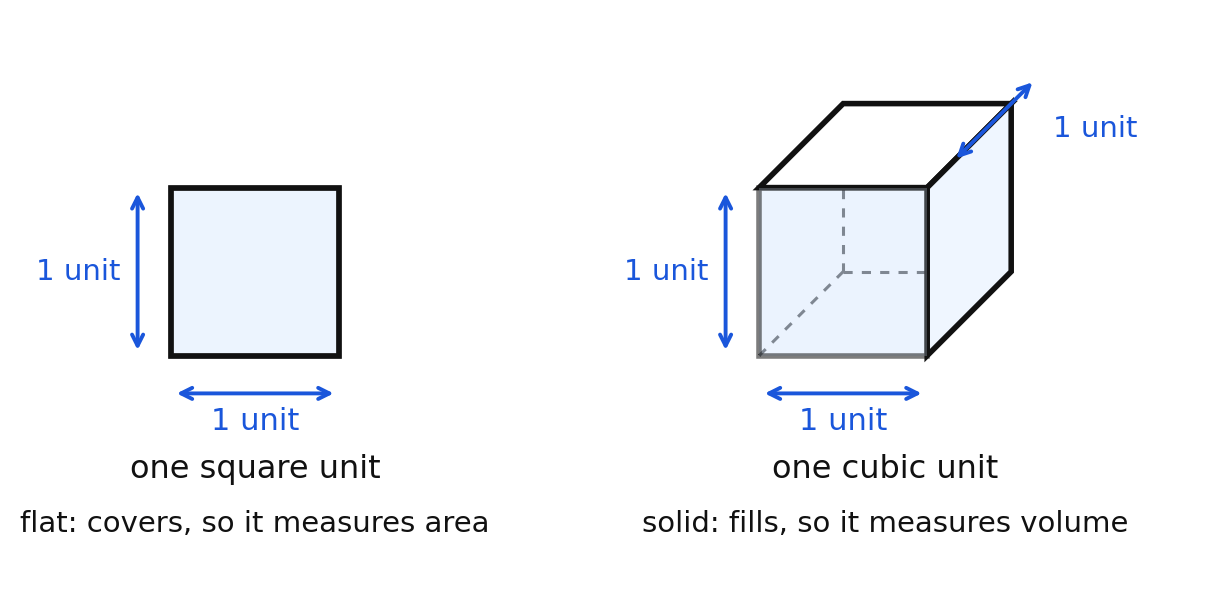
That picture is worth pausing on, because it explains the exponent you will write on every answer in this lesson. A square unit is flat: it covers. A cubic unit is solid: it fills. Since filling takes three measurements — length, width, and height — the unit carries a small 3, as in cm, read "cubic centimeters."
From prism to cylinder
In Grade 6 you found the volume of a rectangular prism by multiplying length times width times height. There is a second way to say the same thing, and it is the way that will carry over to cylinders. Group the first two factors:
Here is the area of the base — the flat face the solid stands on. So the volume of a rectangular prism is the area of its base times its height. Read it as a sentence: cover the bottom, then stack that covering all the way up.
A right cylinder is a solid with two parallel congruent circular bases joined by a curved surface, with the bases lined up directly above one another so the side is perpendicular to the base. A soup can, a roll of coins, and a water tank are all right cylinders.
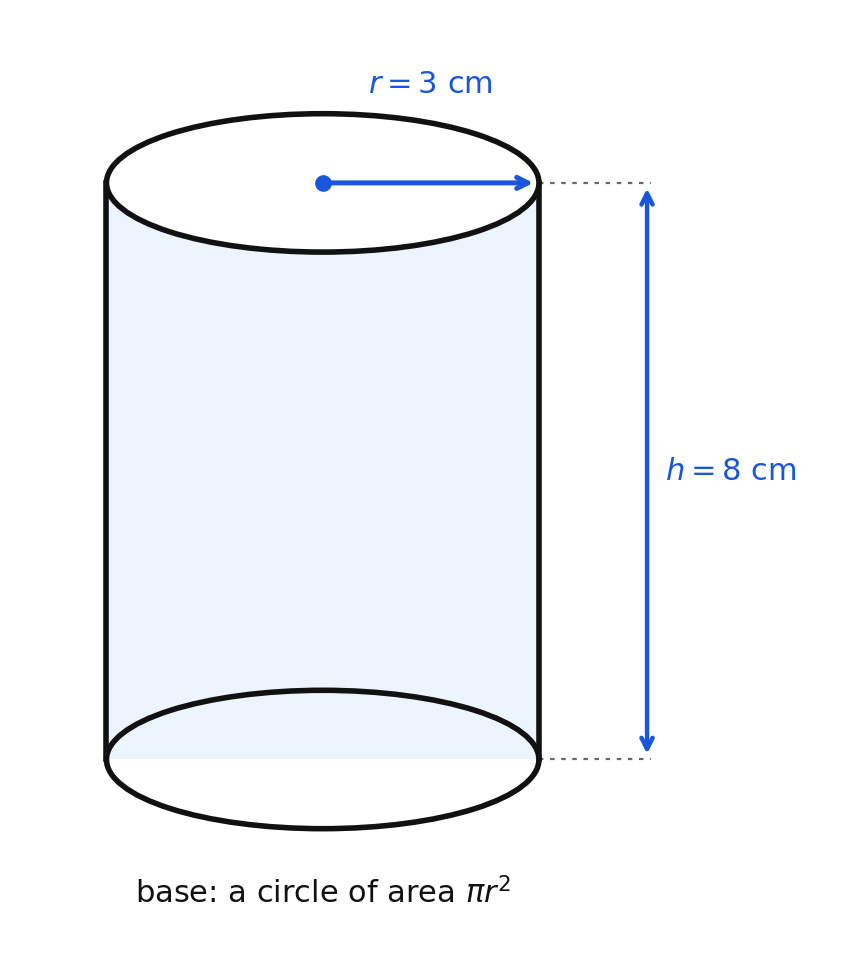
The radius is the distance from the center of a base to its edge, and the height is the distance between the two bases.
Developing the formula
Take a stack of identical coins. One coin is a very short cylinder. Stack six of them and you have a taller cylinder with the same circular base.
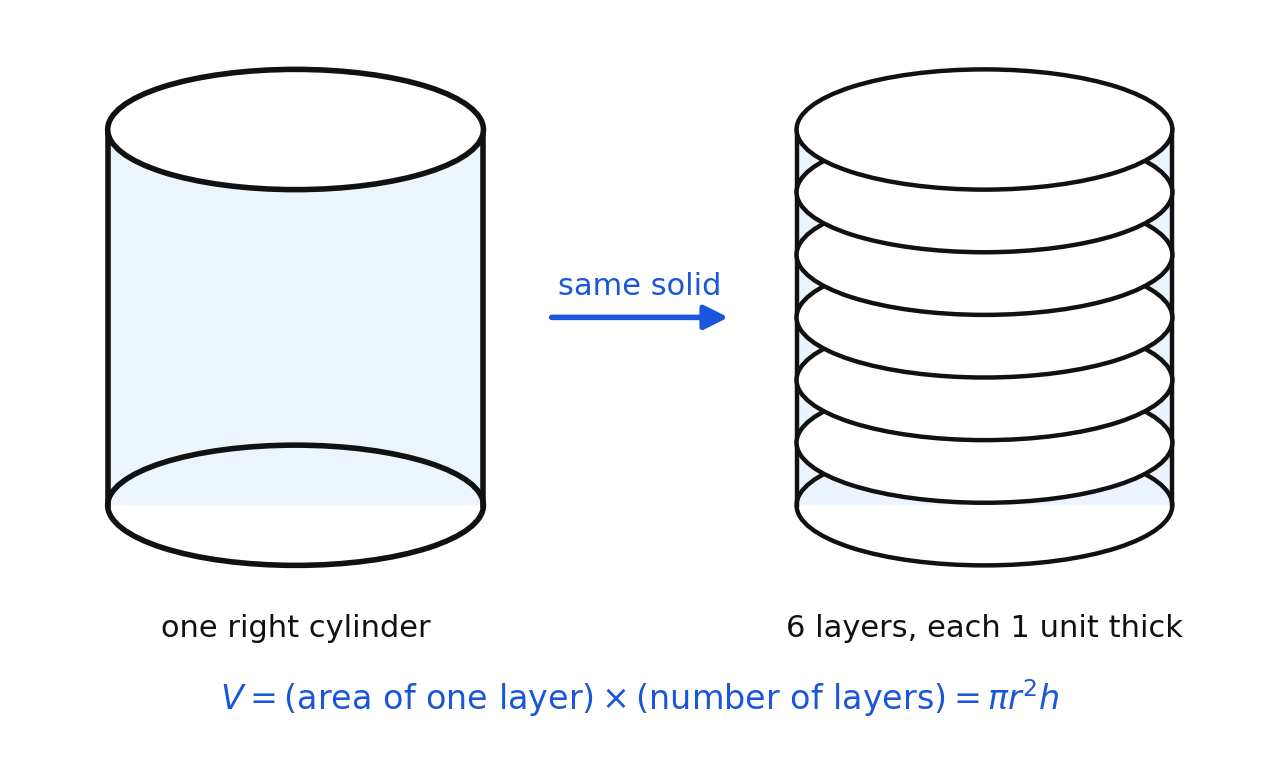
Each layer is one unit thick, so each layer contributes exactly one "layer's worth" of volume — the area of the circular base, counted once for each unit of height. Six layers, six times the base area. That is the same "cover the bottom, then stack it up" idea as the prism, and it gives
The only new thing about a cylinder is the shape of its base. Its base is a circle, and from Grade 6 the area of a circle is . Substituting for :
The volume of a right cylinder is pi times the radius squared times the height.
Using the formula carefully
Three habits prevent almost every error in this lesson.
- Square the radius first, then multiply. In , the exponent attaches only to . For and : first, so . Multiplying by before squaring is a different, wrong number.
- Check whether you were handed the radius or the diameter. The diameter is the full distance across, and . A can with in has in. Using as the radius makes the volume four times too big.
- Write cubic units. is an area in square units, and multiplying by a height in units gives cubic units.
Worked examples
Example 1 — Volume from the radius and height
Find the volume of a right cylinder with radius cm and height cm.
Approximating: .
Answer: cm, or about cm
Example 2 — Volume when the diameter is given
A can has diameter in and height in. Find its volume.
First halve the diameter: in.
Approximating: .
Answer: in, or about in
Example 3 — A wide, short cylinder
Find the volume of a right cylinder with radius ft and height ft.
Approximating: .
Answer: ft, or about ft
Example 4 — A cylinder in context
A cylindrical rain barrel has radius m and height m. How much water does it hold when full?
Holding water is a filling question, so this is volume.
Approximating: .
Answer: m, or about m
Example 5 — Working backward to a height
A cylinder has radius cm and volume cm. Find its height.
Substitute what you know and undo the multiplication.
Because appears on both sides, it divides out, and the height is exact — no approximation needed.
Answer: cm
Guided practice
Give each volume exactly in terms of and then approximately, using .
- A right cylinder has radius cm and height cm. Copy and complete: cm.
- Find the volume of a right cylinder with radius in and height in.
- A right cylinder has diameter m and height m. Find the radius first, then the volume.
- Find the volume of a right cylinder with radius ft and height ft.
- A cylinder has base area cm and height cm. Use to find its volume.
Independent practice
Give each volume exactly in terms of and then approximately, using .
- Radius cm, height cm.
- Diameter in, height in.
- Radius m, height m.
- Radius ft, height ft.
- A cylinder has radius in and volume in. Find its height. (Give an exact answer; no approximation is needed.)
- Application. A soup can is a right cylinder with radius cm and height cm. How much soup does it hold when full?
- Reasoning. Explain why the volume of a cylinder is measured in cubic units, using the two parts of the formula and in your explanation.
Exit ticket 12.1
- Find the volume of a right cylinder with radius in and height in.
- Find the volume of a right cylinder with diameter cm and height cm.
- A cylinder has base area m and height m. Find its volume.
- A cylinder has diameter cm and height cm. Dana wrote cm. Find her error and give the correct volume, exactly and approximately.
Lesson 12.2 — Surface Area of a Rectangular Prism (and Nets)
What surface area measures
Surface area is the total area of all the faces of a solid — the amount of material it takes to cover the outside with no gaps and no overlaps. Because it is a total of areas, surface area is always measured in square units.
A rectangular prism is a solid with six rectangular faces. Every face has a matching opposite face congruent to it, which is why the six faces come in three pairs.
Unfolding the solid: the net
The fastest way to see all six faces at once is to cut along some edges and flatten the box. The flat pattern you get is called a net. A net folds back up into the solid, so its total area is the surface area.
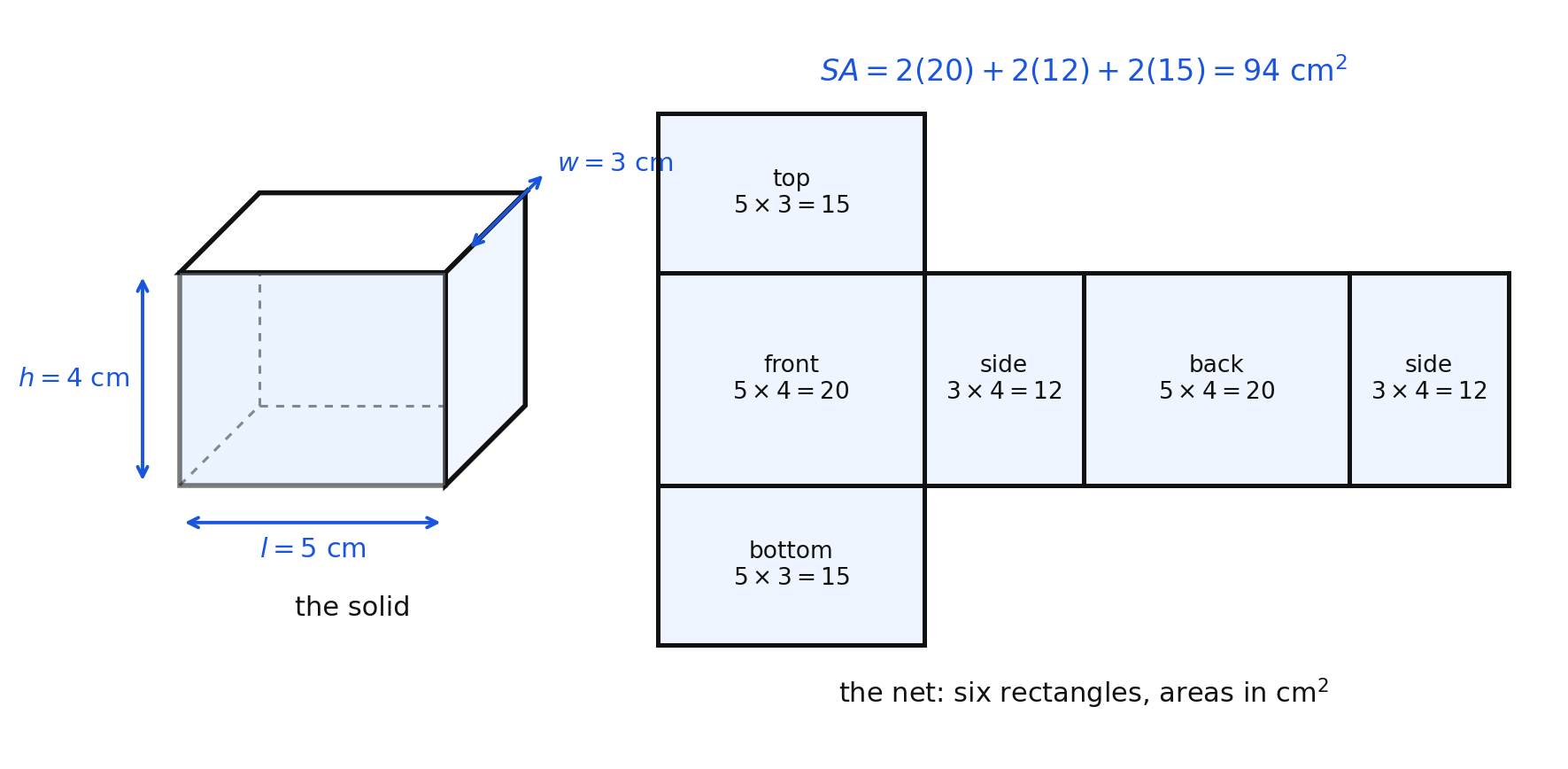
Look at the net and count the pairs for a prism with length cm, width cm, and height cm:
- Top and bottom, each cm
- Front and back, each cm
- Two sides, each cm
Adding all six, and grouping each pair:
That count is the formula. In general,
which you can also write as . The two forms are the same arithmetic; the second is usually faster because you add the three face areas first and double once at the end.
The cube is a special case
A cube is a rectangular prism whose length, width, and height are all equal. If the edge length is , all six faces are squares, so
Reading a net you did not draw
When a problem hands you a net, do not hunt for , , and . Just find the area of every rectangle in the net and add them. A net has six rectangles for a rectangular prism, and they will fall into three matching pairs.
When the solid is open
Some real containers are missing a face — an aquarium with no lid, a box with the top cut off. For those, add only the faces that are actually there. An open-top box has a bottom and four sides, so its surface area is . Read the problem carefully enough to know which faces to count.
Worked examples
Example 1 — Surface area from three dimensions
Find the surface area of a rectangular prism with cm, cm, and cm.
Answer: cm
Example 2 — A cube
Find the surface area of a cube with edge length in.
Answer: in
Example 3 — Reading a net
A net is made of two rectangles, two rectangles, and two rectangles, measured in feet. Find the surface area of the prism it folds into.
Answer: ft
Example 4 — Surface area in context
A gift box measures in by in by in. How much wrapping paper is needed to cover it exactly, with no overlap?
Covering is a surface area question.
Answer: in
Example 5 — An open-top box
A box with no lid is in long, in wide, and in tall. Find the area of cardboard it takes to build it.
Count the bottom once and the four sides.
Answer: in
Guided practice
- A prism is cm by cm by cm. Copy and complete: cm.
- Find the surface area of a cube with edge length in.
- Find the surface area of a prism that is ft by ft by ft.
- Find the surface area of a prism that is m by m by m.
- A net is made of two rectangles, two rectangles, and two rectangles, in inches. Find the surface area of the prism.
Independent practice
- Find the surface area of a prism that is cm by cm by cm.
- Find the surface area of a cube with edge length ft.
- Find the surface area of a prism that is in by in by in.
- Find the surface area of a prism that is m by m by m.
- A prism is cm by cm by cm. List the areas of the three different face shapes in its net, say how many of each there are, and then give the surface area.
- Application. An aquarium with no lid is ft long, ft wide, and ft tall. How much glass does it take to build, counting the bottom and the four sides?
- Reasoning. Explain why surface area is measured in square units and not cubic units, and explain how a net makes that obvious.
Exit ticket 12.2
- Find the surface area of a prism that is in by in by in.
- Find the surface area of a cube with edge length cm.
- A net is made of two rectangles, two rectangles, and two rectangles, in feet. Find the surface area.
- For a prism that is in by in by in, Owen wrote in. Find his error and give the correct surface area.
Lesson 12.3 — Surface Area of a Right Cylinder
Unrolling a can
A cylinder has no flat faces around its side, so at first there seems to be nothing to unfold. But peel the paper label off a soup can and lay it flat. It is a rectangle. Add the two circular ends and you have the complete net of a cylinder: two circles and one rectangle.
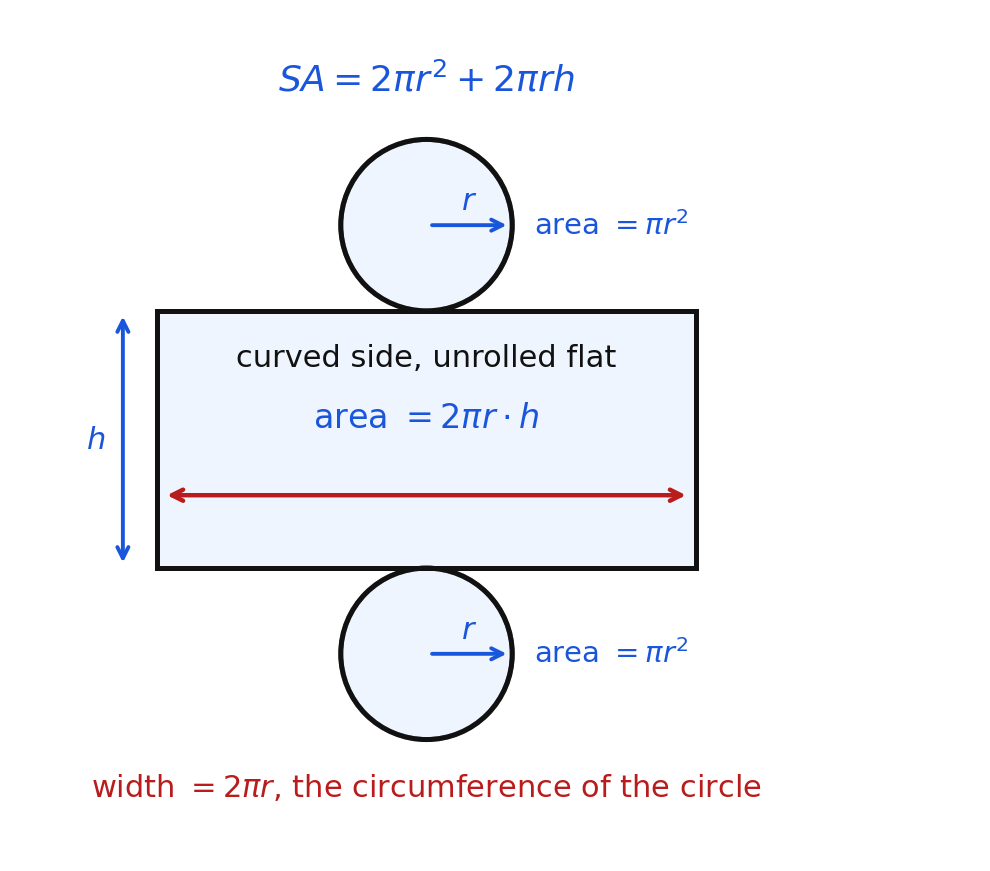
The rectangle is where the thinking happens. Its height is just the height of the cylinder. Its width is the distance the label travels once around the can — and going once around a circle is the circumference, which from Grade 6 is . So the rectangle is wide and tall. In the figure the rectangle really is drawn about times as wide as the circle's radius, because that is what means.
Building the formula
Add up the three pieces of the net:
- Two circular bases, each of area , contributing
- One rectangle of area (width)(height) , contributing
The rectangle alone has a name: the area of the curved side is the lateral area, . When a problem asks about a label, a wrapper, or the paint on the side only, you want the lateral area and not the whole surface area.
Keeping the two terms straight
Both terms begin with , which makes them easy to blur together. Keep them apart by remembering what each one is for:
- — the two flat lids. It has an because a circle's area does.
- — the wrap-around side. It has an because the label is as tall as the can.
Also note that both terms are areas even though and are lengths: is a length times a length, and is a length times a length. Square units, every time.
Worked examples
Example 1 — Full surface area
Find the surface area of a right cylinder with radius cm and height cm.
Approximating: .
Answer: cm, or about cm
Example 2 — A small cylinder
Find the surface area of a right cylinder with radius in and height in.
Approximating: .
Answer: in, or about in
Example 3 — Surface area from a diameter
A cylinder has diameter ft and height ft. Find its surface area.
Halve the diameter first: ft.
Approximating: .
Answer: ft, or about ft
Example 4 — Lateral area only
How much paper is in a label that wraps once around a can of radius cm and height cm, covering the side but not the ends?
A label is the rectangle of the net, so use the lateral area.
Approximating: .
Answer: cm, or about cm
Example 5 — An open-top cylinder
A cylindrical cup with no lid has radius in and height in. Find the area of material used to make it.
One circle for the bottom, plus the side.
Approximating: .
Answer: in, or about in
Guided practice
Give each answer exactly in terms of and then approximately, using .
- Radius m, height m. Copy and complete: m.
- Find the surface area of a cylinder with radius cm and height cm.
- A cylinder has diameter in and height in. Find the radius first, then the surface area.
- Find the lateral area only of a cylinder with radius ft and height ft.
- Find the surface area of a cylinder with radius cm and height cm.
Independent practice
Give each answer exactly in terms of and then approximately, using .
- Radius m, height m.
- Radius in, height in.
- Diameter cm, height cm.
- Find the lateral area only of a cylinder with radius ft and height ft.
- A bucket with no lid has radius in and height in. Find the area of material used to make it.
- Application. A label wraps once around a can of radius cm and height cm, covering the side but not the ends. Find the area of the label, and also give the two dimensions of the flat rectangle it is cut from.
- Reasoning. Explain why the rectangle in a cylinder's net has width . What would go wrong in the formula if you used as the width instead?
Exit ticket 12.3
- Find the surface area of a cylinder with radius cm and height cm.
- Find the surface area of a cylinder with diameter in and height in.
- Find the lateral area only of a cylinder with radius m and height m.
- A cylinder has radius cm and height cm. Malik answered cm for its surface area. Name the part of the net he forgot and give the correct surface area.
Lesson 12.4 — Volume or Surface Area? Deciding from the Problem
One question decides it
Real problems rarely say "find the volume." They say "how much juice fits" or "how much paint do we need." So before you pick a formula, ask one question:
Is this about the inside or the outside?
Inside — filling, holding, pouring, packing, capacity. That is volume, in cubic units.
Outside — covering, wrapping, painting, labeling, building from sheet material. That is surface area, in square units.
Words that tip you off
| Wording in the problem | What it is asking for | Units |
|---|---|---|
| how much water it holds; capacity; how much sand fills it | volume | cubic |
| how much wrapping paper; how much paint; how much cardboard | surface area | square |
| how many cubic feet of concrete | volume | cubic |
| how much sheet metal to build the can | surface area | square |
| how much cereal is in the box | volume | cubic |
| the label around the can | surface area (lateral only) | square |
The tipoff words help, but the underlying question is always inside-or-outside. A phrase you have never seen before will still sort itself if you ask that.
Units are the double check
The unit on your answer is a second, independent way to test whether you chose correctly. If a question asks how much paint and your answer says ft, you found the wrong thing — paint covers, so the answer must be in square feet. Getting into the habit of writing the unit before you look at your number will catch the mistake while it is still cheap to fix.
The procedure
First, decide inside or outside. Then, name the solid — prism or cylinder. Then, choose the matching formula from the four you now know:
Finally, check that the unit on your answer matches the decision you made in the first step.
Worked examples
Example 1 — Deciding without computing
A crew will paint the outside of a shipping crate. Volume or surface area?
Painting covers the outside.
Answer: Surface area, in square units.
Example 2 — Deciding without computing
A tank will be filled with water. Volume or surface area?
Filling is about the inside.
Answer: Volume, in cubic units.
Example 3 — Decide, then compute (prism)
How much cardboard is needed to make a closed box that is in by in by in?
Cardboard covers the outside, so this is surface area.
Answer: Surface area; in
Example 4 — Decide, then compute (cylinder)
How much sand fills a cylindrical container with radius ft and height ft?
Filling is volume.
Approximating: .
Answer: Volume; ft, or about ft
Example 5 — Same solid, two different questions
A closed cylindrical tin has radius in and height in. (a) How much tea fits inside? (b) How much metal forms the tin?
Part (a) is inside, part (b) is outside.
Answer: (a) in, or about in; (b) in, or about in
Guided practice
For each item, first write volume or surface area, then compute. Give cylinder answers exactly in terms of and then approximately, using .
- Wrapping paper to cover a closed box that is in by in by in.
- Water held by a cylindrical tank with radius m and height m.
- Cereal that fills a box measuring in by in by in.
- Foil to cover a closed cylinder completely, radius in and height in.
- Concrete that fills a cylindrical post hole with radius ft and depth ft.
Independent practice
- For each situation write volume or surface area and name the units you would use. a) Painting the outside of a shipping crate, measured in feet b) Filling a swimming pool with water, measured in meters c) Sheet metal needed to build a can, measured in centimeters d) Grain a silo can hold, measured in feet
- A box is in by in by in. Find the gift wrap needed to cover it exactly.
- The same box is in by in by in. Find how much rice fills it.
- A cylinder has radius in and height in. Find how much juice it holds.
- The same cylinder has radius in and height in. Find the metal needed to make it, top and bottom included.
- Application. A cylindrical watering trough is open at the top, with radius ft and height ft. a) How much water does it hold? b) How much metal does it take to build, counting the bottom and the curved side?
- Reasoning. A classmate hands you an answer of cm but cannot remember what the question was. What kind of question must it have been, and how do you know?
Exit ticket 12.4
- Volume or surface area: how much wrapping paper covers a shoebox?
- A cereal box is in by in by in. How much cereal fills it?
- A closed cardboard tube is a cylinder with radius in and height in. How much cardboard does it take?
- A student says a room needs cm of paint. Explain what is wrong with that answer without doing any arithmetic.
Lesson 12.5 — How Changing One Dimension Changes the Volume
Changing exactly one measurement
A rectangular prism has three measured attributes: length, width, and height. In this lesson exactly one of them changes and the other two stay put. That restriction matters. Everything below is about changing one attribute, not about resizing the whole box.
The factor is the number the attribute is multiplied by. This chapter uses only the factors , , , , , and for volume.
Compute before, compute after, compare
Start with a prism that is cm by cm by cm and double its height.
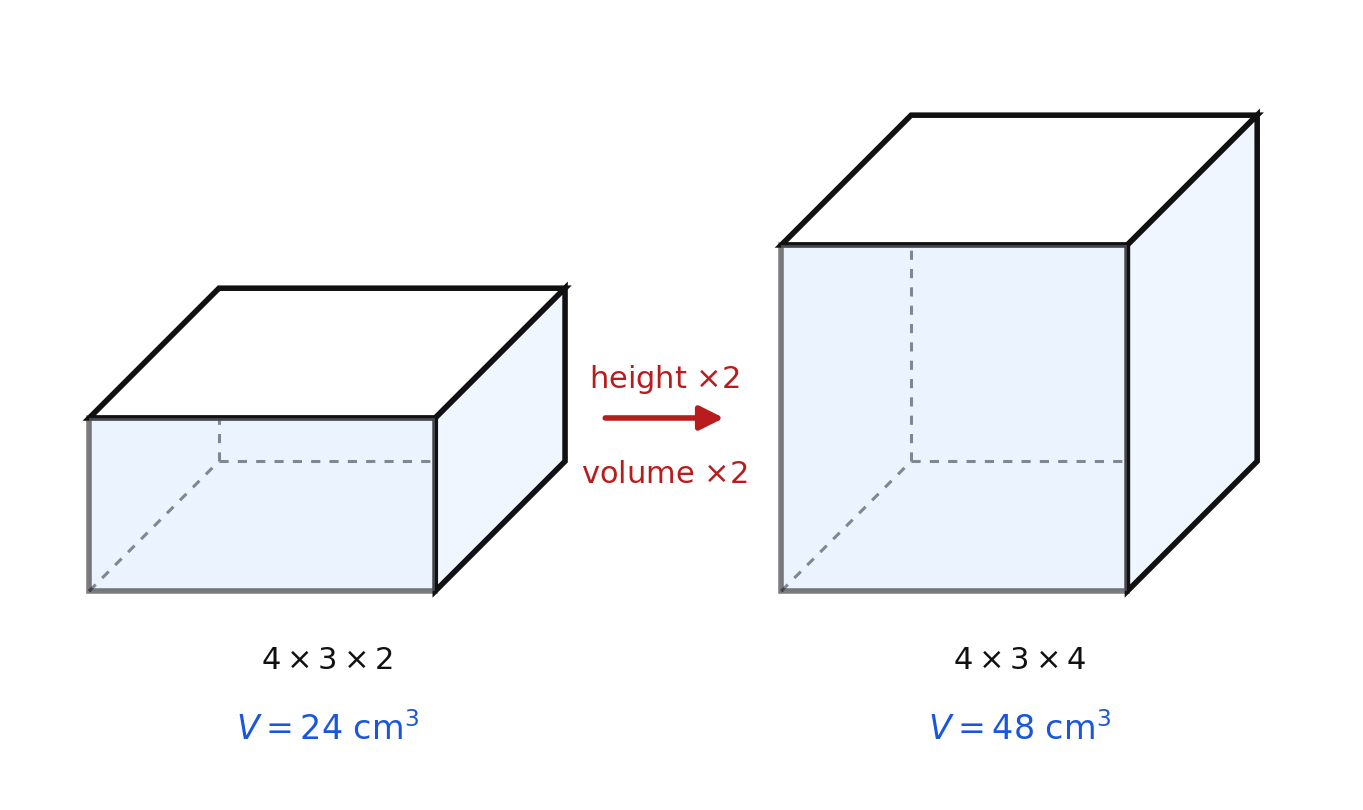
The volume went from to . Comparing them, , so the volume was multiplied by .
Now halve a length instead. Start with a prism that is in by in by in.
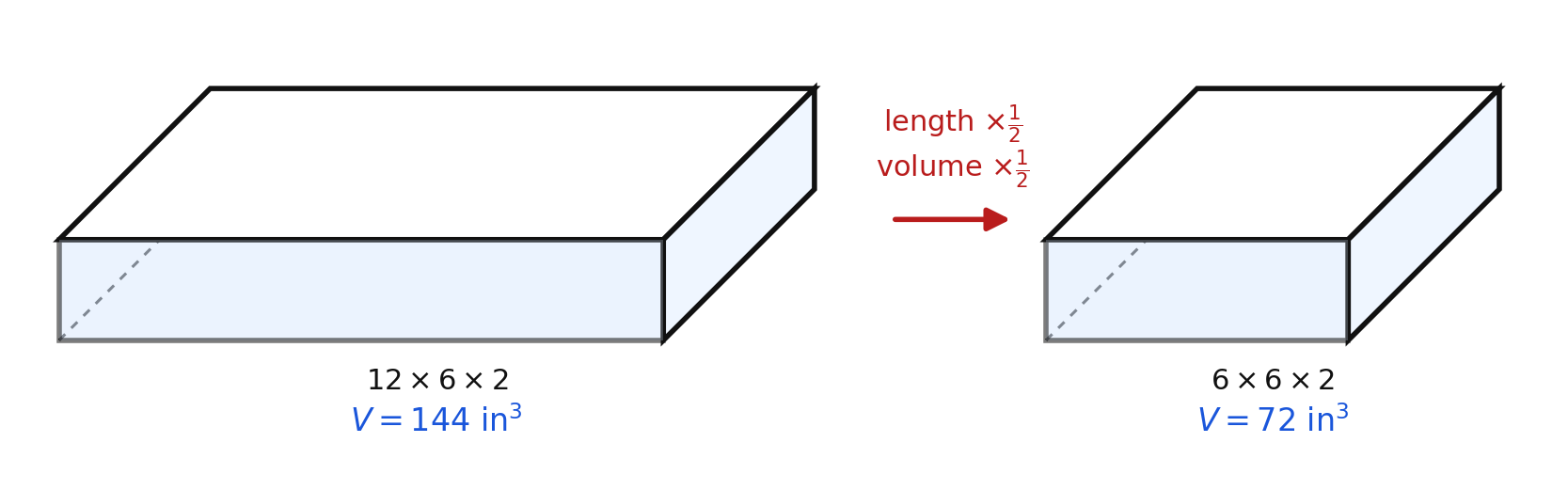
And , so the volume was multiplied by .
The pattern, and why it happens
Try a third case on your own — multiply the width of a prism by and compare cm with cm — and the pattern is unmistakable.
Multiplying one measured attribute of a rectangular prism by a factor multiplies the volume by that same factor.
The formula shows why. Volume is a product of the three attributes:
If the height becomes , then
The factor simply slides out in front. Nothing else in the product changed, so nothing else in the answer changed. The same argument works for a factor of , or , or any of the six factors, and for whichever attribute you pick.
This gives you a shortcut. If you know the original volume, you do not need the individual dimensions at all: multiply the volume by the factor. A prism of volume ft whose width is multiplied by has volume ft.
A caution worth stating plainly. This rule is about changing one attribute. If you multiplied all three attributes by , the volume would grow much more than twofold — that is a different situation, and it is not what this standard or this chapter asks about. Read carefully to confirm that only one measurement changes.
Worked examples
Example 1 — Doubling a height
A prism is cm by cm by cm. The height is multiplied by . Find the new volume and the factor by which the volume changed.
Answer: cm; the volume was multiplied by
Example 2 — Tripling a length
A prism is cm by cm by cm. The length is multiplied by .
Answer: cm; the volume was multiplied by
Example 3 — Halving a width
A prism is cm by cm by cm. The width is multiplied by .
Answer: cm; the volume was multiplied by
Example 4 — A change in context
A storage bin is in by in by in. A shorter model keeps the same base but multiplies the height by . How much does the shorter bin hold?
And is of , as the rule predicts.
Answer: in, which is of the original volume
Example 5 — Using the shortcut
A prism has volume ft. One measured attribute is multiplied by . Find the new volume.
Multiply the volume by the same factor.
Answer: ft
Guided practice
Items 65–68 all start from the same prism: cm by cm by cm, with volume cm. For each, find the new volume and state the factor by which the volume changed.
- The height ( cm) is multiplied by .
- The length ( cm) is multiplied by .
- The width ( cm) is multiplied by .
- The height ( cm) is multiplied by .
- A prism has volume in. Its width is multiplied by . Find the new volume using the shortcut.
- A prism has volume m. Its length is multiplied by . Find the new volume.
Independent practice
- A prism is cm by cm by cm. The height is multiplied by . Give the volume before, the volume after, and the factor.
- A prism is in by in by in. The length is multiplied by . Give the volume before, the volume after, and the factor.
- A prism is ft by ft by ft. The width is multiplied by . Give the volume before, the volume after, and the factor.
- A prism has volume m. One measured attribute is multiplied by . Find the new volume.
- A prism has volume in. One measured attribute is multiplied by . Find the new volume.
- Application. A shipping box is in by in by in and is filled with packing peanuts. The manufacturer doubles the height and keeps everything else the same. How many cubic inches does the new box hold, and how many more cubic inches is that?
- Reasoning. Use the formula to explain why multiplying just the width by multiplies the volume by . Then explain why the answer would be different if all three dimensions were multiplied by .
Exit ticket 12.5
- A prism is cm by cm by cm. The height is multiplied by . Find the new volume.
- The same prism is cm by cm by cm. The length is multiplied by . Find the new volume.
- A prism has volume ft. One measured attribute is multiplied by . Find the new volume.
- Rosa says that doubling the length of a prism makes the volume times as large. Explain her error and state the correct factor.
Lesson 12.6 — How Changing One Dimension Changes the Surface Area
A rule that does not carry over
Lesson 12.5 ended with a clean rule: change one attribute by a factor, and the volume changes by that same factor. It is tempting to expect surface area to behave the same way. It does not, and finding out why is the point of this lesson.
For surface area this chapter uses only the factors and .
Compute before, compute after, compare
Take the same prism as before, cm by cm by cm, and double the height.
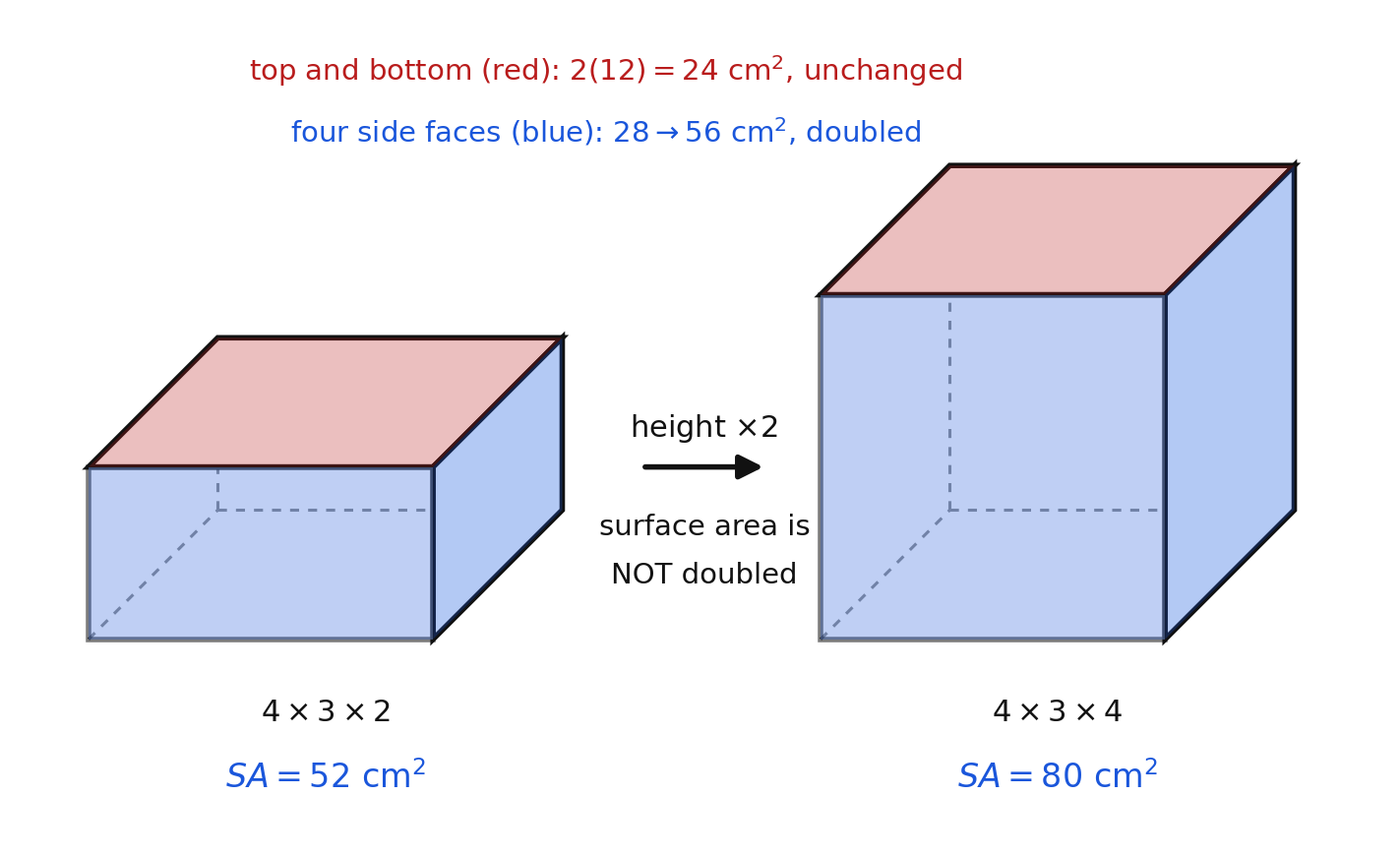
The volume doubled from to cm. The surface area went from to cm — bigger, certainly, but is not . Surface area was not doubled.
Why the two behave differently
Sort the six faces into the ones the change touches and the ones it does not.
- Top and bottom, each cm. Neither one involves the height, so doubling the height leaves them exactly as they were: cm before and after.
- The four side faces, two of cm and two of cm, total cm. Every one of them involves the height, so all four double: cm.
New total: cm. That matches, and it explains the whole thing.
Part of the surface doubles and part of it does not, so the total grows by less than a factor of 2. With volume, the changed attribute appears in the single product , so the factor applies to all of it. With surface area, the changed attribute appears in only four of the six faces.
The same reasoning runs backward for a factor of : the four faces that touch the changed attribute are halved, the two that do not are unchanged, and the total shrinks by less than half.
What you can and cannot say
You can say: the surface area increases when an attribute is doubled and decreases when it is halved; the faces containing that attribute change by the factor; the faces not containing it stay the same; and you can always report the exact new surface area by recomputing.
You cannot say: the surface area is multiplied by the factor. There is no single number that works for every prism here, which is exactly why each problem asks you to compute both values and compare.
Worked examples
Example 1 — Doubling a height
A prism is cm by cm by cm. The height is multiplied by . Find the surface area before and after, and describe the effect.
Answer: cm becomes cm, an increase of cm. The surface area increased but did not double.
Example 2 — Doubling the height of a cube
A cube has edge length in. Its height is multiplied by , making it a prism. Find the surface area before and after.
Answer: in becomes in, an increase of in; not doubled
Example 3 — Halving a length
A prism is in by in by in. The length is multiplied by . Find the surface area before and after.
Answer: in becomes in, a decrease of in. It went down, but not by half — half of would be in.
Example 4 — A change in context
A carton is in by in by in. A taller version doubles the height. How much cardboard does each version take?
Answer: in before and in after, an increase of in
Example 5 — Which faces changed
For the prism in Example 1, show the surface area total as two parts and explain which part changed.
Answer: The four side faces doubled from to cm; the top and bottom stayed at cm, so the total cm is less than twice cm.
Guided practice
Items 82–85 all start from the same prism: cm by cm by cm, with surface area cm.
- The height ( cm) is multiplied by . Find the new surface area, and state whether it doubled.
- The length ( cm) is multiplied by . Find the new surface area, and state whether it doubled.
- The width ( cm) is multiplied by . Find the new surface area, and state whether it was halved.
- In item 82, which two faces did not change, and what is the area of each?
- A cube has edge length in. Its height is multiplied by . Find the surface area before and after.
Independent practice
- A prism is cm by cm by cm. The height is multiplied by . Give the surface area before and after.
- A prism is in by in by in. The length is multiplied by . Give the surface area before and after.
- A prism is ft by ft by ft. The width is multiplied by . Give the surface area before and after.
- A cube has edge length m. One edge is multiplied by . Give the surface area before and after.
- A cube has edge length in. Its height is multiplied by . Give the surface area before and after, then state whether the surface area doubled and by how much it actually changed.
- Application. A shipping box is in by in by in. To save cardboard, the maker multiplies the height by . How much cardboard does each box take, and how much is saved per box?
- Reasoning. Explain why doubling one attribute doubles the volume of a prism but does not double its surface area. Name which faces change and which do not.
Exit ticket 12.6
Items 94–96 all use the prism cm by cm by cm.
- The height ( cm) is multiplied by . Give the surface area before and after.
- Starting again from , the length ( cm) is multiplied by . Give the surface area before and after.
- Give the volume of the prism and the volume after the height is multiplied by . State the factor for the volume, and state whether the surface area changed by that same factor.
- In one or two sentences, explain why volume and surface area respond differently when one attribute is doubled.
Chapter 12 Review
Vocabulary. volume · cubic unit · base area · right cylinder · radius · diameter · surface area · square unit · face · net · rectangular prism · cube · lateral area · circumference · factor
Unless a problem says otherwise, give answers containing exactly in terms of and then approximately, using .
Part A — Volume of right cylinders (7.MG.1a)
- Find the volume of a right cylinder with radius cm and height cm.
- Find the volume of a right cylinder with diameter in and height in.
- Find the volume of a right cylinder with radius m and height m.
- A cylinder has radius ft and volume ft. Find its height. (Exact answer; no approximation needed.)
- Application. A cylindrical drum has radius ft and height ft. How much water does it hold when full?
Part B — Surface area of rectangular prisms and right cylinders (7.MG.1b)
- Find the surface area of a prism that is cm by cm by cm.
- Find the surface area of a cube with edge length in.
- Find the surface area of a cylinder with radius m and height m.
- Find the surface area of a cylinder with diameter in and height in.
- A net is made of two rectangles, two rectangles, and two rectangles, in feet. Find the surface area of the prism it folds into.
- Find the lateral area only of a cylinder with radius cm and height cm.
Part C — Volume or surface area? (7.MG.1c)
- For each situation write volume or surface area and name the units. a) Paint for the outside of a closed crate, measured in feet b) Water that fills a cylindrical tank, measured in meters c) Paper for a label around a can, measured in centimeters d) Soil that fills a rectangular planter box, measured in inches
- A box is in by in by in. How much paint covers its outside?
- The same box is in by in by in. How much sand fills it?
- Application. A cylindrical barrel is open at the top, with radius ft and height ft. a) How much water does it hold? b) How much metal forms the bottom and the curved side?
Part D — Changing one attribute: volume (7.MG.1d)
- A prism is cm by cm by cm. The height is multiplied by . Give the volume before and after.
- A prism is in by in by in. The length is multiplied by . Give the volume before and after.
- A prism has volume m. One measured attribute is multiplied by . Find the new volume.
- Application. A grain bin is ft by ft by ft. A larger model multiplies the width by . How much does each bin hold, and how much more does the larger one hold?
Part E — Changing one attribute: surface area (7.MG.1e)
- A prism is cm by cm by cm. The height is multiplied by . Give the surface area before and after.
- A prism is in by in by in. The length is multiplied by . Give the surface area before and after.
- A cube has edge length ft. One edge is multiplied by . Give the surface area before and after.
Part F — Mixed application and reasoning
- A closed cylindrical can has radius in and height in. a) Find its volume. b) Find its surface area. c) Which of the two answers tells you how much juice the can holds?
- Explain why volume is reported in cubic units while surface area is reported in square units. Use the formulas and in your explanation.
- A student claims that doubling the height of a prism doubles both the volume and the surface area. Use the prism cm by cm by cm to show that one part of the claim is right and the other is wrong. Show all four values.
- Explain how the net of a cylinder shows where each term of comes from.
- Application. A cylindrical can has radius cm and height cm. a) How much does it hold? b) How much paper is in a label that covers the side only? c) Which of your two answers is measured in cm, and why?
Standards coverage check — Chapter 12
| Knowledge and Skill of 7.MG.1 | Where it is taught | Where it is practiced |
|---|---|---|
| a) Develop the volume formula for right cylinders using concrete objects, diagrams, and formulas, and solve problems including contextual ones | 12.1 (stacked-layer derivation, Figures 1 and 2) | Items 1–16; 50, 52, 53, 57, 59a; Review 98–102, 112a, 120a, 124a |
| b) Develop the surface area formulas for rectangular prisms and right cylinders using concrete objects, two-dimensional diagrams, nets, and formulas, and solve problems including contextual ones | 12.2 (prism net, Figure 3), 12.3 (cylinder net, Figure 4) | Items 17–48; 49, 55, 58, 59b; Review 103–108, 112b, 120b, 123, 124b |
| c) Determine whether a contextual problem about a rectangular prism or right cylinder is an application of volume or of surface area | 12.4 (Figures 5 and 9) | Items 49–64; 11, 27, 43; Review 109–112, 120c, 121, 124c |
| d) Describe how the volume of a rectangular prism is affected when one measured attribute is multiplied by , , , 2, 3, or 4, including contextual situations | 12.5 (Figures 6 and 8) | Items 65–81; Review 113–116, 122 |
| e) Describe how the surface area of a rectangular prism is affected when one measured attribute is multiplied by or 2, including contextual situations | 12.6 (Figure 7) | Items 82–97; Review 117–119, 122 |
Constraint check. Every volume scaling factor used in Lesson 12.5 and in Review Part D is one of , , , , , or , as the standard requires. Every surface area scaling factor used in Lesson 12.6 and in Review Part E is or . In both lessons exactly one measured attribute changes at a time.
Scope note. The volume of a rectangular prism is Grade 6 content () and is used here as the starting point for the cylinder derivation and for the scaling work, but it is not re-taught. Circumference and area of a circle come from Grade 6 () and are used directly in the cylinder formulas. Cones, pyramids, spheres, and oblique cylinders are outside 7.MG.1 and are deliberately absent.