Chapter 11 — One- and Two-Step Inequalities
Standard: 7.PFA.4 — The student will write and solve one- and two-step linear inequalities in one variable, including problems in context, that require the solution of a one- and two-step linear inequality in one variable.
By the end of this chapter you will be able to:
- Apply properties of real numbers and the addition, subtraction, multiplication, and division properties of inequality to solve one- and two-step inequalities in one variable, with rational coefficients and numeric terms (7.PFA.4a)
- Investigate and explain how the solution set of a linear inequality is affected by multiplying or dividing both sides by a rational number less than zero (7.PFA.4b)
- Represent solutions to one- or two-step linear inequalities in one variable algebraically and graphically using a number line (7.PFA.4c)
- Write one- or two-step linear inequalities in one variable to represent a verbal situation, including situations in context (7.PFA.4d)
- Create a verbal situation in context given a one- or two-step linear inequality in one variable (7.PFA.4e)
- Solve problems in context that require the solution of a one- or two-step inequality (7.PFA.4f)
- Identify numerical values that are part of the solution set of a given one- or two-step linear inequality in one variable (7.PFA.4g)
- Describe the differences and similarities between solving linear inequalities in one variable and solving linear equations in one variable (7.PFA.4h)
Lessons: 11.1 What an Inequality Says · 11.2 Solving One-Step Inequalities · 11.3 The Reversal Rule: Multiplying or Dividing by a Negative · 11.4 Solving Two-Step Inequalities · 11.5 Graphing Solution Sets on a Number Line · 11.6 Writing and Solving Inequalities in Context
What changes from Chapter 10. Chapter 10 solved two-step equations, each with exactly one solution. This chapter keeps almost every move you learned there and changes two things: the answer is usually a whole range of numbers rather than a single one, and one particular move — multiplying or dividing by a negative number — behaves differently than it did for equations. That second change is the heart of the chapter. Coefficients and numeric terms remain rational, and every inequality is one- or two-step in one variable.
Lesson 11.1 — What an Inequality Says
From "equals" to "compares"
An inequality is a mathematical sentence that compares two expressions instead of claiming they are equal. Four symbols do the comparing.
| Symbol | Read it as | Example | Example says |
|---|---|---|---|
| is less than | is somewhere strictly below 7 | ||
| is greater than | is somewhere strictly above 7 | ||
| is less than or equal to | is 7 or below | ||
| is greater than or equal to | is 7 or above |
The symbols and are called strict inequalities: the boundary number itself is shut out. The symbols and are called inclusive inequalities: the boundary number is allowed in. That single difference decides a great many answers in this chapter, so read the symbol before you do anything else.
A memory hook that never fails: the symbol opens toward the larger amount. In the wide end faces the 8. In the wide end faces the , because really is the larger number.
The solution set
A solution of an inequality is a value for the variable that makes the sentence true. The solution set is the collection of every value that makes it true.
This is where an inequality parts company with an equation. The equation is satisfied by one number. The inequality is satisfied by 4, by 5, by 4.001, by 97, by — by infinitely many numbers, no list of which could ever be complete.
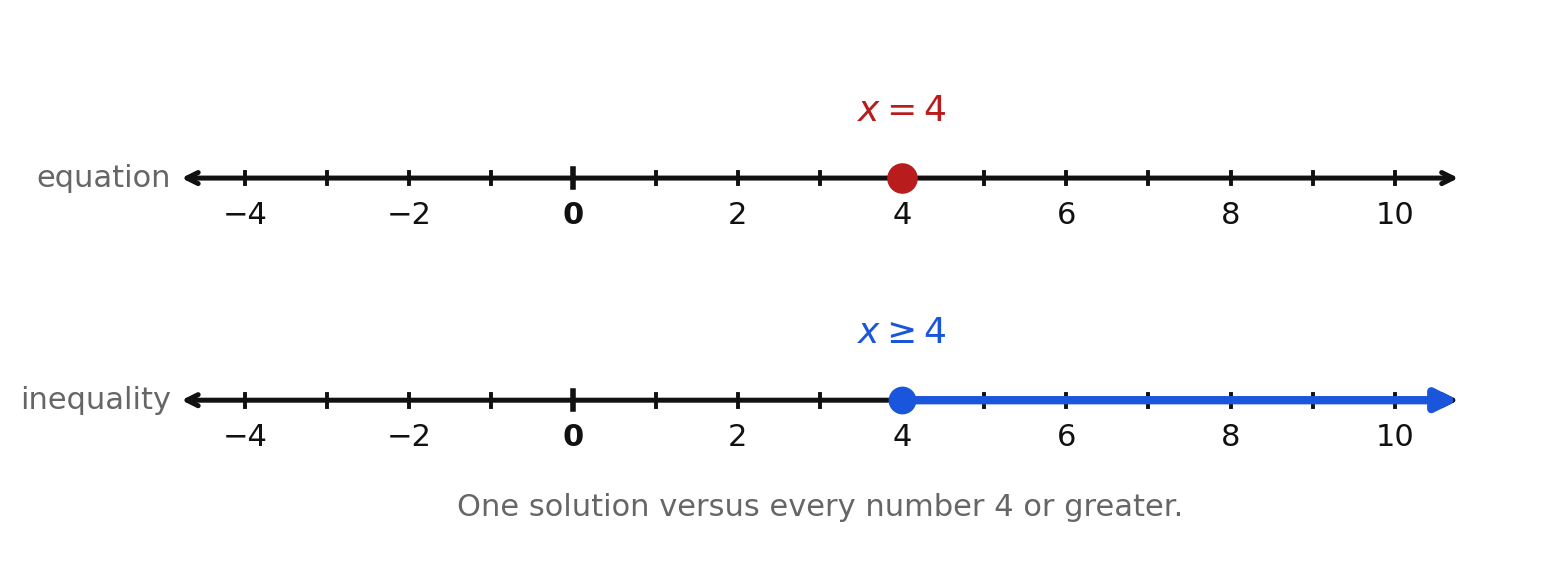
One point versus a shaded ray. Whenever you are asked what the difference between an equation and an inequality is, this picture is the answer.
Testing a value
Because a solution set is infinite, you cannot check an inequality by listing its members. You check it one value at a time, exactly the way you checked equations: substitute the value into the original inequality, simplify each side, and decide whether the resulting number sentence is true.
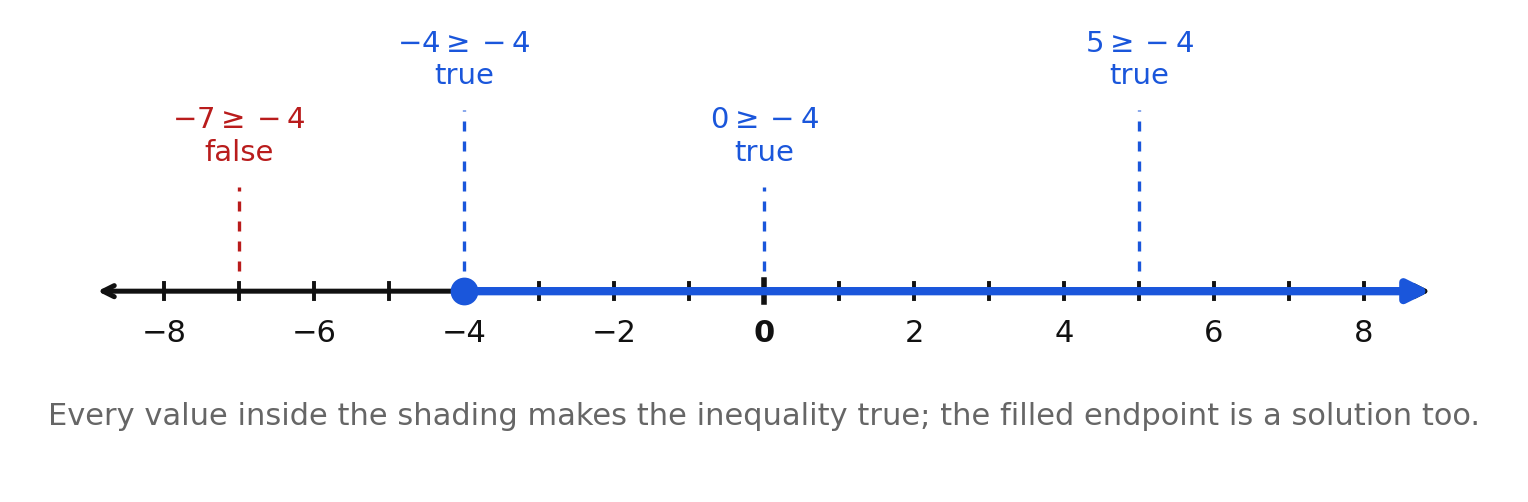
Three habits make a test trustworthy:
- Substitute into the original inequality. Checking against a line you wrote partway through will only confirm your own mistakes.
- Simplify each side separately, following the order of operations.
- Read the symbol honestly at the boundary. The value passes the test because is true. That same value fails , because is false. A number is either strictly greater or exactly equal; it cannot be both.
Words that become symbols
Situations rarely arrive wearing a symbol. They arrive as phrases, and the phrases have to be translated exactly.
| Phrase | Symbol | Is the boundary included? |
|---|---|---|
| at least, no fewer than, a minimum of | yes | |
| at most, no more than, a maximum of | yes | |
| more than, greater than, exceeds, over | no | |
| fewer than, less than, under, below | no |
"A ride requires riders to be at least 48 inches tall" allows a rider who is exactly 48 inches, so it is . "A ride requires riders to be over 48 inches" turns that rider away, so it is . The two sentences differ by exactly one person, and the symbol is what records the difference.
Worked examples
Example 1 — Reading the boundary correctly
Is a solution of ? Is it a solution of ?
Substitute into each. For : the sentence becomes , which is false, since 5 is not strictly greater than itself. For : the sentence becomes , which is true, since 5 is equal to itself.
Answer: No for ; yes for .
Example 2 — Choosing the solutions from a list
Which values from , , , , and are solutions of ?
Substitute each value into the original inequality.
Notice that lands exactly on the boundary and survives, because the symbol is inclusive.
Answer: , , and
Example 3 — Translating phrases
Write each statement as an inequality, using for the number.
A number is at most 12. "At most" means 12 is the ceiling and 12 itself is allowed: .
A number exceeds . "Exceeds" is strict: .
A number is no fewer than 40. "No fewer than" means 40 is the floor and 40 is allowed: .
Answer: ; ;
Example 4 — A boundary value that fails
Is a solution of ? Is it a solution of ?
Substitute 7 into the left side of the original inequality: .
For the strict version, the sentence becomes , which is false. For the inclusive version, it becomes , which is true.
Answer: No for ; yes for .
Example 5 — Why the list never ends
Name five solutions of , including one negative number and one that is not an integer. Then explain why no list can be complete.
Any number strictly below 3 works: , , , , and are five of them. Check the closest one: is true. Check a value that should fail: is false, so 3 itself is not a solution.
No list can be complete because between any two numbers below 3 there is always another one — , then , and so on forever.
Answer: , , , , ; the solution set is infinite, so it is described rather than listed.
Guided practice
- Write in words what says. Then state whether is a solution and why.
- Test each value in and state true or false: , , .
- Which values from , , , and are solutions of ? Show each substitution.
- A backpack is allowed to weigh at most 15 pounds. Using for the weight in pounds, write an inequality, and state whether a 15-pound backpack is allowed.
Independent practice
- Write each statement in symbols using . a) is greater than b) is at least 9 c) is no more than 2.5 d) is fewer than 30
- Decide whether each value is a solution. Show the substitution. a) in b) in c) in d) in
- Which values from , , , , and are solutions of ?
- Give three different solutions of , including one that is not an integer and one that is negative.
- Explain why has infinitely many solutions while has exactly one.
- Application. A roller coaster requires riders to be at least 48 inches tall. Using for a rider's height in inches, write an inequality for the heights that are allowed, and decide whether a rider who is exactly 48 inches tall may ride.
- Reasoning. Explain the difference between and by naming the one number that is a solution of one but not the other.
- Error analysis. Miguel says is a solution of because . Explain his mistake, state whether 4 is a solution, and name an inequality with the same left side for which 4 would be a solution.
Exit ticket 11.1
- Write "a class has no more than 28 students" as an inequality using .
- Which values from , , , and are solutions of ?
- Is a solution of ? Show the substitution.
- Explain in your own words what the solution set of an inequality is and why it is usually described rather than listed.
Lesson 11.2 — Solving One-Step Inequalities
The properties that authorize each move
To solve an inequality is to rewrite it, one legal move at a time, until the variable stands alone and the solution set is plain to read. The moves have names, and naming the one you are using turns a step you remember into a step you can justify.
Addition property of inequality. If you add the same number to both sides of an inequality, the comparison stays true in the same direction. Subtraction property of inequality. If you subtract the same number from both sides, the comparison stays true in the same direction. Multiplication property of inequality. If you multiply both sides by the same positive number, the comparison stays true in the same direction. Division property of inequality. If you divide both sides by the same positive number, the comparison stays true in the same direction.
The word positive in the last two is doing real work, and Lesson 11.3 is devoted to what happens without it. Everything in this lesson multiplies and divides by positive numbers only.
Two properties of real numbers work quietly underneath, exactly as they did for equations. The additive inverse property says a number plus its opposite is zero, which is what makes a constant term disappear. The multiplicative identity property says , which is what leaves the variable standing alone after you divide by its coefficient.
Why adding the same amount is safe
Suppose . Add 5 to each side and you get , still true. Add to each side and you get , still true.
Adding the same number to both sides slides both numbers the same distance in the same direction along the number line. Sliding two points together never changes which one is on the left. That is the whole reason the direction of the symbol survives.
Why multiplying by a positive number is safe
Suppose . Multiply each side by 3 and you get , still true. Multiply each side by and you get , still true.
Multiplying by a positive number stretches or shrinks the distance from zero but never moves a point across zero. The order survives.
The procedure for one step
- Decide what has been done to the variable: something added, something subtracted, something multiplied, or something divided.
- Undo it on both sides, naming the property.
- Check with two tests. Substitute a value from inside your solution set into the original inequality and confirm it is true. Then substitute a value from outside and confirm it is false. One test alone can be passed by a wrong answer; two tests, one from each side, cannot.
That two-sided check is the single best habit in this chapter. Get in the practice now, while the algebra is easy.
Worked examples
Example 1 — Undoing addition
Solve .
Subtract 7 from both sides (subtraction property of inequality).
Check inside: gives , and is true. Check outside: gives , and is false.
Answer:
Example 2 — Undoing subtraction
Solve .
Add 4 to both sides (addition property of inequality).
Check inside: gives , and is true, so the boundary belongs to the set. Check outside: gives , and is false.
Answer:
Example 3 — Undoing multiplication
Solve .
Divide both sides by 5, a positive number, so the direction is unchanged (division property of inequality).
Check inside: gives , and is true. Check outside: gives , and is false.
Answer:
Example 4 — Undoing division
Solve .
The variable has been divided by 3, so multiply both sides by 3, a positive number (multiplication property of inequality).
Check inside: gives , and is true. Check outside: gives , and is false, which is correct, since the symbol is strict.
Answer:
Example 5 — A fractional coefficient
Solve .
Multiply both sides by the reciprocal , which is positive, so the direction is unchanged.
Check inside: gives , and is true. Check outside: gives , and is false.
Answer:
Guided practice
- Solve , naming the property you use, then test one value from inside your solution set and one from outside.
- Solve and test the boundary value.
- Solve and test one value from inside and one from outside.
- Solve and test the boundary value.
Independent practice
- Solve. a) b) c) d)
- Solve. a) b) c) d)
- Solve , then rewrite your answer with the variable written first.
- Solve , then name three solutions, including one negative number.
- Solve and test one value from inside your solution set and one from outside.
- Application. A delivery van can carry at most 1{,}500 pounds of cargo. Each crate weighs 60 pounds. Using for the number of crates, write and solve an inequality, and state how many crates the van can carry given that crates come in whole numbers.
- Reasoning. Explain why solving uses the same first move as solving , and describe how the two answers differ.
- Error analysis. Nadia solves by dividing both sides by 2, writing . Identify her mistake, solve the inequality correctly, and use the test value to show that her answer includes numbers that are not solutions.
Exit ticket 11.2
- Solve and test the boundary value.
- Solve .
- Solve .
- Name the property of inequality you would use to solve , and give the solution.
Lesson 11.3 — The Reversal Rule: Multiplying or Dividing by a Negative
An experiment worth running yourself
Start with a statement everyone agrees is true:
Now multiply both sides by . The left side becomes and the right side becomes . Write down what you get and read it out loud:
Which symbol belongs there? On a number line, sits to the right of , so is the larger number. The true statement is
The direction reversed. This is not a rule someone invented to make algebra harder. It is a fact about what multiplying by a negative number does to the number line.
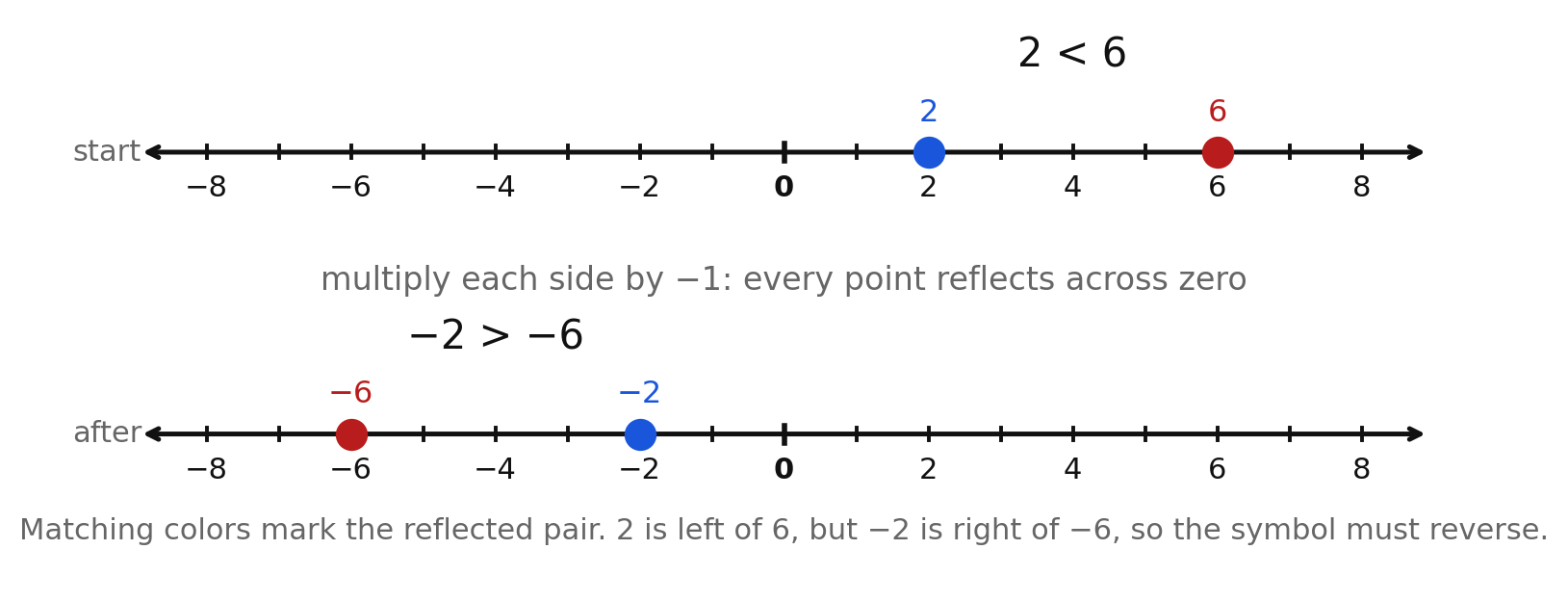
Multiplying by reflects every point across zero, the way a mirror does. A reflection turns left into right. Since was to the left of , its reflection must be to the right of the reflection . The order of the two numbers is reversed by the reflection itself, so the symbol has to be reversed too, or the sentence would become false.
Run the experiment with other numbers and the same thing happens every time.
| True statement | Multiply both sides by | Result | New symbol |
|---|---|---|---|
| and | |||
| and | |||
| and | |||
| and |
Division behaves identically, because dividing by and multiplying by are the same action written two ways.
Adding a negative is a completely different move
Here is the mistake that costs more points than any other in this chapter: seeing a minus sign anywhere and reversing the symbol out of habit.
Start again with and this time add to both sides. The left becomes and the right becomes . Is ? Yes — and the direction did not reverse.
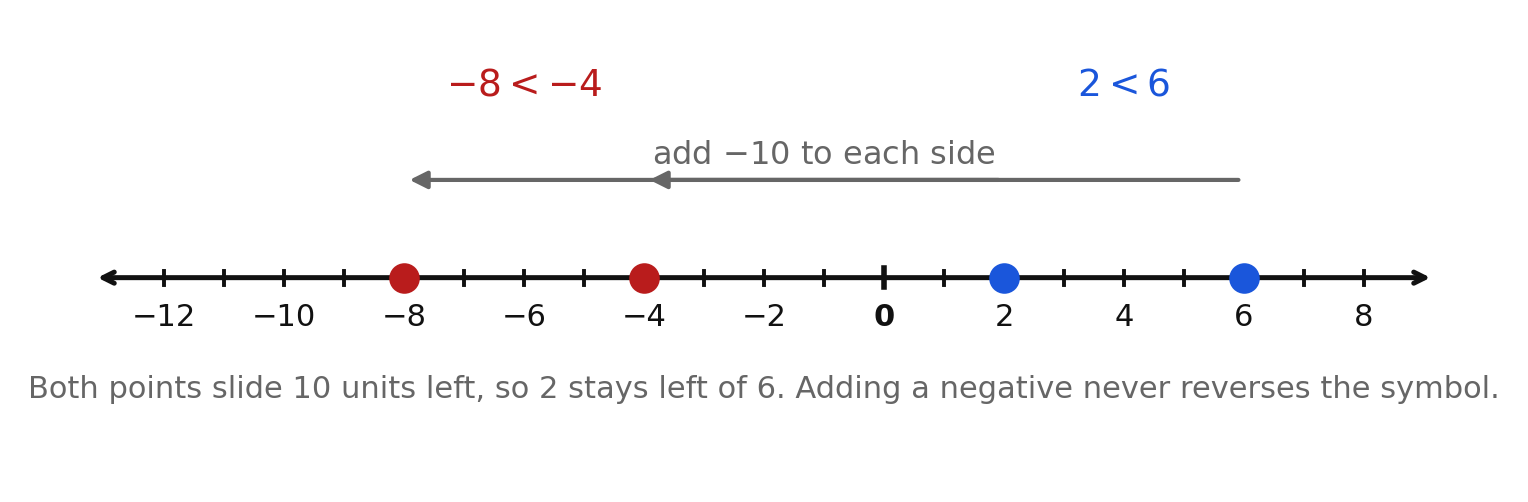
Adding a negative slides both points the same distance in the same direction. Sliding preserves which point is on the left. Multiplying by a negative reflects both points across zero. Reflecting swaps which point is on the left. Slide, and nothing changes; reflect, and everything about the order changes.
The reversal rule, stated precisely. When you multiply or divide both sides of an inequality by a negative number, reverse the direction of the inequality symbol. In every other case — adding any number, subtracting any number, multiplying or dividing by a positive number — the direction stays the same.
Two things that do not trigger the rule, no matter how many minus signs are on the page: adding or subtracting a negative number, and a negative number appearing by itself on one side.
The inequality has two minus signs in it and requires no reversal at all, because solving it means adding 9 to both sides. The inequality looks similar and does require a reversal, because solving it means dividing by . Ask one question every time: am I multiplying or dividing by a negative number? If the answer is no, leave the symbol alone.
Worked examples
Example 1 — Investigating with multiplication and division
Begin with the true statement . Multiply both sides by , then, starting over, divide both sides by . Write the true statement each time.
Multiplying: and . On the number line is to the right of , so the true statement is .
Dividing: and . On the number line is to the right of , so the true statement is .
Answer: and ; both directions reversed.
Example 2 — Adding a negative does not reverse
Begin with and add to both sides. Write the true statement.
and . On the number line is to the left of .
Answer: ; the direction did not change, because both numbers slid 12 units left together.
Example 3 — Dividing by a negative coefficient
Solve and graph the solution set.
Divide both sides by and reverse the symbol.
Check inside: gives , and is true. Check the boundary: gives , and is false, so is correctly excluded. Check outside: gives , and is false.
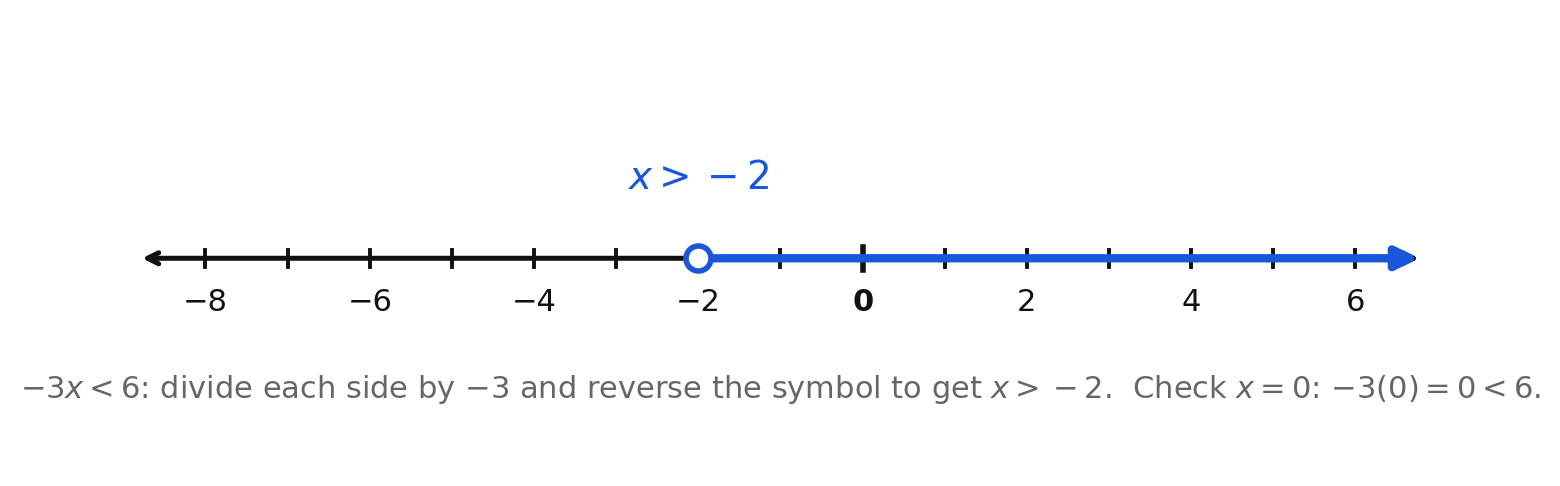
Answer:
Example 4 — Multiplying by a negative
Solve .
The variable has been divided by , so multiply both sides by and reverse the symbol.
Check the boundary: gives , and is true. Check outside: gives , and is false.
Answer:
Example 5 — The pair that separates sliding from reflecting
Solve and , and explain why only one of them reverses.
For , a negative number is being added, so undo it by adding 3 to both sides. No reversal.
Check the boundary: , and is true. Check outside: , and is false.
For , the variable is being multiplied by , so divide both sides by and reverse.
Check inside: gives , and is true, and indeed . Check outside: gives , which is false.
Answer: with no reversal; with a reversal. Only multiplication or division by a negative reverses the symbol.
Guided practice
- Start with the true statement . Multiply both sides by and write the resulting true statement.
- Start with the true statement . Divide both sides by and write the resulting true statement.
- Solve . Test and in the original inequality to confirm your answer.
- Solve . Test the boundary value and one value outside the solution set.
Independent practice
- Begin with the true statement . a) Add to both sides and write the true statement. b) Multiply both sides by and write the true statement. c) State which one reversed and why.
- Solve. a) b) c) d)
- Solve. a) b) c) d)
- Solve and test one value from inside your solution set and one from outside.
- For each move, state whether the direction of the symbol reverses and give the reason. a) subtract 8 from both sides b) divide both sides by c) add to both sides d) multiply both sides by
- Application. A submarine starts at the surface and descends 3 meters every second, so its elevation after seconds is meters. Write and solve an inequality for the number of seconds during which its elevation is below meters, and state the answer in a sentence.
- Reasoning. Begin with the true statement and multiply both sides by . Write the resulting true statement, then explain, using the positions of the numbers on a number line, why the direction had to reverse.
- Error analysis. Cleo solves and writes . Test and in the original inequality, explain what those two tests reveal about Cleo's answer, and give the correct solution.
Exit ticket 11.3
- Solve .
- Solve .
- Start with and multiply both sides by . Write the resulting true statement.
- Explain why subtracting a negative number from both sides does not reverse the direction of the symbol, but dividing both sides by a negative number does.
Lesson 11.4 — Solving Two-Step Inequalities
Everything from Chapter 10, plus one question
A two-step linear inequality in one variable has one of the forms
where , , and are rational numbers and . Two operations have been applied to the variable: multiplication by the coefficient , then addition of the constant term . Undoing them takes two moves, in the reverse of the order they were applied.
That is precisely the Chapter 10 procedure. The only addition is a question you ask at the second step.
- Name the coefficient and the constant term, signs included.
- Undo the addition or subtraction first. Add or subtract the constant term on both sides. The direction never changes at this step.
- Undo the multiplication or division second. Divide both sides by the coefficient, or multiply by its reciprocal. Ask: is that number negative? If it is, reverse the symbol. If it is not, leave it alone.
- Check twice — one value from inside the solution set and one from outside, both substituted into the original inequality.
Only the second undo can ever trigger a reversal, because only the second undo multiplies or divides. Knowing that keeps you from flipping the symbol at the wrong moment.
Where the boundary comes from
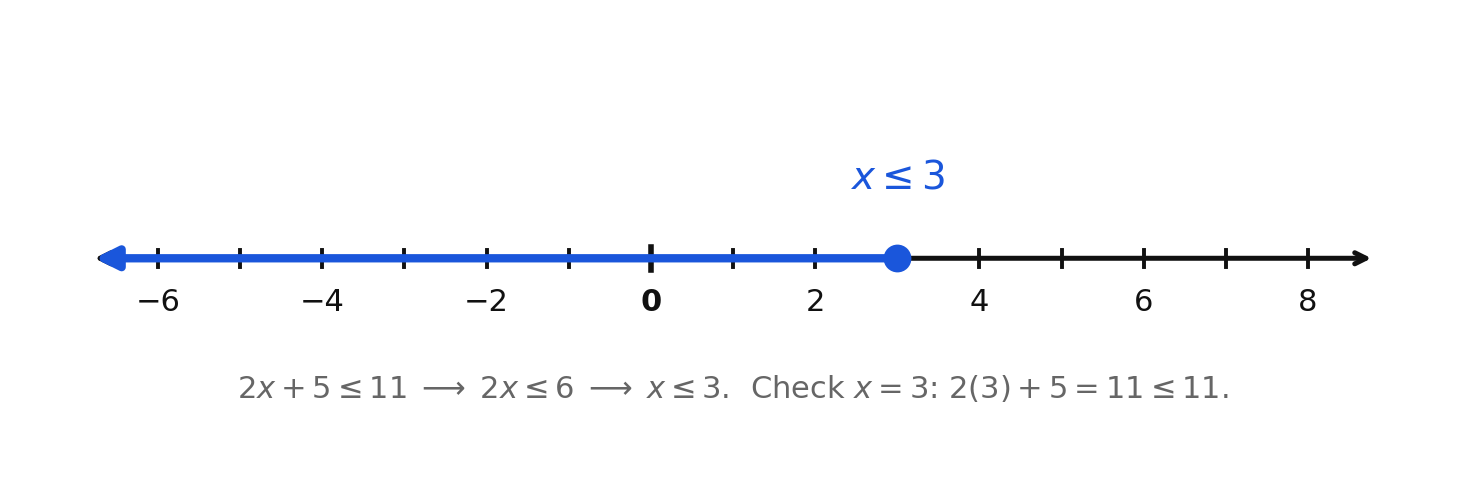
Something worth noticing: the boundary value of the solution set is exactly the solution of the matching equation. Solving gives , and the solution set of is everything from 3 downward. The equation locates the boundary; the inequality symbol then tells you which side of the boundary to keep and whether the boundary itself is included.
That relationship is a useful check. If your inequality answer has a different boundary number than the matching equation would, one of the two is wrong.
Worked examples
Example 1 — A positive coefficient
Solve .
Subtract 5 from both sides, then divide both sides by 2. Since 2 is positive, the direction stays the same.
Check the boundary: , and is true. Check outside: gives , and is false.
Answer:
Example 2 — A negative coefficient
Solve .
Subtract 7 from both sides. No reversal — this step only subtracts.
Now divide both sides by and reverse the symbol.
Check inside: gives , and is true. Check the boundary: gives , and is false, correctly excluding it. Check outside: gives , and is false.
Answer:
Example 3 — A fractional coefficient
Solve .
Add 3 to both sides, then multiply both sides by 4, which is positive.
Check the boundary: , and is true. Check outside: gives , and is false.
Answer:
Example 4 — The variable term written second
Solve .
The variable term is and the constant is 8. Subtract 8 from both sides, then divide by and reverse.
Check inside: gives , and is true. Check the boundary: gives , and is false. Check outside: gives , and is false.
Answer:
Example 5 — A fractional coefficient written as a fraction of
Solve .
Add 5 to both sides, then multiply both sides by the reciprocal , which is positive.
Check the boundary: , and is true. Check outside: gives , and is false.
Answer:
Guided practice
- Solve , naming the property used at each step, then test and in the original inequality.
- Solve and test the boundary value and one value outside the solution set.
- Solve . State the step at which the direction reverses, then test the boundary value.
- Solve and test and .
Independent practice
- Solve. a) b) c) d)
- Solve. a) b) c) d)
- Solve and state the solution exactly.
- Solve .
- Solve , then rewrite your answer with the variable written first.
- Application. A gym charges a $20 joining fee plus $12 per month. Marisol can spend at most $100 in all. Using for the number of months, write and solve an inequality, then state how many whole months she can afford and show the check for that number.
- Reasoning. Solve , then identify the exact step at which the direction of the symbol reverses and explain why it does not reverse at the other step.
- Error analysis. Theo solves correctly down to , then writes . Test in the original inequality, explain what the test reveals, and give the correct solution.
Exit ticket 11.4
- Solve .
- Solve .
- Solve .
- Describe one way that solving a two-step inequality is the same as solving a two-step equation, and one way it is different.
Lesson 11.5 — Graphing Solution Sets on a Number Line
Why a picture is the right representation
A solution set has infinitely many members, so it cannot be listed. It can be drawn. A number-line graph shows the whole set at once: where it starts, which way it runs, and whether the starting number is a member.
Every graph in this chapter has exactly three pieces of information in it, and every one of them comes straight from the inequality.
- The endpoint sits at the boundary number — the number the variable is being compared to once the variable stands alone.
- The circle at the endpoint is hollow or filled. Open circle for or ; closed circle for or . A hollow circle says this exact number is not a solution. A filled circle says this exact number is a solution.
- The shading runs in the direction of the solution set, with an arrowhead to show it never stops. Shade right for or ; shade left for or .
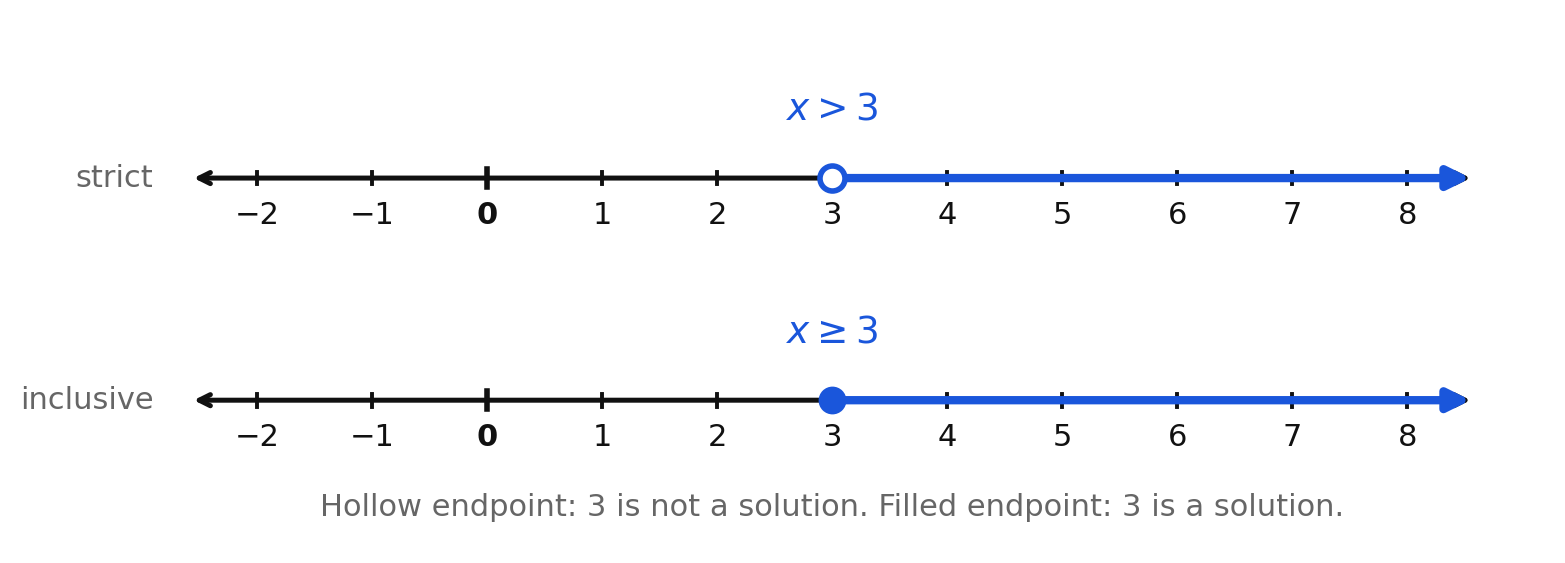
The two graphs above differ by a single point. In the top graph, 3 is not a solution, because is false. In the bottom graph, 3 is a solution, because is true. The circle is how the drawing records that fact.
The four shapes
With one boundary and two choices for each of the two remaining features, every inequality in this chapter graphs into one of four shapes.
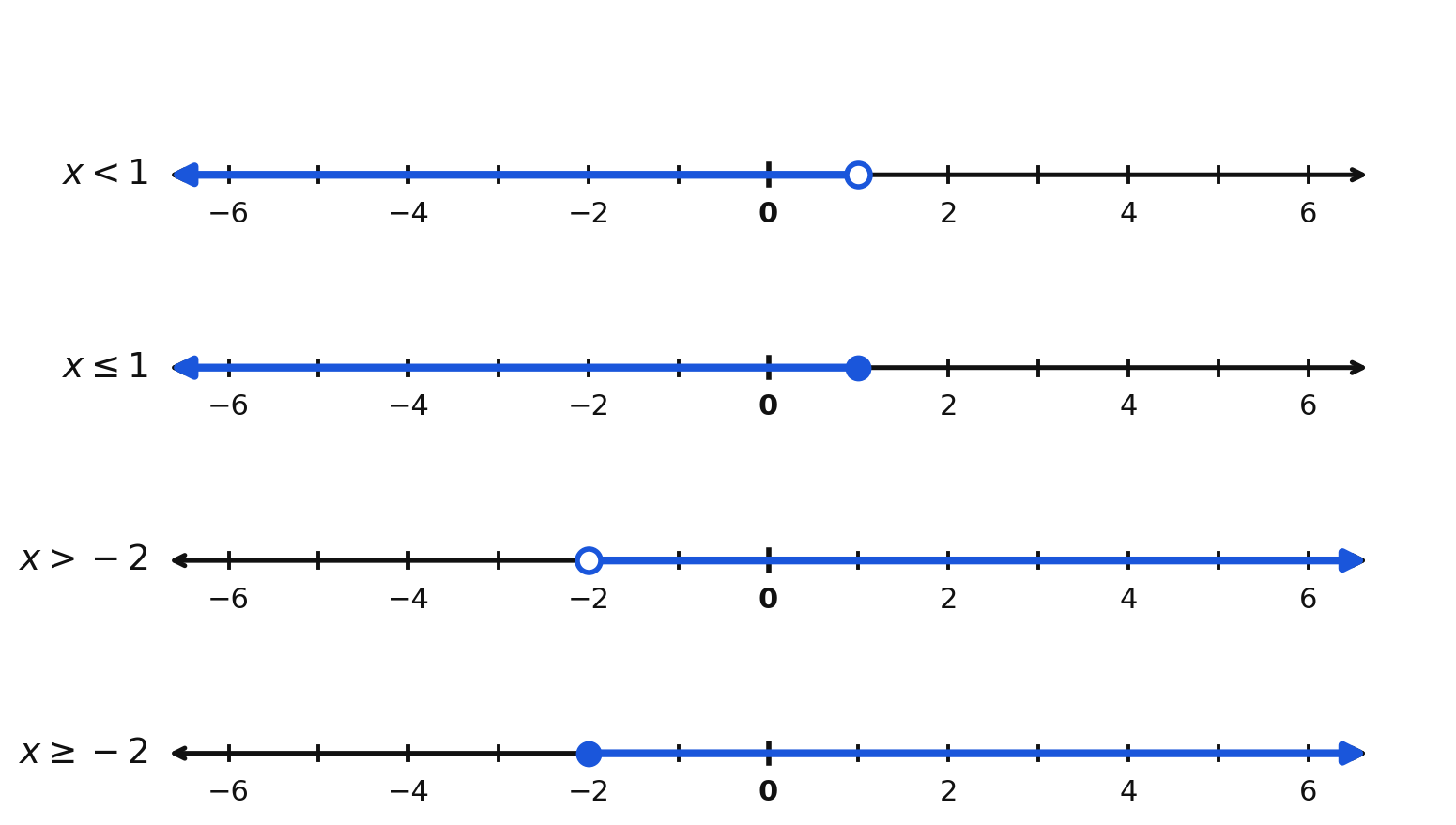
Learn to move in both directions. Given , you should be able to draw the second graph. Given the second graph, you should be able to write .
Write the variable first
The inequality says the same thing as , but only the second form is safe to graph directly, because in the second form the symbol points from the variable toward the boundary.
To rewrite, swap the two sides and swap the direction of the symbol, so that the wide end still faces the same quantity. Reading as "6 is greater than " and then as " is less than 6" is the same swap done in words.
Do this rewrite every time the variable ends up on the right. Graphing as though it were "" is a common and completely avoidable error.
Reading a graph back into symbols
Going from a drawing to an inequality reverses the three steps.
- Read the boundary number under the circle.
- Look at the circle: hollow means or ; filled means or .
- Look at the shading: right means or ; left means or .
A graph with a filled circle at shaded to the right is . To confirm, test a value inside — is true — and one outside — is false.
Worked examples
Example 1 — Graphing a strict inequality
Graph .
The boundary is 2. The symbol is strict, so the circle at 2 is open. The solution set is the numbers larger than 2, so shade to the right with an arrowhead.
Test: is true and lies inside the shading; is false and 2 sits under a hollow circle.
Answer: An open circle at 2 with shading to the right.
Example 2 — Graphing an inclusive inequality
Graph .
The boundary is . The symbol is inclusive, so the circle at is closed. The solution set is the numbers and below, so shade to the left with an arrowhead.
Test: is true, so the filled circle is right; is true and lies inside the shading; is false and 0 lies outside it.
Answer: A closed circle at with shading to the left.
Example 3 — Solve, then graph
Solve and graph .
The boundary is 3, the symbol is inclusive, and the solution set runs upward.
Check the boundary: , and is true. Check outside: gives , and is false.
Answer: , graphed with a closed circle at 3 and shading to the right.
Example 4 — Solve with a reversal, then graph
Solve and graph .
Divide both sides by and reverse the symbol.
Check inside: gives , and is true. Check the boundary: gives , and is false. Check outside: gives , which is false.
The graph runs left, even though the original inequality showed a symbol. The symbol in the original is not the direction of the graph; the symbol in the solved inequality is.
Answer: , graphed with an open circle at and shading to the left.
Example 5 — Reading a graph
A number line shows a closed circle at with shading to the right. Write the inequality, then decide which of , , and belong to the solution set.
Filled circle means inclusive; shading right means greater than. The inequality is .
Test each value: is false; is true; is true.
Answer: ; the solutions among those three are and .
Guided practice
- Graph . State the endpoint value, the circle type, and the shading direction.
- Graph . State the endpoint value, the circle type, and the shading direction.
- Solve and graph .
- Rewrite with the variable written first, then graph it.
Independent practice
- Graph each. a) b) c) d)
- Solve and graph. a) b)
- Solve and graph .
- Solve and graph .
- A number line shows an open circle at with shading to the right. Write the inequality, then name two values that belong to the solution set and one that does not.
- Application. A parking garage admits cars no taller than 6.5 feet. Using for a car's height in feet, write an inequality, graph it, and explain which part of your graph does not describe any real car.
- Reasoning. Explain why the graph of is a single point while the graph of is a ray, and describe what the mark at 3 shows in each picture.
- Error analysis. Owen graphs with an open circle at and shading to the right. Name both of his errors, use a test value to expose each one, and describe the correct graph.
Exit ticket 11.5
- Graph . State the endpoint value, the circle type, and the shading direction.
- Solve and graph .
- A number line shows a closed circle at 2 with shading to the left. Write the inequality.
- State the rule for when to use an open circle and when to use a closed circle, and explain why the rule is what it is.
Lesson 11.6 — Writing and Solving Inequalities in Context
From a situation to a symbol
Most real limits are inequalities, not equations. A budget is a ceiling, not an exact amount. A minimum height is a floor. A weight limit, a passing score, a goal to reach — all of them compare rather than equate.
Writing one follows a reliable path.
- Read the whole situation before writing anything.
- Name the unknown, with units. Write a full sentence: "let = the number of tickets." A variable with no definition is a guess.
- Find the per-unit amount and the fixed amount. Which number happens once, and which happens for every unit?
- Find the limit and its symbol. Use the phrase table from Lesson 11.1 to decide between , , , and . This is the step people rush, and it is the step that decides whether the boundary counts.
- Write, solve, and check — first by substituting into the inequality, then by retelling the story.
Do not trust keywords by themselves. In "shirts cost $12 each plus a $5 shipping fee, and Ana has at most $65," the $5 is added once to the whole order, not to the price of each shirt. The inequality is , not . Reading the action, then retelling the story from your inequality, catches this every time.
When the answer must be a whole number
Algebra does not know what your variable counts. It will hand you without caring that tacos come in whole numbers.
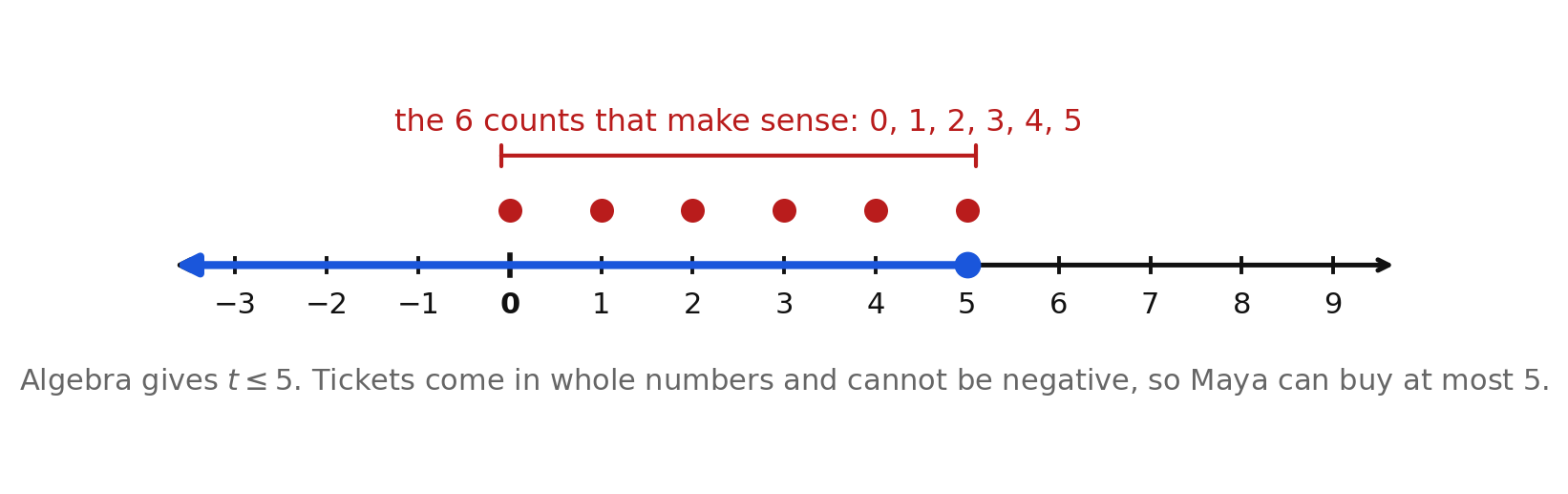
When a variable counts objects that cannot be split — tickets, tacos, boxes, buses, people — the context adds two constraints the algebra never mentioned: the value must be a whole number, and it cannot be negative. So a solution set of becomes the practical answer at most 5, and a solution set of becomes at least 9.
Notice that the rounding goes in different directions in those two cases, so a memorized rule will not save you. Do it by meaning instead. Ask: which whole numbers actually satisfy the original inequality? Then test the two whole numbers nearest the boundary. If one passes and the next fails, you have found the edge.
For with whole tickets, test 5 and test 6. Five satisfies the inequality; six does not; the answer is at most 5. For with whole weeks, test 8 and test 9. Eight fails; nine passes; the answer is at least 9.
Creating a situation from an inequality
The work also runs backward, and running it backward proves you understand what each number in the inequality does. Given , read the parts:
- is the unknown count of something,
- is the amount per unit,
- is a one-time amount,
- is the limit, and means the limit may be reached exactly.
A club orders shirts costing $5 each plus a one-time $20 setup fee, and it can spend at most $70. How many shirts can it order? Solving gives , so , and shirts are whole, so at most 10 shirts. The check confirms it: , and .
A good invented situation passes four tests: the operations match, the numbers land in the right roles, the symbol matches the phrase you used, and the answer is a sensible thing to have that many of. When the coefficient is negative, choose a setting where something decreases — a tank draining, a candle burning, a balance being spent down.
Worked examples
Example 1 — A fee plus a rate, with a ceiling
Tickets to a school play cost $6 each, plus a $2 service charge on the order. Maya has $32. How many tickets can she buy?
Let = the number of tickets. The $6 repeats for every ticket; the $2 happens once; $32 is a ceiling she may reach exactly, so the symbol is .
Check the boundary: , and is true. Check the next whole number: , and is false. Tickets are whole and cannot be negative, so the counts that make sense are 0, 1, 2, 3, 4, and 5.
Answer: ; Maya can buy at most 5 tickets.
Example 2 — Reaching a goal, with a floor
Devon has $45 saved and adds $8 every week. How many weeks until he has at least $117?
Let = the number of weeks. "At least" allows hitting $117 exactly, so the symbol is .
Check the boundary: , and is true. Check outside: , and is false.
Answer: ; Devon needs at least 9 weeks.
Example 3 — Something decreasing
A candle is 24 centimeters tall and burns 3 centimeters every hour. For how many hours is it more than 6 centimeters tall?
Let = the number of hours burned, where . The height after hours is , and "more than" is strict.
Divide both sides by and reverse the symbol.
Check inside: at the height is , and is true. Check the boundary: at the height is , and is false.
Answer: ; the candle is more than 6 centimeters tall for the first 6 hours, that is, for .
Example 4 — Creating a situation from an inequality
Write a situation in context for and solve it.
The 5 is an amount per unit, the 20 is a one-time amount, and 70 is a ceiling that may be reached exactly.
Answer: A club orders shirts that cost $5 each plus a one-time $20 setup fee, and the club can spend at most $70. How many shirts can it order? The solution is , and since shirts are whole, at most 10 shirts. Check: .
Example 5 — A boundary that is not a whole number
A carnival charges $7 for admission plus $3 per ride. Kai has $26. How many rides can he take?
Let = the number of rides.
The algebra allows rides, which the carnival does not. Test the two nearest whole numbers: , and is true; , and is false.
Answer: ; algebraically , and since rides are whole, Kai can take at most 6 rides.
Guided practice
- Movie tickets cost $9 each, and Nia also buys one $6 popcorn. She has at most $42. Write and solve an inequality for the number of tickets, and state how many whole tickets she can buy.
- Write an inequality for this statement: the temperature , in degrees Celsius, stayed above .
- Rosa has $30 and spends $4 on each book. She wants at least $10 left over. Write and solve an inequality for the number of books, and state how many whole books she can buy.
- Write a situation in context for and give the solution.
Independent practice
- A parking lot charges a $4 entry fee plus $2 per hour. Jamal can spend no more than $18. Write and solve an inequality for the number of hours.
- Write and solve an inequality: six more than three times a number is at least 27.
- Write and solve an inequality: five less than twice a number is less than 9.
- Application. An elevator can carry at most 1{,}500 pounds. An operator weighing 180 pounds rides along with boxes weighing 55 pounds each. Write and solve an inequality for the number of boxes, and state how many whole boxes may be loaded.
- Application. A food truck charges $2.50 per taco plus a $1.00 packaging fee. Priya has $14.00. Write and solve an inequality for the number of tacos, and explain how you turned the algebraic answer into a number of tacos.
- Write a situation in context for , choosing a setting where something decreases, and solve it.
- Reasoning. Write a situation in context for , solve it, and explain why the practical answer is "at least 7" rather than "at least 6," given that the unknown counts whole objects.
- Error analysis. For "shirts cost $12 each plus a $5 shipping fee, and Ana has at most $65," Bo writes . Explain why that does not match the situation, write the correct inequality, solve it, and check the largest whole-number answer.
Exit ticket 11.6
- A taxi charges $3 plus $2 per mile, and Lena can spend at most $21. Write and solve an inequality for the number of miles.
- Write and solve an inequality: four more than five times a number is at most 39.
- Write a situation in context for and give the solution.
- Explain when a context forces you to round a fractional answer down to a whole number, and give one example of your own.
Chapter 11 Review
Vocabulary. inequality · strict inequality · inclusive inequality · solution · solution set · properties of inequality · additive inverse property · multiplicative identity property · reciprocal · reversal rule · boundary value · open circle · closed circle · ray · constraint
Part A — Applying properties of inequality (7.PFA.4a)
- Solve. a) b) c) d)
- Solve. a) b) c) d)
- Solve .
- Solve , then rewrite your answer with the variable written first.
- Solve and state the solution exactly.
Part B — Multiplying or dividing by a negative (7.PFA.4b)
- Begin with the true statement . a) Add to both sides and write the true statement. b) Multiply both sides by and write the true statement. c) State which one reversed and why.
- Solve. a) b) c) d)
- Solve and test the boundary value and one value outside the solution set.
- Using and a number line, explain why multiplying both sides by a negative number reverses the direction of the symbol, and state clearly why adding a negative number does not.
Part C — Representing solutions algebraically and graphically (7.PFA.4c)
- Graph . State the endpoint value, the circle type, and the shading direction.
- Graph . State the endpoint value, the circle type, and the shading direction.
- Solve and graph .
- Solve and graph .
- A number line shows a closed circle at with shading to the right. Write the inequality and name two of its solutions.
Part D — Writing an inequality from a situation (7.PFA.4d)
- Write an inequality for this statement: a checked bag must weigh no more than 50 pounds. Use for the weight in pounds.
- A theater seats at most 250 people, and 40 people are already seated. Write and solve an inequality for the number of additional people who may be seated.
- A bike rental costs a $6 fee plus $4 per hour, and Sam can spend at most $30. Write and solve an inequality for the number of hours.
Part E — Creating a situation from an inequality (7.PFA.4e)
- Write a situation in context for and solve it.
- Write a situation in context for and solve it.
- Write a situation in context for , choosing a setting where something decreases, and solve it.
Part F — Solving problems in context (7.PFA.4f)
- A club has $150 to spend on pizzas that cost $13 each plus an $8 delivery fee. Write and solve an inequality for the number of pizzas, and state how many whole pizzas the club can order.
- Mia has $62 and earns $14 for each lawn she mows. She needs at least $160. Write and solve an inequality for the number of lawns, and state how many whole lawns she must mow.
- A 40-gallon tank drains 6 gallons per minute. Write and solve an inequality for the number of minutes during which the tank holds more than 10 gallons.
Part G — Identifying values in a solution set (7.PFA.4g)
- Which values from , , , , and are solutions of ? Show each substitution.
- Which values from , , , and are solutions of ? Show each substitution.
- Name three solutions of , including one that is not an integer, and show that each one works.
Part H — Comparing inequalities and equations (7.PFA.4h)
- Solve and then solve . Describe how the two answers are related and how they differ.
- List two things that solving an inequality has in common with solving an equation, and two ways in which the two processes differ.
- Explain why has exactly one solution while has infinitely many, and describe how the graph of each looks on a number line.
Part I — Mixed application and reasoning
- Solve and graph , and test the boundary value in the original inequality.
- A student says the solution of is . Test in the original inequality, explain what the test shows, and give the correct solution.
- Write an inequality whose solution set is graphed with a closed circle at and shading to the right. Then write a different two-step inequality with the same solution set, and show that it does.
- A school van holds at most 44 people. Eight chaperones ride along, and students sit 4 to a bench. Write and solve an inequality for the number of benches of students, and state how many whole benches may be filled.
- Compare and . Name the one number that separates them, describe how their graphs differ, and give a real situation in which each would be the correct choice.
Standards coverage check — Chapter 11
| Knowledge and Skill | Where it is taught | Where it is practiced |
|---|---|---|
| 7.PFA.4a — apply properties of real numbers and the addition, subtraction, multiplication, and division properties of inequality to solve one- and two-step inequalities with rational coefficients and terms | 11.2, 11.4 | Items 17–32, 49–64; Review Part A (97–101) |
| 7.PFA.4b — investigate and explain how the solution set is affected by multiplying or dividing both sides by a rational number less than zero | 11.3 | Items 33–48, 54, 59, 60; Review Part B (102–105), 127 |
| 7.PFA.4c — represent solutions algebraically and graphically using a number line | 11.5 | Items 65–80; Review Part C (106–110), 126, 128 |
| 7.PFA.4d — write one- or two-step linear inequalities to represent a verbal situation, including in context | 11.1, 11.6 | Items 4, 5, 10, 13, 26, 42, 81–83, 85–89, 92–94; Review Part D (111–113), 129 |
| 7.PFA.4e — create a verbal situation in context given a one- or two-step linear inequality | 11.6 | Items 84, 90, 91, 95; Review Part E (114–116) |
| 7.PFA.4f — solve problems in context requiring a one- or two-step inequality | 11.6 | Items 26, 42, 58, 74, 81, 83, 85, 88, 89, 96; Review Part F (117–119), 129 |
| 7.PFA.4g — identify numerical values that are part of the solution set | 11.1, 11.5 | Items 1–3, 6–8, 11, 12, 14, 15, 24, 73, and the two-sided checks in 17–20, 25, 35, 36, 40, 44, 49–52; Review Part G (120–122) |
| 7.PFA.4h — describe the differences and similarities between solving linear inequalities and linear equations | 11.1, 11.2, 11.4, 11.5 | Items 9, 16, 27, 64, 75; Review Part H (123–125), 130 |
Answer keys for every set in this chapter are in Appendix A.