Chapter 10 — Two-Step Linear Equations
Standard: 7.PFA.3 — The student will write and solve two-step linear equations in one variable, including problems in context, that require the solution of a two-step linear equation in one variable.
By the end of this chapter you will be able to:
- Represent and solve two-step linear equations in one variable using concrete materials and pictorial representations (7.PFA.3a)
- Apply properties of real numbers and properties of equality to solve two-step linear equations with rational coefficients and rational numeric terms (7.PFA.3b)
- Confirm algebraic solutions to linear equations in one variable (7.PFA.3c)
- Write a two-step linear equation in one variable to represent a verbal situation, including situations in context (7.PFA.3d)
- Create a verbal situation in context given a two-step linear equation in one variable (7.PFA.3e)
- Solve problems in context that require the solution of a two-step linear equation (7.PFA.3f)
Lessons: 10.1 What It Means to Solve an Equation · 10.2 Modeling Two-Step Equations with Tiles and a Balance · 10.3 Solving Two-Step Equations · 10.4 Writing an Equation for a Situation · 10.5 Solving Problems in Context
What "two-step" means. In Grade 6 you solved equations like and , each undone by a single operation. Here two things have happened to the variable, so undoing takes two moves. Coefficients and numeric terms are rational numbers — integers, fractions, and decimals all appear.
Lesson 10.1 — What It Means to Solve an Equation
The equal sign is a promise
An equation is a mathematical sentence stating that two expressions name the same number. The equal sign is not an instruction to compute; it is a claim about balance. Everything you do to an equation has to keep that claim true.
A solution of an equation is a value for the variable that makes the sentence true. To solve an equation is to find every value that works. For the equations in this chapter there is exactly one.
What makes an equation two-step
A two-step linear equation in one variable has the form
where , , and are rational numbers and . Two operations have been applied to the variable: it was multiplied by the coefficient , and then the constant term was added.
Read as a set of instructions performed on : start with , multiply by 3, add 7, and you land on 22. Written that way, the path back is obvious — you retrace the steps in reverse.
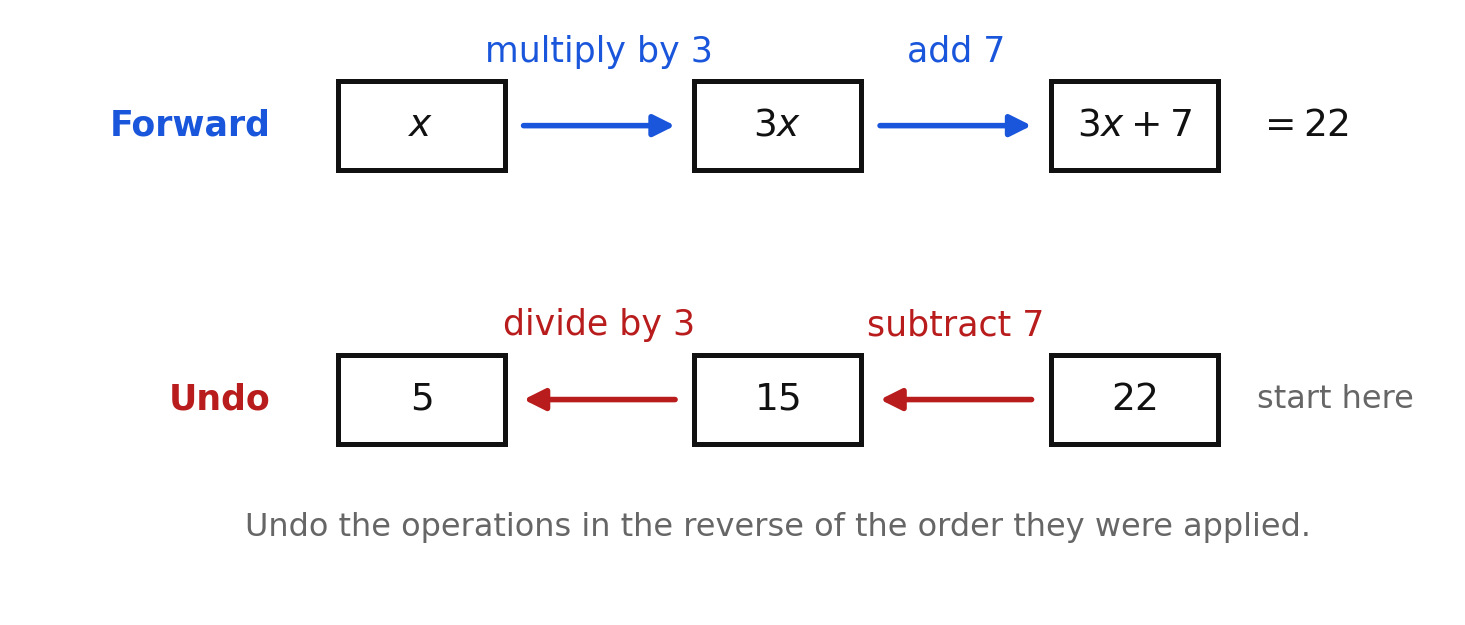
The forward trip multiplies and then adds. The return trip subtracts and then divides. Undoing happens in the reverse of the order the operations were applied, exactly the way you take off your shoes before your socks only if you put your socks on first.
Some equations disguise this shape. In the variable term is and the constant is , because subtracting is the same as adding . In the coefficient is , since dividing by 4 and multiplying by are the same action. Naming the coefficient and the constant correctly, signs and all, is the first thing to do with any equation.
| Equation | Coefficient | Constant term | Operations applied to the variable |
|---|---|---|---|
| multiply by 3, then add 7 | |||
| multiply by 5, then subtract 8 | |||
| multiply by , then add 8 | |||
| divide by 4, then subtract 5 |
Checking a solution by substitution
To substitute is to replace the variable with a number. Substitution is how you find out whether a value is a solution, and it is the one habit that will save you the most points and the most time.
Three rules make a check trustworthy:
- Substitute into the original equation, not into a line you wrote partway through. If you made an error on line two, checking against line two will confirm the error.
- Simplify each side separately, following the order of operations.
- Compare. If the two sides give the same number, the value is a solution. If they do not, it is not — and you know it before anyone grades it.
Checking is also how you tell someone else's answer from a correct answer. A proposed solution is a claim, and substitution settles it.
One solution, one point
Every equation in this chapter has exactly one solution, so its graph on a number line is a single point.
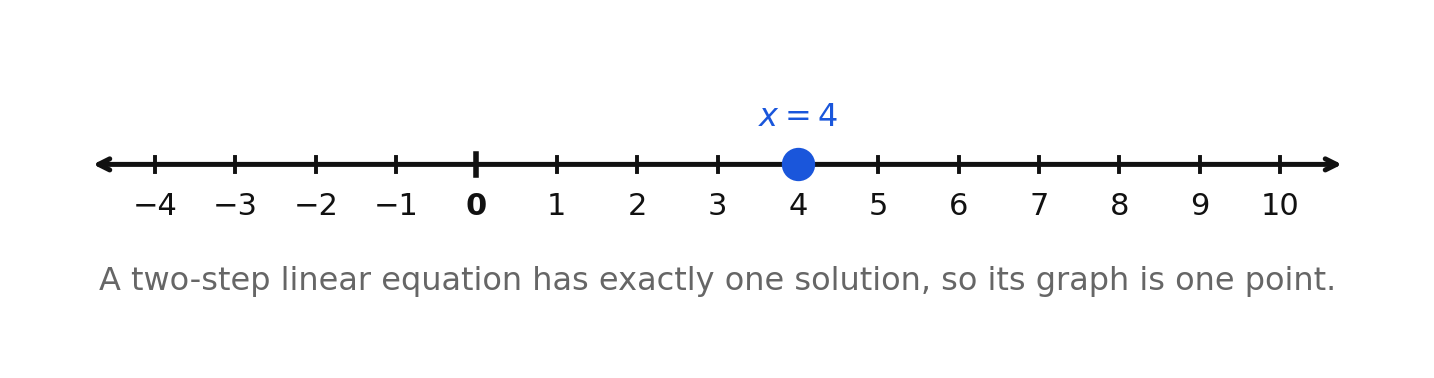
That is worth noticing now, because in Chapter 11 you will meet inequalities, whose solutions fill a whole ray. One point versus a shaded ray is the visible difference between the two ideas.
Worked examples
Example 1 — Testing a proposed solution
Is a solution of ?
Substitute for in the original equation and simplify the left side.
The left side is and the right side is .
Answer: Yes, is a solution.
Example 2 — Choosing the solution from a list
Which value from , , and is the solution of ?
Test each one.
Only the middle test produces .
Answer:
Example 3 — Naming the parts and the undo order
For , name the coefficient and the constant term, state the two operations applied to and the two that undo them, then confirm that is the solution.
The coefficient is ; the sign belongs to it. The constant term is .
Applied to : multiply by , then add 8. To undo: subtract 8, then divide by .
Check: . The right side is .
Answer: Coefficient , constant ; undo by subtracting 8 and then dividing by ; is confirmed.
Example 4 — A proposed solution that fails
Is a solution of ? If not, find the value that is.
Substitute for :
Since , the value is not a solution. Rewrite the equation as and undo: subtract 5 from both sides to get , then divide both sides by to get .
Check: . True.
Answer: No; the solution is .
Example 5 — The variable on the right
Is a solution of ?
The variable may sit on either side of the equal sign; substitution works the same way.
The right side is and the left side is .
Answer: Yes, is a solution.
Guided practice
- Is a solution of ? Show the substitution.
- Which value from , , and is the solution of ?
- Name the coefficient and the constant term in , and state which operation you would undo first.
- Show the check that is the solution of .
Independent practice
- Decide whether each value is a solution. a) in b) in c) in d) in
- Which value from , , and is the solution of ?
- Name the coefficient and the constant term in each. a) b) c)
- List, in order, the two operations applied to the variable in and the two operations that undo them. Then confirm that is the solution.
- Write a two-step equation of the form whose solution is , and show the check.
- Application. A taxi ride costs a $3.00 pickup fee plus $2.00 per mile, so the total for miles is described by . Determine whether is a solution, and say what your answer means about the ride.
- Reasoning. Explain why a check must substitute into the original equation rather than into a line written partway through the solving.
- Error analysis. Jordan tests in and writes , then , and concludes that is not a solution. Find Jordan's mistake, complete the check correctly, and state whether is a solution.
Exit ticket 10.1
- Is a solution of ? Show the substitution.
- Which value from , , and is the solution of ?
- Name the coefficient and the constant term in , and state which operation you would undo first.
- Explain in your own words what it means for a number to be a solution of an equation.
Lesson 10.2 — Modeling Two-Step Equations with Tiles and a Balance
The balance scale
A balance scale is the truest picture of an equal sign. The beam is level exactly when the two pans hold the same total value.
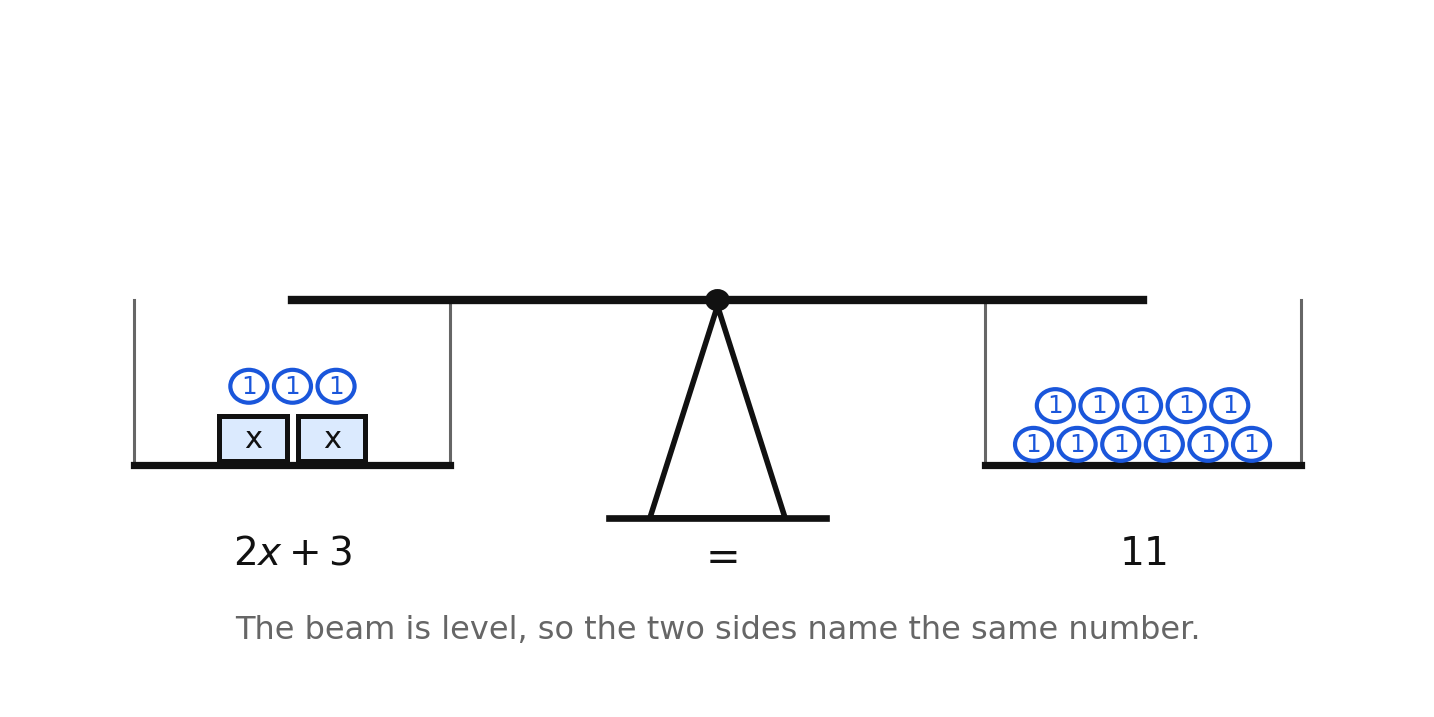
The left pan holds two blocks labeled and three 1-gram chips; the right pan holds eleven 1-gram chips. Because the beam is level, .
One rule governs everything: whatever you do to one pan, you must do to the other. Remove three chips from the left pan only, and the beam tips — which means the sentence you write down is no longer true.
The two legal moves, in order
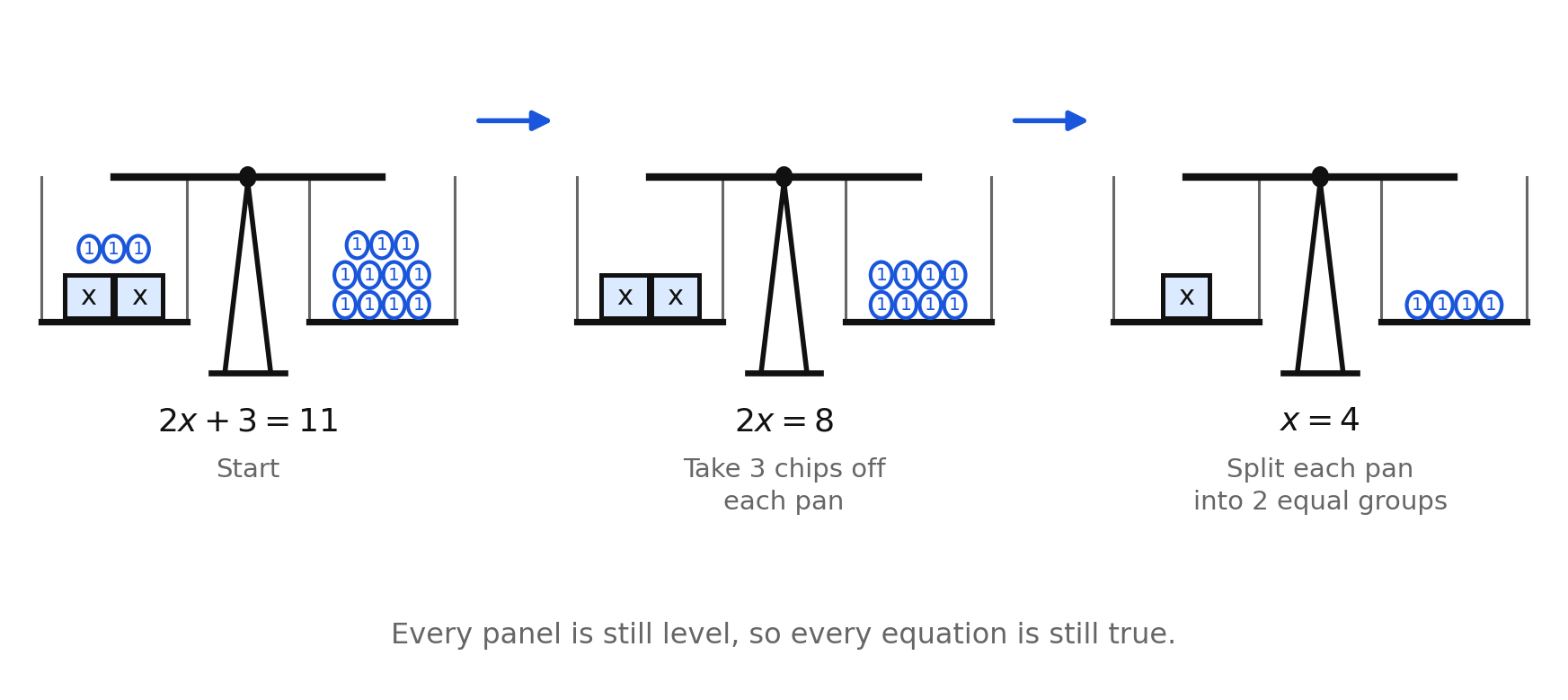
Panel 1 is the original equation. In panel 2, three chips have come off each pan, leaving . In panel 3, each pan has been split into two equal groups and one group from each side is shown, leaving . Every panel is level, so every panel is a true statement.
Notice the order. You clear the loose chips first, then you split into equal groups. Splitting first would mean cutting a pan holding both blocks and chips into equal parts, which is possible but awkward — you would have to share the chips out too.
Algebra tiles
Algebra tiles are the flat version of the same idea. A long rectangle is the tile, a small square is the tile, and tiles of the opposite color are and . The tiles for the left side of the equation go on one mat and the tiles for the right side go on another.
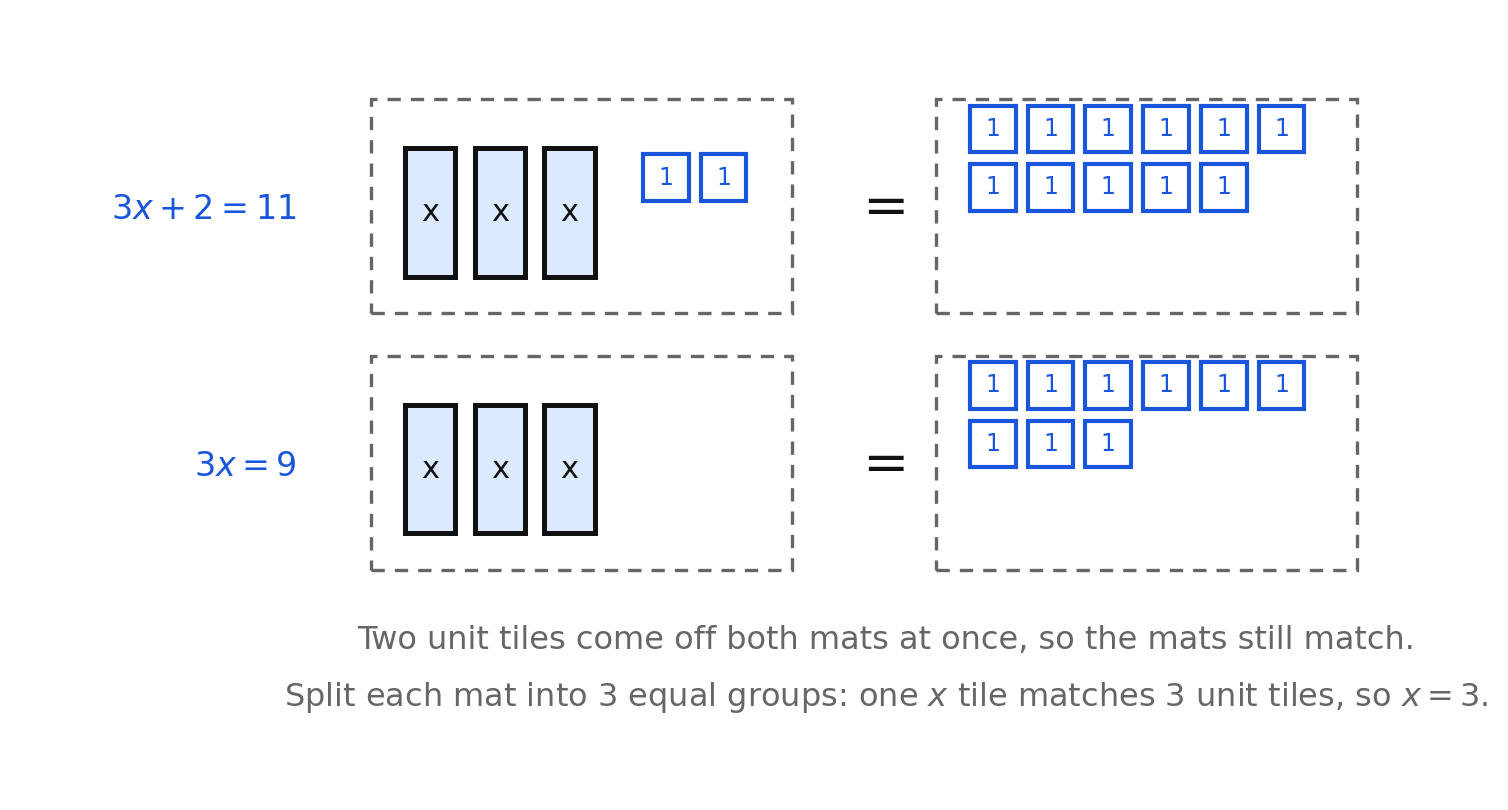
The top row models . Removing two unit tiles from both mats gives . Splitting each mat into three equal groups pairs one tile with three unit tiles, so .
Zero pairs handle subtraction
A tile and a tile together are worth . Together they form a zero pair, and adding or removing a zero pair changes nothing about a mat's value. Zero pairs are what let tiles model an equation like , where something has been subtracted.
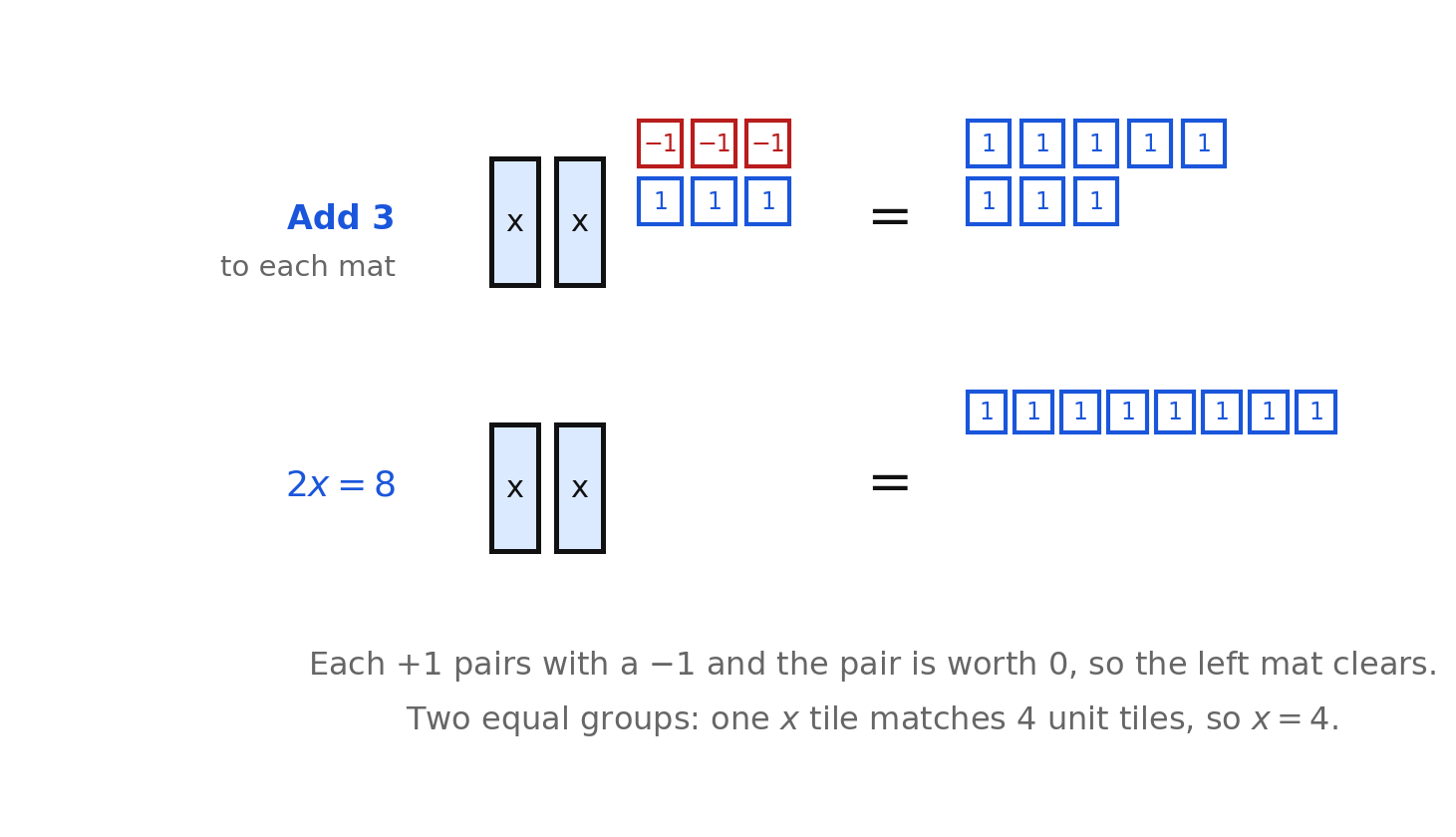
Start with two tiles and three tiles on the left mat and five tiles on the right. To clear the tiles, add three tiles to each mat. On the left, each new pairs with a , and all six tiles come off, leaving . On the right, . So , and splitting into two equal groups gives .
Colored chips work the same way with round pieces: one color is , the other is , a chip of each color is a zero pair, and a cup or envelope marked stands in for the variable.
Confirming a solution with a model
Solving and confirming are two different jobs. To confirm, rebuild the original model, then replace every variable tile with the number of unit tiles your answer claims it is worth, and count both mats. Matching counts mean the model balances and the answer is right. Mismatched counts mean the beam tips, and the proposed answer is wrong.
For with : replace each block with 4 chips. The left pan now holds chips and the right holds . Level, so confirmed.
Worked examples
Example 1 — Solving on a balance scale
A balance holds two blocks labeled and 3 one-gram chips on the left pan, and 11 one-gram chips on the right. Write the equation and find .
The beam is level, so the pans are equal: .
Remove 3 chips from each pan: the left holds , the right holds .
Split each pan into 2 equal groups: one block matches chips.
Check by rebuilding: chips on the left, on the right. Level.
Answer: , and .
Example 2 — Solving with algebra tiles
Model with tiles and solve.
Left mat: three tiles and two tiles. Right mat: eleven tiles.
Remove two tiles from each mat, leaving three tiles on the left and unit tiles on the right.
Split both mats into 3 equal groups: one tile matches unit tiles.
Check: , matching the right mat.
Answer:
Example 3 — Using zero pairs
Model with tiles and solve.
Left mat: two tiles and three tiles. Right mat: five tiles.
Add three tiles to each mat. On the left, three zero pairs form and are removed, leaving . On the right, .
Split both mats into 2 equal groups: one tile matches unit tiles.
Check: , matching the right mat.
Answer:
Example 4 — Negative variable tiles
Model with tiles and solve.
Left mat: two tiles and four tiles. Right mat: ten tiles.
Remove four tiles from each mat, leaving on the left and on the right.
Split both mats into 2 equal groups: one tile matches 3 unit tiles, so . If the opposite of is , then itself is .
Check: . True.
Answer:
Example 5 — Confirming somebody else's answer
Rosa says the solution of is . Use a model to decide.
Replace each tile with 6 unit tiles. The left mat holds tiles, but the right mat holds . The mats do not match, so the model does not balance.
Rebuild and solve: remove four unit tiles from each mat to get , then split into 3 equal groups to get .
Check: , matching the right mat.
Answer: Rosa is incorrect; the solution is .
Guided practice
- A balance holds two blocks labeled and 5 one-gram chips on the left pan, and 13 one-gram chips on the right. Write the equation.
- Solve the equation from item 17 by describing the move you make at each pan, and confirm the solution by rebuilding the scale.
- Model with algebra tiles. Describe each move and give the solution.
- What is a zero pair, and why does adding three tiles to each mat of a model of leave the equation true? Give the solution.
Independent practice
- Write the equation shown by each model and solve it. a) three blocks labeled and 2 chips on the left pan, 17 chips on the right b) two tiles and four tiles on the left mat, six tiles on the right
- Model with tiles. Describe each move and give the solution.
- Model with tiles, naming the zero pairs you use. Give the solution and confirm it with the model.
- Model with tiles. Describe each move and give the solution.
- Model with tiles. Describe each move and give the solution.
- Error analysis. Devon models , removes 5 unit tiles from the left mat only, then splits both mats into 2 equal groups and reports . Explain what went wrong and give the correct solution.
- Application. Three identical boxes and a 4-pound weight together balance a 22-pound weight. Write an equation with for the weight of one box, solve it by describing the scale moves, and confirm the answer on the scale.
- Reasoning. Explain why both mats must be split into the same number of equal groups, and what would go wrong if you split the left mat into 3 groups and the right into 2.
Exit ticket 10.2
- Write and solve the equation modeled by a balance with two blocks labeled and 7 chips on the left pan and 15 chips on the right.
- Model with tiles. Describe each move and give the solution.
- Use a model to confirm whether is the solution of .
- Explain why removing the same number of unit tiles from both mats keeps the equation true.
Lesson 10.3 — Solving Two-Step Equations
The properties that authorize each move
The balance rule has a formal name — four of them, in fact. These are the properties of equality, and naming the one you are using turns a move you remember into a move you can justify.
Addition property of equality. If you add the same number to both sides of an equation, the two sides remain equal. Subtraction property of equality. If you subtract the same number from both sides, the two sides remain equal. Multiplication property of equality. If you multiply both sides by the same number, the two sides remain equal. Division property of equality. If you divide both sides by the same nonzero number, the two sides remain equal.
Two properties of real numbers do the quiet work underneath. The additive inverse property says a number plus its opposite is zero, , which is what makes the constant term disappear. The multiplicative identity property says , which is what leaves the variable standing alone after you divide by the coefficient.
The procedure
- Name the coefficient of the variable and the constant term, signs included.
- Undo the addition or subtraction first. Add or subtract the constant term on both sides.
- Undo the multiplication or division second. Divide both sides by the coefficient, or multiply both sides by its reciprocal.
- Check by substituting into the original equation.
Step 2 comes before step 3 because you are reversing the order of operations. Going forward, the variable is multiplied before the constant is added; going backward, the constant comes off before the multiplication is undone.
Coefficients that are not whole numbers
The standard allows any rational coefficient, so you will see fractions and decimals. The method never changes; only the arithmetic does.
| Equation | To undo the coefficient | Why |
|---|---|---|
| divide both sides by 4 | division undoes multiplication | |
| divide both sides by | the sign belongs to the coefficient | |
| multiply both sides by 6 | the coefficient is | |
| multiply both sides by | is the reciprocal of | |
| divide both sides by | division undoes multiplication |
A reciprocal is the number you multiply by to get 1: . Multiplying by the reciprocal and dividing by the coefficient are the same move written two ways.
When the answer is not a whole number
Some equations have fractional solutions, and a fraction is a perfectly good answer. Write it exactly. Rounding to makes the check fail, and a solution that does not check is not a solution.
Worked examples
Example 1 — A whole-number coefficient
Solve .
Subtract 7 from both sides (subtraction property of equality), then divide both sides by 3 (division property of equality).
Check: . True.
Answer:
Example 2 — A negative coefficient
Solve .
Check: . True.
Answer:
Example 3 — A fractional coefficient
Solve .
Multiply both sides by the reciprocal (multiplication property of equality).
Check: . True.
Answer:
Example 4 — The variable on the right
Solve .
The variable term is and the constant is . Subtract 7 from both sides, then divide by .
Check: . True.
Answer:
Example 5 — A fractional solution
Solve .
Check: . True.
Answer:
Guided practice
- Solve , naming the property of equality used at each step, and check your answer.
- Solve and check your answer.
- Solve and check your answer.
- Solve and check your answer.
Independent practice
- Solve and check. a) b) c) d)
- Solve and check. a) b) c) d)
- Solve and check. a) b)
- Solve and check. State the solution exactly.
- Reasoning. Show every step of , naming the property of equality used at each step. Then explain why undoing the operations in reverse order is what makes the procedure work.
- Write a two-step equation with a negative coefficient whose solution is , and show the check.
- Application. A gym charges a $25 joining fee plus $18 per month. A member's total cost so far is $151. Solve for the number of months, and state the answer in a full sentence.
- Error analysis. Priya solves by dividing by 3 first. She writes , then . Identify her mistake, solve the equation correctly, and show the check that exposes her answer as wrong.
Exit ticket 10.3
- Solve and check.
- Solve and check.
- Solve and check.
- Explain why you undo addition or subtraction before you undo multiplication or division.
Lesson 10.4 — Writing an Equation for a Situation
The shape most situations take
An enormous number of real situations have the same structure: a fixed amount that does not change, plus a repeated amount that depends on how many. A flat fee plus a rate. A starting balance plus a weekly deposit. A one-time charge plus a price per item.
That structure is , where
- is the unknown count or number of units,
- is the amount per unit,
- is the fixed amount,
- is the total.
A reliable path from words to symbols
- Read the whole situation before writing anything.
- Name the unknown. Write a full sentence: "let = the number of games bowled." A variable without a definition is a guess.
- Find the repeated amount and the fixed amount. Which number happens once, and which one happens for every unit?
- Find the total — the number the situation lands on.
- Write the equation, solve it, and check it against the story, not just against the arithmetic.
Do not trust keywords by themselves. "Seven less than four times a number is 21" is , not . "Less than" reverses the order of the words. Reading the action, then retelling the story from your equation, catches this every time.
Reading an equation as a story
The same work runs backward. Given , you can invent a situation that fits, and inventing one proves you understand what each number does.
- is the unknown number of units.
- is the amount charged, earned, or used per unit.
- is the one-time amount.
- is the total.
A club orders shirts at $6 each plus a $10 setup charge, and the bill is $46. How many shirts? Solving gives , and checks.
A good invented situation passes three tests: the operations match, the numbers land in the right roles, and the answer is a sensible thing to have that many of. When the coefficient is negative, choose a context where something decreases — a tank draining, a candle burning, a balance being spent down.
Worked examples
Example 1 — A fee plus a rate
Bowling costs $4 for shoe rental plus $3 per game. Dana spent $19. Write and solve an equation for the number of games.
Let = the number of games. The $3 repeats for every game; the $4 happens once.
Check against the story: 5 games at $3 is $15, plus $4 rental is $19. Correct.
Answer: ; Dana bowled 5 games.
Example 2 — A number sentence in words
Seven less than four times a number is 21. Write and solve an equation.
Let = the number. Four times the number is ; seven less than that is .
Check: . True.
Answer: ; the number is 7.
Example 3 — A decimal rate
A phone plan costs $15.00 per month plus $0.10 for each text message. One month's bill was $21.50. Write and solve an equation for the number of texts.
Let = the number of text messages.
Check: . True.
Answer: ; there were 65 texts.
Example 4 — Writing a situation from an equation
Write a situation in context for and solve it.
The 6 is a per-unit amount, the 10 is a one-time amount, and 46 is the total.
Answer: A club orders shirts that cost $6 each plus a one-time $10 setup charge. The bill was $46. How many shirts did the club order? The solution is shirts, and checks.
Example 5 — A situation for a negative coefficient
Write a situation in context for and solve it.
A coefficient of means something goes down by 5 for each unit, starting from 40.
Answer: A 40-gallon tank drains 5 gallons every minute. After minutes, 15 gallons are left. How many minutes have passed? The solution is minutes, and checks.
Guided practice
- A skating rink charges $5 for admission plus $2 per hour of skate rental. Tomas paid $15. Write and solve an equation for the number of hours.
- Three more than twice a number is 17. Write and solve an equation.
- A plumber charges a $60 service fee plus $45 per hour, and the bill was $285. Define the variable and write the equation, then solve it.
- Write a situation in context for and state the solution.
Independent practice
- Write and solve an equation: eight less than five times a number is 32.
- Write and solve an equation: a number divided by 4, then increased by 6, is 10.
- Application. A food truck charges $2.50 per taco plus a $1.00 packaging fee. An order came to $11.00. Write and solve an equation for the number of tacos.
- A pool holds 30 inches of water and drains 4 inches per hour. After hours, 10 inches remain. Write and solve an equation for .
- Write a situation in context for and solve it.
- Reasoning. Write a situation in context for and solve it. Then explain why your story must halve the unknown before it subtracts 3.
- Write a situation in context for , choosing a setting where a decrease makes sense, and solve it.
- Error analysis. For "tickets cost $6 each plus a $4 order fee, and the total was $34," Sam writes . Explain why this does not match the situation, write the correct equation, and solve it.
Exit ticket 10.4
- Write and solve an equation: a fair charges a $7 entry fee plus $3 per ride, and Nia spent $28.
- Write and solve an equation: six less than three times a number is 9.
- Write a situation in context for and give the solution.
- Explain how you decide which quantity in a situation should be the variable.
Lesson 10.5 — Solving Problems in Context
Finishing the job
Writing the equation and solving it are the middle of the work, not the end. A problem in context is finished when you have
- defined the variable, with units,
- written the equation,
- solved it, naming your moves,
- checked the solution in the original equation,
- checked the answer against the story, and
- stated the result in a sentence with units.
Steps 5 and 6 are the ones people skip, and they are where the meaning lives. An answer of "12" is not an answer. "It takes 12 weeks" is.
Checking against the story
Substitution tells you the arithmetic is right. Only the story tells you the model is right. Ask two questions:
- Is the size sensible? If you solve for a number of pizzas and get 400, or a width of feet, the equation itself is probably wrong.
- Does the answer type fit? Some quantities can be fractions and some cannot. A ribbon can be inches long. A bus cannot make trips — there the fraction tells you the exact break-even point, and you then reason about whole trips.
Contexts that keep coming back
| Context | The fixed amount | The repeated amount |
|---|---|---|
| A bill with a fee | delivery fee, service charge | price per item |
| Saving toward a goal | amount already saved | amount saved each week |
| A tank or candle emptying | starting amount | amount lost per unit of time |
| Perimeter of a figure | the sides you know | the equal sides you do not |
| Temperature changing steadily | starting temperature | degrees changed per hour |
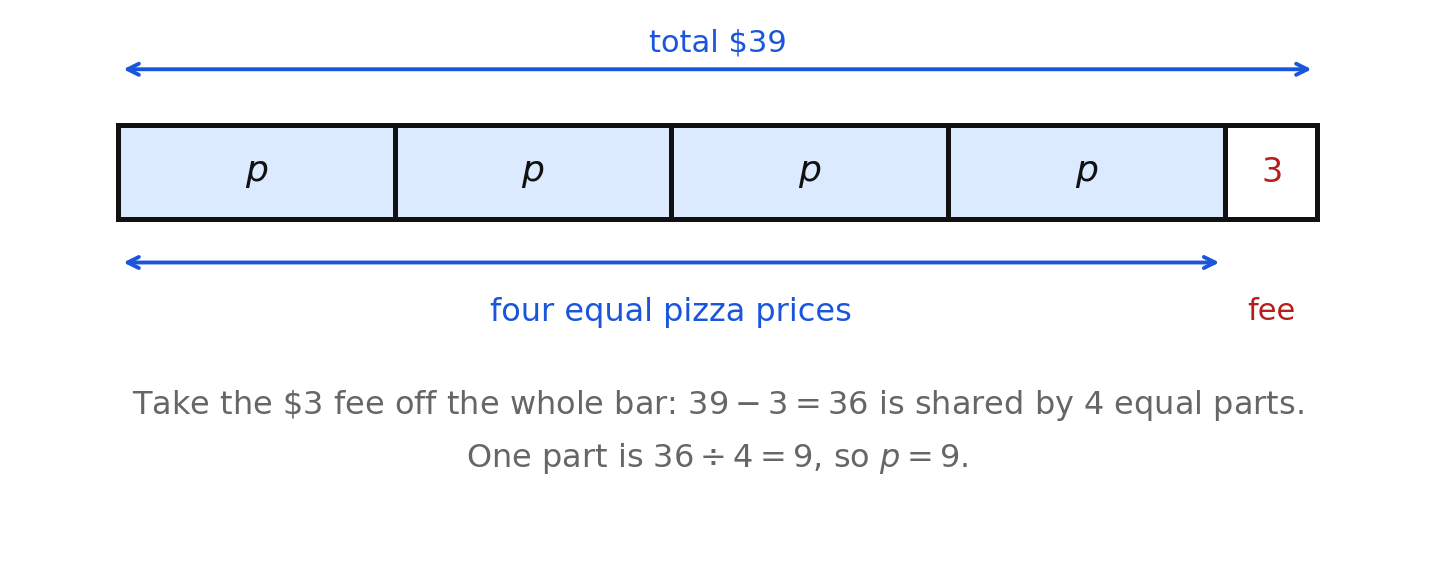
A bar model is often the fastest way to see the structure. The bar above shows a $39 order made of four equal pizza prices plus a $3 delivery fee. Trim the fee off the whole bar, and what is left is four equal parts: , and . That is exactly the two-step procedure, drawn.
Worked examples
Example 1 — Perimeter
A rectangle has a length of 9 cm and a perimeter of 34 cm. Find its width.
Let = the width in centimeters. The perimeter is two lengths plus two widths, so the two known lengths contribute .
Check: . Against the story: a 9 by 8 rectangle has perimeter cm. Correct.
Answer: The width is 8 cm.
Example 2 — Saving toward a goal
Maya has $120 saved and adds $15 every week. How many weeks until she has $300?
Let = the number of weeks.
Check: . True, and 12 weeks is a sensible amount of time.
Answer: It takes 12 weeks.
Example 3 — A quantity going down
At 6 p.m. the temperature is 4°C and it falls 2°C every hour. After how many hours is it °C?
Let = the number of hours. Falling 2 degrees per hour is a change of per hour.
Check: . True.
Answer: After 6 hours, at midnight, the temperature is °C.
Example 4 — A bill with a fee
Four pizzas cost the same amount each, and a $3 delivery fee brings the order to $39. Find the price of one pizza.
Let = the price of one pizza in dollars.
Check: . Against the story: four $9 pizzas is $36, plus $3 delivery is $39. Correct.
Answer: One pizza costs $9.00.
Example 5 — A fractional answer that makes sense
A 25-inch ribbon has 3 inches trimmed off, and the rest is cut into 4 equal pieces. How long is each piece?
Let = the length of one piece in inches. The four pieces plus the 3-inch trim account for the whole 25 inches.
Check: . True. A length of inches is a perfectly sensible piece of ribbon.
Answer: Each piece is inches, or inches, long.
Guided practice
- A rectangle has a length of 12 cm and a perimeter of 40 cm. Write and solve an equation for the width, and state the answer with units.
- Tia has $50 and earns $12 for each lawn she mows. Write and solve an equation for the number of lawns she must mow to have $146.
- A tank holds 60 liters and loses 7 liters per hour. Write and solve an equation for the number of hours until 18 liters remain.
- A lunch order of 5 identical sandwiches plus one $2.50 drink came to $32.50. Write and solve an equation for the price of one sandwich.
Independent practice
- Application. A studio charges a $40 membership fee plus $8.50 per class. Kara paid $91 in all. Write and solve an equation for the number of classes, and state the answer in a sentence.
- A taxi charges $3.25 plus $1.75 per mile. A ride cost $17.25. Write and solve an equation for the number of miles.
- An isosceles triangle has two equal sides of length and a base of 7 inches. Its perimeter is 31 inches. Write and solve an equation for .
- A diver is 6 meters below the surface, at an elevation of meters, and rises 1.5 meters per second. Write and solve an equation for the number of seconds until the diver is 3 meters above the surface.
- A jar holds 3 quarters and some dimes, worth $1.85 in all. Write and solve an equation for the number of dimes.
- A 10-foot board has 1 foot trimmed off, and the rest is cut into 4 equal pieces. Write and solve an equation for the length of one piece, stating the answer exactly.
- Reasoning. Ana models a savings problem with and finds . Show the substitution check, then explain what else she must do before her answer counts as a complete solution to a problem in context.
- Error analysis. For "a $12 service fee plus $5 per hour, total $47," Leo writes and gets . Explain what he mixed up, write the correct equation, solve it, and check it against the story.
Exit ticket 10.5
- A rectangle has a length of 15 m and a perimeter of 54 m. Find its width.
- A $20 gift card is used to buy songs at $1.25 each, and $8.75 remains. Write and solve an equation for the number of songs.
- Ravi has $35 saved and adds $9 each week. Write and solve an equation for the number of weeks until he has $116.
- Explain why you should state your answer with units and check it against the story, not just against the equation.
Chapter 10 Review
Vocabulary. equation · solution · two-step linear equation · coefficient · constant term · substitution · properties of equality · additive inverse property · multiplicative identity property · reciprocal · algebra tiles · zero pair · colored chips · bar model
Part A — Modeling with concrete and pictorial representations (7.PFA.3a)
- Write and solve the equation modeled by a balance holding three blocks labeled and 4 chips on the left pan and 19 chips on the right. Describe each move.
- Describe how to model and solve with algebra tiles.
- Describe how to model and solve with algebra tiles, naming the zero pairs you use.
- Describe how to model and solve with algebra tiles.
Part B — Solving with properties of equality (7.PFA.3b)
- Solve and check. a) b) c) d)
- Solve and check. a) b)
- Solve and check:
- Solve and check: . State the solution exactly.
- Show every step of , naming the property of equality used at each step.
Part C — Confirming algebraic solutions (7.PFA.3c)
- Confirm whether is the solution of .
- Confirm whether is the solution of . If it is not, find the solution.
- Marcus checks in and writes . Find his error, complete the check correctly, and state whether is a solution.
Part D — Writing an equation from a situation (7.PFA.3d)
- Concert tickets cost $9 each plus a $5 order fee, and the total was $68. Write and solve an equation for the number of tickets.
- Eleven less than six times a number is 31. Write and solve an equation.
- A 24-inch candle burns 2 inches per hour. After hours, 9 inches remain. Write and solve an equation for , stating the answer exactly.
Part E — Creating a situation from an equation (7.PFA.3e)
- Write a situation in context for and solve it.
- Write a situation in context for and solve it.
Part F — Solving problems in context (7.PFA.3f)
- A rectangle has a length of 11 ft and a perimeter of 38 ft. Find its width.
- Kim has $18 and saves $6.50 each week. Write and solve an equation for the number of weeks until she has $63.50.
- A phone plan costs $12 per month plus $0.25 per gigabyte of data. One month's bill was $19.50. Write and solve an equation for the number of gigabytes used.
Part G — Mixed application and reasoning
- Solve two ways: first by subtracting 5 and then dividing by 3, and second by dividing the entire side by 3 first and then subtracting. Show both routes and explain why they agree.
- A student says the solution of is . Decide whether that is correct by substitution, and give the correct solution if it is not.
- Write one two-step equation with a negative coefficient and one with a fractional coefficient, each having the solution . Show both checks.
- Plan A costs $30 plus $4 per class. Plan B costs $10 plus $8 per class. Write and solve an equation for the number of classes that makes Plan A cost $70, and another for the number that makes Plan B cost $70. Then explain what the Plan B answer means in a context where classes cannot be split.
Standards coverage check — Chapter 10
| Knowledge and Skill | Where it is taught | Where it is practiced |
|---|---|---|
| 7.PFA.3a — represent and solve two-step equations with concrete materials and pictorial representations | 10.2 | Items 17–32; Review Part A (81–84) |
| 7.PFA.3b — apply properties of real numbers and properties of equality to solve two-step equations with rational coefficients and terms | 10.1, 10.3 | Items 7–9, 33–48; Review Part B (85–89), 101, 103 |
| 7.PFA.3c — confirm algebraic solutions to linear equations in one variable | 10.1, 10.2, 10.3 | Items 1–6, 10–16, 23, 26, 31, and every "and check" in 33–48; Review Part C (90–92), 102 |
| 7.PFA.3d — write a two-step equation to represent a verbal situation, including in context | 10.4 | Items 49–51, 53–56, 60–62; Review Part D (93–95) |
| 7.PFA.3e — create a verbal situation in context given a two-step equation | 10.4 | Items 52, 57–59, 63; Review Part E (96–97) |
| 7.PFA.3f — solve problems in context requiring a two-step equation | 10.4, 10.5 | Items 43, 55, 65–80; Review Part F (98–100), 104 |
Answer keys for every set in this chapter are in Appendix A.