Chapter 9 — Equivalent Algebraic Expressions
Standard: 7.PFA.2 (b–d) — The student will simplify numerical expressions, simplify and generate equivalent algebraic expressions in one variable, and evaluate algebraic expressions for given replacement values of the variables.
By the end of this chapter you will be able to:
- Represent an algebraic expression in one variable with algebra tiles and colored chips, and read an expression off a model (7.PFA.2b)
- Show with a model why two different-looking expressions are equivalent, using zero pairs (7.PFA.2b)
- Identify terms, coefficients, constants, and like terms in an expression (7.PFA.2c)
- Simplify expressions by combining like terms, including terms with negative or fractional coefficients (7.PFA.2c)
- Apply the distributive property to generate equivalent expressions, then simplify (7.PFA.2c)
- Evaluate algebraic expressions for given replacement values, including negative and rational values (7.PFA.2d)
Lessons: 9.1 Modeling Expressions with Algebra Tiles and Chips · 9.2 Like Terms and What Makes Them Alike · 9.3 Combining Like Terms · 9.4 The Distributive Property with Variables · 9.5 Evaluating Expressions for Given Values
Calculator note. Simplifying algebraic expressions is assessed without a calculator. Every number in Lessons 9.1 through 9.4 was chosen so you can handle it mentally. Lesson 9.5 uses a few larger numbers, but the arithmetic there is the order-of-operations work you built in Chapter 8.
Numbering note. Item numbers run straight through the chapter, from 1 in Lesson 9.1 to 120 at the end of the review. They do not restart at each lesson.
Lesson 9.1 — Modeling Expressions with Algebra Tiles and Chips
An expression is a recipe, not an answer
In Chapter 8 you simplified numerical expressions like . Every one of them collapsed to a single number. An algebraic expression is different: it contains a variable, a letter that stands for a number you have not been told.
The expression cannot be collapsed to one number, because you do not know what is. What you can do is rewrite it in a simpler but equally true form, and evaluate it once someone tells you the value of . Those two jobs — rewriting and evaluating — are the whole chapter.
Two expressions are equivalent when they produce the same value for every replacement value of the variable. Not for one lucky value. For every one. That word "every" is doing serious work, and we will come back to it.
Tiles for variables, tiles for units
The fastest way to see why two expressions are equivalent is to build them out of objects and compare the piles. We use two kinds of pieces.
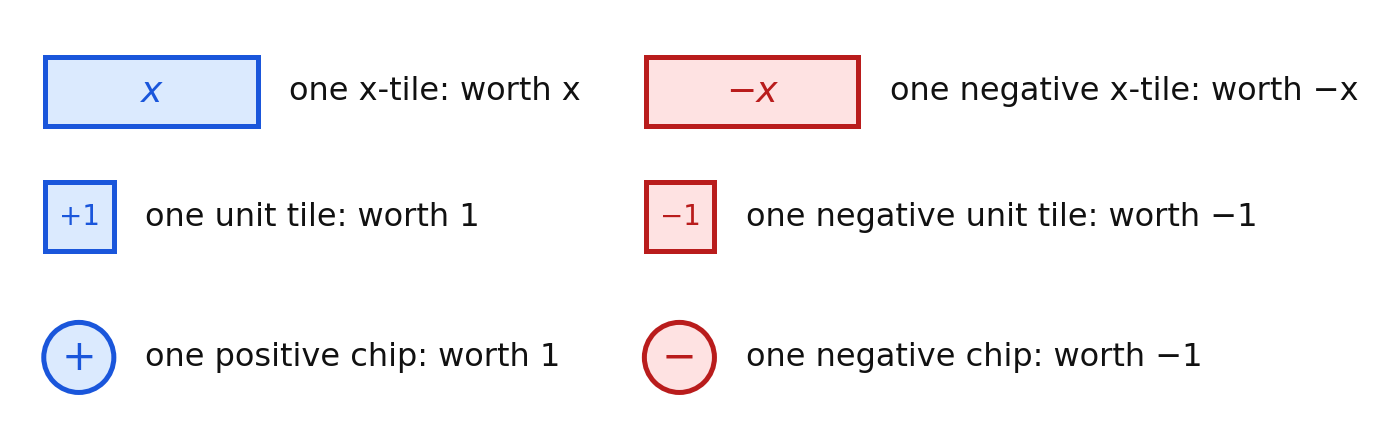
An algebra tile set has long rectangles and small squares. One long rectangle is an -tile: its value is , whatever turns out to be. One small square is a unit tile: its value is . A colored chip is a round counter worth or ; chips are handy when an expression has a lot of constants and no variable pieces to draw.
Color carries the sign. Throughout this book, blue pieces are positive and red pieces are negative.
Here is built from tiles. Count carefully: three -tiles, two unit tiles. The model is a literal picture of the expression.
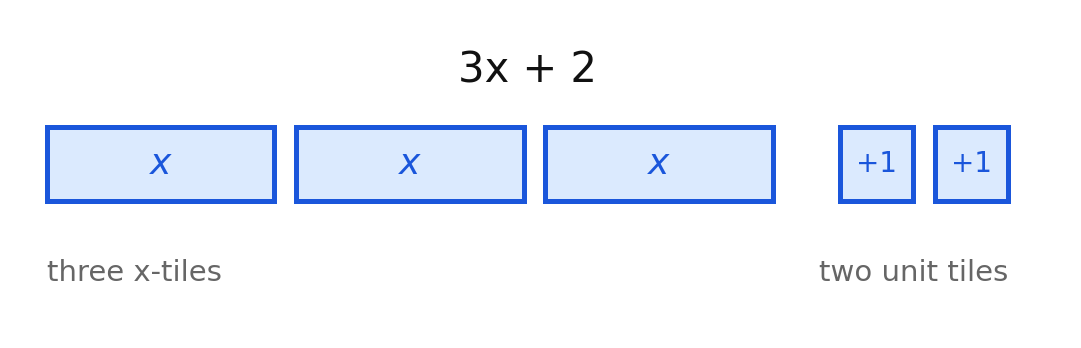
Notice what the picture makes obvious. The -tile is drawn longer than the unit tile and we never say how much longer, because we do not know. That is exactly right: is unknown. A student who assumes the -tile is worth 3 unit tiles has stopped modeling a variable.
Reading a model, writing a model
Going from tiles to symbols is counting. Three -tiles and four negative unit tiles is . Going from symbols to tiles is the same trip backwards: needs two negative -tiles and five positive unit tiles.
Watch the signs. In , the subtraction sign belongs to the , so the model has five positive unit tiles and two negative -tiles. Reading as "five negatives and two -tiles" is the single most common modeling error.
Zero pairs
A positive -tile placed with a negative -tile is worth . That is a zero pair. The same goes for a positive chip with a negative chip, or a unit tile with a negative unit tile.
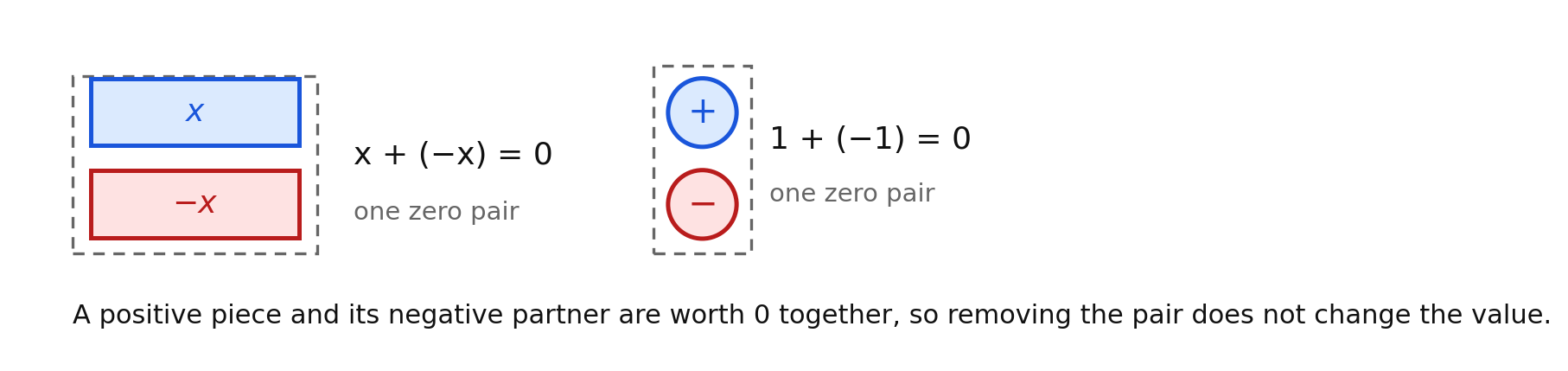
Zero pairs are the engine of this chapter. Removing a zero pair from a model removes a value of , and removing never changes what the pile is worth. So the model before and the model after represent equivalent expressions. When you later "combine like terms" on paper, this is what is really happening.
Chips alone can show the same idea with pure numbers.
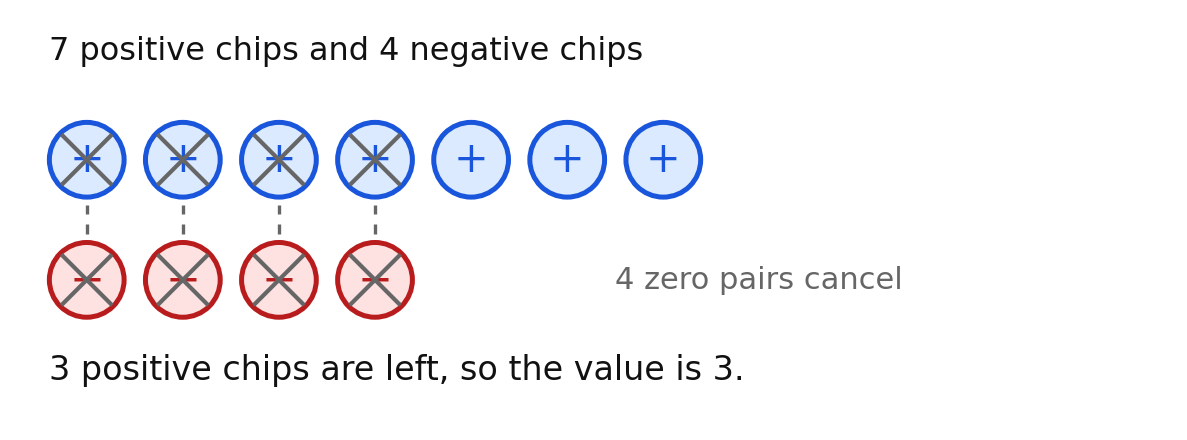
Seven positive chips and four negative chips: four zero pairs cancel, three positive chips survive, and the value is .
Worked examples
Example 1 — Reading an expression from a tile model
A model shows four -tiles and three negative unit tiles. Write the expression.
Four -tiles give . Three negative unit tiles give .
Answer:
Example 2 — Building a model from an expression
Describe a tile model for .
The coefficient calls for two negative -tiles. The calls for six positive unit tiles.
Answer: Two negative -tiles and six positive unit tiles.
Example 3 — A subtraction sign in front of the variable term
Describe a tile model for .
Rewrite the expression as a sum so each sign is attached to its own term: . The is seven positive unit tiles; the is three negative -tiles.
Answer: Seven positive unit tiles and three negative -tiles.
Example 4 — Using zero pairs on a model
A model shows five -tiles and two negative -tiles. What is left after removing all zero pairs, and what does that tell you?
Pair each negative -tile with a positive -tile. Two pairs form and cancel, and positive -tiles remain.
Answer: Three -tiles remain, so is equivalent to .
Example 5 — Comparing two models
Model A: three -tiles and one negative unit tile. Model B: one -tile, four negative unit tiles, two -tiles, and three positive unit tiles. Are the two expressions equivalent?
Model A is . Model B is . In Model B, group the -tiles: one and two make three. Then pair the four negative unit tiles against the three positive unit tiles: three zero pairs cancel and one negative unit tile is left.
So Model B reduces to three -tiles and one negative unit tile — exactly Model A.
Answer: Yes. Both are equivalent to .
Guided practice
- A model shows three -tiles and two positive unit tiles. Write the expression.
- Describe a tile model for .
- Describe a tile model for .
- A model shows four -tiles and three negative unit tiles. Write the expression.
- What is the value of one zero pair, and why does removing one leave the total unchanged?
- A model shows three -tiles and two negative -tiles. Remove all zero pairs and write what remains.
Independent practice
- Write the expression modeled by each set of tiles. a) two -tiles and six negative unit tiles b) three negative -tiles and one positive unit tile c) one -tile and five positive unit tiles
- Describe a tile model for .
- A pile has seven positive chips and four negative chips. What is its value?
- A pile has five negative chips and two positive chips. What is its value?
- Reasoning. Model with tiles. Explain what is left and why the expression is equivalent to .
- Model A shows three -tiles and two negative unit tiles. Model B shows one -tile, five negative unit tiles, two -tiles, and three positive unit tiles. Are the two expressions equivalent? Justify with zero pairs.
- Application. A concert ticket costs dollars, and the site adds a flat $2 service fee to the whole order. Write an expression for the cost of three tickets plus the fee, and describe a tile model for it.
- Error analysis. To model , a student lays out five negative unit tiles and two positive -tiles. Explain the mistake and describe the correct model.
Exit ticket 9.1
- Write the expression modeled by two -tiles and four negative unit tiles.
- Describe a tile model for .
- A model shows five -tiles and three negative -tiles. What remains after all zero pairs are removed?
- Explain why one positive chip together with one negative chip is worth zero.
Lesson 9.2 — Like Terms and What Makes Them Alike
Terms, coefficients, and constants
An expression is built from terms. A term is a single number, a single variable, or a number multiplied by a variable. Terms are separated by addition and subtraction signs.
To count terms reliably, first rewrite every subtraction as adding the opposite. In , rewrite as : three terms, namely , , and .
The number multiplying the variable is the coefficient. A term that is just a number is a constant.
| Expression | Terms | Coefficient of | Constant |
|---|---|---|---|
| , | |||
| , | |||
| , | |||
| none |
Two entries in that table deserve a second look. In , the coefficient is , not or nothing: means . And in , the coefficient is , with the sign. The sign in front of a term belongs to that term. Nearly every sign error in this chapter traces back to forgetting that one sentence.
What makes terms "like"
Like terms are terms with exactly the same variable part. So and are like terms. So are and , and so are the constants and , which both have no variable at all.
But and are not like terms, and this is where the tile model earns its keep. Seven -tiles and seven unit tiles are different-shaped objects. You can say "seven -tiles and seven unit tiles," and that is as short as the description gets — you cannot merge them into "fourteen somethings," because you do not know how long an -tile is. In symbols: cannot be simplified.
This chapter stays inside expressions with only linear and numeric terms — every variable term is a number times to the first power, and there are no terms — so there are only ever two families of like terms to sort: the -terms and the constants.
Sorting before simplifying
Given , rewrite as a sum, then sort:
- -terms: and
- constants: and
Sorting is the whole skill of this lesson. Lesson 9.3 does the arithmetic.
Worked examples
Example 1 — Naming the parts
In , name the coefficient of and the constant.
Rewrite as . The number multiplying is ; the term with no variable is .
Answer: coefficient ; constant
Example 2 — A hidden coefficient
In , what is the coefficient of ?
The term means .
Answer:
Example 3 — Counting terms
How many terms are in , and what are they?
Rewrite as .
Answer: three terms — , , and
Example 4 — Identifying like terms
Identify the like terms in .
Rewrite as . Group by variable part.
Answer: and are like terms; and are like terms.
Example 5 — Fractional and decimal coefficients
Are and like terms?
Both have the variable part . The coefficients are rational numbers, one positive and one negative, but that does not matter: like terms are decided by the variable part alone.
Answer: Yes.
Guided practice
- In , name the coefficient of and the constant.
- How many terms are in ?
- In , what is the coefficient of ?
- Are and like terms? Explain in one sentence.
- Identify the like terms in .
- Are and like terms?
Independent practice
- List the terms of .
- Name the coefficient in each term: a) b) c) d)
- Which pairs are like terms? a) and b) and c) and d) and
- Sort the terms of into -terms and constants.
- Reasoning. Explain, using algebra tiles, why and are not like terms.
- Are and equivalent? Test both at and at , then say what the models look like.
- Application. A rectangle has length centimeters and width centimeters. Its perimeter is . Name the like terms in that expression.
- Error analysis. A student says that in the coefficient of is . Explain what is wrong and give the correct coefficient.
Exit ticket 9.2
- Name the coefficient and the constant in .
- Are and like terms? Explain.
- How many terms are in ?
- In your own words, what makes two terms like terms?
Lesson 9.3 — Combining Like Terms
Why like terms combine at all
"Combine like terms" is usually taught as a rule to follow. It is better understood as the distributive property read backwards.
The distributive property says . Read it right to left and it says — a common factor can be pulled out front. Now look at . Both terms have the factor :
Nothing was memorized. The was factored out, the numbers and were added because they are plain numbers, and the was multiplied back in. That is also exactly what the tiles show: five -tiles pushed together with three -tiles make eight -tiles.
Try the same move on and it stalls: there is no common factor of , since the second term has no in it. That is the real reason unlike terms do not combine.
Doing it on paper
- Rewrite every subtraction as adding the opposite, so each sign is attached to its term.
- Group like terms, keeping each sign with its term.
- Add the coefficients of the -terms; add the constants.
- Write the result, conventionally with the -term first.
Here is the full process on :
The tile picture of the same idea, with a different expression, is worth studying because it shows the zero pairs explicitly.
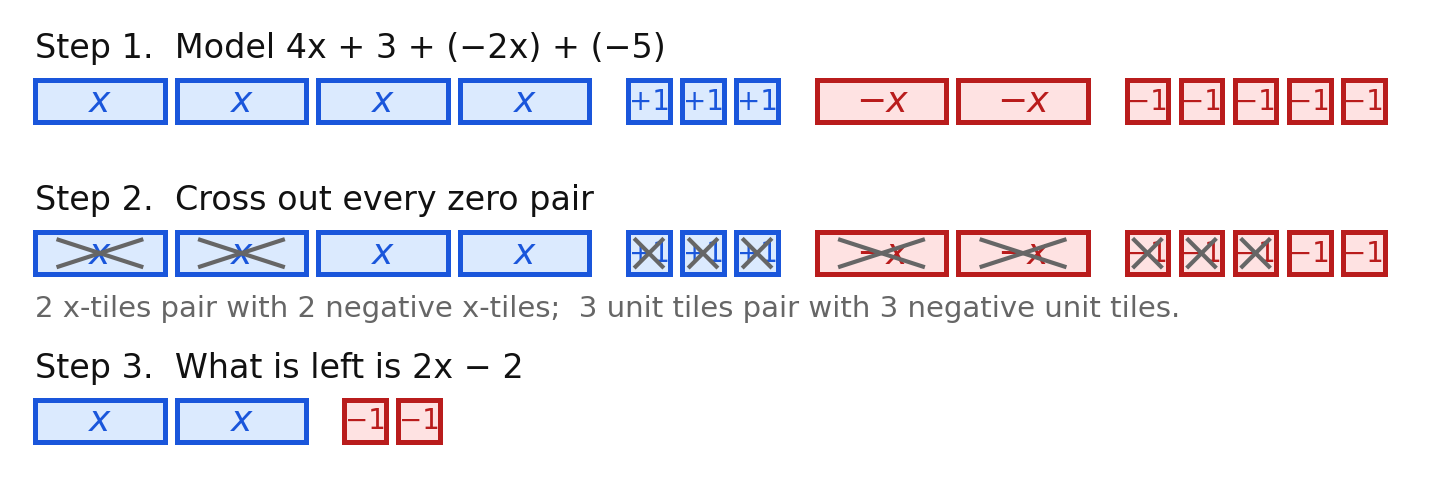
Coefficients that are not whole numbers
The standard allows coefficients that are positive or negative rational numbers, and the method does not change. Add the coefficients the way you learned to add rational numbers in Chapter 4.
Worked examples
Example 1 — Two like terms
Simplify .
Answer:
Example 2 — A negative sum of coefficients
Simplify .
Answer:
Example 3 — Two families at once
Simplify .
Answer:
Example 4 — Constants first, variable term negative
Simplify .
Answer:
Example 5 — Everything cancels
Simplify .
Since for every value of , the expression is equivalent to . In tiles: every piece finds a partner and the table is empty.
Answer:
Guided practice
- Simplify .
- Simplify .
- Simplify .
- Simplify .
- Simplify .
- Simplify .
- Simplify .
- Simplify .
Independent practice
- Simplify each. a) b) c) d)
- Simplify .
- Simplify .
- Simplify .
- Simplify .
- Simplify .
- Reasoning. Use the distributive property to explain why . Then explain why the same reasoning does not let you write as .
- Show that and are equivalent by simplifying, then check by evaluating both at and at .
- Application. A triangle has sides of length , , and inches. Write and simplify an expression for its perimeter.
- Error analysis. A student simplifies to . Explain the error and give the correct simplification.
Exit ticket 9.3
- Simplify .
- Simplify .
- Simplify .
- Explain why cannot be simplified any further.
Lesson 9.4 — The Distributive Property with Variables
One rectangle, two ways to measure it
The distributive property states that for any numbers , , and ,
An area model shows why. A rectangle of height and width has area . Cut it at the seam between the part and the part, and you have two rectangles with areas and . Same rectangle, two descriptions, so the two expressions must be equal.
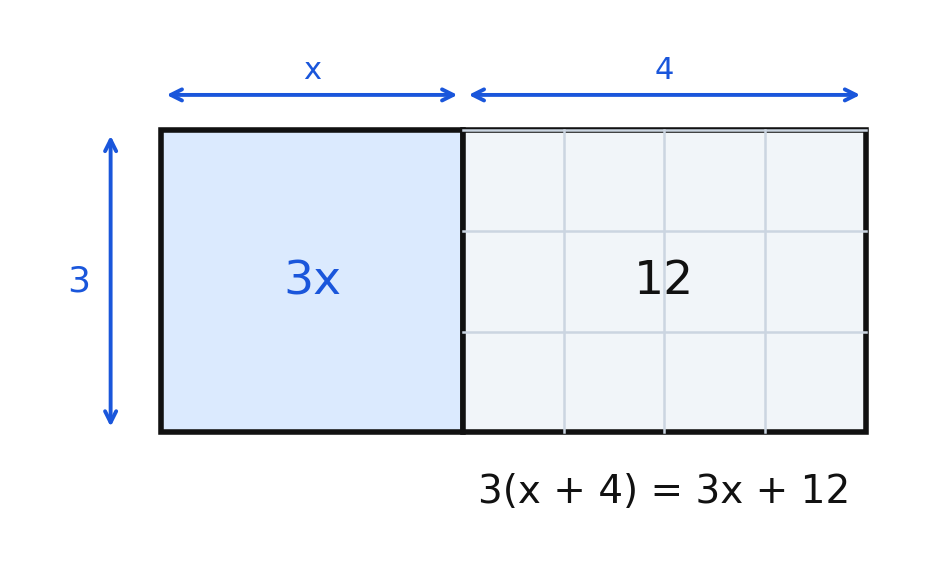
The factor outside multiplies every term inside — not just the first one. Writing leaves three-quarters of the rectangle unaccounted for.
Distributing a negative factor
When the factor outside is negative, each product picks up a sign change. Take it one term at a time and write the sign down before you move on.
That second one is the trap. The inside times the outside gives , because a negative times a negative is positive. If your answer to a problem like this has two negative terms, check that product again.
A bare minus sign in front of parentheses means a factor of :
Distribute, then combine
Most problems ask for both moves. Distribute first, because the parentheses are the innermost grouping, then combine like terms.
Note how the subtraction in the middle was handled: it distributed as across both terms of , giving . Distributing it across only the and writing is the most frequent error in this lesson.
Worked examples
Example 1 — A positive factor
Simplify .
Answer:
Example 2 — A negative factor
Simplify .
Answer:
Example 3 — A fractional factor
Simplify .
Answer:
Example 4 — Distribute twice, then combine
Simplify .
Distribute each factor, keeping the attached to the second set of parentheses:
Now combine:
Answer:
Example 5 — A bare minus sign in front of parentheses
Simplify .
Answer:
Guided practice
- Simplify .
- Simplify .
- Simplify .
- Simplify .
- Simplify .
- Simplify .
- Simplify .
- Simplify .
Independent practice
- Expand each. a) b) c) d)
- Simplify .
- Simplify .
- Simplify .
- Simplify .
- Reasoning. Use an area model to explain why . Describe what each region of the rectangle represents.
- Application. A teacher fills four identical party bags. Each bag holds stickers and erasers. Write an expression for the total number of items using parentheses, then expand it.
- Error analysis. A student writes . Identify the error and give the correct expansion.
Exit ticket 9.4
- Expand .
- Simplify .
- Simplify .
- Explain why the factor outside the parentheses must multiply every term inside.
Lesson 9.5 — Evaluating Expressions for Given Values
Substitution
To evaluate an expression, you replace the variable with a given replacement value and then simplify the resulting numerical expression using the order of operations from Chapter 8.
The one habit that prevents most errors: substitute inside parentheses. Write at as
not as , which no longer says what you meant. The parentheses keep the negative sign glued to the number and keep the multiplication visible.
The order of operations still rules
An expression to evaluate may contain exponents on positive integer bases (limited to exponents , , , and ), square roots of perfect squares, brackets, and absolute value bars. Brackets and absolute value bars are grouping symbols: finish everything inside them before you use the result.
Absolute value bars work the same way — simplify inside first, then take the distance from zero:
Simplify first, then evaluate
If an expression can be simplified, simplifying it before substituting is usually less work and gives fewer chances to slip. It is also safe, because a simplified expression is equivalent to the original — same value for every replacement value.
Take . Simplified, it is . Evaluating both at :
Same answer, as it must be.
Testing equivalence by substitution
Substitution also gives you a way to check whether two expressions are equivalent. Pick several replacement values, ideally including a negative one and zero, and evaluate both.
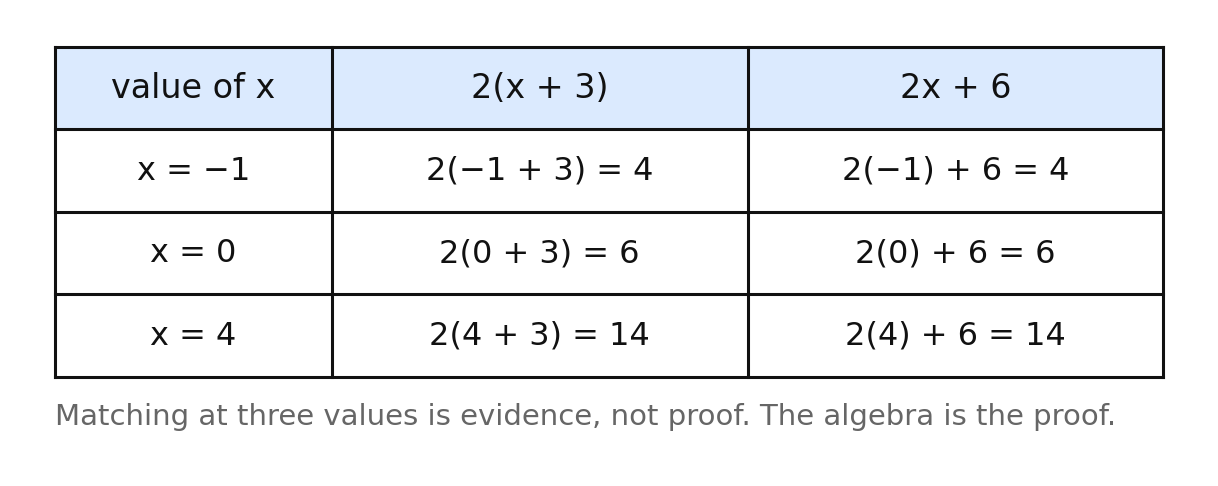
Be honest about what this shows. Agreement at three values is strong evidence, and disagreement at even one value is proof that the expressions are not equivalent. But agreement can never be a full proof of equivalence, because equivalence is a claim about every replacement value, and there are infinitely many. The algebra — distributing, combining like terms — is what proves it.
Here is why that caution matters. The expressions and both equal at . Test only that one value and you would wrongly call them equivalent. At they give and , and the claim collapses.
Worked examples
Example 1 — A negative replacement value
Evaluate for .
Answer:
Example 2 — A fractional replacement value
Evaluate for .
Answer:
Example 3 — With an exponent
Evaluate for .
Exponents come before addition: .
Answer:
Example 4 — With brackets and a square root
Evaluate for .
Answer:
Example 5 — With absolute value bars
Evaluate for .
Answer:
Example 6 — Simplify, then evaluate at two values
Simplify , then evaluate the simplified form at and at .
Answer: ; values and
Guided practice
- Evaluate for .
- Evaluate for .
- Evaluate for .
- Evaluate for .
- Evaluate for .
- Evaluate for .
- Evaluate for .
- Evaluate for .
Independent practice
- Evaluate for a) b) c)
- Evaluate for a) b) c)
- Evaluate for .
- Evaluate for .
- Evaluate for .
- Simplify . Then evaluate both the original and the simplified expression at and at , and say what the results show.
- Application. A kayak rental costs $12 per hour plus a $5 launch fee. The total cost in dollars is , where is the number of hours. Find the cost of a 3-hour rental.
- Error analysis. Asked to evaluate for , a student writes . Identify the error and give the correct value.
Exit ticket 9.5
- Evaluate for .
- Evaluate for .
- Evaluate for .
- Explain why you should write parentheses around a negative replacement value when you substitute. Use at as your example.
Chapter 9 Review
Vocabulary. algebraic expression · variable · equivalent · algebra tile · -tile · unit tile · colored chip · zero pair · term · coefficient · constant · like terms · distributive property · evaluate · replacement value
Part A — Modeling with tiles and chips (7.PFA.2b)
- Write the expression modeled by three -tiles and five negative unit tiles.
- Describe a tile model for .
- A model shows six -tiles and four negative -tiles. Remove all zero pairs and write the simplified expression.
- A pile has eight positive chips and eleven negative chips. What is its value?
- Explain how zero pairs show that .
Part B — Simplifying and generating equivalent expressions (7.PFA.2c)
- Simplify each. a) b) c) d)
- Simplify .
- Simplify .
- Simplify .
- Simplify .
- Simplify .
- Write two different expressions equivalent to . At least one must use parentheses, and explain why each is equivalent.
Part C — Evaluating expressions (7.PFA.2d)
- Evaluate for a) b) c)
- Evaluate for .
- Evaluate for .
- Evaluate for .
- Evaluate for .
Part D — Mixed application and reasoning
- Show that and are equivalent by simplifying the first expression, then check by evaluating both at and at .
- Application. A ride costs $3 plus $2 per mile, so one rider pays dollars for miles. Two friends each take their own ride of the same length. Write an expression for the total using parentheses, simplify it, and find the total for a 7-mile trip.
- Error analysis. A student simplifies to . Identify the error and give the correct simplification.
- Reasoning. Explain why checking a single replacement value is not enough to prove two expressions are equivalent. Use and in your explanation.
- Use algebra tiles to justify that and are equivalent. Describe the tiles in both arrangements.
Standards coverage check — Chapter 9
| Knowledge and Skill | Where it is taught | Where it is practiced |
|---|---|---|
| 7.PFA.2b — represent equivalent algebraic expressions in one variable using concrete manipulatives and pictorial representations (colored chips, algebra tiles) | 9.1; revisited in 9.2, 9.3, 9.4 | Items 1–18; 29, 30; 51; 72; Review Part A, items 99–103, and item 120 |
| 7.PFA.2c — simplify and generate equivalent algebraic expressions in one variable by applying the order of operations and properties of real numbers, combining like terms; linear and numeric terms only; coefficients may be positive or negative rational numbers | 9.2, 9.3, 9.4 | Items 19–78; 92; Review Part B, items 104–110, and items 116–118 |
| 7.PFA.2d — evaluate algebraic expressions for given replacement values, using the order of operations; exponents 1–4 on positive integer bases, brackets and absolute value bars, perfect-square roots, at most three replacement values per expression, values may be positive or negative rational numbers | 9.5 | Items 30, 52; 79–98; Review Part C, items 111–115, and items 116, 117, 119 |
Part a of 7.PFA.2 — using the order of operations and the properties of real numbers to simplify purely numerical expressions — is covered in Chapter 8, and this chapter assumes it.
Answer keys for every set in this chapter are in Appendix A.