Chapter 8 — Simplifying Numerical Expressions
Standard: 7.PFA.2 (a) — The student will simplify numerical expressions, simplify and generate equivalent algebraic expressions in one variable, and evaluate algebraic expressions for given replacement values of the variables.
By the end of this chapter you will be able to:
- Use the order of operations to simplify a numerical expression to a single value (7.PFA.2a)
- Simplify expressions containing exponents of 1, 2, 3, or 4 on positive integer bases (7.PFA.2a)
- Simplify expressions containing square roots of perfect squares (7.PFA.2a)
- Work correctly with nested grouping symbols, including brackets and absolute value bars (7.PFA.2a)
- Apply the properties of real numbers as shortcuts that make simplifying easier without changing the value (7.PFA.2a)
Lessons: 8.1 The Order of Operations · 8.2 Exponents and Perfect-Square Roots Inside Expressions · 8.3 Brackets and Absolute Value Bars · 8.4 Properties of Real Numbers as Shortcuts
Calculator note. Everything in this chapter is meant to be done by mental math and pencil work. Virginia assesses this skill without a calculator, so every number here is chosen so that you can reach it by hand. A calculator would also hide the very thing this chapter teaches: the order you do the steps in.
A note on notation. This chapter uses parentheses
( ), brackets[ ], and absolute value bars| |. It does not use braces{ }. Exponents stay at 1, 2, 3, or 4, bases are positive integers, and every square root you meet has a perfect square underneath it.
Lesson 8.1 — The Order of Operations
Why an order is necessary
Look at this expression:
Two students simplify it. One adds first and gets . The other multiplies first and gets . Both did real arithmetic, and they got different answers. That is a problem — not a small one. If a single expression could mean two things, then a recipe, a price tag, a bridge measurement, and a test question could all mean two things.
Mathematicians settled this the way any community settles an ambiguity: by agreeing on a rule and using it everywhere. That agreement is called the order of operations. It is not a law of nature and it is not a trick. It is a shared convention, and its whole value comes from everyone following it.
The agreement says the second student is right. .
A numerical expression is a combination of numbers and operation symbols, with no equals sign — for example or . To simplify a numerical expression means to carry out its operations in the agreed order until only a single number is left. That single number is the value of the expression.
The four tiers
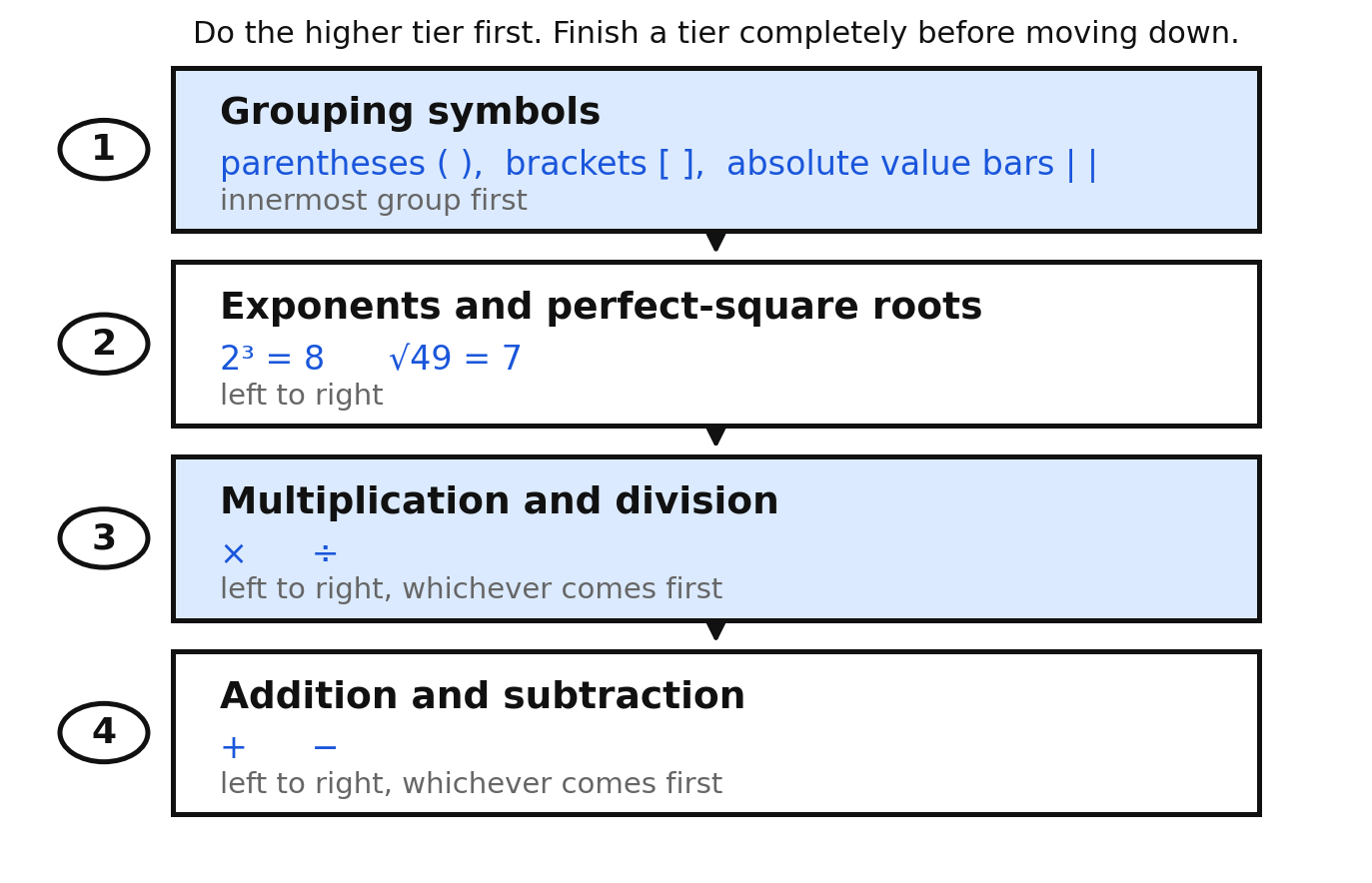
Read the ladder from the top down.
- Tier 1 — Grouping symbols. Anything inside parentheses, brackets, or absolute value bars is simplified first, working from the innermost group outward.
- Tier 2 — Exponents and perfect-square roots. Powers and radicals come next. You will meet these in Lesson 8.2.
- Tier 3 — Multiplication and division. These two share a tier. Do them left to right, in whatever order they appear.
- Tier 4 — Addition and subtraction. These two also share a tier. Again, left to right.
The part everyone gets wrong
Tiers 3 and 4 each hold two operations, and those two operations are equal in rank. Multiplication does not outrank division, and addition does not outrank subtraction. Within a tier you simply move left to right.
That matters because subtraction and division are not commutative — order changes the answer.
If you had multiplied first, you would have gotten , which is wrong. Same symbols, different value, and only one of them follows the agreement.
The same trap sits in the bottom tier:
Adding first would give . Also wrong. When you see a string of additions and subtractions, walk it left to right like you are reading a sentence.
A caution about memory devices. Whatever mnemonic you learned, remember that it lists four tiers, not six steps. Multiplication and division are one tier read left to right, and addition and subtraction are one tier read left to right.
How to show your work
Simplify one tier at a time and rewrite the whole expression on a new line after each step. Do not do two steps in your head at once. The rewriting is what makes an error findable — if the value comes out wrong, you can see exactly which line broke.
Worked examples
Example 1 — Multiplication before addition
Simplify .
There are no grouping symbols and no exponents, so start at tier 3.
Answer:
Example 2 — Two operations from the same tier
Simplify .
Division and multiplication share a tier, so work left to right. The division is leftmost.
Answer:
Example 3 — Grouping symbols first
Simplify .
Tier 1 is the parentheses. Then tier 3, left to right. Then tier 4.
Answer:
Example 4 — A four-step expression
Simplify .
Clear tier 3 completely before touching tier 4.
Notice the last two lines: the subtraction happened before the addition only because it was farther left.
Answer:
Example 5 — Two separate groups
Simplify .
There are two groups, and neither is inside the other, so simplify both.
Answer:
Guided practice
- Simplify . Which tier do you do first?
- Simplify . Compare your answer to item 1 and explain what the parentheses changed.
- Simplify .
- Simplify . Write the leftmost operation first.
- Simplify .
- Simplify .
Independent practice
- Simplify each: a) b) c) d)
- Simplify each: a) b) c) d)
- Simplify .
- Simplify .
- Simplify .
- Simplify .
- Simplify .
- Application. A class buys 4 packs of markers that cost $3 each and 2 notebooks that cost $5 each. Write a single numerical expression for the total cost, then simplify it.
- Reasoning. Explain why does not equal . Give the correct value and say what rule settles it.
- Error analysis. Riley simplified by writing and then . Identify the error and give the correct value.
Exit ticket 8.1
- Simplify .
- Simplify .
- Simplify .
- In your own words, explain why mathematicians needed to agree on an order of operations at all.
Lesson 8.2 — Exponents and Perfect-Square Roots Inside Expressions
Exponents, briefly
An exponent tells you how many times a base is used as a factor. In , the base is 2 and the exponent is 3, so
Read as "two to the third power" or "two cubed." Read as "five squared."
Two reminders that catch people every year. First, is not . The exponent counts factors; it does not multiply. Second, and are different numbers: while . The base and the exponent are not interchangeable.
In this course, exponents are limited to 1, 2, 3, and 4, and bases are positive integers. An exponent of 1 leaves the base alone: , because 7 is used as a factor exactly once.
Here are the powers you will use most. Build them by repeated multiplication if you do not remember one.
| Base | to the 1st | to the 2nd | to the 3rd | to the 4th |
|---|---|---|---|---|
| 2 | 2 | 4 | 8 | 16 |
| 3 | 3 | 9 | 27 | 81 |
| 4 | 4 | 16 | 64 | 256 |
| 5 | 5 | 25 | 125 | 625 |
| 10 | 10 | 100 | 1{,}000 | 10{,}000 |
Perfect-square roots, briefly
The square root of a number is the number that, multiplied by itself, gives it. The radical sign asks for the positive square root, and the number underneath is the radicand.
Every radicand in this chapter is a perfect square — a number produced by multiplying a whole number by itself — so every root you take comes out to a whole number. The list you built in Chapter 3 is the list you need here: .
Where they sit in the order
Exponents and perfect-square roots share tier 2. They come after grouping symbols and before any multiplication, division, addition, or subtraction.
The became 9 before anything was multiplied, and certainly before anything was added.
There is one detail about the radical sign worth stating plainly: the radical sign is also a grouping symbol. Everything sitting under the bar is one package, and you simplify that package completely before taking the root.
You may not take the roots one at a time — is a different expression entirely. The bar over groups those numbers just as parentheses would.
The same holds for a power applied to a group. In the exponent belongs to the whole group, so simplify inside first:
That is not the same as . Squaring a sum is not squaring the pieces.
Worked examples
Example 1 — A power inside a longer expression
Simplify .
Tier 2 first, then tier 3, then tier 4.
Answer:
Example 2 — A power with a division
Simplify .
Answer:
Example 3 — A root and a power together
Simplify .
Both tier-2 pieces come first, then the multiplication, then the addition.
Answer:
Example 4 — An exponent on a group
Simplify .
The parentheses are tier 1, so they go before the exponent even though the exponent is attached to them.
Answer:
Example 5 — A radicand that must be simplified first
Simplify .
The radical sign groups , so add underneath before taking the root.
Answer:
Guided practice
- Evaluate: a) b) c) d)
- Simplify .
- Simplify .
- Simplify .
- Simplify .
- Simplify . What do you do before applying the exponent?
Independent practice
- Evaluate: a) b) c) d)
- Evaluate: a) b) c) d)
- Simplify .
- Simplify .
- Simplify .
- Simplify .
- Simplify .
- Simplify .
- Application. A square garden covers 144 square feet. Write a numerical expression using a square root for the distance all the way around the garden, then simplify it.
- Reasoning. Explain why and are not equal, even though the same two numbers appear in both. Give both values.
- Error analysis. Tomas simplified by writing and then . Identify the error and give the correct value.
Exit ticket 8.2
- Simplify .
- Simplify .
- Simplify .
- Explain why is not the same as . Give both values.
Lesson 8.3 — Brackets and Absolute Value Bars
A second pair of grouping symbols
When one group sits inside another, writing parentheses inside parentheses gets hard to read: makes your eye count symbols instead of think. So we use brackets [ ] for the outer group:
Brackets do exactly what parentheses do. They are not a stronger or weaker grouping symbol — they are the same idea in a different shape, used so the layers are easy to see. (You may have seen braces { } used as a third layer. In Grade 7 we stop at two, so no expression in this book uses braces.)
Peel from the inside out
With nested groups, the rule from tier 1 does the work: innermost first.
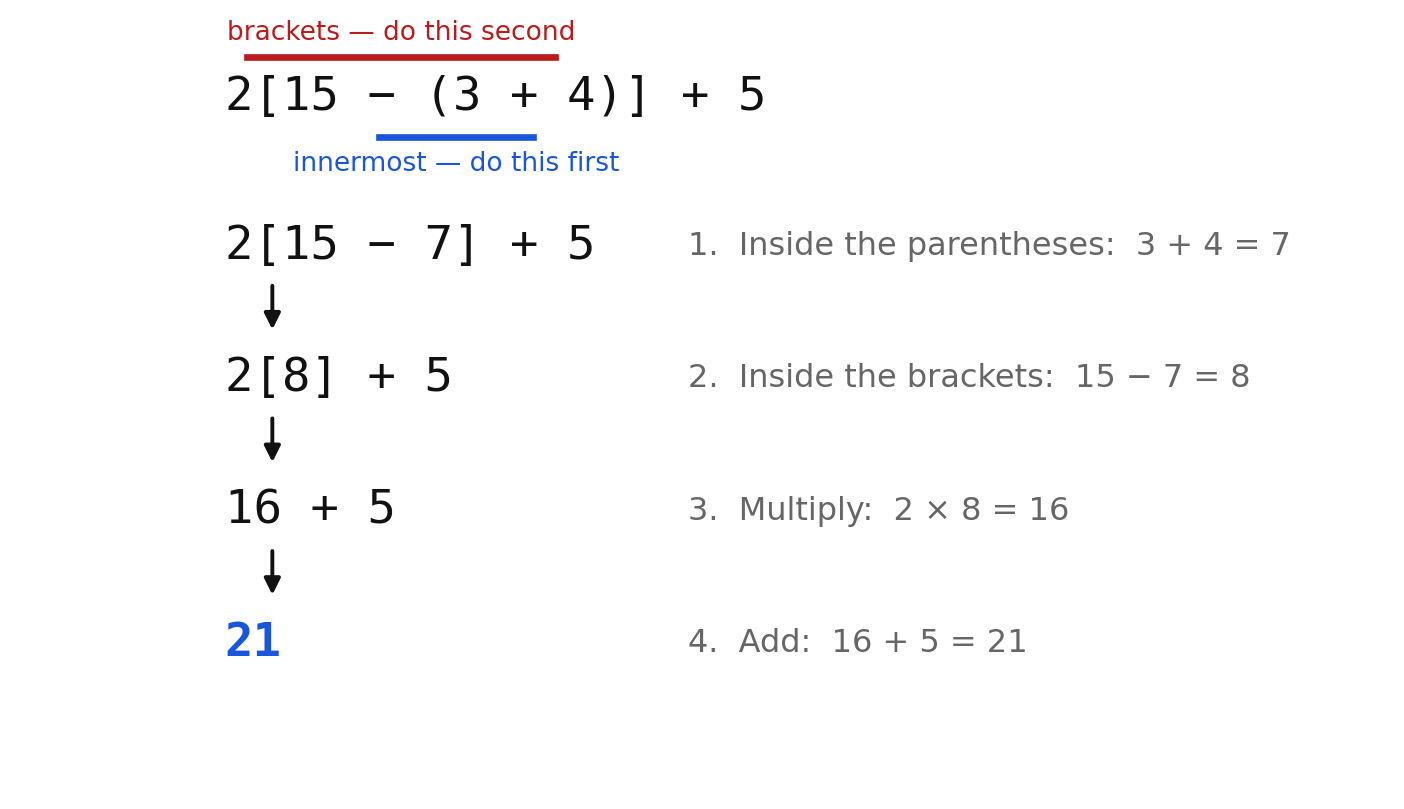
Think of the expression as an onion. The parentheses are the center. Simplify them, rewrite the whole expression, and the brackets become the new center. Simplify those, rewrite again, and now you have an ordinary expression with no grouping symbols left. Each rewrite makes the next step obvious.
One notational point: in , the 2 sitting against the bracket means multiplication, the same way it does in . So .
Absolute value bars group too
The absolute value of a number is its distance from zero on the number line. Distance has no direction, so absolute value is never negative.
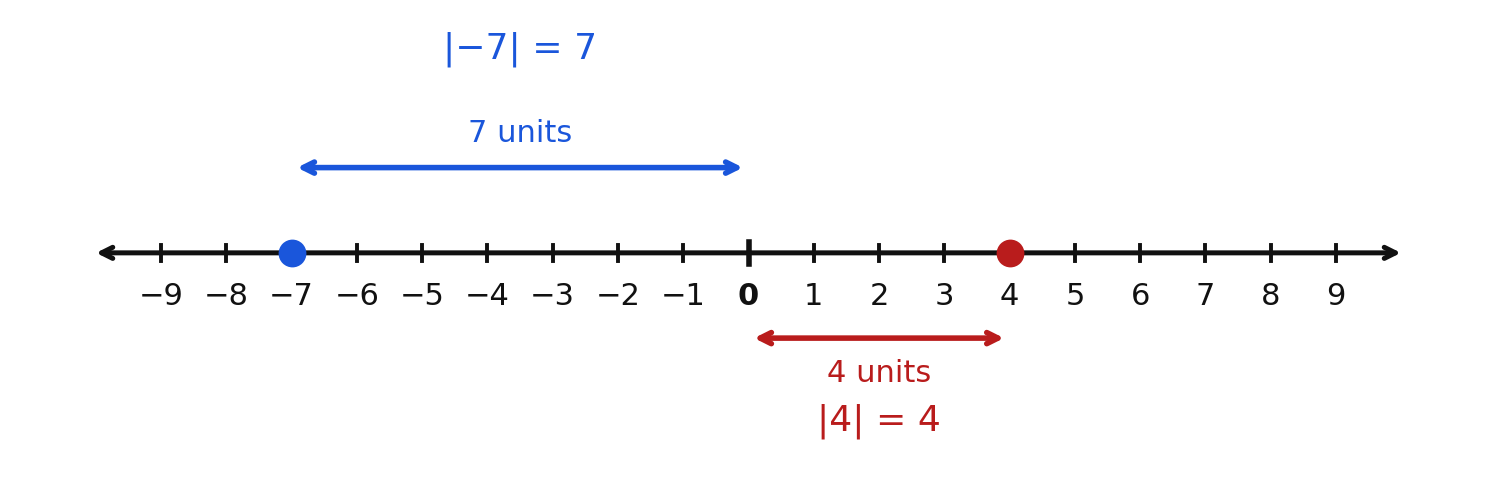
Now the part that belongs to this chapter. A pair of absolute value bars is a grouping symbol. It works in two moves, always in this order:
- First, simplify everything between the bars, all the way down to a single number.
- Then, take that number's distance from zero.
You may not drop the bars and simplify as you go. Writing as gives once you finish the surrounding expression incorrectly, and it throws away what the bars are for. Simplify inside; then take the distance.
This is the place where a negative value inside becomes positive, and that is not a trick — it is what distance means. The number sits 7 units from zero, so its absolute value is 7.
Two more useful facts:
- and always give the same value, because the distance from to does not depend on which one you start at. So and .
- A number written immediately before the bars multiplies the result: means .
Where the bars sit in the order
Absolute value bars are tier 1, right alongside parentheses and brackets. If bars appear inside brackets, the bars are the inner layer and go first. If a bracket appears inside bars, the bracket goes first. Innermost first, always.
Worked examples
Example 1 — Brackets around parentheses
Simplify .
Innermost group first.
Answer:
Example 2 — Brackets with a power outside
Simplify .
Answer:
Example 3 — A negative value inside the bars
Simplify .
Simplify inside the bars, then take the distance from zero, then add.
Answer:
Example 4 — A multiplier in front of the bars
Simplify .
Answer:
Example 5 — Bars nested inside brackets
Simplify .
The bars are the innermost layer. Then finish the brackets, then work tier 3 left to right.
Answer:
Guided practice
- Simplify . Which group do you simplify first?
- Simplify .
- Find .
- Find . Write the value inside the bars before you take the distance.
- Simplify .
- Simplify .
Independent practice
- Evaluate: a) b) c) d)
- Simplify .
- Simplify .
- Simplify .
- Simplify .
- Simplify .
- Simplify .
- Simplify .
- Application. At 6 a.m. the temperature was °F. By noon it was °F. Write an expression using absolute value bars for how many degrees the temperature changed, then simplify it.
- Reasoning. Explain why and have the same value, using the idea of distance.
- Error analysis. Priya simplified by dropping the bars and writing . Identify the error and give the correct value.
Exit ticket 8.3
- Simplify .
- Simplify .
- Simplify .
- Explain why the bars in are called grouping symbols. What must you finish before taking the absolute value?
Lesson 8.4 — Properties of Real Numbers as Shortcuts
Shortcuts, not exceptions
Simplify strictly left to right: , then . Correct, but the middle step was the hard one.
Now try it the easy way. Add the 17 and the 3 first to make 20, then add 46: . Same answer, no hard step.
Rearranging like that is allowed, and it is allowed for a reason with a name. The properties of real numbers are statements about which rearrangements never change a value. They are not exceptions to the order of operations — they are facts about addition and multiplication that let you reach the same correct value by an easier road. If a shortcut ever gives you a different answer than the strict order would, the shortcut was misapplied.
The properties you will use
| Property | What it says | Example |
|---|---|---|
| Commutative property of addition | Order of addends does not matter | |
| Commutative property of multiplication | Order of factors does not matter | |
| Associative property of addition | Regrouping addends does not matter | |
| Associative property of multiplication | Regrouping factors does not matter | |
| Distributive property | A factor multiplies each term of a sum | |
| Additive identity | Adding 0 changes nothing | |
| Multiplicative identity | Multiplying by 1 changes nothing | |
| Additive inverse | A number plus its opposite is 0 | |
| Multiplicative inverse | A number times its reciprocal is 1 |
The one boundary line
The commutative and associative properties belong to addition and multiplication only. They do not hold for subtraction or division:
So you may freely reorder the addends of a sum or the factors of a product, but you may not swap the two sides of a subtraction or a division. That single boundary keeps the shortcuts honest.
You also cannot reorder across tiers. In the 3 and the 4 are factors of one product; the 5 is an addend. No property lets you add the 5 and the 3 first.
Making friendly numbers
Most shortcuts come down to one habit: rearrange to make a 10, a 100, or a 1,000, then finish.
The first uses the commutative and associative properties of addition; the second uses the commutative and associative properties of multiplication. Both give exactly what strict left-to-right would give, with less strain.
Additive inverses are worth watching for too:
That line used the commutative property to bring the opposites together, the additive inverse property to get 0, and the additive identity property to drop it.
The distributive property
The distributive property is the one that connects multiplication and addition, and the area of a rectangle is the clearest picture of it.
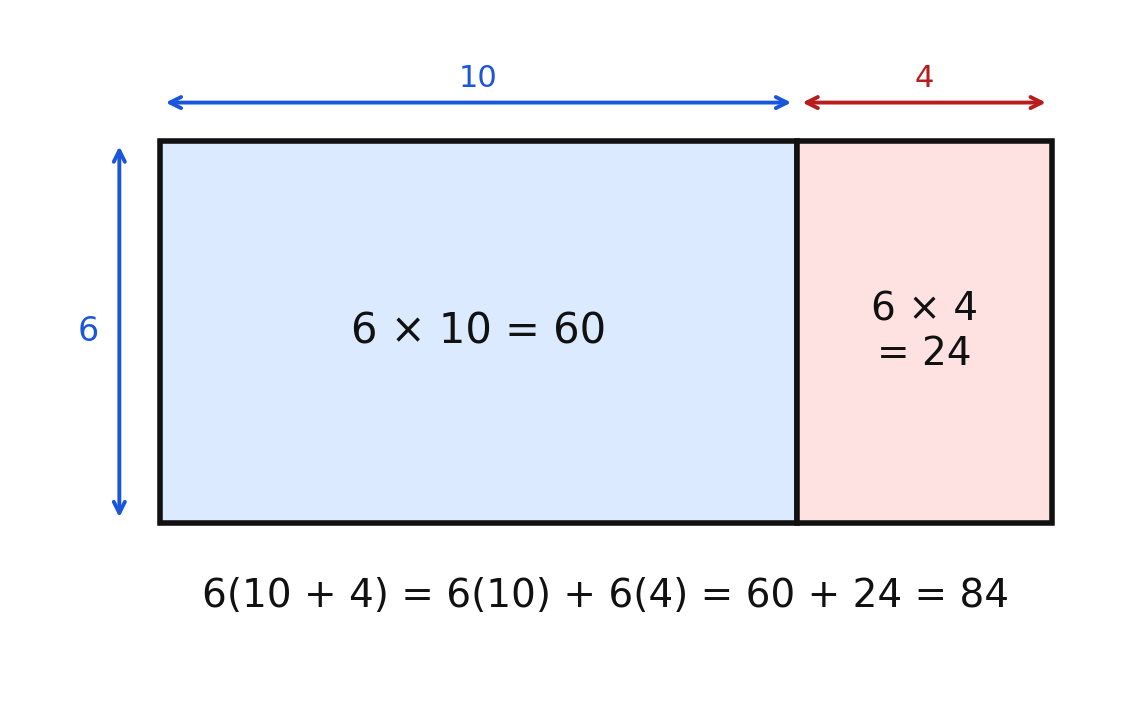
The whole rectangle is 6 units tall and units wide, so its area is . Cut it along the line and you have a piece of area 60 and a piece of area 24, and . The pieces have to total the whole, which is exactly what the property claims:
Notice what the shortcut bought you. Multiplying in your head is a little work; multiplying and is almost none. That is why you break a number into a friendly part and a small part:
The distributive property also works over a subtraction, and the same picture explains it — you compute a big rectangle and remove a strip:
Check it the strict way: . The shortcut and the rule agree, as they always must.
Distribute to every term. The most common error here is multiplying the first term and forgetting the second: writing as . The factor outside touches everything inside.
Worked examples
Example 1 — Commutative and associative properties of addition
Simplify using a shortcut, and name the properties.
Reorder (commutative) and regroup (associative) to pair the numbers that make 20.
Check strictly: and . ✓
Answer:
Example 2 — Commutative and associative properties of multiplication
Simplify .
Pair the 25 and the 4 to make 100.
Check strictly: and . ✓
Answer:
Example 3 — Distributive property
Simplify two ways.
Using the distributive property:
Using the order of operations directly:
Answer:
Example 4 — Inverse and identity
Simplify and name each property used.
Answer:
Example 5 — A shortcut inside a longer expression
Simplify .
Distribute to handle the product easily, then finish in order.
Check strictly: and . ✓
Answer:
Guided practice
- Name the property: .
- Name the property: .
- Use a shortcut to simplify , and say which two numbers you paired and why.
- Use a shortcut to simplify .
- Use the distributive property to simplify .
- Name the property: .
Independent practice
- Name the property shown by each: a) b) c) d)
- Use a shortcut to simplify .
- Use a shortcut to simplify .
- Use the distributive property to simplify , then check by simplifying inside the parentheses first.
- Use the distributive property to simplify .
- Simplify and name the three properties you used.
- Simplify and name the two properties you used.
- Simplify .
- Application. A teacher buys 8 boxes of pencils at $12 each and 8 boxes of erasers at $3 each. Write the total cost two ways — as and as a single product — and simplify.
- Reasoning. Show with an example that subtraction is not commutative. Then explain why the properties in this lesson are shortcuts rather than exceptions to the order of operations.
- Error analysis. Devon simplified as . Identify the error and give the correct value, with a check.
Exit ticket 8.4
- Name the property: .
- Use a shortcut to simplify .
- Use the distributive property to simplify .
- Explain why using a property shortcut can never change the value of an expression.
Chapter 8 Review
Vocabulary. numerical expression · simplify · value · order of operations · exponent · base · square root · radical sign · radicand · perfect square · brackets · absolute value · commutative property · associative property · distributive property · identity property · inverse property
Part A — Order of operations (7.PFA.2a)
- Simplify .
- Simplify .
- Simplify .
- Simplify .
- Simplify .
Part B — Exponents and perfect-square roots (7.PFA.2a)
- Evaluate: a) b) c) d)
- Evaluate: a) b) c) d)
- Simplify .
- Simplify .
Part C — Brackets and absolute value bars (7.PFA.2a)
- Simplify .
- Simplify .
- Simplify .
- Simplify .
Part D — Properties of real numbers (7.PFA.2a)
- Name the property shown by each: a) b) c)
- Use a shortcut to simplify .
- Use the distributive property to simplify .
Part E — Mixed application and reasoning
- Simplify .
- Application. A square courtyard covers 225 square feet. The owner wants fencing all the way around it, except for a 6-foot gate. Write a numerical expression using a square root for the length of fencing needed, then simplify it.
- Reasoning. Simplify and . Explain why the two expressions have different values even though they use the same three numbers.
- Error analysis. Sam simplified by subtracting first: , then . Identify the error, show the correct work line by line, and give the correct value.
Standards coverage check — Chapter 8
| Component of 7.PFA.2a | Where it is taught | Where it is practiced |
|---|---|---|
| Order of operations, including equal-rank tiers worked left to right | 8.1; reinforced in every later lesson | 1–20; 25, 29–34, 38–40; 49–55, 60–61; 76; Review 84–88, 100, 102–103 |
| Exponents limited to 1, 2, 3, or 4 with positive integer bases | 8.2 | 21–23, 26–27, 29–34, 37–38, 40; 46, 52, 54–55; 76; Review 89, 91–92, 95, 100 |
| Square roots limited to perfect squares | 8.2 | 24–25, 28, 30, 32–33, 35, 39, 41; 53; Review 90–92, 96, 100–101 |
| Brackets as grouping symbols, nested innermost-first (no braces used anywhere) | 8.3 | 42–43, 47, 49–50, 52, 54–55, 60–61; Review 93, 95–96, 100, 103 |
| Absolute value bars as grouping symbols, including a negative value inside | 8.3 | 44–46, 48, 51–59, 62; Review 94–96, 102 |
| Properties of real numbers — commutative, associative, distributive, identity, inverse | 8.4 | 63–83; Review 97–99 |
Item numbers run continuously from 1 to 103 across the chapter.
Parts b, c, and d of 7.PFA.2 — modeling equivalent algebraic expressions with manipulatives, generating equivalent algebraic expressions by combining like terms, and evaluating algebraic expressions for given replacement values — are covered in Chapter 9. This chapter deliberately stays with numerical expressions so the order of operations is secure before variables enter.
Answer keys for every set in this chapter are in Appendix A.