Chapter 6 — Percent of a Number
Standard: 7.CE.2 (d) — The student will solve problems, including those in context, involving proportional relationships.
By the end of this chapter you will be able to:
- Find benchmark percentages — 1%, 5%, 10%, 25%, 50%, 75%, and 100% — of a whole number using mental math (7.CE.2d)
- Estimate the percentage of a whole number by rounding to a friendly benchmark, and tell whether the estimate is high or low (7.CE.2d)
- Determine the exact percentage of a whole number using decimal multiplication, a fraction, a proportion, or a combination of benchmarks (7.CE.2d)
- Estimate and determine percentages of whole numbers in contextual problems such as tips, tax, discounts, and survey results (7.CE.2d)
Lessons: 6.1 Benchmark Percentages · 6.2 Estimating a Percent of a Number · 6.3 Finding an Exact Percent of a Number · 6.4 Percent in Context
Chapter 5 built the machinery of ratio tables, proportions, and unit conversion. This chapter puts one particular proportional relationship to work: the relationship between a percent and an amount. Everything you learned about proportions still applies, and we will use it — but the goal here is speed and judgment. By the end you should be able to find a tip in your head at a restaurant table, and know without checking whether your answer is roughly right.
Lesson 6.1 — Benchmark Percentages
Percent means "per hundred"
A percent is a ratio that compares a number to 100. The symbol means "per hundred," so means 35 out of every 100. That single idea is the whole foundation of this chapter.
Because a percent is a ratio out of 100, every percent can be written three equivalent ways:
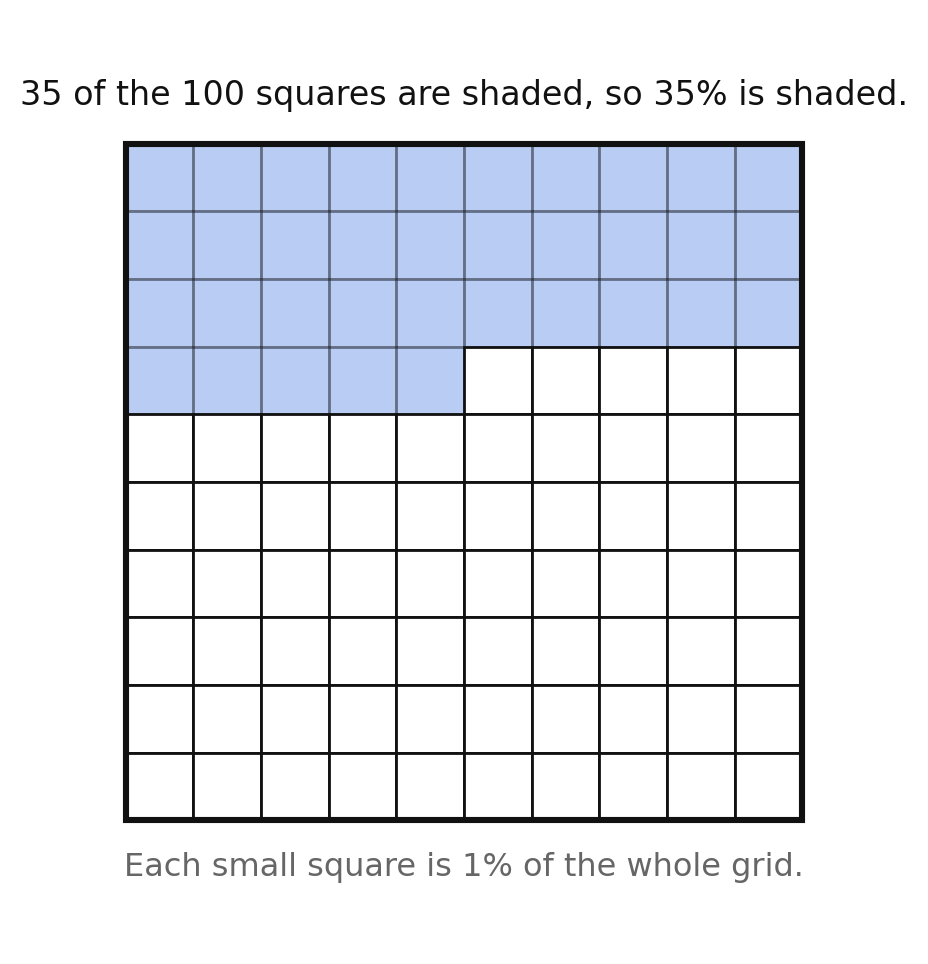
Each small square in the grid is one hundredth of the whole, which is exactly . Shade 35 of them and you have shaded of the grid. When someone asks for "35% of 80," they are asking: if the whole 80 were split into 100 equal pieces, how much would 35 of those pieces be worth?
The whole matters
A percent by itself is not an amount. of 8 is 4, and of 800 is 400. The percent tells you what fraction of the whole to take; the whole (also called the base) tells you what you are taking it from. Always name the whole before you start computing.
The benchmark percentages
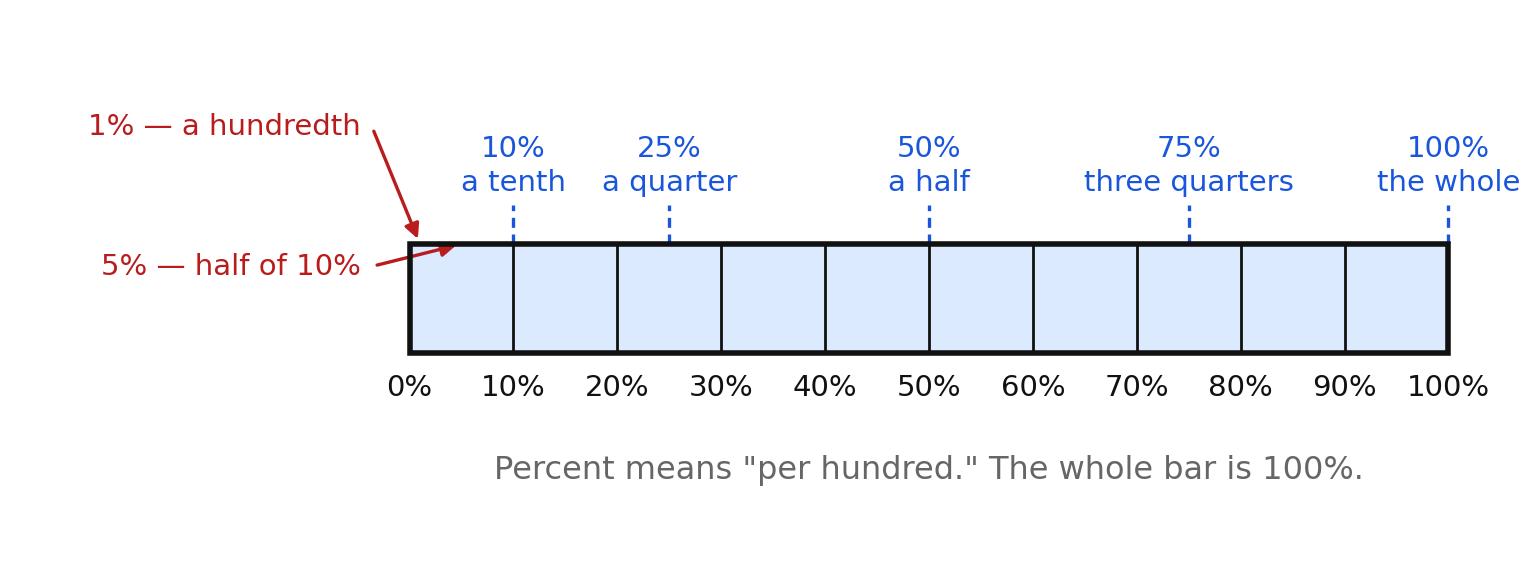
A benchmark percentage is a percent whose value you can find in your head, without writing anything down. These seven are worth memorizing as actions, not as facts:
| Benchmark | What it means | How to find it | Example |
|---|---|---|---|
| the whole thing | leave the number alone | of 39 is | |
| one half | divide by 2 | of 86 is | |
| one quarter | divide by 4, or halve twice | of 120 is | |
| three quarters | of 120 is | ||
| one tenth | shift the decimal point one place left | of 74 is | |
| half of a tenth | find , then halve it | of 74 is | |
| one hundredth | shift the decimal point two places left | of 74 is |
Why the decimal point shifts
Finding means dividing by 10, and finding means dividing by 100. Dividing by 10 shifts the decimal point one place to the left; dividing by 100 shifts it two places. This is not a trick to memorize — it is what our place-value system does, and you saw it in Chapter 1 with powers of ten.
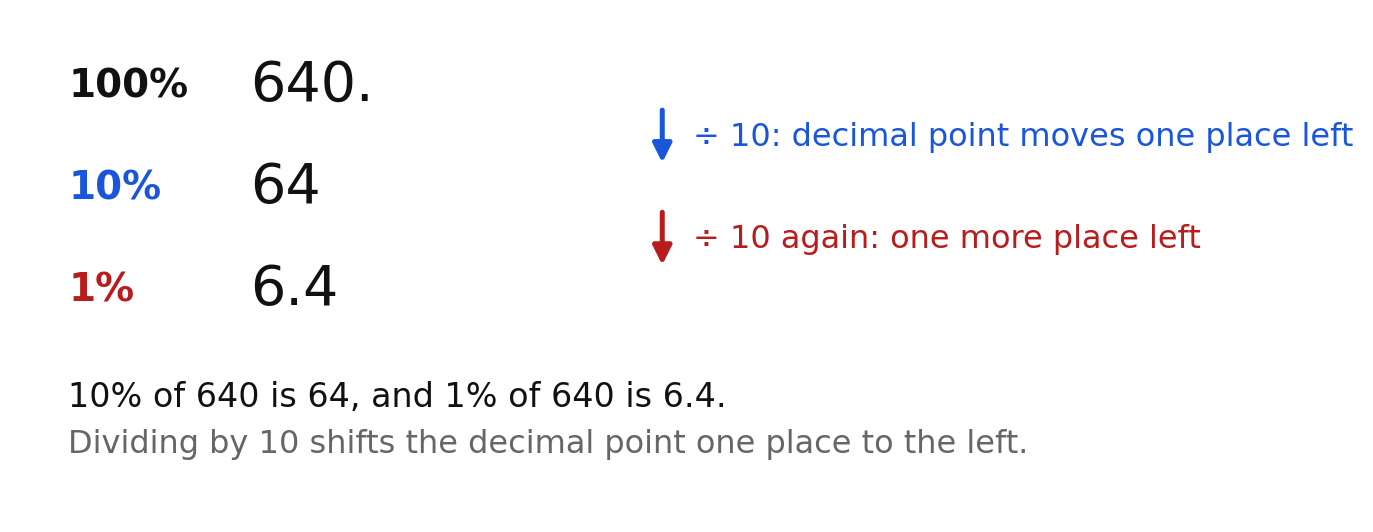
So of is , and of is . Every whole number has an invisible decimal point sitting after its last digit, which is why becomes and then .
Watch the whole, not the digits. Students sometimes learn "move the decimal" and then apply it to the percent instead of the base. The decimal point that moves belongs to the whole. To find of 74, move the point in 74.
Combining benchmarks
The reason these seven benchmarks are enough for most mental math is that other percents can be built from them by adding, subtracting, or halving.
- , or double
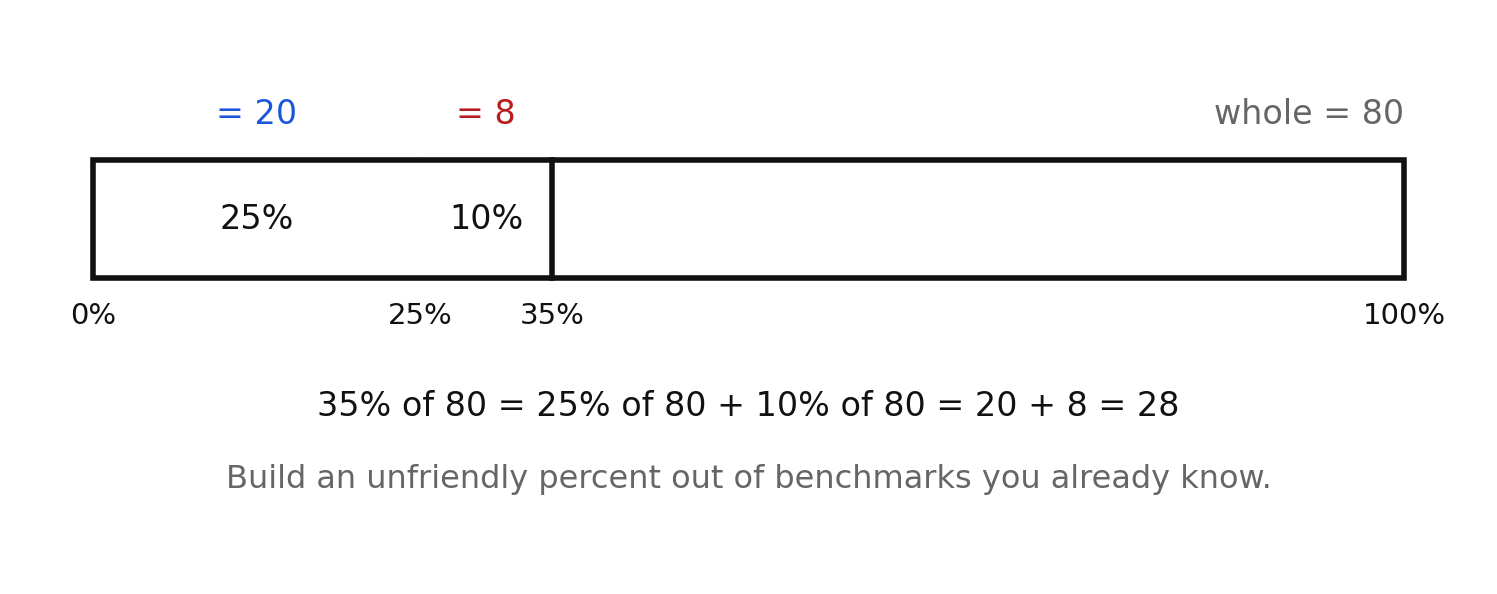
The bar shows of 80. The piece is worth 20 and the piece is worth 8, so the two together are worth 28. Checking with multiplication: . The benchmark route and the multiplication route must always agree, and if they do not, one of them contains an error.
Percents over 100 and under 1
Nothing in the definition stops a percent from being larger than 100 or smaller than 1.
- of a number is twice the number, because . So of 45 is .
- of a number is the whole number plus another half of it: of 48 is .
- is half of . Since of 400 is 4, of 400 is .
A percent greater than always produces an amount larger than the whole, and a percent less than always produces an amount smaller than the whole. That is a useful check on every answer you write in this chapter.
A double number line for percents
Because percent and amount are proportional, they can be drawn on a double number line — the same tool you used for rates in Chapter 5. The top line carries the percent, always running from to , and the bottom line carries the amount, running from 0 to the whole.
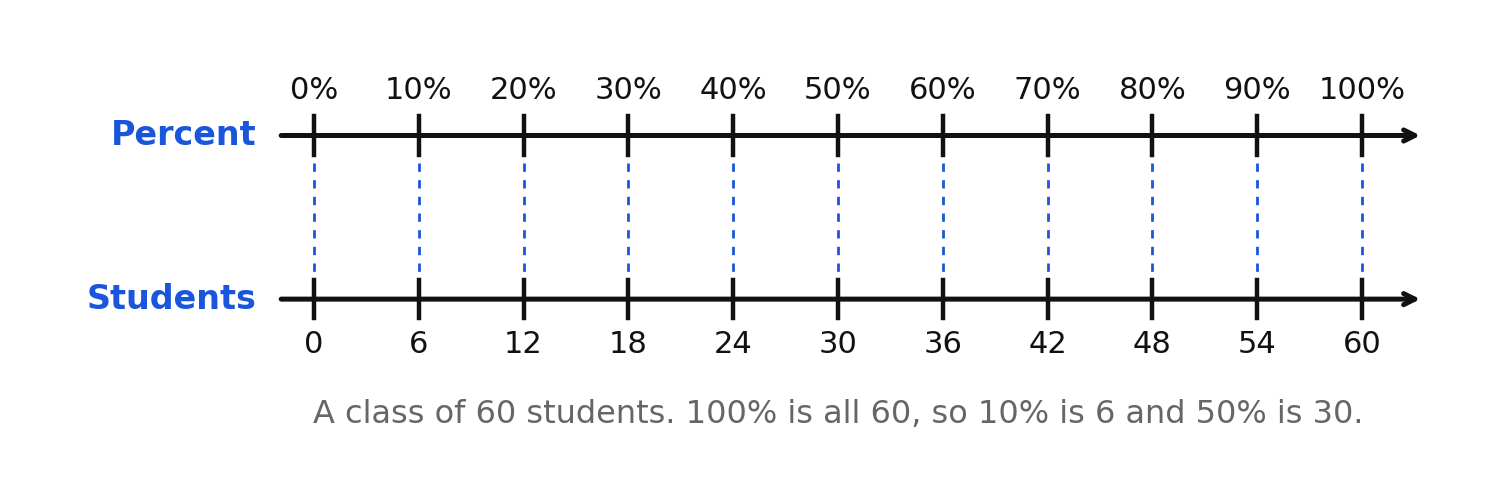
For a class of 60 students, lines up with 60, so each step is 6 students. Reading straight down from any percent gives the matching amount: is 18 students, is 42 students.
Worked examples
Example 1 — Halves and quarters
Find of 48 and of 48.
Half of 48 is 24. A quarter is half of that half.
Answer: of 48 is ; of 48 is
Example 2 — Tenths and hundredths
Find of 350 and of 350.
Shift the decimal point one place left, then two places left.
Answer: and
Example 3 — Building 5% from 10%
Find of 240.
First , then halve it, because is half of .
Answer:
Example 4 — Building 75% from two benchmarks
Find of 64.
Check: .
Answer:
Example 5 — 100% and 200%
Find of 87 and of 87.
is the whole itself. is two wholes.
Answer: and
Guided practice
- Find of 86.
- Find of 120.
- Find of 74.
- Find of 74.
- Find of 60. (Find first, then halve it.)
- Find of 200. (Add of 200 and of 200.)
Independent practice
Find each: a) of 250 b) of 88 c) of 4{,}500 d) of 620
Find each: a) of 140 b) of 48 c) of 39 d) of 45
Find of 96, then use that result to find of 96.
Which is greater, of 160 or of 380? Show both amounts.
Explain how to find of 730 without dividing on paper, and give the answer.
Complete the benchmark table for a whole of 600.
Percent Amount of 600 Application. A restaurant bill is $40. Find a tip and a tip on that bill.
Reasoning. Explain why of a number is always exactly half of of that same number.
Exit ticket 6.1
- Find of 92.
- Find of 830.
- Find of 830.
- Describe two different ways to find of 48, then give the answer.
Lesson 6.2 — Estimating a Percent of a Number
Why estimate at all
You will not always need an exact answer, and you will not always have paper. Standing in a store, "about $12 off" is enough to decide. More importantly, an estimate is how you catch mistakes: if you estimate and your calculator says , you know to look again before you trust it.
To estimate a percent of a number means to replace the problem with a nearby, friendlier problem you can do in your head. You make two decisions:
- Round the percent to a nearby benchmark. becomes ; becomes ; becomes ; becomes .
- Round the whole to a friendly number. Friendly means easy to halve, quarter, or divide by 10 — usually a multiple of 10, 20, or 100.
Then compute the friendly problem exactly. That result is your estimate.
Naming the strategy
An estimate is only defensible if you say what you rounded to. "About 40" means nothing on its own; " of 80 is 40, so it's about 40" is a complete answer that another person can check. Throughout this lesson, state the benchmark you used.
The symbol is read "is approximately equal to." Use it whenever you replace a problem with a nearby one, and save the equals sign for statements that are exactly true.
High or low?
You can often tell which side of the exact answer your estimate falls on, just by looking at how you rounded.
- Rounding the percent up makes the estimate larger than the exact answer.
- Rounding the percent down makes the estimate smaller.
- Rounding the whole up makes the estimate larger.
- Rounding the whole down makes the estimate smaller.
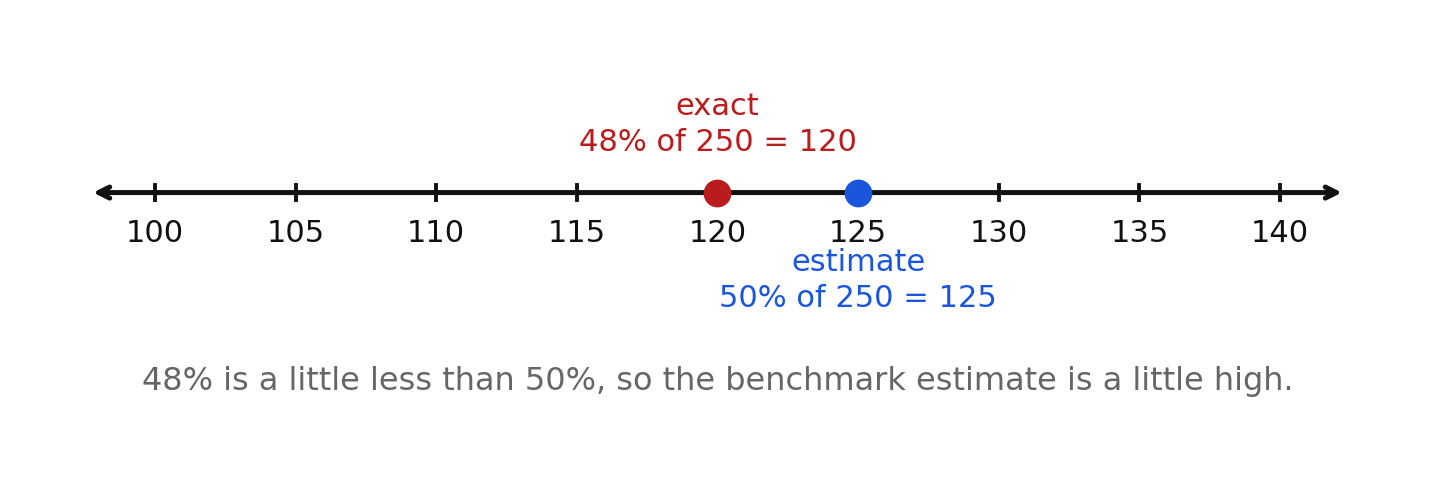
For of 250, only the percent was rounded, and it was rounded up from to . So the estimate of 125 must be a little high — and it is, since the exact value is 120.
When you round the percent one way and the whole the other way, the two effects push in opposite directions and you cannot tell the direction of the error from the rounding alone. In that situation, say so rather than guessing.
Worked examples
Example 1 — Rounding to 50%
About how much is of 82?
is close to , and 82 is close to 80.
Answer: about
Example 2 — Rounding to 25%
About how much is of 119?
is close to , and 119 is close to 120, which divides evenly by 4.
Answer: about
Example 3 — Rounding to 10%
About how much is of 71?
Because the percent was rounded up and the whole was rounded down, the two errors partly cancel. The exact value is , close to the estimate.
Answer: about
Example 4 — Rounding to 75%
About how much is of 41?
Answer: about
Example 5 — Choosing among options
Which is closest to of 246: 25, 50, 75, or 100?
Round to of 250. Since of 250 is 25, doubling gives of .
Answer:
Guided practice
- Estimate of 78 by finding of 80.
- Estimate of 41 by finding of 40.
- Estimate of 89 by finding of 90.
- Estimate of 61 by finding of 60.
- Estimate of 412 by finding of 400.
- Estimate of 305 by finding of 300.
Independent practice
- Estimate each using the benchmark and friendly whole shown in parentheses. a) of 62 ( of 60) b) of 79 ( of 80) c) of 51 ( of 50) d) of 81 ( of 80)
- Which is closest to of 297: 30, 60, 90, or 120? Name the benchmark you used.
- Which is closest to of 396: 8, 16, 24, or 40? Name the benchmark you used.
- Estimate of 398 by finding of 400. Is your estimate higher or lower than the exact answer? Explain how you know without computing the exact answer.
- Estimate of 61 by combining two benchmarks of 60.
- Application. A jacket costs $59. About how many dollars is of that price? Use $60 as the friendly whole.
- Application. A school has 412 students, and about of them ride the bus. About how many students ride the bus? Name the friendly whole you used.
- Reasoning. Marisol estimates of 240 as 24, because of 240 is 24. Is her estimate higher or lower than the exact answer? Explain.
Exit ticket 6.2
- Estimate of 78 by finding of 80.
- Estimate of 121 by finding of 120.
- Which is closest to of 508: 5, 50, 100, or 250?
- Explain why rounding the whole up, with the percent left alone, makes an estimate greater than the exact answer.
Lesson 6.3 — Finding an Exact Percent of a Number
Four routes to the same answer
When an exact answer is required, you have four reliable methods. They are not competing rules to choose between at random — each is best suited to a particular kind of problem.
Method 1 — Multiply by the decimal. Rewrite the percent as a decimal by dividing by 100, then multiply.
Method 2 — Multiply by the fraction. Rewrite the percent as a fraction over 100 and multiply. This is often fastest when the fraction simplifies.
Method 3 — Set up a proportion. From Chapter 5, a proportion is an equation stating that two ratios are equal. The percent proportion pairs the part-to-whole ratio with the percent-to-100 ratio:
For of 250, that gives . Solve it with the cross-product reasoning from Chapter 5: , so .
Method 4 — Combine benchmarks. Break the percent into benchmark pieces, find each piece, and add.
All four give 45, because they are all expressions of the same proportional relationship. Method 1 is the workhorse. Method 4 is the one to use when you have no pencil.
Choosing well
| If the percent is… | Reach for… |
|---|---|
| built from benchmarks, like , , | Method 4, benchmarks |
| an awkward two-digit percent, like or | Method 1, decimal multiplication |
| a percent whose fraction simplifies, like or | Method 2, fractions |
| stated in a word problem with an unknown to name | Method 3, a proportion |
Writing the decimal correctly
Converting a percent to a decimal means dividing by 100, which shifts the decimal point two places left. Keep track of where the point started.
| Percent | Decimal | Note |
|---|---|---|
| two digits, so no extra zero needed | ||
| one digit, so a placeholder zero is required | ||
| greater than 1, as it must be | ||
| half of |
The single most common error in this lesson is writing as . That is — ten times too big. Estimating first protects you: of 250 must be a small piece of 250, so 20 is plausible and 200 is not.
Worked examples
Example 1 — Decimal multiplication
Find of 250.
Estimate check: of 250 would be 50, and is a bit less than that.
Answer:
Example 2 — Benchmark combination
Find of 80.
Check: .
Answer:
Example 3 — Using a proportion
Find of 150.
Let be the part.
Answer:
Example 4 — A small percent
Find of 45.
Check with benchmarks: of 45 is , and .
Answer:
Example 5 — Beyond 100% and below 1%
Find of 65 and of 400.
The first answer is greater than 65, as it must be for a percent above . The second is tiny, as it must be for a percent below .
Answer: and
Guided practice
- Find of 45.
- Find of 60 by adding of 60 and of 60.
- Find of 250. (Write the decimal carefully.)
- Find of 80.
- Find of 140 by adding of 140 and of 140.
- Find of 90.
Independent practice
- Find each: a) of 70 b) of 300 c) of 40 d) of 225
- Find each: a) of 120 b) of 60 c) of 48 d) of 850
- Find of 240 by combining benchmarks. Show which benchmarks you used.
- Find of 950 by multiplying by a decimal.
- Write a proportion for " of 175" and solve it. Show the cross products.
- Find of 600.
- Application. A store has 640 T-shirts in stock, and of them are blue. How many blue T-shirts are in stock?
- Reasoning. Explain why finding of 84 gives the same result as dividing 84 by 4. Give the answer as part of your explanation.
Exit ticket 6.3
- Find of 65.
- Find of 220.
- Find of 50.
- Find of 60 two different ways and show that both give the same answer.
Lesson 6.4 — Percent in Context
The four questions that cover most of it
Almost every percent problem you meet outside a classroom is one of four familiar situations. In all four, the mathematics is identical — find a percent of a whole — and the only new work is reading carefully enough to identify which number is the whole.
- A tip (also called a gratuity) is an amount added for service, calculated as a percent of the bill.
- Sales tax is an amount added by law, calculated as a percent of the purchase price.
- A discount is an amount subtracted from a price. The sale price is the original price minus the discount.
- A survey or count reports a percent of a group; the whole is the size of the group.
A reliable procedure
- Name the whole. Which number is the bill, the price, the group size?
- Name the percent.
- Estimate with a benchmark, so you know roughly what to expect.
- Compute exactly.
- Answer the question that was asked. A discount problem may ask for the amount off, or for the sale price. Those are different numbers.
Step 5 is where careful students still lose points. Read the last sentence of the problem twice.
Working with money
Money answers are written with two decimal places, because prices are exact to the cent: write $9.00, not $9, and $8.64, not $8.64000. When a computation produces a third decimal place, the problem will tell you to round to the nearest cent. If it does not tell you, the numbers were chosen so that the answer lands exactly on the cent.
The benchmark tip
The most useful mental-math skill in this whole chapter is the restaurant tip, and it runs entirely on the benchmarks from Lesson 6.1.
- A tip: shift the decimal point one place left. On a $40 bill, that is $4.00.
- A tip: find and double it. On a $40 bill, $8.00.
- A tip: find , halve it to get , and add. On a $40 bill, .
Worked examples
Example 1 — A tip
Find a tip on a $45 restaurant bill.
The whole is $45. Find , then double.
Answer: $9.00
Example 2 — Sales tax and a total
A bicycle helmet costs $120. Sales tax is . Find the tax and the total cost.
Answer: tax $7.20; total $127.20
Example 3 — A discount and a sale price
A jacket regularly costs $85 and is marked off. Find the discount and the sale price.
Answer: discount $25.50; sale price $59.50
Example 4 — A survey
In a school of 350 students, walk to school. How many students walk?
The whole is 350 students.
An answer of 42 students is sensible: it is a small part of 350, and it is a whole number of people, which it must be.
Answer: 42 students
Example 5 — Estimate, then compute
A dinner bill is $62 and you want to leave a tip. Estimate first, then find the exact tip.
Estimate with a friendly $60: of 60 is 6, half of that is 3, so about $9.
Exact: .
Answer: about $9; exactly $9.30
Guided practice
- Find a tip on a $36 bill.
- Find a tip on a $55 bill.
- A furniture order costs $240. Find the sales tax.
- Shoes that cost $64 are marked off. Find the amount of the discount.
- In a group of 250 students, chose soccer. How many students chose soccer?
Independent practice
- Find a tip on an $80 bill. (Use plus .)
- A tablet costs $150 and sales tax is . Find the tax.
- A coat regularly costs $120 and is marked off. Find the discount and the sale price.
- A basketball team attempted 40 free throws and made of them. How many did they make?
- A phone plan includes 1{,}250 megabytes of data, and Jordan has used of it. How many megabytes has Jordan used?
- Application. A restaurant bill is $48. Find an tip, then find the total the customer pays.
- Application. A theater has 350 seats, and of them are in the balcony. First estimate the number of balcony seats using of 350, then find the exact number.
- Reasoning. Explain why taking off a $60 price gives the same sale price as finding of $60. Show both computations.
Exit ticket 6.4
- Find a tip on a $65 bill.
- A chair costs $250 and sales tax is . Find the tax.
- A bike listed at $140 is marked off. Find the amount of the discount.
- Describe a benchmark strategy for finding a tip on a $40 bill, and give the tip.
Chapter 6 Review
Vocabulary. percent · whole (base) · benchmark percentage · estimate · double number line · discount · sale price · sales tax · tip
Part A — Benchmark percentages (7.CE.2d)
- Find of 148.
- Find of 320.
- Find of 76.
- Find of 76.
- Find of 180.
- Find of 88.
Part B — Estimating a percent of a number (7.CE.2d)
- Estimate of 122 by finding of 120.
- Estimate of 79 by finding of 80.
- Estimate of 305 by finding of 300.
- Estimate of 41 by finding of 40.
- Which is closest to of 298: 30, 60, 100, or 150? Name the benchmark you used.
- Is of 480 a high estimate or a low estimate for of 480? Give both the estimate and the exact value.
Part C — Determining an exact percent (7.CE.2d)
- Find of 150.
- Find of 425.
- Find of 80.
- Find of 375.
- Find of 60.
- Find of 800.
Part D — Percent in context (7.CE.2d)
- Find an tip on a $60 restaurant bill.
- A backpack costs $45 and sales tax is . Find the tax and the total cost.
- A tent listed at $95 is marked off. Find the discount and the sale price.
Part E — Mixed application and reasoning
- Find of 260 by combining benchmarks. Show each benchmark amount and the sum.
- Estimate of 250 using a benchmark, then compute the exact value. Explain why the estimate falls on the high side.
- Explain why moving the decimal point gives and of a number. Use 640 in your explanation.
Standards coverage check — Chapter 6
Bullet d of 7.CE.2 asks students to "estimate and determine the percentage of a given whole number, including but not limited to the use of benchmark percentages." That single bullet contains three component demands, tracked separately below.
| Component demand of 7.CE.2d | Where it is taught | Where it is practiced |
|---|---|---|
| Use benchmark percentages (, , , , , , ) of a whole number | 6.1 | Items 1–18; 29; 38, 41, 45; 55–60, 71; Review 72–77, 93, 95 |
| Estimate the percentage of a whole number | 6.2 | Items 19–36; 66; Review 78–83, 94 |
| Determine the percentage of a whole number, "not limited to" benchmarks — decimals, fractions, and proportions | 6.3 | Items 37–54; 61–65, 68–70; Review 84–89, 90–92 |
| Apply both estimating and determining to problems in context | 6.2, 6.4 | Items 30, 31; 49; 55–71; Review 90–92, 94 |
Percents greater than appear in items 8d, 42, 44c, 53, and 88; percents less than appear in items 48 and 89. The whole is a whole number throughout, as the standard specifies.
Scope note. Parts a–c of 7.CE.2 — ratio tables, writing and solving proportions, and unit conversion with a given conversion factor — are covered in Chapter 5. This chapter uses proportions as one of four solution methods in Lesson 6.3 but does not re-teach them. Percent increase and decrease, percent error, and finding the whole from a known part are not part of 7.CE.2d and appear in later standards, so they are deliberately absent here.
Answer keys for every set in this chapter are in Appendix A.