Chapter 5 — Ratio Tables and Proportions
Standard: 7.CE.2 (a–c) — The student will solve problems, including those in context, involving proportional relationships.
By the end of this chapter you will be able to:
- Create and use a ratio table to find missing values in a proportional relationship (7.CE.2a)
- Write a proportion that represents the relationship between two quantities (7.CE.2b)
- Solve a proportion to find a missing value, including problems set in context (7.CE.2b)
- Apply proportional reasoning to convert units of measurement when the conversion factor is given (7.CE.2c)
- Apply proportional reasoning to solve multi-step problems in context, and recognize when a situation is not proportional (7.CE.2b, 7.CE.2c)
Lessons: 5.1 Ratio Tables and Missing Values · 5.2 Writing a Proportion · 5.3 Solving a Proportion · 5.4 Converting Units with a Given Conversion Factor · 5.5 Proportional Reasoning in Context
Lesson 5.1 — Ratio Tables and Missing Values
What a ratio is, and what makes a relationship proportional
A ratio is a comparison of two quantities. If a movie theater charges $9 for one ticket, then the ratio of tickets to dollars is 1 to 9. We can write that ratio three ways: , "1 to 9," or as the fraction .
Ratios become powerful the moment you notice that the same comparison holds at every size. Two tickets cost $18. Three cost $27. Ten cost $90. In every one of those pairs, the number of dollars is nine times the number of tickets. When two quantities are related that way — one is always the same fixed number of times the other — we say they are in a proportional relationship.
The fixed number is called the unit rate, or sometimes the constant of proportionality. Here it is 9 dollars per ticket. A unit rate is just a rate whose second quantity is 1, and getting to a unit rate is often the fastest route through a problem.
Not every relationship works this way. If the theater charged a flat $5 processing fee plus $9 per ticket, one ticket would cost $14 and two would cost $23 — and is not twice . That situation is not proportional. Deciding whether a relationship is proportional before you start computing will save you from a wrong answer that looks tidy.
Building a ratio table
A ratio table is a table whose columns all show the same ratio. It is the most flexible tool in this chapter, because you can enter it from any column you happen to know and travel in either direction.
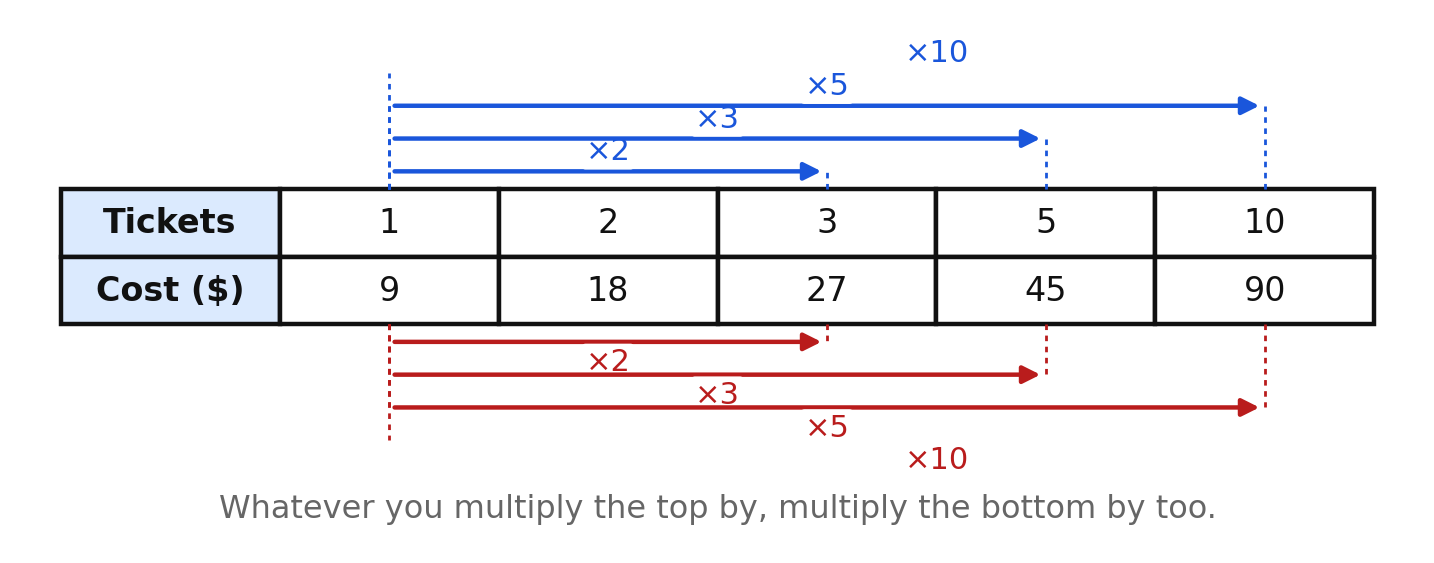
Two moves fill in any ratio table:
- Scaling up. Multiply both entries in a column by the same number. From the column , multiplying both by 5 gives .
- Scaling down. Divide both entries in a column by the same number. From , dividing both by 2 gives — the same column, reached from the other side.
The rule that makes this legal is that multiplying both parts of a ratio by the same nonzero number does not change the ratio, exactly the way and are the same fraction.
Multiply, do not add. Adding 4 to both entries of gives , and is not . Ratios are preserved by multiplication, not by addition. This is the single most common error in this chapter.
Using the unit rate column
Every ratio table has one column that is worth more than the others: the column where the first quantity is 1. Once you have it, every other column is one multiplication away.
To find the unit rate, divide. If 6 water bottles cost $4.50, then one bottle costs
so the unit rate is $0.75 per bottle. Now 12 bottles cost and 20 bottles cost , without any further setup.
Double number lines
A double number line shows the same information as a ratio table, with the added benefit that it keeps the spacing honest. Values that line up vertically are the paired values.
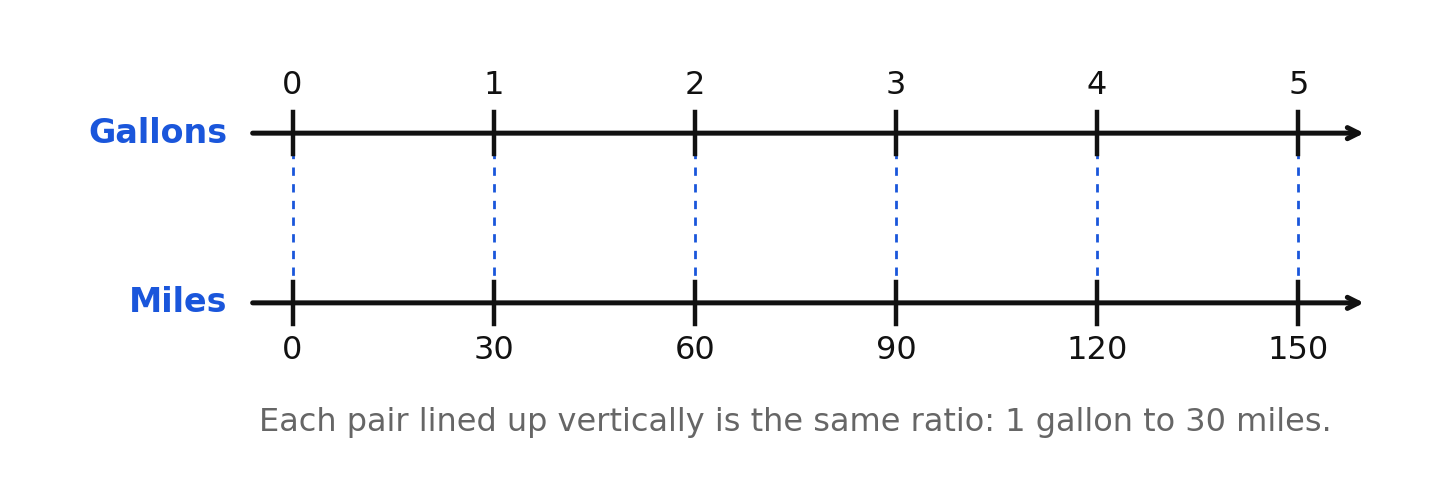
Reading the picture: 2 gallons pairs with 60 miles, 4 gallons pairs with 120 miles. Because the tick marks are evenly spaced on both lines, you can see at a glance that doubling the gallons doubles the miles. That is what a proportional relationship looks like.
Worked examples
Example 1 — Filling a table from the unit rate
A print shop charges $4 per poster. Complete the ratio table.
| Posters | 1 | 3 | 7 | 12 |
|---|---|---|---|---|
| Cost ($) | 4 | ? | ? | ? |
Multiply each poster count by the unit rate 4.
, , .
Answer: $12; $28; $48
Example 2 — Finding the unit rate first
A hose fills 45 gallons in 5 minutes. How many gallons does it fill in 8 minutes?
Divide to reach the 1-minute column: gallons per minute.
Multiply up to 8 minutes: .
Answer: 72 gallons
Example 3 — Scaling down
A carton of 24 eggs costs $7.20. What do 6 eggs cost?
Six is a quarter of 24, so divide both entries by 4.
Answer: $1.80
Example 4 — Finding the multiplier between two columns
In this table, what number takes the first column to the second?
| Hours | 3 | 12 |
|---|---|---|
| Miles | 21 | ? |
Compare the known pair: , so the multiplier is 4. Apply it to the bottom row: .
Answer: The multiplier is 4, and the missing value is 84 miles.
Example 5 — Deciding whether a table is proportional
Is this a ratio table?
| Bags | 2 | 4 | 6 |
|---|---|---|---|
| Marbles | 10 | 20 | 32 |
Check the ratio in each column: , ,
The third column breaks the pattern.
Answer: No. The first two columns show 5 marbles per bag, but the third does not. To make it proportional, the last entry would have to be .
Guided practice
A theater charges $9 per ticket. Complete the ratio table.
Tickets 1 2 3 5 10 Cost ($) 18 A printer prints 24 pages in 3 minutes. Find the unit rate in pages per minute, then complete the table.
Minutes 1 3 6 9 12 Pages 24 What number do you multiply the first column by to get the second column?
Hours 4 20 Miles 26 130 A store sells 7 pounds of rice for $21. Use the unit rate to find the cost of 4 pounds.
Explain why and can appear in the same ratio table, but and cannot.
Independent practice
One gallon of paint covers 35 square feet. Complete the ratio table.
Gallons 1 2 3 5 8 Square feet 105 Six water bottles cost $4.50. Find the unit price, then complete the table.
Bottles 1 4 6 10 12 Cost ($) 4.50 Twelve sandwiches feed 18 people. Complete the table by scaling down.
Sandwiches 12 6 4 2 People 18 One entry in this table is wrong. Name it, explain how you know, and give the correct value.
Bags 4 8 12 16 Apples 10 20 28 40 A resting heart beats 210 times in 3 minutes. Find the unit rate, then complete the table.
Minutes 1 3 5 10 Beats 210 Application. A car travels 180 miles on 6 gallons of gasoline. Build a ratio table with columns for 1, 6, and 11 gallons, and use it to find how far the car can travel on 11 gallons.
Reasoning. Devon fills in a ratio table by adding 3 to the top entry and 3 to the bottom entry each time, starting from . Show the first three columns he gets, explain why the table is not a ratio table, and give the correct third column.
Exit ticket 5.1
Four notebooks cost $10. Complete the table.
Notebooks 1 4 6 Cost ($) 10 What number takes the column to the column ?
A faucet fills 8 liters in 2 minutes. How many liters in 7 minutes?
In your own words, what stays the same in every column of a ratio table?
Lesson 5.2 — Writing a Proportion
Two equal ratios
A proportion is an equation stating that two ratios are equal:
A ratio table is a proportion in disguise. Any two columns of a ratio table, written as fractions, form a proportion. From the ticket table, the columns and give
Writing a proportion is how you handle a problem when the numbers do not scale by a convenient whole number and building the whole table would be slow.
Lining up the units
The most important habit in this lesson is a bookkeeping habit: the same unit must sit in the same position on both sides of the equation.
Suppose 3 pounds of apples cost $5.40 and you want the cost of 7 pounds. Write it with labels first:
Pounds are on top on both sides; dollars are on the bottom on both sides. That is a correct setup.
This setup is also correct:
Both are fine, because flipping both ratios keeps the equation true. What is not fine is mixing them:
Here pounds are on top on the left and on the bottom on the right. The equation no longer describes the situation, and it will produce a wrong number that looks perfectly respectable. Labeling the units as you write is cheap insurance.
Testing whether two ratios form a proportion
Sometimes the question is not "find the missing value" but "are these two ratios actually equal?" There are two reliable tests.
Test 1 — Simplify both ratios. simplifies to , and also simplifies to . Equal, so they form a proportion.
Test 2 — Compare cross products. The cross products of are and . If the two cross products are equal, the ratios are equal; if not, they are not.
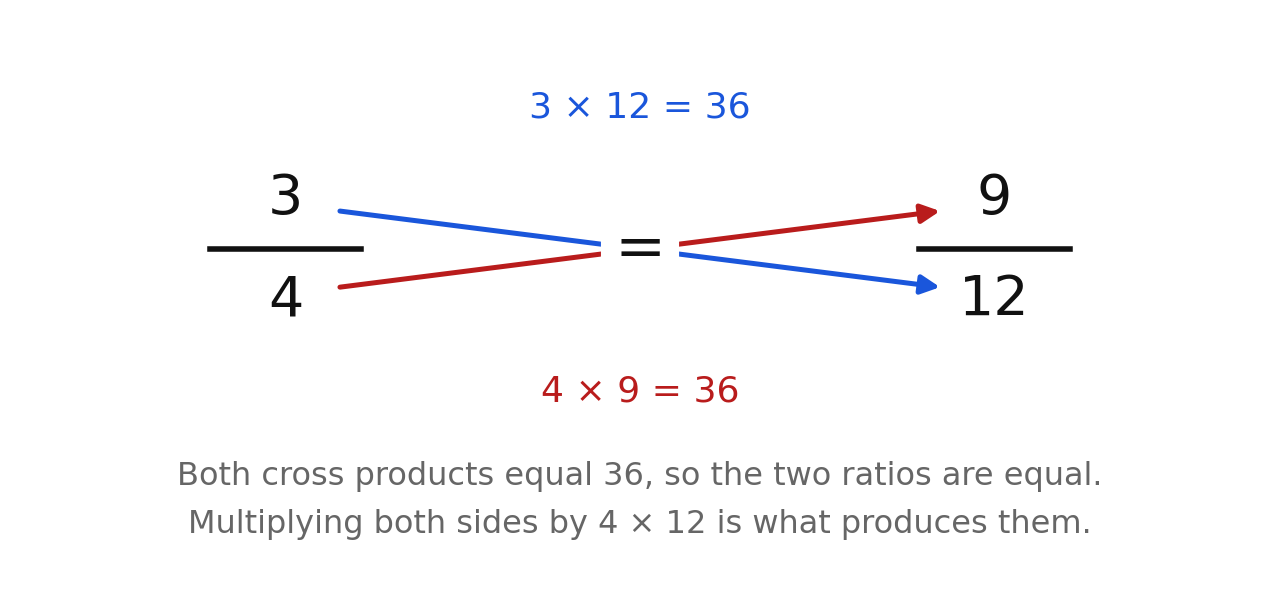
For and : and . Equal, so it is a proportion.
For and : and . Not equal, so it is not a proportion.
Why the cross-product test works
This is worth understanding rather than memorizing, because you will use it constantly in the next lesson.
Start with , where and are not zero. Multiply both sides by — legal, because doing the same thing to both sides of a true equation keeps it true:
On the left, the in the numerator cancels the in the denominator, leaving . On the right, the 's cancel, leaving . So
Cross multiplication is not a trick. It is one multiplication applied to both sides, with the cancelling already done for you.
Worked examples
Example 1 — Writing a proportion from a rate
Five minutes of typing produces 350 words. Write a proportion for the number of words produced in 12 minutes.
Minutes on top, words on the bottom, on both sides.
Answer:
Example 2 — Writing the same relationship the other way
Write a second correct proportion for Example 1.
Flip both ratios at once.
Answer:
Example 3 — Testing with cross products
Do and form a proportion?
The cross products match.
Answer: Yes.
Example 4 — A pair that fails the test
Do and form a proportion?
Answer: No. Since , the ratios are not equal.
Example 5 — Catching a bad setup
A recipe uses 4 cups of flour for 6 servings. A student writes to find the servings from 10 cups of flour. Is the setup correct?
Label the parts. On the left, . On the right, is a number of servings and 10 is a number of cups, so the right side is . The positions are swapped.
Answer: No. A correct setup is , keeping cups on top on both sides.
Guided practice
- Three apples cost $2.10. Write a proportion for the cost of 8 apples. Do not solve it.
- A runner covers 350 meters in 5 minutes. Write a proportion for the distance covered in 12 minutes. Do not solve it.
- Use cross products to decide whether and form a proportion. Show both products.
- Use cross products to decide whether and form a proportion. Show both products.
- Copy and label what quantity stands for, including its unit.
Independent practice
- Use cross products to decide whether each pair forms a proportion. Show your products. a) and b) and c) and
- Nine tiles cover 12 square feet. Write a proportion for the number of tiles needed to cover 40 square feet. Do not solve it.
- Write two different correct proportions for this situation: 4 pounds of dog food last 10 days, and you want to know how many days that 15 pounds will last.
- On a map, 2 inches represents 35 miles. Write a proportion for the actual distance represented by 7 inches. Do not solve it.
- A student writes . Explain what is wrong with the setup and write a correct one.
- Application. A 15-ounce box of cereal costs $3.60. Write a proportion for the cost of a 25-ounce box, assuming the price is proportional to the weight. Then explain, in a sentence, why a real store might not price it that way.
- Reasoning. Explain why and describe exactly the same relationship, and predict whether they will give the same value of .
Exit ticket 5.2
- Do and form a proportion? Show the cross products.
- Seven buses carry 336 students. Write a proportion for the number of students that 10 buses carry. Do not solve it.
- Which setup is correct for "3 gallons cover 240 square feet; how many gallons cover 400 square feet"? a) b)
- Explain why the units must line up in the same positions on both sides of a proportion.
Lesson 5.3 — Solving a Proportion
Four strategies, one answer
A proportion with one unknown can be solved several ways. Good problem solvers pick the strategy that fits the numbers instead of always reaching for the same one.
Take .
Strategy 1 — Equivalent fractions. Simplify the known ratio: . Now , so .
Strategy 2 — Scaling. Compare the denominators: , so the right side is the left side scaled by 3. Then , giving .
Strategy 3 — Unit rate. The right ratio is units per 1. So .
Strategy 4 — Cross multiplication.
All four give , which is the point: they are the same reasoning wearing different clothes. Scaling is fastest when the multiplier is a whole number. Unit rate is best when you will reuse the rate. Cross multiplication always works, including when the numbers are ugly, which is why it is worth having.
Cross multiplication, step by step
- Write the proportion with the unknown in one position.
- Multiply the numerator of each ratio by the denominator of the other. Set those two products equal.
- You now have a one-step equation. Divide both sides by the coefficient of the variable.
- Check by substituting your answer back and comparing the cross products.
Step 4 is not optional busywork. It catches arithmetic slips in seconds.
Cross multiplication is a shortcut for multiplying both sides. From , multiply both sides by . The left becomes and the right becomes . That is exactly what the cross-multiplication step wrote down.
When the answer is not a whole number
Nothing requires a proportion to come out even. If , then and . That is an exact answer, so report it exactly.
When a problem does need rounding, it will say so — "round to the nearest tenth" or "round to the nearest cent." Never round silently, and never round in the middle of a calculation; carry the exact value until the last step.
Worked examples
Example 1 — Solving by scaling
Solve .
The numerators go from 3 to 12, which is a multiplier of . Apply it to the denominator: .
Check: , since and .
Answer:
Example 2 — Solving by cross multiplication
Solve .
Check: and .
Answer:
Example 3 — The unknown in a numerator on the right
Solve .
Answer:
Example 4 — A decimal in the proportion
Solve .
Answer:
Example 5 — A proportion in context, with money
Three pounds of apples cost $5.40. What do 7 pounds cost?
Set up with pounds on top on both sides:
Cross multiply:
Check with the unit rate: per pound, and .
Answer: $12.60
Guided practice
- Solve . Show the cross products and the division step.
- Solve .
- Solve .
- Solve .
- Solve .
Independent practice
- Solve each proportion. a) b) c)
- Solve two ways: by scaling and by cross multiplication.
- Solve .
- Solve . Give the exact answer.
- Application. Three pounds of grapes cost $5.40. Write and solve a proportion for the cost of 7 pounds.
- Application. A typist enters 84 words in 2 minutes. Write and solve a proportion for the number of words entered in 5 minutes at the same rate.
- Reasoning. Explain why cross multiplication works, using the fact that you may multiply both sides of an equation by the same nonzero number. Use in your explanation.
Exit ticket 5.3
- Solve .
- Solve .
- Five concert tickets cost $62.50. Write and solve a proportion for the cost of 8 tickets.
- Name a strategy other than cross multiplication for solving , and use it.
Lesson 5.4 — Converting Units with a Given Conversion Factor
A conversion factor is a ratio
Changing units is a proportion problem, not a separate topic. A conversion factor is a ratio of two measurements of the same amount expressed in different units. "1 yard = 3 feet" is a conversion factor, and it can be written as the ratio or .
Because a yard is three feet, that ratio holds at every size. Two yards is 6 feet, five yards is 15 feet, and so on — a perfectly ordinary proportional relationship.
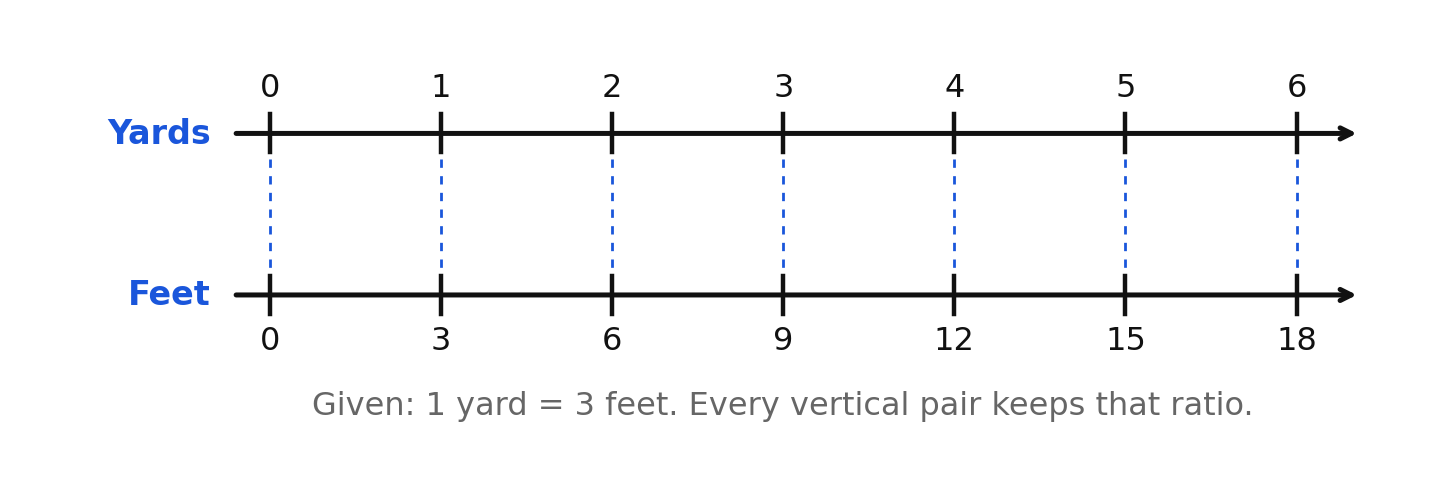
The problem will give you the factor. In this course you are never expected to have memorized how many grams are in a pound or how many milliliters are in a cup. Every conversion problem you meet states the factor. Your job is to use it correctly.
Setting up a conversion
Use the same discipline as Lesson 5.2: same unit, same position.
Convert 3 miles to feet, given that 1 mile = 5,280 feet.
Cross multiply: , so feet.
Does the answer make sense?
Before you write the answer down, ask which unit is bigger.
- Big unit to small unit, such as miles to feet: you should get more of the smaller unit. miles becoming feet passes this check.
- Small unit to big unit, such as quarts to gallons: you should get fewer of the bigger unit. quarts becoming gallons passes this check.
This one question catches the most common conversion error, which is multiplying when you should have divided. If your answer moved the wrong direction, your proportion was set up backward.
Worked examples
Example 1 — Big unit to small unit
Given 1 mile = 5,280 feet, convert 3 miles to feet.
Feet are smaller than miles, so a larger number is expected.
Answer: 15,840 feet
Example 2 — Using a decimal factor
Given 1 kilogram = 2.2 pounds, convert 15 kilograms to pounds.
Answer: 33 pounds
Example 3 — Small unit to big unit
Given 1 gallon = 4 quarts, convert 26 quarts to gallons.
Gallons are bigger than quarts, so a smaller number is expected.
Answer: 6.5 gallons
Example 4 — A conversion that needs rounding
Given 1 mile = 1.609 kilometers, convert 8 miles to kilometers. Round to the nearest tenth.
Round only at the end: rounds to .
Answer: about 12.9 kilometers
Example 5 — Converting inside a context
A recipe calls for 2.5 pounds of flour. Given 1 pound = 453.6 grams, how many grams is that?
Answer: 1,134 grams
Guided practice
- Given 1 mile = 5,280 feet, convert 3 miles to feet.
- Given 1 kilogram = 2.2 pounds, convert 15 kilograms to pounds.
- Given 1 gallon = 4 quarts, convert 26 quarts to gallons.
- Given 1 inch = 2.54 centimeters, convert 12 inches to centimeters.
- Given 1 hour = 3,600 seconds, convert 2.5 hours to seconds.
Independent practice
- Convert each. The factor is given with the problem. a) 1 yard = 3 feet; convert 21 feet to yards. b) 1 pound = 16 ounces; convert 5.5 pounds to ounces. c) 1 liter = 1,000 milliliters; convert 2,450 milliliters to liters.
- Given 1 mile = 1.609 kilometers, convert 8 miles to kilometers. Round to the nearest tenth.
- Given 1 cup = 8 fluid ounces, convert 60 fluid ounces to cups.
- Given 1 meter = 100 centimeters, convert 3.4 meters to centimeters.
- Application. A bag of flour weighs 2.5 pounds. Given 1 pound = 453.6 grams, find its weight in grams.
- Application. A student exchanges 250 euros for dollars. Given 1 euro = 1.08 dollars on that day, how many dollars does the student receive?
- Reasoning. A classmate converts 48 inches to feet using 1 foot = 12 inches and gets 576 feet. Without redoing the arithmetic, explain how you can tell the answer is wrong, then give the correct answer.
Exit ticket 5.4
- Given 1 foot = 12 inches, convert 7.5 feet to inches.
- Given 1 kilogram = 1,000 grams, convert 4,750 grams to kilograms.
- Given 1 gallon = 3.785 liters, convert 6 gallons to liters. Round to the nearest tenth.
- Explain how checking whether the unit gets bigger or smaller helps you catch a backward setup.
Lesson 5.5 — Proportional Reasoning in Context
Choosing a tool
By now you have four tools: ratio tables, double number lines, unit rates, and proportions solved by cross multiplication. Real problems do not announce which one to use. A short decision guide:
- Several values wanted from one rate? Build a ratio table.
- Comparing two different deals? Find each unit rate and compare them.
- One missing value? Write and solve a proportion.
- Units to change first? Convert using the given factor, then proceed.
Unit rates for comparison shopping
A unit price is the cost of one unit of an item — one ounce, one pound, one bottle. Unit prices make different package sizes directly comparable, which is exactly why grocery shelf tags print them.
A 12-ounce jar costs $3.00 and a 20-ounce jar costs $4.60. Which is the better buy?
The 20-ounce jar costs less per ounce, so it is the better buy at $0.23 per ounce.
Ratios that split a total
Some contexts give you a ratio and a total rather than a rate. A tape diagram makes these visible.
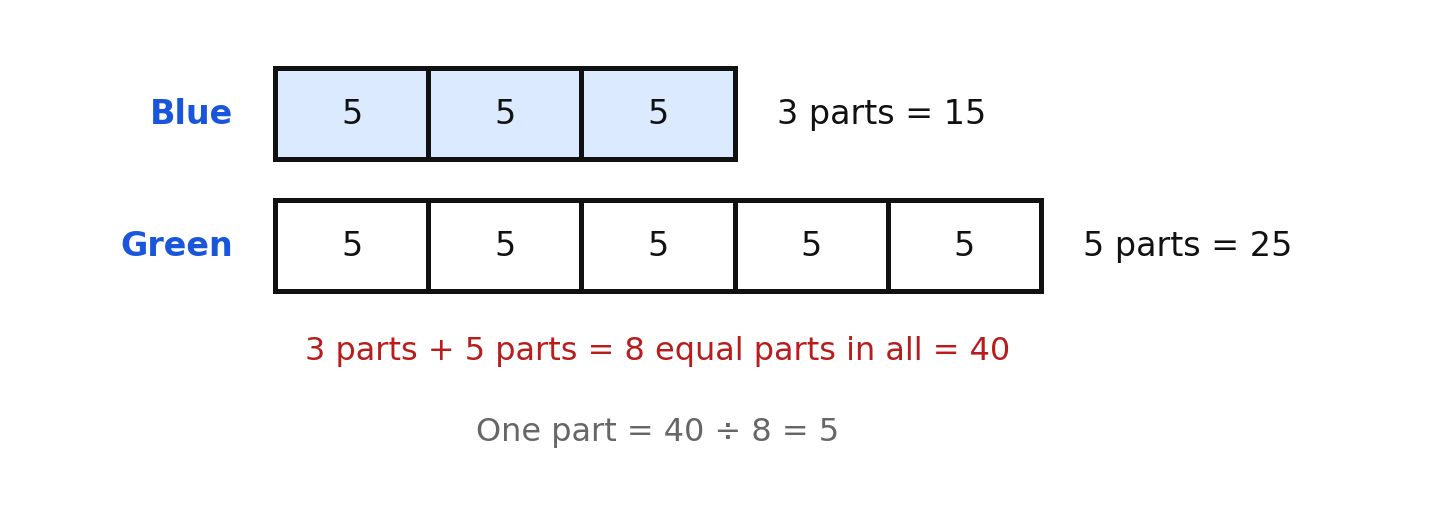
Forty marbles are shared in the ratio 3 blue to 5 green. There are equal parts, so one part is marbles. Then blue gets and green gets . Checking, , and simplifies to .
The graph of a proportional relationship
Plotting the pairs from a ratio table produces a picture with two unmistakable features.
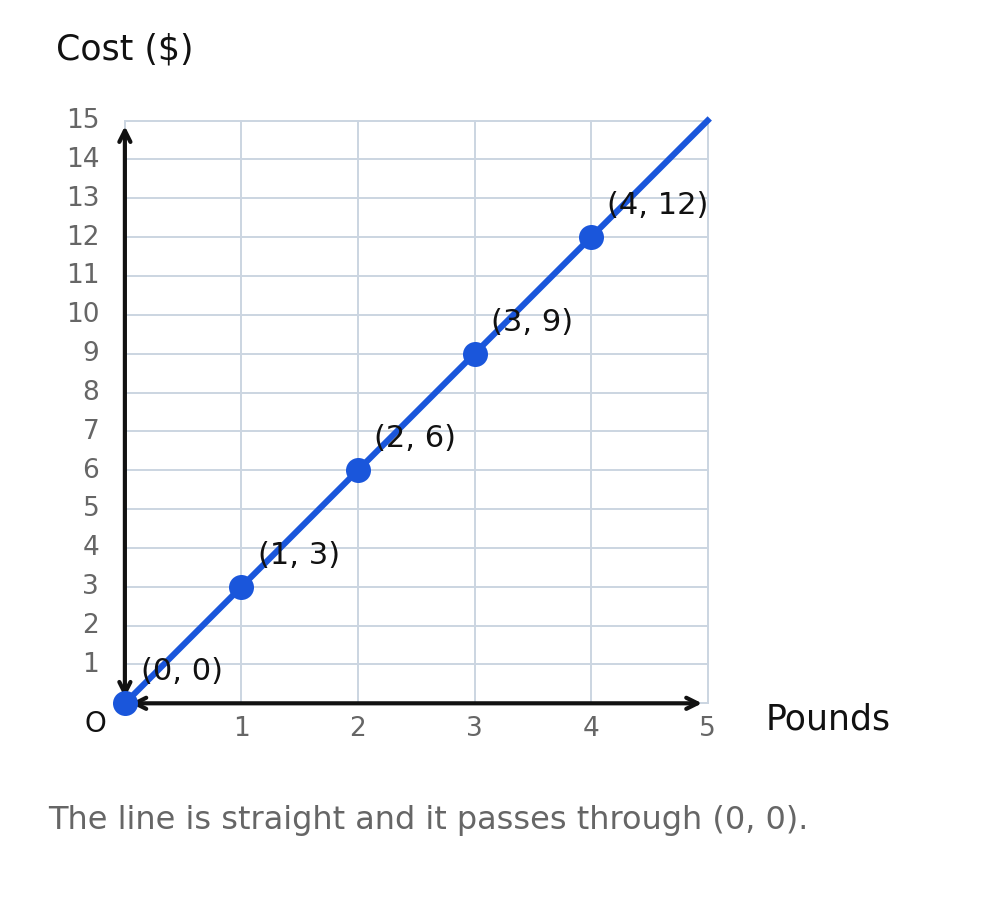
The points lie on a straight line, and the line passes through the origin, the point . The origin belongs on the graph for a reason you can state in words: buying zero pounds costs zero dollars. Any relationship whose graph is a straight line through the origin is proportional, and any relationship whose graph bends, or misses the origin, is not.
When a situation is not proportional
A taxi charges a $3 pickup fee plus $2 per mile. A 4-mile ride costs , and an 8-mile ride costs . Doubling the distance did not double the cost, because the $3 rides along unchanged. Graphed, this line would cross the vertical axis at 3, not at the origin.
Before you set up a proportion, check that the situation really is proportional. Flat fees, starting fees, and one-time charges are the usual warning signs.
Worked examples
Example 1 — Comparing unit prices
A 12-ounce jar of sauce costs $3.00. A 20-ounce jar costs $4.60. Which is the better buy?
Answer: The 20-ounce jar, at $0.23 per ounce compared with $0.25 per ounce.
Example 2 — Scaling a recipe
A soup recipe serving 6 people uses 2.5 cups of broth. How much broth is needed for 15 servings?
Answer: 6.25 cups of broth
Example 3 — A scale drawing
On a floor plan, 1 inch represents 12 feet. A wall measures 4.5 inches on the plan. How long is the actual wall?
Answer: 54 feet
Example 4 — Two steps, with a conversion
A machine fills 250 bottles in 5 minutes. Given 1 hour = 60 minutes, how many bottles does it fill in 2 hours?
First convert: minutes.
Then set up the proportion:
Answer: 6,000 bottles
Example 5 — Recognizing a non-proportional situation
A gym charges a $25 joining fee plus $15 per month. Is the total cost proportional to the number of months? Explain.
One month costs ; two months cost . If the relationship were proportional, two months would cost .
Answer: No. The joining fee is charged once no matter how long you stay, so doubling the months does not double the cost. The graph would cross the vertical axis at 25 instead of passing through the origin.
Guided practice
- A 12-ounce jar costs $3.00 and a 20-ounce jar costs $4.60. Find each unit price and name the better buy.
- A soup recipe serving 6 uses 2.5 cups of broth. How much broth is needed for 15 servings?
- On a floor plan, 1 inch represents 12 feet. How long is a wall that measures 4.5 inches on the plan?
- A car travels 150 miles in 3 hours at a steady speed. How far does it travel in 7 hours?
- Twenty-four stickers are shared in the ratio 1 to 3. How many does each person get? (Hint: how many equal parts are there in all?)
Independent practice
- Find the unit price of each and list them from least to greatest cost per ounce: a 10-ounce bag for $2.50, a 16-ounce bag for $3.84, and a 25-ounce bag for $5.75.
- Eight gallons of fertilizer treat 2,000 square feet of lawn. How many gallons are needed for 4,500 square feet?
- Forty marbles are shared in the ratio 3 blue to 5 green. How many of each color are there? Show that your answer keeps the ratio.
- A printing service charges $0.12 per page with no other fees. Make a ratio table for 10, 25, and 100 pages, then explain how the graph of this relationship would look.
- Application. A cyclist rides 42 kilometers in 3 hours at a steady speed. Given 1 kilometer = 0.621 miles, how many miles does the cyclist ride in 5 hours? Round to the nearest tenth of a mile.
- Application. A tree grows 18 inches in 2 years at a steady rate. Given 1 foot = 12 inches, how many feet will it grow in 8 years?
- Reasoning. A phone plan costs $20 per month plus $0.10 per gigabyte of data. Show that the cost is not proportional to the gigabytes used by computing the cost for 10 GB and for 20 GB, and explain what feature of the plan breaks the proportionality.
Exit ticket 5.5
- A 6-pack of juice costs $4.50 and a 10-pack costs $7.00. Which is the better buy? Show the unit prices.
- A recipe for 4 servings uses 3 cups of rice. How much rice is needed for 10 servings?
- A model train is built at a scale where 1 inch represents 8 feet. How long is a real car represented by a 2.5-inch model?
- A pool service charges a $40 visit fee plus $12 per hour. Explain why the total cost is not proportional to the number of hours.
Chapter 5 Review
Vocabulary. ratio · proportional relationship · unit rate · constant of proportionality · ratio table · double number line · proportion · cross products · conversion factor · unit price · origin
Part A — Ratio tables and missing values (7.CE.2a)
A bakery sells muffins at $2.75 each. Complete the ratio table.
Muffins 1 4 6 12 Cost ($) 2.75 A machine seals 96 envelopes in 4 minutes. Find the unit rate, then complete the table.
Minutes 1 4 7 10 Envelopes 96 One entry in this table is wrong. Name it and give the correct value.
Hours 2 5 8 10 Pages read 24 60 88 120 What number takes the column to the column ?
Part B — Writing and solving proportions (7.CE.2b)
- Do and form a proportion? Show the cross products.
- Solve each proportion. a) b) c)
- Four pounds of birdseed cost $7.00. Write and solve a proportion for the cost of 10 pounds.
- A student writes to find servings from 10 cups. Explain the error and write a correct proportion.
- Solve . Give the exact answer.
Part C — Converting units with a given factor (7.CE.2c)
- Given 1 pound = 16 ounces, convert 3.75 pounds to ounces.
- Given 1 meter = 3.28 feet, convert 25 meters to feet.
- Given 1 gallon = 4 quarts, convert 34 quarts to gallons.
- Given 1 kilometer = 0.621 miles, convert 12 kilometers to miles. Round to the nearest tenth.
Part D — Mixed application and reasoning
- A 9-ounce bag of nuts costs $4.05 and a 15-ounce bag costs $6.60. Find both unit prices and name the better buy.
- A hiker walks 3 miles in 50 minutes at a steady pace. Given 1 hour = 60 minutes, how many miles does the hiker walk in 2 hours?
- A streaming service charges a $10 signup fee plus $8 per month. A second service charges $9 per month with no signup fee. Explain which cost is proportional to the number of months and which is not, and describe how each one would look when graphed.
Standards coverage check — Chapter 5
| Knowledge and Skill | Where it is taught | Where it is practiced |
|---|---|---|
| 7.CE.2a — given a proportional relationship, create and use a ratio table to determine missing values | 5.1 | Items 1–16; 69, 72, 73; Review Part A, items 81–84 |
| 7.CE.2b — write and solve a proportion representing a proportional relationship, including problems in context | 5.2, 5.3 | Items 17–48; 66–68, 71, 78, 79; Review Part B, items 85–89 |
| 7.CE.2c — apply proportional reasoning in context, including converting units when given the conversion factor | 5.4, 5.5 | Items 49–64; 65, 70, 74–77, 80; Review Part C, items 90–93, and Part D, items 94–96 |
Part d of 7.CE.2, estimating and determining the percentage of a given whole number, is covered in Chapter 6.
Answer keys for every set in this chapter are in Appendix A.