Chapter 4 — Operations with Rational Numbers in Context
Standard: 7.CE.1 — The student will estimate, solve, and justify solutions to multistep contextual problems involving operations with rational numbers.
By the end of this chapter you will be able to:
- Add and subtract rational numbers — integers, proper and improper fractions, mixed numbers, and decimals, positive or negative — to answer questions about real situations (7.CE.1a)
- Multiply and divide those same rational numbers in context, including problems about rates, scaling, and sharing (7.CE.1a)
- Estimate a solution before computing, and use the estimate to judge whether a computed answer is reasonable (7.CE.1a)
- Solve multistep contextual problems that require more than one operation (7.CE.1a)
- Justify a solution by explaining the estimate, the operations chosen, and what the answer means in the situation (7.CE.1a)
Lessons: 4.1 Adding and Subtracting Rational Numbers · 4.2 Multiplying and Dividing Rational Numbers · 4.3 Estimating to Judge Whether an Answer Is Reasonable · 4.4 Multistep Problems in Context · 4.5 Justifying a Solution
Calculator note. A calculator is allowed throughout this chapter. That does not make estimation optional — it makes it essential. A calculator will faithfully compute whatever you type, including a mistyped decimal point or a dropped negative sign. Your estimate is the only thing standing between a typing slip and a wrong answer.
Lesson 4.1 — Adding and Subtracting Rational Numbers
What counts as a rational number
A rational number is any number that can be written as a fraction of two integers, with a denominator that is not zero. That definition is broader than it first sounds. It includes:
- integers, such as , , and , since
- proper fractions, such as and , where the numerator is smaller than the denominator
- improper fractions, such as and , where the numerator is at least as large as the denominator
- mixed numbers, such as and
- decimals that end, such as , , and
In this chapter, fractions may be positive or negative, and decimals may be positive or negative and go no further than the thousandths place — three digits after the decimal point, like .
Every one of these forms shows up in real situations, often in the same problem. A bank statement mixes decimals and integers. A recipe mixes mixed numbers and fractions. Part of the work in this chapter is moving comfortably between forms.
Adding and subtracting with signs
Adding rational numbers works exactly the way adding integers worked in Grade 6, because the number line does not change when the values between the tick marks get finer.
Adding a positive moves right. Adding a negative moves left.
A temperature of °F that falls degrees is a starting point plus a negative change:
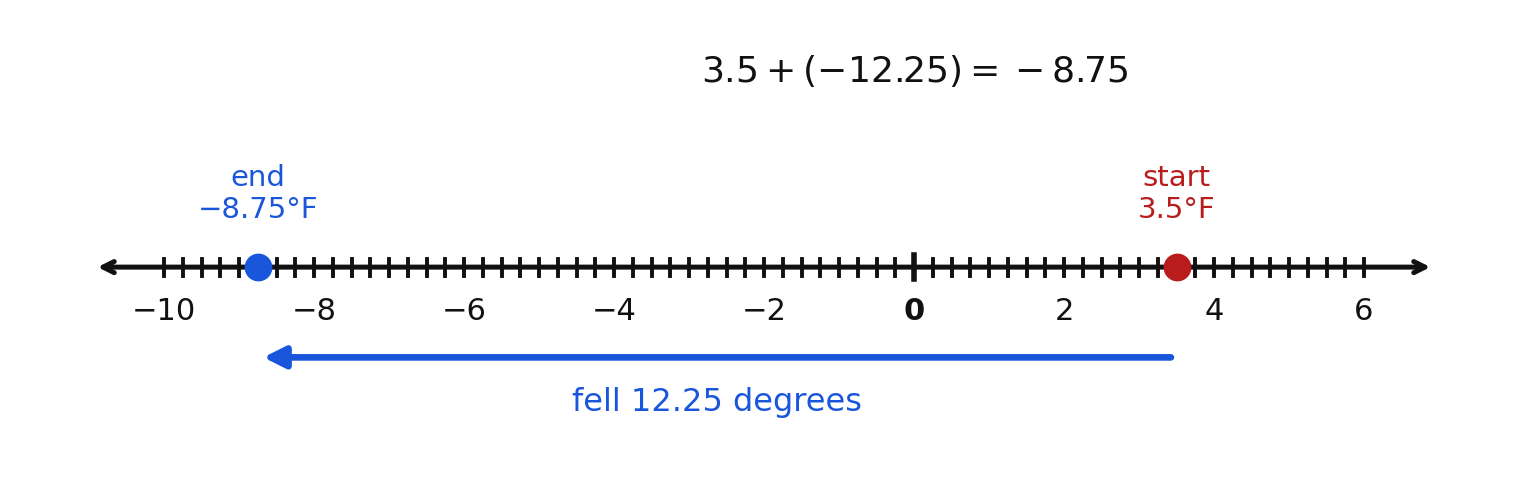
Notice how the picture makes the size of the answer sensible before you compute anything. The starting point is only above zero, and the fall is much larger than that, so the result must be negative — and it must be a bit less than , since .
Subtraction is handled by one rule you will use constantly:
To subtract, add the opposite.
So becomes . Subtracting a negative increases the value, which feels strange until you attach it to a situation: if a $3.85 fee is removed from your account, your balance goes up.
Adding and subtracting fractions in context
With fractions, the arithmetic needs one extra step: a common denominator. You cannot combine eighths and quarters until they are written as the same kind of piece.
A cook starts with cups of broth and uses cups. Write both as eighths:
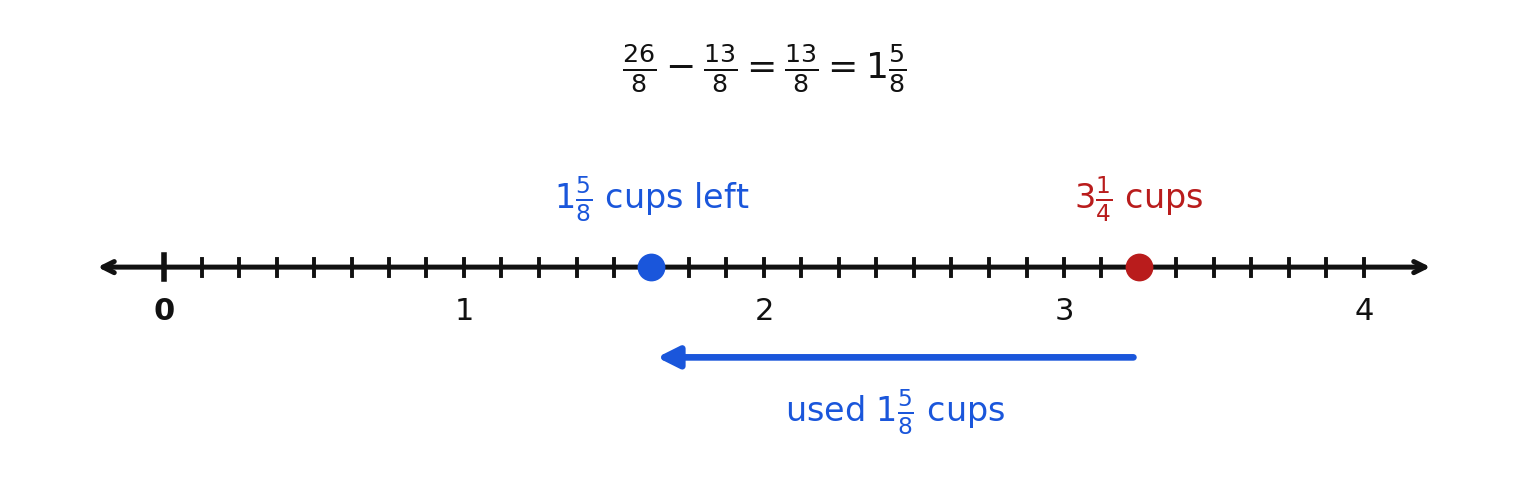
The line is ticked in eighths so that both quantities land exactly on a tick. That is not decoration — it is the whole reason common denominators exist. Equal-sized pieces are what make the subtraction possible.
Chains of changes
Real situations rarely involve just one change. A diver at ft descends another ft, then rises ft. Work left to right:
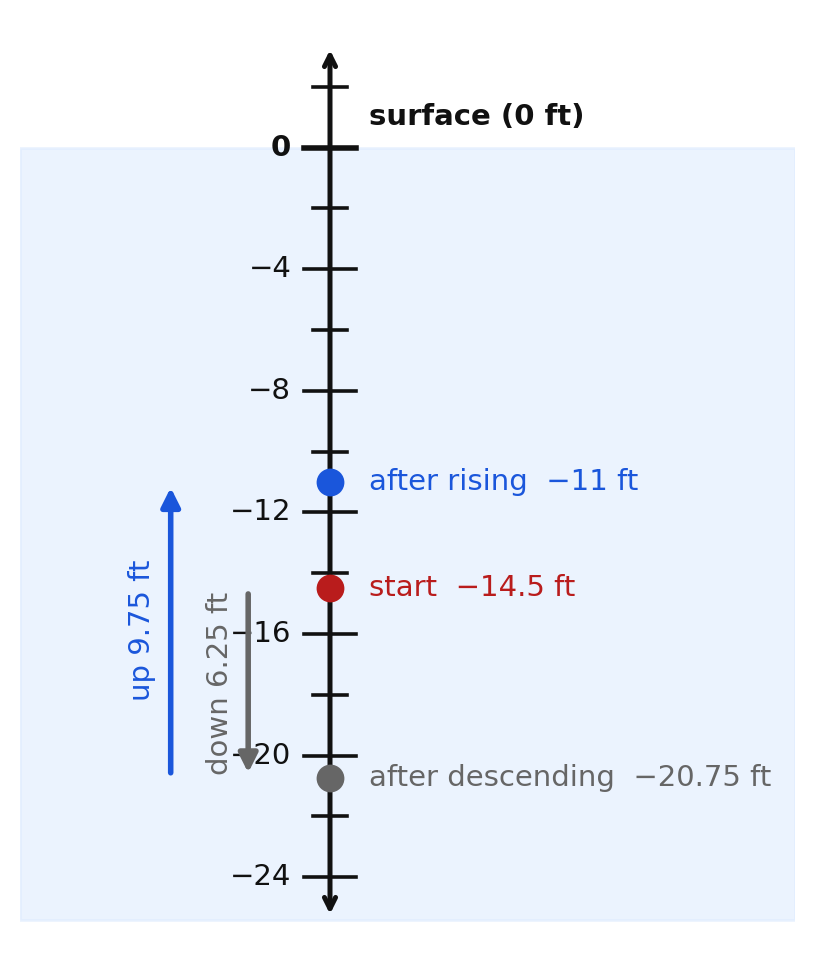
Two habits will save you here. First, decide what positive means before you start — for elevation, up is positive — and then translate every phrase in the problem into a signed number. Second, keep the running total visible, as shown above, so you can check each stage against the picture rather than only checking the final number.
Worked examples
Example 1 — An overdrawn account receives a deposit
Kalia's checking balance is . She deposits $45.50. What is her new balance?
A deposit is a positive change, so add.
The deposit is larger than the debt, so the result is positive. Its size is the difference: .
Answer: $26.75
Example 2 — A temperature falling through zero
At 4 p.m. the temperature is °F. Overnight it falls degrees. What is the temperature afterward?
A fall is a negative change.
Since , the answer is negative, with size .
Answer: °F
Example 3 — Subtracting mixed numbers in a recipe
A pot holds cups of broth. A cook uses cups. How much is left?
Rewrite both as eighths, then subtract.
Answer: cups
Example 4 — A chain of elevation changes
A diver is at ft. She descends ft, then rises ft. What is her final depth?
Descending is negative, rising is positive. Work left to right.
Answer: ft, or 11 feet below the surface
Example 5 — Adding two negative mixed numbers
A well's water level drops ft in June and another ft in July. What is the total change?
Both changes are drops, so both are negative.
Answer: ft, a total drop of feet
Guided practice
- Find . First decide whether the answer is positive or negative, then find its size.
- Find . Both quantities are already in fourths.
- Rewrite as an addition problem, then evaluate it.
- At 5 p.m. the temperature is °C. It drops °C overnight. What is the temperature the next morning?
- Devon's balance is $34.20. He writes a check for $52.75. What is his new balance? State what the sign of your answer means.
Independent practice
- Evaluate. a) b) c) d)
- A hiker starts at an elevation of ft, descends ft into a valley, then climbs ft. What is her final elevation?
- A savings account is overdrawn at . The owner deposits $120.00, then two charges of $18.60 and $35.75 post to the account. What is the final balance?
- A jug holds quarts of cider. Two pitchers are filled, one with quarts and one with quarts. How much cider remains in the jug?
- Over four days a stock's price changes by , , , and dollars. What is the total change, and did the price end higher or lower than it started?
- Application. At 6 a.m. the temperature is °F. By noon it has risen degrees. By 9 p.m. it has fallen degrees from the noon reading. What is the temperature at 9 p.m.?
- Reasoning. Jordan writes , explaining that "subtracting makes it smaller, so I subtracted the digits." Find the correct answer and explain precisely what Jordan misread.
Exit ticket 4.1
- Find .
- Find .
- A balance of receives a $25.00 deposit. What is the new balance?
- Explain, using a situation of your choice, why subtracting a negative number makes a result larger.
Lesson 4.2 — Multiplying and Dividing Rational Numbers
The sign rules, and why they are true
Multiplication is repeated addition, and that is enough to explain the signs.
If a reservoir drops inches every month, then after 6 months the change is six drops of :
A negative repeated a positive number of times stays negative. That gives the first two rules. The third — that two negatives make a positive — is easiest to see by running a pattern backward:
Each time the second factor drops by 1, the product rises by . Continuing the pattern past zero forces the product to become positive. In context: if a reservoir has been dropping inches per month, then one month ago — a negative number of months from now — the level was inches higher.
| Signs of the factors | Sign of the product or quotient |
|---|---|
| positive positive | positive |
| positive negative | negative |
| negative positive | negative |
| negative negative | positive |
Division follows the same table, because every division statement is a multiplication statement in disguise: is true precisely because .
Multiplying and dividing fractions
To multiply fractions, multiply numerators and multiply denominators. Convert mixed numbers to improper fractions first, or the distributive property will bite you.
To divide by a fraction, multiply by its reciprocal — the fraction turned upside down.
That answer means something concrete: cups of soup fills eight full -cup bowls with half a bowl left over. Division by a fraction almost always answers the question how many of these fit inside that?, and reading the answer back into the situation is how you check that you divided in the right direction.
Two questions division answers
Division in context comes in two flavors, and naming them helps you decide what to divide by what.
- Sharing. A $73.50 debt is split evenly among 5 people. Each share is , so each person owes $14.70. Here you know the number of groups and want the size of each group.
- Measuring. A -ft ribbon is cut into -ft pieces. The number of pieces is . Here you know the size of each group and want the number of groups.
Both are division. What changes is which quantity is the divisor, and the surest way to get it right is to state which flavor you are in before you touch the calculator.
Worked examples
Example 1 — A steady negative rate
A reservoir level falls inches each month. What is the total change after 6 months?
A fall is negative, repeated 6 times.
Answer: inches, a drop of 27 inches
Example 2 — Multiplying a fraction by a negative mixed number
Find .
Write the mixed number as an improper fraction, then multiply across.
Answer:
Example 3 — Sharing a debt
Five roommates split a $73.50 utility overcharge equally. Write the change to each person's balance.
The overcharge is a negative change of , shared 5 ways.
Answer: each, meaning each roommate owes $14.70
Example 4 — Measuring with a fraction divisor
How many -cup servings can be filled from cups of soup?
This is a measuring problem: how many fit inside . Divide by multiplying by the reciprocal.
Answer: 8 full servings, with half a serving left over
Example 5 — A rate given to the thousandths
A drainage ditch loses inches of water per week. What is the change in level after 4 weeks?
Answer: inches, a drop of inches
Guided practice
- Find . State the sign first, then the size.
- Find and write the answer in simplest form.
- Find .
- Find . Convert to improper fractions first.
- A well's water level drops ft each day. What is the change in level after 8 days?
Independent practice
- Evaluate. a) b) c) d)
- Four friends split a restaurant bill of $146.20 equally. How much does each pay?
- A bread recipe calls for cups of flour for one batch. How much flour is needed for batches?
- A scuba tank loses psi of pressure each minute. What is the change in pressure after minutes?
- A submarine descends at a steady ft per minute for minutes. Write its change in elevation as a signed number.
- Application. A caterer has cups of chili and serves it in -cup portions. How many portions can be served, and how do you know none is left over?
- Reasoning. Explain why the quotient of two negative numbers is positive. Use the utility-overcharge situation from Example 3 or a situation of your own, not just the sign rule.
Exit ticket 4.2
- Find .
- Find in simplest form.
- Find .
- A quotient has exactly one negative number in it — either the dividend or the divisor, but not both. What is the sign of the quotient, and how do you know?
Lesson 4.3 — Estimating to Judge Whether an Answer Is Reasonable
Why estimate when you have a calculator
An estimate is an approximate answer found quickly with friendly numbers. Its purpose is not to replace the exact answer. Its purpose is to tell you, in advance, roughly where the exact answer must land — so that when the calculator returns something far away, you know a key was mistyped.
The two mistakes a calculator cannot catch for you are the two most common ones: a misplaced decimal point and a dropped negative sign. Both produce answers that are wildly wrong, and both are invisible unless you already know what to expect.
Three ways to estimate
Rounding. Round each number to a place that keeps one or two significant digits, then compute mentally. For , round to .
Compatible numbers. Change the numbers to ones that divide evenly. For , use . Compatible numbers are usually better than rounding for division, because rounding to the nearest ten often produces a division that is no easier than the original.
A low and a high estimate. Round both numbers down to get a value the answer must exceed, then round both up to get a value the answer must fall below. This gives a bracket — a range the exact answer is guaranteed to sit inside.
For :
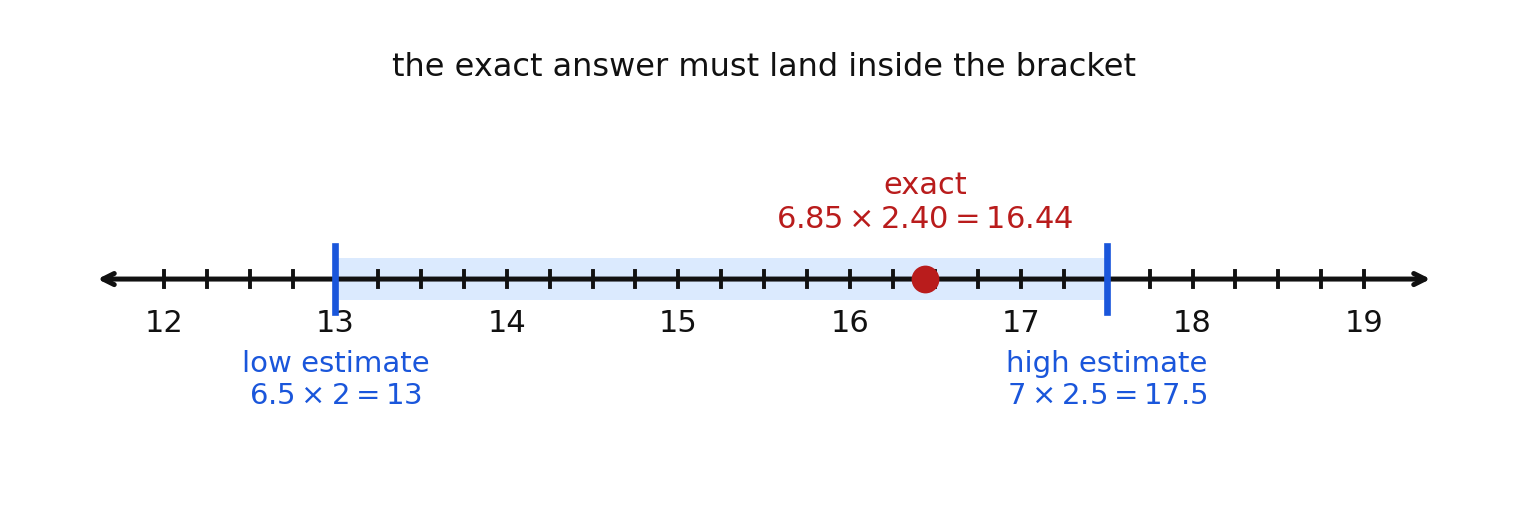
The exact product is , which sits inside the bracket. A bracket is stronger than a single estimate because it converts "about right" into a claim you can actually test: any answer outside to is definitely wrong.
Using an estimate to judge an answer
Once you have an estimate, judging takes one question: is the computed answer close to the estimate, and on the same side of zero?
Suppose a student reports . Estimate first. Dividing by — a number smaller than 1 — must make the result bigger than , not smaller. A compatible-number estimate gives . The reported answer is off by a factor of 10, which is the signature of a misplaced decimal point. The exact answer is .
Dividing by a number less than 1 increases the result. This surprises people constantly. Ask how many s fit inside — clearly many more than 48 of them would fit if the pieces were whole, so the count must be large.
Estimating with fractions
For fractions and mixed numbers, round to the nearest whole number, or to the nearest half when the fractions are small.
The exact sum, using a common denominator of 24, is . The estimate of was slightly high, which makes sense: two of the three numbers were rounded up.
Noticing which direction your estimate leans is part of the skill. If you rounded everything up, the true answer is below your estimate, and an answer above it is suspicious.
Worked examples
Example 1 — Estimate, then compute
Apples cost $2.40 per pound. Estimate the cost of pounds, then find the exact cost.
Round to .
The exact cost is a little under the estimate, as expected, since was rounded up.
Answer: estimate $16.80; exact cost $16.44
Example 2 — Building a bracket
Give a low and a high estimate for and check that the exact answer falls inside.
Round both down, then both up.
Since , the exact answer lies inside the bracket.
Answer: the bracket is $13 to $17.50, and $16.44 falls inside it
Example 3 — Judging a reported answer
A student reports . Is that reasonable?
Estimate with . The reported answer is very close to 40 and positive, as it should be.
Answer: Reasonable, and in fact correct.
Example 4 — Catching a misplaced decimal point
A student reports . Judge the answer.
Dividing by a number less than 1 must produce a result larger than . A compatible estimate is .
The reported answer is one-tenth of the true value.
Answer: Unreasonable. The correct answer is ; the decimal point was misplaced.
Example 5 — Estimating a sum of mixed numbers
Estimate , then find the exact sum.
Round each to the nearest whole number.
Now use a common denominator of 24.
Answer: estimate ; exact sum
Guided practice
- Estimate by rounding each factor to the nearest whole number, then compute the exact product.
- Estimate using compatible numbers, then compute the exact quotient.
- Estimate by rounding each to the nearest whole number, then find the exact sum.
- A student reports . Estimate the product and decide whether the report is reasonable. If it is not, give the correct answer.
- Give a low estimate and a high estimate for , then compute the exact product and confirm it lands inside.
Independent practice
- For each, give an estimate and then the exact value. a) b) c) d)
- Build a bracket for by rounding both factors down and then both up. Compute the exact product and confirm it falls inside the bracket.
- Decide whether each reported answer is reasonable. Give a one-line estimate as your reason, and correct any that are wrong. a) b) c) d)
- Application. Gasoline costs $3.199 per gallon. Estimate the cost of gallons, then compute the exact cost and round it to the nearest cent.
- Application. Five friends split a $97.35 bill equally. Estimate each share first, then compute it exactly. Explain how the estimate confirms your exact answer.
- Application. Four concert tickets cost $13.75 each, and parking costs $8.50. Use estimation to decide whether $60 is enough, then compute the exact total to confirm.
- Reasoning. Explain why rounding both numbers up always produces an estimate that is too high for a product of two positive numbers, and why a low-and-high pair is more useful than a single estimate.
Exit ticket 4.3
- Estimate , then compute the exact product.
- A student reports . Is that reasonable? Give the correct answer.
- Give a low and a high estimate for , then compute the exact product.
- Explain how an estimate can catch a misplaced decimal point that a calculator will not catch for you.
Lesson 4.4 — Multistep Problems in Context
A plan that works every time
A multistep problem requires more than one operation before you reach the answer. What makes them hard is not the arithmetic — a calculator handles that — but keeping track of what each number means and doing the steps in the right order.
Use the same four moves every time.
- Understand. Say in your own words what the question asks for, and name the unit of the answer: dollars, degrees, cups, feet.
- Estimate. Get a rough answer with friendly numbers before you compute anything.
- Solve. Do the steps in order, labeling each intermediate result with its unit and its meaning.
- Check. Compare with the estimate, and if you can, work backward from your answer to a number the problem gave you.
Step 4 is the one students skip and the one that catches the most errors.
Order matters
Consider a $78.60 dinner bill with a $12.60 coupon, split evenly among 3 people.
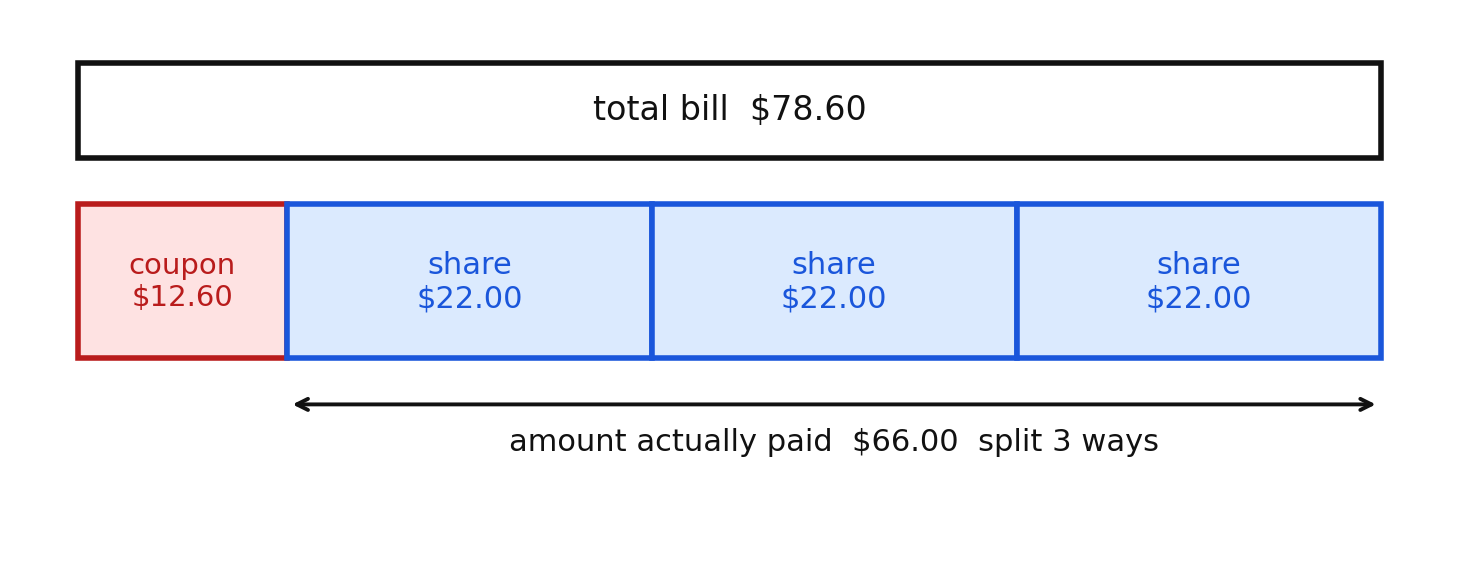
Subtract the coupon first, then divide:
Dividing first and then subtracting would give a different — and wrong — answer, because it would take the whole $12.60 off each person's share instead of off the bill once. The bar model settles the question visually: the coupon is one piece of the whole bar, removed once, and only what remains gets divided into three equal parts.
When a problem involves an expression rather than a sequence of sentences, the order of operations decides for you. In , the multiplication happens first:
Reading it as would give , which is not just a different number — it answers a different question.
Rates over time
Many multistep problems combine a starting value with a rate applied over a period of time. The structure is almost always the same:
The rate carries the sign. A temperature falling degrees per hour for 6 hours, starting at °F:
Writing the rate as a signed number, rather than remembering separately that it was a fall, is what keeps long chains from going wrong.
Worked examples
Example 1 — A bill, a coupon, and a split
A $78.60 dinner bill is reduced by a $12.60 coupon, and the rest is split evenly among 3 people. How much does each person pay?
Understand: the answer is in dollars per person. Estimate: about .
Subtract the coupon from the whole bill first.
Then divide by 3.
Check by working backward: .
Answer: $22.00 each
Example 2 — A starting temperature and a falling rate
The temperature is °F and falls degrees per hour for 6 hours. What is the temperature at the end?
Estimate: a fall of about degrees from about 5 lands near .
The exact answer, , is close to the estimate of and on the same side of zero.
Answer: °F
Example 3 — Scaling a recipe and comparing to what you have
A recipe that serves 4 uses cups of flour. You need enough for 10 servings and you have cups. How much more flour do you need?
Scale by the factor .
Subtract what you already have, written in eighths.
Answer: more cups
Example 4 — Repeated payments and a deposit
An account holds $212.40. Three automatic payments of $27.85 each post, then a $95.00 deposit arrives. What is the final balance?
Estimate: three payments of about $28 is about $84, so roughly .
Answer: $223.85
Example 5 — Two rates in sequence
A drone hovers at ft. It descends at ft per second for 8 seconds, then rises at ft per second for 4 seconds. What is its final height?
Compute each leg as rate times time, keeping signs.
Answer: ft
Guided practice
- A $44.80 bill is reduced by a $4.80 discount and split evenly among 4 people. Subtract first, then divide. How much does each person pay?
- The temperature is °C and rises °C per hour for 4 hours. Find the change first, then the final temperature.
- Cheese costs $6.40 per pound. What is the cost of pounds?
- A tank holds 20 gallons and loses gallons per hour for 6 hours. How much water remains?
- A -ft ribbon is cut into -ft pieces. How many pieces are there?
Independent practice
- A phone plan costs $24.99 per month plus $0.045 for each extra minute. What is the bill in a month with 60 extra minutes?
- A hiker begins at an elevation of ft and descends at ft per hour for 6 hours. What is her elevation at the end?
- Painting one room takes gallons of paint. You need to paint 3 rooms and you have gallons. How much more paint do you need?
- An account is overdrawn at . A $150.00 deposit arrives, and then four withdrawals of $22.50 each post. What is the final balance?
- Twenty shares of a stock are bought at $18.75 each. The price then falls $0.625 per day for 6 days. What is the new price per share, and what is the total loss on the 20 shares?
- Application. A class of 27 students goes on a field trip. Admission is $8.75 per student, and the bus costs $148.50, shared equally by the class. What does each student pay in total?
- Reasoning. For item 49, a student divided the $44.80 by 4 first and then subtracted the $4.80 discount from each share. Compute what that student would get, and explain in terms of the situation why the order matters.
Exit ticket 4.4
- A $56.40 bill is reduced by a $6.40 gift card and split evenly among 5 people. How much does each pay?
- The temperature is °F and falls °F per hour for 6 hours. What is the final temperature?
- A pot holds cups of soup, served in -cup bowls. How many bowls can be filled?
- Describe the check you would use to confirm your answer to item 62 is reasonable.
Lesson 4.5 — Justifying a Solution
What a justification is
To justify a solution is to give someone else a reason to believe it — before they redo your arithmetic. "I used a calculator" is not a justification, because a calculator will produce a confident wrong answer just as fast as a right one.
A complete justification has three parts.
- An estimate that shows roughly where the answer had to land, including its sign.
- The operations you chose, and why each one matches something in the situation.
- An answer sentence with units that actually answers the question that was asked, plus a check when one is available.
That third part is easy to shortchange. The number is not an answer; "each person pays $22.00" is.
A worked justification
Problem. Three friends split a $47.25 bill after a $5.25 coupon. What does each pay?
Estimate. The bill is about $47 and the coupon about $5, leaving about $42. Split three ways, each share is about $14.
Operations. Subtract the coupon once, because it comes off the bill as a whole, not off each person. Then divide by 3, because the remainder is shared into 3 equal parts.
Answer and check. Each friend pays $14.00. Working backward, , which is the original bill.
The estimate, the reasoning, and the check each rule out a different kind of error: the estimate catches size and sign mistakes, the reasoning catches wrong-operation mistakes, and the check catches arithmetic slips.
Justifying why an answer must be negative
Sometimes the most important thing to justify is the sign. If a temperature of °F falls degrees per hour for 3 hours, the total fall is degrees — larger than the degrees the temperature had above zero. So the result must be below zero before you compute anything:
An answer of °F would be arithmetically tidy and physically impossible. Reasoning about the sign in advance is what catches that.
Error analysis is justification in reverse
Finding someone else's mistake and naming it precisely is the same skill as justifying your own work. Consider evaluated as .
That student added first: , then multiplied by 3. But the order of operations requires multiplication first.
The correct value is . Notice the useful description is not "they got it wrong" but "they added before multiplying." Naming the specific move is what makes error analysis worth doing.
Worked examples
Example 1 — A complete justification
Three friends split a $47.25 bill after a $5.25 coupon. Justify the amount each pays.
Estimate: about . Subtract the coupon once from the whole bill, then divide by 3.
Check: .
Answer: Each friend pays $14.00, confirmed by the estimate of $14 and by working backward to the original bill.
Example 2 — Justifying the choice of operation
A -pound bag of rice is repackaged into -pound bags. Which operation applies, and why?
The question asks how many -pound portions fit inside pounds, which is a measuring question, so divide. Multiplying would answer a different question — the weight of portions.
Check: .
Answer: Division; there are 10 bags.
Example 3 — Error analysis with order of operations
A student evaluates and gets . Find and name the error.
The student added before multiplying. Multiplication comes first.
Answer: The correct value is . The error was adding before multiplying.
Example 4 — Justifying with an estimate and a rounding instruction
A driver buys gallons of gas at $3.125 per gallon. Justify the cost, rounded to the nearest cent.
Estimate: , so the cost is near $45.
Rounded to the nearest cent, that is $45.63.
Answer: $45.63, which matches the estimate of about $45.
Example 5 — Justifying the sign of a result
An account is overdrawn at . Four deposits of $12.75 each arrive. Justify whether the final balance is positive or negative, then find it.
Four deposits of about $13 total about $52, which is more than the $32.50 owed, so the balance must end positive.
Answer: $18.50, positive as predicted
Guided practice
- Write a one-sentence estimate that justifies why is reasonable.
- A -pound bag of rice is repackaged into -pound bags. Name the operation, explain why it is the right one, and find the number of bags.
- A student writes . Find the error, name it, and give the correct answer.
- The temperature is °F and falls °F per hour for 3 hours. Explain, before computing, why the answer must be negative. Then compute it.
- Five friends split $81.25 evenly. Write a justification with all three parts: estimate, operation with a reason, and an answer sentence.
Independent practice
- A student writes . Name the error and give the correct product.
- A student reports . Use an estimate to show the answer is unreasonable, then give the correct quotient.
- Seven friends split a $103.60 bill after a $5.25 coupon. Write a complete justification: estimate, operations with reasons, computation, answer sentence, and check.
- Application. A pool loses inches of water per day to evaporation. Find the change in level after 12 days, and justify both the sign and the size of your answer.
- Application. A recipe uses cups of sugar for 8 servings. How much sugar is needed for 20 servings? Justify your scaling factor.
- Reasoning. Two students solve item 72 and get $14.05 and $14.50. Use estimation to decide which is right without redoing the division, and explain your reasoning.
- Reasoning. Explain why checking a solution by working backward is stronger evidence than saying "I used a calculator."
Exit ticket 4.5
- Write an estimate that justifies as reasonable, addressing both the size and the sign.
- A student writes . Name the error and give the correct quotient.
- Justify why four people splitting a $63.80 bill each pay $15.95. Include a check.
- Name the three parts of a complete justification.
Chapter 4 Review
Vocabulary. rational number · proper fraction · improper fraction · mixed number · thousandths place · common denominator · reciprocal · estimate · bracket · compatible numbers · multistep problem · justify
Part A — Adding and subtracting rational numbers (7.CE.1a)
- Evaluate. a) b) c) d)
- An account balance is . A $140.00 deposit arrives, then a $36.45 withdrawal posts. What is the final balance?
- The temperature is °F. It falls degrees, then rises degrees. What is the final temperature?
Part B — Multiplying and dividing rational numbers (7.CE.1a)
- Evaluate. a) b) c) d)
- A -ft rope is cut into -ft pieces. How many pieces are there?
- A tank drains gallons per minute for 8 minutes. Write the change in volume as a signed number.
Part C — Estimating and judging reasonableness (7.CE.1a)
- Give an estimate and then the exact value. a) b) c)
- Build a low-and-high bracket for , then compute the exact product and confirm it falls inside.
- Which reported answers are unreasonable? Give an estimate as your reason and correct any that are wrong. a) b) c)
Part D — Multistep problems in context (7.CE.1a)
- A $96.40 catering bill is reduced by a $14.40 coupon and split evenly among 4 people. How much does each pay?
- Twenty-four students take a field trip. Admission is $6.25 each, and the $114.00 bus fee is shared equally. What does each student pay in total?
- A soup recipe uses cups of stock for 6 servings. How much stock is needed for 15 servings?
- A drone at ft descends at ft per second for 6 seconds, then rises ft. What is its final height?
Part E — Mixed reasoning and justification (7.CE.1a)
- A student evaluates and gets . Name the error and give the correct value.
- Six friends split a $77.70 bill evenly. Write a complete justification: estimate, operation with a reason, computation, answer sentence, and check.
- Explain why estimating first is worth the time even when a calculator is allowed. Give one specific kind of error an estimate catches and a calculator does not.
Standards coverage check — Chapter 4
| Knowledge and Skill | Where it is taught | Where it is practiced |
|---|---|---|
| 7.CE.1a — estimate solutions to contextual problems with rational numbers | 4.3; estimate step in 4.4 and 4.5 | 33–48; 54–60; 65, 69, 71, 72, 75, 77; Review 87–89, 95, 96 |
| 7.CE.1a — solve contextual problems using addition and subtraction of integers, fractions, mixed numbers, and decimals | 4.1; chains of changes in 4.4 | 1–16; 49, 50, 52, 56, 57; Review 81–83, 90, 93 |
| 7.CE.1a — solve contextual problems using multiplication and division of integers, fractions, mixed numbers, and decimals | 4.2; rate and scaling work in 4.4 | 17–32; 51, 53, 54, 55, 58, 59; Review 84–86, 91, 92 |
| 7.CE.1a — solve multistep contextual problems requiring more than one operation | 4.4 | 49–64; 72, 73, 74; Review 90–93, 95 |
| 7.CE.1a — justify solutions, including the operations chosen and the meaning of the answer | 4.5; check step in 4.4 | 12, 28, 44, 48, 60, 64; 65–80; Review 94–96 |
| 7.CE.1a — work within the stated bounds: fractions positive or negative; decimals positive or negative, to the thousandths place | 4.1 opening; 4.2; 4.4 | throughout; thousandths appear in 10, 25, 41, 52, 54, 58, 73, 86 |
Answer keys for every set in this chapter are in Appendix A.