Chapter 3 — Square Roots and Perfect Squares
Standard: 7.NS.3 — The student will recognize and describe the relationship between square roots and perfect squares.
By the end of this chapter you will be able to:
- Determine the positive square root of a perfect square from 0 to 400 (7.NS.3a)
- Recognize the perfect squares from to and explain what makes a number a perfect square (7.NS.3a)
- Describe the relationship between square roots and perfect squares, including how squaring and taking the positive square root undo each other (7.NS.3b)
- Use perfect squares as neighbors to reason about a number that is not a perfect square (7.NS.3b)
Lessons: 3.1 Perfect Squares from 0 to 400 · 3.2 The Positive Square Root · 3.3 How Square Roots and Perfect Squares Undo Each Other
Calculator note. Everything in this chapter is meant to be done by mental math and pencil work. Virginia assesses this standard without a calculator, so every number here is chosen to be reachable by hand.
Lesson 3.1 — Perfect Squares from 0 to 400
Where the word "square" comes from
Mathematical names usually come from pictures, and this one comes from the most familiar picture there is. Build a square out of unit squares — small tiles one unit on each side — with 4 tiles along each edge. How many tiles did you use?
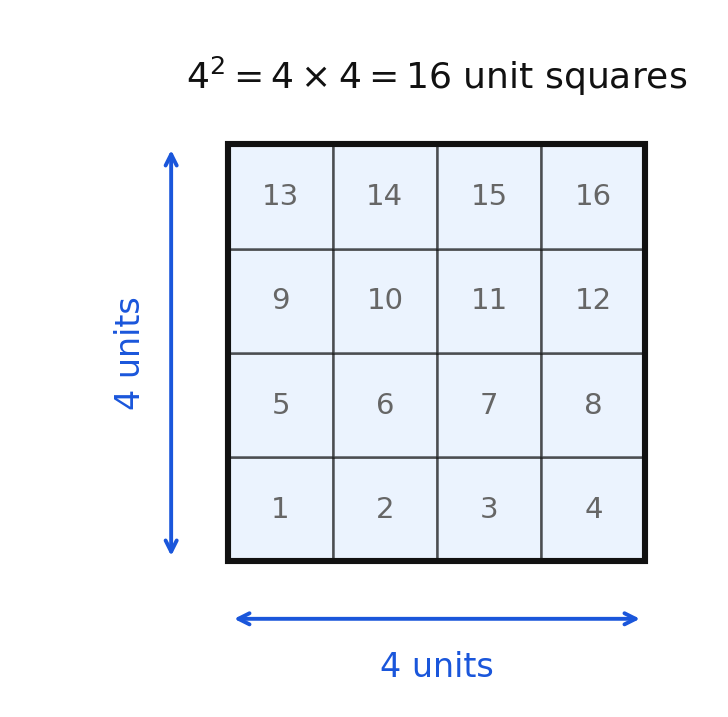
Four rows of four tiles is tiles. The array is literally a square, and the number 16 is what you get when you build one. That is why we call 16 "four squared" and write it .
The small raised 2 is an exponent. It tells you how many times the base is used as a factor:
Read as "four squared" or "four to the second power." Be careful here: does not mean . The exponent counts factors, it does not multiply. A student who reads as 8 has built a rectangle, not a square.
The picture also hands you the geometry for free. A square whose side measures 4 units has an area of 16 square units, because area counts the unit squares that fill a figure. So for any square,
Hold on to that sentence. Every idea in this chapter is a different way of looking at it.
What makes a number a perfect square
A perfect square is a number you get by multiplying a whole number by itself. Since 16 is , 16 is a perfect square. Since 20 is not any whole number times itself, 20 is not.
Watch the squares grow, all drawn to the same unit scale:
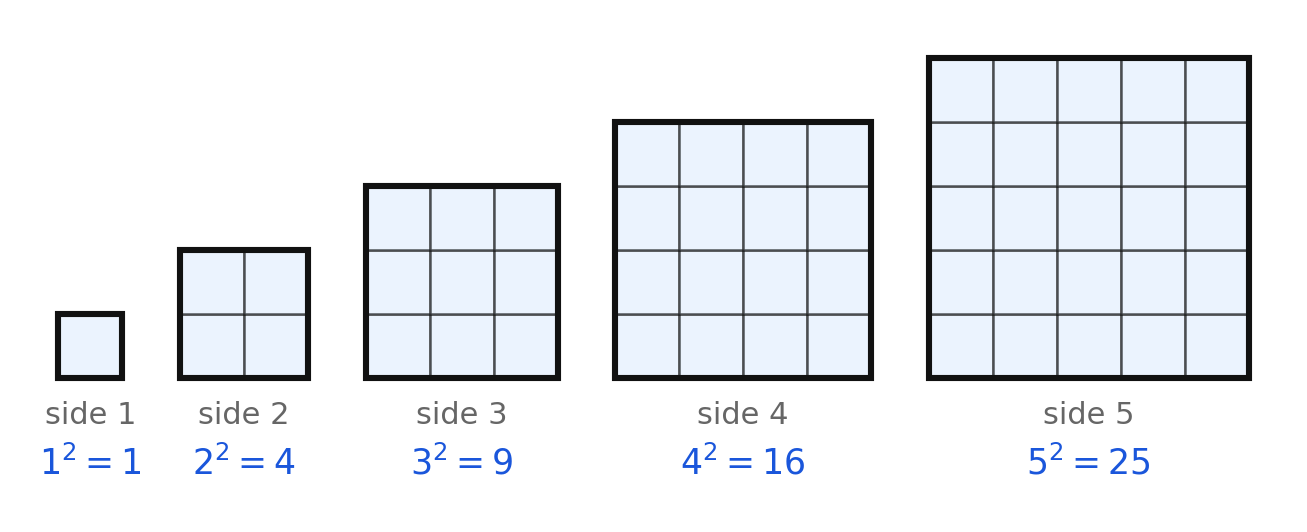
Each time the side grows by 1, the array gains a whole new row and a whole new column. That is why perfect squares spread out so fast: The gaps between them are — the odd numbers, in order. If you know and you want , you can add the next odd number after 24, which is 25: . That check is a nice way to catch an error without starting over.
The perfect squares you need to know
This standard works with perfect squares from 0 to 400, which means the squares of the whole numbers 0 through 20. Here is the complete list.
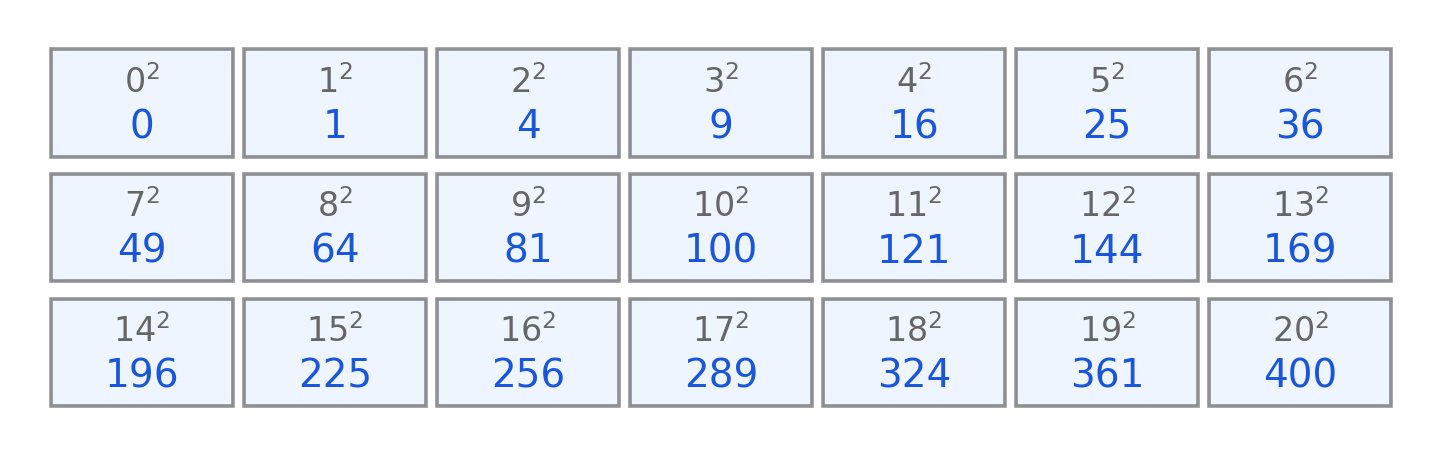
| 0 | 1 | 2 | 3 | 4 | 5 | 6 | 7 | 8 | 9 | 10 | |
|---|---|---|---|---|---|---|---|---|---|---|---|
| 0 | 1 | 4 | 9 | 16 | 25 | 36 | 49 | 64 | 81 | 100 |
| 11 | 12 | 13 | 14 | 15 | 16 | 17 | 18 | 19 | 20 | |
|---|---|---|---|---|---|---|---|---|---|---|
| 121 | 144 | 169 | 196 | 225 | 256 | 289 | 324 | 361 | 400 |
Two entries at the start deserve a comment. , because a square with no side length encloses no area. And , because a single tile is already a square. Both are perfect squares, and both show up on tests precisely because students forget them.
Why stop at 400? Because and the next one, , is past the boundary this standard sets. Knowing where the list ends is part of knowing the list.
Deciding whether a number is a perfect square
You do not have to guess. Two moves settle it.
Move 1 — Find the neighbors. Every whole number that is not a perfect square sits between two consecutive perfect squares, meaning two perfect squares that are next to each other on the list. Take 50. Running down the list, and , and there is nothing between them. Since , the number 50 falls in the gap, so it is not a perfect square.
Move 2 — Check the last digit as a quick rule-out. Look at the ones digits in the table: Only the digits 0, 1, 4, 5, 6, and 9 ever appear. So a number ending in 2, 3, 7, or 8 cannot possibly be a perfect square. This test only rules numbers out — 52 ends in a legal digit but still is not a perfect square, as shows. Use Move 2 to save time, and Move 1 to be sure.
Worked examples
Example 1 — Squaring a whole number
Find .
The exponent 2 says to use 7 as a factor twice.
Answer:
Example 2 — Area of a square
A square tabletop measures 15 inches on each side. Find its area.
Area of a square is the side length squared.
Answer: square inches
Example 3 — Testing a number
Is 90 a perfect square?
The ones digit is 0, which is allowed, so the quick test does not rule it out. Find the neighbors instead: and , and . Since 90 lands strictly between two consecutive perfect squares, no whole number squared gives 90.
Answer: No. It lies between the perfect squares and .
Example 4 — Using the odd-number pattern
You know . Use the pattern of gaps to find .
The gap from to is the odd number . Here , so the gap is .
Check by direct multiplication: .
Answer:
Example 5 — Naming the neighbors
Between which two consecutive perfect squares does 300 lie?
Walk the top of the list: and . Since , those are the neighbors.
Answer: lies between and .
Guided practice
- A square is built from unit squares with 6 tiles along each side. How many unit squares does it contain? Write your answer using an exponent.
- Evaluate: a) b) c)
- Evaluate: a) b) c)
- Is 50 a perfect square? Name the two consecutive perfect squares it lies between.
- Fill in the missing whole number: and .
- Between which two consecutive perfect squares does 200 lie?
Independent practice
- Evaluate: a) b) c) d)
- Evaluate: a) b) c) d)
- List every perfect square between 100 and 200.
- Which of these are perfect squares: 24, 25, 60, 64, 90, 100?
- The first five perfect squares are . Find the difference between each pair of neighbors, describe the pattern, and use it to predict the next perfect square.
- A number ends in the digit 7. Explain how you know immediately that it is not a perfect square.
- Between which two consecutive perfect squares does 250 lie?
- Explain why 400 is the largest perfect square used in this chapter.
- Application. A community garden is shaped like a square measuring 18 feet on each side. How many square feet of soil does it cover?
- Reasoning. Jo says 20 is a perfect square because and both 4 and 5 are whole numbers. Explain the mistake, and name the two perfect squares 20 falls between.
Exit ticket 3.1
- Evaluate and .
- Is 144 a perfect square? If so, what whole number is squared to get it?
- Between which two consecutive perfect squares does 130 lie?
- Explain, using unit squares, what makes a number a perfect square.
Lesson 3.2 — The Positive Square Root
Running the question backward
Lesson 3.1 asked forward questions: here is the side, what is the area? This lesson asks the same question backward: here is the area, what is the side?
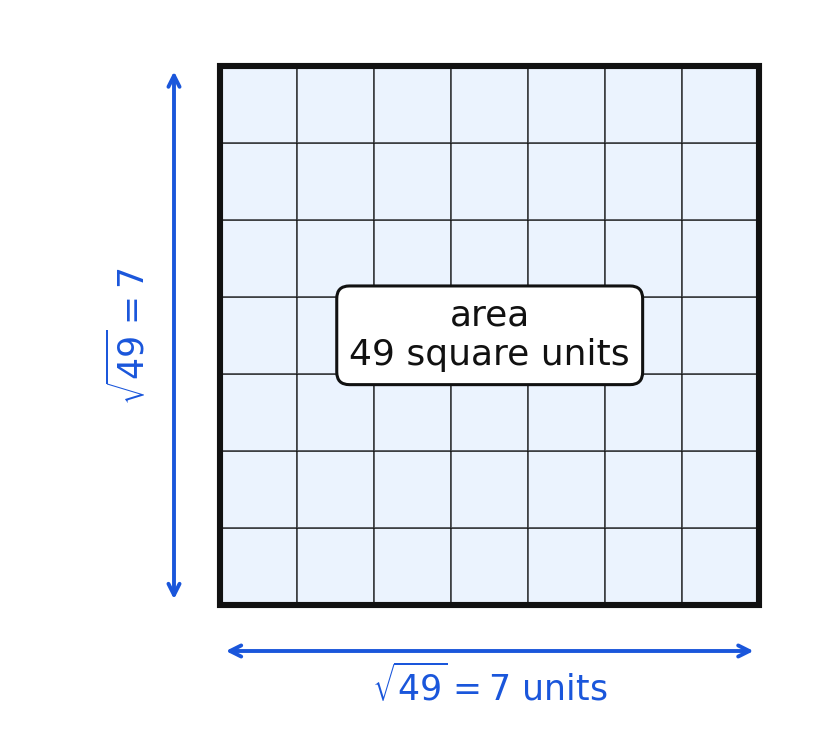
A square floor covers 49 square units. What is the length of one side? You need the whole number that, multiplied by itself, gives 49. That number is 7, since .
The square root of a number is a number that, multiplied by itself, gives that number. We write it with a radical sign:
The number tucked under the radical sign is called the radicand. Read as "the square root of forty-nine." Here 49 is the radicand and 7 is the square root.
Why "positive"
In Grade 7 you take the positive square root, which is the positive number whose square is the radicand. This is the value the radical symbol reports, and it is the only value asked for on this standard.
The reason is not a technicality — it is the picture. A square root answers "how long is the side?", and a side length is a distance. Distances are positive. There is no square with a side of feet.
One special case: , because . Zero is its own square root, and zero is the only number for which that is true besides 1, since gives .
Finding a square root of a perfect square
If the radicand is one of the perfect squares from 0 to 400, its square root is a whole number, and you find it by reading the table from Lesson 3.1 in reverse.
If you do not remember an entry, work up the list. For : is too small, hits it exactly. So .
A useful narrowing trick for the larger radicands: check the hundreds first. Anything from 100 up to 400 has a square root somewhere from 10 to 20, so you only ever have eleven candidates to consider.
Do not halve. The most common wrong answer for is 18. Halving reverses multiplying by 2; it does not reverse squaring. Ask "what times itself is 36?" and the answer is 6.
When the radicand is not a perfect square
Sometimes the number under the radical is not on the list. You will not compute a decimal for it in this course, but you can say a great deal about it using its neighbors.
Take . Locate 30 between consecutive perfect squares:
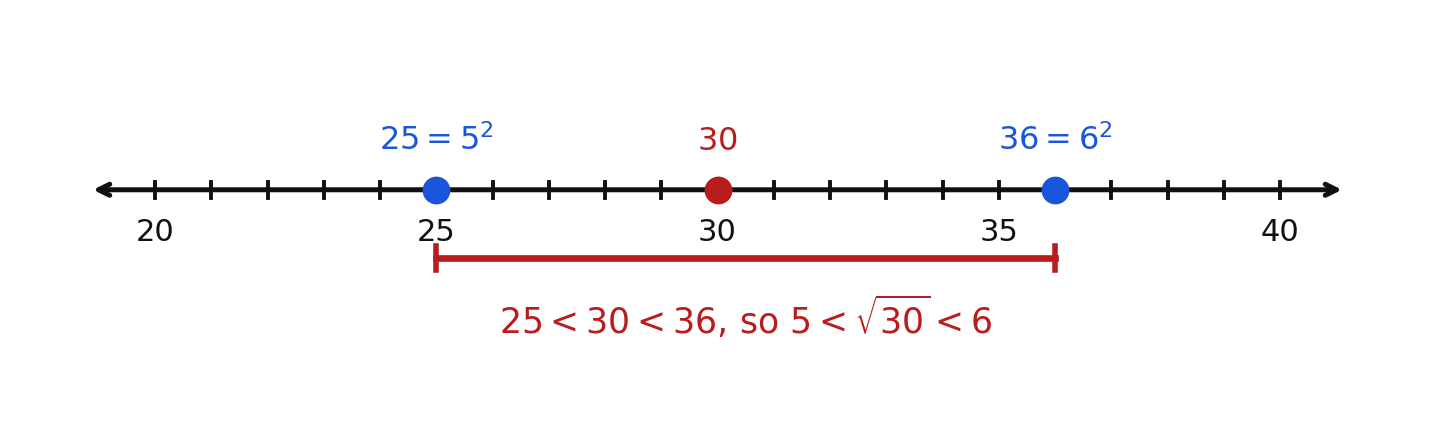
Squaring preserves order for positive numbers: a bigger side always builds a bigger square. So taking square roots preserves order too, and
That tells you is a number between 5 and 6, so it is not a whole number at all. Reasoning like this is enough. You are never asked for a decimal value of a root that is not perfect.
Worked examples
Example 1 — A basic square root
Find .
Ask: what positive number times itself is 81? Since :
Answer:
Example 2 — A larger radicand
Find .
The radicand is between 100 and 400, so the root is between 10 and 20. Test upward: , too small. , exact.
Answer:
Example 3 — Square root from an area
A square rug covers 121 square feet. How long is each side?
Side length is the positive square root of the area.
Answer: feet
Example 4 — Ordering square roots
Order , , , from least to greatest.
Evaluate each first: , , , . Ordering the values :
Answer: , , ,
Example 5 — Reasoning about a non-perfect square
Between which two consecutive whole numbers does lie?
Find the perfect-square neighbors of 115. and , and . Taking square roots across the inequality:
Answer: Between and
Guided practice
- Find .
- Find .
- Find and .
- Find .
- A square has an area of 100 square centimeters. How long is each side?
- Between which two consecutive whole numbers does lie?
Independent practice
- Evaluate: a) b) c) d)
- Evaluate: a) b) c) d)
- Evaluate: a) b) c) d)
- Order from least to greatest: , , , .
- Between which two consecutive whole numbers does lie? Name the two perfect squares you used.
- Between which two consecutive whole numbers does lie? Name the two perfect squares you used.
- True or false, with a reason: .
- Explain why and .
- Application. A square rug covers 225 square feet of floor. Find the length of one side, then find how much braided trim it would take to go all the way around the rug.
- Reasoning. Without finding any decimal, explain how you know that is between 13 and 14.
Exit ticket 3.2
- Evaluate and .
- A square patio has an area of 196 square feet. How long is each side?
- Between which two consecutive whole numbers does lie?
- In your own words, what does the symbol ask you to find?
Lesson 3.3 — How Square Roots and Perfect Squares Undo Each Other
Two directions along the same road
You have now traveled the same road in both directions. Squaring takes a side length and returns an area. Taking the positive square root takes an area and returns the side length.
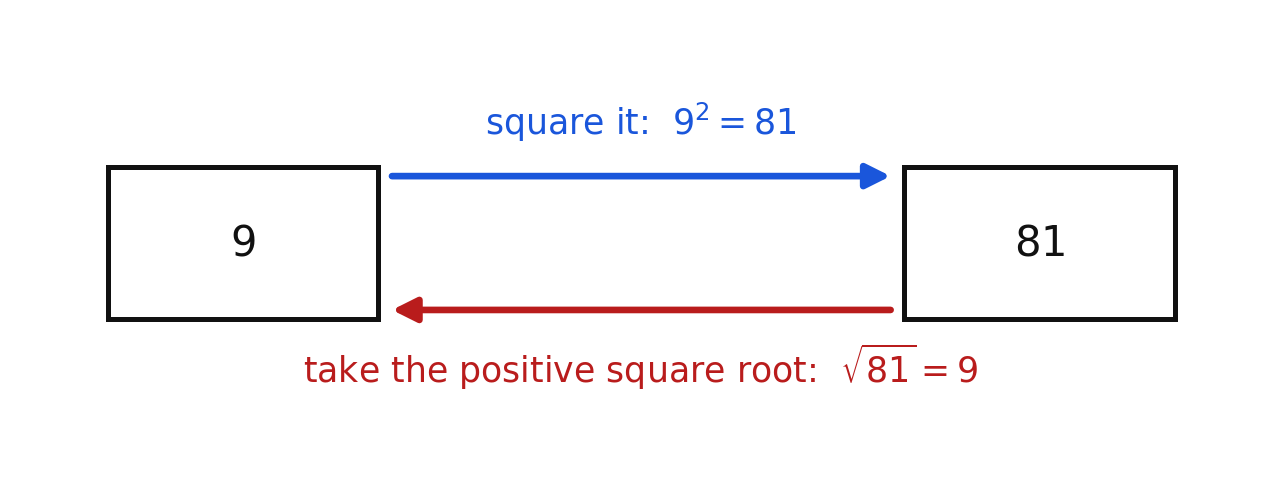
Operations that undo each other are called inverse operations. You already know two pairs of them: addition and subtraction, multiplication and division. Squaring and taking the positive square root are a third pair, with one condition attached — you stay with positive numbers and zero, which is exactly where this standard lives.
Being inverses means each one returns you to your starting number:
So for any whole number from 0 to 20,
You can evaluate an expression like in a single glance. The two operations cancel, so the answer is 15 — no need to compute 225 first and then hunt back down the table for its root. Recognizing that shortcut is describing the relationship between square roots and perfect squares.
Perfect squares are exactly the numbers with whole-number roots
The inverse relationship also gives a clean definition of the list from Lesson 3.1. A number from 0 to 400 is a perfect square precisely when its positive square root is a whole number.
- is a perfect square, and , a whole number.
- is not a perfect square, and falls between 13 and 14, so it is not a whole number.
The two ideas are two views of one fact. "Perfect square" describes the number you land on; "square root" describes the trip back.
Checking your own work
Because these operations are inverses, every square root answer carries its own check built in: square your answer and see whether you get the radicand back.
This is worth doing every single time, and it is the reason no calculator is needed. The check costs one multiplication and catches the halving error, the off-by-one error, and a misread table entry all at once.
The same idea solves side-length problems. If a square has area 64 square inches and stands for its side length, then . Undo the squaring by taking the positive square root of both sides: inches. Since is a length, the positive root is the only answer that makes sense.
Worked examples
Example 1 — Undoing in both directions
Evaluate and then .
Squaring took 12 to 144; the square root brought 144 back to 12.
Answer: and
Example 2 — Canceling the operations
Evaluate .
Squaring and taking the positive square root are inverse operations, so they undo each other and return the starting number. (If you prefer to see it: and .)
Answer:
Example 3 — The other order
Evaluate .
Work inside out. , and then . The two operations returned the radicand.
Answer:
Example 4 — Solving for a side length
A square window has an area of 361 square inches. Find its side length, and check.
Let be the side length, so . Take the positive square root of both sides:
Check: . A side length must be positive, so 19 inches is the answer.
Answer: inches
Example 5 — Filling in both directions
Fill in the blanks: and .
The first blank asks for the number whose positive square root is 14, which is . The second asks for the number whose square is 196, which is .
Answer: and
Guided practice
- Complete both: and .
- Complete both: and .
- Evaluate .
- Evaluate .
- A square has an area of 64 square inches. Find its side length, then check your answer by squaring it.
- Complete the sentence: squaring a positive number and taking its positive square root are ____________ operations.
Independent practice
- Evaluate: a) b) c) d)
- Copy and complete the table for , , , and : one column for and one for . What do you notice about the last column?
- A square has an area of 289 square meters. Find its side length and check by squaring.
- Fill in both blanks: and .
- Fill in both blanks: and .
- If and is the positive side length of a square, what is ?
- Explain how you can evaluate without ever multiplying .
- Order from least to greatest: , , , .
- Application. A square patch of turf covers 324 square feet. The groundskeeper wants to run edging all the way around it. How many feet of edging is needed?
- Reasoning. Dana says that since , the way to undo squaring is to take half, so . Explain what is wrong and give the correct value with a check.
Exit ticket 3.3
- Evaluate and .
- Evaluate .
- A square has an area of 400 square centimeters. How long is each side?
- In your own words, describe how square roots and perfect squares undo each other. Use an example.
Chapter 3 Review
Vocabulary. exponent · base · perfect square · area · square root · radical sign · radicand · positive square root · consecutive perfect squares · inverse operations
Part A — Perfect squares from 0 to 400 (7.NS.3a, 7.NS.3b)
- Evaluate: a) b) c) d)
- List every perfect square between 200 and 400.
- Which of these are perfect squares: 45, 49, 81, 96, 196, 300?
- Between which two consecutive perfect squares does 275 lie?
- A square tile measures 13 centimeters on each side. Find its area.
Part B — Positive square roots (7.NS.3a)
- Evaluate: a) b) c) d)
- Evaluate: a) b) c) d)
- Order from least to greatest: , , , .
- A square garden has an area of 144 square feet. How long is each side?
- Between which two consecutive whole numbers does lie?
- Between which two consecutive whole numbers does lie?
Part C — The inverse relationship (7.NS.3b)
- Evaluate .
- Evaluate .
- Fill in both blanks: and .
- If and is a positive side length, what is ?
- Explain how to check that without a calculator.
Part D — Mixed application and reasoning
- Application. A square patio covers 289 square feet. Find the side length and the distance all the way around the patio.
- Application. A square mural with an area of 100 square feet is repainted at a larger size with an area of 400 square feet. Find both side lengths and describe how the side length changed.
- Reasoning. A square has an area of 49 square units. Explain why there is exactly one acceptable answer for the side length.
- Reasoning. Explain how you know is not a whole number, and name the two consecutive whole numbers it lies between.
Standards coverage check — Chapter 3
| Knowledge and Skill | Where it is taught | Where it is practiced |
|---|---|---|
| 7.NS.3a — determine the positive square root of a perfect square from 0 to 400 | 3.2; supported by the perfect-square list built in 3.1 and the check in 3.3 | 21–40; 45, 47, 49–52, 55, 57–59; Review 66–71, 72–75, 77–78 |
| 7.NS.3b — describe the relationship between square roots and perfect squares | 3.1 (area of a square, the full list, neighbors), 3.3 (inverse operations) | 1–20; 26, 31–32, 34, 36, 39–40; 41–60; Review 61–65, 70–71, 72–76, 79–80 |
Answer keys for every set in this chapter are in Appendix A.