Chapter 2 — Comparing and Ordering Rational Numbers
Standard: 7.NS.2 — The student will reason and use multiple strategies to compare and order rational numbers.
By the end of this chapter you will be able to:
- Recognize a rational number and write it as an integer, a proper or improper fraction, a mixed number, a decimal, or a percent (7.NS.2a)
- Use benchmarks and equivalency to compare two rational numbers, positive or negative (7.NS.2a)
- Compare rational numbers on a number line using the symbols , , and (7.NS.2a)
- Order a set of no more than four rational numbers in ascending or descending order (7.NS.2a)
- Justify a comparison or an ordering out loud, in writing, or with a model (7.NS.2a)
Lessons: 2.1 What Makes a Number Rational · 2.2 Comparing with Benchmarks and Equivalency · 2.3 Comparing on a Number Line with , , and · 2.4 Ordering a Set of Rational Numbers
Calculator note. This chapter is assessed without a calculator. Every problem here is built so that benchmarks, common denominators, and short pencil division are enough. If you find yourself reaching for a calculator, that is a signal to look for the easier strategy you missed.
Lesson 2.1 — What Makes a Number Rational
One family, many outfits
In Grade 6 you compared integers. This year the number line gets crowded: fractions, mixed numbers, decimals, and percents all move in. The good news is that they are not four unrelated kinds of number. They are four ways of writing the same kind of number.
A rational number is any number that can be written as a fraction , where and are integers and . The word rational comes from ratio, not from "reasonable" — a rational number is a number expressible as a ratio of two integers.
That single definition is wider than it first looks:
- Integers are rational. , and . Every integer is a fraction with denominator .
- Proper fractions are rational: , . A proper fraction has a numerator smaller in size than its denominator, so its value sits between and .
- Improper fractions are rational: . An improper fraction has a numerator at least as large as its denominator, so it names a value of or more (or or less, if negative).
- Mixed numbers are rational: means , which is .
- Terminating decimals are rational: .
- Percents are rational: .
A number that cannot be written as a ratio of integers is not rational. A decimal like , whose digits go on forever without ever settling into a repeating block, is such a number. You will meet those in Grade 8. Everything in this chapter is rational.
Reading the forms
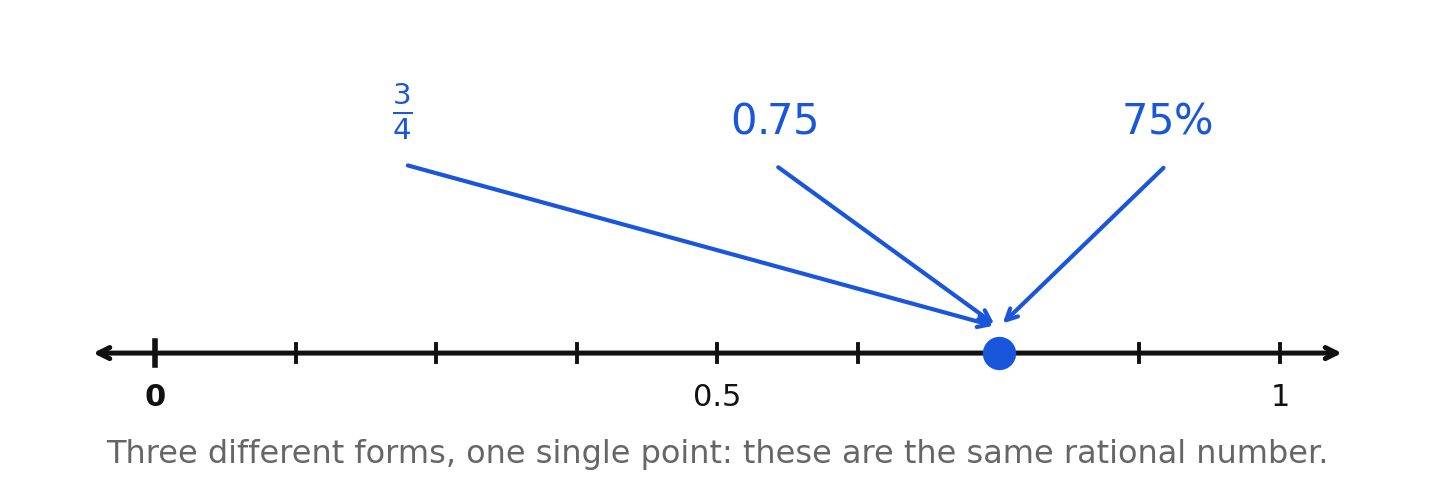
Look carefully at that picture. There is exactly one point marked. The labels , , and are three names for it, the way a person can be Katherine, Kate, and Ms. Alvarez without being three people. Equivalent forms are different-looking expressions with the same value.
This is the central idea of the chapter. You almost never compare a fraction to a decimal directly. You rewrite one of them so both wear the same outfit, and then the comparison is easy.
Moving between forms
Fraction to decimal. Divide the numerator by the denominator. .
Some divisions never end. , written , where the bar marks the digit that repeats forever. A repeating decimal is still rational — it still came from a ratio of integers.
Decimal to fraction. Say the decimal out loud and write what you hear. is "four tenths," so . is "one hundred twenty-five thousandths," so . Then simplify.
Anything to percent. A percent means "per hundred," so means . To go from a decimal to a percent, multiply by — which shifts the digits two places left. . To go from a percent to a decimal, divide by : .
Mixed number to improper fraction. Multiply the whole part by the denominator, add the numerator, keep the denominator. .
For a negative mixed number, the sign belongs to the whole quantity, not just the whole part: means the opposite of , so it equals . Students often lose the sign on the fraction part here, and it is worth slowing down for.
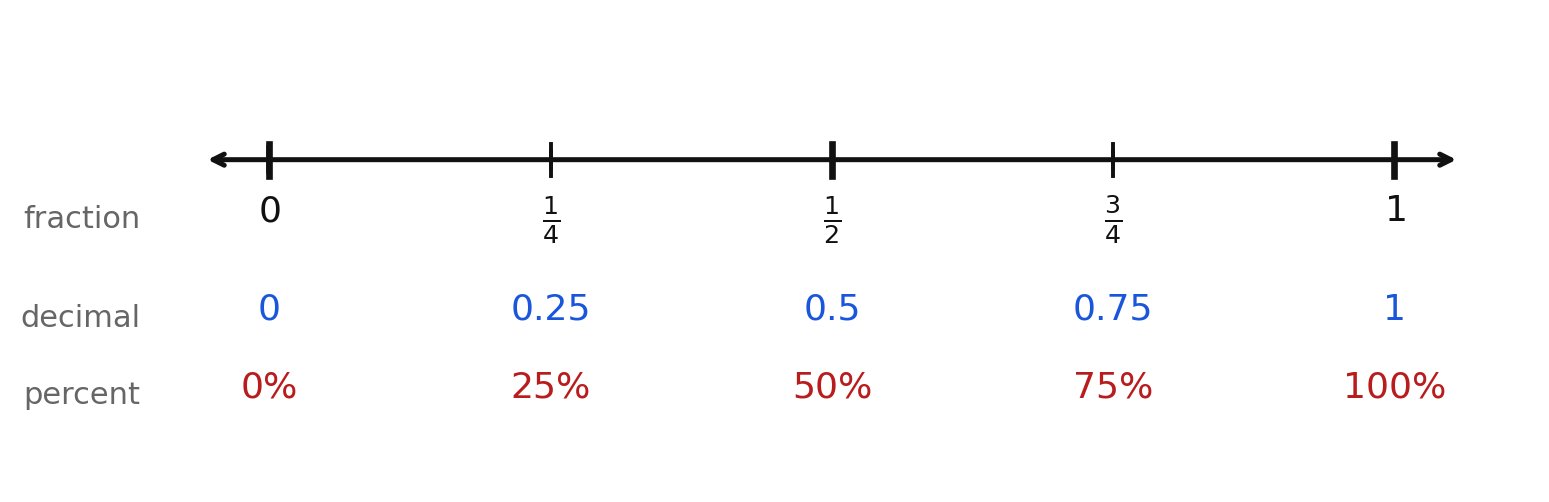
The conversions worth memorizing
You will do this so often that a handful of conversions should become automatic. Knowing these lets you compare in your head instead of on paper.
| Fraction | Decimal | Percent |
|---|---|---|
Worked examples
Example 1 — Writing an integer as a fraction
Show that is a rational number.
A rational number is a ratio of two integers with a nonzero denominator. Put over .
Both and are integers, and .
Answer: , so it is rational.
Example 2 — Fraction to decimal to percent
Write as a decimal and as a percent.
Twenty divides into one hundred evenly, so build an equivalent fraction with denominator instead of dividing.
And is per hundred.
Answer: and
Example 3 — Decimal to fraction in simplest form
Write as a fraction in simplest form.
Read it: three hundred seventy-five thousandths, negative.
Divide numerator and denominator by :
Answer:
Example 4 — Negative mixed number, three ways
Write as an improper fraction and as a decimal.
First convert the size, then attach the sign to the whole thing.
Answer: and
Example 5 — Percent greater than 100
Write as a decimal and as a fraction in simplest form.
Percent means per hundred, so . Dividing by gives the decimal.
A percent above is simply a number greater than . There is nothing illegal about it.
Answer: and
Guided practice
- Write each number as a fraction of two integers. a) b) c) d)
- Write as a decimal and as a percent.
- Write as a fraction in simplest form and as a decimal.
- Write as an improper fraction and as a decimal.
- Is a rational number? Explain how you know.
Independent practice
- Write each fraction as a decimal: a) b) c) d)
- Write each decimal as a fraction in simplest form: a) b) c) d)
- Write each as a percent: a) b) c) d)
- Write each percent as a decimal and as a fraction in simplest form: a) b) c)
- Which of these are rational numbers: , , , (the digits never end and never repeat), ?
- Application. A set of plans calls for a board inch thick. The lumber at the store is labeled inch thick. Is that the same thickness or a different one? Show the conversion that settles it.
- Reasoning. Explain why every integer is a rational number, using as your example. Then explain why the reverse is not true.
Exit ticket 2.1
- Write as a fraction in simplest form and as a percent.
- Write as an improper fraction and as a decimal.
- Write as a decimal and as a percent.
- Explain in a sentence why is a rational number.
Lesson 2.2 — Comparing with Benchmarks and Equivalency
Two strategies, one goal
To compare two rational numbers you need them in a form where the comparison is obvious. There are two reliable ways to get there.
Strategy 1: benchmarks. A benchmark is a familiar reference value — usually , , or — that you compare both numbers to. If one number is below the benchmark and the other is above it, you are done without any exact arithmetic.
Strategy 2: equivalency. Rewrite both numbers in the same form: a common denominator, or both as decimals, or both as percents. Then compare digit by digit or numerator by numerator.
Benchmarks are faster; equivalency always works. Skilled students try the benchmark first and fall back to equivalency when the two numbers land on the same side.
Using one half as a benchmark
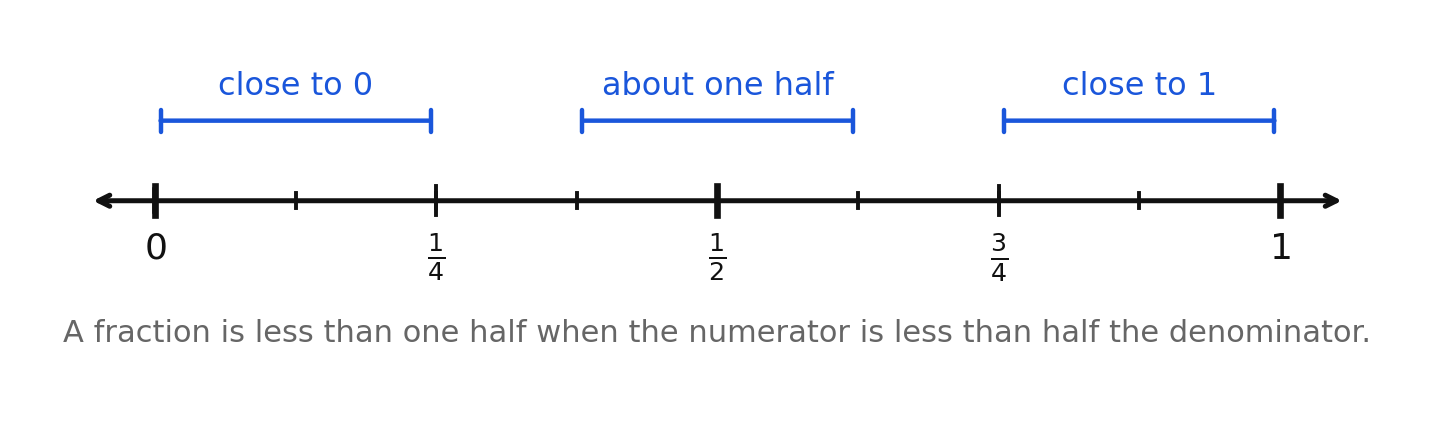
Here is the test, and it is worth saying out loud until it is automatic:
A fraction is greater than when its numerator is more than half its denominator, less than when its numerator is less than half its denominator, and equal when the numerator is exactly half.
Try . Half of is . The numerator is more than , so .
Try . Half of is , and , so .
Now put those together with a second fraction. Comparing and by common denominator would mean working in ths — unpleasant with no calculator. But is below one half and is above it (half of is , and ), so with no multiplication at all.
Using equivalency
When both numbers sit on the same side of every benchmark, rewrite them.
Common denominator. Compare and . The least common denominator of and is .
Same-size pieces now, so more pieces means more. , therefore .
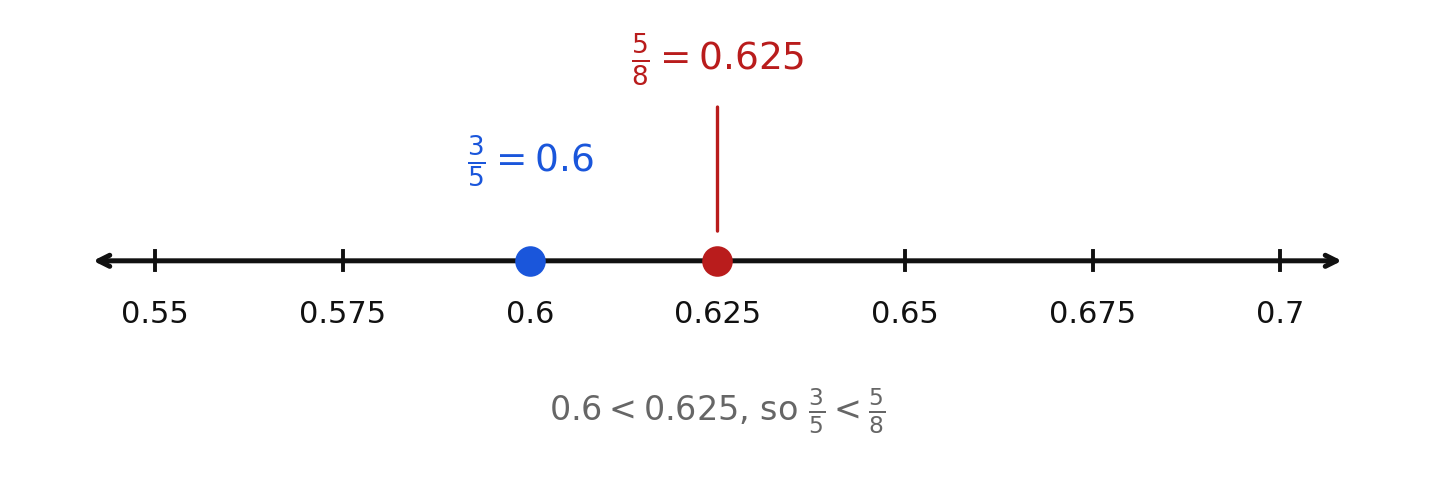
Common form. Compare and . Convert the fraction: . Line up the place values and compare left to right.
The tenths place decides it: , so . Writing as is the small move that keeps this honest — comparing to can tempt you into thinking the longer decimal is the larger number, which is exactly backwards.
Comparing negatives
The rules do not change, but the direction does. On the negative side of zero, the number closer to zero is greater. So among negatives, the one with the smaller distance from zero wins.
Compare and . Convert: . Which is closer to zero? is closer than , so
A useful habit: compare the two numbers as if they were positive, then flip the result. Since , we get .
Worked examples
Example 1 — Benchmark comparison
Which is greater, or ?
Half of is , and , so . Half of is , and , so .
One is below the benchmark and one is above it.
Answer: is greater.
Example 2 — Common denominator
Compare and using , , or .
Both are above , so the benchmark does not settle it. The least common denominator of and is .
Answer:
Example 3 — Fraction against a percent
Compare and .
Put both in percent form. .
Answer:
Example 4 — Two negatives
Compare and .
Ignore the signs for a moment and use the common denominator :
So , which means is farther from zero. On the negative side, farther from zero is less.
Answer:
Example 5 — Deciding they are equal
Compare and .
They are the same number in different forms, so the correct symbol is . Not every comparison ends in or , and noticing equality is part of the skill.
Answer:
Guided practice
- Is less than, greater than, or equal to ? Show the halving test.
- Is closest to , , or ?
- Compare and using a common denominator.
- Compare and .
- Compare and .
Independent practice
- Use the one-half benchmark. For each fraction, state whether it is greater than or less than : a) b) c) d)
- Compare using a common denominator. Fill in , , or : a) b) c)
- Compare by converting to decimals. Fill in , , or : a) b) c)
- Fill in , , or : a) b) c)
- Which is greater, or ? Show the work that proves it.
- Application. In Ms. Reyes' class, of the students walk to school. In Mr. Kim's class, of the students walk. Which class has the greater share of walkers? Justify your answer in writing.
- Reasoning. Explain how the benchmark lets you compare and without ever finding a common denominator.
Exit ticket 2.2
- Is greater than or less than ?
- Fill in , , or :
- Fill in , , or :
- Explain in writing how you know that without dividing.
Lesson 2.3 — Comparing on a Number Line with , , and
The rule that never fails
Every comparison in this chapter reduces to one fact about the number line, the same fact you used with integers in Grade 6:
The number farther to the right is greater. The number farther to the left is less.
What is new in Grade 7 is that the points between the integers are now in play.
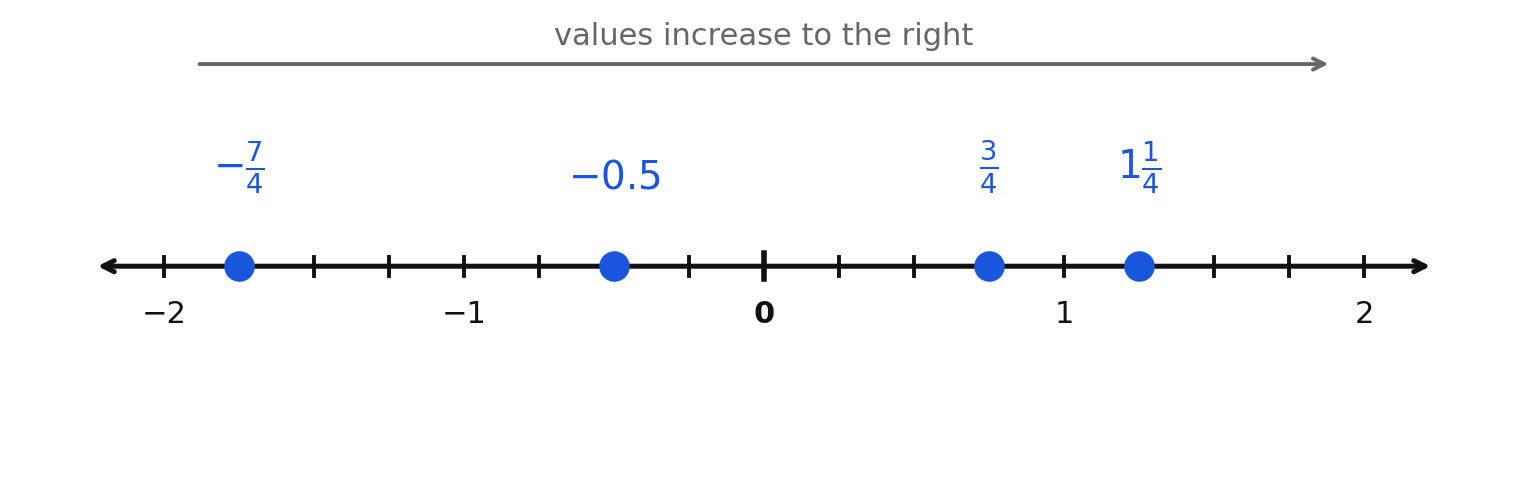
Read that line left to right: , then , then , then . Every one of these is true, and you can see each one:
Notice that is , which lands three quarter-marks past on the way to . Placing a value correctly is itself a check on your conversion: if you cannot say where it goes, you do not yet know how big it is.
Placing a number before comparing it
To locate a rational number on a number line:
- Decide the sign. Negative means left of zero.
- Find the two integers it falls between. For , that is and .
- Divide that unit into equal parts matching the denominator or decimal place, and count.
- Label the point with the original form, so your picture answers the question that was asked.
The three symbols
| Symbol | Meaning | Example | Read as |
|---|---|---|---|
| is less than | negative three fourths is less than negative seven tenths | ||
| is greater than | five eighths is greater than six tenths | ||
| is equal to | seventy-five hundredths equals seventy-five percent |
The open end of the symbol always faces the greater number. Because of that, every comparison can be written two ways: and say the same thing. Which one you write depends only on which number you started with.
The trap: longer is not larger
With whole numbers, more digits means a bigger number. With decimals, that habit becomes a bug.
The second one has more digits, but is closer to than is. Line up the place values:
In the tenths place, , so , so is farther from zero. On the negative side that makes it less: .
Padding with zeros so both decimals have the same number of places costs you two seconds and prevents this mistake entirely. And padding never changes a value: , , and all name the identical point, because five tenths, fifty hundredths, and five hundred thousandths are the same amount.
Worked examples
Example 1 — A fraction against a decimal
Fill in , , or : , then locate both on a number line.
. Padding, compare and . In the tenths place .
On a line marked in thousandths between and , the point sits to the left of .
Answer:
Example 2 — Two negative decimals
Compare and .
Pad: and . Ignoring signs, , so is farther from zero and therefore farther left.
Answer:
Example 3 — A negative fraction against a negative decimal
Compare and .
. Pad: and . Since , the value is closer to zero, so it lies to the right.
Answer:
Example 4 — Recognizing equality across forms
Compare and .
, so . They are the same point.
Answer:
Example 5 — Writing a comparison both ways
Write two true statements comparing and .
, which is negative, and is positive. Every negative number is less than every positive number.
Answer: and
Guided practice
- Using the number line figure in this lesson, which is greater, or ? How does the picture show it?
- Which is farther to the right on a number line, or ?
- Fill in , , or :
- Fill in , , or :
- Rewrite using the symbol.
Independent practice
- Fill in , , or : a) b) c) d)
- Name a rational number that lies between and , and explain where it sits on the number line.
- Which is greater, or ? Explain what the number line shows.
- Rewrite each statement the other way: a) b)
- Which of these are false? Correct each false one: a) b) c)
- Application. On Tuesday the temperature changed by °C and on Wednesday by °C. Write a comparison using a symbol, and state which day's change was greater.
- Reasoning. Explain why , , and all occupy the same point on a number line, and why padding a decimal with zeros is safe.
Exit ticket 2.3
- Fill in , , or :
- Fill in , , or :
- Which is greater, or ?
- Explain how a number line decides a comparison between a negative fraction and a negative decimal.
Lesson 2.4 — Ordering a Set of Rational Numbers
From two numbers to four
Ordering means arranging a set of numbers by size. Ascending order runs from least to greatest; descending order runs from greatest to least. In this course you will order sets of no more than four numbers, which is small enough to do carefully and by hand.
The reliable procedure is the same every time:
- Convert everything to one common form. Decimals are usually easiest, because place-value comparison is fast. Pad so all decimals have the same number of places.
- Sort the negatives, then zero, then the positives. Every negative is less than every positive, so half the work is often free.
- Read the sorted list back in the original forms. The question asked about , so the answer says , not .
- Check the ends. Confirm that your first value really is the smallest and your last really is the largest.
Step 3 is the one students skip, and it costs points. Converting is your scratch work; the answer belongs in the language of the question.
Ordering with a model
A number line is more than a check — for many problems it is the fastest method, and it is one of the three ways the standard lets you justify an answer.
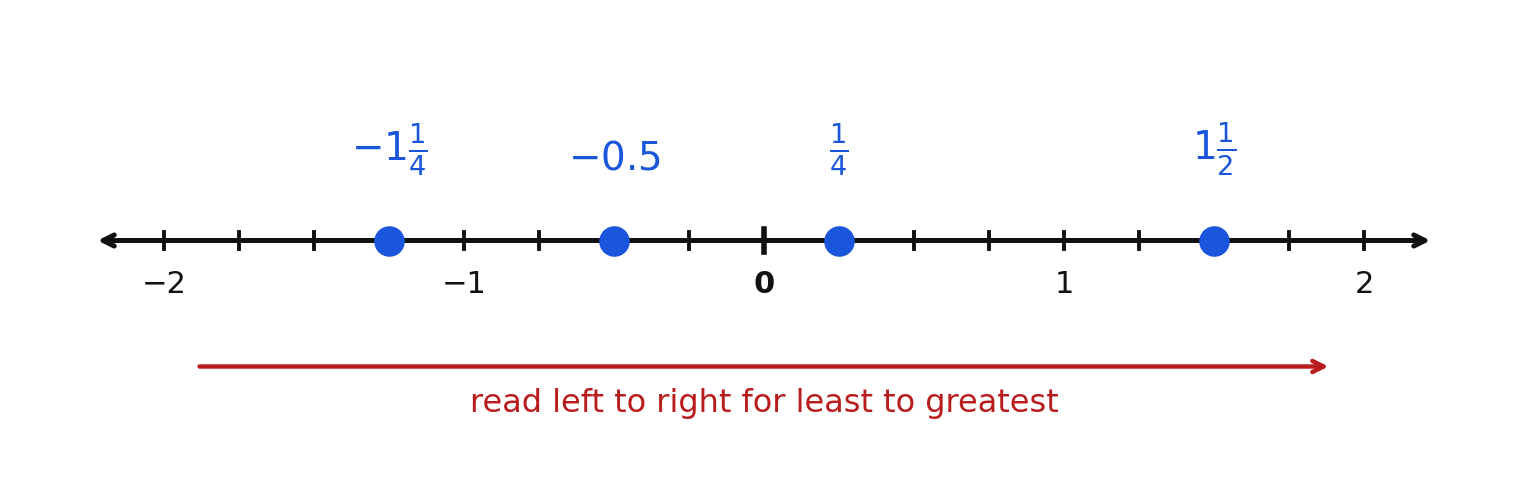
The set is plotted here as , , , and would be. Reading left to right gives ascending order; reading right to left gives descending order. No arithmetic is required once the points are placed — the picture is the argument.
Justifying your answer
The standard asks you to justify solutions orally, in writing, or with a model. A justification is not "I converted them." A justification names the strategy and shows the evidence:
and . Padding to thousandths, , because the two numbers agree in the tenths place and in the hundredths place. So .
That is a complete written justification: a conversion, a comparison of specific place values, and a conclusion.
A warning about negatives
The single most common ordering error is treating negatives as if larger digits mean a larger number. Consider , , and . A student who sorts writes , , and calls it ascending. But that list is descending: is the greatest of the three, because it is closest to zero. Correct ascending order is , , .
Whenever a set contains negatives, sort them by distance from zero and then reverse that part of the list.
Worked examples
Example 1 — Ascending with mixed forms
Order , , , from least to greatest.
Convert to decimals and pad to hundredths:
Sorted: , , , . Now translate back.
Answer: , , ,
Example 2 — Descending with negatives
Order , , , from greatest to least.
Convert: , , , . The positives are and , so leads. The negatives are and ; since , the value is farther from zero and therefore last.
Sorted descending: , , , .
Answer: , , ,
Example 3 — Four values close together
Order , , , from least to greatest.
Convert everything to thousandths:
Compare: Note that repeats forever, but the tenths place alone ( versus ) is not enough while the hundredths place ( versus ) settles it against .
Answer: , , ,
Example 4 — All negative, descending
Order , , , from greatest to least.
Convert: , , , . Pad to hundredths: , , , .
Distance from zero, least to greatest: , , , . The one closest to zero is the greatest, so reverse nothing — read that list as is and attach the signs.
Answer: , , ,
Example 5 — Ordering in context
Four packages weigh lb, lb, lb, and lb. List them from heaviest to lightest.
Every value starts with , so only the fraction part decides the order. Convert and pad to thousandths:
Descending: , , , .
Answer: lb, lb, lb, lb
Guided practice
- Order from least to greatest: , , , .
- Order from greatest to least: , , , .
- Order from least to greatest: , , , .
- Order from greatest to least: , , , .
- Take the four numbers from item 50 and describe where each one sits on a number line from to marked in fourths. Then read them off left to right.
Independent practice
- Order from least to greatest: , , , .
- Order from greatest to least: , , , .
- Order from least to greatest: , , , .
- Order from greatest to least: , , , .
- Application. Four days' temperature change from normal was °C, °C, °C, and °C. Order them from coldest to warmest.
- Application. Four bags of flour weigh lb, lb, lb, and lb. Order them from heaviest to lightest, and explain in writing which single place value did the most work in your comparison.
- Reasoning. A student ordered , , and as , , and labeled it "ascending." Explain the mistake and give the correct ascending order.
Exit ticket 2.4
- Order from least to greatest: , , , .
- Order from greatest to least: , , , .
- Order from least to greatest: , , , .
- Write a justification for your ordering in item 63. Name the strategy you used and show the evidence.
Chapter 2 Review
Vocabulary. rational number · proper fraction · improper fraction · mixed number · percent · repeating decimal · equivalent · benchmark · ordering · ascending order · descending order
Part A — Forms of a rational number (7.NS.2a)
- Write each as a decimal: a) b) c) d)
- Write each as a percent: a) b) c)
- Write each percent as a fraction in simplest form: a) b) c)
- Write as a fraction in simplest form.
- Which of these are rational numbers: , , , (never ends, never repeats)?
- Write as an improper fraction and as a decimal.
Part B — Comparing with benchmarks, equivalency, and symbols (7.NS.2a)
- Fill in , , or : a) b) c) d)
- Greater than or less than ? a) b) c) d)
- Compare and using a common denominator. Show the equivalent fractions.
- Which is greater, or ?
- Rewrite using the symbol.
- Name a rational number between and , and show why it lies between them.
Part C — Ordering a set of four (7.NS.2a)
- Order from least to greatest: , , , .
- Order from greatest to least: , , , .
- Order from least to greatest: , , , .
- Order from greatest to least: , , , .
Part D — Mixed application and reasoning
- Application. Four long jumps measured m, m, m, and m. Order them from longest to shortest.
- Application. A checking account showed four changes in one week: , , , and . Order them from least to greatest, then state which change hurt the balance most and explain why that is not the same as the least value being "smallest in size."
- Reasoning. A student says because . Explain the error and write the correct comparison.
- Justify in writing. Describe two different strategies for comparing and , carry each one out, and confirm that they agree.
- Justify with a model. Describe a number line from to marked in fourths, and use it to place , , , and . Then state the ascending order and explain how the picture proves it.
Standards coverage check — Chapter 2
| Knowledge and Skill | Where it is taught | Where it is practiced |
|---|---|---|
| 7.NS.2a — recognize rational numbers and write them as integers, proper and improper fractions, mixed numbers, decimals, and percents (positive and negative) | 2.1 | Items 1–16; Review Part A, items 65–70 |
| 7.NS.2a — compare using multiple strategies: benchmarks and equivalency | 2.2 | Items 17–32; Review Part B, items 71–74, 84 |
| 7.NS.2a — compare using a number line and the symbols , , | 2.3 | Items 33–48; Review Part B, items 71, 74–76 |
| 7.NS.2a — order a set of no more than four rational numbers, ascending or descending | 2.4 | Items 49–63; Review Part C, items 77–80; items 81, 82 |
| 7.NS.2a — justify solutions orally, in writing, or with a model | 2.2, 2.3, 2.4 | Items 27, 28, 32, 39, 40, 44, 48, 53, 59, 60, 64; Review items 82–85 |
Decimals throughout this chapter are limited to the thousandths place, and every ordering set contains no more than four numbers, as the standard requires.
Answer keys for every set in this chapter are in Appendix A.