Chapter 1 — Powers of Ten and Scientific Notation
Standard: 7.NS.1 — The student will investigate and describe the concept of exponents for powers of ten and compare and order numbers greater than zero written in scientific notation.
By the end of this chapter you will be able to:
- Investigate and describe powers of 10 with negative exponents by examining patterns (7.NS.1a)
- Represent a power of 10 with a negative exponent in fraction form and in decimal form (7.NS.1b)
- Convert between numbers greater than 0 written in scientific notation and the same numbers written as decimals (7.NS.1c)
- Compare and order no more than four numbers greater than 0 written in scientific notation, in ascending or descending order (7.NS.1d)
Lessons: 1.1 Powers of 10 with Negative Exponents · 1.2 Fraction Form and Decimal Form · 1.3 Scientific Notation and Decimal Form · 1.4 Comparing and Ordering Numbers in Scientific Notation
Calculator note. Everything in this chapter is designed for pencil and paper. Powers of ten follow such a clean pattern that a calculator would actually get in your way — it would hand you an answer without showing you the structure that produces it. Work these by hand.
Lesson 1.1 — Powers of 10 with Negative Exponents
What an exponent counts
An exponent tells you how many times to use a base as a repeated factor. In , the base is and the exponent is , so
A number written this way is a power of ten. For a positive exponent there is a shortcut worth noticing: is a followed by three zeros, is a followed by five zeros. The exponent counts the zeros.
That shortcut is handy, but it will not stretch to cover what comes next. "Use as a factor negative two times" is not a sentence that means anything. So instead of forcing the repeated-factor idea to do work it cannot do, we will find the pattern in the powers we already know and follow that pattern downward. That is what mathematicians do when they extend an idea: they keep the pattern and let it tell them what the new symbols must mean.
Following the pattern down
Start at the top and walk down one row at a time.
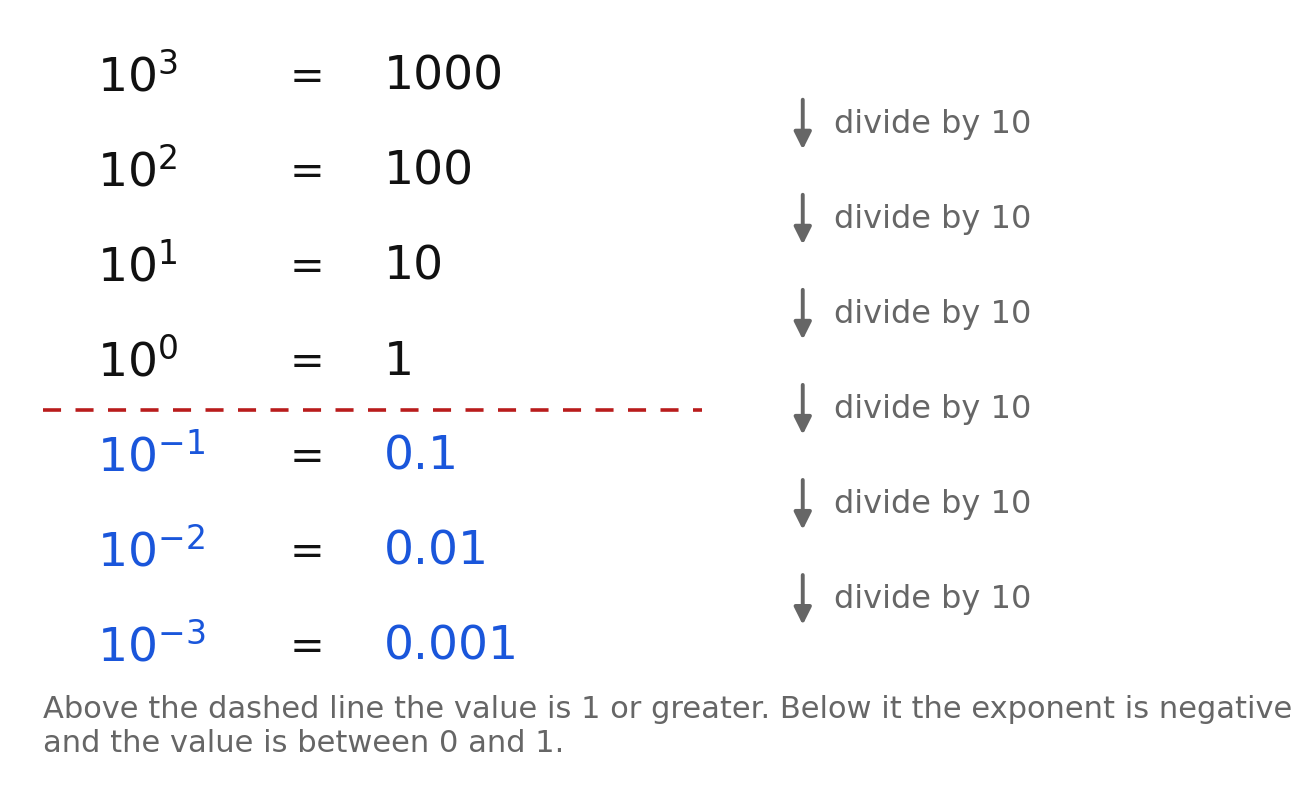
Read the left column from top to bottom and the exponent drops by one each time: , , , , , , . Read the right column and each value is the one above it divided by : , , , , and then , , .
That gives us the rule for the whole chapter, and it is one rule, not two:
Each time the exponent decreases by 1, the value is divided by 10. Each time the exponent increases by 1, the value is multiplied by 10.
Two consequences fall out of it immediately.
Why . Going from to means dropping the exponent by one, so it means dividing by . And . No special case, no memorized exception — just the pattern doing what the pattern does.
What a negative exponent means. Going from to means dividing by again: . One more step gives , which is . A negative exponent means you have divided by 10 that many times.
A negative exponent does not make a negative number. , which is a positive number — a small one, but positive. The negative sign is a direction on the exponent, telling you to divide instead of multiply. Every power of ten is greater than zero, no matter what the exponent is.
Negative powers of ten in the place-value chart
You have been using negative powers of ten since fourth grade without calling them that. Look at a place-value chart with a power of ten written over each column.
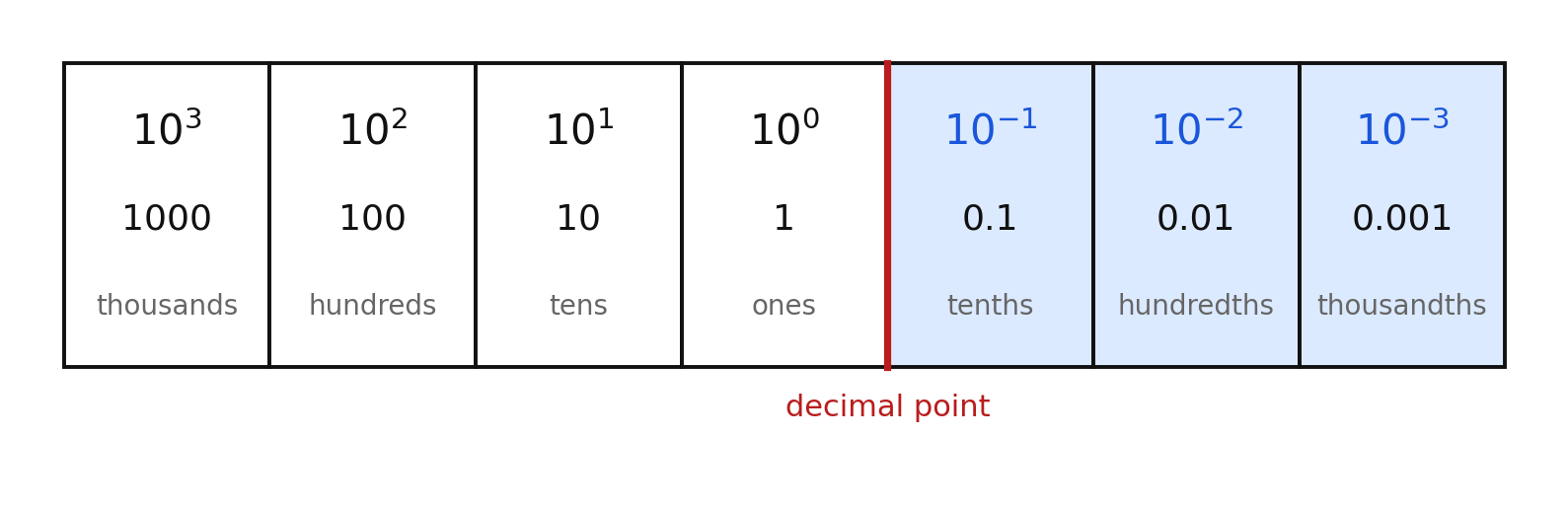
The columns to the left of the decimal point are , , , . The columns to the right are , , — tenths, hundredths, thousandths. The decimal point is not the center of the chart; the ones place, , is. The decimal point just marks where the whole-number part ends.
This is why the exponent is such a reliable guide. In , the exponent says the sits in the fourth place after the decimal point: . Count the places, not the zeros, and you will never miscount.
Worked examples
Example 1 — Continuing the pattern downward
The list below is missing its last two entries. Fill them in.
Each step down divides by .
, so .
, so .
Answer: and
Example 2 — Evaluating a negative power
Write as a decimal.
The exponent is , so the lands in the fourth decimal place. Write the decimal point, then three zeros as placeholders, then the .
Check by dividing down from : .
Answer:
Example 3 — Reading the pattern backward
Which power of ten equals ?
Count the decimal places to reach the : — the is in the fifth place. The exponent is the negative of that count.
Answer:
Example 4 — Naming the operation between two rows
What single operation takes you from to ?
The exponent decreased by , so the value was divided by . Confirm with the decimals: .
Answer: Divide by .
Example 5 — Comparing two negative powers
Which is greater, or ?
Write both as decimals: and . Both are positive, and has its first nonzero digit in a higher place.
The more negative the exponent, the more times you have divided by , and the smaller the result.
Answer: is greater.
Guided practice
- Complete each value: , , , .
- Continue the same pattern two more steps: and .
- What operation moves you from to ?
- Write as a decimal.
- Which power of ten equals ?
Independent practice
- Evaluate each as a decimal: a) b) c) d)
- Write the power of ten for each decimal: a) b) c)
- Copy and complete:
- Order from least to greatest: , , , .
- In the decimal form of , how many zeros stand between the decimal point and the ?
- Application. One sheet of a certain printer paper is about meters thick. Write that thickness as a decimal, then find how many sheets you would have to stack to reach a height of meter. Explain how the exponent gave you the second answer without any long division.
- Reasoning. Jonah says must be a negative number because the exponent is negative. Explain what he is confusing, and use the pattern from this lesson to show what really equals.
Exit ticket 1.1
- Evaluate .
- Which power of ten equals ?
- What happens to the value of a power of ten each time the exponent decreases by ?
- Explain why , using the pattern rather than a memorized rule.
Lesson 1.2 — Fraction Form and Decimal Form
Dividing by 10 is the same as taking a tenth
In Lesson 1.1 you built negative powers of ten by dividing repeatedly by . Dividing by and multiplying by are the same operation, so the same powers can be written as fractions:
That is the general fact, and it is worth stating on its own line:
In words: a power of ten with a negative exponent equals divided by the same power of ten with a positive exponent. This is the fraction form, sometimes called the unit-fraction form, because the numerator is always .
Three ways to write the same number
Every negative power of ten has an exponent form, a fraction form, and a decimal form. All three name the same number.
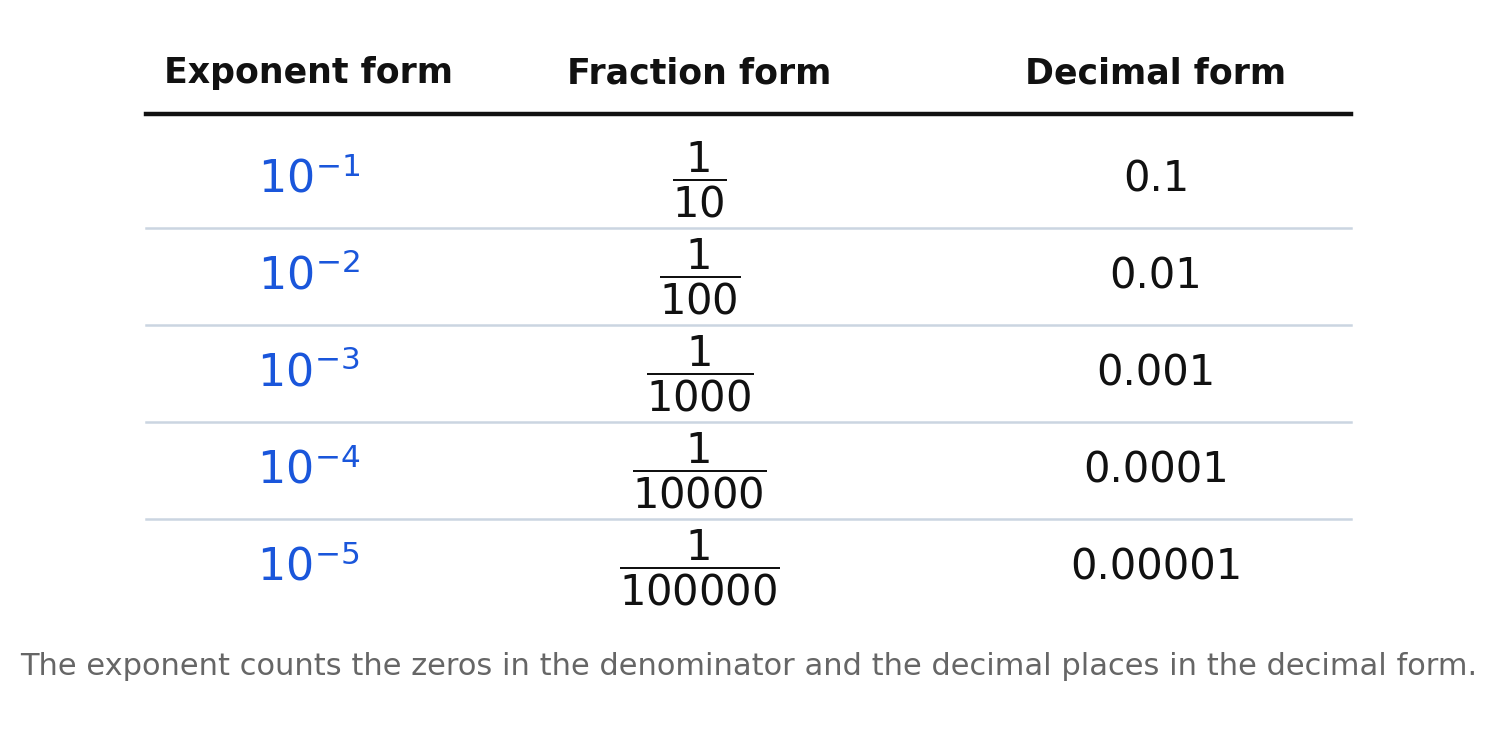
One number — the exponent — controls both of the other columns:
- In fraction form, the exponent counts the zeros in the denominator. , and the denominator has four zeros.
- In decimal form, the exponent counts the decimal places. , and the sits in the fourth place.
These two counts always match, because a denominator of means four place-value steps to the right of the ones place. It is one fact wearing two costumes.
Going backward
You will also be asked to start from a fraction or a decimal and produce the exponent form. Both directions use the same count.
From a fraction: count the zeros in the denominator, and make the exponent negative that many. has five zeros, so it is .
From a decimal: count the decimal places out to the , and make the exponent negative that many. has three places, so it is .
A common slip. is not . The exponent tells you how many tens are multiplied together in the denominator, not what to multiply the ten by. , and while . Those are very different numbers.
Worked examples
Example 1 — All three forms at once
Write in fraction form and in decimal form.
Fraction form: the exponent is , so the denominator is .
Decimal form: two decimal places, so the is in the hundredths place.
Answer: and
Example 2 — A larger exponent
Write in fraction form and in decimal form.
The denominator is , a followed by five zeros.
In decimal form the occupies the fifth place after the point, so four zeros come first.
Answer: and
Example 3 — Fraction back to exponent form
Write as a power of ten, then as a decimal.
The denominator has four zeros, so and the fraction is . Four decimal places gives .
Answer: and
Example 4 — Decimal back to the other two forms
Write as a power of ten and in fraction form.
Count the places out to the : six. So the exponent is , and the denominator is a followed by six zeros.
Answer: and
Example 5 — Deciding whether two expressions match
Is the same number as ? Justify your answer.
By the rule , taking gives exactly . Both equal .
Answer: Yes. Both equal .
Guided practice
- Complete: (decimal).
- Complete: (decimal).
- Write as a power of ten.
- Write in fraction form.
- Complete:
Independent practice
- Copy and complete the table.
| Exponent form | Fraction form | Decimal form |
|---|---|---|
- Write each as a power of ten: a) b) c)
- Write each in fraction form: a) b) c)
- True or false, with a reason: .
- Which is greater, or ? Show how you decided.
- Application. A milligram is of a gram. Write that fraction as a power of ten and as a decimal. Then find the mass in grams of a mg tablet.
- Reasoning. Explain why the exponent in counts both the zeros in the denominator of the fraction form and the decimal places in the decimal form. Why must those two counts always agree?
Exit ticket 1.2
- Write in fraction form and in decimal form.
- Write as a power of ten.
- Write in fraction form.
- Describe in your own words how is related to .
Lesson 1.3 — Scientific Notation and Decimal Form
Why we need a shorter way to write numbers
Some real quantities are enormous and some are tiny. The distance light travels in a year is about kilometers. A red blood cell is about meters across. Written out, both are hard to read, easy to mistype, and nearly impossible to compare at a glance — you end up counting zeros with your finger.
Scientific notation fixes that by splitting a number into two parts: the digits that carry the meaning, and a power of ten that says how big the number is.
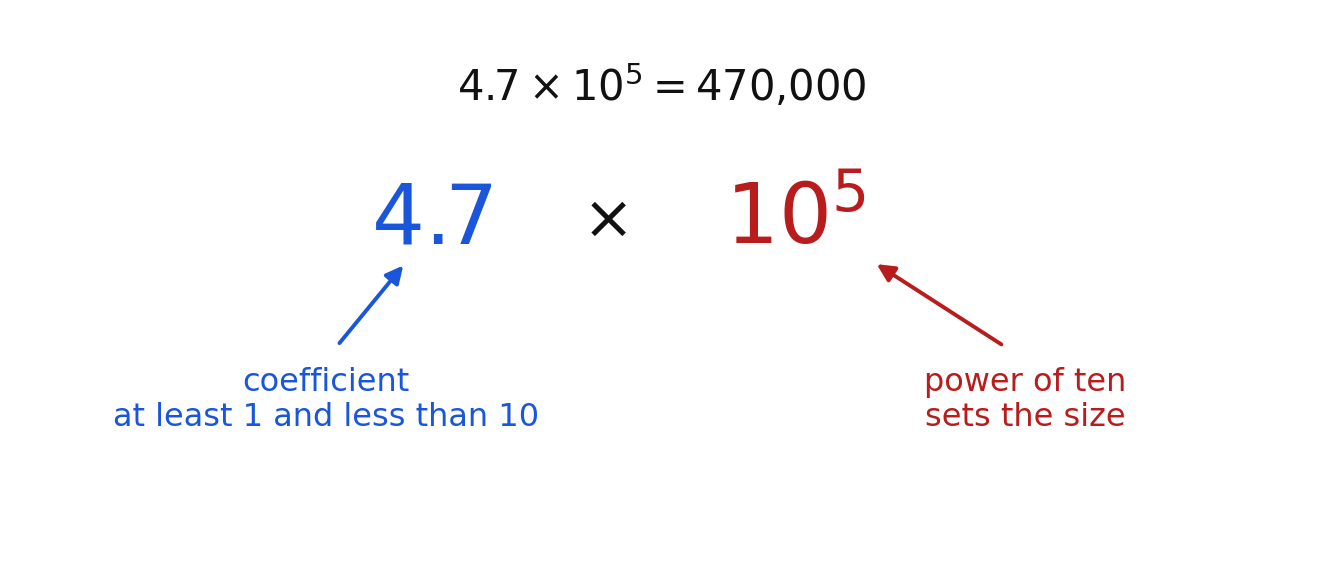
A positive number is in scientific notation when it is written as
where the coefficient satisfies and the exponent is an integer.
The rule is what makes the notation useful: it forces exactly one nonzero digit in front of the decimal point, so every number has exactly one correct scientific-notation form. Without that rule, could be written as or or , and comparing numbers would be guesswork.
Everything in this chapter is greater than zero. Scientific notation can be extended to negative numbers, but the Grade 7 standard is limited to numbers greater than , so every coefficient you meet here is positive.
Converting from scientific notation to decimal form
Multiplying by with positive multiplies by a total of times, and each multiplication by shifts the decimal point one place to the right. Multiplying by with negative divides by a total of times, and each division shifts the point one place to the left.
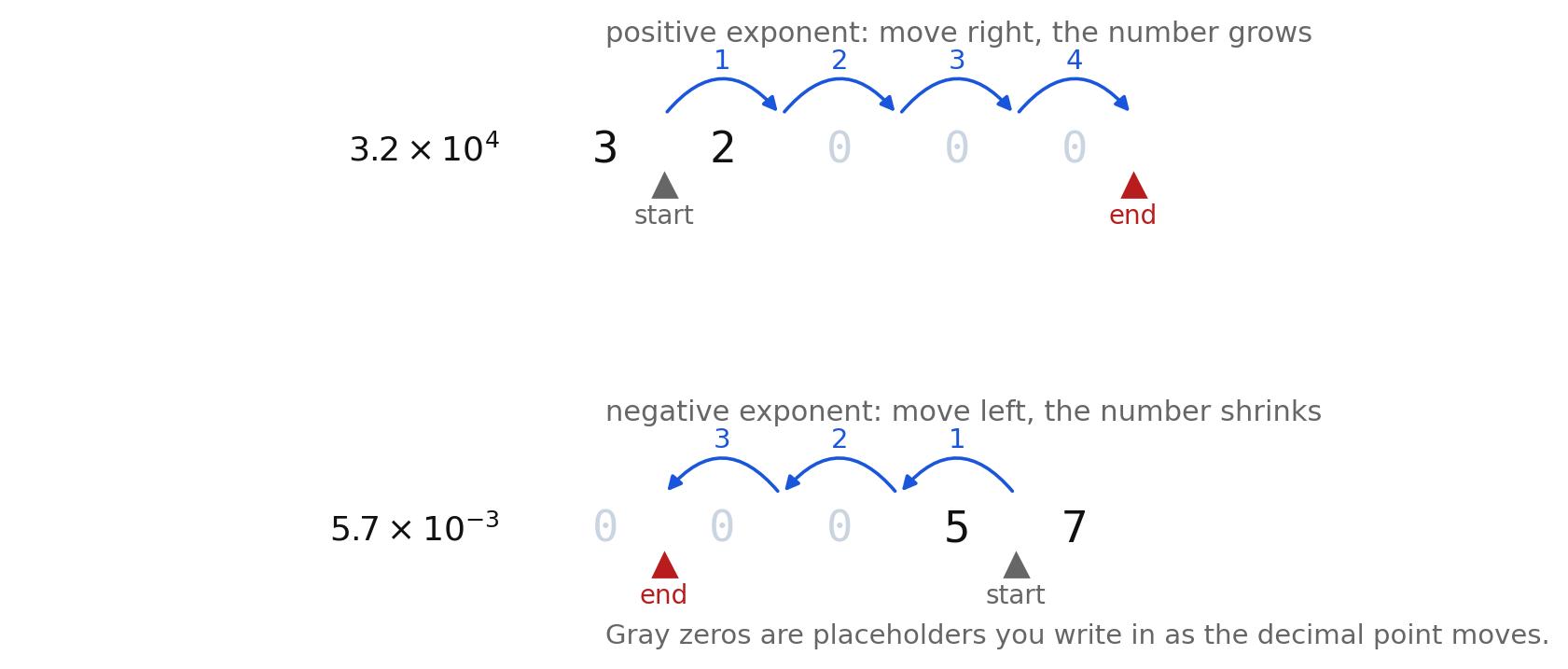
So the exponent is a set of directions for the decimal point:
- Positive exponent → move right that many places → the number gets larger.
- Negative exponent → move left that many places → the number gets smaller, landing between and .
Write in zeros as placeholders whenever you run out of digits, and for a number less than always write the zero in the ones place: , not .
Converting from decimal form to scientific notation
Now run the process backward.
- Place the decimal point so that exactly one nonzero digit stands in front of it. That gives your coefficient .
- Count how many places you moved the point.
- If the original number was or greater, the exponent is that count, positive. If the original number was less than , the exponent is that count, negative.
- Drop any leading or trailing zeros that were only placeholders, and check that .
Take . Moving the point to sit right after the takes four places to the right, and the original number is less than , so the exponent is : the answer is .
Take . Moving the point from the end to just after the takes four places to the left, and the original number is greater than , so the exponent is : the answer is .
Step 3 has a built-in sanity check. A number smaller than must have a negative exponent, and a number of or more must have a positive one. If your exponent's sign disagrees with the size of the number you started with, you moved the point the wrong way.
Worked examples
Example 1 — Positive exponent to decimal form
Write in decimal form.
The exponent is positive, so move the decimal point four places right, writing placeholder zeros as needed.
Answer:
Example 2 — Negative exponent to decimal form
Write in decimal form.
The exponent is negative, so move the point three places left.
Answer:
Example 3 — A large number into scientific notation
Write in scientific notation.
Put the point after the first nonzero digit: . Count the places from the original point at the end of back to that spot: places. The number is greater than , so the exponent is positive.
Answer:
Example 4 — A small number into scientific notation
Write in scientific notation.
The first nonzero digit is , so the coefficient is . Moving the point from to takes places. The number is less than , so the exponent is negative.
Answer:
Example 5 — Fixing an expression that is not yet in scientific notation
Is written in scientific notation? If not, rewrite it correctly.
The coefficient is not less than , so this is not scientific notation. First find the value: . Then rewrite with one nonzero digit in front of the point: , moved places.
Answer: No. Correctly written, it is .
Guided practice
- Write in decimal form.
- Write in decimal form.
- Write in scientific notation.
- Write in scientific notation.
- Is in scientific notation? Explain, then write the number correctly.
Independent practice
- Write each in decimal form: a) b) c) d)
- Write each in scientific notation: a) b) c) d)
- Which of these are correctly written in scientific notation? For each one that is not, explain what is wrong: a) b) c) d)
- Write in decimal form.
- A number is written as and equals . Find .
- Application. A red blood cell is about meters wide, and a sold-out arena holds about people. Write each in decimal form, and state which of the two numbers required moving the decimal point farther.
- Reasoning. Explain why moving the decimal point to the right always goes with a positive exponent, and moving it to the left always goes with a negative one. Connect your explanation to what multiplying and dividing by actually do.
Exit ticket 1.3
- Write in decimal form.
- Write in scientific notation.
- Write in scientific notation.
- Explain how you decide whether the exponent should be positive or negative.
Lesson 1.4 — Comparing and Ordering Numbers in Scientific Notation
The exponent decides first
Here is the payoff for all the work of Lesson 1.3. Once numbers are in scientific notation, comparing them takes almost no arithmetic, because the exponent already reports the size of the number.
Picture a line where each step to the right is one power of ten.
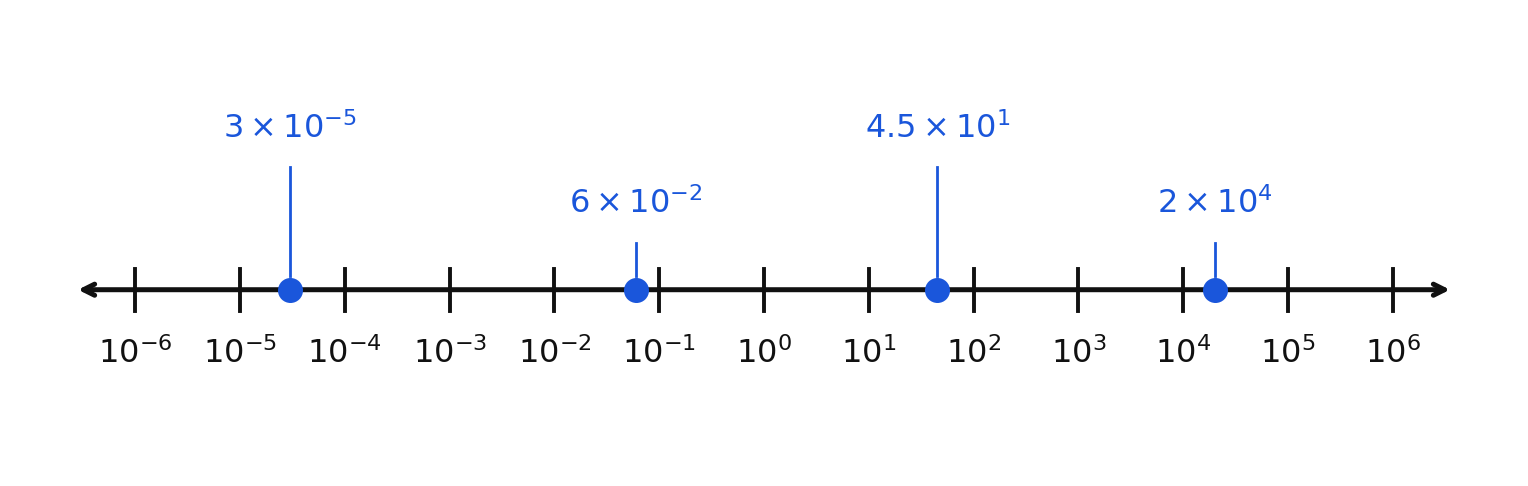
On this line, a number with exponent sits in the region between and , and a number with exponent sits between and . Those regions do not overlap. That is the whole idea:
Compare the exponents first. The number with the greater exponent is greater. Only if the exponents are equal do you compare the coefficients.
The reason the regions cannot overlap is the coefficient rule from Lesson 1.3. Since , the value of is at least and always less than . So a number with exponent can never catch up to a number with exponent , no matter how large its coefficient is. For example, is still less than .
When the exponents are equal
If two numbers have the same exponent, they sit in the same region of the line, and the coefficients settle it. Compare coefficients the way you compare any two decimals: place by place, left to right.
Same exponent, so compare and . Since , we get .
Be careful when the coefficients have different numbers of digits. Comparing and , line up the place values: the tenths digits are and , so . Writing as makes the comparison easy to see.
Negative exponents run the same way
The rule does not change for negative exponents, but it is worth saying out loud what it means there: the more negative the exponent, the smaller the number. So , because dividing by six times leaves less than dividing by twice. Students often reverse this by comparing and as if they were plain counts. Reading the exponents as positions on the magnitude line above keeps you honest — is farther left than , and farther left is smaller.
Ordering a set
To order up to four numbers, sort by exponent first, then break any ties by coefficient.
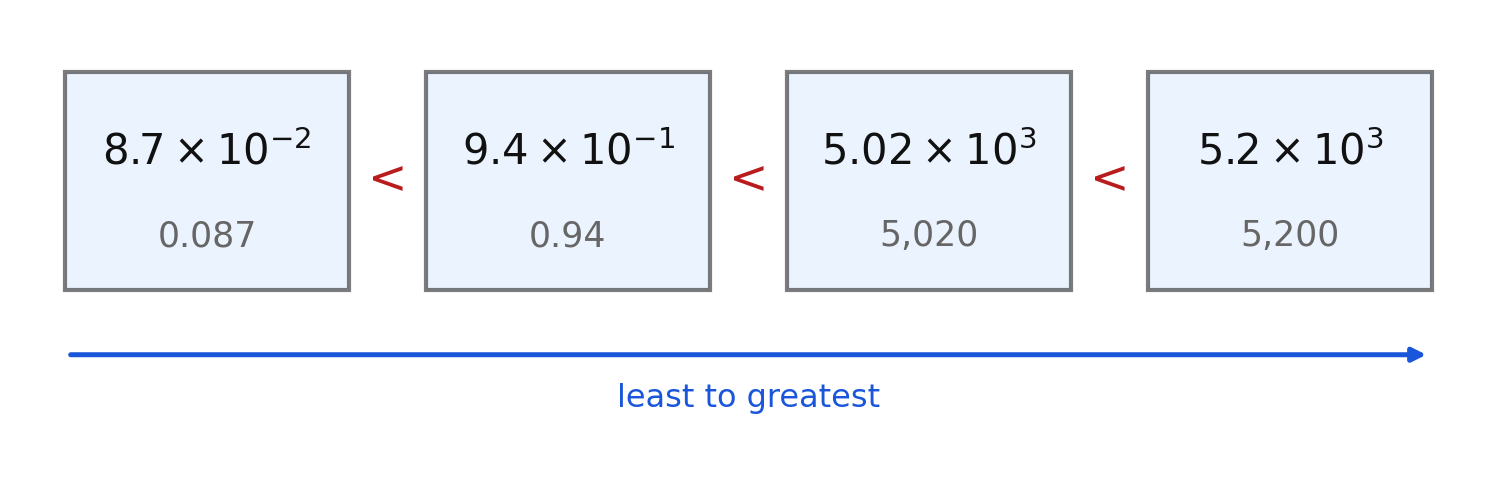
Reading left to right gives ascending order: , , , . Ascending order means least to greatest; descending order means greatest to least, which is the same list read right to left.
Notice that the two smallest values have the smaller coefficients written on cards with the smaller exponents, and that the tie between the two numbers with exponent was broken by comparing with . Converting to decimal form, shown in gray under each card, is always available as a check — but with practice you will not need it.
Worked examples
Example 1 — Different exponents
Which is greater, or ?
Compare exponents: . The coefficient looks impressive, but it cannot make up two full powers of ten.
Check: and .
Answer: is greater.
Example 2 — Equal exponents
Which is greater, or ?
The exponents match, so compare coefficients: .
Answer: is greater.
Example 3 — Two negative exponents
Which is greater, or ?
Compare exponents: , since lies to the right of .
Check: and .
Answer: is greater.
Example 4 — Ordering four numbers
Order , , , and in ascending order.
Sort by exponent: . That places first and second.
Two numbers share the exponent , so compare coefficients: , which puts before .
Answer: , , ,
Example 5 — When the coefficient is misleading
Which is greater, or ?
The larger coefficient belongs to the smaller number. Exponents decide: .
Check: and .
Answer: is greater.
Guided practice
- Fill in , , or :
- Fill in , , or :
- Fill in , , or :
- Which is greater, or ?
- Order in ascending order: , , .
Independent practice
- Fill in or for each: a) b) c) d)
- Order in ascending order: , , , .
- Order in descending order: , , , .
- Which of these four numbers is least: , , , ?
- Which is greater, or ? Show the conversion you used.
- Application. A lab measures four dust particles with diameters m, m, m, and m. Order them from smallest to largest, and name the diameter of the largest particle in decimal form.
- Reasoning. Priya claims that because . Explain her error and give the correct comparison, supporting it with decimal forms.
Exit ticket 1.4
- Fill in , , or :
- Order in ascending order: , , .
- Which is greater, or ?
- State the two-step rule for comparing two numbers written in scientific notation.
Chapter 1 Review
Vocabulary. exponent · base · power · negative exponent · fraction form · decimal form · scientific notation · coefficient · ascending order · descending order
Part A — Powers of 10 with negative exponents (7.NS.1a)
- Evaluate each as a decimal: a) b) c)
- Which power of ten equals ?
- Continue the pattern two more steps: , , , , .
- Describe what happens to the value of a power of ten each time the exponent decreases by , and explain why that makes smaller than .
Part B — Fraction form and decimal form (7.NS.1b)
- Write in fraction form and in decimal form.
- Write as a power of ten.
- Write each in decimal form: a) b)
- Which is greater, or ? Explain how you decided.
Part C — Scientific notation and decimals (7.NS.1c)
- Write each in decimal form: a) b)
- Write each in scientific notation: a) b)
- Explain why is not in scientific notation, and rewrite it correctly.
- A number is written as and equals . Find .
- A grain of fine sand is about meters across. Write that width in decimal form.
Part D — Comparing and ordering (7.NS.1d)
- Fill in or : a) b)
- Order in ascending order: , , , .
- Order in descending order: , , , .
Part E — Mixed application and reasoning
- Application. Four colors of visible light have wavelengths m, m, m, and m. Order the wavelengths in ascending order, and explain which step of the comparison rule did all the work here.
- Application. Write in scientific notation, then state whether it is greater or less than and by how many powers of ten the two differ.
- Reasoning. Explain why is less than even though is greater than . Use the idea of repeated division by in your explanation.
- Reasoning. Why does scientific notation require the coefficient to be at least and less than ? Describe one specific problem that would appear if that requirement were dropped.
Standards coverage check — Chapter 1
| Knowledge and Skill | Where it is taught | Where it is practiced |
|---|---|---|
| 7.NS.1a — investigate and describe powers of 10 with negative exponents by examining patterns | 1.1 | Items 1–16; Review Part A, items 65–68; items 83, 84 |
| 7.NS.1b — represent a power of 10 with a negative exponent in fraction and decimal form | 1.2 | Items 17–32; Review Part B, items 69–72 |
| 7.NS.1c — convert between numbers greater than 0 in scientific notation and decimals | 1.3 | Items 33–48; items 58, 59; Review Part C, items 73–77; item 82 |
| 7.NS.1d — compare and order no more than four numbers greater than 0 in scientific notation, ascending or descending | 1.4 | Items 49–64; Review Part D, items 78–80; items 81, 82 |
Answer keys for every set in this chapter are in Appendix A.