Chapter 8 — Systems of Two Linear Equations
Standard: A.EI.2 (a, b, c, h)
A.EI.2 — verbatim. The student will represent, solve, explain, and interpret the solution to a system of two linear equations, a linear inequality in two variables, or a system of two linear inequalities in two variables. Students will demonstrate the following Knowledge and Skills: a) Create a system of two linear equations in two variables to represent a contextual situation. b) Apply the properties of real numbers and/or properties of equality to solve a system of two linear equations in two variables, algebraically and graphically. c) Determine whether a system of two linear equations has one solution, no solution, or an infinite number of solutions. h) Verify possible solution(s) to a system of two linear equations, a linear inequality in two variable, or a system of two linear inequalities algebraically, graphically, and with technology to justify the reasonableness of the answer(s). Explain the solution method and interpret solutions for problems given in context.
By the end of this chapter you will be able to:
- Create a system of two linear equations in two variables from a situation, defining each variable in a full sentence with units (A.EI.2a)
- Say what a solution of a system is — one ordered pair that makes both equations true — and test a candidate pair against both (A.EI.2h)
- Solve a system graphically, by graphing both lines and reading the point they share (A.EI.2b)
- Solve a system algebraically by substitution and by elimination, and choose sensibly between them (A.EI.2b)
- Decide whether a system has one solution, no solution, or infinitely many, from the equations and from the graph (A.EI.2c)
- Verify a solution three ways — algebraically, graphically, and with technology — and treat a disagreement between them as information (A.EI.2h)
- Explain your solution method in words and interpret the solution in context, with units (A.EI.2h)
Lessons: 8.1 What a System Is, and What a Solution Means · 8.2 Solving a System by Graphing · 8.3 Solving by Substitution · 8.4 Solving by Elimination · 8.5 One Solution, No Solution, or Infinitely Many · 8.6 Modeling with Systems, and Verifying Three Ways
Why this chapter matters. Chapters 5 through 7 studied one line at a time: its slope, its intercepts, its equation, its graph. Almost every real question, though, involves two conditions at once. Two rental plans, and you want the mileage at which they cost the same. A total number of tickets and a total amount of money, and you want how many of each kind were sold. Two lines, one question: where do they agree? That question is a system, and this chapter answers it three different ways — by picture, by substitution, and by elimination — and then insists you check the answer.
Scope note. This chapter is about systems of exactly two linear equations in two variables. Inequalities are not in this chapter. A linear inequality in two variables, and a system of two of them, are A.EI.2 d, e, f, and g, and they are Chapter 9, which builds directly on the vocabulary fixed here. Solving a single linear equation in one variable is Chapter 2, and this chapter uses that skill constantly. Writing the equation of a line from a graph, from two points, or from a slope and a point is Chapter 6. Graphing a linear function and evaluating it are Chapter 7. All three are assumed and used freely. Bullet h is deliberately shared with Chapter 9, because verifying and interpreting is a habit rather than a topic; here it is exercised on systems of equations.
Conventions this chapter fixes.
- A system of two linear equations is two linear equations in the same two variables, considered together. It is written as a stacked pair, and both equations are always in play.
- A solution of a system is an ordered pair that makes both equations true. It is never a single number. Answering "" to a system question is an incomplete answer; the answer is .
- Verify means substitute the pair into both original equations and show both sides agree. Checking one equation proves nothing, because every point of one line satisfies that equation.
- The three outcomes are named one solution, no solution, and infinitely many solutions, matching the language Chapter 2 fixed for a single linear equation.
- This chapter uses a graphing calculator or graphing site freely. A.EI.2h names technology explicitly. No part of this course is calculator-free; technology here is an instrument of verification, not a shortcut, and a disagreement between a graph and the algebra is treated as information rather than as an accident.
- Item numbering runs straight through the chapter, from 1 in Lesson 8.1 to 132 at the end of the review. It does not restart at each lesson.
Lesson 8.1 — What a System Is, and What a Solution Means
Two equations, one question
A system of two linear equations in two variables is a pair of linear equations considered at the same time, in the same two unknowns:
Each equation on its own has infinitely many solutions — every point of its line. The system asks a narrower question: which ordered pairs satisfy both at once?
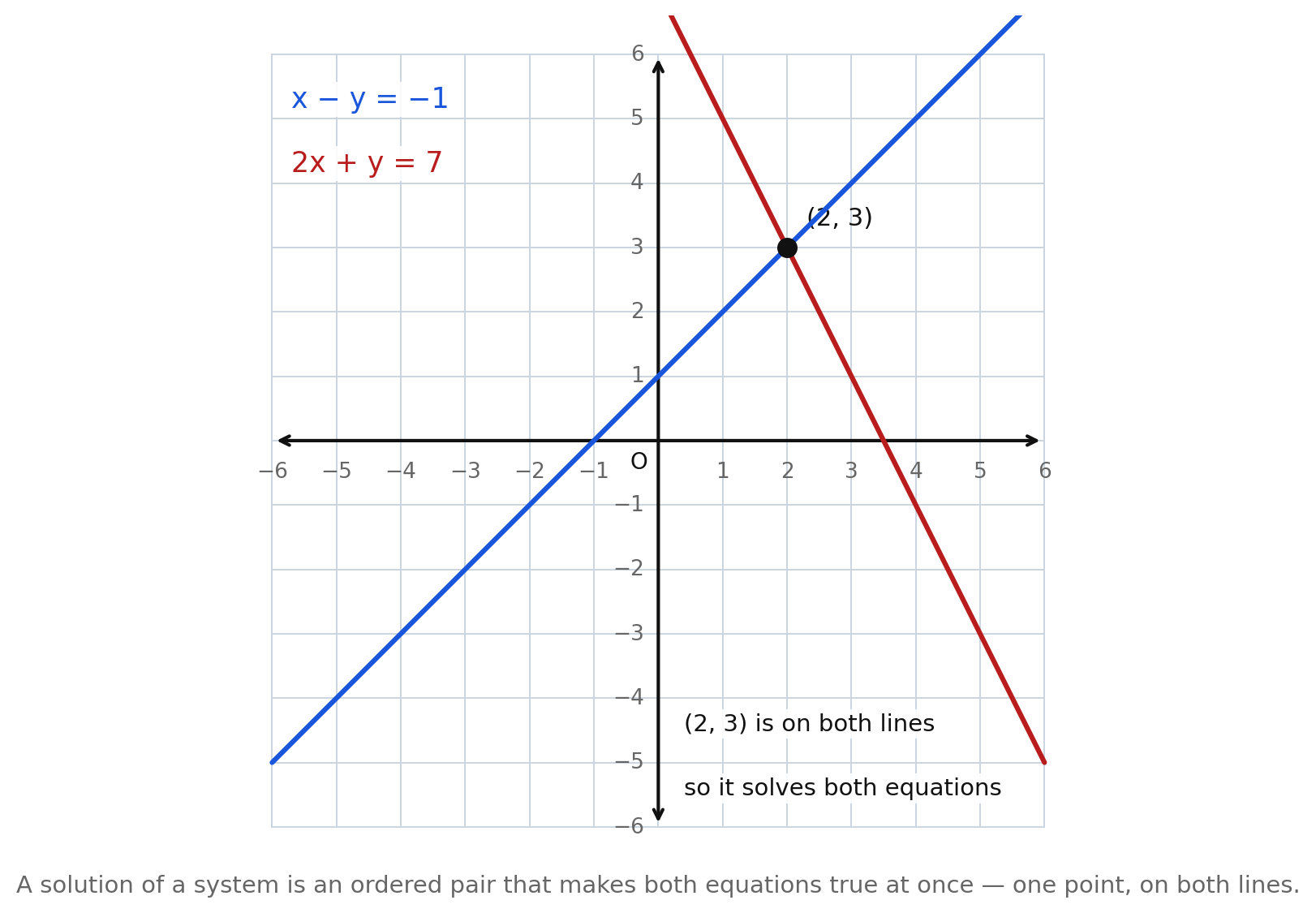
The figure draws both lines. The blue line is every pair satisfying ; the red line is every pair satisfying . They share exactly one point, , and that point is the solution of the system.
A solution of a system is an ordered pair that makes both equations true. Test in each original equation:
- becomes ✓
- becomes ✓
Both check, so is the solution. Notice the grammar: the answer is a point, written as an ordered pair. "" is half of it.
Satisfying one equation is not enough
This is the single most common error in the chapter, so it gets a picture.
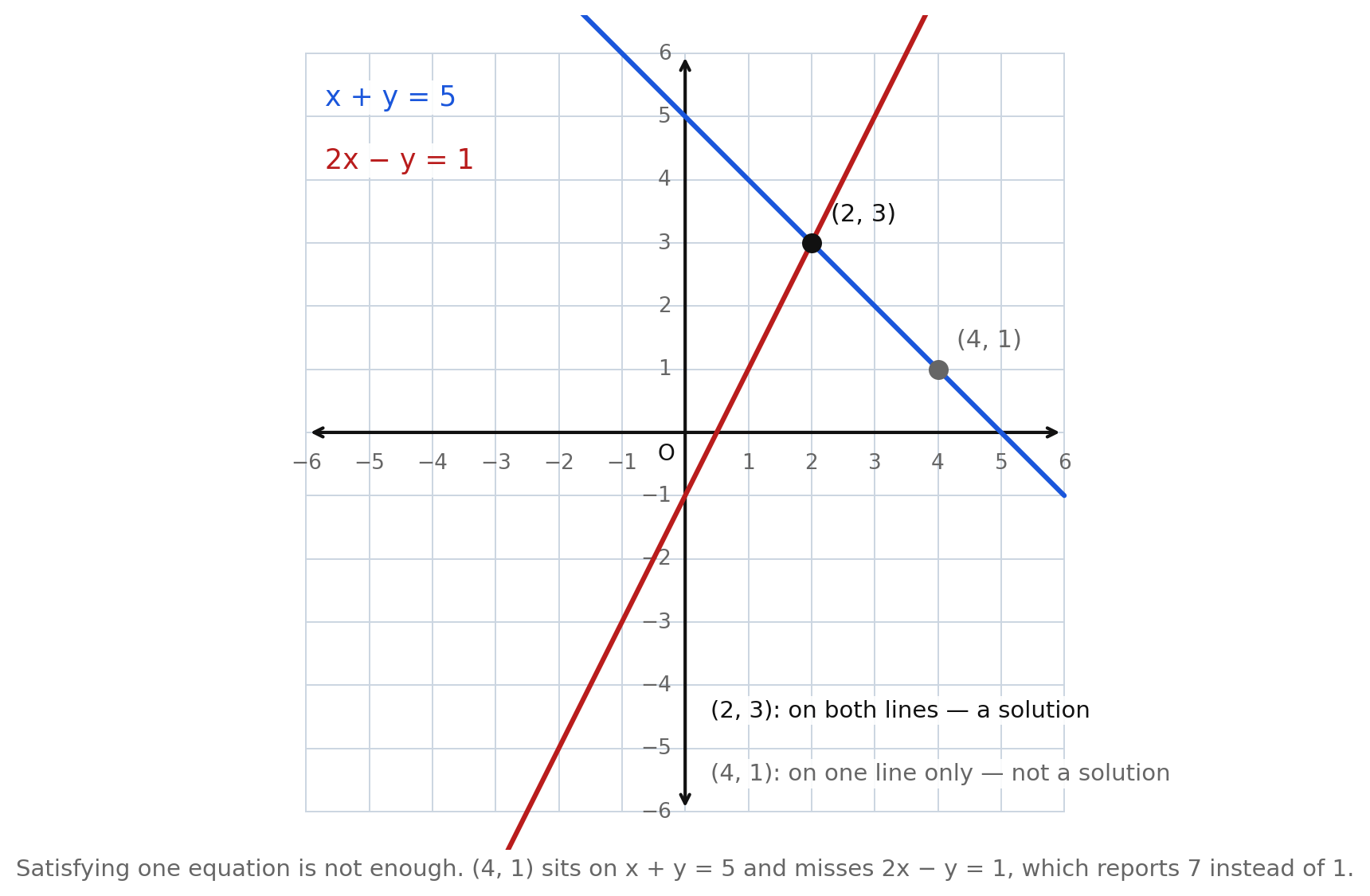
The system here is
The point is drawn in gray. It sits squarely on the blue line, and sure enough ✓. But it is nowhere near the red line, and the second equation reports , not ✗. So is not a solution of the system, even though it satisfies one of the equations.
The point is on both lines: ✓ and ✓. That is the solution.
Verify means both. A verification that stops after one equation has checked that the point is on one of the two lines — which every point of that line does. It has tested nothing about the system.
Creating a system from a situation
A.EI.2a asks you to build a system, not just solve one. The procedure has three steps, and the first one is the step students skip.
- Define each variable in a full sentence, with units. Write "Let be the number of adult tickets sold" — not " = adults," which does not say whether counts people, tickets, or dollars.
- Find the two independent facts. A contextual system almost always contains one fact about a count or a total amount and one fact about a value, a relationship, or a rate. Each fact becomes one equation.
- Write one equation per fact, keeping the units consistent within each equation.
A worked build. A theater sells adult tickets for and child tickets for . On Friday it sold tickets and took in .
- Let be the number of adult tickets sold, and let be the number of child tickets sold.
- Fact one, a count of tickets: .
- Fact two, an amount of money in dollars: .
Check that the two equations really say different things. The first counts tickets; the second counts dollars. If both equations say the same thing in different words, you have not written a system at all — you have written one equation twice, which is Lesson 8.5's infinitely-many case.
Why "exactly two solutions" is impossible
Two straight lines in a plane have exactly three possible relationships: they cross once, they never cross, or they lie on top of each other. There is no fourth arrangement, and in particular there is no way for two straight lines to meet at exactly two points — two points already determine a whole line, so lines through both of them are the same line. That is why the answer to "how many solutions?" is always one, none, or infinitely many, and never a number like or . Lesson 8.5 makes this precise.
Worked examples
Example 1 — Testing a candidate pair
Is a solution of and ?
✓ and ✓.
Answer: Yes. Both equations are true, so solves the system.
Example 2 — A pair that fails the second equation
Is a solution of the same system?
✓, but , and ✗.
Answer: No. It satisfies the first equation only, so it is on one line and not the other.
Example 3 — Creating a system from coins
A jar holds coins, all nickels and dimes, worth cents in total. Write a system.
Let be the number of nickels and the number of dimes. One fact counts coins; the other counts cents.
Answer: and
Example 4 — Creating a system from a relationship
A rectangle has perimeter cm, and its length is cm more than its width. Write a system.
Let be the length in centimeters and the width in centimeters.
Answer: and
Example 5 — Reading a solution off a graph
Two lines are drawn and they cross at . What is the solution of the system, and how would you confirm it?
Answer: The solution is . Confirm it by substituting and into both original equations and checking that each one is true.
Guided practice
- Use the figure of two lines crossing at a marked point. Give the solution of the system and , and say what feature of the graph names it.
- Verify that solution algebraically by substituting it into both original equations, showing the arithmetic for each.
- Is a solution of that same system? Test it in both equations and explain your conclusion.
- Use the figure showing the gray point . Which of and solves the system , ? Justify with the arithmetic for both equations.
- A theater sells adult tickets for and child tickets for . It sold tickets and took in . Define both variables in full sentences and write the system. Do not solve it.
- Explain in one or two sentences why an ordered pair must satisfy both equations to be a solution of a system.
Independent practice
- Determine whether each ordered pair is a solution of and . Show both substitutions each time. a) b) c) d)
- Verify that is a solution of and .
- Application. A jar holds coins, all nickels and dimes, worth cents. Define both variables in full sentences with units, then write the system. Do not solve it.
- Application. Use the ride-plan figure. Ride Rite charges plus per mile; Cab Co charges plus per mile. Define the variables and write the system the figure graphs.
- Application. A rectangle has perimeter cm and its length is cm more than its width. Define both variables with units and write the system.
- Application. A class of students has more than twice as many boys as girls. Define both variables and write the system.
- Reasoning. Explain why a system of two linear equations cannot have exactly two solutions. Your explanation should say something about what two points determine.
- Error analysis. A student says is the solution of and "because ." Identify the error, and find the actual solution by reading it off a graph of the two lines.
- Technology. Describe, in steps a classmate could follow, how you would use a graphing calculator or graphing site to check whether solves and .
- Application. Maria buys notebooks and pens for . Later she buys notebooks and pens for . Define both variables in full sentences with units, and write the system. Do not solve it.
Exit ticket 8.1
- Is a solution of and ? Show both substitutions.
- Is a solution of and ? Show both substitutions.
- A tank holds fish, guppies and tetras, and there are twice as many tetras as guppies. Define both variables and write the system.
- Explain, in your own words, what "solution of a system of two linear equations" means, and why it is written as an ordered pair.
Lesson 8.2 — Solving a System by Graphing
The method
If a solution is the point two lines share, then drawing both lines and reading the crossing point solves the system. That is the graphical method, and A.EI.2b requires it alongside the algebra.
- Solve each equation for . Slope-intercept form is what you can graph fastest, and Chapter 5 taught the conversion.
- Graph both lines on the same grid, using the -intercept and the slope, as in Chapter 7.
- Read the coordinates of the crossing point.
- Verify the pair in both original equations. The reading is a claim; the substitution is the proof.
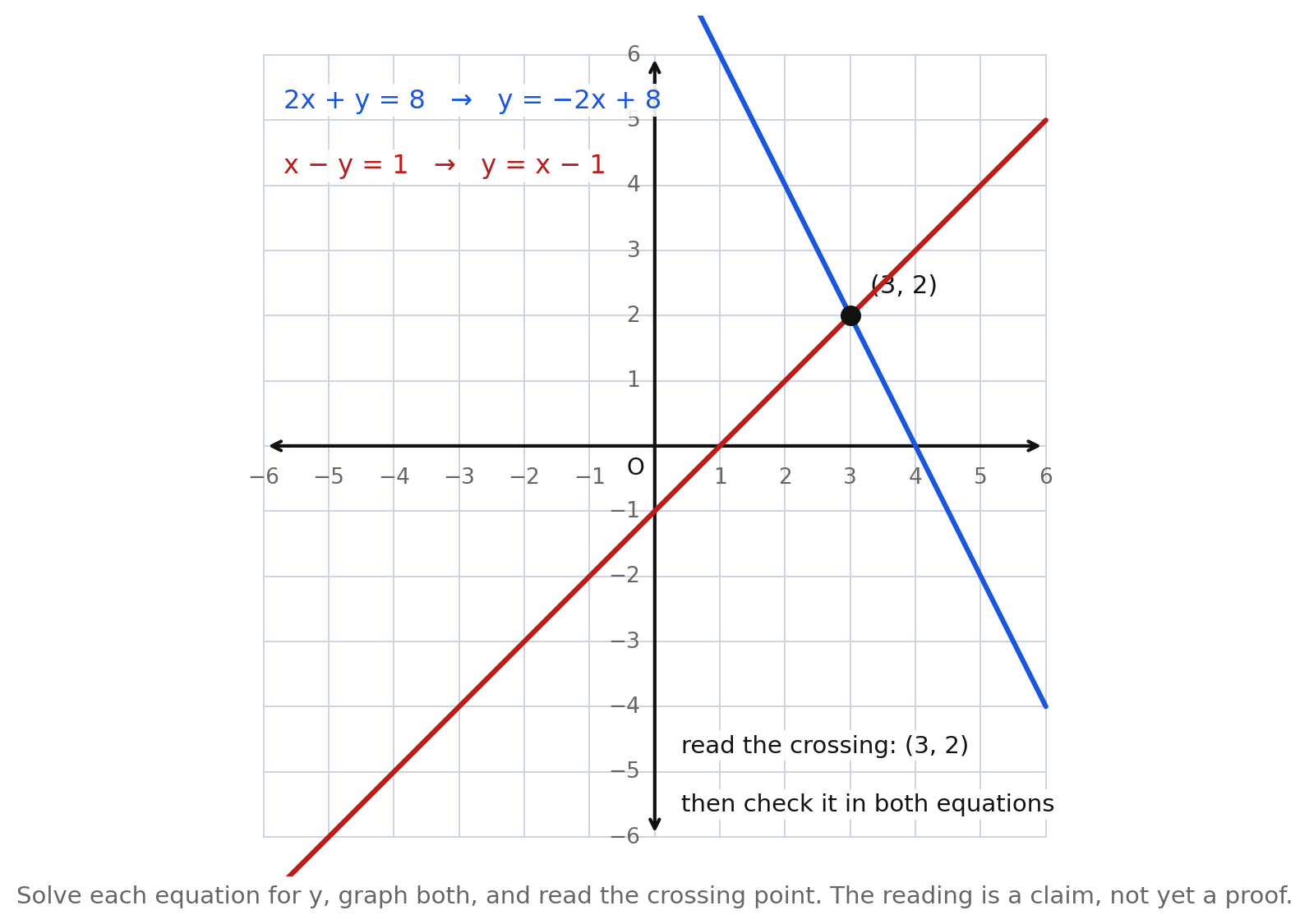
Solving each for gives and . Graphed, they cross at . Verify in the original equations, not in the rewritten ones:
- ✓
- ✓
Solution: .
What a graph is good at, and what it is bad at
A graph is unbeatable at showing you what kind of answer to expect. You can see at a glance whether the lines cross, and roughly where.
It is much weaker at producing exact numbers. Read the crossing of and off a grid and you will report something like "about ." The true solution is . A graph is exact only when the crossing lands on a lattice point — a corner of the grid, where both coordinates are integers. Every graphing exercise in this lesson is built so that it does.
That limitation is not a reason to skip graphing. It is the reason A.EI.2b asks for both: the graph tells you the shape of the answer, and the algebra pins down the numbers.
The window that lies
Technology has the same weakness, plus one of its own: it only draws the part of the plane you ask it to.
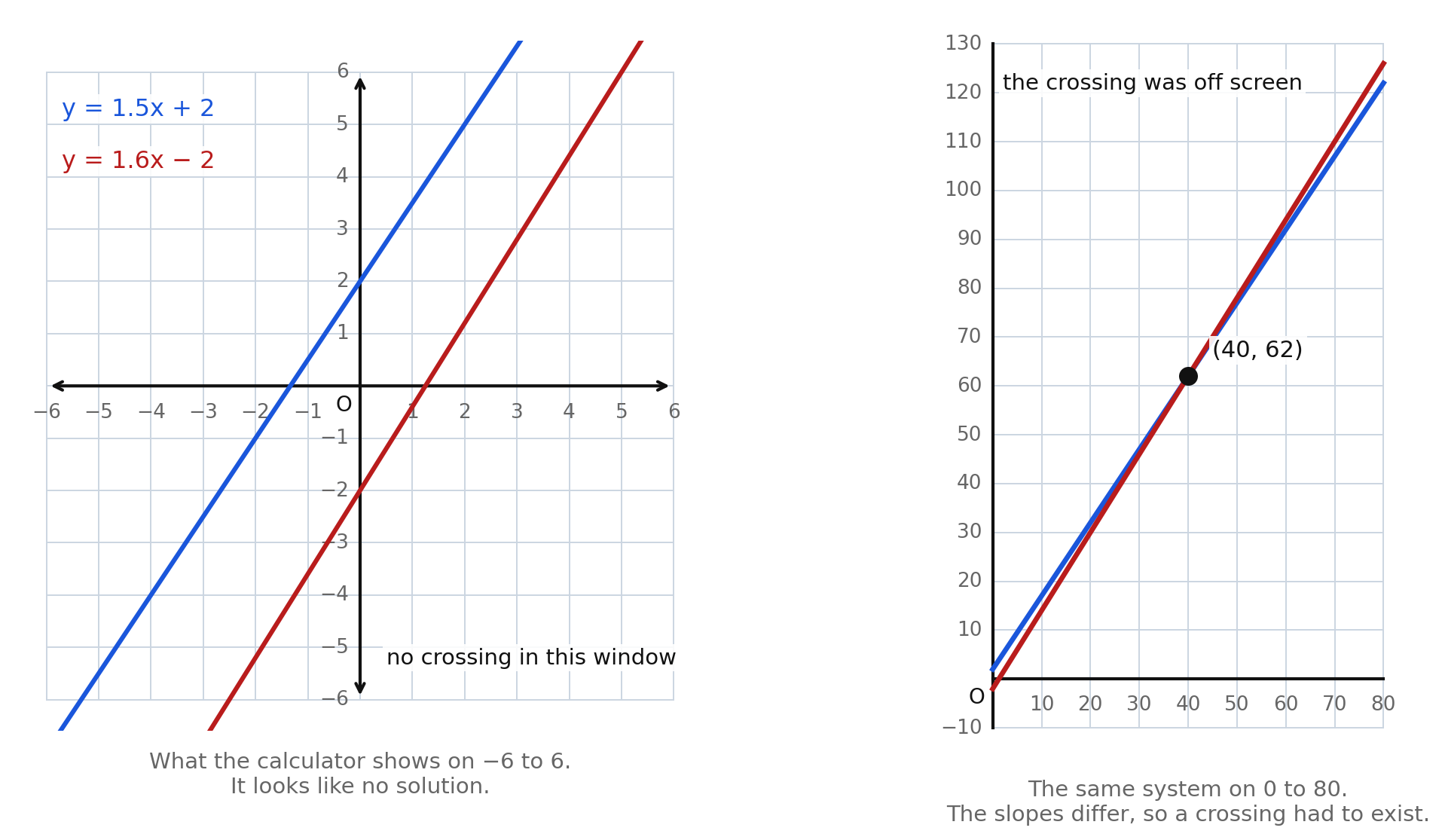
The left panel is the standard to window. Two lines, no crossing anywhere in sight; a student reading only that picture reports no solution.
That answer is wrong, and the algebra says so before you graph anything. The slopes are and . They are different, and Lesson 8.5 proves that lines with different slopes must cross exactly once. The right panel widens the window to , and there is the crossing, at :
A disagreement is information. When the algebra and the picture disagree, one of them is being misread, and finding out which is part of the work. Here the picture was not wrong — it was incomplete, and the algebra told you where to look. Widen the window, zoom out, or use the calculator's intersect feature, which searches beyond what is displayed.
Reading a context off a graph
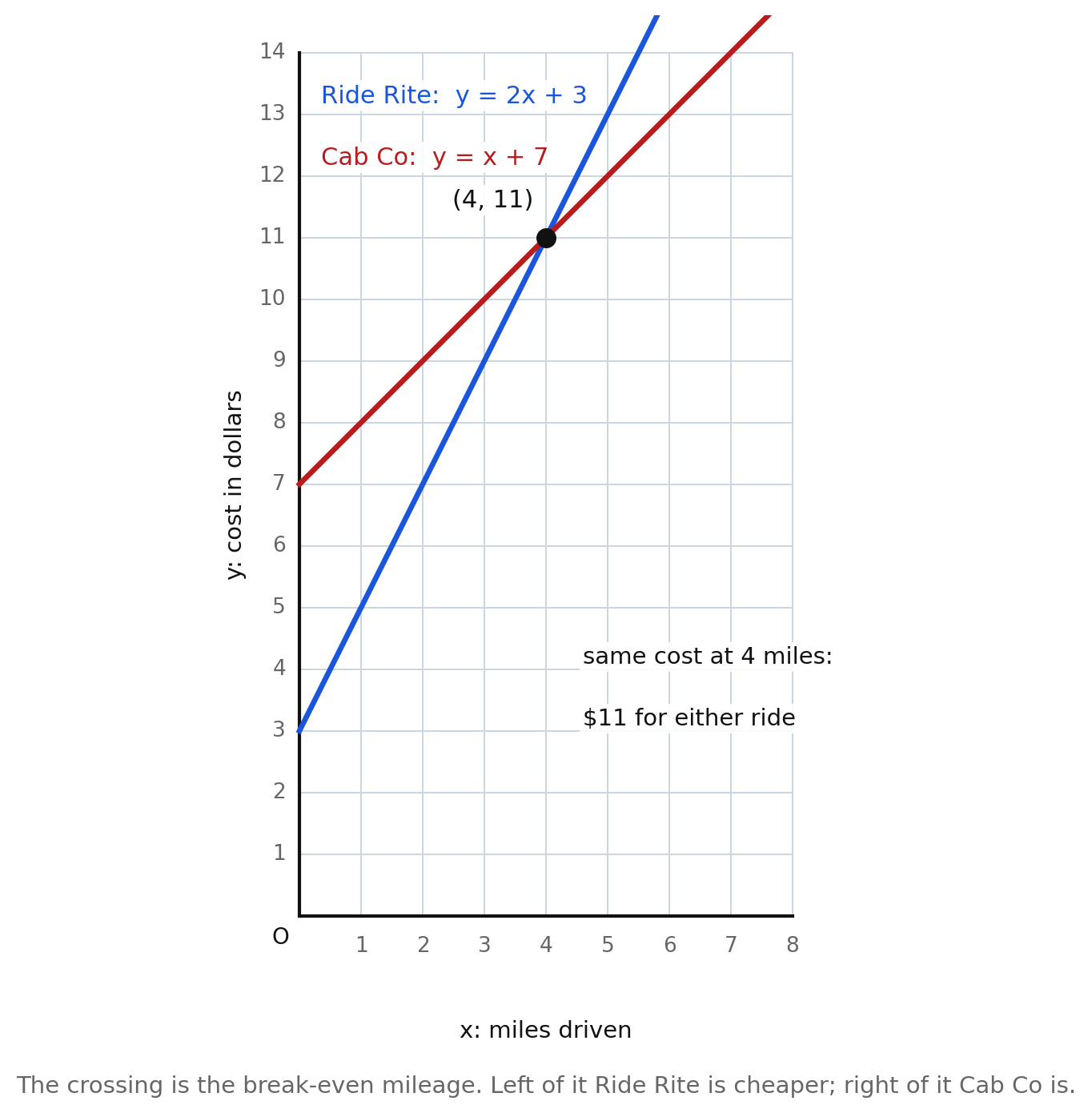
Ride Rite charges plus a mile, so . Cab Co charges plus a mile, so . The lines cross at .
In context that ordered pair is a sentence: a -mile trip costs with either company. And the graph says more than the point does. To the left of the crossing the blue line is lower, so short trips are cheaper with Ride Rite. To the right the red line is lower, so long trips are cheaper with Cab Co. Reading which side is which is the interpretation A.EI.2h asks for.
Worked examples
Example 1 — Both equations already solved for
Solve by graphing: and .
Graph a line with -intercept and slope , and a line with -intercept and slope . They cross at . Check: ✓ and ✓.
Answer:
Example 2 — Rewriting first
Solve by graphing: and .
Rewrite as and . They cross at . Check in the originals: ✓ and ✓.
Answer:
Example 3 — The lines never meet
Solve by graphing: and .
Both have slope , so the graphs are parallel; the second sits units below the first at every input.
Answer: No solution. The lines never cross.
Example 4 — One line drawn twice
Solve by graphing: and .
Dividing the second equation by gives , which is — the same line.
Answer: Infinitely many solutions; every point of solves both.
Example 5 — Interpreting a crossing
Two cost lines cross at , where is shirts made and is dollars. What does the point mean?
Answer: At shirts, cost and revenue are both — the break-even point. Below shirts the business loses money; above it makes money.
Guided practice
- Use the figure showing and . Give the slope-intercept form of each equation and the solution the graph shows.
- Verify that solution by substituting it into both original equations.
- Use the figure of and . Read the solution off the graph and verify it algebraically.
- Solve and by graphing, and verify.
- Solve and by graphing, and verify.
- Use the two-panel figure of the misleading window. Explain what the left panel appears to show, why that reading is wrong, and what the slopes told you before you graphed anything.
Independent practice
- Solve each by graphing. Every crossing lands on a grid corner. a) and b) and c) and d) and
- Rewrite each equation in slope-intercept form, then solve by graphing and verify in the originals. a) and b) and c) and
- Graph and . How many solutions does the system have? Explain what the picture shows.
- Graph and . How many solutions does the system have? Explain what the picture shows.
- Application. Use the ride-plan figure. Give the solution, write one sentence interpreting it with units, and say which company is cheaper for a -mile trip and which for a -mile trip.
- Application. Dana has and saves a week; Eli has and saves a week. Write the system with in weeks and in dollars, then say what viewing window you would need for the crossing to be visible, and give the solution.
- Technology. Graph and with technology. Report a window in which the crossing is visible, give the intersection point, and confirm it algebraically in both equations.
- Reasoning. Explain why solving by graphing gives an exact answer only when the crossing point has integer coordinates, and say what you should do when it does not.
- Error analysis. A student graphs and , sees the two lines run off the top corner of the grid close together, and reports a solution of "about ." Identify the error and give the correct answer.
- Application. A shop's cost is dollars to make shirts, and its revenue is dollars. Solve the system by graphing, and interpret the solution in context with units.
- Graph and on one grid. Give the solution of that system, and explain why the vertical line cannot be written in slope-intercept form even though the system is easy to solve.
Exit ticket 8.2
- Solve and by graphing, and verify in both equations.
- Solve and by graphing, and verify in both equations.
- Two lines are graphed. Both fall four units for every one unit right, and they cross the -axis at different points. How many solutions does the system have? Explain.
- Technology. You graph a system and see no crossing on the standard window, but the two equations have different slopes. What do you conclude, and what is your next step?
Lesson 8.3 — Solving by Substitution
The idea
The graph gave you a picture; substitution gives you exact numbers. It rests on one property of equality you have used since Chapter 2: substitution. If two expressions are equal, either may replace the other.
If one equation says , then wherever the other equation says , it may instead say . Making that replacement turns a two-variable problem into the one-variable equation you learned to solve in Chapter 2.
The procedure
- Isolate one variable in one equation. Choose a variable whose coefficient is or if one exists — it keeps you out of fractions.
- Substitute that expression into the other equation. Never back into the same equation; that produces a true statement that tells you nothing.
- Solve the resulting one-variable equation.
- Back-substitute into either original equation to find the second variable.
- Write the answer as an ordered pair, and verify it in both original equations.
A worked run.
- The first equation already isolates .
- Substitute into the second: .
- Solve: , so and .
- Back-substitute: .
- The solution is . Verify: ✓ and ✓.
When no variable is isolated yet
Nothing is lost; isolate one yourself.
The first equation has an with coefficient , so solve it for : . Substitute into the second:
Then . The solution is . Verify: ✓ and ✓.
Two cautions, and they are where the marks are lost.
- Distribute across the whole substituted expression. Writing as drops the multiplication on the second term.
- Finish the job. Finding and stopping answers half the question. A system's answer is an ordered pair.
What substitution does in the degenerate cases
Sometimes both variables vanish. That is not a failure; it is the answer, exactly as in Chapter 2.
For and , substituting gives
a false statement. No pair can rescue it, so the system has no solution and the lines are parallel.
For and , substituting gives
a true statement with no variable left. Every pair on the line works, so there are infinitely many solutions. Lesson 8.5 collects both cases.
Worked examples
Example 1 — A variable already isolated
Solve and .
, so and . Then . Check: ✓.
Answer:
Example 2 — Isolating first
Solve and .
From the first, . Then , so , giving and . Then .
Answer:
Example 3 — Negative coefficient
Solve and .
From the first, . Then , so , giving and . Then .
Answer:
Example 4 — In context
Two numbers have a sum of and a difference of . Find them.
Let be the larger and the smaller. Then and , so . Substituting, , giving and , then .
Answer: The numbers are and .
Example 5 — A degenerate case
Solve and .
becomes , which is false.
Answer: No solution; the lines are parallel.
Guided practice
- Solve and by substitution, then verify in both equations.
- Solve and by substitution, then verify in both equations.
- Solve and by substitution. (Setting the two expressions for equal is substitution.)
- Solve and by substitution, showing the isolating step.
- Verify your answer to item 45 in both original equations, showing the arithmetic.
- Explain why substitution is easiest when some variable has a coefficient of or .
Independent practice
- Solve each by substitution. A variable is already isolated in each. a) and b) and c) and d) and
- Solve each by substitution. You must isolate a variable first; say which one you chose and why. a) and b) and c) and
- Solve and by substitution. Report what happens to the variables, and give the number of solutions and the picture that goes with it.
- Solve and by substitution. Report what happens to the variables, and give the number of solutions and the picture that goes with it.
- Application. Two numbers have a sum of and a difference of . Write the system, solve it by substitution, and state both numbers.
- Application. Solve the rectangle system you wrote in item 11 — perimeter cm, length cm more than width — by substitution. Give the length and the width with units.
- Application. Solve the class system you wrote in item 12 — students, more than twice as many boys as girls — by substitution, and state how many of each there are.
- Application. Plan A costs a month plus per minute; Plan B costs a month plus per minute. Write the system with in minutes and in dollars, solve it by substitution, and interpret the solution in a sentence with units.
- Reasoning. Describe a system for which substitution is clearly the better method, and a system for which it would be painful. Explain what feature of the equations you looked at.
- Error analysis. A student solving and substitutes for back into the first equation, gets , and concludes the system has infinitely many solutions. Explain what went wrong with the method, then redo the problem correctly and give the true number of solutions.
- Solve and by substitution, verify in both equations, and describe how a graph of the two lines would confirm your answer.
Exit ticket 8.3
- Solve and by substitution, and verify.
- Solve and by substitution, and verify.
- Solve and by substitution, showing the isolating step.
- Application. Solve the fish-tank system you wrote in item 19 — fish, twice as many tetras as guppies — and state how many of each there are.
Lesson 8.4 — Solving by Elimination
The idea
Substitution replaces a variable. Elimination cancels one, by adding the two equations together.
It rests on the addition property of equality: if and , then . Adding equals to equals preserves equality, so adding two true equations produces a third true equation — and if the coefficients of one variable are opposites, that variable disappears from the sum.
The -terms are and , exact opposites. Add the equations column by column:
Back-substitute into either original: gives . The solution is . Verify: ✓ and ✓.
The procedure
- Line up like terms. Write both equations in the form , with the -terms above the -terms and the constants above the constants.
- Make one pair of coefficients opposites. Multiply one or both equations by a nonzero number if you need to. Multiplying a whole equation by a nonzero number produces an equivalent equation — the same line, so the same solution set.
- Add the equations. One variable vanishes.
- Solve for the surviving variable.
- Back-substitute and write the ordered pair. Verify in both originals.
Multiplying one equation
Nothing cancels yet. Multiply the second equation by , which turns into , the opposite of :
Now add:
Back-substitute into : , so . The solution is . Verify in both originals: ✓ and ✓.
Multiplying both equations
Sometimes neither coefficient divides the other.
To kill the -terms, make both coefficients : multiply the first by and the second by .
Now the coefficients are equal rather than opposite, so subtract — which is the same as multiplying one equation by and adding:
Back-substitute into : , so . The solution is . Verify: ✓ and ✓.
Subtracting is where signs go wrong. subtracts every term of the second equation, constants included. Students who write correctly and then forget the sign on the get the right answer by luck; students who forget it on the constants do not. If subtraction makes you nervous, multiply one equation by first and add — the arithmetic is identical and the sign is handled once, in the open.
Which method to choose
| Situation | Reach for |
|---|---|
| A variable already isolated, as in | Substitution |
| A variable with coefficient or | Substitution |
| Both equations in form | Elimination |
| Coefficients of one variable already opposite or equal | Elimination |
Both methods always work, and both give the same answer, because both are just properties of equality applied to true statements. Choosing well saves arithmetic, not correctness.
The degenerate cases again
Elimination shows the same two endings substitution did.
For and , multiply the first by to get , and subtract: , false, so no solution.
For and , multiply the first by to get , and subtract: , true, so infinitely many solutions.
Worked examples
Example 1 — Add as they stand
Solve and .
The -terms are opposites, so adding gives and . Then , so .
Answer:
Example 2 — Multiply one equation
Solve and .
Multiply the first by : . Add: , so . Then gives .
Answer:
Example 3 — Multiply both equations
Solve and .
Multiply the first by and the second by : and . Subtract: , so . Then gives .
Answer:
Example 4 — In context
A theater sold tickets for , with adult tickets at and child tickets at . How many of each?
and . Multiply the first by : . Add: , so , and then .
Answer: adult tickets and child tickets.
Example 5 — A degenerate case
Solve and .
Doubling the first gives . Subtracting yields , which is false.
Answer: No solution.
Guided practice
- Solve and by elimination, and verify in both equations.
- Solve and by elimination, and verify.
- Solve and by elimination, showing which equation you multiplied and by what.
- Solve and by elimination, showing both multiplications.
- Verify your answer to item 66 in both original equations, showing the arithmetic.
- Explain why adding the two equations of a system produces a true equation. Name the property of equality that permits it.
Independent practice
- Solve each by adding or subtracting as the equations stand. a) and b) and c) and d) and
- Solve each by multiplying one equation first. State the multiplier you used. a) and b) and c) and
- Solve each by multiplying both equations. State both multipliers. a) and b) and
- Solve and by elimination. Report the statement you end with, the number of solutions, and what the graph looks like.
- Solve and by elimination. Report the statement you end with, the number of solutions, and what the graph looks like.
- Application. Solve the notebook-and-pen system you wrote in item 16 by elimination, and state the price of one notebook and one pen with units.
- Application. Solve the theater system you wrote in item 5 by elimination, and state how many tickets of each kind were sold.
- Application. Solve the coin system you wrote in item 9 by elimination, and state how many nickels and how many dimes are in the jar.
- Application. Use the ticket figure. A club sold tickets and took in , with adult tickets at and student tickets at . Write the system, solve it by elimination, and confirm your answer against the point marked on the graph.
- Reasoning. Explain why multiplying one equation of a system by a nonzero number does not change the solution set. Say what would go wrong if you multiplied by .
- Error analysis. A student solving and subtracts and writes . Identify the error, do the subtraction correctly, and give the solution.
Exit ticket 8.4
- Solve and by elimination, and verify.
- Solve and by elimination, and verify.
- Solve and by elimination, stating your multiplier.
- Application. Five hot dogs and two drinks cost ; three hot dogs and four drinks cost . Write the system, solve it by elimination, and give the price of one hot dog and one drink with units.
Lesson 8.5 — One Solution, No Solution, or Infinitely Many
Three cases, and only three
A.EI.2c asks for the count. Because two lines in a plane can only cross once, never cross, or coincide, there are exactly three answers.
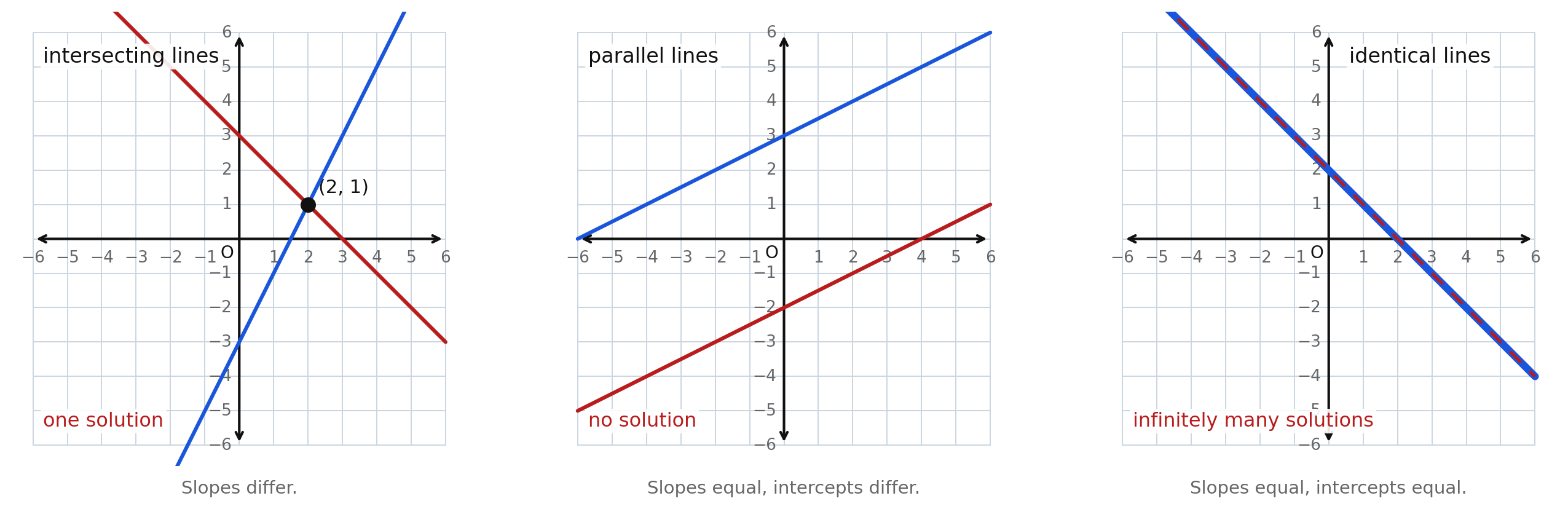
| Case | Slopes and intercepts | Graph | Algebra ends with | Solutions |
|---|---|---|---|---|
| One solution | slopes differ | lines cross once | a number | exactly one ordered pair |
| No solution | slopes equal, -intercepts differ | parallel lines | a false statement, like | none |
| Infinitely many | slopes equal, -intercepts equal | one line drawn twice | a true statement, like | every point of the line |
This is the same trichotomy Chapter 2 established for a single linear equation, moved up one dimension. There, the variable vanished and left a true or a false statement; here, exactly the same thing happens, and the picture is two lines instead of two sides of an equation.
One solution: the slopes differ
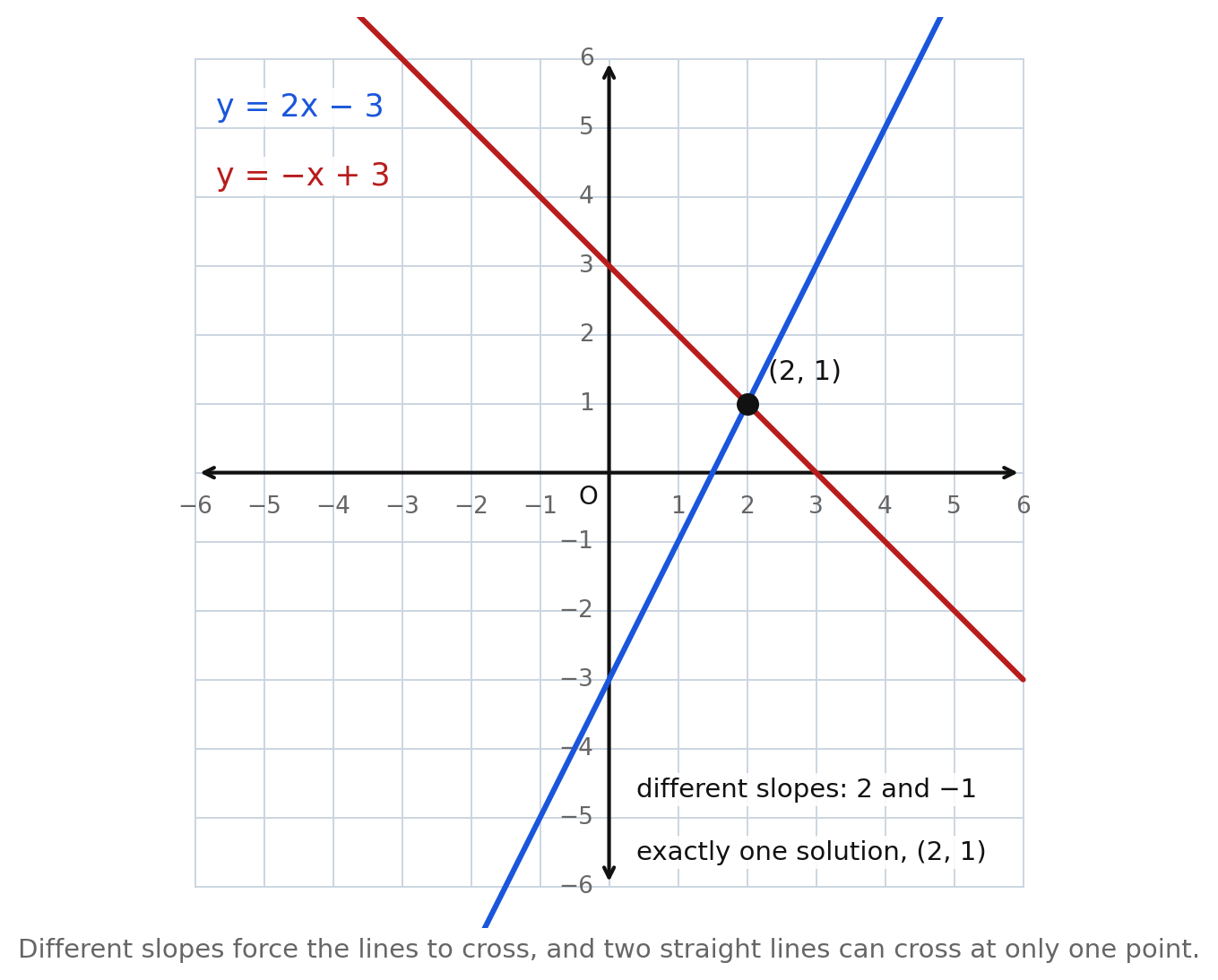
climbs for every across; falls . Different rates mean the gap between the lines is changing, and a changing gap must pass through zero exactly once. They cross at , and they cross nowhere else.
Test: put both equations in slope-intercept form. Different slopes exactly one solution. You do not have to solve the system to know this.
No solution: same slope, different intercepts
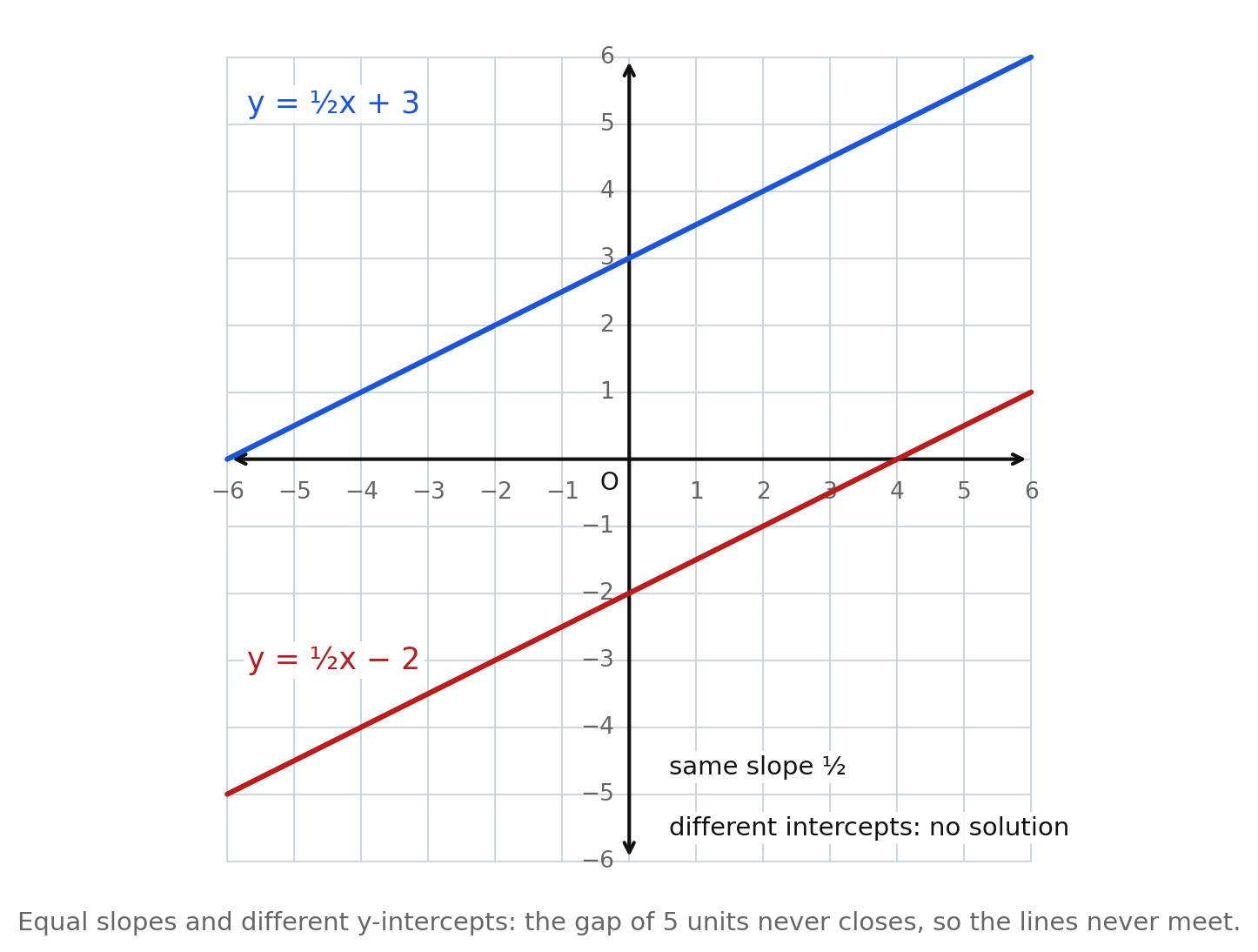
and climb at exactly the same rate. The second is units below the first at , and because they rise together, it is units below at every . A gap of that never changes is a gap that never closes.
Test: equal slopes and different -intercepts no solution.
Algebraically, both variables vanish and leave a false statement. The two are the same fact: "" is what "the gap is never zero" looks like written down.
Infinitely many: same slope, same intercept
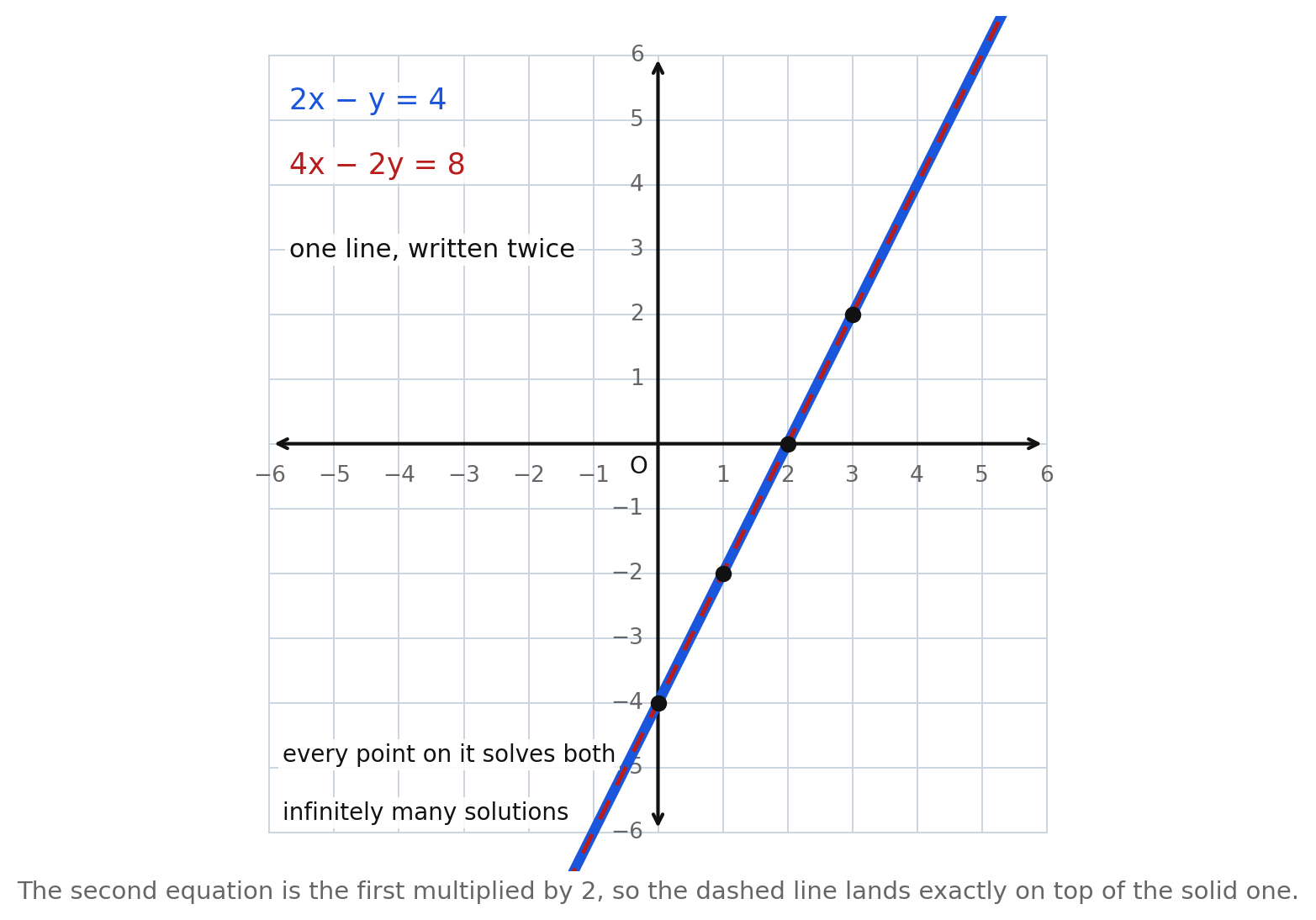
The second equation is the first multiplied by . It is not new information; it is the same line described with bigger numbers. Solve each for and both become .
Every point on that line satisfies both equations, so there are infinitely many solutions. The solution set is not "all real numbers" — it is every ordered pair on the line , which is a specific infinite set. The pairs , , , and are four of its members, and is not.
Test: equal slopes and equal -intercepts infinitely many solutions. Equivalently, in standard form, one equation is a nonzero constant multiple of the other.
Classifying without solving
Two routes give the same answer.
Route 1 — compare slopes and intercepts. Rewrite both in form and read the two numbers off each.
For and : the first is and the second is . Same slope, different intercepts, so no solution.
Route 2 — solve and watch what happens. Run substitution or elimination and read the ending.
- The variable survives and you get a number: one solution.
- Both variables vanish, false statement: no solution.
- Both variables vanish, true statement: infinitely many.
Route 1 is faster when you only need the count. Route 2 you get for free when you were solving anyway.
The trap. Ending with means every pair on the line works — infinitely many solutions. Ending with means no pair works. Students routinely swap these two. Read the statement: is it true, or is it false? True means everything works; false means nothing does.
Worked examples
Example 1 — Classify by slopes
Classify and .
The slopes and differ.
Answer: One solution.
Example 2 — Parallel
Classify and .
Same slope , different intercepts and .
Answer: No solution; the lines are parallel.
Example 3 — The same line twice
Classify and .
Dividing the second by gives , which is .
Answer: Infinitely many solutions.
Example 4 — From the algebra
Elimination on a system ends with . What is the answer?
The statement is false, and no substitution can change it.
Answer: No solution; the lines are parallel.
Example 5 — Choosing a coefficient
For what value of does and have no solution?
Parallel needs equal slopes and different intercepts. The intercepts and already differ.
Answer: . Every other value of gives different slopes, hence exactly one solution.
Guided practice
- Use the three-panel figure. Name the three cases in order, and give the number of solutions each one has.
- Use the figure of two crossing lines. Classify the system , and justify your answer with the slopes.
- Use the figure of two parallel lines. Classify the system , and justify your answer with the slopes and intercepts.
- Use the figure of one line drawn twice. Classify the system , , and show that the second equation is a multiple of the first.
- Classify and without solving. Explain how you decided.
- Classify and without solving. Explain how you decided.
Independent practice
- Classify each system as one solution, no solution, or infinitely many, by comparing slopes and -intercepts. a) and b) and c) and d) and e) and
- Rewrite each system in slope-intercept form, then classify it. a) and b) and c) and
- Find the value of for which and has no solution. Then explain why no value of gives that system infinitely many solutions.
- Find the value of for which and has infinitely many solutions, and explain why every other value of gives no solution at all.
- Application. Print Shop A charges plus per shirt; Print Shop B charges plus per shirt. Write the system, classify it, and explain in context what the classification means about the two shops' prices.
- Reasoning. Explain why a system of two linear equations can never have exactly three solutions, referring to what two lines can do in a plane.
- Error analysis. A student solves a system, reaches , and writes "no solution." Identify the error, state the correct conclusion, and describe the graph.
- Reasoning. Explain the connection between "both variables vanished and left a false statement" and "the two lines are parallel." Your explanation should mention slopes.
Exit ticket 8.5
- Classify and , and describe the graph.
- Classify and , and describe the graph.
- Classify and . If it has one solution, find it.
- Explain in your own words the difference between ending a solution with and ending it with , and name the number of solutions each ending reports.
Lesson 8.6 — Modeling with Systems, and Verifying Three Ways
Building the model
A.EI.2a is a creating skill, and A.EI.2h asks you to explain the method and interpret the result. Together they make a five-step routine that this lesson practices from end to end.
- Define both variables in full sentences, with units.
- Write one equation per independent fact.
- Solve — by graphing, substitution, or elimination — and say why you chose that method.
- Verify three ways: algebraically, graphically, and with technology.
- Interpret the ordered pair as a sentence about the situation, with units.
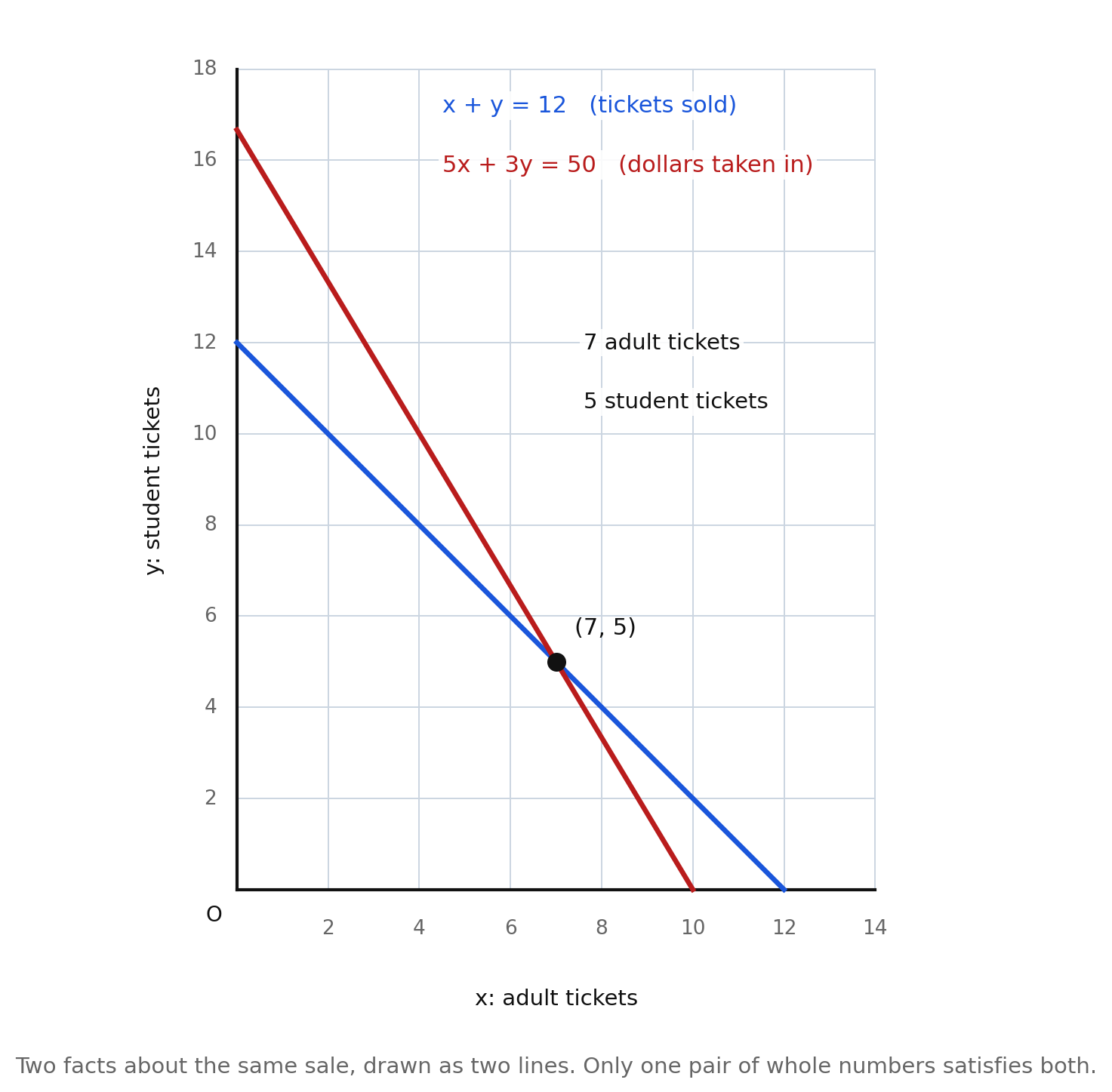
A worked model. A club sells adult tickets for and student tickets for . It sold tickets and took in . How many of each?
Step 1. Let be the number of adult tickets sold, and let be the number of student tickets sold. Both are counts of tickets.
Step 2. One fact counts tickets and one counts dollars:
Step 3. Elimination is convenient because both equations are in standard form. Multiply the first by to get , and add:
Step 4. Verify, three ways, below.
Step 5. Interpret: the club sold adult tickets and student tickets. That is the answer a person asked for; "" is the answer the mathematics produced.
The three-way verification
Bullet h names three checks by name, and they are three different kinds of evidence. Do all three.
1. Algebraically. Substitute the pair into both original equations and show each is true.
This is the only one of the three that is a proof. It shows the pair satisfies both conditions exactly.
2. Graphically. Graph both lines and confirm the crossing sits at the reported point. In the figure, the two lines meet at — seven units right, five units up. This check catches an answer that is wildly wrong: a sign error that put the solution in the wrong quadrant shows up instantly, long before you find it in the arithmetic.
3. With technology. Enter both equations in a graphing calculator or graphing site, choose a window that contains the crossing, and use the intersect feature. It should report , . Technology also catches the errors the other two miss — a misread of your own handwriting, a slip in the multiplication you did twice the same wrong way.
When the three disagree. A disagreement never means "mathematics is broken." It means one of the three was done wrong, and usually the disagreement tells you which. If the algebra says and the graph shows no crossing, suspect the window — you saw this in Lesson 8.2. If the graph and the technology agree with each other and your algebra disagrees with both, suspect a sign error in your arithmetic. If all three agree, you are done.
Interpreting the answer, including when it is unreasonable
An ordered pair is not an answer until it is a sentence. "" becomes "the two gyms cost the same after months, at each."
And interpretation includes noticing when the mathematics gives a number the situation cannot use.
A trip uses vehicles — vans holding people and buses holding — to carry people. Let be the number of vans and the number of buses. Then and . Substituting :
so and . The algebra is correct, the pair genuinely solves the system, and it is useless: nobody sends of a bus. The honest interpretation is that no combination of whole vehicles carries exactly people at exactly full capacity, so one of the stated facts must be wrong or the vehicles are not full.
That is not a failure of the method. Checking whether the solution makes sense in context is the last step of the method, and A.EI.2h calls it justifying the reasonableness of the answer.
Explaining the method
The standard asks you to explain the solution method, in words. A complete explanation names four things:
- which method you used;
- why — what feature of the equations made it convenient;
- the key step — what you substituted, or what you multiplied by and added;
- how you checked.
A model answer for the ticket problem: "I used elimination, because both equations were already in standard form and neither variable was isolated. I multiplied by so the -terms would cancel, added the equations to get , and found . Back-substituting gave . I checked in both original equations, saw the crossing at on the graph, and confirmed it with the intersect feature on a graphing calculator."
Worked examples
Example 1 — Build, solve, interpret
A jar of marbles holds more blue than red. How many of each?
Let be the number of red marbles and the number of blue. Then and . Substituting: , so and , then . Check: ✓ and ✓.
Answer: red marbles and blue marbles.
Example 2 — A break-even month
Gym A charges a joining fee plus a month; Gym B charges to join plus a month. When do they cost the same?
With in months and in dollars, and . Setting them equal: , so and , giving .
Answer: After months, both memberships have cost .
Example 3 — Verifying graphically
How would you check the answer to Example 2 on a graph?
Answer: Graph both cost lines with months on the horizontal axis and dollars on the vertical, using a window reaching at least and . The lines should cross at . Left of the crossing Gym B is cheaper; right of it Gym A is.
Example 4 — Two candles
A -cm candle burns cm per hour; a -cm candle burns cm per hour. When are they the same height?
and . Setting equal: , so and , giving .
Answer: After hours, both candles are cm tall.
Example 5 — An unreasonable solution
A system modeling whole numbers of vehicles gives . What do you report?
Answer: That the pair solves the system but cannot describe the situation, because vehicles come in whole numbers. No whole-number combination satisfies both facts, so one of the stated facts must be wrong.
Guided practice
- Use the ticket figure. Define both variables in full sentences, write the system, solve it, and interpret the solution in a sentence with units.
- Use the ride-plan figure. Define both variables, write the system, solve it, and say what the crossing means and what each side of it means.
- A jar of marbles holds more blue marbles than red. Define both variables, write the system, and solve it.
- Verify your answer to item 104 three ways: algebraically in both equations, graphically by describing where the lines cross, and with technology by describing what you would enter and what it should report.
- Write a complete explanation of your solution method for item 104, naming the method, the reason you chose it, the key step, and how you checked.
- A trip uses vehicles — vans holding and buses holding — to carry people. Write and solve the system, then explain why the solution cannot describe the trip.
Independent practice
- Application. Gym A charges to join plus a month; Gym B charges to join plus a month. Define the variables, write the system, solve it, and interpret the solution with units.
- Application. A rectangular garden has perimeter feet, and its length is three times its width. Define both variables with units, write the system, solve it, and give the dimensions.
- Application. A cashier has bills, all twos and fives, worth . Define both variables, write the system, solve it, and state how many of each bill there are.
- Application. A -cm candle burns down cm per hour; a -cm candle burns down cm per hour. Define the variables with units, write the system, solve it, and interpret the solution.
- Technology. Check your answer to item 111 with technology. Give a viewing window in which the crossing is visible, say what the intersect feature reports, and state whether the technology agrees with your algebra.
- Reasoning. Explain why substituting a candidate pair into only one of the two equations proves nothing about whether it solves the system.
- Error analysis. A student solves a ticket problem, finds , and writes "the solution is ." Identify what is missing, and explain what a complete answer to a system problem looks like.
- Application. Print Shop A charges plus per shirt; Print Shop B charges plus per shirt. Write the system, solve it, and interpret what the result means for a customer deciding between the shops.
- Application. A store advertises " pounds of trail mix and pound of nuts for " and also " pounds of trail mix and pounds of nuts for ." Write the system, classify it, and explain in context why the second advertisement gives a shopper no new information.
Exit ticket 8.6
- Application. A quiz has questions, each worth either points or points, and the quiz is worth points in total. Define both variables in full sentences, write the system, and solve it.
- Verify your answer to item 117 algebraically in both equations, and describe the graphical check.
- Interpret your answer to item 117 in one sentence with units.
- Technology. Describe how you would confirm item 117 with a graphing calculator, and say what you would conclude if the calculator reported a different point.
Chapter 8 Review
Vocabulary. system of two linear equations · solution of a system · ordered pair · satisfy · verify · solve by graphing · point of intersection · substitution · back-substitute · elimination · addition property of equality · equivalent equation · one solution · no solution · infinitely many solutions · parallel lines · identical lines · break-even point · viewing window · interpret
A.EI.2 a, b, c, and h ask four different kinds of question, so this review is organized by bullet. Part A creates systems from context (bullet a), Part B solves them graphically and algebraically (bullet b), Part C classifies the solution count (bullet c), and Part D verifies, explains, and interprets (bullet h).
Part A — Creating a system from a context
- Application. A school store sells pencils for and erasers for . In one week it sold items and took in . Define both variables in full sentences with units, write the system, and solve it.
- Application. Two numbers have a sum of , and the larger is less than twice the smaller. Define both variables, write the system, and find both numbers.
Part B — Solving algebraically and graphically
- Solve and by graphing, and verify in both equations.
- Solve and by substitution.
- Solve and by elimination.
- Solve and by any method, and name the method you chose and why.
Part C — Counting the solutions
- Classify and , and describe the graph.
- Classify and , and describe the graph.
- Classify and . If it has one solution, find it.
Part D — Verifying, explaining, and interpreting
- Verify your answer to item 126 three ways: algebraically in both original equations, graphically by naming the crossing point, and with technology by describing the window and what the intersect feature should report.
- Application. Tank A holds liters and drains at liters per minute; Tank B holds liters and fills at liters per minute. Define both variables with units, write the system, solve it, and interpret the solution in a sentence.
- Application. Write a complete explanation of your work on item 131: name the method you used and why, give the key step, state how you verified the answer three ways, and say whether the solution is reasonable for the situation.
Standards coverage check — Chapter 8
A.EI.2b names two solution routes — algebraic and graphical — and the algebraic route splits into two standard methods, so coverage of that bullet is broken out by method.
| Knowledge and Skill | Aspect | Where it is taught | Where it is practiced | Where it is interpreted in context |
|---|---|---|---|---|
| A.EI.2a — create a system of two linear equations in two variables to represent a contextual situation | Defining variables and writing two equations | 8.1 (the three-step build); 8.6 (the full five-step routine) | 5, 9, 10, 11, 12, 16, 19; 52, 55; 77, 83; 102, 104, 107, 108, 109, 110, 111, 115, 116, 117; 121, 122, 131 | 5, 9, 10, 11, 12, 16, 19, 52, 55, 83, 102, 103, 108–111, 115–117, 121, 122, 131 |
| A.EI.2b — apply the properties of real numbers and/or equality to solve a system algebraically and graphically | Graphically | 8.2 (rewrite for , graph both, read the crossing, verify) | 21–33, 36–39; 123 | 31, 32, 36 |
| A.EI.2b | Substitution | 8.3 (isolate, substitute, solve, back-substitute, verify) | 42–46, 48–51, 57–61; 124 | 52–55, 62, 104, 107, 111, 117 |
| A.EI.2b | Elimination | 8.4 (line up, multiply, add, back-substitute, verify) | 63–67, 69–73, 79–82; 125, 126 | 74–77, 83, 102, 110 |
| A.EI.2c — determine whether a system has one solution, no solution, or an infinite number of solutions | All three cases, from the graph and from the algebra | 8.5 (the three cases, the slope-intercept test, and what the algebra ends with) | 29, 30, 35, 40; 50, 51; 72, 73; 84–101; 127, 128, 129 | 94, 115, 116 |
| A.EI.2h — verify possible solutions algebraically, graphically, and with technology; explain the solution method and interpret solutions in context | Verify algebraically | 8.1 (both equations, never one); 8.6 (step 4) | 2, 3, 4, 7, 8, 17, 18; 22, 23; 46, 58; 67; 105, 113, 118; 130 | 105, 118, 130 |
| A.EI.2h | Verify graphically | 8.2 (reading and confirming a crossing); 8.6 (step 4) | 22, 23, 31, 38, 39; 58; 77; 105, 118; 130 | 31, 103, 131 |
| A.EI.2h | Verify with technology | 8.2 (the window that lies); 8.6 (the intersect feature, and what a disagreement means) | 15, 33, 41; 112, 120; 130 | 33, 112, 120 |
| A.EI.2h | Explain the method | 8.4 (choosing between methods); 8.6 (the four parts of an explanation) | 47, 49, 56; 68, 70, 71, 78, 82; 101, 106, 126, 132 | 106, 132 |
| A.EI.2h | Interpret in context | 8.2 (which side of the crossing is cheaper); 8.6 (a sentence with units, and unreasonable answers) | 31, 36; 103, 107, 114, 119; 131 | 31, 36, 103, 107, 108–111, 115, 116, 119, 131 |
Supporting items: 6, 13, 20 fix what a solution of a system is and why exactly two solutions is impossible; 34, 41 name the limits of a graph and of a viewing window; 14, 35, 57, 79, 96, 114 are error analyses aimed at the six most common failures — checking only one equation, misreading a graph, substituting back into the same equation, mishandling a subtraction, swapping with , and reporting a single number instead of an ordered pair.
Boundaries respected. Every system in this chapter has exactly two linear equations in exactly two variables. No item asks about a linear inequality in two variables or a system of inequalities; those are A.EI.2 d, e, f, and g, in Chapter 9. No item asks the student to solve a single linear equation as the whole task (Chapter 2), to write the equation of a line from a graph or from two points (Chapter 6), or to graph or evaluate a single linear function as the answer to a characteristic question (Chapter 7) — those skills are used as tools throughout and are never the object of assessment. Bullet h is shared with Chapter 9 by design; here it is exercised entirely on systems of equations.
Answer keys for every item in this chapter are in Appendix A.