Chapter 6 — Writing Equations of Lines
Standard: A.F.1 (d, e)
A.F.1 — verbatim. The student will investigate, analyze, and compare linear functions algebraically and graphically, and model linear relationships. Students will demonstrate the following Knowledge and Skills: d) Write the equation of a linear function to model a linear relationship between two quantities, including those that can represent contextual situations. Writing the equation of a linear function will include the following situations: given the graph of a line; given two points on the line whose coordinates are integers; given the slope and a point on the line whose coordinates are integers; vertical lines as ; and horizontal lines as . e) Write the equation of a line parallel or perpendicular to a given line through a given point.
By the end of this chapter you will be able to:
- Write the equation of a line from a slope and one point whose coordinates are integers, using point-slope form and then slope-intercept form (A.F.1d)
- Write the equation of a line from two points whose coordinates are integers (A.F.1d)
- Write the equation of a line from its graph, both when the -intercept is visible and when it is not (A.F.1d)
- Write a horizontal line as and a vertical line as , and say which of the two is a function (A.F.1d)
- Model a real relationship with a linear equation and say what its slope and its -intercept mean, with units (A.F.1d)
- Write the equation of a line parallel to a given line through a given point, and the equation of a line perpendicular to a given line through a given point (A.F.1e)
- Verify every equation you write two ways — by substituting the given point and by graphing — and treat a disagreement between the two as information
Lessons: 6.1 From a Slope and a Point · 6.2 From Two Points · 6.3 From a Graph · 6.4 Horizontal and Vertical Lines · 6.5 Parallel and Perpendicular Lines
Why this chapter matters. Chapter 5 handed you an equation and asked what it says. This chapter reverses the arrow. You are handed a situation — two billed jobs, a line drawn on a grid, a rate and a single measurement, a street that must run alongside another one — and you produce the equation. That is what modeling is, and it is the skill that makes every later chapter usable: a system of equations in Chapter 8 is two of these written down at once, and a line of best fit in Chapter 19 is this same act performed on data that does not lie perfectly straight.
Scope note. This chapter writes equations. Identifying and interpreting slope, intercepts, zeros, domain, and range, and converting among slope-intercept, standard, and point-slope forms, are A.F.1 a, b, and c, in Chapter 5 — this chapter uses all of them freely as things you already know, and cites Chapter 5 when it does. Graphing a linear function with and without technology is A.F.1f, evaluating at an input is A.F.1g, and recovering from a given is A.F.1h; all three are Chapter 7. When this chapter asks you to graph, it is always to check an equation you have already written algebraically, never as the answer itself. The five situations of A.F.1d are exactly the five this chapter teaches, and no more: a graph, two points with integer coordinates, a slope and a point with integer coordinates, a vertical line , and a horizontal line . Bullet e is parallel or perpendicular through a given point, which is the only thing that pins one line down out of the infinitely many with the right slope.
Conventions this chapter fixes.
- Point-slope form is , where is the slope and is a point on the line. It is the tool of this chapter, because it is the only form that accepts a slope and any point at all.
- Slope-intercept form is . Unless a problem says otherwise, a written equation is reported in slope-intercept form, because that is the form the next chapter graphs and evaluates.
- A vertical line is written and a horizontal line is written , using the letters A.F.1d uses. A vertical line has no slope and is not a function; a horizontal line has slope and is a function.
- Parallel lines have equal slopes. Perpendicular lines have slopes whose product is — each is the negative reciprocal of the other. The one exception is a vertical line and a horizontal line, which are perpendicular even though has no slope to multiply.
- Every written equation gets checked. Substitute the given point back in, and graph the result. This volume treats technology as an instrument of verification: the algebra produces the equation, the graph confirms it, and if the two disagree, one of them is wrong and you are not done.
- Item numbering runs straight through the chapter, from 1 in Lesson 6.1 to 123 at the end of the review. It does not restart at each lesson.
Lesson 6.1 — From a Slope and a Point
The problem slope-intercept form cannot solve directly
You know from Chapter 5 that carries two facts: the slope and the -intercept . That form is perfect when a problem hands you those exact two things.
But most problems do not. A problem hands you a slope and some point — , say, which is nowhere near the -axis. Slope-intercept form has no place to put that point.
Point-slope form does.
Here is the slope and is any point on the line. That is the whole advantage: point-slope form does not care which point you have. You met this form in Chapter 5 and read information out of it; here you write information into it.
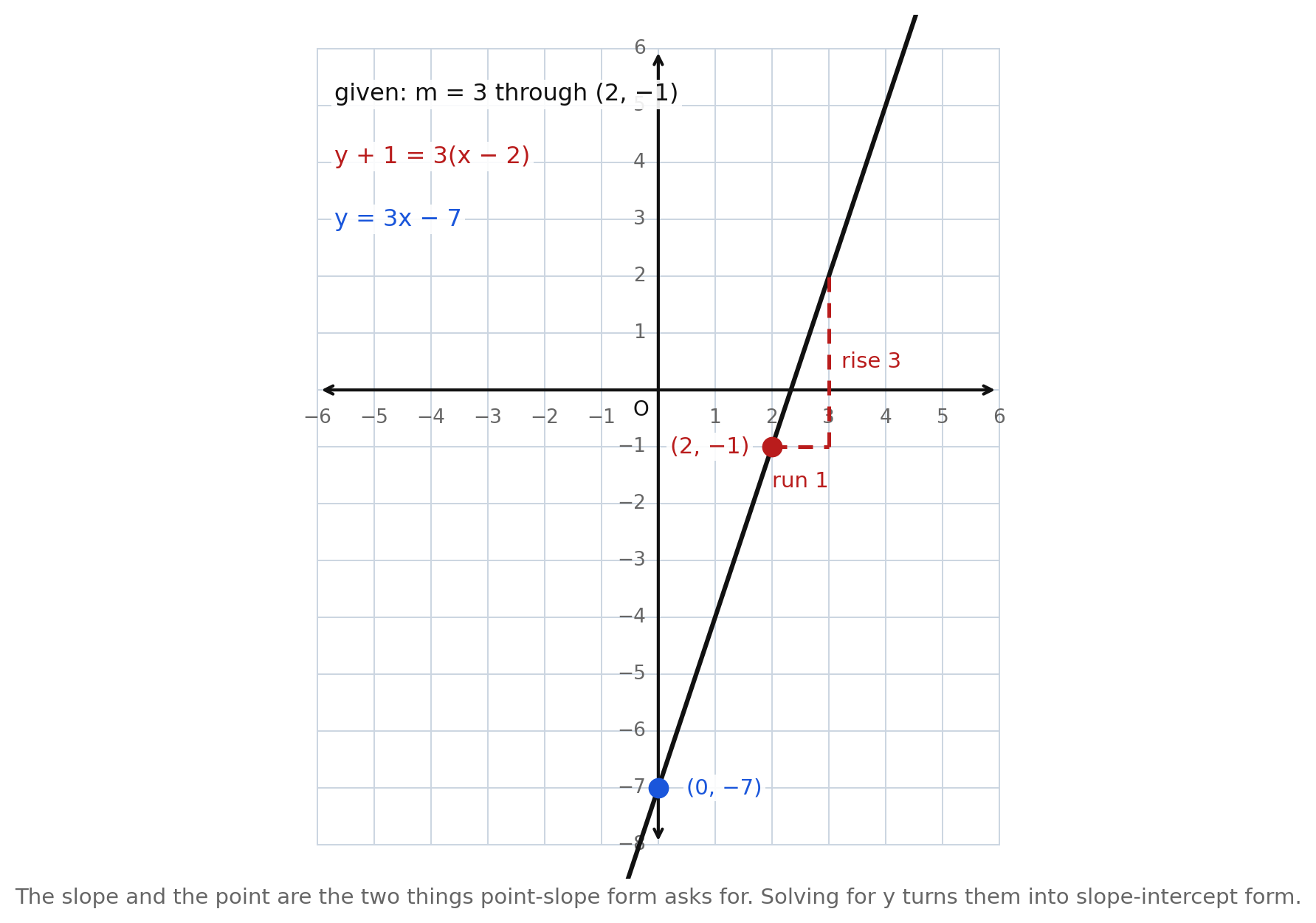
The figure works one problem all the way through. Given: slope , through the point .
Drop the two given things into their two slots:
That is already a correct equation of the line. Solving for turns it into the form the rest of the course prefers:
- Distribute.
- Isolate .
Now compare the two forms against the picture. Point-slope form advertises the point you were given, , which is marked in red. Slope-intercept form advertises the -intercept , which is marked in blue — a point nobody mentioned, and which the algebra found for you. The dashed triangle confirms the slope: from , going right and up lands you back on the line, so .
The procedure
- Identify and . Write them down before you write anything else.
- Substitute into . Substitute; do not simplify yet.
- Watch the double negatives. If is negative, becomes . Same for .
- Distribute and solve for to reach slope-intercept form.
- Check. Put the given point into your final equation. It must produce a true statement.
Step 5 is not optional. It costs ten seconds and it catches the sign error that step 3 warns about.
The two sign traps
Almost every wrong answer in this lesson is one of these two.
A negative . Given through , the form is , which is . Writing instead produces , a line parallel to the right one but two units too high. Check it: , not . The check catches it immediately.
A negative . Given through , the form is , which is :
Check: . ✓
The special case where the point is already the intercept
If the given point is on the -axis, you are done before you start. Given through , the point tells you directly, so . Point-slope form would get you there too, just with an extra step.
What the two numbers mean in a situation
A.F.1d asks for models, and a model is a slope and a point wearing units.
A pool drains at gallons per minute, and a worker measures gallons in it minutes after draining began. The rate is the slope, gallons per minute — negative, because the water is going down. The measurement is the point .
The was never mentioned in the story, and it is the most useful number in the answer: the pool held gallons at the moment draining began. That is what a -intercept means in a model, exactly as in Chapter 5 — the starting value.
Confirming with a graph
Write the equation algebraically first. Then graph it and look for the given point on the line. If the point is not on the graph, something is wrong — and the useful part is that the kind of miss tells you which mistake you made. A point that misses vertically means the constant is wrong, which is the sign trap above. A line through the point at the wrong steepness means the slope was mishandled. A disagreement between your algebra and your graph is never a reason to pick one and move on; it is a reason to find the error.
Worked examples
Example 1 — A positive slope and a negative -coordinate
Write the equation of the line with slope through .
, so .
Answer: . Check: ✓
Example 2 — A negative slope
Write the equation of the line with slope through .
, so .
Answer: . Check: ✓
Example 3 — A fractional slope and a negative -coordinate
Write the equation of the line with slope through .
, so .
Answer: . Check: ✓
Example 4 — The point is the intercept
Write the equation of the line with slope through .
The point has -coordinate , so it is the -intercept and .
Answer:
Example 5 — A model
A gym charges the same amount every month, and a member who has belonged for months has paid in total, at per month. Write the total-paid function and interpret both numbers.
The rate is dollars per month and the point is . Then , so .
Answer: . The slope is the monthly charge, in dollars per month. The -intercept is a one-time joining fee of — paid at zero months of membership, so it cannot be a monthly charge.
Guided practice
- Use the figure of a slope and a point. What slope and what point is the problem given, and which slot of point-slope form does each one fill?
- In that same figure, write the equation in point-slope form exactly as it appears, and explain why becomes .
- In that same figure, solve your point-slope equation for , and name the -intercept your answer reveals.
- In that same figure, the dashed triangle shows a run of and a rise of . Explain how it confirms that the slope is .
- Write the equation of the line with slope through , in point-slope form and then in slope-intercept form.
- Write the equation of the line with slope through , and check your answer by substituting the given point.
Independent practice
- Write each in point-slope form, then in slope-intercept form. a) slope through b) slope through c) slope through d) slope through
- Write the equation of the line with slope through , and say what kind of line it is.
- Write the equation of the line with slope through , and explain why point-slope form was not needed.
- Reasoning. Explain why point-slope form works with any point on the line, while slope-intercept form needs the one particular point .
- Write the equation of the line with slope through , and check it by substitution.
- Error analysis. Given slope through , a student writes and reports . Identify the error, give the correct equation, and show the substitution check that would have caught it.
- Application. A pool drains at gallons per minute, and minutes after draining began it holds gallons. Write for the gallons left after minutes, then interpret the slope and the -intercept with units.
- Application. A gym charges per month, and a member who has belonged months has paid in all. Write the total-paid function, then say what the -intercept is and why it cannot be a monthly charge.
- Technology. Graph your answer to 7a and confirm that lies on it. Then say what you would conclude — and what you would do next — if the point did not lie on your graph.
- Write the equation of the line with slope through , and check it by substitution.
Exit ticket 6.1
- Write the equation of the line with slope through .
- Write the equation of the line with slope through .
- Use the figure of a slope and a point. Write the line's equation in point-slope form and in slope-intercept form, and name the point each form displays.
- Explain in one or two sentences why substituting the given point back into your finished equation is a check worth doing every time.
Lesson 6.2 — From Two Points
Two points, one extra step
A.F.1d names two points whose coordinates are integers, and that is the situation of this lesson. It is Lesson 6.1 with one step added at the front, because two points do not hand you a slope — they contain one.
- Find the slope with the formula from Chapter 5: .
- Pick either point and write point-slope form, exactly as in Lesson 6.1.
- Solve for .
- Check with the point you did not use. This is the best check in the chapter, because it tests the whole answer against information you have not yet leaned on.
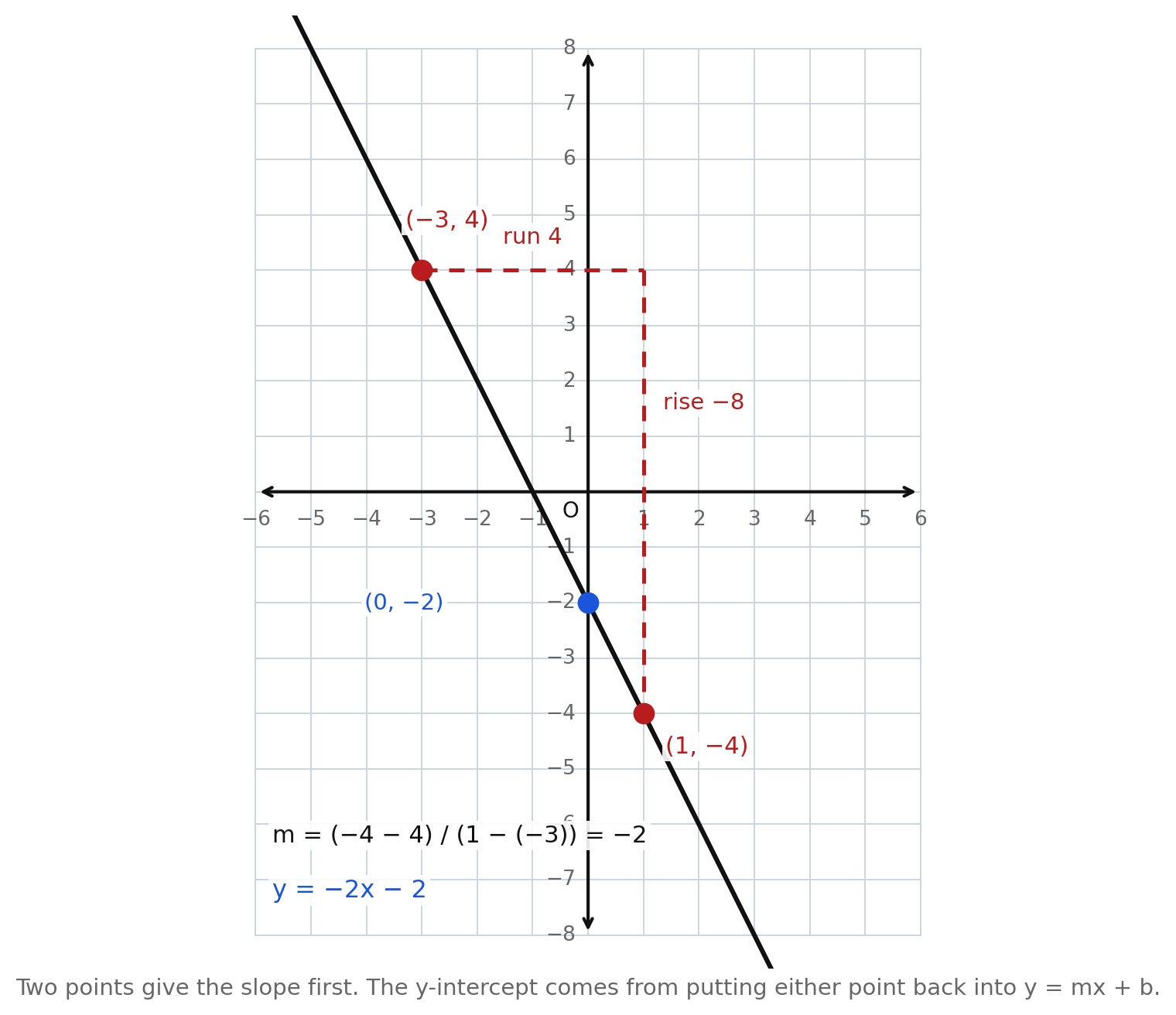
The figure runs the procedure on and .
Step 1 — slope.
The dashed path shows the same two numbers as a picture: a run of to the right and a rise of , which is a fall of .
Step 2 and 3 — the equation. Using :
Step 4 — check with the other point. At : ✓, which is exactly the -coordinate of .
Either point, same line
It genuinely does not matter which point you choose in step 2. Take and :
Using : , so and .
Using : , so and .
Same equation. That is not a coincidence and it is not luck: both points are on the same line, and a slope plus any point on a line determines that line completely.
The shortcut when one point is on the -axis
If either given point has -coordinate , you already have . Through and : the slope is , and says , so with no substitution step at all.
The two points that do not give a slope you can use
Two points can also describe a horizontal or a vertical line, and the slope formula tells you which.
- and : the rise is , so and the line is horizontal — the equation is .
- and : the run is , and is undefined. The line is vertical, its equation is , and it is not a function.
Lesson 6.4 gives both cases their own treatment. Notice them here so that a run of zero reads as "this is the vertical case" rather than as a dead end.
Two points in a situation
Two measurements of the same relationship are two points, and this is the single most common way a real linear model gets built.
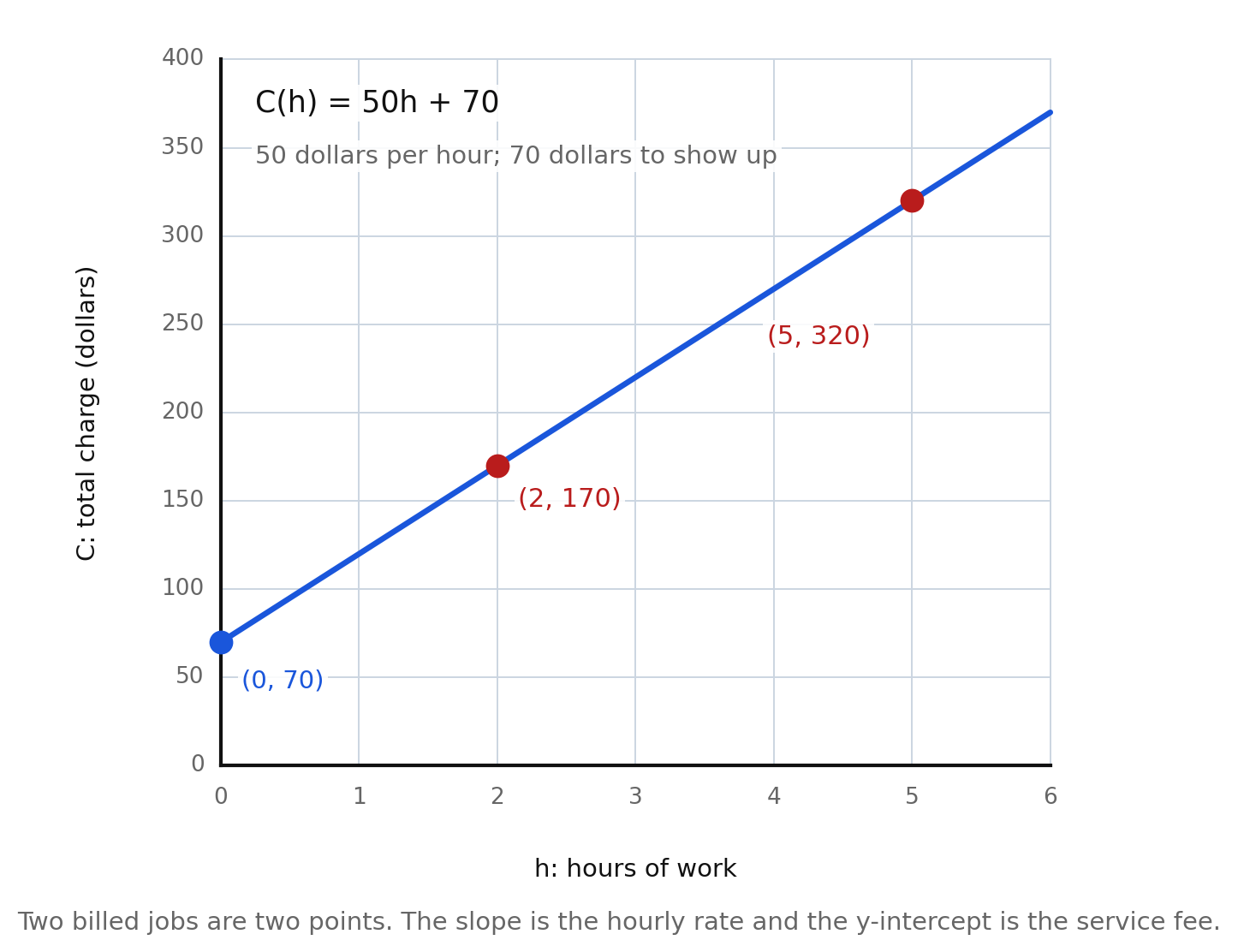
A plumber bills two jobs: a -hour job costs , and a -hour job costs . Those are the points and .
Using : , so .
Now say what the two numbers mean, because that is what A.F.1d asks for:
- The slope is the hourly rate: per hour of work. Slope carries the units of the output over the units of the input, dollars per hour.
- The -intercept is the charge for a job of zero hours: a service fee for showing up, paid before any work happens.
Neither number was stated in the story. Both came out of two bills.
Verifying an equation you wrote
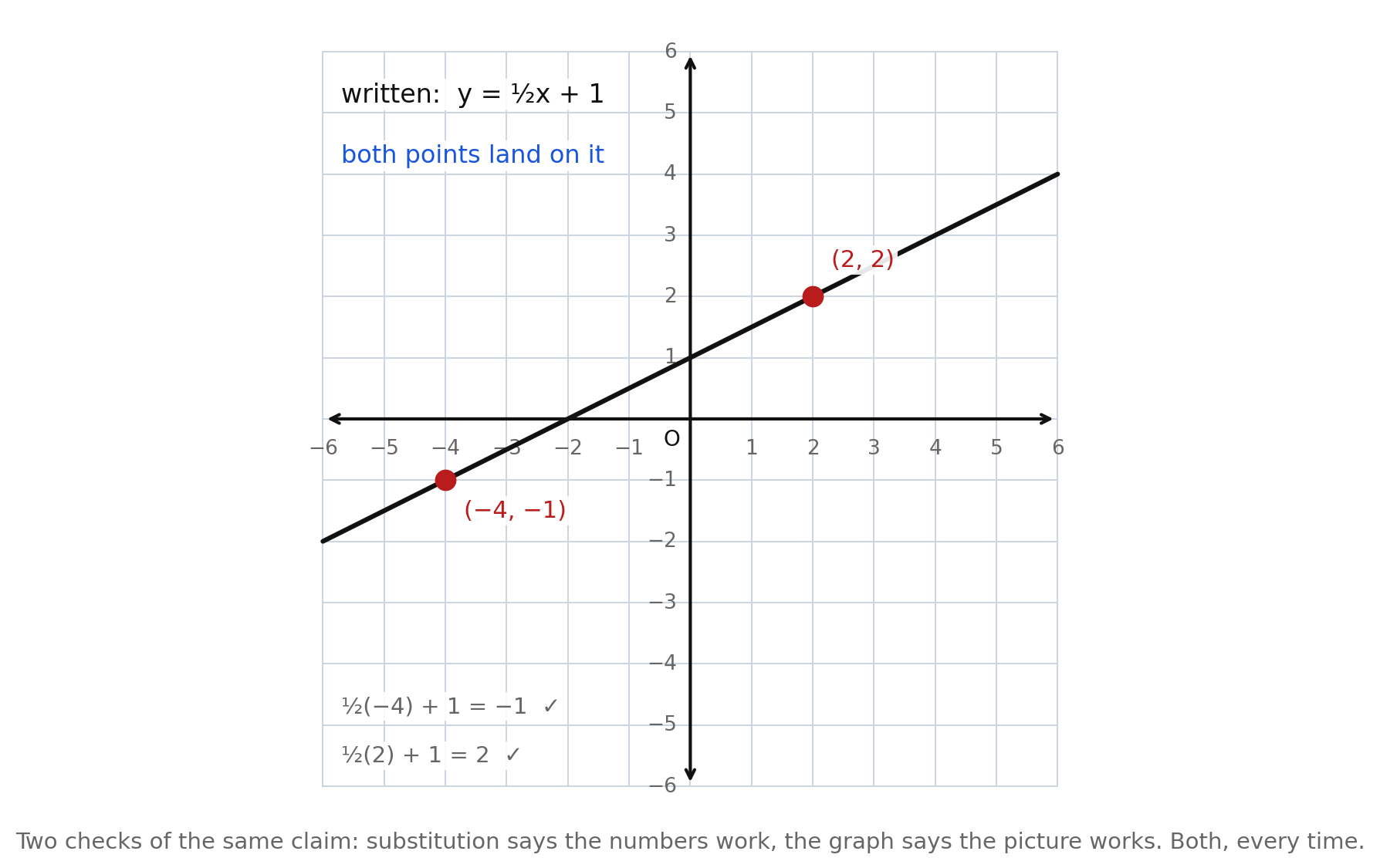
This figure shows the habit this volume asks for on every written equation. The line was produced algebraically from the two points and . Then it was checked twice:
- By substitution. ✓ and ✓
- By graphing. Both points land on the drawn line.
Two checks of the same claim, in two different languages. If the substitution works and the graph does not, you have graphed the wrong equation. If the graph looks right and the substitution fails, trust the substitution — the arithmetic is exact and the eye is not.
Worked examples
Example 1 — Two integer points
Write the equation of the line through and .
. Using : , so .
Answer: . Check with : ✓
Example 2 — A fractional slope from integer points
Write the equation of the line through and .
. Using : , so .
Answer: . Check with : ✓
Example 3 — A point on the -axis
Write the equation of the line through and .
, and is the -intercept.
Answer:
Example 4 — A run of zero
Write the equation of the line through and .
The run is , so the slope is undefined. Both points share the input .
Answer: , a vertical line with no slope, and not a function.
Example 5 — A model from two measurements
A rideshare charges the same rate per mile plus a fixed fee. A -mile ride costs and a -mile ride costs . Write the cost function and interpret both numbers.
. Using : , so .
Answer: . The slope is per mile; the -intercept is a fee charged before the car moves.
Guided practice
- Use the figure of a line through two integer points. Name the two marked points and compute the slope from them.
- In that same figure, use either point to write the equation in point-slope form, then solve for .
- In that same figure, check your equation with the point you did not use in item 22, and show the substitution.
- Write the equation of the line through and , and say why no substitution step was needed.
- Write the equation of the line through and .
- Use the verification figure. Name the two checks it shows, and say which one you would trust if they disagreed.
Independent practice
- Write each line's equation in slope-intercept form. a) through and b) through and c) through and d) through and
- Write the equation of the line through and , and check it with both points.
- Write the equation of the line through and , and say what the slope formula produced and what kind of line that makes.
- Write the equation of the line through and . Say what happens in the slope formula, and whether the result is a function.
- Application. Use the plumber figure. From the two marked jobs, write , then interpret the slope and the -intercept in context, with units.
- Application. A candle is measured twice: after hour it is inches tall, and after hours it is inches tall. Write , then interpret the slope and the -intercept with units.
- Application. A tree is feet tall at age years and feet tall at age years. Write a linear model for its height, interpret the slope with units, then explain why the -intercept of this model is not a believable fact about the tree.
- Technology. Graph your answer to 27d and confirm that both given points lie on it. Say what a miss at only one of the two points would tell you about where the error is.
- Reasoning. Using and , write the equation twice — once starting from each point — and show that the two results are identical. Explain why that had to happen.
- Error analysis. To find the slope through and , a student computes . Identify the error, give the correct slope, and give the correct equation.
Exit ticket 6.2
- Write the equation of the line through and .
- Write the equation of the line through and .
- Write the equation of the line through and , and give its slope.
- Application. A rideshare charges a fixed fee plus a rate per mile. A -mile ride costs and a -mile ride costs . Write the cost function and interpret both numbers with units.
Lesson 6.3 — From a Graph
Reading the two numbers off a picture
A.F.1d's first situation is a line already drawn for you. Nothing new is needed — the graph is just a different container for the same two facts.
- Find , if you can see it. Look where the line crosses the -axis.
- Find by counting a slope triangle between two lattice points — points where the line passes exactly through a grid corner.
- Write , and check with a third point on the graph.
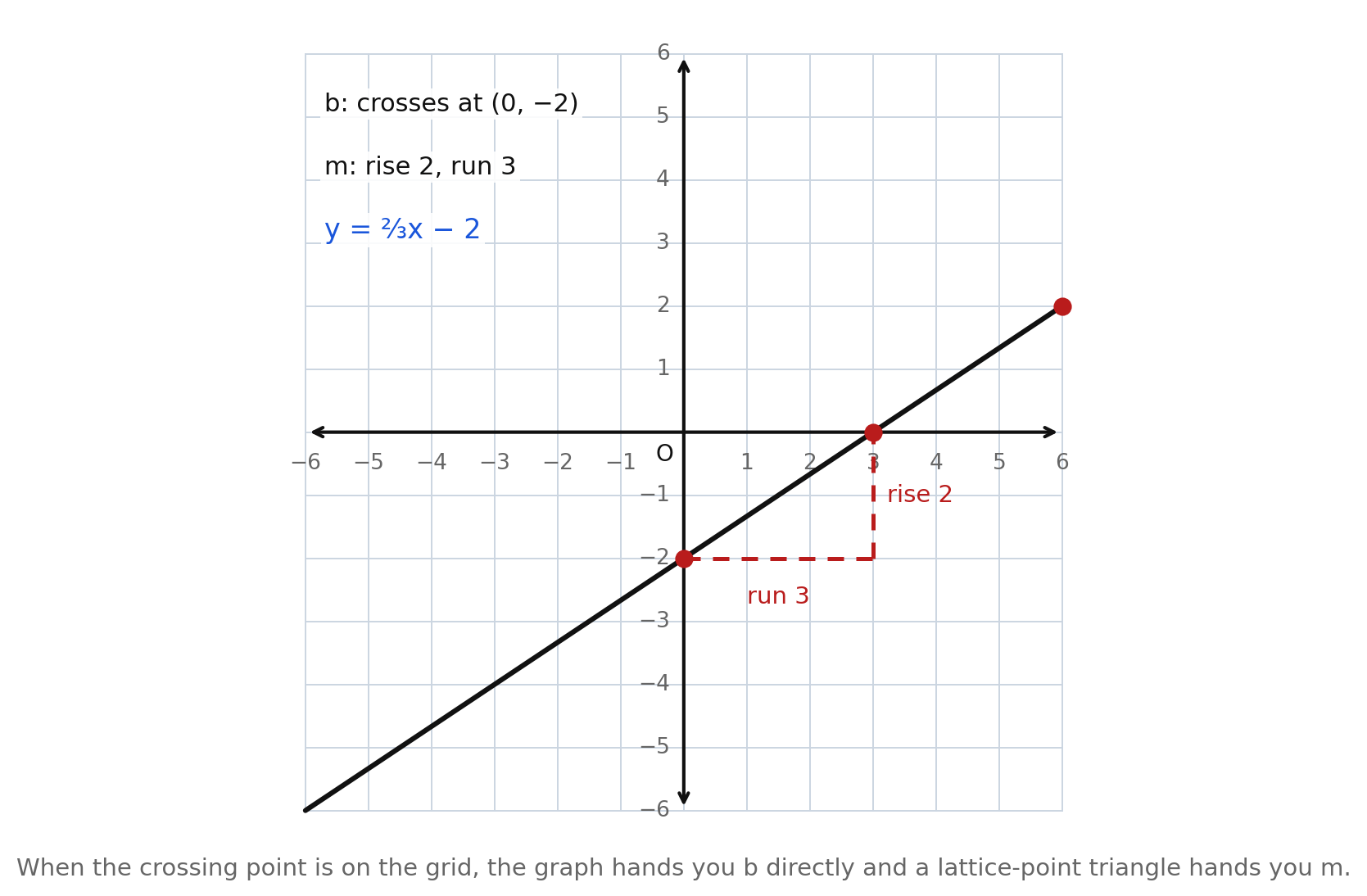
In the figure, the line crosses the -axis at , so . From that crossing, going right and up lands on the lattice point , so
and the equation is .
Check with the third marked point, : ✓
Count lattice points, not eyeballed ones. The reason the figure marks , , and is that all three sit exactly on grid corners. A point read off the middle of a square is a guess, and a guessed rise over a guessed run is a guessed slope. Look along the line until it crosses a corner cleanly, and count from there.
When the -intercept is not on the grid
Sometimes the drawn window does not include the -axis crossing at all. Step 1 fails, and this is exactly the situation point-slope form exists for.
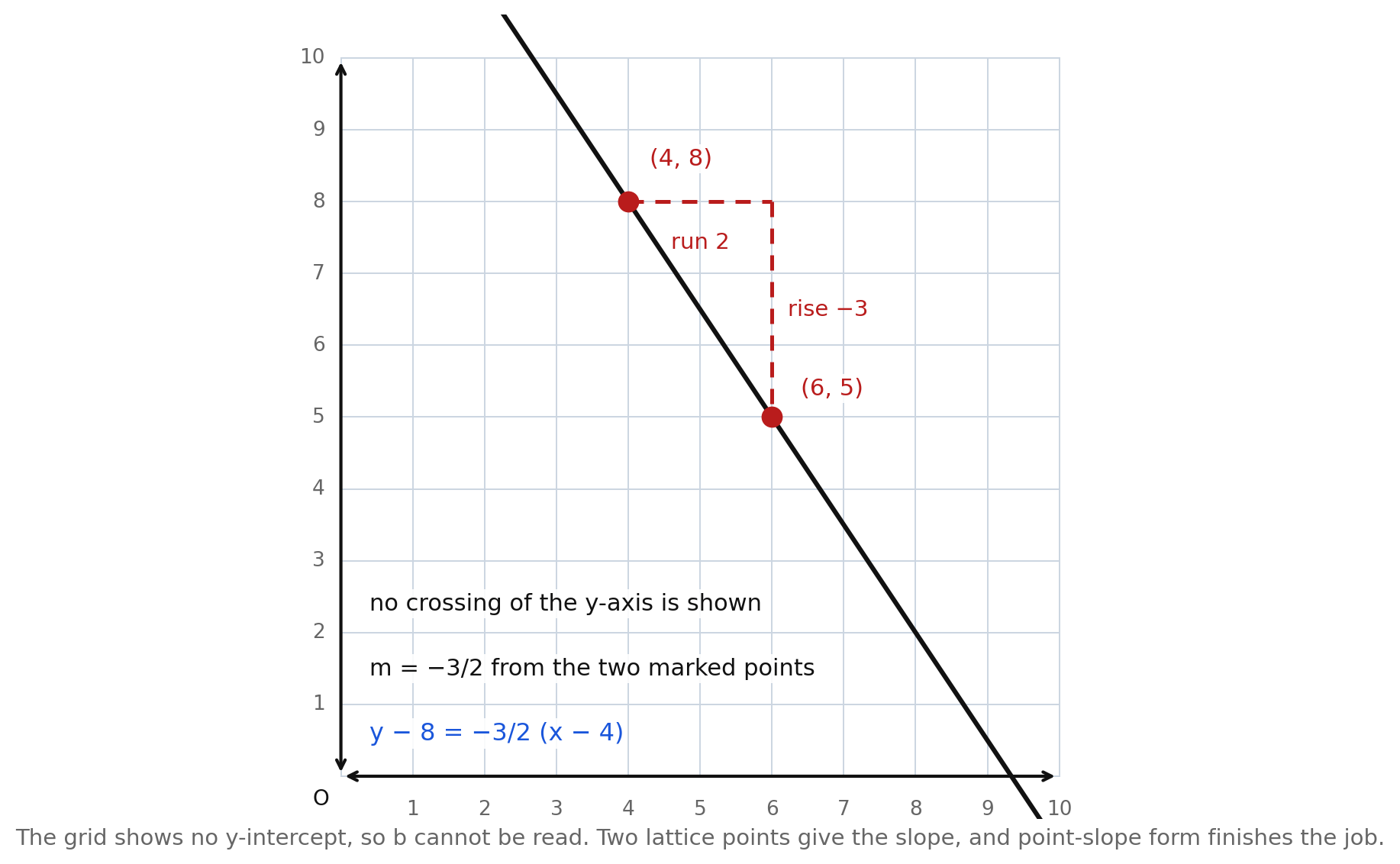
The window here runs from to on both axes, and the line leaves the top of the picture before it ever reaches the -axis. There is no to read.
But there are still two clean lattice points, and :
Now use the point you have, exactly as in Lesson 6.1:
The -intercept is — a point well off the top of the drawn grid, which is precisely why it could not be read. Check with the other lattice point: ✓
This is the general lesson of the chapter in one picture. You do not need the -intercept to write the equation of a line. You need a slope and any one point.
Worked examples
Example 1 — Both numbers visible
A line crosses the -axis at and passes through . Write its equation.
, and .
Answer:
Example 2 — A negative slope from a graph
A line crosses the -axis at and passes through . Write its equation.
, and .
Answer:
Example 3 — No visible intercept
A graph shows a line through the lattice points and , with the -axis crossing off the drawn window. Write its equation.
. Then , so .
Answer: . Check at : ✓
Example 4 — Reading a steep triangle
A line crosses the -axis at , and its slope triangle shows a run of and a rise of . Write its equation.
and .
Answer:
Example 5 — Checking against a third point
Confirm that the equation read from the first graph figure, , agrees with its third marked point .
, and the marked point's -coordinate is .
Answer: They agree, so the equation describes the drawn line at a point that was not used to build it.
Guided practice
- Use the first graph figure of this lesson. Where does the line cross the -axis, and what does that give you?
- In that same figure, use the dashed triangle to find the slope, and say which two lattice points the triangle runs between.
- In that same figure, write the equation of the line in slope-intercept form.
- Use the figure whose window shows no -axis crossing. Explain why the first step of the usual procedure fails there.
- In that same figure, name the two marked lattice points and compute the slope from them.
- In that same figure, write the equation in point-slope form and then in slope-intercept form, and name the -intercept your answer predicts.
Independent practice
- Describe, in your own words, the three-step procedure for writing the equation of a line from its graph, and say which step fails when the -axis crossing is off the window.
- A line crosses the -axis at and passes through the lattice point . Write its equation.
- A line crosses the -axis at and passes through the lattice point . Write its equation.
- A graph shows a line through the lattice points and , with no -axis crossing visible. Write its equation.
- Use the first graph figure of this lesson. Verify your equation with the marked point , showing the substitution.
- Use the figure with no visible intercept. Verify your equation with the marked point , showing the substitution.
- A line crosses the -axis at , and a slope triangle on it shows a run of and a rise of . Write its equation.
- Reasoning. Explain why counting a slope triangle between two lattice points is more reliable than measuring between two points read off the middle of the grid squares.
- Error analysis. Reading the first graph figure of this lesson, a student reports . Identify the error, give the correct equation, and give a point that shows the student's line is wrong.
- Technology. Graph and compare it with the first figure of this lesson. Name two specific features you would check to confirm that the two pictures show the same line.
Exit ticket 6.3
- A line crosses the -axis at and passes through the lattice point . Write its equation.
- A graph shows a line through the lattice points and . Write its equation.
- Use the figure with no visible -axis crossing. Write the line's equation in slope-intercept form and name its -intercept.
- Explain when you can read straight off a graph, and what you do instead when you cannot.
Lesson 6.4 — Horizontal and Vertical Lines
The two lines A.F.1d names by their own forms
The standard lists two situations that do not fit the pattern of the first three, and it tells you exactly how to write each one: vertical lines as and horizontal lines as .
They are worth their own lesson because the equations look wrong the first several times you write them. Each names only one coordinate, and each says something about every point on the line at once.
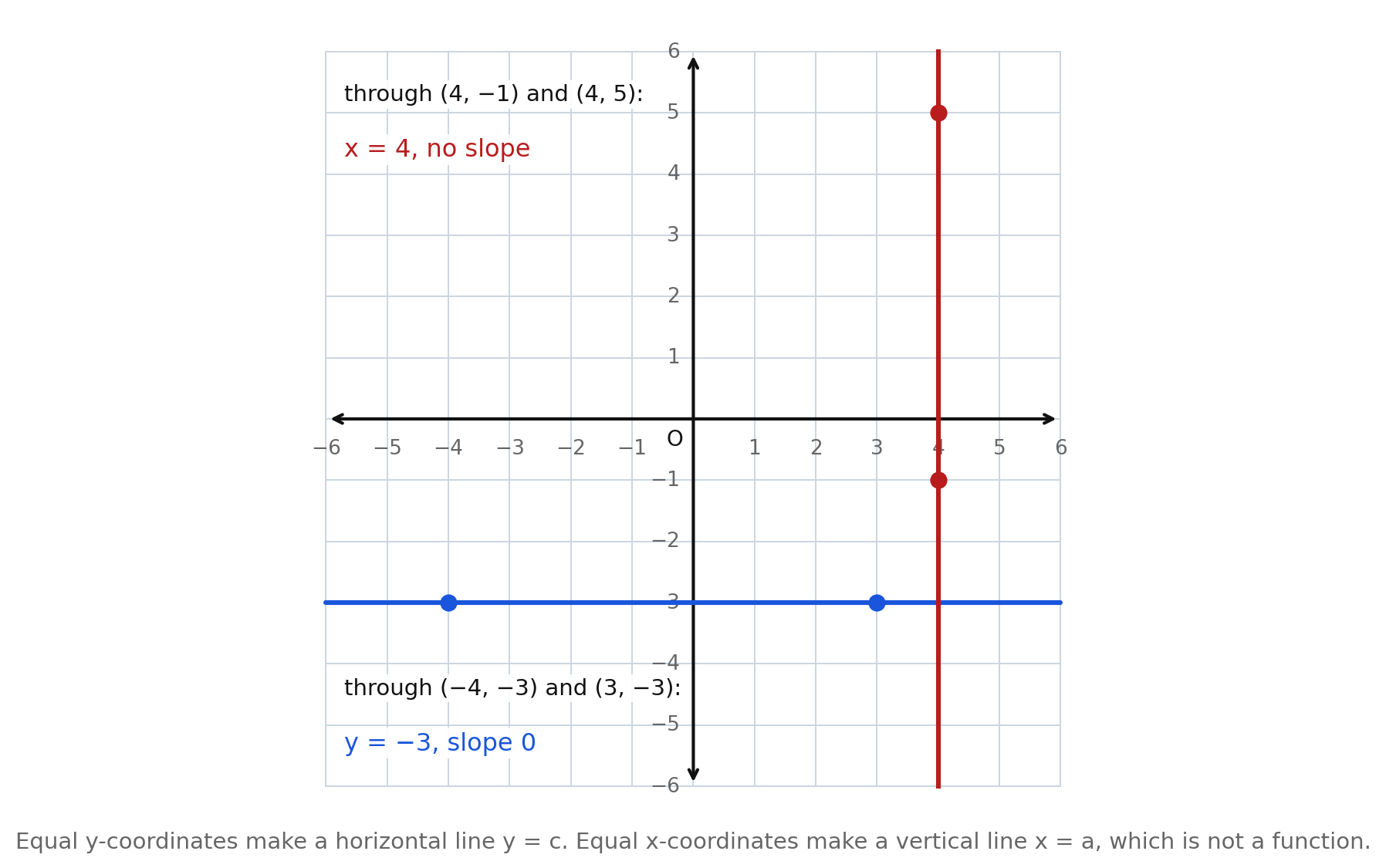
The horizontal line. Look at and . Their -coordinates are equal. Every point on that line has -coordinate , whatever its -coordinate is, and the equation says exactly that:
Its slope is , because the rise between any two of its points is . In slope-intercept form it is , so it is a linear function — a perfectly ordinary one whose output never changes.
The vertical line. Look at and . Their -coordinates are equal. Every point on that line has -coordinate :
It has no slope, because the run between any two of its points is , and a rise cannot be divided by . As Chapter 5 established, it cannot be written as at all, and it is not a function — the single input is paired with every output at once, which is the vertical line test failing against a vertical line.
How to tell which one you need
Given two points, compare coordinates before you reach for the slope formula.
| What matches | The line is | Its equation | Its slope | A function? |
|---|---|---|---|---|
| The -coordinates are equal | horizontal | , the shared -value | yes | |
| The -coordinates are equal | vertical | , the shared -value | none | no |
Given a single point and a direction, it is even shorter. The horizontal line through is ; the vertical line through the same point is . The horizontal line takes the -coordinate; the vertical line takes the -coordinate. Swapping those two is the most common error in this lesson, and it is worth saying out loud each time: a horizontal line is a statement about height, so it names .
These lines in a situation
A horizontal line models a quantity that does not change. A thermostat holding a room at degrees all day is : the slope is degrees per hour, which is the mathematical way of saying nothing is happening to the temperature.
A vertical line models a boundary rather than a relationship — the east wall of a building feet east of a map's origin is . It is a line on the map, but it is not a function of , and that is not a defect. It simply is not the kind of object describes.
A note on technology
Most graphing calculators accept only equations of the form , so they will graph happily and refuse . That refusal is informative rather than annoying: it is the calculator telling you the same thing Chapter 5 did — a vertical line is not a function, and function-graphing tools graph functions. Some tools offer a separate way to draw a vertical line; if yours does, use it, and if it does not, plot two points with the same -coordinate and draw the line through them.
Worked examples
Example 1 — A horizontal line through a point
Write the equation of the horizontal line through .
A horizontal line fixes the -coordinate.
Answer:
Example 2 — A vertical line through the same point
Write the equation of the vertical line through .
A vertical line fixes the -coordinate.
Answer: , and it has no slope.
Example 3 — From two points
Write the equation of the line through and .
The -coordinates match, so the line is horizontal and .
Answer:
Example 4 — From two points, the other case
Write the equation of the line through and .
The -coordinates match, so the run is and the slope is undefined.
Answer: , with no slope; it is not a function.
Example 5 — In context
A thermostat holds a room at degrees for the whole day. Write the temperature function and interpret its slope.
The output never changes, so the graph is horizontal at height .
Answer: . The slope is degrees per hour: the temperature is not changing as the hours pass.
Guided practice
- Use the figure of a horizontal and a vertical line. The two blue points share a coordinate — say which one, and write the equation of the line through them.
- In that same figure, the two red points share a coordinate — say which one, and write the equation of the line through them.
- In that same figure, which of the two lines is a function? Explain what goes wrong for the other one.
- Write the equation of the horizontal line through .
- Write the equation of the vertical line through .
- Explain why cannot be written in the form , citing what Chapter 5 established about its slope.
Independent practice
- Write the equation of each line. a) the horizontal line through b) the vertical line through c) the line through and d) the line through and
- Give the slope of each of the four lines in item 67, using the words "no slope" where they apply.
- Which of the four lines in item 67 are functions? Explain your test in one sentence.
- Write the equation of the horizontal line through , and the equation of the vertical line through . Say which axis each line crosses.
- Application. A thermostat holds a room at degrees all day, so for the hours of the day. Interpret the slope with units, and say what the graph looks like.
- Application. On a map with the origin at a corner of a lot, a garage's back wall runs straight north–south, feet east of the origin. Write the equation of the wall, and explain why it is not a function of .
- Error analysis. Asked for the horizontal line through , a student writes . Name the two separate mistakes in that answer, and give the correct equation.
- Technology. Enter and then into a graphing calculator. Describe what happens with each, and explain what the second result tells you about vertical lines and functions.
Exit ticket 6.4
- Write the equation of the horizontal line through .
- Write the equation of the vertical line through .
- Write the equation of the line through and , and give its slope.
- Explain the difference between and : which is which, what slope each has, and which one is a function.
Lesson 6.5 — Parallel and Perpendicular Lines
One slope rule for each word
A.F.1e asks for a line parallel or perpendicular to a given line, through a given point. There are two slope rules and one procedure, and the procedure is Lesson 6.1 with a new first step.
- Parallel lines have the same slope. Two lines that never meet must climb at the same rate — if their slopes differed, one would eventually catch the other.
- Perpendicular lines have slopes whose product is . Each slope is the negative reciprocal of the other: flip the fraction over, and change the sign.
| Given slope | Parallel slope | Perpendicular slope |
|---|---|---|
Check any row by multiplying the outer two columns: , and .
The procedure
- Get the slope of the given line. If it is in slope-intercept form, read it. If it is in standard form, solve for first — that is Chapter 5's conversion.
- Decide the new slope. Copy it for parallel; negative-reciprocal it for perpendicular.
- Use the given point in point-slope form, exactly as in Lesson 6.1.
- Solve for , and check by substituting the given point.
Step 3 is where the given point earns its keep. There are infinitely many lines parallel to a given line, and the point is what selects one of them.
Parallel
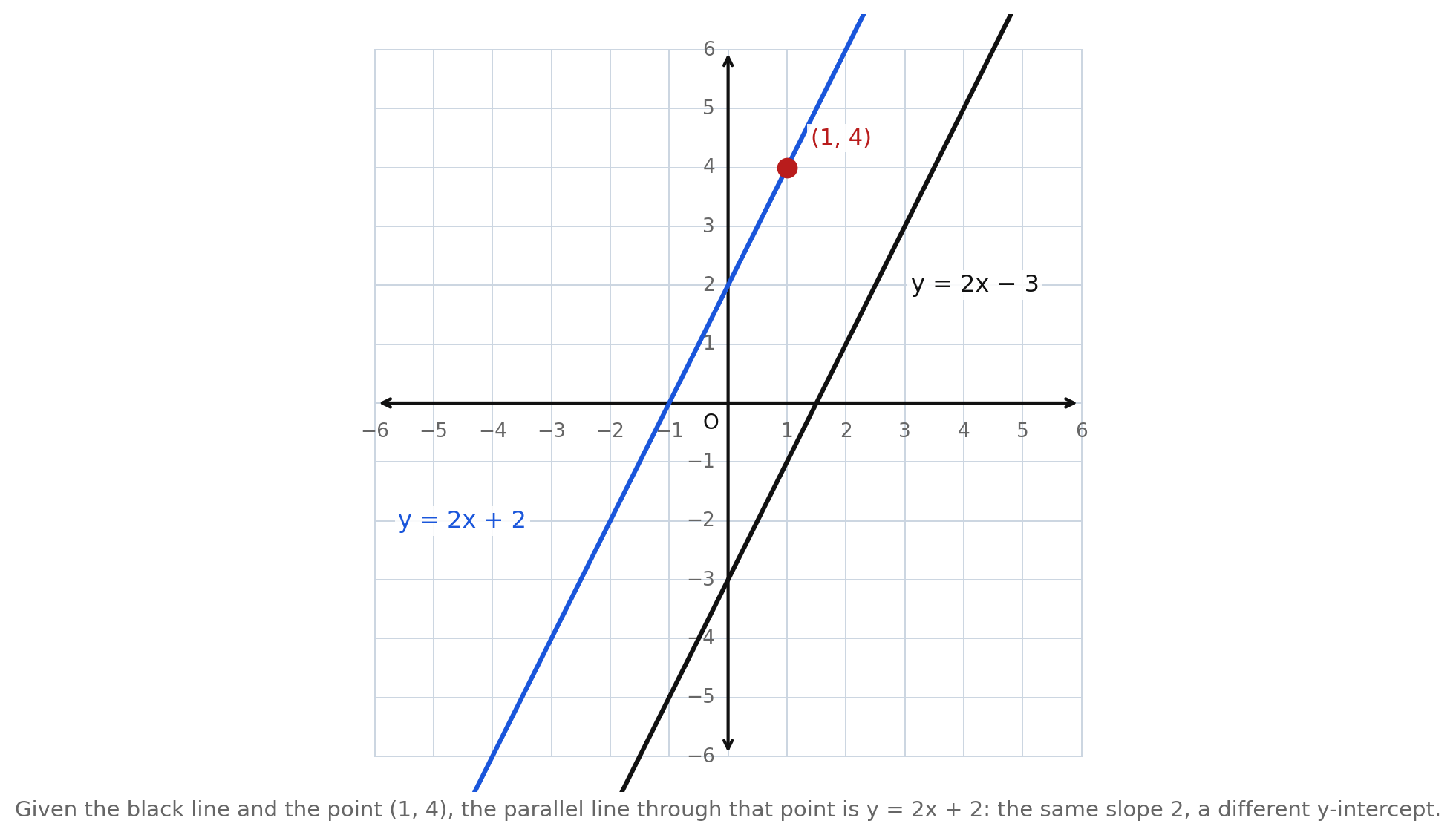
Write the equation of the line parallel to through .
- The given slope is .
- Parallel means the same slope, so .
- , so . Check: ✓
In the figure the two lines have visibly identical steepness and never meet. Their -intercepts differ — and — and that difference is the only difference between them.
A warning worth one line. If the given point already lies on the given line, the "parallel" line through it is the given line itself. Check the point against the original equation if you suspect it.
Perpendicular
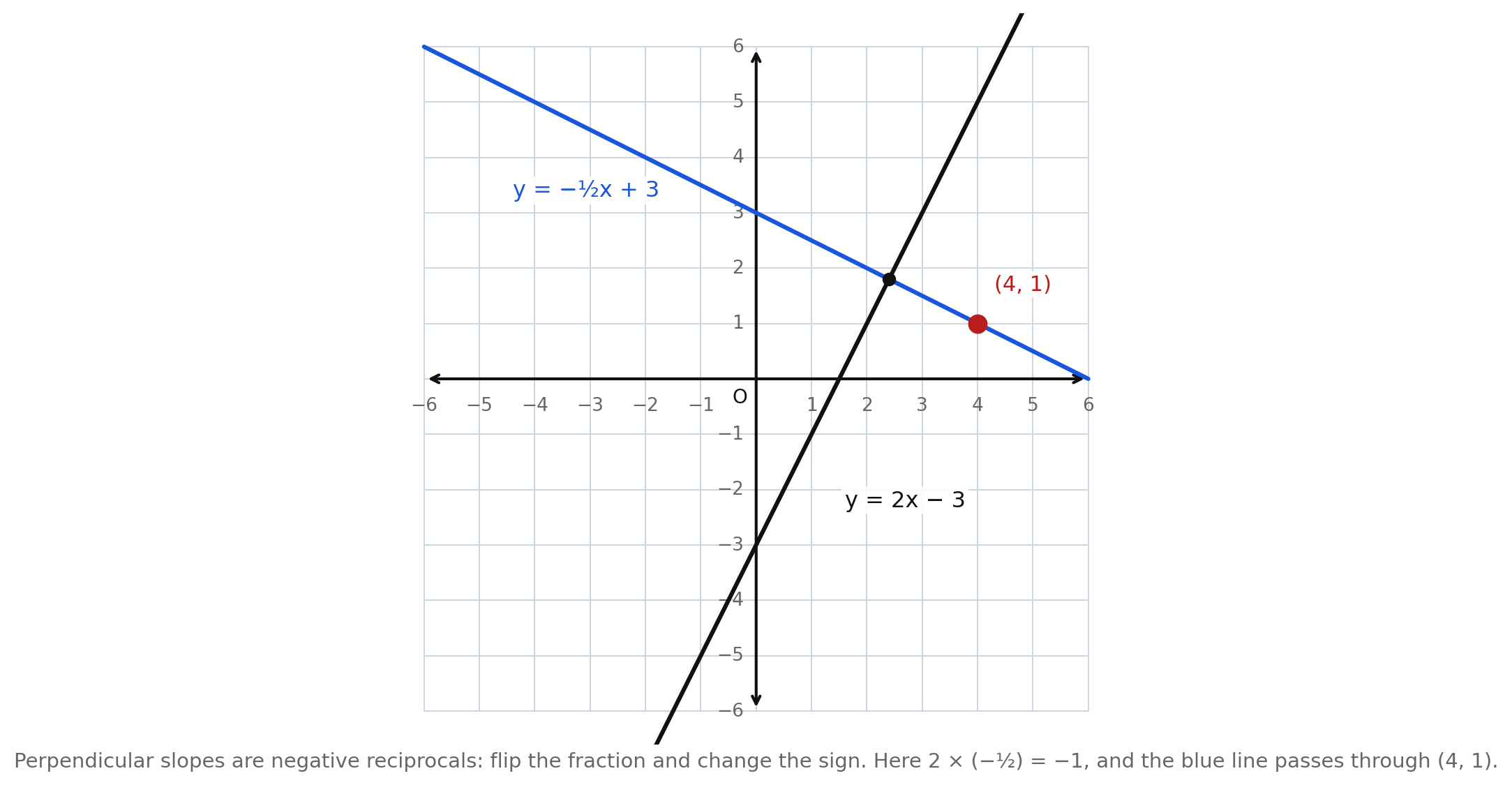
Write the equation of the line perpendicular to through .
- The given slope is , which is .
- Flip it to and change the sign: . Confirm: ✓
- , so . Check: ✓
Why the negative reciprocal
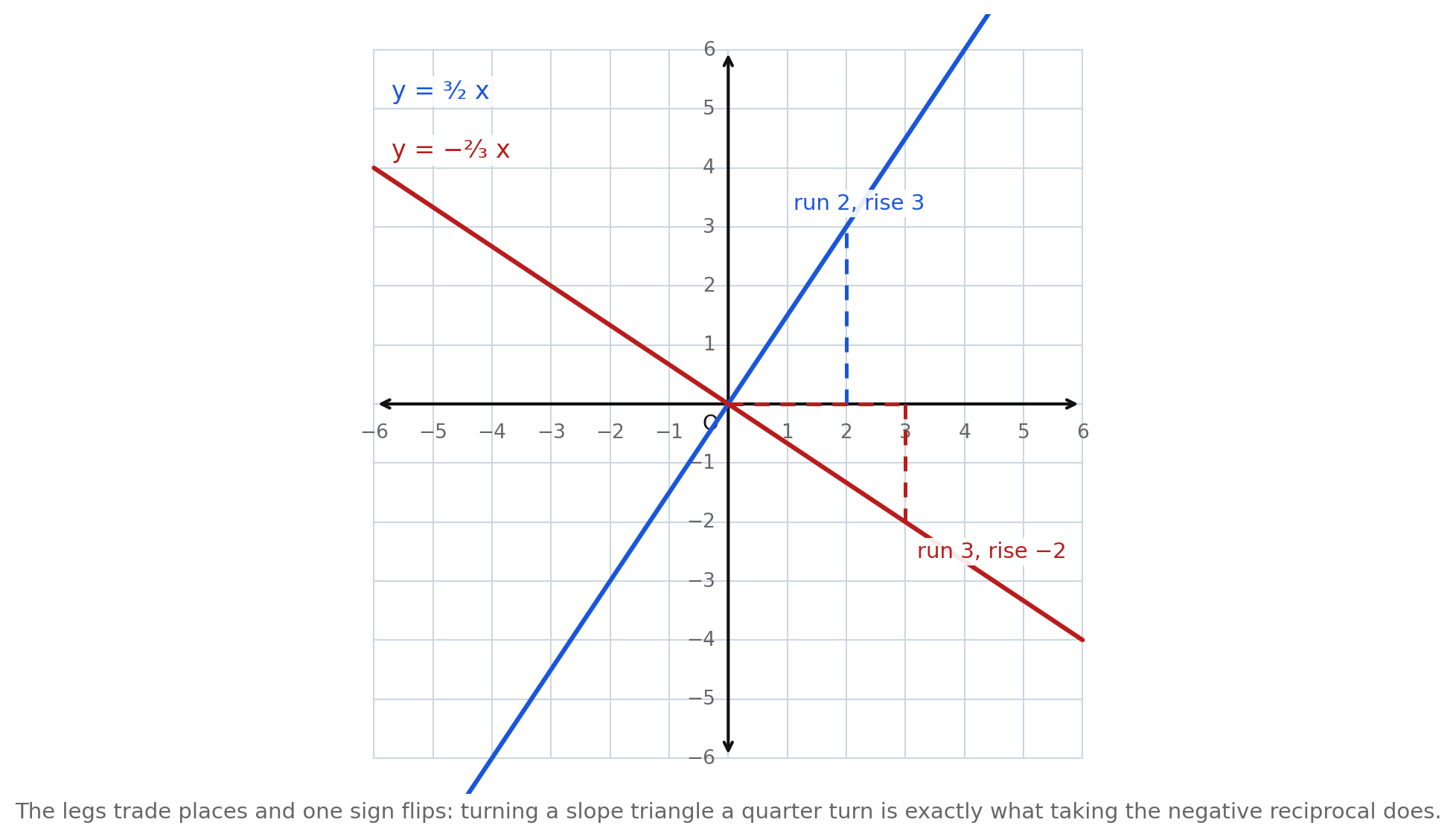
The rule is not arbitrary, and the picture makes it obvious. Take the line and its slope triangle: run , rise .
Now turn that triangle a quarter turn, which is what "perpendicular" means. The leg that ran across is now standing up, and the leg that stood up is now lying across — the run and the rise have traded places. And because the turn carries one of them in the opposite direction, one of the two signs flips. The new triangle is run , rise , giving slope .
Trade the numbers, flip a sign: that is exactly "flip the fraction and change the sign." And the product tells the same story: .
The one pair the product rule cannot describe
A vertical line and a horizontal line are perpendicular — they meet at a perfect right angle — but has no slope, so there is no product to compute. Handle that pair by name rather than by formula:
- The line parallel to through is horizontal: .
- The line perpendicular to through is vertical: .
- The line parallel to through is vertical: .
- The line perpendicular to through is horizontal: .
Checking a right angle on a screen
Here is a real trap in graphical verification. On a window that is wider than it is tall, perpendicular lines do not look perpendicular — the picture stretches one direction more than the other, and a genuine right angle can appear as a wide or narrow one.
So when you graph a perpendicular pair to check it, set a square window first. And if the picture still looks wrong after that, go back to the arithmetic: the product of the two slopes is either or it is not, and that computation does not care how the screen is shaped. This is the clearest case in the chapter of the two checks disagreeing, and of the algebra being the one to trust.
Worked examples
Example 1 — Parallel
Write the equation of the line parallel to through .
Same slope, : , so .
Answer: . Check: ✓
Example 2 — Perpendicular with a whole-number slope
Write the equation of the line perpendicular to through .
The negative reciprocal of is : , so .
Answer: . Check: ✓
Example 3 — Perpendicular with a fractional slope
Write the equation of the line perpendicular to through .
The negative reciprocal of is : , so .
Answer: . Check: ✓
Example 4 — The given line is in standard form
Write the equation of the line parallel to through .
Solve for first (Chapter 5): , so the slope is . Then , so .
Answer: . Check: ✓
Example 5 — A pair with no slope to multiply
Write the equation of the line perpendicular to through .
The given line is vertical, so the perpendicular one is horizontal, and a horizontal line takes the -coordinate of the point.
Answer:
Guided practice
- Use the parallel-lines figure. Give the slope of the given black line and the slope of the blue line, and say why they must be equal.
- In that same figure, write the equation of the line parallel to the given line through the marked point, and check it by substitution.
- Use the perpendicular-lines figure. Give the slope of the blue line, and show that the product of the two slopes is .
- In that same figure, write the equation of the line perpendicular to the given line through the marked point, and check it by substitution.
- Use the negative-reciprocal figure. Name the two slopes shown and multiply them.
- In that same figure, explain how the two slope triangles show what "flip the fraction and change the sign" means.
Independent practice
- Write the equation of the line parallel to through .
- Write the equation of the line parallel to through .
- Write the equation of the line perpendicular to through .
- Write the equation of the line perpendicular to through .
- Write the equation of the line parallel to through . Show the conversion step first.
- Write the equation of the line perpendicular to through . Show the conversion step first.
- Write the equation of the line parallel to through , and the equation of the line perpendicular to through the same point.
- Write the equation of the line parallel to through , and the equation of the line perpendicular to through the same point.
- Are and perpendicular? Compute the product of their slopes and explain your answer.
- Application. On a city map, Main Street follows the line . A new street is to run parallel to Main Street through the fire station at , and an access road is to run perpendicular to Main Street through that same fire station. Write both equations, and check that each passes through .
- Technology. Graph your answer to item 88 together with the given line, on a square window. Describe what you see, and explain why a wide window could make a correct answer look wrong.
- Error analysis. Asked for a line perpendicular to , a student uses the slope . Identify what the student did and did not do, give the correct perpendicular slope, and verify it with the product rule.
Exit ticket 6.5
- Write the equation of the line parallel to through .
- Write the equation of the line perpendicular to through .
- Write the equation of the line parallel to through .
- State the parallel rule and the perpendicular rule, one sentence each, and name the one pair of perpendicular lines the product rule cannot be used on.
Chapter 6 Review
Vocabulary. point-slope form · slope-intercept form · slope · -intercept · lattice point · horizontal line · vertical line · parallel · perpendicular · negative reciprocal · model · verification
A.F.1d names five situations and A.F.1e names two relationships, so this review is organized by situation. Part A is a slope and a point, Part B is two points, Part C is a graph and the two special lines, Part D is parallel and perpendicular, and Part E mixes everything in context and asks for verification.
Part A — From a slope and a point
- Write the equation of the line with slope through .
- Write the equation of the line with slope through .
- Application. A drone climbs at meters per second, and seconds after it started climbing it is meters above the ground. Write its height function, then interpret the slope and the -intercept with units.
- Error analysis. Given slope through , a student writes . Identify the error, give the correct equation in slope-intercept form, and show the check.
Part B — From two points
- Write the equation of the line through and .
- Write the equation of the line through and .
- Application. Use the plumber figure from Lesson 6.2. Write from the two marked jobs, then interpret the slope and the -intercept with units.
- Application. A print shop charges a setup fee plus a price per flyer. An order of flyers costs and an order of flyers costs . Write the cost function and interpret both numbers with units.
Part C — From a graph, and the two special lines
- Use the graph figure from Lesson 6.3 whose -axis crossing is visible. Write the line's equation, and say where each of the two numbers came from.
- Use the graph figure whose -axis crossing is not visible. Write the line's equation, and explain why could not be read off the picture.
- Use the figure of a horizontal and a vertical line. Write both equations, give the slope of each, and say which one is a function.
- Write the equation of the horizontal line through , and the equation of the vertical line through .
- Error analysis. A line crosses the -axis at , and its slope triangle shows a rise of over a run of . A student writes . Identify the error and give the correct equation.
Part D — Parallel and perpendicular
- Write the equation of the line parallel to through .
- Write the equation of the line perpendicular to through .
- Write the equation of the line parallel to through . Show the conversion step.
- Write the equation of the line perpendicular to through .
- Write the equation of the line perpendicular to through , and explain why the product rule was not used.
Part E — Mixed application and verification
- Application. A subscription service charges a signup fee plus a fixed monthly amount. After months a customer has paid ; after months the same customer has paid . Write the total-paid function, interpret both numbers with units, and say how much a customer who cancels after one month has paid.
- Application. Use the plumber figure from Lesson 6.2, whose charge is . A second plumber charges a service fee plus per hour. Write the second plumber's equation, find the number of hours at which the two charge the same, and say which is cheaper for a -hour job.
- Technology. Write the equation of the line through and . Then graph it, confirm both points lie on it, and describe what you would do if the graph and the substitution disagreed.
- Reasoning. Three of the five situations in A.F.1d — a graph, two points, and a slope with a point — end up being the same two questions asked in different orders. Name those two questions, and explain how each of the three situations answers them.
- Application. On a park map, a bike path follows the line . A new footpath must run perpendicular to the bike path through the trailhead at , and a service road must run parallel to the bike path through the maintenance shed at . Write both equations, and verify each one against the point it is required to pass through.
Standards coverage check — Chapter 6
A.F.1d names five situations by name, so coverage of that bullet is broken out situation by situation.
| Knowledge and Skill | Situation | Where it is taught | Where it is practiced | Where it is modeled in context |
|---|---|---|---|---|
| A.F.1d — write the equation of a linear function to model a linear relationship, including contextual situations | Given the graph of a line | 6.3 (read and count a lattice-point slope triangle; the case where is off the window) | 41–53, 55–59; 109, 110, 113 | 56, 121 |
| A.F.1d | Given two points with integer coordinates | 6.2 (slope first, then point-slope, then check with the unused point) | 21–30, 34–39; 105, 106, 121 | 31, 32, 33, 40, 107, 108, 119, 120 |
| A.F.1d | Given the slope and a point with integer coordinates | 6.1 (point-slope form, the two sign traps, the intercept special case) | 1–12, 15–19; 101, 102, 104 | 13, 14, 103 |
| A.F.1d | Vertical lines as | 6.4 (equal -coordinates; no slope; not a function) | 30, 39, 62, 63, 65–70, 74, 76, 78, 92, 99; 111, 112, 118 | 72 |
| A.F.1d | Horizontal lines as | 6.4 (equal -coordinates; slope ; a function) | 8, 29, 61, 63, 64, 67–70, 73, 75, 77, 78, 91; 111, 112, 118 | 71 |
| A.F.1e — write the equation of a line parallel or perpendicular to a given line through a given point | Parallel | 6.5 (equal slopes; the given point selects one of infinitely many) | 79, 80, 85, 86, 89, 91, 92, 97, 99, 100; 114, 116 | 94, 123 |
| A.F.1e | Perpendicular | 6.5 (negative reciprocals; why the rule is a quarter turn; the vertical-horizontal pair) | 81–84, 87, 88, 90–93, 96, 98, 100; 115, 117, 118 | 94, 123 |
Supporting items: 10, 20, 35, 47, 54, 60, 122 ask for the reasoning behind a procedure rather than its output; 12, 36, 55, 73, 96, 104, 113 are error analyses aimed at the seven most common failures in the chapter — the two point-slope sign traps, an inverted slope formula, an inverted rise over run, the swapped and , and a forgotten reciprocal. Items 15, 34, 56, 74, 95, 121 are the technology-verification items required by this volume's calculator policy; item 95 in particular asks students to recognize a graphical check that misleads on a non-square window, and to trust the algebra when it does.
Boundaries respected. No item asks the student to identify or interpret the characteristics of a function they were handed as the point of the exercise, or to convert among forms for its own sake — that is A.F.1 a, b, and c, in Chapter 5, and this chapter uses those skills only as steps inside writing an equation, citing Chapter 5 each time. No item asks the student to produce a graph as the final answer, to evaluate at a supplied input, or to recover from a supplied ; those are A.F.1 f, g, and h, in Chapter 7, and every graph requested here is a verification of an equation already written algebraically. The two points given in every two-point item have integer coordinates, and the point given in every slope-and-point item has integer coordinates, as A.F.1d requires. Every parallel and perpendicular item supplies a point, as A.F.1e requires.
Answer keys for every item in this chapter are in Appendix A.