Chapter 5 — Linear Functions: Characteristics and Forms
Standard: A.F.1 (a, b, c)
A.F.1 — verbatim. The student will investigate, analyze, and compare linear functions algebraically and graphically, and model linear relationships. Students will demonstrate the following Knowledge and Skills: a) Determine and identify the domain, range, zeros, slope, and intercepts of a linear function, presented algebraically or graphically, including the interpretation of these characteristics in contextual situations. b) Investigate and explain how transformations to the parent function affects the rate of change (slope) and the -intercept of a linear function. c) Write equivalent algebraic forms of linear functions, including slope-intercept form, standard form, and point-slope form, and analyze and interpret the information revealed by each form.
By the end of this chapter you will be able to:
- State the domain and range of a linear function from its equation or its graph, and explain why an unrestricted line has all real numbers for both (A.F.1a)
- Find the slope of a line from a graph, from two points, from a table, and from an equation (A.F.1a)
- Identify the -intercept and the -intercept of a linear function, and find the zero the -intercept names (A.F.1a)
- Interpret every one of those characteristics in a real situation, with units — what the slope measures, what the -intercept starts at, what the zero is the moment of (A.F.1a)
- Recognize as the parent function of every linear function, and give its slope, intercept, zero, domain, and range (A.F.1b)
- Explain how transformations of change the rate of change and the -intercept — and which transformation changes which (A.F.1b)
- Write a linear function in slope-intercept form, standard form, and point-slope form, convert between them, and say what each form hands you for free (A.F.1c)
Lessons: 5.1 Domain and Range of a Linear Function · 5.2 Slope and the Two Intercepts · 5.3 The Zero of a Linear Function · 5.4 The Parent Function · 5.5 Transformations of the Parent Function · 5.6 Three Equivalent Forms
Why this chapter matters. Chapter 4 taught you to ask whether a relation is a function and what its domain and range are. This chapter takes the single most useful family of functions — the linear ones — and asks five sharper questions of every member: how steep is it, where does it cross each axis, what input makes the output zero, what inputs are allowed, and what outputs come back. Those five answers are what a linear model tells you about a situation. Everything after this — systems, inequalities in two variables, curves of best fit — reads the same five numbers off the same kind of picture.
Scope note. This chapter identifies and interprets the characteristics of a linear function you are handed, and converts a linear function between three forms. It does not build an equation from scratch. Writing the equation of a line from a graph, from two points, or from a slope and a point is A.F.1d, and parallel and perpendicular lines are A.F.1e; both are Chapter 6. Graphing a linear function with and without technology is A.F.1f, and evaluating at an input or recovering from a given is A.F.1g; both are Chapter 7. The transformations in Lesson 5.5 are transformations of the parent function only, and only their effect on the slope and the -intercept, which is exactly what A.F.1b asks. The forms in Lesson 5.6 are the three A.F.1c names and no others.
Conventions this chapter fixes.
- A linear function is written or . The number is the slope, also called the rate of change; the number is the -coordinate of the -intercept.
- An intercept is a point, written as an ordered pair: the -intercept of is , not . A zero is a number: the zero of that same function is . Keeping the two apart is worth the effort, because A.F.1a asks for both by name.
- A vertical line is not a function, so it has no slope and no zero. It appears in this chapter only in Lesson 5.6, where it is the one line standard form can write and slope-intercept form cannot.
- Domains and ranges of continuous graphs are described in words or with inequalities such as , as in Chapter 4. Interval notation is never required.
- Item numbering runs straight through the chapter, from 1 in Lesson 5.1 to 124 at the end of the review. It does not restart at each lesson.
Lesson 5.1 — Domain and Range of a Linear Function
The default answer, and why
A linear function is one whose graph is a straight line, written . Unless something stops it, that line runs forever in both directions.
That fact settles the domain and the range before you do any work.
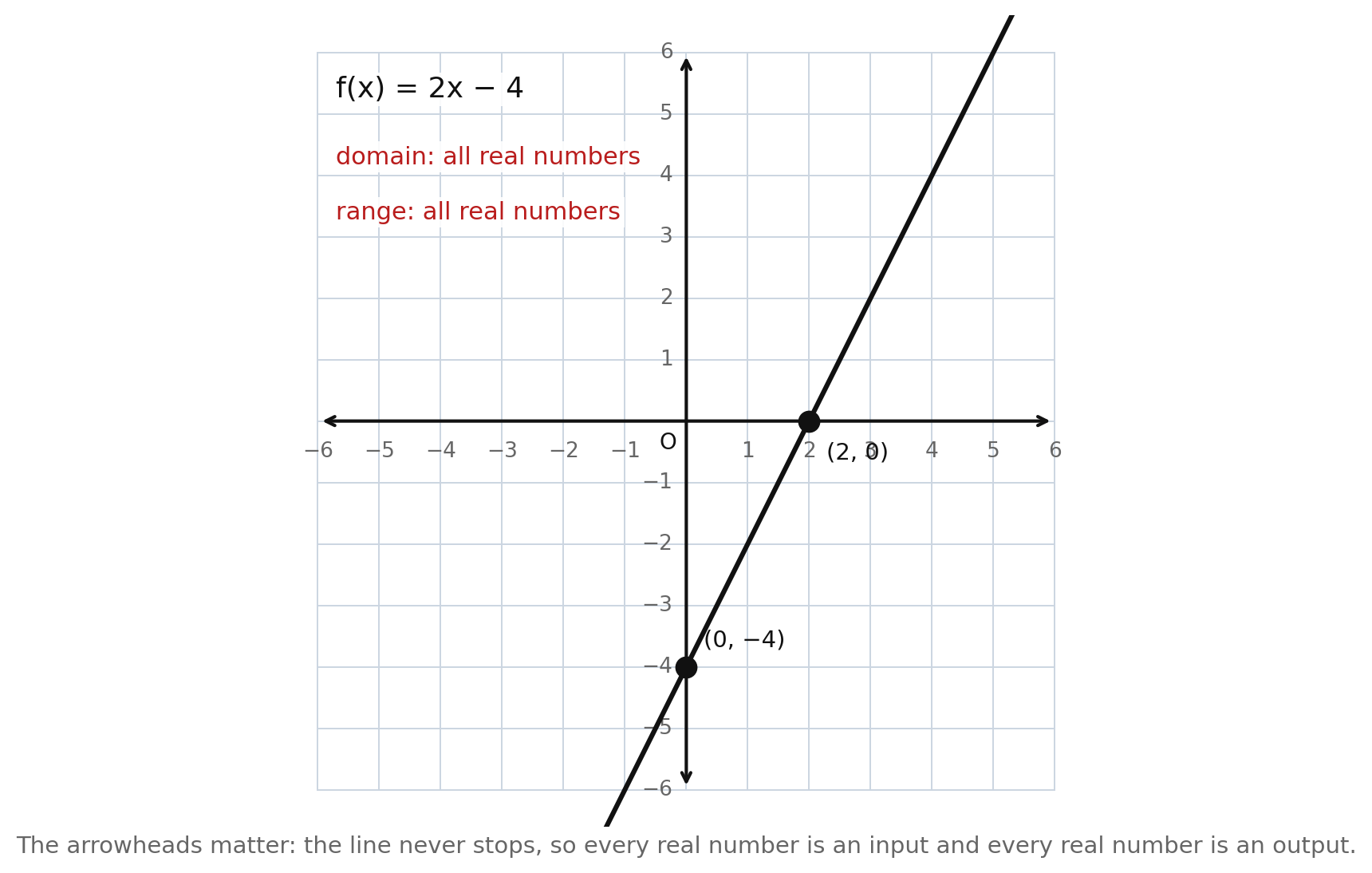
The figure shows . Its -intercept is and its -intercept is , and the arrowheads on both ends say the line does not stop where the grid does.
- Domain: all real numbers. Pick any input at all — , , — and the rule produces an output. There is no number you may not substitute.
- Range: all real numbers. The line is slanted, so as it climbs it eventually reaches every height. Name any output and the line passes through it exactly once.
So for a linear function with a nonzero slope, the domain and the range are both all real numbers, every time. That is not a guess to be checked case by case; it is a consequence of the graph being an unbroken slanted line with no ends.
The one exception: a horizontal line
There is exactly one linear function whose range is not all real numbers.
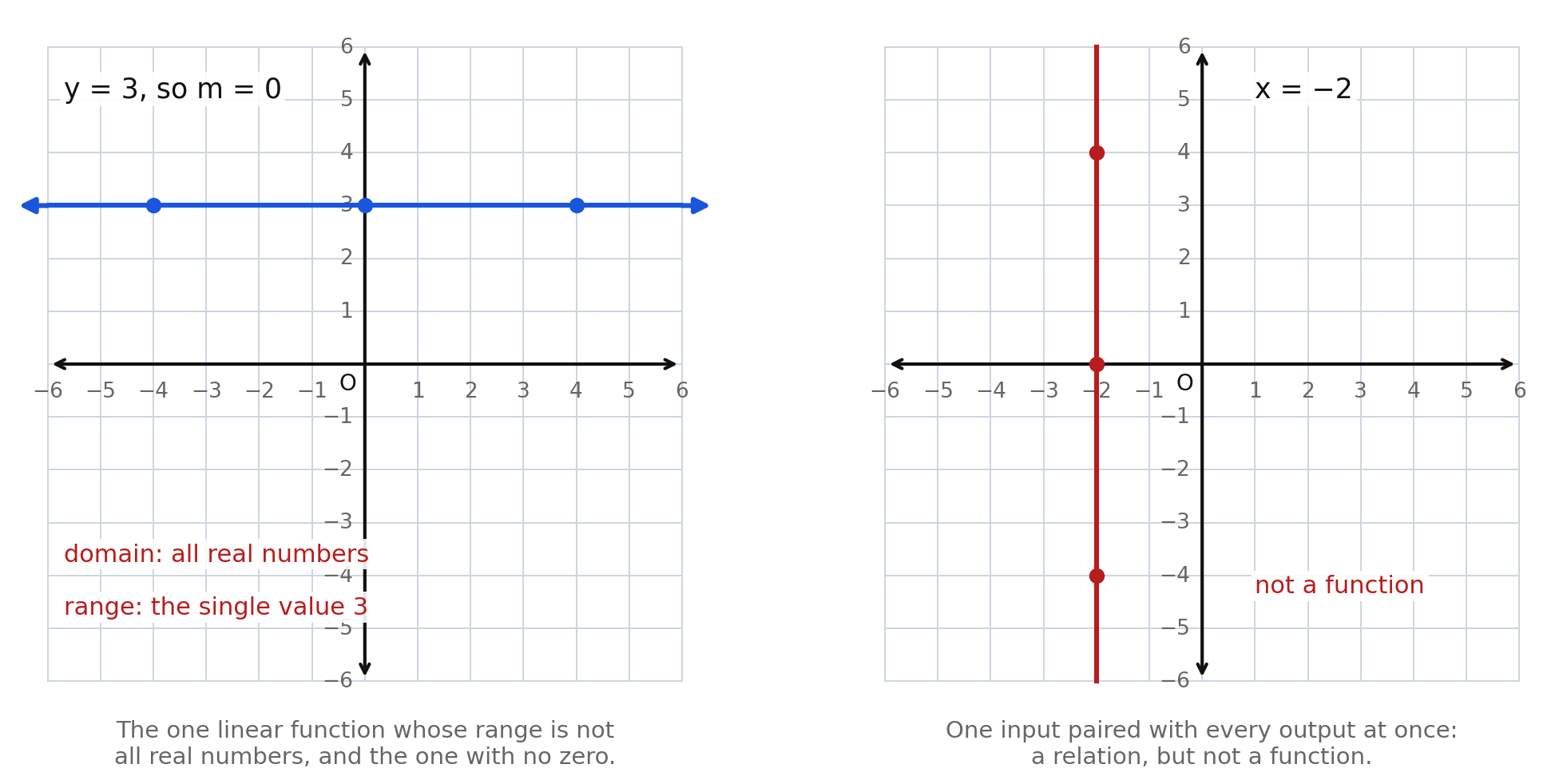
On the left is , a line with slope . Every input still works, so the domain is still all real numbers. But the line never leaves the height , so the only output it ever produces is .
- Domain: all real numbers
- Range: the single value
That is also the one linear function with no zero, a fact Lesson 5.3 returns to. The line never touches the -axis, so no input makes the output .
On the right is . It is a straight line, but it is not a function — the single input is paired with every output at once, which is exactly the failure the vertical line test detects. It has no slope, because you cannot divide a rise by a run of zero, and it is not written as at all. Lesson 5.6 gives it the only form it does have.
When a situation cuts the domain down
An equation is willing to accept any input. A situation usually is not.
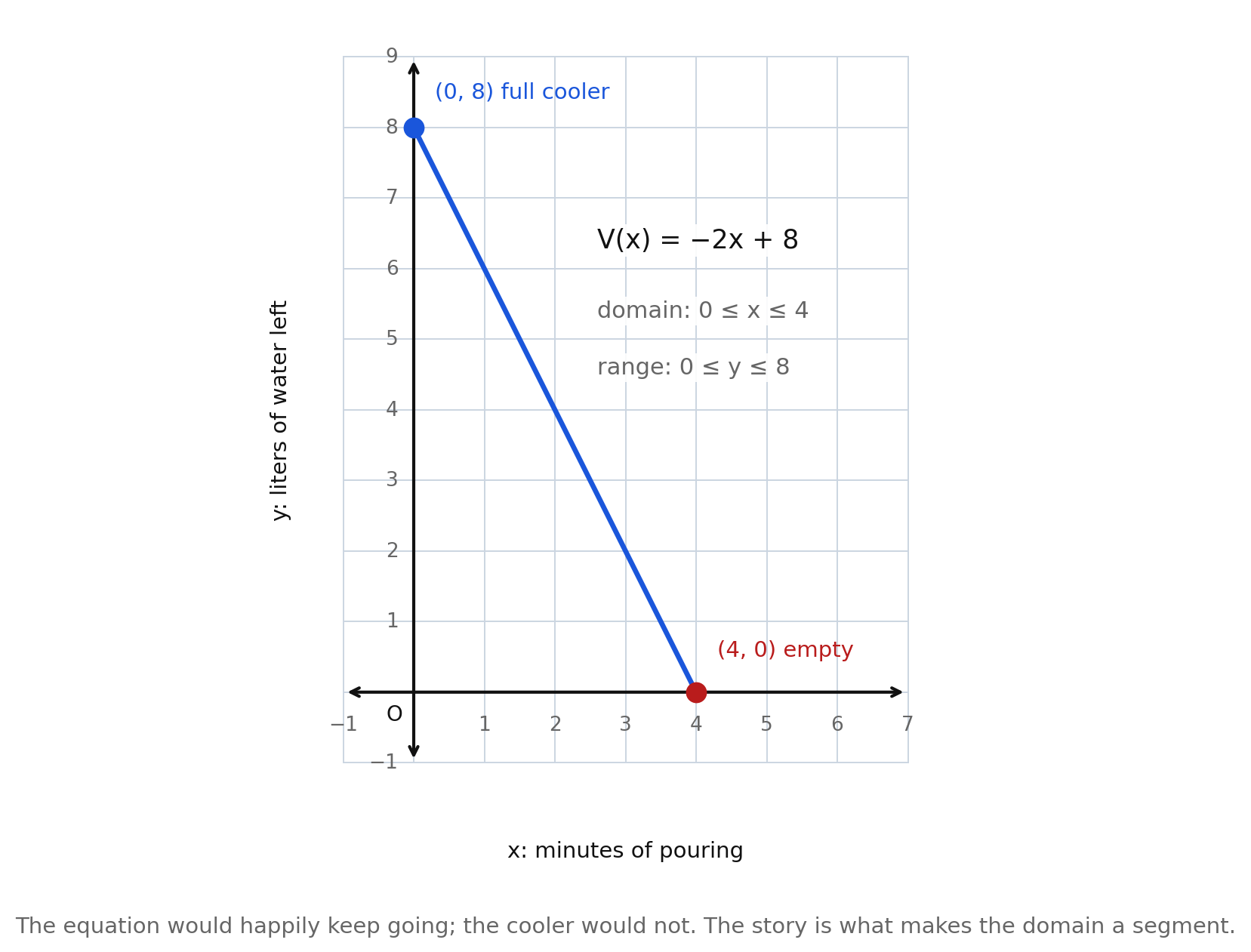
A cooler holds liters of water and pours out at liters per minute, so the amount left after minutes is
The equation would happily accept and report liters, and it would accept and report liters. Neither is a fact about the cooler. Water cannot start being poured before pouring begins, and a cooler cannot hold a negative amount, so the picture is a segment, not a line:
- Domain: — the minutes during which there is still water to pour
- Range: — the liters that can actually be in the cooler
Both endpoints are filled in, because (the full cooler) and (the empty one) are both real moments in the story.
Here is the habit to build. Ask the equation for the domain and you always get all real numbers. Ask the situation, and you get the truth. When a linear function models something, three questions cut the domain down:
- Can the input be negative? Times, counts, and lengths usually cannot.
- Can the input be a fraction? Numbers of tickets and numbers of people cannot; minutes and gallons can.
- Where does the story end? The cooler runs out at minutes, so nothing past is being modeled.
When the answer to question 2 is no, the domain is a listed set of whole numbers and the graph is dots, exactly as in Chapter 4. When it is yes, the domain is a stretch of real numbers and the graph is a segment.
Worked examples
Example 1 — Straight from the equation
Give the domain and range of .
The slope is not zero, so the graph is an unbroken slanted line with no ends.
Answer: Domain: all real numbers. Range: all real numbers.
Example 2 — A horizontal line
Give the domain and range of .
The slope is , so every input produces the same output.
Answer: Domain: all real numbers. Range: the single value .
Example 3 — A story that ends
A candle is inches tall and burns down inches per hour, so . Give the domain and range in context.
The candle is lit at and is gone when , which happens at , so .
Answer: Domain: hours. Range: inches.
Example 4 — A story that counts
A shuttle van charges per passenger and seats at most six. Give the domain and range of the fare function.
Passengers are counted in whole numbers, and there can be at most six.
Answer: Domain passengers; range dollars. The graph is six separate dots.
Example 5 — Reading the arrowheads
A line is drawn across a grid with an arrowhead on each end. What do the arrowheads tell you about the domain?
An arrowhead says the graph continues past the edge of the grid rather than stopping there.
Answer: They say the domain is all real numbers, not just the inputs the grid happens to show. Without them, the drawn portion would be a segment with a restricted domain.
Guided practice
- Give the domain and range of from the figure of a line drawn with arrowheads.
- In that same figure, what do the two arrowheads tell you that the drawn portion of the line does not?
- Give the domain and range of the horizontal line in the figure showing two special lines.
- In that same figure, is a function? Explain what goes wrong, and say why it has no slope.
- Give the domain and range of the cooler function shown in the context figure.
- Explain why the domain of is not all real numbers, even though the domain of the equation is.
Independent practice
- Give the domain and range of each linear function. a) b) c) d)
- Application. A candle is inches tall and burns down inches per hour, so . Give the domain and range in context, with units, and say what fact about the candle fixes each endpoint.
- Application. A shuttle van charges per passenger and seats at most six. Give the domain and range of the fare function, and explain why the graph is dots rather than a segment.
- Reasoning. Explain why the range of a linear function with a nonzero slope is always all real numbers, no matter what and are.
- Application. Use the cooler figure. State the domain and the range, then write one sentence for each saying what it means about the cooler, with units.
- Error analysis. A student says the range of is "all real numbers greater than , because the graph starts at the -intercept ." Identify the error and give the correct range.
Exit ticket 5.1
- Give the domain and range of .
- Give the domain and range of .
- Is the vertical line a function? Explain, and say what its slope is.
- Explain the difference between the domain of a line drawn with arrowheads on both ends and the domain of a line drawn as a segment with two filled-in endpoints.
Lesson 5.2 — Slope and the Two Intercepts
Slope is a rate of change
The slope of a line measures how much the output changes for each unit the input increases. It is the line's rate of change, and it is the same number everywhere along the line — that constancy is what makes a line a line.
Given two points and on the line,
Read the sign as a direction. A positive slope rises from left to right; a negative slope falls. A slope of zero is a horizontal line, which never rises at all. A vertical line has no slope — the run would be , and dividing by is not allowed.
Read the size as a steepness. climbs five units for every one across; climbs one unit for every five across and is far gentler. Comparing steepness means comparing , so is steeper than even though its slope is the smaller number.
The two intercepts
An intercept is a point where the graph crosses an axis, and there are two of them to keep straight.
- The -intercept is where the graph crosses the -axis. Its -coordinate is , so it is the point .
- The -intercept is where the graph crosses the -axis. Its -coordinate is , so it is the point where the output is zero.
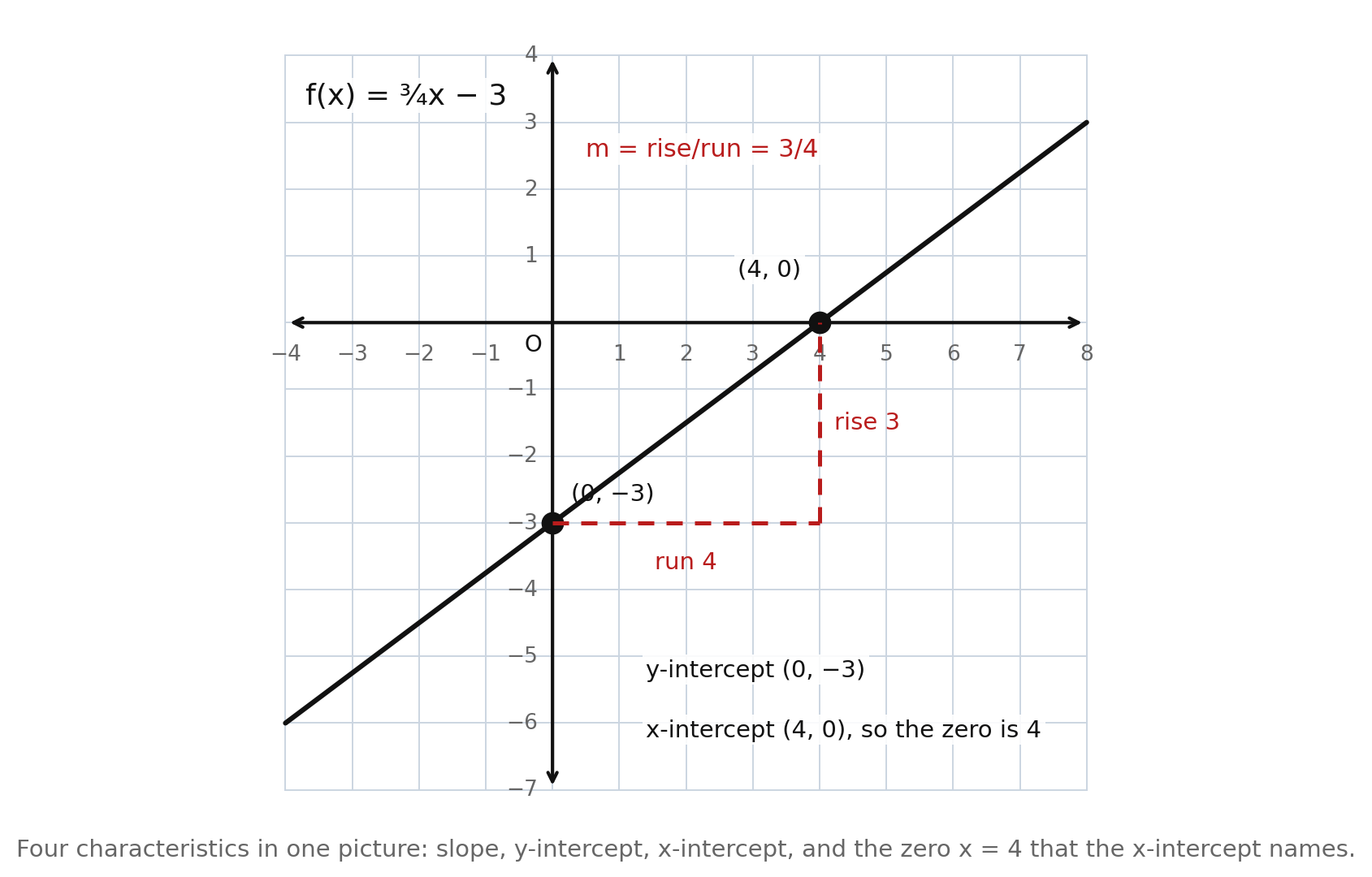
The figure shows , and it carries four characteristics at once.
- Slope . The dashed triangle runs from across to and up to : a run of and a rise of , so .
- -intercept . The line crosses the -axis three units below the origin, which is the at the end of .
- -intercept . The line crosses the -axis four units right of the origin.
- Zero , which is the -coordinate of that -intercept and the subject of Lesson 5.3.
Notice that the same triangle does two jobs. It shows the slope, and because it is drawn from one intercept to the other, it also shows that the two intercepts sit exactly four across and three up from each other.
Reading slope and intercept off the equation
Slope-intercept form is named for the fact that it hands you two of the five characteristics with no work at all.
In , the slope is and the -intercept is . Two cautions:
- The sign travels with the number. In the slope is and the -intercept is . Rewriting it as makes that visible; reading left to right does not.
- The -intercept is a point. Writing "the -intercept is " is loose shorthand for , and it is the shorthand that later causes students to answer the -intercept question with a -value.
The -intercept is the one that takes a step of work. Set the output to and solve for — the same multi-step linear equation you solved in Chapter 2.
For : set , so and . The -intercept is .
Reading slope off a table
A table of a linear function has a constant rate of change: equal steps in produce equal steps in .
Each time increases by , increases by , so . And the row already contains the input , so the -intercept is sitting there in plain sight: .
If the table does not contain , use any two rows in the slope formula. The answer is the same whichever two you pick, which is worth checking once to convince yourself.
What the two numbers mean in a situation
This is the part A.F.1a names explicitly, and it is the part that carries units.
A phone plan costs per month plus per minute of calling, so the monthly cost after minutes is
- The slope is a rate: per minute. Every additional minute of calling adds five cents to the bill. Slope always carries the units of the output divided by the units of the input.
- The -intercept is the starting value: with zero minutes of calling, the bill is still . That is the monthly fee, the part you pay for existing as a customer.
A negative slope reads the same way with the opposite direction. If a tank holds gallons after minutes, the slope means the tank loses gallons per minute, and says it held gallons when the draining began.
Worked examples
Example 1 — Slope from two points
Find the slope of the line through and .
Answer:
Example 2 — A negative slope from two points
Find the slope of the line through and .
Answer:
Example 3 — Both intercepts from an equation
Find both intercepts of .
The -intercept is read off: . For the -intercept, set the output to : , so and .
Answer: -intercept ; -intercept
Example 4 — A slope that is zero, and one that does not exist
Find the slope through and , and the slope through and .
First: . Second: , which is undefined.
Answer: The first line is horizontal, slope . The second is vertical and has no slope; it is not a function.
Example 5 — Interpreting in context
A tank drains according to gallons after minutes. Interpret the slope and the -intercept.
Answer: The slope means the tank loses gallons every minute. The -intercept means the tank held gallons at the moment draining started.
Guided practice
- Use the figure of a line with its slope triangle. Name the slope and both intercepts of .
- In that same figure, what do the labels "rise " and "run " tell you, and how do they produce the slope?
- In that same figure, at what point does the graph cross the -axis, and what is the value of in ?
- Find the slope of the line through and .
- Find the slope of the line through and .
- Give the slope and the -intercept of .
Independent practice
- Give the slope and the -intercept of each. a) b) c) d)
- Find the slope of the line through each pair of points. a) and b) and c) and d) and
- Find both intercepts of .
- Find both intercepts of .
- A table lists -values with -values . Give the slope and the -intercept, and say how you got each from the table.
- Application. A phone plan costs dollars for minutes of calling. Interpret the slope and the -intercept in context, with units.
- Application. A tank drains according to gallons after minutes. Interpret the slope and the -intercept with units, then find the -intercept and say what it means about the tank.
- Error analysis. A student reads and reports a slope of and a -intercept of . Identify the error and give the correct slope and -intercept.
Exit ticket 5.2
- Give the slope and the -intercept of .
- Find the slope of the line through and .
- Find both intercepts of .
- Application. A concert charges dollars for tickets bought in one order. Interpret the slope and the -intercept in context, with units.
Lesson 5.3 — The Zero of a Linear Function
One idea wearing three names
The zero of a function is an input whose output is .
For a linear function that is a single number, and it is a number you already know how to find. Three descriptions all point at the same place on the graph:
- the zero of — the input for which
- the -intercept — the point where the graph crosses the -axis
- the solution of — the equation you solve to get there
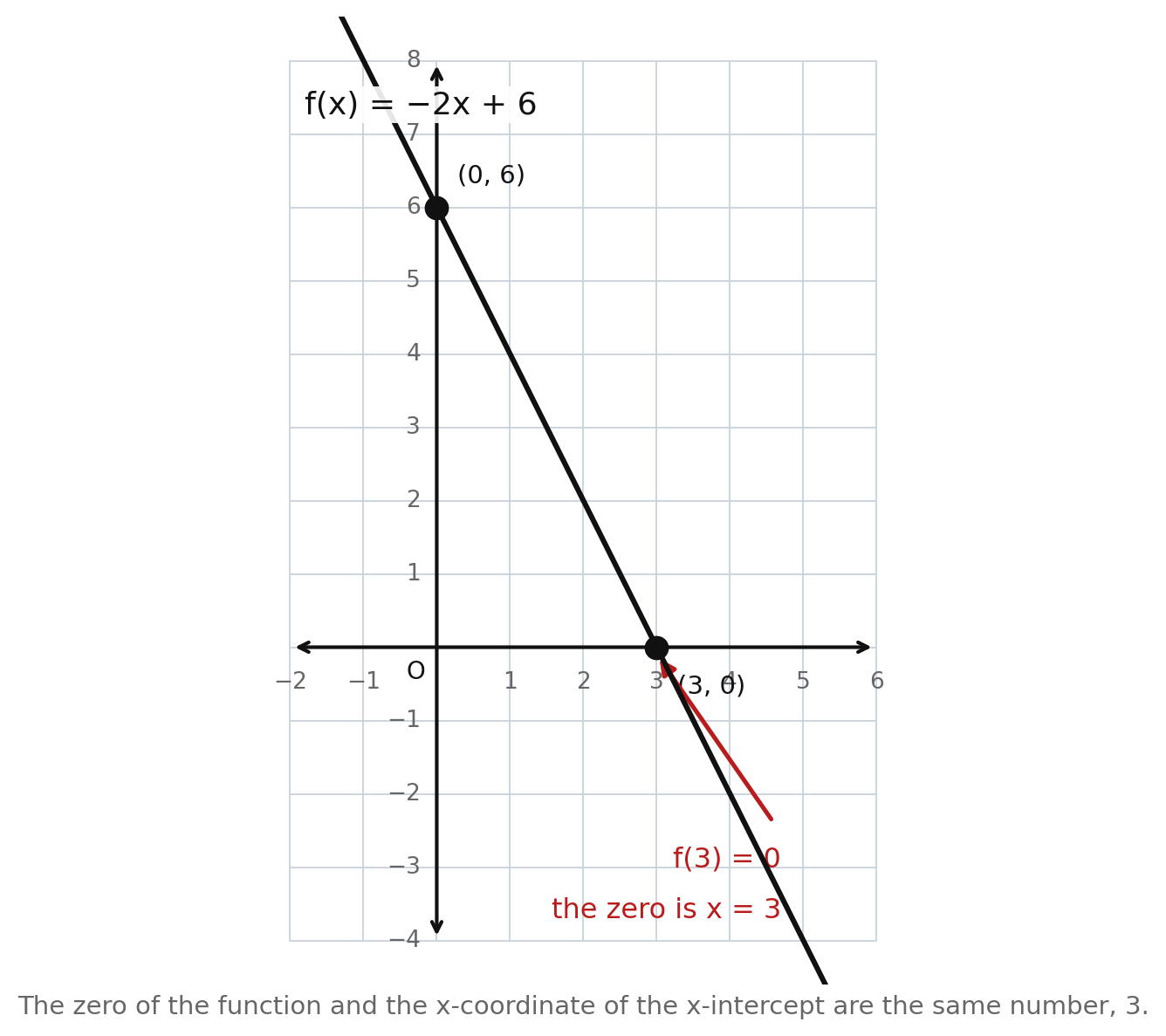
The figure shows . Its graph crosses the -axis at , so and the zero is . Its -intercept is .
Keep the grammar straight, because A.F.1a asks for zeros and intercepts as separate items:
- A zero is a number: .
- An -intercept is a point: .
They contain the same information, and the zero is the -coordinate of the -intercept. Answering "the zero is " or "the -intercept is " will be understood, but the distinction is the one the standard is testing.
Finding a zero
Set the output to zero and solve.
For : , so and . The zero is and the -intercept is .
For : , so and . A zero does not have to be a whole number. The -intercept is .
How many zeros a line can have
- If , the line is slanted and crosses the -axis exactly once. There is exactly one zero, namely .
- If and , the line is horizontal and above or below the -axis forever. There is no zero. The line from Lesson 5.1 is the example.
- If and , the function is , the -axis itself, and every real number is a zero. This is the one strange case, and it is worth naming once so that "exactly one zero" is a claim you understand rather than a slogan.
The zero in a situation
In a real model, the zero is almost always the moment something runs out, reaches the ground, or breaks even. It is the most quotable number a linear model produces.
A student has saved and spends a week, so the balance after weeks is . Setting gives .
The zero is , and in context that is a sentence: the savings run out after weeks.
The cooler of Lesson 5.1 works the same way. has zero , and the sentence is: the cooler is empty after minutes of pouring. That is also why the domain stopped at — in these draining-and-emptying models, the zero is exactly the right-hand endpoint of the realistic domain.
Worked examples
Example 1 — From an equation
Find the zero of .
Set , so .
Answer: The zero is ; the -intercept is .
Example 2 — A fractional zero
Find the zero of .
Set , so .
Answer: The zero is ; the -intercept is .
Example 3 — From a graph
A line crosses the -axis at . What is the zero?
The zero is the -coordinate of the -intercept.
Answer: The zero is .
Example 4 — A function with no zero
Does have a zero?
Its slope is and it sits three units above the -axis forever, so no input ever produces the output .
Answer: No. A horizontal line other than has no zero.
Example 5 — In context
A student has and spends a week, so . Find the zero and say what it means.
gives and .
Answer: The zero is : the savings run out after weeks.
Guided practice
- Use the figure of the line crossing the -axis. What is the zero of , and what point on the graph names it?
- In that same figure, explain in one sentence why is the same statement as "the graph passes through ."
- Find the zero of .
- Find the zero of .
- Use the figure with the slope triangle. What is the zero of , and how does the figure show it?
- Use the figure of the horizontal line . Does that function have a zero? Explain.
Independent practice
- Find the zero of each function. a) b) c) d)
- Application. A student has saved and spends a week, so . Find the zero and write one sentence saying what it means, with units.
- Application. Use the cooler figure from Lesson 5.1. Find the zero of , say what it means with units, and explain why the domain of the model ends at exactly that input.
- Error analysis. A student says the zero of is . Identify what the student found instead, and give the correct zero and the correct -intercept.
Exit ticket 5.3
- Find the zero of .
- Find the zero of .
- Application. A drone descends according to meters above the ground after seconds. Find the zero and say what it means, with units.
- Explain in one or two sentences why the zero of , the -intercept of its graph, and the solution of are three names for the same fact.
Lesson 5.4 — The Parent Function
The simplest line there is
Every family of functions has a parent function: the plainest member, the one every other member can be described as a modification of. For linear functions the parent is
Its rule is the shortest possible sentence: each output equals its own input.
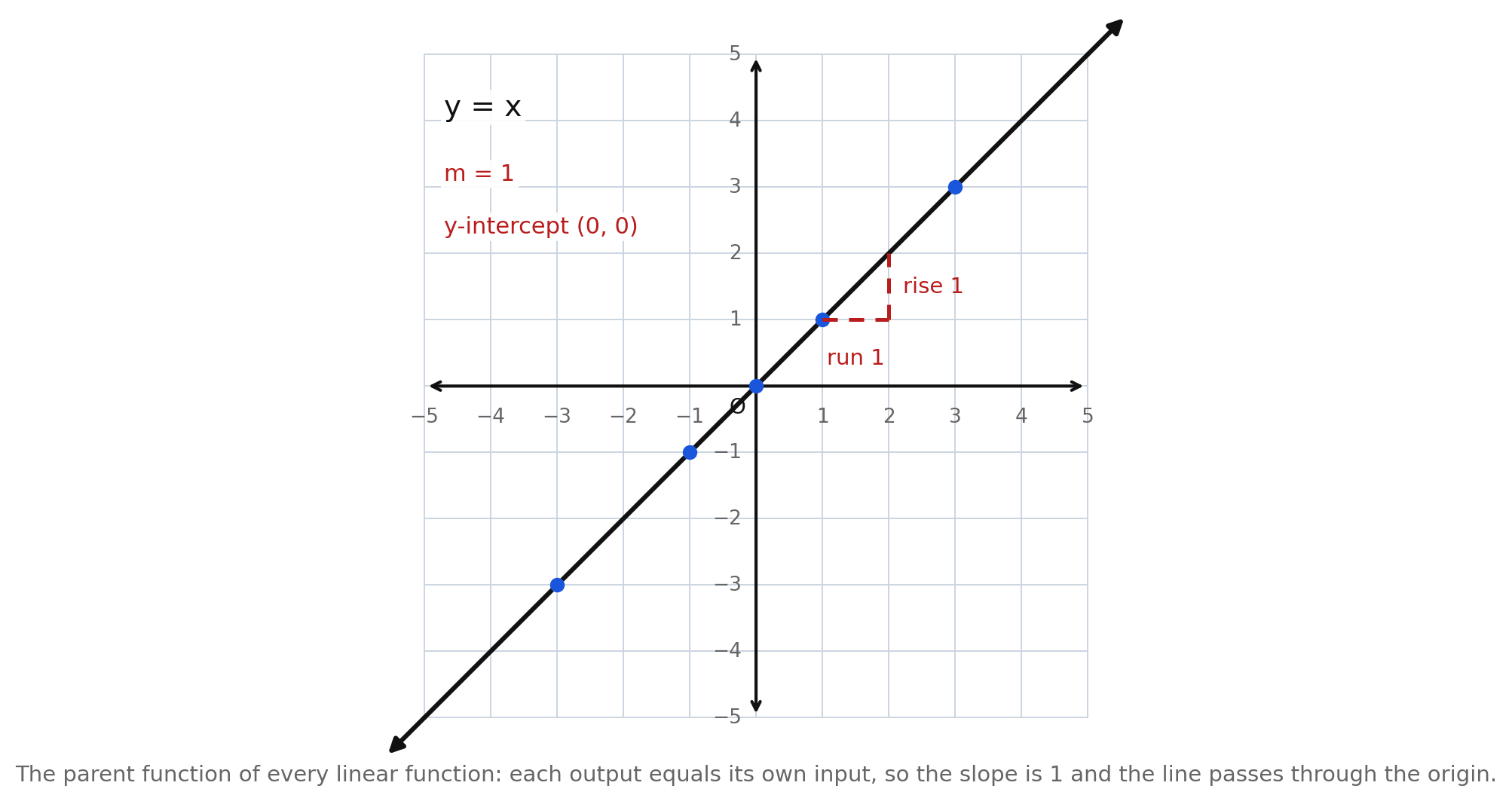
The figure marks five of its points: , , , , and . In every one of them the two coordinates are the same number, which is the whole content of the rule.
The dashed triangle shows a rise of over a run of , so
and the line passes straight through the origin, so the -intercept is .
All five characteristics of the parent
Everything this chapter asks of a linear function, asked of the plainest one:
| Characteristic | Value for |
|---|---|
| Slope | |
| -intercept | |
| -intercept | |
| Zero | |
| Domain | all real numbers |
| Range | all real numbers |
The two intercepts coincide, because the line passes through the origin, and that is the only line for which the question "which intercept is that dot?" has two right answers.
Why this one is the parent
Write the general linear function beside the parent:
The parent is the case and . Every other linear function is obtained by choosing a different , a different , or both — and there are only those two dials to turn. That is precisely why A.F.1b frames transformations in terms of their effect on the slope and the -intercept: those two numbers are the entire difference between any linear function and its parent.
Lesson 5.5 turns the dials one at a time.
Worked examples
Example 1 — Points on the parent
Is on the graph of ? Is ?
The rule requires the output to equal the input.
Answer: is on the graph, because . is not, because .
Example 2 — A table for the parent
Complete a table of for the inputs , , , , .
Answer: The outputs are , , , , — each output is a copy of its input.
Example 3 — The zero of the parent
Find the zero of .
Set the output to : .
Answer: The zero is , and the -intercept is .
Example 4 — Reading and
What are and for the parent function, written in the form ?
Writing in full gives .
Answer: and .
Example 5 — The parent in a context
A club gives one hour of service credit for each hour a student volunteers, so . Interpret the slope and the -intercept.
Answer: The slope means each hour volunteered earns exactly hour of credit — a rate of one credit hour per volunteer hour. The -intercept means a student who volunteers nothing has no credit; nobody starts with a head start.
Guided practice
- Use the parent-function figure. Give the slope and the -intercept of .
- In that same figure, list the five marked points.
- In that same figure, what does the rise-, run- triangle show, and what slope does it produce?
- Give the domain and range of .
- Give the zero of , and name the point that carries it.
- Explain what a parent function is, and why is the parent of the linear family.
Independent practice
- Complete a table of for the inputs , , , , .
- Is on the graph of ? Is ? Explain each answer.
- Written as , what are and for the parent function?
- Application. A club gives one hour of service credit for each hour a student volunteers, so . Interpret the slope and the -intercept in context, with units.
Exit ticket 5.4
- Give the slope, the -intercept, the zero, the domain, and the range of .
- Is the point on the parent function? Explain.
- Error analysis. A student says the parent function of the linear family is , "because that is the simplest equation." Explain what is wrong, and name the correct parent.
- Explain what makes the parent function, and name one linear function that is a transformation of it.
Lesson 5.5 — Transformations of the Parent Function
Two dials
Start at . There are exactly two ways to change it, and A.F.1b asks you to say what each one does.
- Multiply the input by a number. becomes . This changes the slope, and it leaves the -intercept at .
- Add a constant. becomes . This changes the -intercept to , and it leaves the slope at .
Do both and you get , which is every linear function there is.
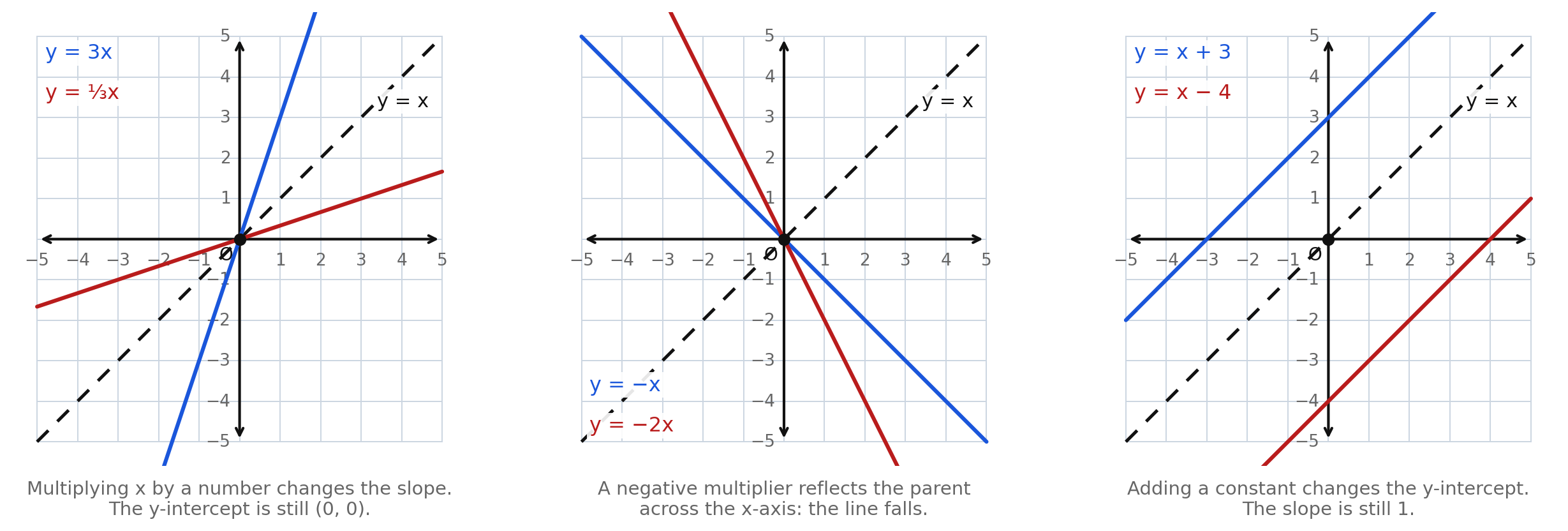
The parent is drawn dashed in black in all three panels so that every comparison is against the same line.
Panel 1 — Changing the slope
The blue line is and the red line is .
- has slope . Three is bigger than one, so the line is steeper than the parent — it climbs three units for each one across instead of one.
- has slope . One-third is between and , so the line is less steep — flatter, closer to horizontal.
- Both still pass through . Multiplying the input never moves the -intercept, because no matter what is.
The rule: if , the line is steeper than the parent; if , it is less steep.
Panel 2 — A negative multiplier reflects
The blue line is and the red line is .
- has slope . It has the same steepness as the parent but falls from left to right instead of rising: it is the parent reflected across the -axis.
- has slope . It is reflected and steeper, since .
- Both still pass through . A reflection through the origin does not move the origin, so the -intercept is unchanged.
Panel 3 — Adding a constant shifts vertically
The blue line is and the red line is .
- is the parent shifted up . Its -intercept is .
- is the parent shifted down . Its -intercept is .
- Both still have slope . They are exactly as steep as the parent; adding a constant adds the same amount to every output, so every rise-over-run is untouched.
A table makes the last point concrete:
Each output moved up by the same . Because every output moved by the same amount, the difference between consecutive outputs — which is what the slope measures — did not change at all.
Describing a transformation
Given any linear function, describe it against the parent by answering two questions in order.
- What is ? Say whether the line is steeper or less steep than the parent, and whether a negative sign has reflected it.
- What is ? Say how far up or down the parent has been shifted, and name the resulting -intercept.
For : the slope reflects the parent across the -axis and makes it less steep, since ; the shifts it up , so the -intercept is .
Worked examples
Example 1 — A slope change
Describe as a transformation of the parent.
The multiplier is and nothing is added.
Answer: The slope is multiplied by , so the line is steeper than the parent. The -intercept is unchanged at .
Example 2 — A vertical shift
Describe as a transformation of the parent.
Nothing multiplies , and is subtracted.
Answer: The parent is shifted down , so the -intercept moves to . The slope is still .
Example 3 — Both at once
Describe as a transformation of the parent.
The slope is and the constant is .
Answer: The slope is halved, so the line is less steep than the parent, and the graph is shifted down , so the -intercept is .
Example 4 — Comparing steepness
Which is steeper, or ?
Steepness compares the size of the slope, not its sign: and .
Answer: is steeper. It also falls rather than rises, because its slope is negative.
Example 5 — Building one from a description
Write the function obtained from by multiplying the slope by and then shifting down .
The slope becomes and the constant becomes .
Answer:
Guided practice
- Use the left panel of the transformations figure. Name the two equations shown, give the slope of each, and give the -intercept they share.
- In that same panel, which line is steeper than the parent and which is less steep? Explain how you can tell from the slopes.
- Use the middle panel. What transformation of the parent do those two lines show, and what are their slopes?
- Use the right panel. What changed relative to the parent, and what stayed the same?
- Describe as a transformation of , naming the effect on the slope and on the -intercept.
- Describe as a transformation of , naming the effect on the slope and on the -intercept.
Independent practice
- Describe each as a transformation of , naming the effect on the slope and on the -intercept. a) b) c) d)
- Which is steeper, or ? Explain what you compared.
- Write the linear function obtained from by multiplying the slope by and shifting the graph down .
- Use the middle panel of the transformations figure. Does reflecting the parent across the -axis change the -intercept? Explain why or why not.
- A line is the parent function shifted up . Give its slope, its -intercept, its equation, and its zero.
- Complete a table of and of for the inputs , , and , then say in one sentence what the table shows about the shift.
- Reasoning. Explain why changing never changes the slope. Your explanation should say what happens to every output when changes.
- Error analysis. A student says is the parent function shifted down . Identify the error and describe the transformation correctly.
Exit ticket 5.5
- Describe as a transformation of the parent, naming the slope and the -intercept.
- Describe as a transformation of the parent, naming the slope and the -intercept.
- Describe as a transformation of the parent, naming the slope and the -intercept.
- In , which number does a slope-changing transformation affect, and which does a vertical shift affect? Say what each transformation leaves alone.
Lesson 5.6 — Three Equivalent Forms
The same line, written three ways
A.F.1c names three forms, and a single line can be written in all three at once.
| Form | Looks like | Hands you for free |
|---|---|---|
| Slope-intercept | the slope and the -intercept | |
| Standard | both intercepts, in one substitution each | |
| Point-slope | the slope and one point on the line |
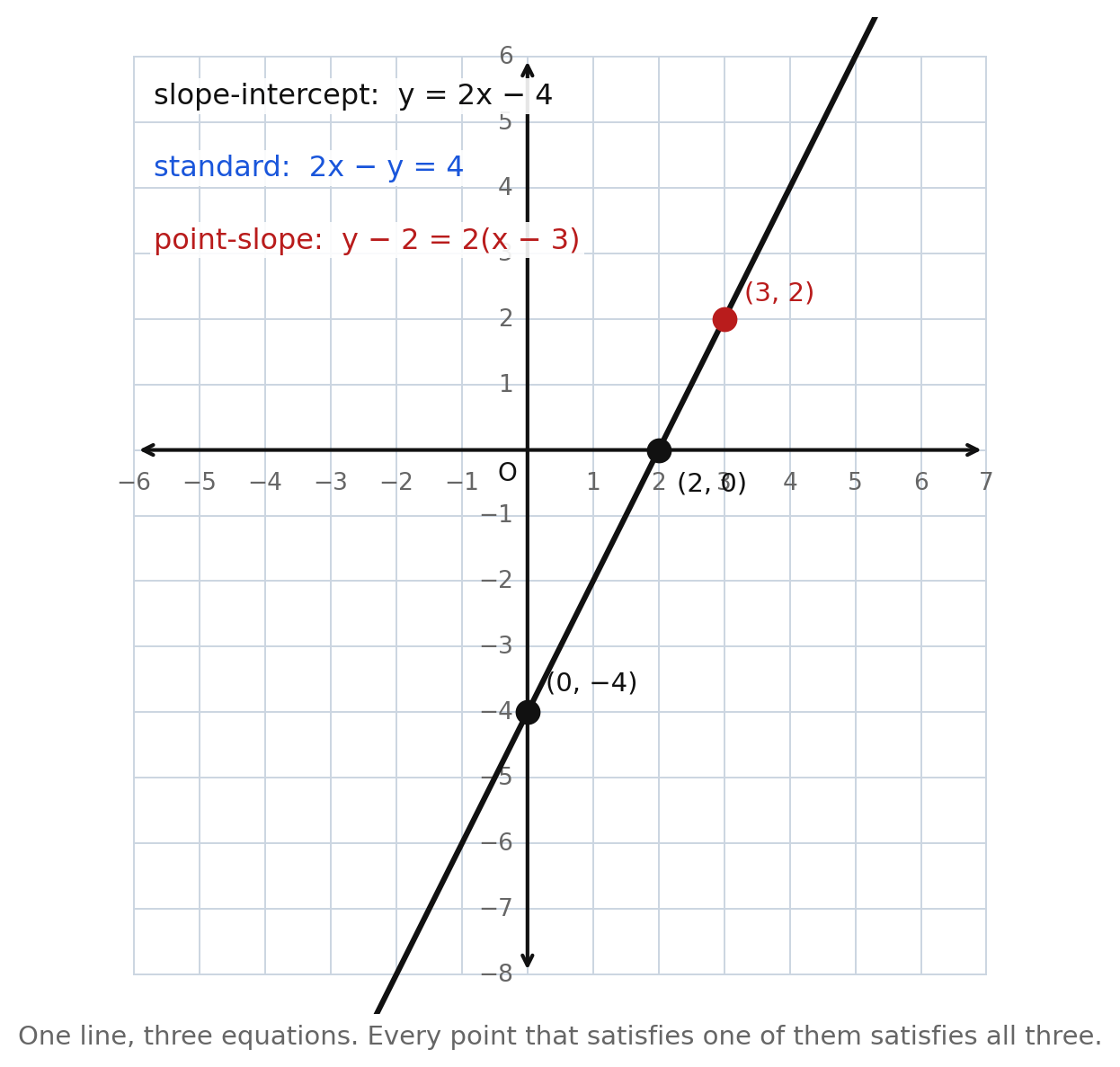
The figure shows one line and three equations for it:
These are not three lines that happen to look alike. They are the same set of points, described three ways. Test any point you like: at ,
- gives ✓
- gives ✓
- gives and ✓
All three agree, and they agree at every other point of the line too.
Read what each form is advertising. Slope-intercept announces and . Standard makes both intercepts one substitution away. Point-slope announces the slope and the specific point , which is marked on the graph — the point-slope form is built around a point that the other two forms never mention.
Converting to slope-intercept form
Solve for . That is the entire procedure, and it is Chapter 2's work.
From standard form. For :
- Subtract from both sides: .
- Divide every term by : .
So the slope is and the -intercept is .
From point-slope form. For :
- Distribute on the right: .
- Add to both sides: .
Two cautions worth naming, because they are where the errors live.
- Divide every term. Turning into divides only part of the right side and produces a different line.
- Watch the sign when the -term is negative. For : subtracting gives , and then multiplying by gives . Forgetting that last sign flip on the constant is the single most common mistake in this lesson.
Converting to standard form
Standard form is . This volume writes it with integer coefficients, so the work is: clear fractions, then move the -term to the left.
For :
- Multiply every term by to clear the fraction: .
- Subtract from both sides: .
- Multiply by so the leading coefficient is positive: .
For : subtract to get , then multiply by to get .
What standard form is good for
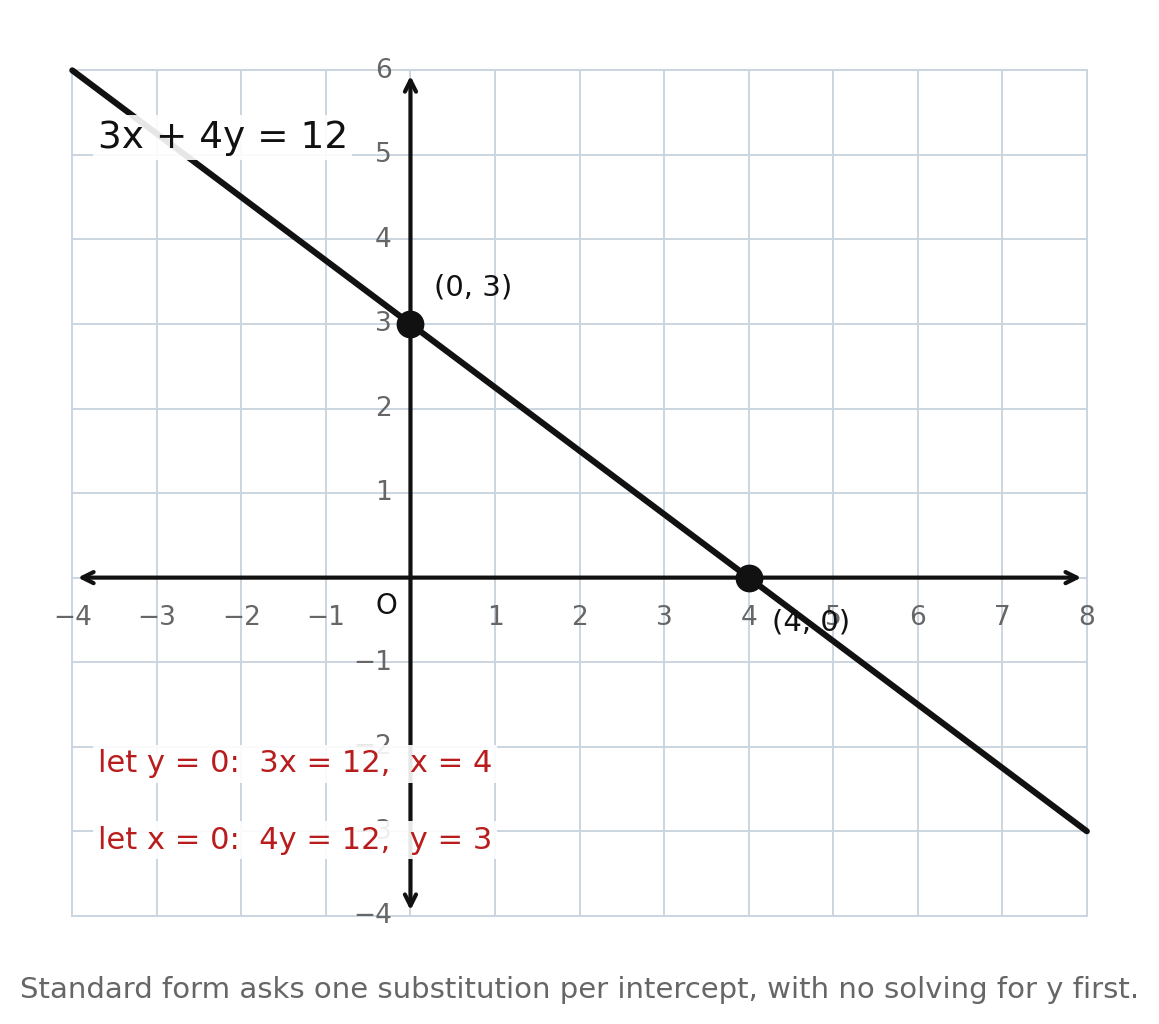
Standard form makes both intercepts nearly free, because setting a variable to zero deletes a whole term.
For :
- -intercept: let . Then , so . The point is .
- -intercept: let . Then , so . The point is .
No solving for first, no fractions along the way. Compare that with the slope-intercept form of the same line, , where finding the -intercept means solving — perfectly doable, but three steps instead of one.
There is a second thing standard form can do that slope-intercept form cannot do at all.
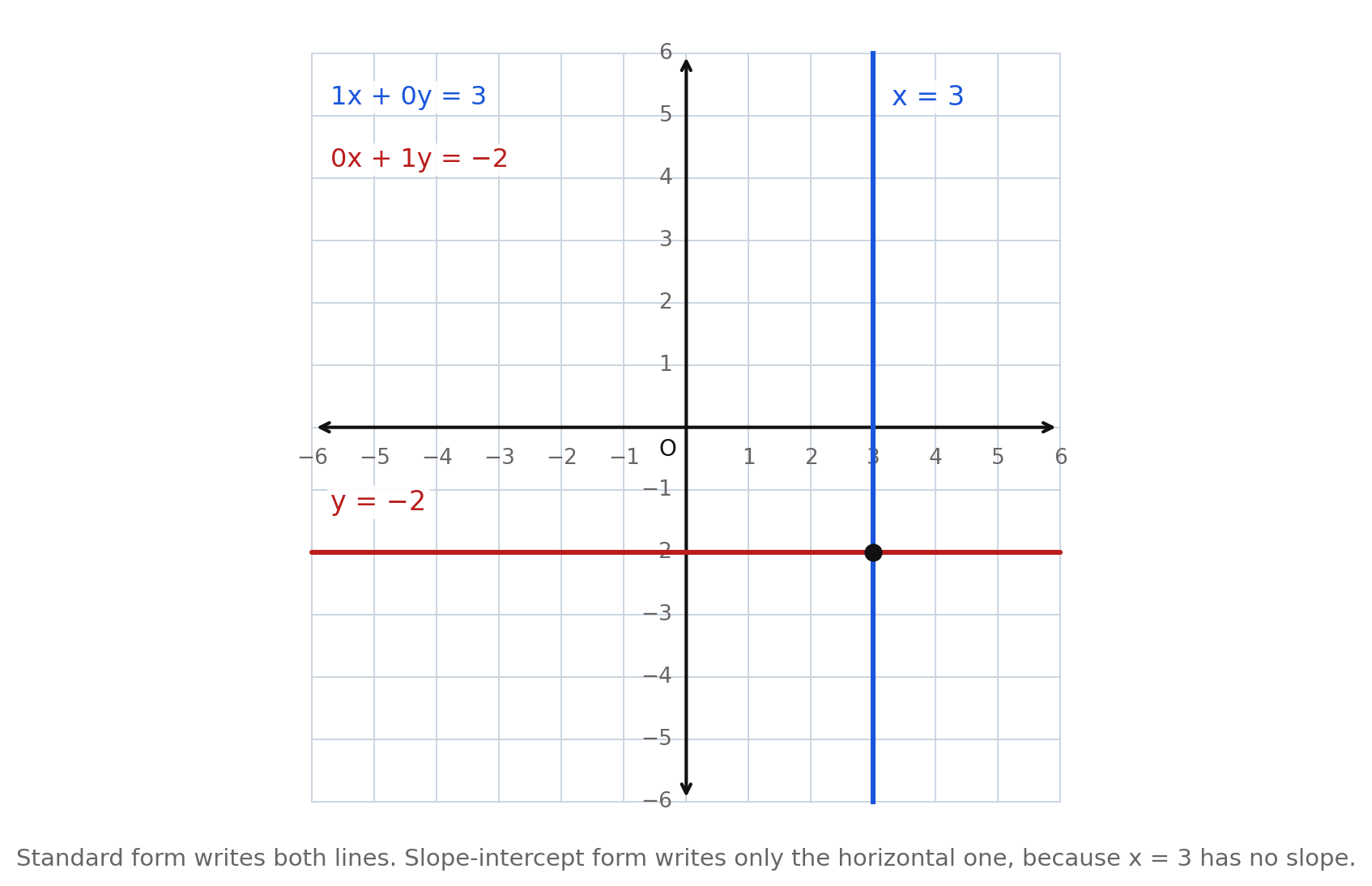
The vertical line has no slope, so there is no to put into and no way to write it in slope-intercept form. In standard form it is simply
with . The horizontal line is in standard form and in slope-intercept form, so that one both forms can write. Standard form covers every line in the plane; slope-intercept form covers every line except the vertical ones — which is another way of saying it covers every linear function, since a vertical line is not one.
What point-slope form is good for
Point-slope form is the only one of the three that names a point other than an intercept. Read it directly:
In , the slope is . The point takes one moment of care: the form subtracts , and the equation adds , so . The point is .
Its real use is writing the equation of a line from a point and a slope, which is A.F.1d in Chapter 6. Here, you read it and convert it.
Which form to reach for
- Want the slope or the starting value of a model? Slope-intercept.
- Want both intercepts, or need to write a vertical line? Standard.
- Handed a slope and a specific point? Point-slope.
A situation often decides for you. A taxi that charges to start plus per mile is naturally , because the two numbers in the story are the slope and the -intercept. A booster club selling shirts and hats toward a goal is naturally , because the story is a total, and the two intercepts — and — answer the two questions people actually ask: shirts and no hats, or hats and no shirts.
Worked examples
Example 1 — Standard to slope-intercept
Convert to slope-intercept form.
Subtract : . Divide every term by : .
Answer: , with slope and -intercept
Example 2 — Slope-intercept to standard
Convert to standard form with integer coefficients.
Multiply by : . Add : .
Answer:
Example 3 — Point-slope to slope-intercept
Convert to slope-intercept form.
Distribute: . Subtract : .
Answer:
Example 4 — Both intercepts from standard form
Find both intercepts of .
Let : , so . Let : , so .
Answer: -intercept ; -intercept
Example 5 — Reading point-slope form
Give the slope and a point on the line .
The multiplier outside the parentheses is the slope. The form subtracts , and here .
Answer: Slope ; the point
Guided practice
- Use the figure showing one line with three equations. Write the three equations it carries.
- In that same figure, which form shows the slope and the -intercept at a glance? Name both values.
- In that same figure, which form names a point on the line that the other two never mention? Give that point.
- Use the standard-form figure. Find both intercepts of using the two substitutions shown.
- Convert to slope-intercept form, and give the slope and the -intercept.
- Use the figure of a vertical line and a horizontal line. Explain why cannot be written in slope-intercept form, and write it in standard form.
Independent practice
- Convert each to slope-intercept form, then give the slope and the -intercept. a) b) c) d)
- Convert each to standard form with integer coefficients. a) b) c) d)
- Convert each to slope-intercept form. a) b) c)
- From , read the slope and a point on the line directly, without converting.
- Find both intercepts of .
- Find both intercepts of .
- Show that , , and describe the same line by checking the point in all three.
- Application. A booster club sells shirts for and hats for , and wants to raise , so where is shirts sold and is hats sold. Find both intercepts and say what each one means in context.
- Application. A taxi charges to start plus per mile. Which of the three forms displays both of those numbers directly? Write the equation in that form and point to each number.
- Error analysis. A student converts and writes . Identify the error and give the correct slope-intercept form.
Exit ticket 5.6
- Convert to slope-intercept form, and give the slope and the -intercept.
- Convert to standard form with integer coefficients.
- Convert to slope-intercept form.
- Find both intercepts of .
Chapter 5 Review
Vocabulary. linear function · slope · rate of change · rise · run · -intercept · -intercept · zero · domain · range · parent function · transformation · reflection · vertical shift · slope-intercept form · standard form · point-slope form
A.F.1 a, b, and c ask three different kinds of question, so this review is organized by bullet. Parts A and B are the five characteristics of bullet a, Part C is the parent function and its transformations from bullet b, Part D is the three forms of bullet c, and Part E mixes all three in context.
Part A — Domain, range, and zeros
- Give the domain, the range, and the zero of .
- Give the domain, the range, and the zero of .
- Is a function? Explain, and say what its slope is.
- Use the cooler figure from Lesson 5.1. Give the domain, the range, and the zero of , and interpret all three in context with units.
- Application. An elevator descends from meters above the ground at meters per second, so . Give the zero, the domain, and the range in context, with units.
- Reasoning. Explain why a linear function with a nonzero slope has exactly one zero, and name the kind of linear function that has none.
Part B — Slope and intercepts
- Give the slope and both intercepts of .
- Find the slope of the line through and .
- Find both intercepts of .
- Application. A pool is filling according to gallons after minutes. Interpret the slope and the -intercept in context, with units.
- Use the figure with the slope triangle. Read the slope, both intercepts, and the zero of , and say which part of the figure gives you each one.
- Error analysis. A student says the -intercept of is . Identify the error, and give both intercepts correctly.
Part C — The parent function and transformations
- Describe as a transformation of , naming the effect on the slope and on the -intercept.
- Describe as a transformation of , naming the effect on the slope and on the -intercept.
- Use the three-panel transformations figure. For each panel, name what changed relative to the parent and what stayed the same.
- Write two transformations of the parent that keep the -intercept at but have different steepness, and say which of your two is steeper.
- Reasoning. Explain why every linear function can be described as a transformation of , referring to and . Name the one kind of straight line this does not cover, and say why.
Part D — Three equivalent forms
- Convert to slope-intercept form, and give the slope and the -intercept.
- Convert to standard form with integer coefficients.
- Convert to slope-intercept form.
- Find both intercepts of .
- Use the figure of a vertical line and a horizontal line. Which of the three forms can write , and which can write ? Explain the difference.
Part E — Mixed application
- Application. A rideshare charges dollars for a ride of miles. Give the slope, the -intercept, and the zero. Interpret the slope and the -intercept in context with units, then explain why the zero has no meaning in this situation.
- Application. A fundraiser sells tickets at and programs at , aiming to raise , so . Find both intercepts and say what each means. Then convert the equation to slope-intercept form and say what that form reveals that standard form did not.
Standards coverage check — Chapter 5
A.F.1a names five characteristics and demands contextual interpretation of each, so coverage of that bullet is broken out characteristic by characteristic.
| Knowledge and Skill | Characteristic | Where it is taught | Where it is practiced | Where it is interpreted in context |
|---|---|---|---|---|
| A.F.1a — determine and identify the domain, range, zeros, slope, and intercepts of a linear function, presented algebraically or graphically, including interpretation in contextual situations | Domain | 5.1 (all real numbers by default; a situation cuts it down) | 1, 3, 5, 7, 13, 14, 52, 59; 101, 102, 104 | 8, 9, 11, 105 |
| A.F.1a | Range | 5.1 (all real numbers unless ) | 1, 3, 5, 7, 10, 12, 13, 14, 52, 59; 101, 102, 104 | 8, 9, 11, 105 |
| A.F.1a | Zeros | 5.3 (the zero, the -intercept, and the solution of ) | 37–41, 44–46, 48, 53, 59, 73; 101, 102, 106, 111 | 42, 43, 47, 104, 105, 123 |
| A.F.1a | Slope | 5.2 (rise over run, two points, a table, an equation); 5.4 (the parent's slope) | 17–27, 31, 32, 49, 51, 57, 59; 107, 108, 111 | 28, 29, 34, 58, 110, 123 |
| A.F.1a | Intercepts | 5.2 (both intercepts, and the difference between a point and a number) | 17, 19, 22, 23, 25, 26, 27, 31, 33, 49, 59; 107, 109, 111, 112 | 28, 29, 34, 94, 110, 123, 124 |
| A.F.1b — investigate and explain how transformations to the parent function affect the rate of change (slope) and the -intercept | Parent function | 5.4 (all five characteristics of ; why it is the parent) | 49–57, 59–62 | 58 |
| A.F.1b | Transformations | 5.5 (slope change, reflection, vertical shift; each named against the parent) | 63–80; 113–117 | 58, 123 |
| A.F.1c — write equivalent algebraic forms of linear functions, including slope-intercept, standard, and point-slope form, and analyze and interpret the information revealed by each | Slope-intercept | 5.6 (converting into it from both other forms; what it advertises) | 82, 85, 87, 89, 97, 99; 118, 120, 124 | 95, 124 |
| A.F.1c | Standard | 5.6 (converting into it; intercepts in one substitution; the vertical line) | 84, 86, 88, 91, 92, 98, 100; 119, 121, 122 | 94, 124 |
| A.F.1c | Point-slope | 5.6 (reading the slope and the point; converting out of it) | 81, 83, 89, 90, 93, 99; 120 | 95 |
Supporting items: 2, 4, 15, 16 establish what an arrowhead, a segment, and a vertical line each say about a graph; 30, 76, 96, 112 are error analyses aimed at the four most common confusions in the chapter; 93 asks the student to confirm by substitution that two forms really are equivalent.
Boundaries respected. No item asks the student to write the equation of a line from a graph, from two points, or from a slope and a point — that is A.F.1 d and e, in Chapter 6 — and no item mentions parallel or perpendicular lines. No item asks the student to graph a linear function on a blank grid as the answer to a characteristic question, and none asks for to be evaluated at a supplied input or for to be recovered from a supplied ; those are A.F.1 f and g, in Chapter 7. The transformations of Lesson 5.5 are transformations of only, and are described only through their effect on the slope and the -intercept. The forms of Lesson 5.6 are the three A.F.1c names and no others.
Answer keys for every item in this chapter are in Appendix A.