Chapter 4 — Functions, Domain, and Range
Standard: A.F.2 (a)
A.F.2 — verbatim. The student will investigate, analyze, and compare characteristics of functions, including quadratic, and exponential functions, and model quadratic and exponential relationships. Students will demonstrate the following Knowledge and Skills: a) Determine whether a relation, represented by a set of ordered pairs, a table, a mapping, or a graph is a function; for relations that are functions, determine the domain and range.
By the end of this chapter you will be able to:
- Read a relation presented as a set of ordered pairs, a table, a mapping, or a graph, and rewrite it in any of the other three forms (A.F.2a)
- Decide whether a relation is a function by checking whether any input is paired with more than one output, in all four representations (A.F.2a)
- Apply the vertical line test to a graph — a set of dots or an unbroken curve — and say exactly what it detects (A.F.2a)
- Recognize the two traps: a repeated output never breaks the function rule, and an input listed twice with the same output does not break it either (A.F.2a)
- State the domain and the range of a function, in words and as a listed set for discrete relations (A.F.2a)
- Read the notation as the name of a rule and the name of that rule's output (A.F.2a)
Lessons: 4.1 Relations and Their Four Representations · 4.2 Deciding Whether a Relation Is a Function · 4.3 Graphs and the Vertical Line Test · 4.4 Domain and Range
Why this chapter comes first among the function chapters. Every later chapter of this volume — linear functions, quadratic functions, exponential functions, systems — reasons in the vocabulary fixed here. When Chapter 16 says "the range of this quadratic is all real numbers greater than or equal to ," it is using the word range exactly as this chapter defines it.
Scope note. This chapter stops where A.F.2a stops: deciding whether a relation is a function, and stating the domain and range when it is. Function notation is introduced here only as a name — the name of a rule, and the name of the output that rule produces at an input. Actually computing for a linear rule is Chapter 7; doing it for quadratic and exponential rules is Chapters 16 and 17.
Conventions this chapter fixes.
- A domain or a range for a relation with finitely many pairs is written inside braces, with each value listed once and in increasing order: .
- When a graph is an unbroken curve, the domain and range are described in words — "all real numbers," or "all real numbers greater than and up to and including ." This volume does not require interval notation, and this chapter does not use it. If your teacher introduces it, means the same thing as "all real numbers from up to but not including ."
- Item numbering runs straight through the chapter, from 1 in Lesson 4.1 to 116 at the end of the review. It does not restart at each lesson.
Lesson 4.1 — Relations and Their Four Representations
What a relation is
A relation is any set of ordered pairs. That is the entire definition. The pairs do not have to follow a pattern, do not have to come from a formula, and do not have to behave well.
In an ordered pair , the first number is the input — also called the -coordinate, the independent value, or the argument — and the second number is the output, also called the -coordinate or the dependent value. The word ordered is doing real work: and are different pairs, because they name different inputs.
You met relations in Grade 8. What Algebra 1 adds is a fourth way of writing one down, and permission to work with relations whose graphs are unbroken curves rather than a handful of dots.
The four representations
A.F.2a names exactly four ways a relation can arrive on the page, and you must be able to work in all four.
- A set of ordered pairs, written inside braces:
- A table, with the inputs in one column and their outputs beside them
- A mapping, two boxes joined by arrows — inputs on the left, outputs on the right, one arrow per pair
- A graph, one point for each pair
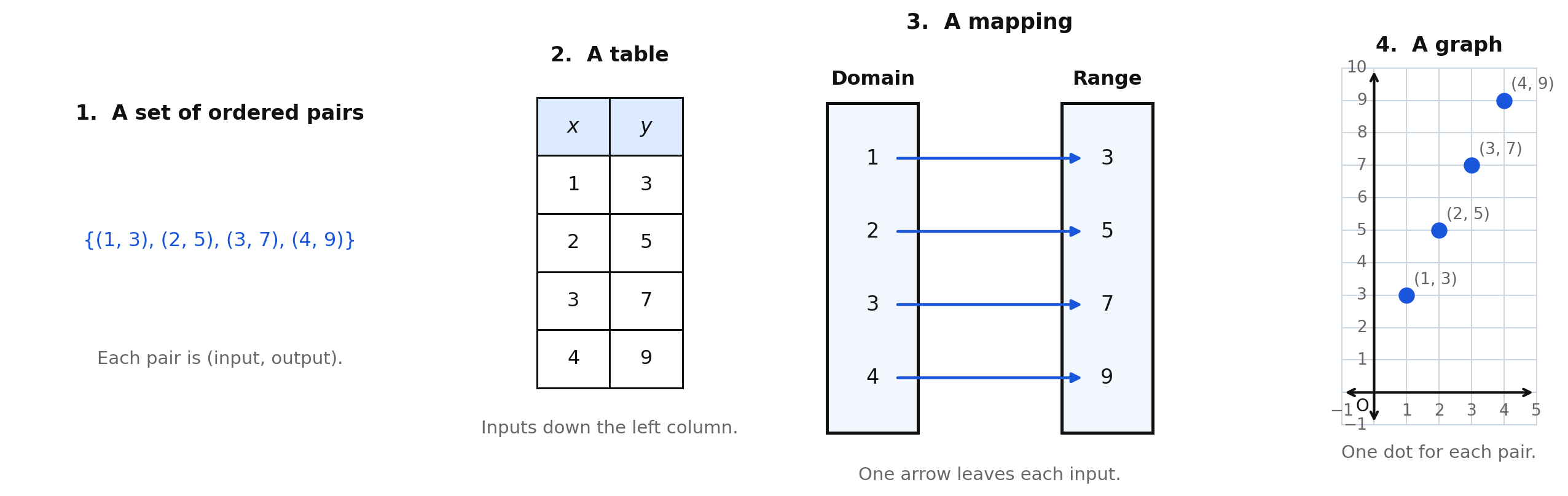
Nothing was added or lost between those four panels. They are four ways of writing the same four facts.
Moving between the representations
- Set to table: each pair becomes one row, input on the left.
- Table to set: each row becomes one pair, input first.
- Set or table to mapping: collect the distinct inputs into the left box and the distinct outputs into the right box, then draw one arrow per pair. A value that occurs twice is written once in its box; only the arrows are repeated.
- Set or table to graph: each pair becomes one point, plotted units across and then units up or down.
- Graph to set: read each point's coordinates, across first and then up.
The one place this goes wrong is order. A table with -values and and -values and is the relation — never .
Discrete graphs and continuous graphs
Grade 8 kept every graph to a small number of separate dots. Algebra 1 does not.
A discrete graph is a set of separated points. It states a fact at each plotted input and says nothing at all in between. A continuous graph is an unbroken curve or line; every input in the stretch it covers has a point above or below it.
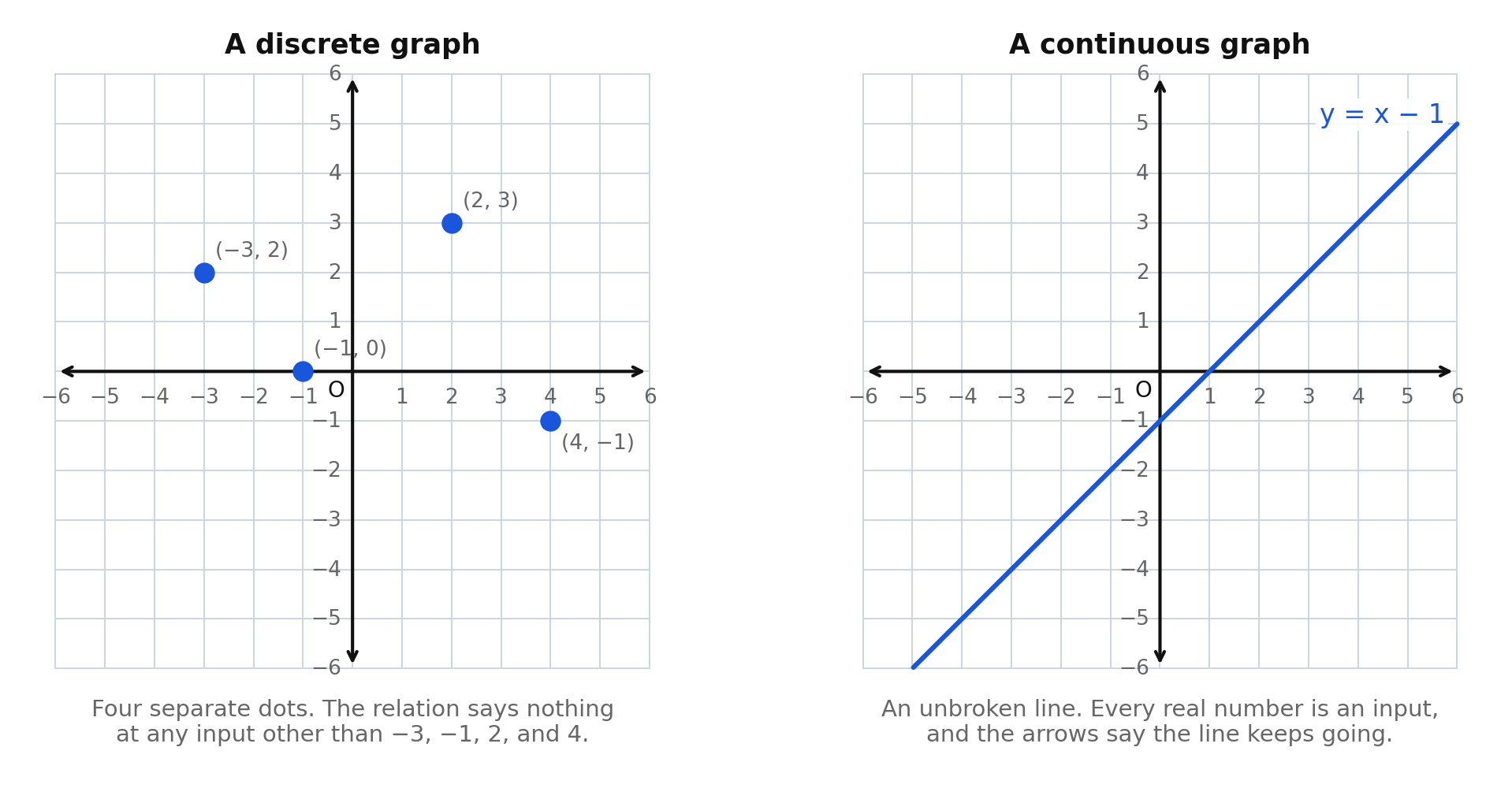
Both pictures are graphs of relations, and every tool in this chapter applies to both. What changes is only how you describe the domain and the range at the end, which is Lesson 4.4's problem.
The choice between them is usually made by the situation. Tickets sold, students enrolled, and bracelets bought are counted in whole numbers, so their graphs are dots. Distance traveled, temperature, and elapsed time vary smoothly, so their graphs are curves.
Worked examples
Example 1 — A set as a table
Write as a table.
Each pair becomes a row, input on the left.
Answer:
Example 2 — A table as a set
A table lists -values with -values . Write the relation as a set of ordered pairs.
Read across each row: pairs with , then with , then with .
Answer:
Example 3 — A set as a mapping
Describe the mapping of : what goes in each box, and how many arrows are drawn?
The distinct inputs are , , and ; the distinct outputs are and . The output is used twice but is written once in the box.
Answer: The left box holds , , and the right box holds , . Three arrows are drawn: , , and .
Example 4 — A relation from a rule
Each output is three less than twice its input, and the inputs are , , , . Write the relation as a set of ordered pairs.
Apply to each input: , , , .
Answer:
Example 5 — A relation from a situation
A craft booth rents for per hour. Write the relation for renting , , , or hours, and say what the input and the output represent.
Multiply each hour count by .
Answer: . The input is the number of hours rented; the output is the cost in dollars. The pair says three hours cost .
Guided practice
- Write as a table.
- A table lists -values with -values . Write the relation as a set of ordered pairs.
- In the ordered pair , name the input and the output.
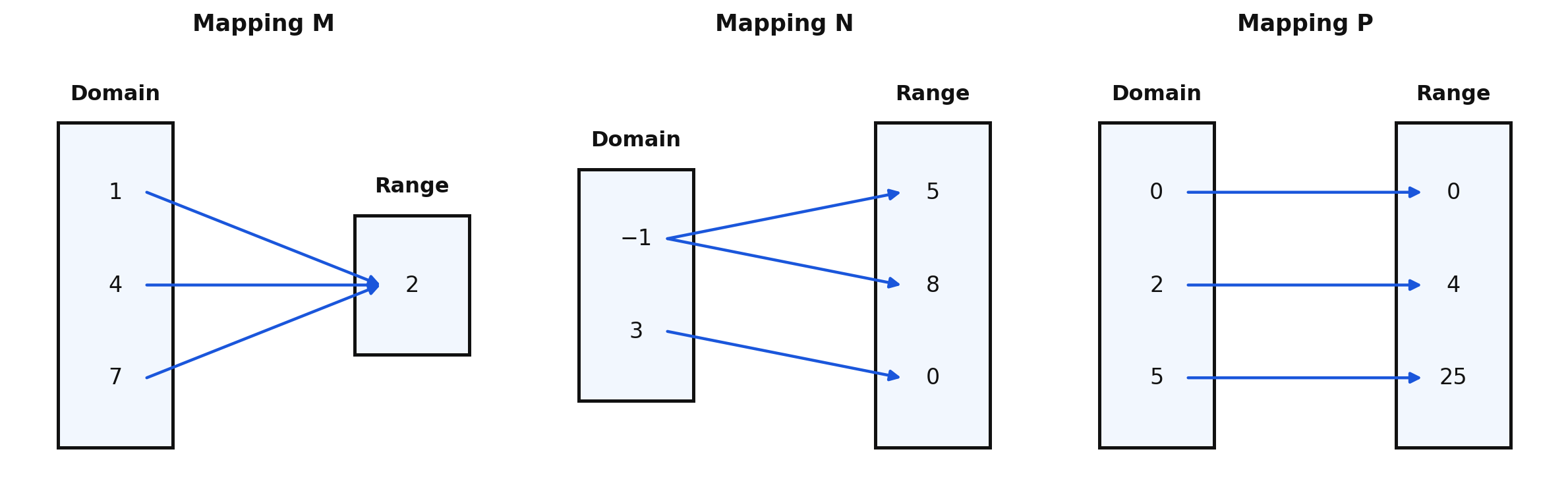
- List the ordered pairs of Mapping M in the figure below as a set.
- Name the four representations of a relation that this standard requires.
- In one sentence each, say what a discrete graph is and what a continuous graph is.
Independent practice
- Write each table as a set of ordered pairs. a) -values with -values b) -values with -values
- Write as a table.
- List, as a set of ordered pairs, the four points on the discrete graph in the figure above showing a discrete graph beside a continuous one.
- Describe the mapping of : which values go in the left box, which in the right box, and how many arrows are drawn?
- Each output is three less than twice its input, and the inputs are , , , . Write the relation as a set of ordered pairs.
- Write the relation from item 11 as a table.
- Reasoning. Which of the four representations makes a repeated input easiest to spot, and which makes it easiest to miss? Explain your choice.
- Application. A craft booth rents for per hour. Write the relation for , , , and hours as a set of ordered pairs, and state what the input and output represent.
- Error analysis. A table lists -values and with -values and . A student writes the relation as . Identify the error and write the relation correctly.
- Reasoning. The sets and are the same relation, but and are different ordered pairs. Explain why both statements are true.
Exit ticket 4.1
- Write as a table.
- A table lists -values with -values . Write the relation as a set of ordered pairs.
- In the ordered pair , name the input and the output.
- Name the four representations A.F.2a lists, and give one sentence on how you would read a relation out of each.
Lesson 4.2 — Deciding Whether a Relation Is a Function
The definition
A function is a relation in which each input is paired with exactly one output.
Read that sentence slowly, because nearly every mistake in this chapter comes from reading it loosely.
- It says each input. It says nothing whatever about outputs.
- It says exactly one output. Not "at most one," not "at least one" — one.
So there is exactly one way for a relation to fail: some input shows up with two different outputs. That single failure is the only thing you are hunting for, in every representation.
A useful test question: point at an input and ask, "what is the output here?" If the relation ever answers with two different numbers, it is not a function.
In a set of ordered pairs
Scan the first coordinates. If a value appears more than once, compare the second coordinates beside those appearances.
— the inputs , , are all different, so no input can possibly have two outputs. It is a function.
— the input appears with and with . Ask "what is the output at ?" and you get two answers. It is not a function.
In a table
The inputs are a column, so scan that column for a repeat and then compare the outputs beside it.
| ← input , output | ||
| ← input again, output | ||
The input has outputs and , two different values, so this table is not a function. Note that the rows are in no particular order, which is precisely why the repeated input can hide two rows apart.
In a mapping
A mapping makes the definition visible, because "exactly one output" becomes exactly one arrow leaving each input.
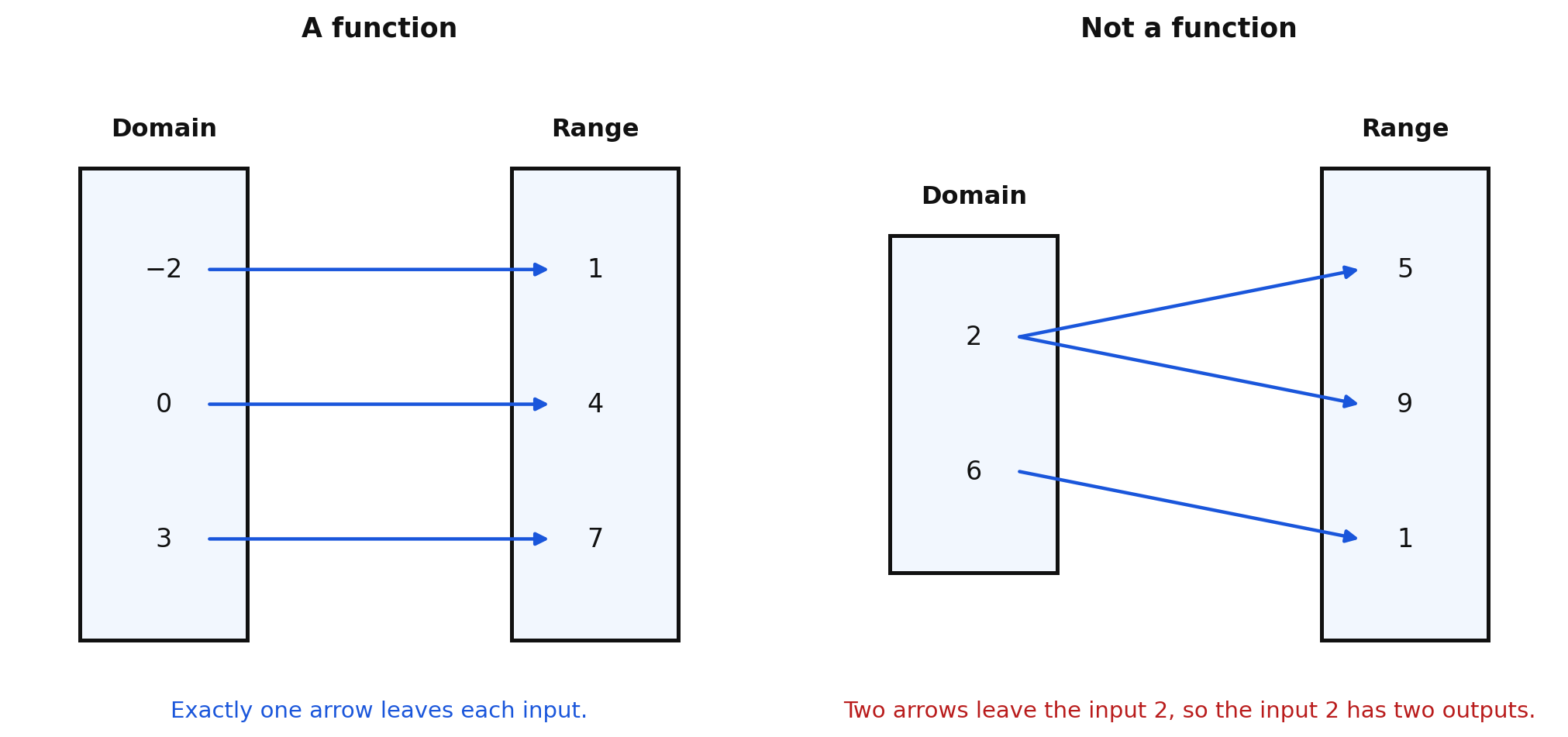
On the left, three arrows leave three different inputs. Every input has exactly one arrow leaving it, so the relation is a function.
On the right, two arrows leave the input — one to and one to . The relation gives two answers to one question. It is not a function.
The rule for reading a mapping: count the arrows that LEAVE each input, never the arrows that ARRIVE at an output.
Trap 1 — a repeated output is completely fine
Consider . The output appears three times. Is that a problem?
No. Check the definition: input has exactly one output, input has exactly one output, input has exactly one output. It is a function. Nothing in the definition limits how often an output may be reused.
In a mapping, this is the case where several arrows arrive at the same value.
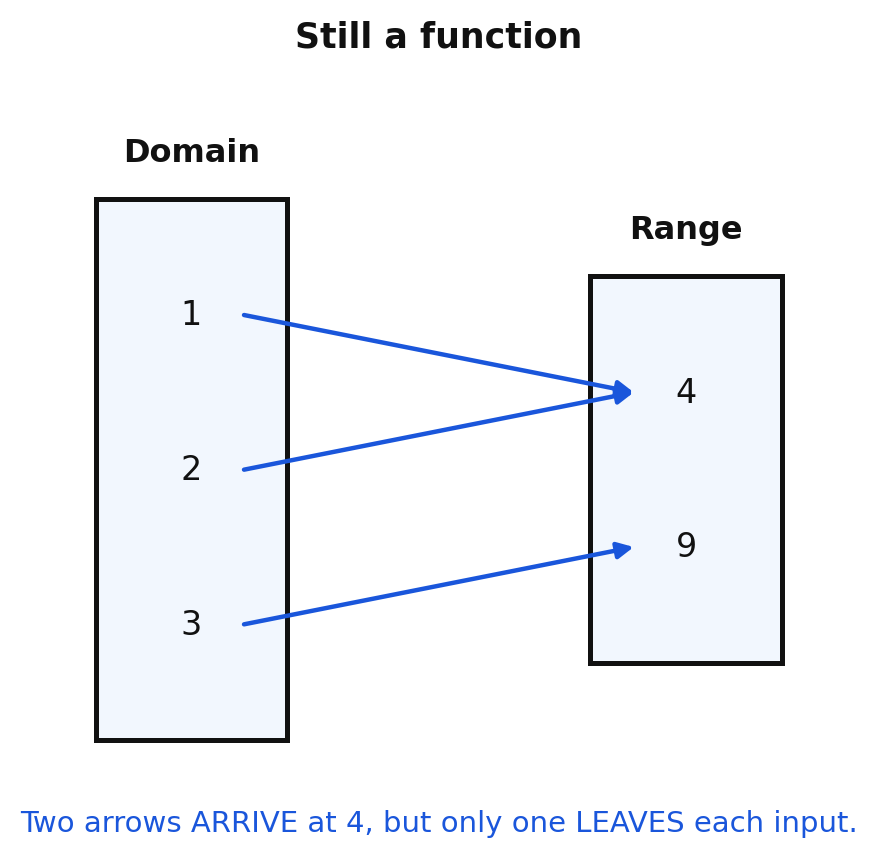
Two arrows arrive at , but only one arrow leaves each of , , and . This is a function. The situation is ordinary: two different students can have the same height, and two different inputs can produce the same output.
Trap 2 — a repeated input can still be fine
Here is the case students get wrong most often. Look at
The input appears twice. Does that break the rule?
No — because both times, the input is paired with the output . Ask "what is the output at ?" and the relation gives exactly one answer: . It is a function. Plotted, the two copies of land on the same point, so the graph shows three points, not four.
Hold these two statements together:
- A repeated output never breaks the rule.
- A repeated input breaks the rule only when the two outputs differ.
The test is not "does an input repeat." The test is does any input have two different outputs.
Naming a function: the notation
When a relation is a function, we usually give it a name. The name is a single letter — most often , sometimes or — and the notation looks like this:
Read it aloud as " of ." It is not multiplication. It carries two pieces of information at once:
- The letter names the rule — the whole function, the entire pairing.
- The expression names the output that the rule produces at the input .
So is a compact way to write the sentence "the function named pairs the input with the output ," which is the same fact as the ordered pair . In the same way, a function given by satisfies , because the pair is in it.
Two habits worth forming now:
- Inside the parentheses is always an input. Outside, the whole symbol is an output.
- Only a function gets this notation, and that is the point of it. Writing presumes there is exactly one output at to write down. The relation cannot be given a name this way, because would have to equal both and .
This chapter uses only to name things. Computing from a linear rule such as is the work of Chapter 7.
Worked examples
Example 1 — All inputs different
Is a function?
The inputs , , are all different, so no input can carry two outputs.
Answer: Yes, it is a function.
Example 2 — An input with two outputs
Is a function?
The input is paired with and also with .
Answer: No. The input has two different outputs.
Example 3 — A repeated output
Is a function?
Each of the inputs , , appears once, so each has exactly one output. The repeated output is irrelevant to the definition.
Answer: Yes, it is a function.
Example 4 — A repeated input with the same output
Is a function?
The input appears twice, but its output is both times, so the question "what is the output at ?" has exactly one answer.
Answer: Yes, it is a function.
Example 5 — From a table
A table lists -values with -values . Is it a function?
The input fills two rows, once with and once with .
Answer: No. The input has two different outputs, and . (The repeated output at and is not the problem.)
Guided practice
- Is a function? Explain in one sentence.
- Is a function? Explain in one sentence.
- Is a function? Explain in one sentence.
- Is a function? Explain in one sentence.
- In the figure of two mappings above, which one is a function? Say what you counted.
- In the figure showing two inputs sending arrows to the same output, is the relation a function? Explain using the words leave and arrive.
Independent practice
- Decide whether each relation is a function, and give the reason. a) b) c) d)
- A table lists -values with -values . Is the relation a function? Explain.
- A table lists -values with -values . Is the relation a function? Explain.
- A table lists -values with -values . Is the relation a function? Explain.
- Use the figure of Mappings M, N, and P. Which are functions? For each one that is not, name the input that breaks the rule and give its two outputs.
- A relation is written with ordered pairs, but only different inputs appear. Can it still be a function? Explain what would have to be true.
- Reasoning. Explain why a repeated output never breaks the function rule but a repeated input sometimes does. Give one example of each.
- Application. A school assigns lockers. The relation pairs a student ID with a locker number. Is it a function? Explain what the pair says, and explain why the school would have a problem if the relation contained both and .
- Error analysis. A student says is not a function "because repeats." Explain what the student confused, and give the correct verdict.
- Reasoning. The relation is a function, and we name it . Explain what the statement says, and explain why the relation could not be named this way.
Exit ticket 4.2
- Is a function? Explain.
- Is a function? Explain.
- Is a function? Explain.
- Explain what the two parts of the notation name, and why only a function can be written this way.
Lesson 4.3 — Graphs and the Vertical Line Test
Why a graph needs its own test
In a set, a table, or a mapping, you find a repeated input by reading. On a graph there is nothing to read — but there is something to see, because every point with the same input sits on the same vertical line.
The vertical line test. If any vertical line passes through two or more points of the graph, the relation is not a function. If every vertical line passes through at most one point of the graph, the relation is a function.
That is not a separate rule. It is the definition in picture form: two points on one vertical line share an -coordinate — one input — and differ in their -coordinate — two outputs.
The test on an unbroken curve
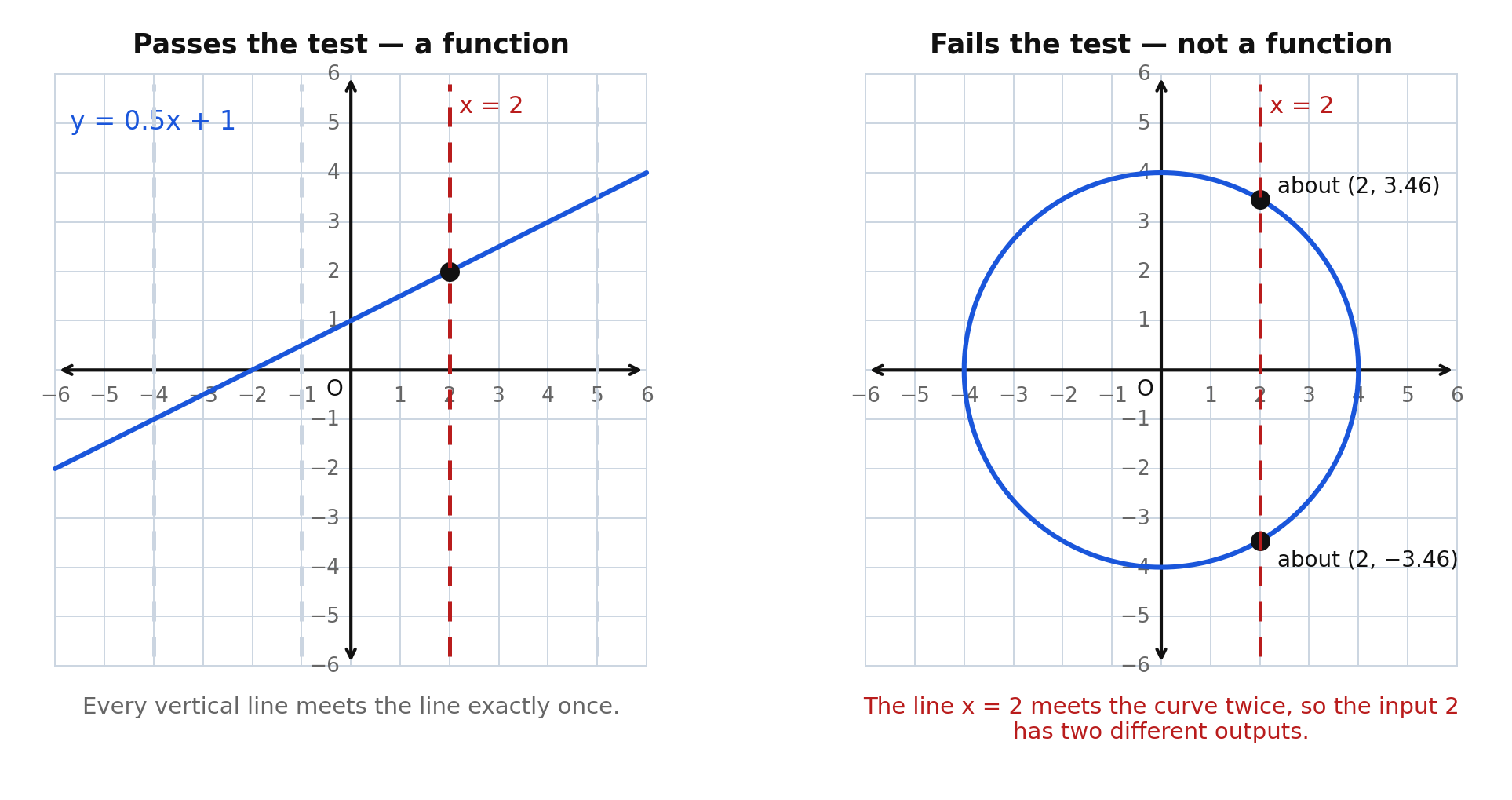
On the left is the line . Slide a vertical line anywhere across the picture and it crosses the line exactly once. Every input has exactly one output, so this graph is a function.
On the right is a circle of radius centered at the origin. The vertical line crosses it twice, at about and about . The input has two different outputs, so the circle is not the graph of a function. Every vertical line strictly between and does the same thing; one such line is enough to settle it.
You only need one offending vertical line to prove a relation is not a function. To prove that it is one, you have to be satisfied that no vertical line ever hits twice, which is a claim about the whole picture.
The test on a discrete graph
The test reads exactly the same way when the graph is a set of separate points: a vertical line through two of the plotted points is the picture of one input with two outputs.
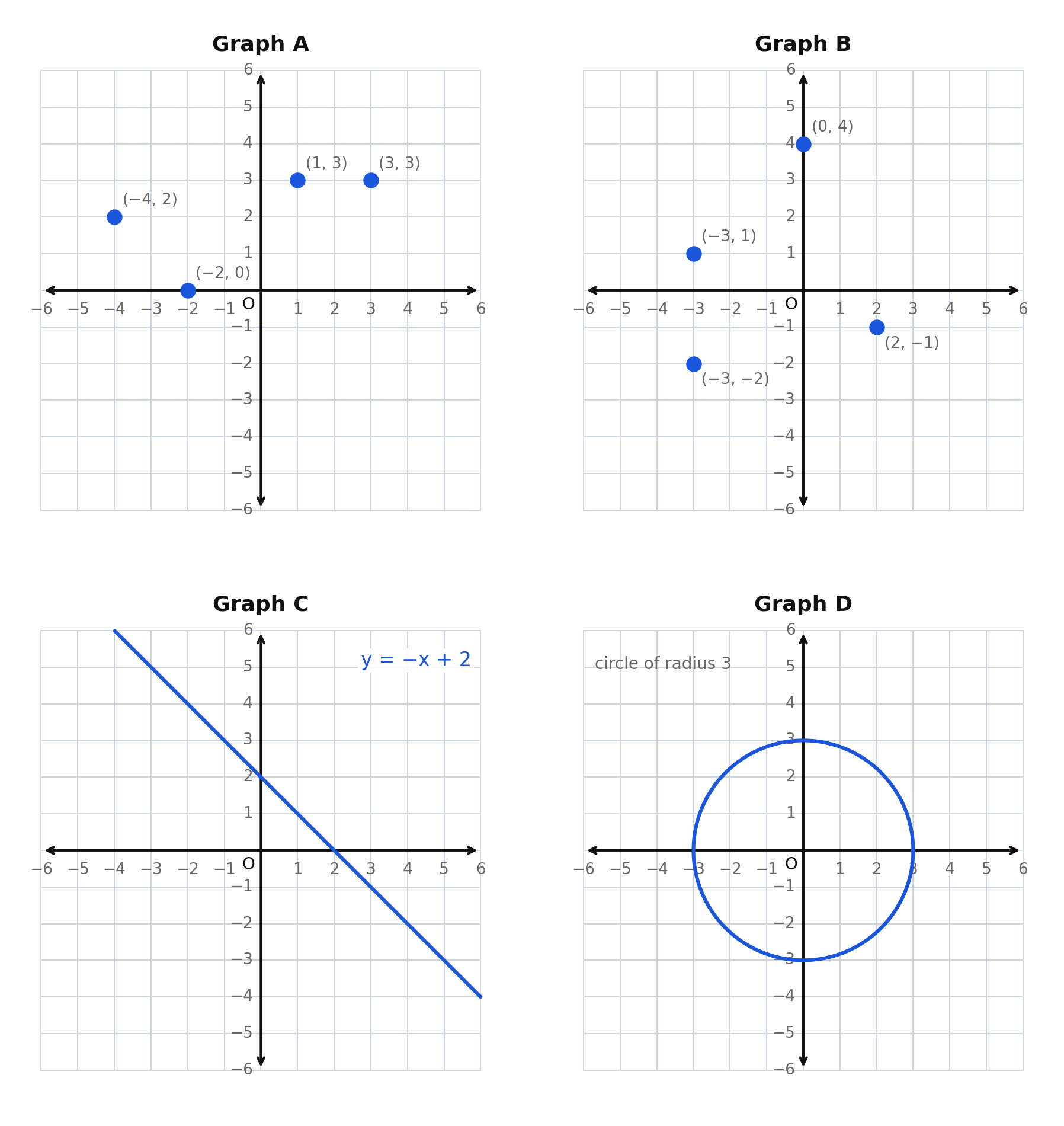
- Graph A is the four points , , , . Each sits on its own vertical line, so A is a function. The two points sharing the output are not a problem — they sit on the same horizontal line, and the test is not about horizontal lines.
- Graph B is , , , . The line passes through and , so B is not a function.
- Graph C is the line . Every vertical line meets it once. C is a function.
- Graph D is a circle of radius . The line passes through and , so D is not a function.
Two special lines
A horizontal line such as is a function. Every vertical line crosses it exactly once. Every input has the single output , and reusing an output is allowed.
A vertical line such as is not a function. The single vertical line lies on top of the entire graph, so the input has infinitely many outputs — and every other input has none.
These two are worth memorizing as a pair, because they are the fastest check that you have the definition pointing in the right direction.
Worked examples
Example 1 — A discrete graph that passes
A graph shows the points , , , . Is the relation a function?
The inputs , , , are all different, so no vertical line meets two points. The repeated output is allowed.
Answer: Yes, it is a function.
Example 2 — A discrete graph that fails
A graph shows the points , , . Is the relation a function?
The points and share the input .
Answer: No. The vertical line passes through and .
Example 3 — A circle
Explain why the circle of radius centered at the origin is not the graph of a function, and name a vertical line that proves it.
A vertical line strictly inside the circle enters and leaves it, crossing twice.
Answer: Not a function. The line passes through and , so the input has two different outputs.
Example 4 — A vertical line
Is the graph of a function?
Every point of that graph has the input , and there are infinitely many of them.
Answer: No. The vertical line lies along the entire graph, so the input is paired with every possible output.
Example 5 — A horizontal line
Is the graph of a function?
A vertical line drawn anywhere crosses at exactly one point.
Answer: Yes. Every input has the single output ; a repeated output never breaks the rule.
Guided practice
- In the vertical-line-test figure above, is the graph on the left a function? Name the test you used.
- In the same figure, is the circle on the right a function? Name a vertical line that proves your answer, and give the two points it passes through.
- Is Graph A in the four-graph figure a function? List its ordered pairs.
- Is Graph B a function? If not, name the vertical line that proves it.
- Is Graph C a function? Explain in one sentence.
- Is Graph D a function? If not, name a vertical line that proves it.
Independent practice
- A graph shows the points , , , . Is the relation a function? Explain.
- A graph shows the points , , . Is the relation a function? If not, name the vertical line that proves it.
- Is the graph of the vertical line a function? Explain.
- Is the graph of the horizontal line a function? Explain.
- Reasoning. Explain why the vertical line test works, in terms of the definition of a function. Your explanation should mention what two points on one vertical line have in common.
- Which of these graphs fail the vertical line test: an unbroken slanted line, a circle, a horizontal line, a vertical line? For each failure, name one vertical line that proves it.
- Application. Use the ticket-cost figure in Lesson 4.4. Is that relation a function? Explain what a "no" answer would have meant for a customer buying tickets.
- Error analysis. A student says the horizontal line is not a function "because every input gives the same output, so the outputs repeat." Identify the error and give the correct verdict.
- Reasoning. A graph passes the vertical line test. Can two of its points still share the same -coordinate? Explain, and sketch or describe an example.
- Application. A weather station records the outdoor temperature once every minute for an hour and plots the readings against the time. Explain why the resulting graph must pass the vertical line test.
Exit ticket 4.3
- A graph shows the points , , . Is the relation a function? If not, name the vertical line that proves it.
- State the vertical line test, and say exactly what it detects.
- Is the unbroken line in the discrete-and-continuous figure the graph of a function? Explain.
- Explain in one or two sentences why a circle can never be the graph of a function.
Lesson 4.4 — Domain and Range
The two sets
Every relation carries two sets of numbers with it.
The domain is the set of all inputs — all the -values.
The range is the set of all outputs — all the -values.
A.F.2a asks for the domain and range of relations that are functions, so the habit to build is: settle the function question first, then report the two sets. (The two sets can be listed for any relation, and a few items below ask you to do that on purpose, but the standard's target is the function case.)
Two conventions apply every time you write one of these sets for a relation with finitely many pairs.
- No repeats. A set records which values occur, not how many times. If the output occurs at two inputs, the range contains once.
- Increasing order. Write from least to greatest. The mathematics does not require it; comparing two answers and spotting a missing value both become much easier with it.
From a set of ordered pairs, a table, or a mapping
Take the first coordinates for the domain and the second coordinates for the range, then drop repeats and sort.
For : first coordinates give domain ; second coordinates give range , with the listed once.
A table works the same way, one column at a time. A mapping is even quicker: the left box, sorted, is the domain, and the right box, sorted, is the range — the boxes already dropped the repeats for you when you drew them.
From a discrete graph
Read the domain by traveling across — the -coordinate of every point. Read the range by traveling up and down — the -coordinate of every point.
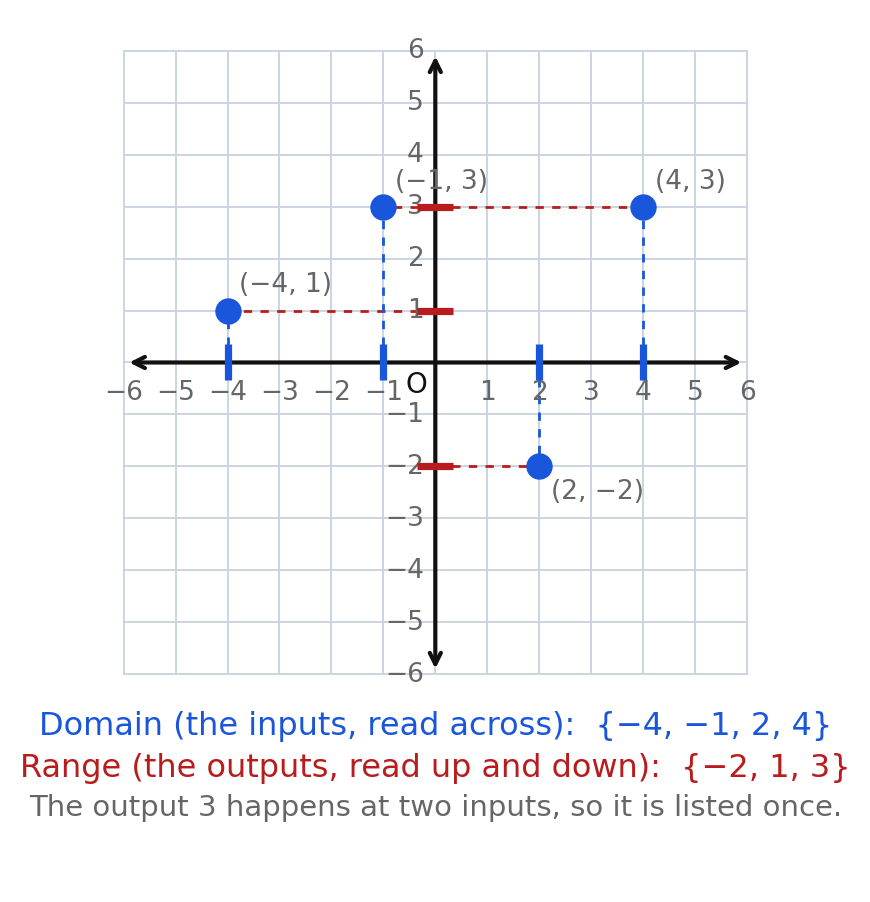
The four points are , , , and .
- Domain:
- Range: — the output happens at two different inputs, so it appears once
From a continuous graph
A curve has infinitely many points, so its domain and range cannot be listed. They are described in words instead, and the description has to account for two things: where the graph starts and stops, and whether the endpoints are included.
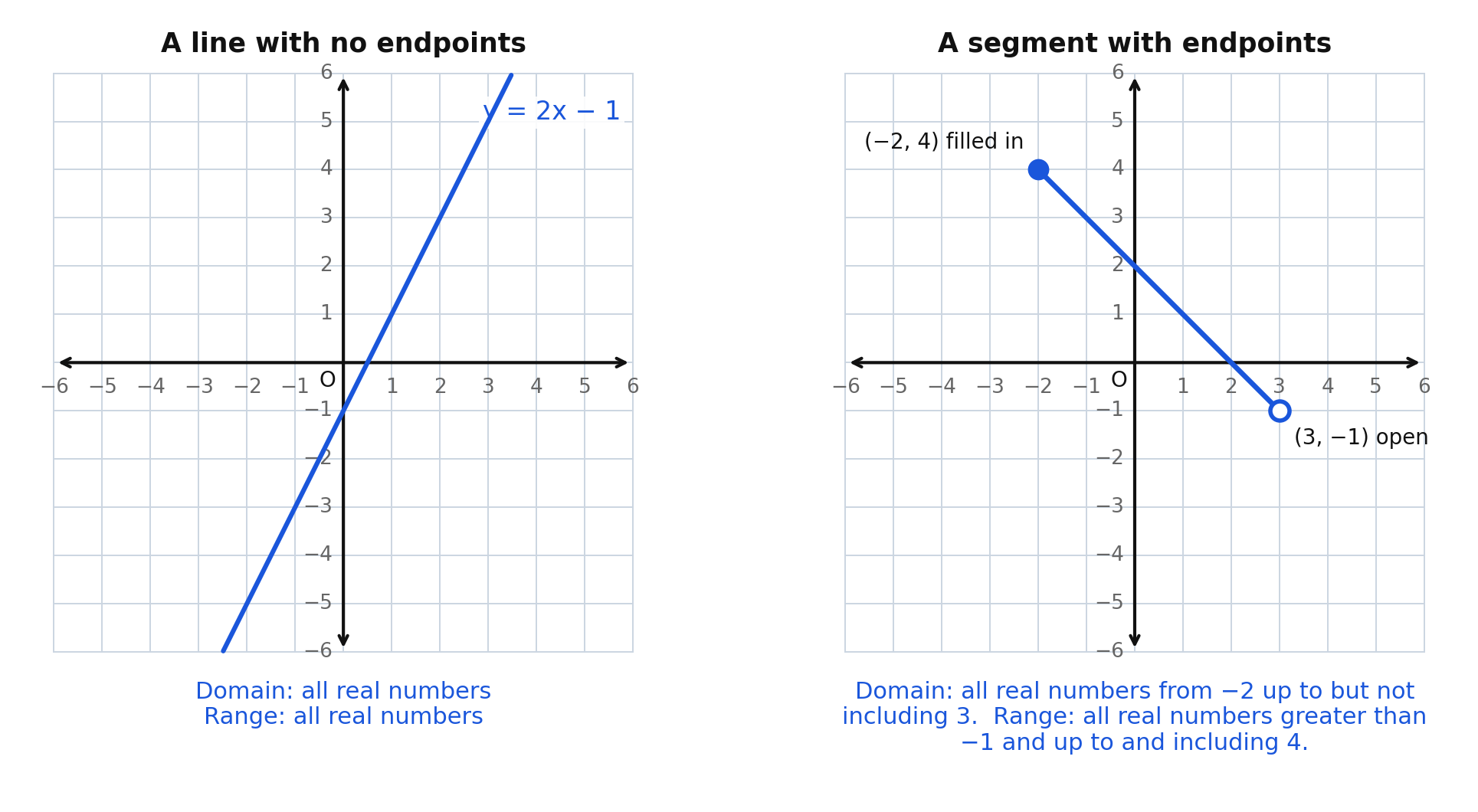
On the left is , drawn with arrows on both ends to say it never stops. Every real number is an input, and every real number occurs as an output.
- Domain: all real numbers
- Range: all real numbers
On the right is a segment from to . The endpoint at is a filled-in point, which means is an input. The endpoint at is an open point — a small hollow circle — which means the graph approaches but is not an input.
- Domain: all real numbers from up to but not including
- Range: all real numbers greater than and up to and including
Notice how the range flipped the roles of the two endpoints. This line falls from left to right, so the included input produces the included output , and the excluded input would have produced the excluded output . Always trace the endpoints through to their outputs rather than copying the inclusion from the domain.
If you have seen interval notation, those two answers are written and : a square bracket includes the endpoint and a parenthesis excludes it. This volume does not require it, and every answer key here gives the description in words.
A counting fact worth knowing
Because a function pairs each input with exactly one output, the range of a function with finitely many pairs can never contain more values than the domain. Each input contributes one output, so there can be at most as many outputs as inputs.
The range can certainly contain fewer. In the domain has three values and the range has one. Nothing is wrong: three inputs share an output, which the definition allows.
Domain in context
When a function comes from a real situation, the situation itself can cut the domain down. A ticket count cannot be or , so the domain of a ticket-cost function is a list of whole numbers, and the graph is dots.
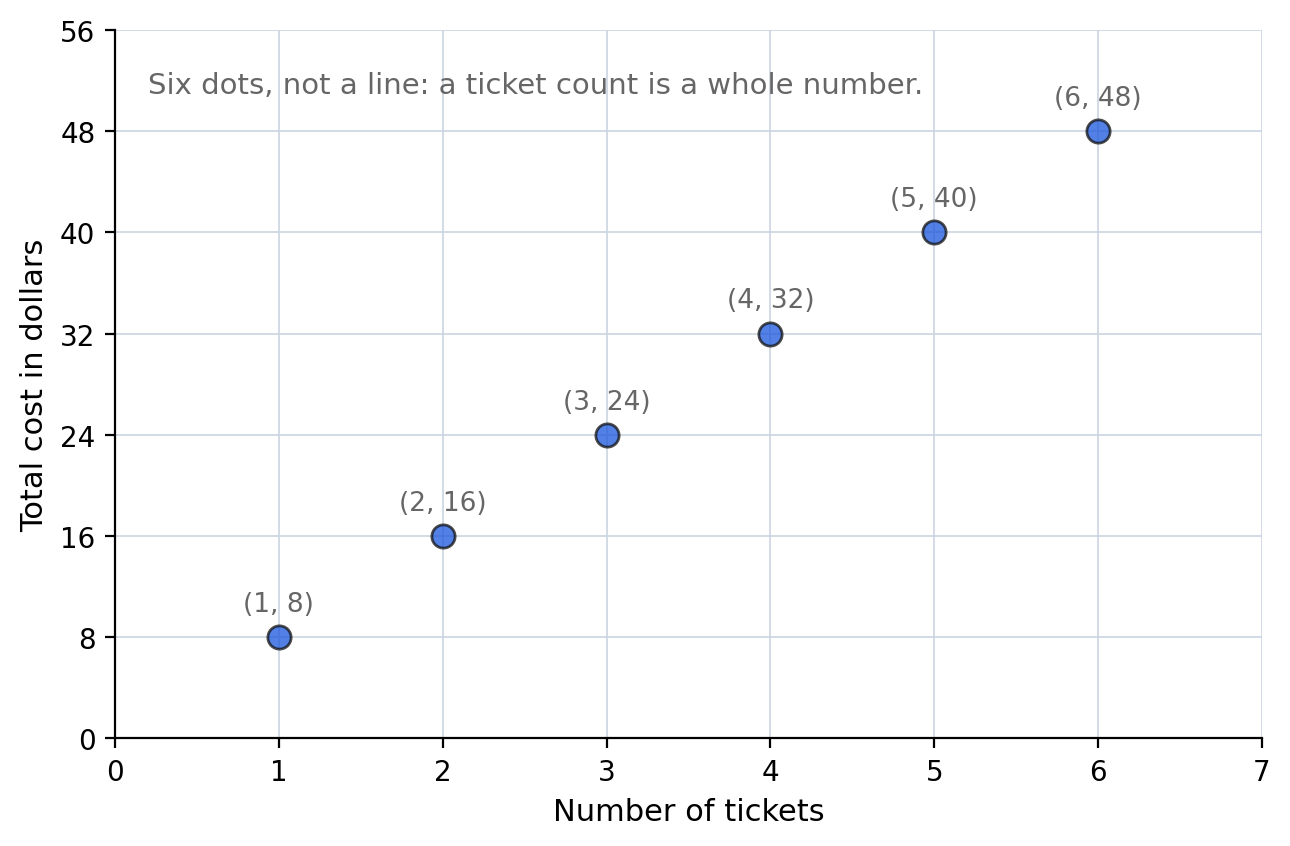
Concert tickets cost each, and a customer may buy up to six.
- The pairs are .
- Each input appears once, so it is a function.
- Domain — the numbers of tickets a customer may buy.
- Range — the possible total costs in dollars.
The pair says four tickets cost . If the function is named , the same fact is written .
Worked examples
Example 1 — From a set
Give the domain and range of .
First coordinates ; second coordinates , and the is written once.
Answer: domain ; range
Example 2 — A repeated ordered pair
Give the domain and range of .
The pair is listed twice, so neither nor is written twice. (It is a function: the input has the single output .)
Answer: domain ; range
Example 3 — From a table
A table lists -values with -values . Give the domain and range.
The output fills two rows and is listed once; both sets are sorted.
Answer: domain ; range
Example 4 — From a mapping
Mapping M sends , , and . Give the domain and range.
The left box holds , , ; the right box holds only .
Answer: domain ; range
Example 5 — From a continuous graph
Give the domain and range of the line , drawn with arrows on both ends.
The line never stops in either direction, and it is slanted, so it eventually reaches every height.
Answer: domain: all real numbers; range: all real numbers
Guided practice
- Give the domain and range of .
- Give the domain and range of .
- A table lists -values with -values . Give the domain and range.
- Give the domain and range of Mapping M in the three-mapping figure.
- Give the domain and range of the discrete graph in the domain-and-range figure above.
- Give the domain and range of the line shown in the continuous domain-and-range figure.
Independent practice
- Give the domain and range of each relation. a) b) c) d)
- A table lists -values with -values . Give the domain and range.
- Give the domain and range of Mapping N. (It is not a function, but both sets can still be listed.)
- Give the domain and range of Mapping P.
- Give the domain and range of Graph A in the four-graph figure.
- Give the domain and range of Graph B. (It is not a function; list both sets anyway.)
- Give the domain and range of Graph C, the line .
- Give the domain and range of the segment in the continuous domain-and-range figure, the one with a filled-in endpoint at and an open endpoint at .
- Application. Use the ticket-cost figure. List the ordered pairs, decide whether the relation is a function, give the domain and range, and say what means.
- Application. A café sells muffins for each, and a customer may buy at most four. Write the relation as a set of ordered pairs, decide whether it is a function, and give the domain and range. Explain why the domain is not "all real numbers from to ."
- Reasoning. Can the range of a function with finitely many pairs contain more values than its domain? Explain.
- Error analysis. A student gives the domain of as . Identify the error, and give the correct domain and range.
Exit ticket 4.4
- Give the domain and range of , and say whether it is a function.
- A table lists -values with -values . Give the domain and range.
- Give the domain and range of the discrete graph in the domain-and-range figure.
- Explain how reading the domain off a discrete graph differs from reading it off an unbroken line.
Chapter 4 Review
Vocabulary. relation · ordered pair · input · output · set of ordered pairs · table · mapping · graph · discrete · continuous · function · vertical line test · function notation · domain · range
A.F.2a is a single bullet that spans four representations, so this review is organized by representation. Parts A through D each ask the same two questions — is it a function, and what are the domain and range — of a different way of writing a relation down.
Part A — Relations given as a set of ordered pairs
- Is a function? Give the domain and range.
- Is a function? Give the domain and range.
- Is a function? Give the domain and range.
- Is a function? Give the domain and range.
- Is a function? Give the domain and range.
- Is a function? Give the domain and range.
- Write a relation with four ordered pairs that is not a function. Then change exactly one number to make it a function, and explain why your change works.
- Reasoning. A relation is written with ordered pairs, but only different inputs appear. Can it be a function? Explain what would have to be true of the three extra listings.
Part B — Relations given as a table
- -values with -values . Function? Give the domain and range.
- -values with -values . Function? Give the domain and range.
- -values with -values . Function? Give the domain and range.
- -values with -values . Function? Give the domain and range.
- Application. A table pairs hours worked with pay: -values with -values . Is it a function? Give the domain and range, and say what the pair means.
- Reasoning. Describe how to check a table for the function property in a single pass down the input column, and say what you must do whenever you meet a repeat.
Part C — Relations given as a mapping
- Is Mapping M a function? Give the domain and range.
- Is Mapping N a function? If not, name the input that breaks the rule and give its two outputs. Give the domain and range.
- Is Mapping P a function? Give the domain and range.
- Look again at the mapping in which two inputs send arrows to the same output. Is it a function? Explain the difference between an arrow that leaves an input and an arrow that arrives at an output.
- Describe a mapping with domain and range : what is in each box, how many arrows are drawn, and is it a function?
- Reasoning. Explain how to decide the function question from a mapping at a glance, and say why counting the arrows arriving at an output tells you nothing about it.
Part D — Relations given as a graph
- Is Graph A a function? Give the domain and range.
- Is Graph B a function? Name the vertical line that proves your answer, and give the domain and range.
- Is Graph C a function? Give the domain and range.
- Is Graph D a function? Name a vertical line that proves your answer.
- In the vertical-line-test figure, explain why the line on the left is a function, referring to what every vertical line does.
- Give the domain and range of the segment with a filled-in endpoint at and an open endpoint at , and explain what the open point changes.
- Application. Use the ticket-cost figure. Is it a function? Give the domain and range, and say what means.
- Reasoning. Explain why the vertical line test is not an extra rule but the definition of a function seen in a picture.
Part E — Mixed application and reasoning
- Application. A bike shop charges a deposit plus per hour. Write the relation for , , , and hours as a set of ordered pairs, decide whether it is a function, give the domain and range, and say what means.
- Reasoning. Explain the two traps of this chapter in your own words: why a repeated output never breaks the function rule, and why a repeated input breaks it only sometimes.
- Error analysis. A student says is not a function because the input appears twice. Explain the mistake and give the correct verdict, domain, and range.
- Reasoning. The same relation is handed to you once as a table and once as a graph. Explain why checking the input column for a repeat and applying the vertical line test must always reach the same verdict.
- Write a function with domain whose range contains exactly two values, and explain why your relation is a function.
- Application. The ticket-cost function is named , so that is the cost of tickets. Explain what says about the situation, naming what the and the each represent.
Standards coverage check — Chapter 4
A.F.2a is a single bullet naming four representations and two tasks, so coverage is broken out by representation.
| Knowledge and Skill | Representation | Where it is taught | Where the function question is practiced | Where domain and range are practiced |
|---|---|---|---|---|
| A.F.2a — determine whether a relation is a function; for relations that are functions, determine the domain and range | Set of ordered pairs | 4.1 (reading and writing a set), 4.2 (scanning first coordinates; both traps), 4.4 (both sets from a set) | 21–24, 27, 33, 35, 36, 37–39; 89; Review Part A, 83–88, 90; 112, 113, 115 | 61, 62, 67, 77, 78, 79; Review Part A, 83–88; 111, 113, 115 |
| A.F.2a | Table | 4.1 (set ↔ table), 4.2 (scanning the input column), 4.4 (both sets from a table) | 28, 29, 30; Review Part B, 91–96 | 63, 68, 80; Review Part B, 91–95 |
| A.F.2a | Mapping | 4.1 (building a mapping), 4.2 (arrows leaving vs. arriving), 4.4 (the two boxes are the two sets) | 4, 10, 25, 26, 31; Review Part C, 97–102 | 64, 69, 70; Review Part C, 97–99, 101 |
| A.F.2a | Graph | 4.1 (discrete vs. continuous), 4.3 (the vertical line test on both kinds; horizontal and vertical lines), 4.4 (both sets from a discrete graph and from a curve, including open and closed endpoints) | 9, 41–60; Review Part D, 103–110 | 65, 66, 71–76, 81, 82; Review Part D, 103–105, 108, 109 |
Supporting items: 1–3, 5–8, 11–20 establish the four representations and the reading skill every part of the bullet depends on; 40 and 116 practice the notation as a name for a rule and its output; 114 asks students to reconcile two representations of the same relation.
Boundaries respected. No item asks for a quadratic or exponential function (A.F.2 b–g), and no item asks the student to compute from a symbolic rule, which is A.F.1g in Chapter 7 and A.F.2g in Chapters 16 and 17. Interval notation is defined once in Lesson 4.4 as an aside and never required in an answer.
Answer keys for every item in this chapter are in Appendix A.