Chapter 3 — Linear Inequalities in One Variable
Standard: A.EI.1 (c, f) — The student will represent, solve, explain, and interpret the solution to multistep linear equations and inequalities in one variable and literal equations for a specified variable. Students will demonstrate the following Knowledge and Skills: c) Solve multistep linear inequalities in one variable algebraically and graph the solution set on a number line, including those in contextual situations, by applying the properties of real numbers and/or properties of inequality. f) Verify possible solution(s) to multistep linear equations and inequalities in one variable algebraically, graphically, and with technology to justify the reasonableness of the answer(s). Explain the solution method and interpret solutions for problems given in context.
By the end of this chapter you will be able to:
- Solve multistep linear inequalities in one variable algebraically, naming the property of real numbers or property of inequality that authorizes each step (A.EI.1c)
- Graph the solution set of a linear inequality on a number line, choosing an open or a closed endpoint correctly and shading in the correct direction (A.EI.1c)
- Decide, at every step, whether the inequality symbol must reverse, and explain why multiplying or dividing by a negative number reverses it (A.EI.1c)
- Write and solve inequalities for contextual situations, including situations in which something decreases (A.EI.1c)
- Verify a solution set three ways — algebraically by substitution, graphically by comparing two lines, and with technology (A.EI.1f)
- Explain your solution method and interpret a solution set in context, deciding which values are usable and whether the endpoint makes sense (A.EI.1f)
Lessons: 3.1 Inequalities, Solution Sets, and the Number Line · 3.2 The Reversal Rule and Why It Happens · 3.3 Multistep Inequalities with Every Step Named · 3.4 Verifying and Interpreting Solutions
What carries over from Chapter 2. You have just finished solving multistep linear equations, including literal equations, and classifying an equation as having one solution, no solution, or infinitely many. Every procedure you built there survives intact. Expanding with the distributive property, combining like terms, collecting the variable on one side, and isolating it are all the same moves in the same order. Exactly one thing is new: multiplying or dividing both sides by a negative number reverses the direction of the inequality symbol. That rule has no equation analogue, so it is the conceptual centerpiece of this chapter, and Lesson 3.2 is devoted to justifying it rather than merely announcing it.
Conventions this chapter fixes.
- Every inequality in this chapter has one variable, and every solution set is graphed on a number line. Inequalities in two variables, and the shaded half planes that go with them, are Chapter 9.
- A solution set is reported algebraically with the variable written first — , not — and then graphically.
- An open circle marks a boundary excluded by a strict symbol, or . A closed circle marks a boundary included by an inclusive symbol, or . The shaded ray runs right for or and left for or .
- Every answer in this chapter is verified by three substitutions: one value inside the claimed solution set, the boundary value itself, and one value outside. The boundary test is what distinguishes a strict answer from an inclusive one, so it is never skipped.
Numbering note. Item numbers run straight through the chapter, from 1 in Lesson 3.1 to 88 at the end of the review. They do not restart at each lesson.
Lesson 3.1 — Inequalities, Solution Sets, and the Number Line
An equation asks for a number; an inequality asks for a region
A linear equation in one variable, such as , is a claim that two expressions name the same number. Solving it produces, in the ordinary case, one value.
A linear inequality in one variable, such as , is a claim that one expression is at least as large as another. A value that makes the claim true is a solution, and the collection of every such value is the solution set. That set is almost always infinite, so it is described rather than listed.
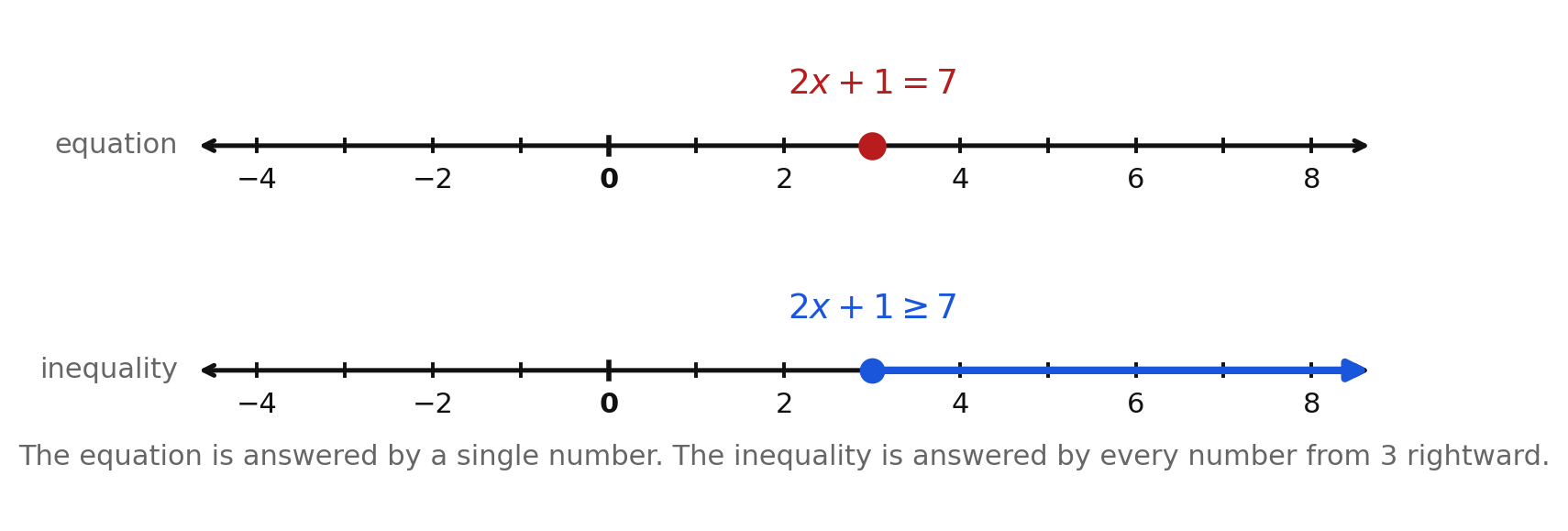
The two problems share a boundary. The equation locates it; the inequality keeps everything on one side of it. That relationship is worth holding onto: solve the matching equation and you have found where the answer changes from true to false.
The four symbols
| Symbol | Read it as | Boundary included? | Endpoint |
|---|---|---|---|
| is less than | no — strict | open circle | |
| is greater than | no — strict | open circle | |
| is less than or equal to | yes — inclusive | closed circle | |
| is greater than or equal to | yes — inclusive | closed circle |
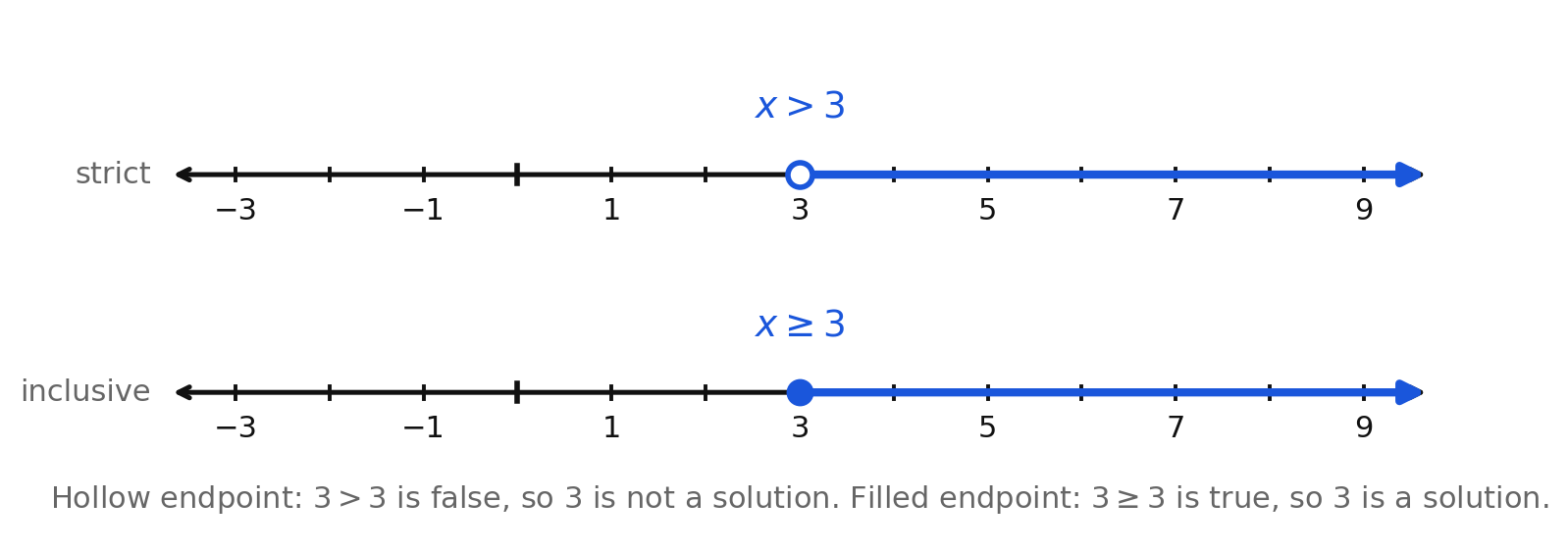
The two graphs differ by a single point. In the top graph 3 is excluded, because is false. In the bottom graph 3 is included, because is true. The circle is not decoration; it is the answer to the question is the boundary itself a solution?
The properties that authorize each move
Solving an inequality is a chain of legal moves, and each link has a name.
Addition and subtraction properties of inequality. Adding the same number to, or subtracting the same number from, both sides produces an equivalent inequality with the direction unchanged.
Multiplication and division properties of inequality. Multiplying or dividing both sides by the same positive number leaves the direction unchanged. Multiplying or dividing both sides by the same negative number reverses the direction.
Underneath these sit the properties of real numbers from Chapter 1: the distributive property, which expands a product; the commutative and associative properties, which let like terms be gathered; the additive inverse property, which makes a constant term vanish; and the multiplicative inverse property, which turns a coefficient into 1.
A.EI.1c asks you to apply "the properties of real numbers and/or properties of inequality," so this chapter names the property beside every step. Naming is not busywork: the property is the reason the new line is true, and a step you cannot name is a step you cannot defend.
Writing the variable first
Solving sometimes leaves the variable on the right, as in . Read it aloud: "3 is less than or equal to ," which says the same thing as " is greater than or equal to 3." To rewrite, swap the two sides and swap the direction of the symbol, so the wide end still faces the same quantity. Then graph.
Graphing as though it read is one of the two most common errors in this chapter. The other is forgetting to reverse, which is Lesson 3.2.
Checking is three substitutions, not one
Because the solution set is infinite, you cannot check by listing. You check by substituting into the original inequality.
- One value inside the claimed set. The original must come out true.
- The boundary value. The original must come out true for and , and false for and .
- One value outside. The original must come out false.
A single inside test can be passed by a wrong answer. All three together almost never can, and the boundary test is the one that catches a strict symbol written as an inclusive one.
Worked examples
Example 1 — Is this value a solution?
Is a solution of ?
Substitute into each side of the original inequality separately.
The sentence becomes , which is true, because allows equality.
Answer: Yes.
Example 2 — Solve and graph
Solve and graph .
Inside, : , and is true. Boundary, : , and is false, so 4 is correctly excluded. Outside, : is false.
Answer: , graphed with an open circle at 4 and shading to the left.
Example 3 — An inclusive symbol, with every property named
Solve and graph .
Inside, : , true. Boundary, : , true, so 3 belongs to the set. Outside, : , false.
Answer: , graphed with a closed circle at 3 and shading to the right, as in the second number line above.
Example 4 — The variable on both sides
Solve .
Subtracting from both sides is a slide, not a scaling, so nothing reverses. Inside, : , true. Boundary, : , false. Outside, : , false.
Answer:
Example 5 — Writing the variable first
Solve and graph .
Now rewrite with the variable first, swapping both the sides and the symbol: .
Boundary, : , true. Outside, : , false. Inside, : , true.
Answer: , graphed with a closed circle at 3 and shading to the right.
Guided practice
- Is a solution of ? Show both substitutions and state the resulting number sentence.
- Solve and graph . State the endpoint value, the circle type, and the shading direction.
- Solve and graph , naming the property used at each step.
- Solve , naming the property used at each step, then test the boundary value in the original inequality.
Independent practice
- Solve and graph. a) b) c) d)
- Solve and graph , and name the property used at each step.
- Rewrite with the variable written first, then graph it.
- Which values from , , , , and are solutions of ? Solve first, then sort the list, then confirm the two values nearest the boundary by substitution.
- A number line shows a closed circle at with shading to the right. Write the inequality, then write a multistep inequality with the same solution set and show that it has that solution set.
- Name three solutions of , including one negative number and one that is not an integer, and show that each one makes the original true.
- Application. A robotics club has for a competition kit. It spends on a base kit and then for each sensor. Write and solve an inequality for the number of sensors the club can buy, and state the greatest whole number of sensors.
- Reasoning. Explain why the answer to is a single point on a number line while the answer to is a ray. In your explanation, say what the two problems have in common and where that shared number comes from.
Exit ticket 3.1
- Solve and graph .
- Is a solution of ? Show both substitutions.
- Solve and graph .
- State the rule for open and closed endpoints, and explain why the rule is what it is.
Lesson 3.2 — The Reversal Rule and Why It Happens
The one move with no equation analogue
Everything you did in Chapter 2 transfers to inequalities except one move. Multiplying or dividing both sides by a negative number reverses the direction of the symbol. With equations this never came up, because an equation has no direction to reverse: if , then , and there is nothing more to say.
An inequality does have a direction, and a negative multiplier turns it around. Here is why.
A reflection reverses order
Start with a statement nobody disputes.
Multiply both sides by . The left becomes and the right becomes . On a number line sits to the right of , so is the larger number, and the true statement is
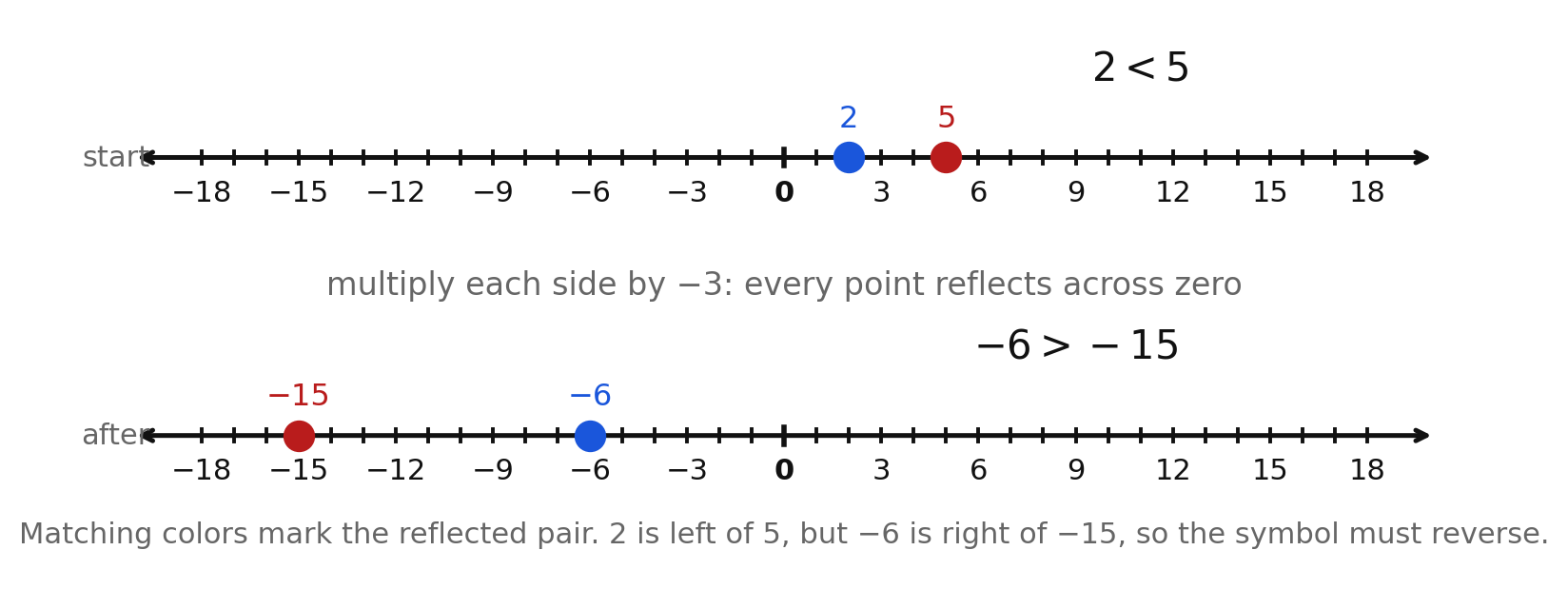
Multiplying by a negative number reflects every point across zero, the way a mirror swaps left and right. Because was to the left of , the reflection must land to the right of the reflection . The reflection reverses the order all by itself. The symbol has to be reversed as well, or the sentence you write down would be false.
That is the entire justification. It is not an arbitrary rule to memorize; it is a description of what reflection does to order. The size of the multiplier stretches the picture, but only the sign flips it.
A slide does not reverse order
Here is the error that costs the most points in this chapter: seeing a minus sign somewhere on the page and reversing out of habit.
Start again with and this time add to both sides. The left becomes and the right becomes . Is ? Yes, and the direction did not reverse.
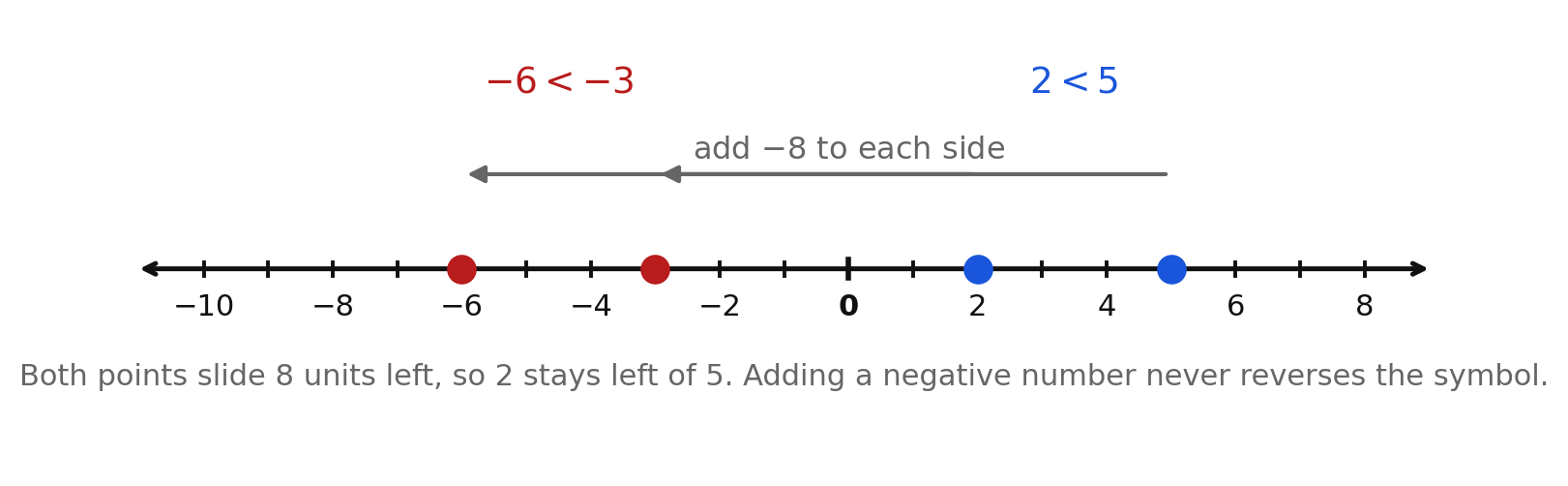
Adding a negative number slides both points the same distance in the same direction. A slide never changes which point is on the left. A reflection always does.
The reversal rule, stated precisely. Reverse the direction of the inequality symbol exactly when you multiply or divide both sides by a negative number. In every other case — adding any number, subtracting any number, multiplying or dividing by a positive number, distributing, combining like terms — the direction stays the same.
The decision, asked once per step
At every step, ask one question:
Am I multiplying or dividing both sides by a negative number?
If yes, reverse. If no, leave the symbol alone. Distributing a across a set of parentheses is not multiplying both sides; it changes one side only, so nothing reverses.
| The move | Reverses? | Why |
|---|---|---|
| subtract from both sides | no | a slide |
| add to both sides | no | a slide |
| distribute across | no | changes one side only |
| divide both sides by | yes | a reflection |
| multiply both sides by | yes | a reflection |
| multiply both sides by | no | a stretch toward zero, no crossing of zero |
A route that avoids the reversal entirely
There is an alternative some students prefer: move the variable term to whichever side keeps its coefficient positive.
Solve both ways.
Route 1 — keep the coefficient positive. Add to both sides: , then , then , which is . No reversal anywhere.
Route 2 — isolate the negative coefficient. Subtract 9: . Dividing by reverses, giving .
Both routes are legal and both land on . Knowing both means you can pick the one with fewer chances to slip, and you can check one against the other.
Worked examples
Example 1 — Multiplying a true statement by a negative
Begin with the true statement . Multiply both sides by . Then, starting over, add to both sides. Write the true statement each time.
Multiplying: and . On a number line is to the right of , so the true statement is .
Adding: and . On a number line is to the left of , so the true statement is .
Answer: , reversed; , not reversed. Only the multiplication reflected the points.
Example 2 — A negative coefficient at the last step
Solve and graph .
Now divide both sides by , a negative number, and reverse the symbol.
Inside, : , and is true. Boundary, : , and is true, so belongs. Outside, : , and is false.
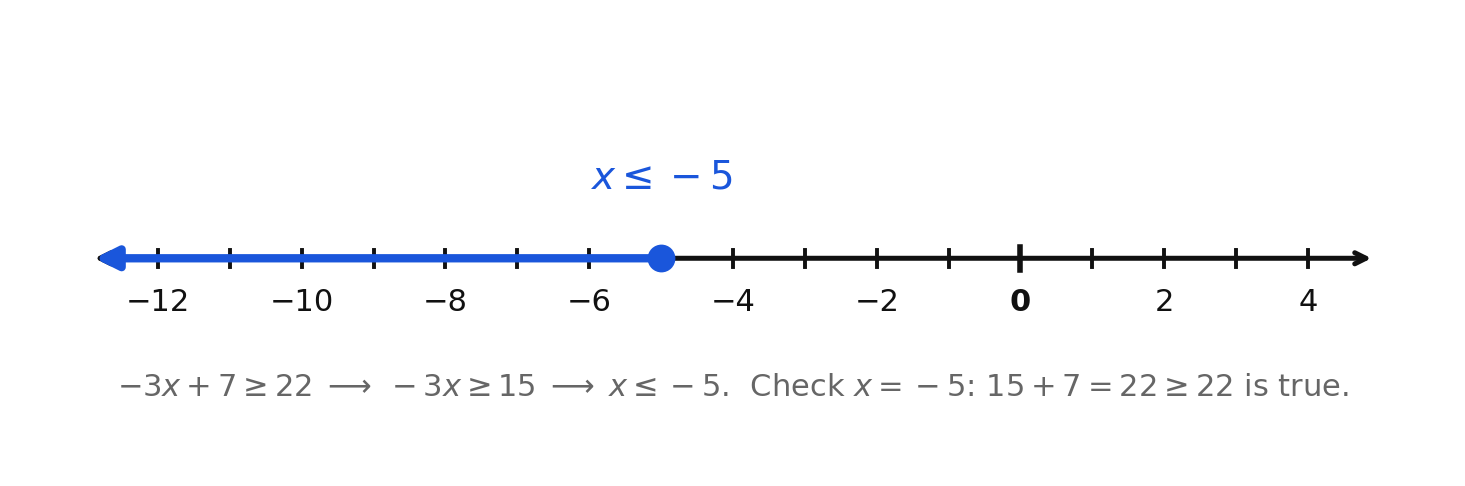
Answer: , graphed with a closed circle at and shading to the left.
Example 3 — A negative rational coefficient
Solve .
Multiply both sides by the reciprocal , which is negative, so reverse.
Inside, : , true. Boundary, : , and is false, so is correctly excluded. Outside, : , false.
Answer:
Example 4 — Two routes, one answer
Solve two ways.
Route 1: add to both sides, giving , then , then , that is . No reversal.
Route 2: subtract 9 from both sides, giving , then divide by and reverse: .
Boundary, : , and is true. Outside, : , false. Inside, : , true.
Answer: by either route.
Example 5 — The pair that separates sliding from reflecting
Solve and , and explain why only one reverses.
For , a number is being subtracted from the variable, so add 8 to both sides. That is a slide, so no reversal: . Boundary, : , true. Outside, : , false.
For , the variable is being multiplied by , so divide both sides by and reverse: . Boundary, : , true. Outside, : , false. Inside, : , true.
Answer: with no reversal; with a reversal. The minus signs look alike; the operations do not.
Guided practice
- Begin with the true statement and multiply both sides by . Write the resulting true statement and state whether the direction changed.
- Begin with the true statement and add to both sides. Write the resulting true statement and state whether the direction changed.
- Solve and graph , naming the exact step at which the direction reverses.
- Solve , then test the boundary value and one value inside the solution set in the original inequality.
Independent practice
- Solve and graph. a) b) c) d)
- Solve each and explain why only one of the two requires a reversal. a) b)
- Solve and graph the solution set.
- Solve and test the boundary value.
- For each move, state whether the direction reverses and give the reason. a) subtract from both sides b) multiply both sides by c) distribute across d) divide both sides by
- Application. A drone hovering at 320 feet begins descending 25 feet per second, so its altitude after seconds is feet. Write and solve an inequality for the times at which the drone is below 145 feet, and state the answer in a sentence.
- Reasoning. Begin with the true statement and multiply both sides by . Write the resulting true statement, then explain, using the positions of the four numbers on a number line, why the direction had to reverse.
- Error analysis. Kai solves by subtracting 2 to get and then dividing by without changing the symbol, writing . Test in the original inequality, explain what the test reveals, and give the correct solution.
Exit ticket 3.2
- Solve and graph .
- Solve .
- Begin with the true statement and divide both sides by . Write the resulting true statement.
- Explain why multiplying both sides by a negative number reverses the symbol, but distributing a negative number across parentheses does not.
Lesson 3.3 — Multistep Inequalities with Every Step Named
The order of work
A multistep inequality is solved in the same order as a multistep equation, with the reversal question asked at each step.
- Expand every product written with parentheses, using the distributive property.
- Combine like terms on each side, separately.
- Collect the variable on one side, using the addition or subtraction property of inequality.
- Move the constant to the other side, using the addition or subtraction property of inequality.
- Isolate the variable, using the multiplication or division property of inequality, and ask the reversal question.
- Write the variable first, then graph, then verify with three substitutions.
The first two moves act on one side at a time. They rewrite an expression as an equivalent expression, which is Chapter 1 work, not inequality work, so they can never change the direction of the symbol — no matter how many negative numbers appear in them.
The sign trap in front of parentheses
A minus sign in front of parentheses is a factor of , and it multiplies every term inside.
The most common error in this lesson is distributing to the first term only: writing as instead of . Writing the factor above each term before multiplying catches it.
Which side should the variable go to?
Either side works and both give the same answer; they differ only in how much sign-handling you do. Choosing the side that leaves the variable with a positive coefficient removes the reversal step, and with it the most error-prone move in the chapter. That is a preference, not a rule — the other route is equally correct, and comparing the two is a free check.
Worked examples
Example 1 — Expand, then finish
Solve .
Inside, : , and is true. Boundary, : , and is true. Outside, : , and is false.
Answer:
Example 2 — Subtracting a product
Solve .
The multiplies both terms inside the parentheses.
Inside, : , and is true. Boundary, : , and is false. Outside, : , false.
Answer:
Example 3 — Two routes for a variable on both sides
Solve two ways.
Route 1 — keep the coefficient positive. Subtract from both sides: , then , then , that is . No reversal.
Route 2 — collect on the left. Subtract from both sides: , then , then divide by and reverse: .
Boundary, : , true. Outside, : , false. Inside, : , true.
Answer: by either route.
Example 4 — Rational coefficients on both sides
Solve .
Inside, : and , and is true. Boundary, : and , and is false. Outside, : and , and is false.
Answer:
Example 5 — Parentheses on both sides
Solve and graph .
Dividing by reverses the symbol even though the right side is 0; the rule depends on the sign of the divisor, not on the number being divided.
Inside, : and , and is true. Boundary, : , true. Outside, : and , and is false.
Answer: , graphed with a closed circle at 0 and shading to the left.
Guided practice
- Solve , naming the property used at each step.
- Solve and test the boundary value in the original inequality.
- Solve twice, once by subtracting first and once by subtracting first, and confirm that the answers agree. State which route required a reversal.
- Solve and graph , and state the endpoint value, the circle type, and the shading direction.
Independent practice
- Solve and graph. a) b) c) d)
- Solve , naming the property used at each step.
- Solve .
- Solve .
- Solve .
- Error analysis. Dana solves by writing . Name her error, solve the inequality correctly, and use the test value to show that her answer includes a number that is not a solution.
- Application. Hall A charges a booking fee plus per guest. Hall B charges a booking fee plus per guest. Write and solve an inequality for the guest counts at which Hall A costs no more than Hall B, and interpret the answer in a sentence.
- Reasoning. Solve . Then identify the two separate places a sign could go wrong in this problem and describe how you guarded against each.
Exit ticket 3.3
- Solve .
- Solve and graph .
- Solve .
- Explain why expanding and combining like terms can never reverse the inequality symbol, even when the number being distributed is negative.
Lesson 3.4 — Verifying and Interpreting Solutions
Three ways to be sure
A.EI.1f asks for a solution to be verified algebraically, graphically, and with technology, and then explained and interpreted. The three verifications are not repetitions of one another; each catches a different kind of mistake.
Algebraically — substitute into the original. Test one value inside the claimed set, the boundary itself, and one value outside. Substituting into the original inequality, not into a line partway down your work, is what makes this a check rather than a rerun of a possible error.
Graphically — compare two lines. An inequality such as asks: for which is the graph of above the graph of ? Graph both lines. They cross at the boundary. To the right of the crossing one line is on top; to the left the other is. The solution set is the set of -values where the correct line is higher.
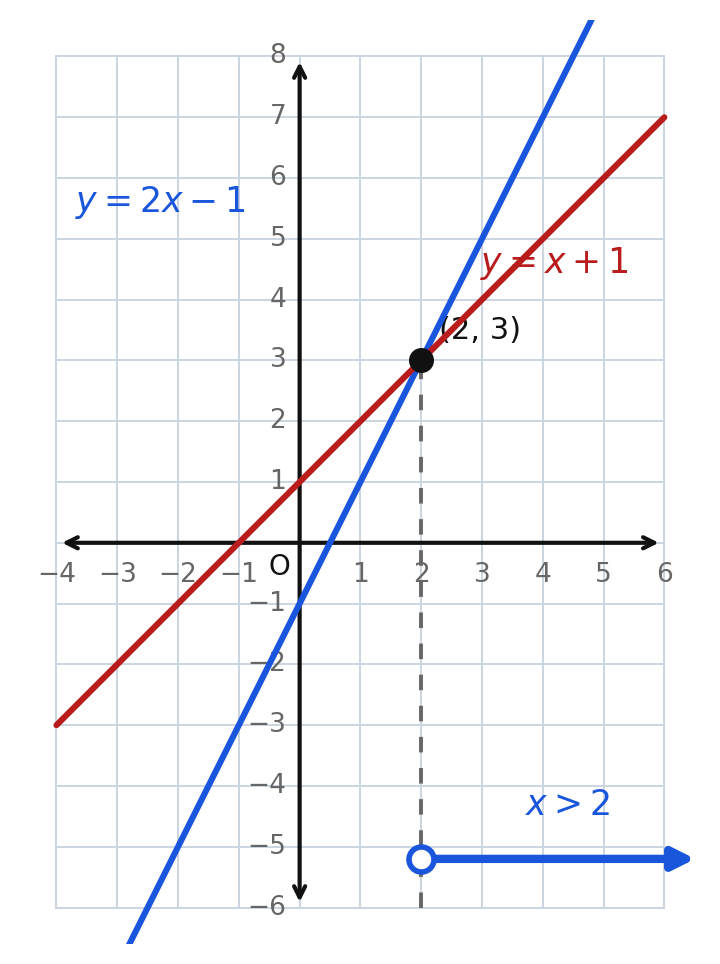
The lines cross at . To the right of the line is higher, so there, and the solution set is . The crossing point itself is excluded, because at the two sides are equal, not greater. This is the picture behind the whole chapter: the matching equation locates the boundary, and the inequality claims one side of it.
With technology — graph or tabulate. On a graphing calculator, enter the left side as and the right side as . Graph both and use the intersect feature to find the boundary; or open the table and read down the two columns, noting the first row where the comparison changes. A calculator will not tell you which side of the boundary to take, so read the columns rather than trusting the picture alone.
When the three disagree, that is information. A disagreement means one of them is wrong, and finding out which is faster than resolving it by preference. Substitution is the tiebreaker, because it tests the original sentence directly.
Explaining the method
The standard asks you to explain the solution method, not just produce an answer. A complete explanation says what you did, in order, and why each move was allowed: which side you cleaned up first, which property authorized each step, whether the reversal question was ever answered yes, and how you checked. "I divided by and reversed because dividing both sides by a negative number reflects both sides across zero" is an explanation. "I got " is an answer.
Interpreting in context
Algebra hands back a set of numbers. The situation decides what those numbers mean and which of them a person could actually use. Three questions turn a solution set into an answer.
- What does the variable count, and in what units? "" means nothing until you say "at most 26.7 tables."
- Must the value be a whole number, and must it be non-negative? Tables, tickets, boxes, and people cannot be split or negative. Gallons, hours, dollars, and miles often can be.
- Does the endpoint make sense here? Test the two whole numbers nearest the boundary in the original inequality. If one passes and the next fails, you have found the practical edge.
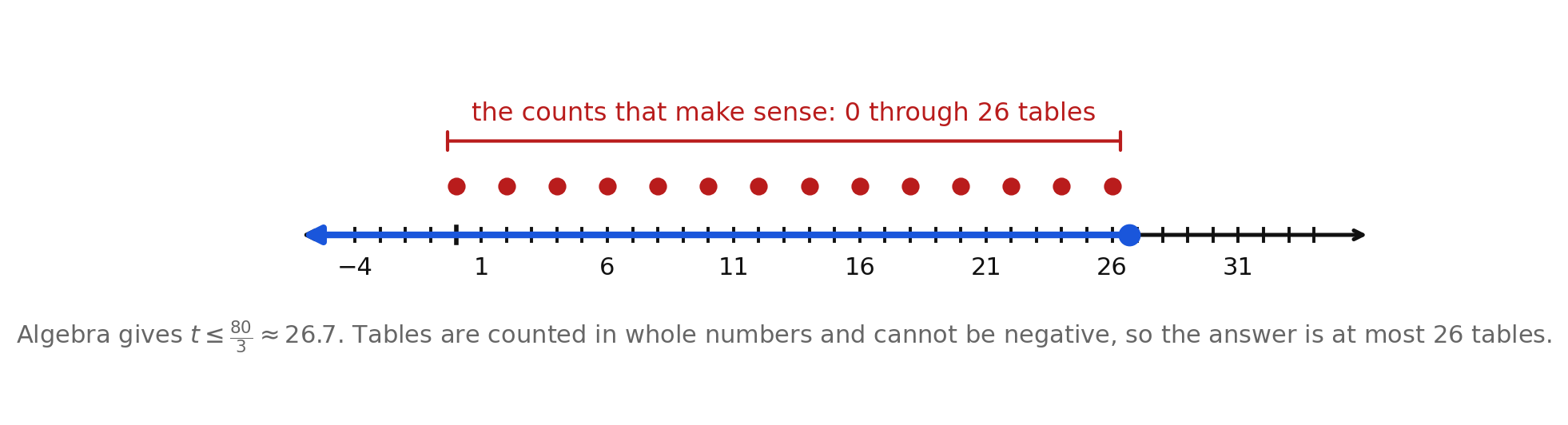
Rounding direction is decided by meaning, never by a memorized rule. A ceiling of whole tables becomes at most 26. A floor of whole hours becomes at least 9. Those round in opposite directions, and only a test of the nearby whole numbers tells you which is which.
Sometimes the endpoint lands exactly on a usable value, and then it is part of the answer: a load limit that solves to crates includes 28 crates, and 28 must be checked against the original limit to prove it fits.
Finally, notice which part of a graph describes nothing real. A tank-draining problem whose solution set is days is graphed as a ray running left forever, but days before the drain opened do not exist. In context the answer is . Say so.
Worked examples
Example 1 — Algebraic verification, all three substitutions
Verify that the solution of is .
Solving: subtract to get , add 7 to get , divide by 2 to get .
Inside, : and , and is true. Boundary, : and , and is true, so the closed circle is right. Outside, : and , and is false.
Answer: , verified inside, at the boundary, and outside.
Example 2 — Graphical verification
Verify graphically that the solution of is .
Graph and on the same axes. They intersect at . For -values to the right of 2 the line lies above ; to the left it lies below. So exactly when , and the intersection is excluded because there the two sides are equal.
Substitution agrees: at , is true; at , is false; at , is false.
Answer: , confirmed by the graph and by substitution.
Example 3 — Verification with technology
Describe how to verify that the solution of is using a graphing calculator.
Enter and . Graph both. The line falls from left to right and crosses the horizontal line at ; the intersect feature reports . To the left of that crossing is above , which is where holds, so the solution set runs left from . The table confirms it: at , and ; at the two columns read 22 and 22, equal, which the symbol accepts; at , , which is less than 22.
Answer: . The crossing gives the boundary, the columns give the direction, and the equal row at shows the endpoint is included.
Example 4 — A context whose endpoint is not usable
A student council has for a banquet. The DJ costs , and decorations cost per table. How many tables can be decorated?
Let = the number of tables, a whole number with .
Test the two nearest whole numbers: at , the cost is dollars, and is true; at , the cost is dollars, and is false.
Answer: , giving . Tables come in whole numbers, so the council can decorate at most 26 tables. The algebraic endpoint, 26.7 tables, is not a usable value.
Example 5 — A context whose endpoint is usable
A freight elevator carries at most 2{,}000 pounds. The operator weighs 180 pounds and each crate weighs 65 pounds. How many crates may ride along?
Let = the number of crates.
Test the boundary: at , the load is pounds, and is true, so 28 crates exactly reaches the limit and is allowed. At the load is pounds, which is false.
Answer: , giving : at most 28 crates. Here the endpoint is a whole number and the symbol is inclusive, so the boundary itself is the answer — a full load, exactly at the limit.
Guided practice
- Verify that the solution of is by testing one value inside the set, the boundary, and one value outside.
- Verify graphically that the solution of is . State where the two lines cross, which line is higher to the right of the crossing, and why the crossing point is excluded.
- Describe how you would verify that the solution of is with a graphing calculator, and state exactly what you would see in the graph and in the table.
- A student council has , the DJ costs , and decorations cost per table. Write and solve an inequality for the number of tables, then interpret the answer in a sentence.
Independent practice
- Solve and verify your answer with all three substitutions: inside, boundary, and outside.
- Solve . Then describe the graphs of and : where do they cross, and on which side is the first graph higher?
- A table of values is given for and .
| 0 | 1 | 2 | 3 | 4 | 5 | |
|---|---|---|---|---|---|---|
| 5 | 3 | 1 | ||||
| 0 | 1 |
Use the table to decide where , then solve algebraically and confirm the two agree. 56. Application. A phone plan costs per month plus for each text beyond the included limit, and Amara will spend at most in a month. Write and solve an inequality for the number of extra texts, and interpret the answer. 57. Application. A freight elevator carries at most 2{,}000 pounds. The operator weighs 180 pounds and each crate weighs 65 pounds. Write and solve an inequality for the number of crates, then explain why the endpoint is usable in this situation. 58. Interpretation. A problem about a subscription gives the solution set , where counts whole months. State what the answer means in context, give the greatest usable value, and show the pair of tests that confirms it is the edge. 59. Reasoning. A classmate verifies a solution set by testing a single value inside it. Explain why that is not enough, name the three tests that together are convincing, and say which of the three decides between an open and a closed endpoint. 60. Error analysis. Priya solves and reports . Test in the original inequality, explain what the test reveals, and give the correct solution and its graph.
Exit ticket 3.4
- Solve and verify with three substitutions.
- Describe how to verify your answer to item 61 graphically, naming the two lines you would graph and where they cross.
- Application. A food truck charges per taco plus a packaging fee, and Devon has . Write and solve an inequality for the number of tacos, and state how many he can buy.
- Explain what it means to interpret a solution in context, and give an example in which the algebraic endpoint is not the practical answer.
Chapter 3 Review
Vocabulary. inequality · strict inequality · inclusive inequality · solution · solution set · boundary value · properties of inequality · addition property of inequality · subtraction property of inequality · multiplication property of inequality · division property of inequality · distributive property · additive inverse property · multiplicative inverse property · like terms · coefficient · constant term · reciprocal · reversal rule · reflection · open circle · closed circle · ray · verify · interpret in context
Part A — Solving inequalities algebraically and graphing the solution set (A.EI.1c)
- Solve and graph. a) b) c) d)
- Solve and graph , naming the property used at each step.
- Solve and graph .
- Solve and graph .
- Solve and graph .
- Solve and graph .
- Solve and graph .
- Rewrite with the variable written first, then graph it.
- Which values from , , , , and are solutions of ? Solve first, then sort the list.
- A number line shows an open circle at with shading to the right. Write the inequality, then write a multistep inequality with the same solution set and show that it has that solution set.
- Application. A hiker starts a descent at an elevation of 2{,}400 feet and drops 150 feet each hour, so her elevation after hours is feet. Write and solve an inequality for the times at which she is below 1{,}500 feet, graph the solution set, and state which part of the graph describes no real moment.
- Reasoning. State the complete rule for deciding whether to reverse the inequality symbol. Give one example that requires a reversal and one example in which several minus signs appear but no reversal is required, and solve both.
Part B — Verifying solutions algebraically, graphically, and with technology, and interpreting in context (A.EI.1f)
- Solve and verify with all three substitutions: inside, boundary, and outside.
- Verify graphically that the solution of is . Name the two lines, state where they cross, and say which one is lower to the left of the crossing.
- A table of values is given for and .
| 0 | 1 | 2 | 3 | 4 | 5 | |
|---|---|---|---|---|---|---|
| 1 | 3 | 5 | 7 | 9 | 11 | |
| 8 | 7 | 6 | 5 | 4 | 3 |
Use the table to estimate where , then solve algebraically and explain why the table alone could not give the exact boundary. 80. Explain how to use a graphing calculator to verify the solution set of a linear inequality in one variable, and state what you should do when the calculator and your algebra disagree. 81. Application. Gym A charges per month plus per class. Gym B charges per month plus per class. Write and solve an inequality for the numbers of classes at which Gym A costs no more than Gym B, and state the answer as a whole number of classes. 82. Application. A rain barrel holds 90 gallons and loses 6 gallons each day to watering, so it holds gallons after days. Write and solve an inequality for the days on which it holds more than 30 gallons, graph the solution, and state which part of the graph describes no real day. 83. Application. A delivery service charges a handling fee plus per box, and a shop will spend at most . Write and solve an inequality for the number of boxes, and state how many whole boxes may be shipped. 84. Interpretation. Item 57 gives crates and item 83 gives boxes. Explain why the endpoint is part of the answer in the first case and not in the second, and describe the test that settles each one. 85. Interpretation. A descent problem gives , where is the number of hours since the descent began and the elevation is feet. Interpret the answer in a sentence, and state the elevation at exactly . 86. Reasoning. A classmate says he has verified the solution because makes the original inequality true. Explain why that verification is incomplete, name the tests he is missing, and describe a wrong answer that his single test would fail to catch. 87. Error analysis. Marcus solves by subtracting 5 to get and then dividing by without changing the symbol, writing . Test in the original inequality, explain what the test reveals, give the correct solution, and describe its graph. 88. Write a situation in context for , solve it, verify it with a boundary test and one outside test, and interpret the answer in a sentence.
Standards coverage check — Chapter 3
| Knowledge and Skill | Where it is taught | Where it is practiced |
|---|---|---|
| A.EI.1c — solve multistep linear inequalities in one variable algebraically and graph the solution set on a number line, including contextual situations, by applying the properties of real numbers and/or properties of inequality | 3.1, 3.2, 3.3, 3.4 | Items 2–8, 10, 11, 13, 15, 17–31, 33–47, 52, 53, 55–57, 61, 63; Review Part A (65–76), 77, 81–83, 87, 88 |
| A.EI.1f — verify possible solutions to multistep linear inequalities in one variable algebraically, graphically, and with technology to justify the reasonableness of the answer; explain the solution method and interpret solutions for problems given in context | 3.1, 3.2, 3.3, 3.4 | Items 1, 4, 9, 12, 14, 16, 20, 22, 24, 27, 28, 32, 34–36, 42, 44, 48, 49–64; Review Part B (77–88), 73, 74, 76 |
Answer keys for every set in this chapter are in Appendix A.