Chapter 2 — Multistep and Literal Linear Equations
Standard: A.EI.1 (a, b, d, e, f) — The student will represent, solve, explain, and interpret the solution to multistep linear equations and inequalities in one variable and literal equations for a specified variable.
By the end of this chapter you will be able to:
- Write a linear equation in one variable to represent a contextual situation (A.EI.1a)
- Solve multistep linear equations in one variable, including those in context, by applying the properties of real numbers and the properties of equality — and name the property at every step (A.EI.1b)
- Rearrange a formula or literal equation to solve for a specified variable by applying the properties of equality (A.EI.1d)
- Determine whether a linear equation in one variable has one solution, no solution, or infinitely many solutions (A.EI.1e)
- Verify a solution algebraically, graphically, and with technology, explain the solution method, and interpret the solution in context (A.EI.1f)
Lessons: 2.1 Writing an Equation for a Situation · 2.2 Solving Multistep Equations, One Named Property at a Time · 2.3 The Variable on Both Sides, and Clearing Fractions and Decimals · 2.4 One Solution, No Solution, Infinitely Many · 2.5 Literal Equations and Formulas · 2.6 Verifying Algebraically, Graphically, and with Technology
Conventions this chapter fixes.
One variable, always. Every equation in this chapter has exactly one unknown. Two equations in two unknowns are systems, and they wait until Chapter 8. Inequalities are the other half of A.EI.1, and they wait until Chapter 3.
Name the property. A.EI.1b does not ask you to solve an equation; it asks you to solve one by applying the properties of real numbers and/or properties of equality. In this chapter every step in a worked solution carries the name of the property that authorizes it, and you are asked to do the same.
The grapher is an instrument of verification. A.EI.1f names technology in the same breath as algebra. This volume's stance is that the calculator does not replace the algebra — it checks it. Every worked solution here is confirmed, and when the algebra and the graph disagree, that disagreement is information: one of them is wrong, and the disagreement tells you to go find out which.
A solution is a number that makes the sentence true. Not every equation has one, and some have all of them. Saying so precisely — "no solution" or "infinitely many solutions" — is part of solving, not an admission of defeat.
Numbering note. Item numbers run straight through the chapter, from 1 in Lesson 2.1 to 124 at the end of the review. They do not restart at each lesson.
Lesson 2.1 — Writing an Equation for a Situation
What A.EI.1a actually asks
The first Knowledge and Skill of this standard is not about solving. It is about writing: turning a situation described in words into a linear equation in one variable — an equation in which the unknown appears only to the first power, never multiplied by itself and never in a denominator.
Writing the equation is the part that carries the meaning. Once the equation exists, the rest of this chapter is procedure.
The five moves
- Read the whole situation before you write anything. The last sentence usually says what is being set equal.
- Name the unknown in a full sentence, with units. "Let = the number of miles driven." A variable without a definition is a guess, and it makes the answer uninterpretable later.
- Build each quantity separately. A fixed amount plus a rate per unit becomes . A quantity that shrinks becomes .
- Decide what is being set equal. Sometimes a total is known, and the known number is the whole other side. Sometimes two quantities are being compared, and then each one becomes a side — that is where the variable on both sides comes from.
- Reread the story from your equation. If your equation cannot be told back as the story, it is the wrong equation.
The two shapes
| Situation | Shape of the equation | Example |
|---|---|---|
| A total is known | ||
| Two options are compared |
The second shape is the signature of Algebra 1. "When are the costs the same?" "When are the two heights equal?" "How many before the totals match?" Each question puts a whole expression on each side.
Do not trust keywords alone. "Seven less than four times a number" is , not . "Less than" reverses the order in which the words arrive. Retelling the story from the finished equation catches this every time.
Worked examples
Example 1 — A known total
A rideshare charges a base fare plus per mile. A ride cost . Write an equation for the number of miles.
Let = the number of miles driven. The mileage charge is , and the base fare is a one-time .
Solving gives and . Confirm: . True.
Answer: ; the ride was 8 miles.
Example 2 — A number sentence
Seven less than four times a number is the same as the number increased by 11. Write and solve an equation.
Let = the number.
Confirm: and . True.
Answer: ; the number is 6.
Example 3 — A geometric relationship
A rectangle's length is 5 cm more than twice its width, and its perimeter is 82 cm. Write an equation and find both dimensions.
Let = the width in centimeters, so the length is .
The length is cm. Confirm: cm. True.
Answer: The width is 12 cm and the length is 29 cm.
Example 4 — Two options compared
Gym A charges a joining fee plus per month. Gym B charges per month with no fee. After how many months are the totals equal?
Let = the number of months.
Confirm: and . True.
Answer: ; the totals are equal after 5 months, at each.
Example 5 — Money that is not a whole number
Five concert tickets plus a order fee came to . Write an equation for the price of one ticket.
Let = the price of one ticket in dollars.
Confirm: . True. A price of is an ordinary ticket price, so the answer is usable.
Answer: ; one ticket costs .
Guided practice
- A concert charges per ticket plus a order fee, and an order came to . Define the variable, write an equation, and solve it.
- Five more than three times a number is 26. Write and solve an equation.
- A taxi charges plus per mile, and a ride cost . Write and solve an equation for the number of miles.
- A rectangle's length is 3 cm less than twice its width, and its perimeter is 54 cm. Write and solve an equation for the width, then give both dimensions.
Independent practice
- Write and solve an equation for each comparison. a) Maya has and saves per week; Devon has and saves per week. When do they have the same amount? b) One tree is 42 inches tall and grows 3 inches per year; another is 60 inches tall and grows 1.5 inches per year. When are they the same height?
- Write and solve an equation. a) A caterer charges per guest plus a room fee, and the bill was . How many guests? b) Three identical crates and a 14-kilogram toolbox together have a mass of 71 kilograms. What is the mass of one crate?
- A room is F and cools F per hour. Write and solve an equation for when it reaches F.
- Twice the sum of a number and 6 equals 3 less than five times the number. Write and solve an equation.
- A pool holds 4,500 gallons and drains at 150 gallons per minute. Write and solve an equation for when 1,800 gallons remain.
- Application. Print shop A charges a setup fee plus per shirt; shop B charges per shirt with no setup fee. Write and solve an equation for the number of shirts that makes the bills equal, and state the equal total.
- Reasoning. A classmate writes for "eight less than a number." Explain why that is wrong, give the correct expression, and describe a test you can run on any translation to catch this kind of mistake.
- Error analysis. For "Store A charges per book plus shipping, and Store B charges per book with free shipping; for how many books are the bills equal?" a student writes . Explain why that equation does not match the situation, write the correct equation, and solve it.
Exit ticket 2.1
- A gym charges a joining fee plus per month, and a member has paid in all. Write and solve an equation for the number of months.
- Four less than six times a number equals twice the number increased by 20. Write and solve an equation.
- A rectangle's length is twice its width and its perimeter is 96 m. Write and solve an equation for the width, then give both dimensions.
- Explain how you decide which quantity in a comparison belongs on each side of the equal sign.
Lesson 2.2 — Solving Multistep Equations, One Named Property at a Time
Every move has a name
You have been solving equations since Grade 7. What A.EI.1b adds is that you must say why each move is legal. There are two families of reasons.
Properties of equality — reasons you may change both sides.
Addition property of equality. If , then . Subtraction property of equality. If , then . Multiplication property of equality. If , then . Division property of equality. If and , then . Substitution property of equality. If , then may replace anywhere. This is the property that makes checking an answer legal.
Properties of real numbers — reasons you may rewrite one side without touching the other.
Distributive property. . Read forward it expands; read backward it combines like terms, since . Commutative and associative properties of addition. and . These let you slide terms around inside a side so like terms can meet. Additive inverse property. . This is what makes a term vanish. Multiplicative inverse property. for . This is what a reciprocal is for. Multiplicative identity property. . This is what leaves the variable standing alone after you divide.
The distinction matters. Rewriting one side changes how it is written, not what it is worth, so no matching move is needed on the other side. Changing what a side is worth demands a property of equality and the identical change on the other side.
The order of business
- Expand any parentheses — distributive property.
- Combine like terms within each side — distributive property, with the commutative and associative properties of addition to bring them together.
- Undo the addition or subtraction — addition or subtraction property of equality.
- Undo the multiplication or division — division or multiplication property of equality.
- Verify in the original equation — substitution property of equality.
Step 5 is not one of the solving steps. It is the check, and A.EI.1f requires it. Notice that it goes back to the original equation, never to a line you wrote partway through. A check against your own line three will happily confirm your own error.
Worked examples
Example 1 — Combine, then undo
Solve .
Verify: . True.
Answer:
Example 2 — Expand, then combine
Solve .
Verify: . True.
Answer:
Example 3 — A negative factor
Solve .
The factor outside multiplies every term inside, sign and all.
Verify: . True.
Answer:
Example 4 — A fractional coefficient
Solve .
Multiplying by the reciprocal and dividing by are the same move; the reciprocal is usually less error-prone.
Verify: . True.
Answer:
Example 5 — Decimal coefficients
Solve .
Verify: . True.
Answer:
Guided practice
- Solve . Name the property used at each step, then verify.
- Solve . Name the property used at each step, then verify.
- Solve and verify. Say what happens to the sign of the second product.
- Solve by multiplying by a reciprocal, naming the property at each step, then verify.
Independent practice
- Solve and verify. a) b) c) d)
- Solve and verify. a) b)
- Solve and verify: . State the solution exactly and say why it is a perfectly ordinary answer.
- Solve and verify:
- Solve and verify:
- Application. A landscaper charges per hour plus for materials, and the bill was . Write and solve an equation for the number of hours, then say what the answer means.
- Reasoning. Show every step of , naming the property of real numbers or property of equality that authorizes each one. Then explain why combining like terms needs no matching move on the other side while subtracting 15 does.
- Error analysis. Asked to solve , a student writes and reports . Find the mistake, solve correctly, and show the check that exposes the wrong answer.
Exit ticket 2.2
- Solve , naming each property, and verify.
- Solve , naming each property, and verify.
- Solve and verify.
- Explain the difference between a property of equality and a property of real numbers, and give one example of each from your work above.
Lesson 2.3 — The Variable on Both Sides, and Clearing Fractions and Decimals
One extra job
When the variable appears on both sides, add one step to the order of business: use the addition or subtraction property of equality to gather the variable terms on a single side and the constants on the other.
Verify: and . True.
Which side should the variable end up on?
Either. Both routes are legal and both give the same number. There is a practical preference: move the smaller variable term, so the coefficient you finally divide by is positive. Fewer negative signs means fewer chances to lose one.
For , adding to both sides gives , then and . Subtracting instead gives , then and — same answer, one more negative to keep track of.
Clearing fractions and decimals
The multiplication property of equality lets you multiply both sides by any nonzero number. Choosing that number well makes an ugly equation ordinary.
- Fractions. Multiply both sides by the least common denominator. For , multiply by 4.
- Decimals. Multiply both sides by a power of ten large enough to clear the longest decimal. For , multiply by 100.
This is optional. Working in fractions or decimals throughout is equally correct. Clearing is a labor-saving choice, not a rule — but you must multiply every term on both sides, which is the distributive property doing the work.
Worked examples
Example 1 — Gathering the variable
Solve .
Subtract from both sides (subtraction property of equality): . Add 4 (addition property of equality): . Divide by 4 (division property of equality): .
Verify: and . True.
Answer:
Example 2 — Expand, then gather
Solve .
Verify: and . True.
Answer:
Example 3 — A negative variable term
Solve .
Add to both sides, since is the smaller variable term: . Add 21: . Divide by 6: .
Verify: and . True.
Answer:
Example 4 — Clearing fractions
Solve .
Multiply both sides by 4, the least common denominator (multiplication property of equality), distributing across every term:
Verify in the original: and . True.
Answer:
Example 5 — Clearing decimals
Solve .
Multiply both sides by 100:
Verify in the original: and . True.
Answer:
Guided practice
- Solve , naming the property at each step, and verify.
- Solve and verify. Say which variable term you moved and why.
- Solve by clearing fractions first, and verify in the original equation.
- Solve by clearing decimals first, and verify in the original equation.
Independent practice
- Solve and verify. a) b) c) d)
- Solve and verify. a) b)
- Solve and verify:
- Solve and verify:
- Solve and verify:
- Application. Truck rental A charges plus per mile; rental B charges plus per mile. Write and solve an equation for the mileage that makes the two costs equal, and state that cost.
- Reasoning. Solve twice — once by subtracting from both sides, once by subtracting . Show both routes and explain why two different legal routes cannot reach different answers.
- Error analysis. Solving , a student subtracts from the left side only and writes . Explain why that line is false even though the final answer happens to come out right, and give a correct solution with the property named at each step.
Exit ticket 2.3
- Solve and verify.
- Solve and verify.
- Solve and verify.
- Explain why multiplying both sides by a common denominator cannot change the solution of an equation.
Lesson 2.4 — One Solution, No Solution, Infinitely Many
Three possible answers
A.EI.1e asks a question that sounds strange until you have met it: how many solutions does this equation have? A linear equation in one variable has exactly one of three answers.
- One solution. The variable survives to the last line and lands on a single number, as in , whose solution is .
- No solution. The variable terms cancel and what remains is a false statement, such as . No number can rescue a sentence that no longer contains the variable, so nothing is a solution.
- Infinitely many solutions. The variable terms cancel and what remains is a true statement, such as or . Every real number is a solution. An equation like this is called an identity, because the two sides were the same expression written two ways all along.
Nothing new is needed to reach any of these three. You solve exactly as before and read what the last line tells you.
What the algebra looks like
| Equation | Gather the variable terms | Last line | Solution count |
|---|---|---|---|
| subtract | one solution | ||
| subtract | , false | no solution | |
| expand, subtract | , true | infinitely many |
A warning about . "The variable disappeared" and "the answer is zero" are completely different outcomes. In the variable does not disappear; it survives to , and is a perfectly ordinary single solution. Zero is a number. "No solution" means no number at all works.
What the graph looks like
Graph each side of the equation as its own function of . Then the three cases are the only three things two lines can do.
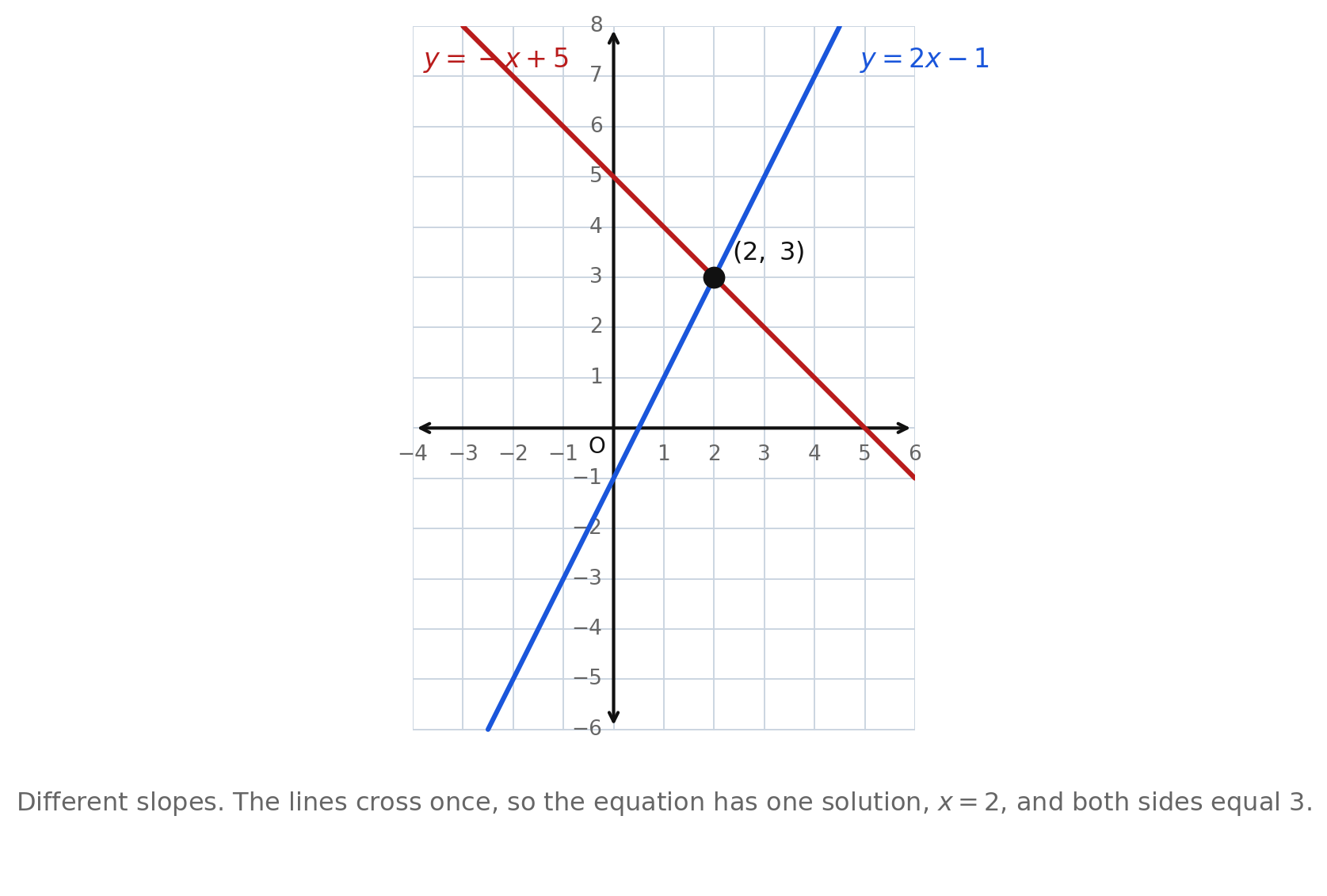
One solution — the lines cross once. Different slopes force exactly one meeting point, and its -coordinate is the solution.
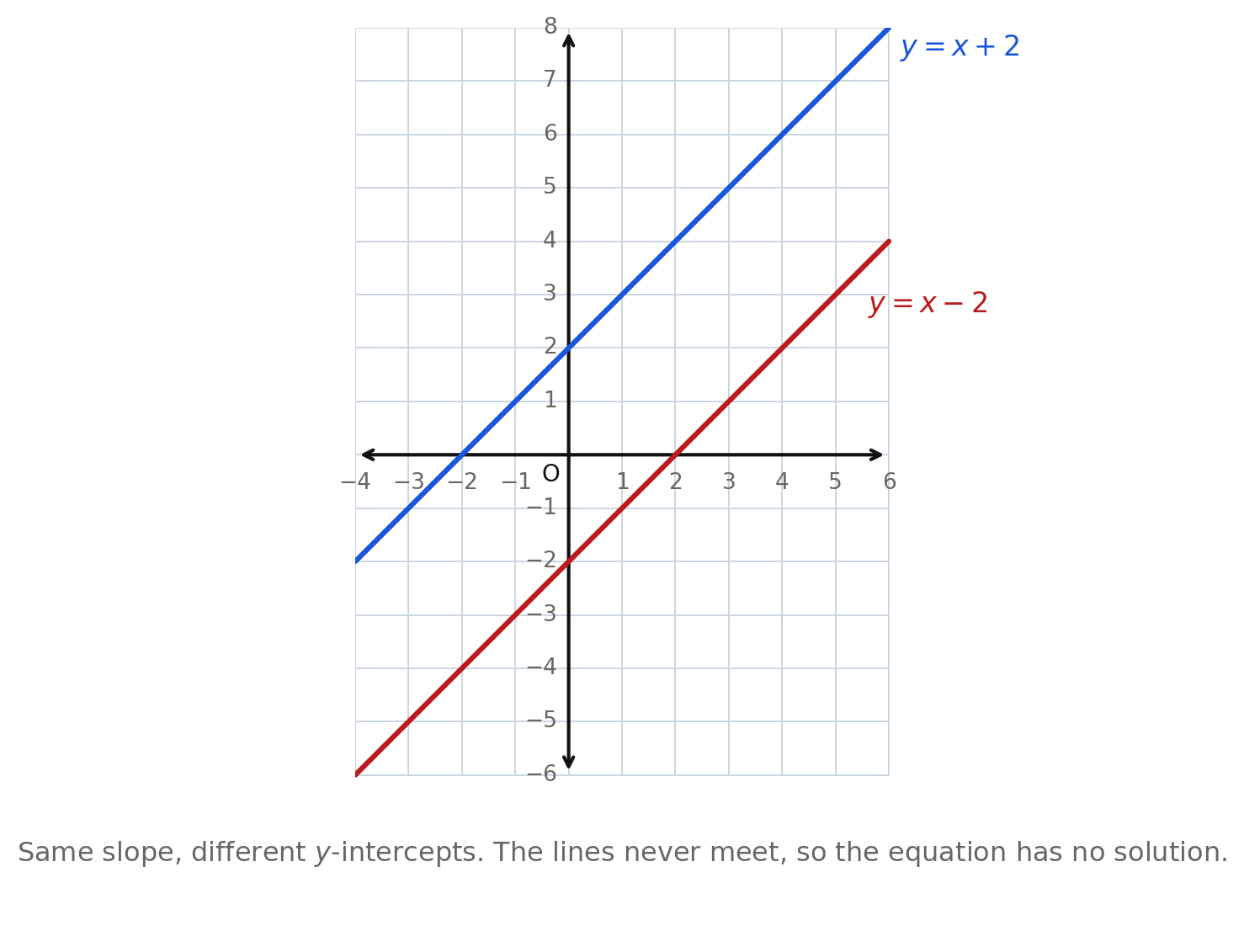
No solution — the lines are parallel. Same slope, different -intercepts. The sides differ by the same amount at every , so they are never equal.
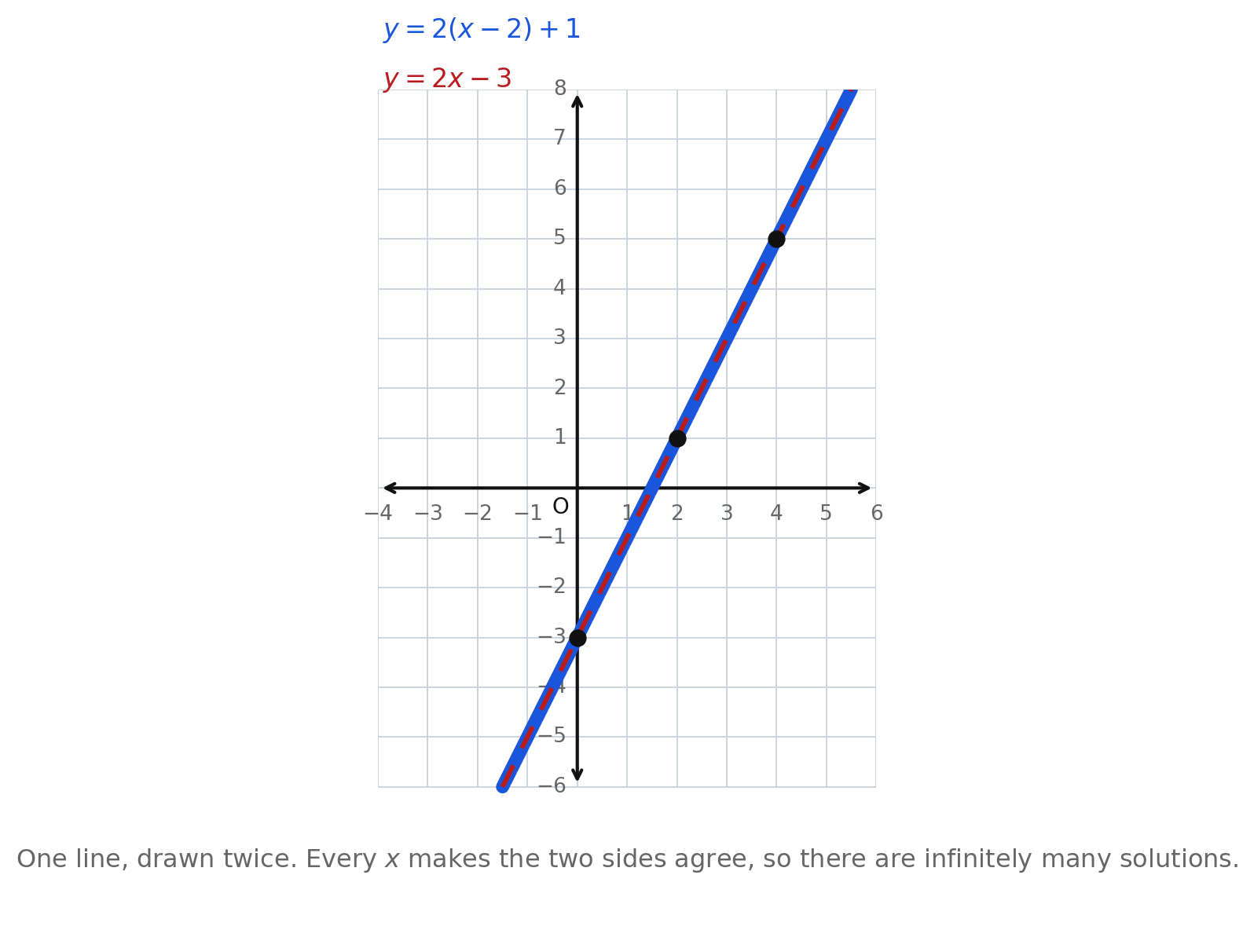
Infinitely many — the lines coincide. Same slope and same -intercept. Every point on the line is a place where the two sides agree.
This gives you a fast test in slope-intercept form. Write each side as . If the slopes differ, one solution. If the slopes match but the intercepts do not, no solution. If both match, infinitely many.
Where the solutions live
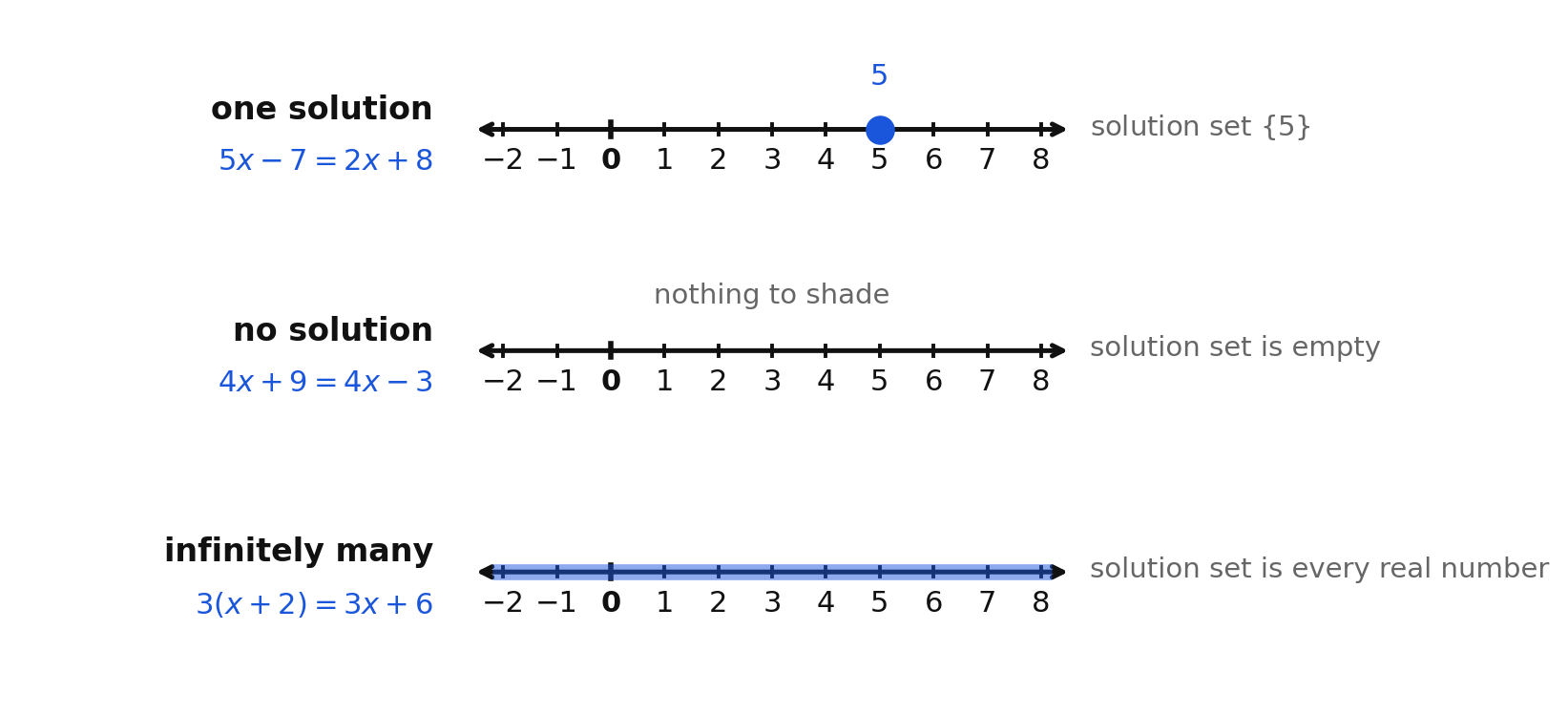
The solution set is the collection of every number that makes the equation true. Drawn on a number line, one solution is a single dot, no solution is a line with nothing on it, and infinitely many solutions is the whole line shaded. Chapter 3 will draw solution sets constantly, because an inequality almost always has infinitely many solutions; getting used to the picture now costs nothing.
Worked examples
Example 1 — An identity in disguise
Solve .
The last line is true and contains no variable.
Answer: Infinitely many solutions. Every real number satisfies the equation.
Example 2 — A contradiction
Solve .
The last line is false and contains no variable.
Answer: No solution.
Example 3 — One solution
Solve .
Verify: and . True.
Answer: One solution, .
Example 4 — Hidden by a negative factor
Solve .
Answer: Infinitely many solutions. The two sides are the same expression.
Example 5 — Almost an identity
Solve .
One digit separates this from Example 4, and it changes the answer completely.
Answer: No solution.
Guided practice
- Solve . State the number of solutions and explain what the last line tells you.
- Solve . State the number of solutions and describe the graph of the two sides.
- Solve . State the number of solutions and verify it.
- Solve . State the number of solutions and explain why the negative factor does not change the reasoning.
Independent practice
- Solve and classify each as one solution, no solution, or infinitely many. a) b) c) d)
- Solve and classify. a) b)
- Find the value of that makes have infinitely many solutions, and explain what happens for every other value of .
- Find the value of that makes have infinitely many solutions, and explain why every other value of gives no solution at all — not even one.
- Solve and classify:
- Application. Shop A charges per shirt plus a setup fee; shop B charges per shirt plus a setup fee. Write the equation that asks when the bills are equal, solve it, and interpret the result in a sentence about the two shops.
- Reasoning. Explain how you can decide the number of solutions of by comparing with and with , without finishing the algebra. Illustrate with one example of each of the three cases.
- Error analysis. Solving , a student reaches and writes "no solution, because there is no in the answer." Explain what the student misread and give the correct classification with a reason.
Exit ticket 2.4
- Solve and classify:
- Solve and classify:
- Solve and classify:
- Describe the graph of each side for all three cases, and say which feature of the two lines — slope, -intercept, or both — decides the answer.
Lesson 2.5 — Literal Equations and Formulas
Solving for a letter
A literal equation is an equation with more than one letter in it. A formula is a literal equation that describes a relationship people use — , , , .
A.EI.1d asks you to rearrange such an equation to solve for a specified variable: to rewrite it so that the variable you want stands alone on one side. This is not a new skill. It is the skill from Lesson 2.2 with letters in the places where numbers used to be.
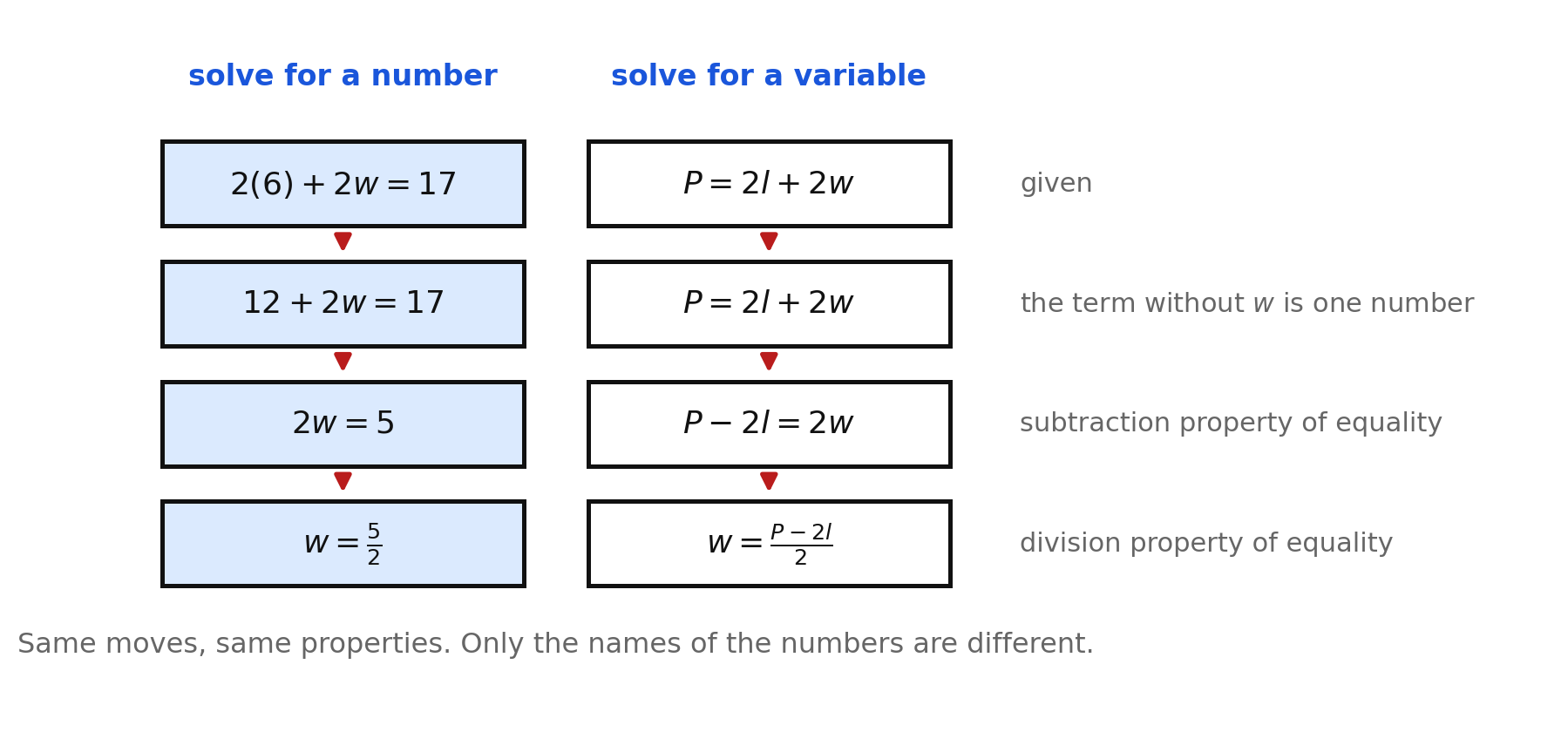
The two columns are the same four moves. Only the names of the numbers differ. Every step is still authorized by a property of equality, and you still name it.
Why bother
Because rearranging once beats substituting many times. If you must find the width of thirty rectangles from their perimeters and lengths, you can undo the formula thirty times, or you can undo it once into and then just evaluate.
Three habits that prevent most errors
- Treat every other letter as a number. In , when you are solving for the symbols and are just numbers whose names you do not happen to know.
- Undo in reverse order, exactly as with numbers: strip away addition and subtraction first, then multiplication and division.
- Divide the whole side, not one term. This is the single most common mistake. From , dividing both sides by 2 gives — the entire numerator is divided. Writing divides only part of it and is wrong.
How to check a rearrangement. Substitute a convenient set of numbers into the original formula, then into your rearranged version, and confirm they agree. With and , the original gives , so ; the rearrangement gives . Agreement is not proof, but disagreement is proof of an error, and it costs ten seconds.
Worked examples
Example 1 — One move
Solve for .
Check with and : the original gives , so , and . Agreed.
Answer:
Example 2 — Two moves, and the whole numerator
Solve for .
Check with , : , and . Agreed.
Answer:
Example 3 — Solving for a factor
Solve for .
The restriction is real: if the original equation says nothing at all about , so there is nothing to solve for.
Answer: , for
Example 4 — A formula with a fraction
Solve for .
Check with : , and . Agreed.
Answer:
Example 5 — Clearing a fraction first
Solve for .
Check with , : , and . Agreed.
Answer:
Guided practice
- Solve for , naming the property used, and check with and .
- Solve for , naming each property used.
- Solve for , naming each property used, and check with and .
- Solve for , naming each property used, and state the restriction on .
Independent practice
- Solve for the specified variable. a) for b) for c) for d) for
- Solve for the specified variable. a) for b) for
- Solve for , then use your result to convert to Celsius.
- Solve for , and write the result in the form .
- Application. The area of a trapezoid is . Solve for , then find the height of a trapezoid with area 48 square inches and bases 6 inches and 10 inches.
- Application. Use to find the width of a rectangle whose perimeter is 84 cm and whose length is 25 cm. Then verify your width in the original formula .
- Reasoning. Explain why solving for uses exactly the same properties as solving for . Then explain what is harder about the literal version, and why it is not the mathematics that is harder.
- Error analysis. Asked to solve for , a student writes . Explain the error, give the correct rearrangement, and use and to show that the student's version fails.
Exit ticket 2.5
- Solve for .
- Solve for , and state the restriction.
- Solve for .
- Explain how to check a rearranged formula, and say why agreement on one set of numbers is reassuring but not a proof.
Lesson 2.6 — Verifying Algebraically, Graphically, and with Technology
Three checks, three different jobs
A.EI.1f asks for a solution to be verified three ways. They are not three copies of the same check; each one catches something the others miss.
Algebraically. Substitute the value into the original equation, simplify each side separately, and compare. This catches arithmetic errors in your solving. It is authorized by the substitution property of equality.
Graphically. Graph each side as its own function of and find where the graphs meet. This catches a structural error — a misread coefficient, a dropped term, a sign flipped during expansion — because a wrong equation produces a visibly different picture rather than a slightly different number.
With technology. Enter both sides into a graphing calculator and read the intersection, or enter the difference and read the zero. This catches errors your hand-drawn graph is too coarse to show, and it is the check the standard names by name.
When they disagree, that is information. A disagreement never means "the calculator is right." It means exactly one of these is true: you solved wrongly, you typed the equation in wrongly, or you read the graph wrongly. All three are findable in under a minute, and the disagreement is what told you to look.
The picture behind a one-variable equation
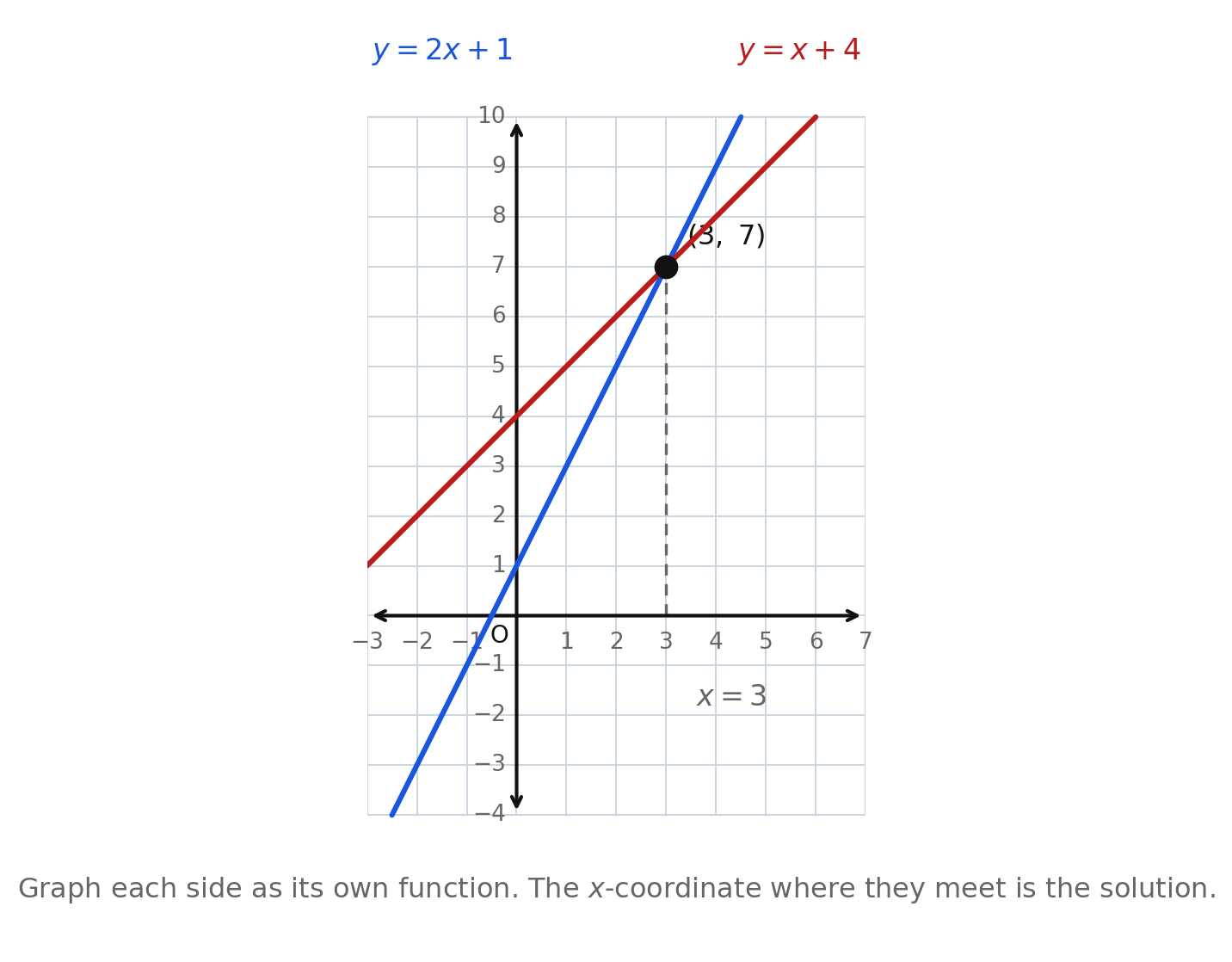
To check , graph and . They meet at . The solution of the equation is the -coordinate of that point, ; the -coordinate, 7, is the common value of the two sides.
That last sentence is the one students most often get backwards. The solution is the -coordinate. The -coordinate is what both sides equal when the solution is substituted — useful in context, because it is often the cost, the height, or the total.
The one-graph version
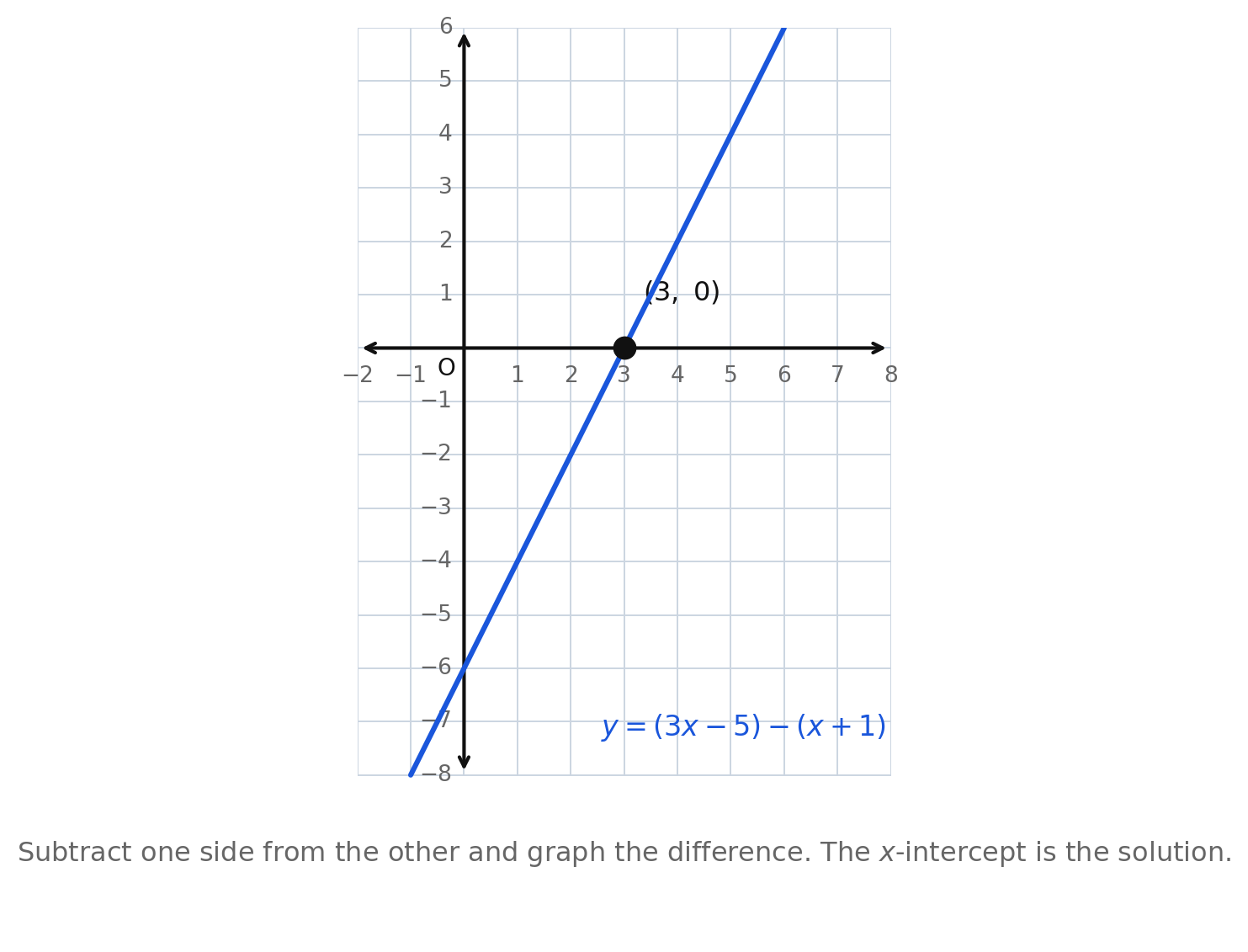
There is a second graphical method, and calculators make it the faster one. Move everything to one side and graph the difference. To check , graph
The equation is true exactly where the difference is zero, so the solution is the -intercept, . One graph instead of two, and one feature to read instead of an intersection.
The three solution counts show up here too. A difference function that is a slanted line has one zero. A difference function that is a nonzero constant, like , never touches the axis: no solution. A difference function that is identically zero lies on the axis everywhere: infinitely many solutions.
Explaining and interpreting
A.EI.1f also asks two things that are not checks at all.
Explain the solution method. Say what you did and why it was legal — "I expanded with the distributive property, gathered the variable terms with the subtraction property of equality, and divided by 3." A solution nobody can follow is not finished.
Interpret the solution in context. Say what the number means. Three questions do it:
- What does the number count or measure? "" is not an answer. "The bills are equal at 15 shirts" is.
- Is the size sensible? A negative number of hours or a width of feet means the model, not the arithmetic, needs fixing.
- Can the quantity take this value? A price can be . A shirt order cannot be 15.4 shirts. When the exact answer is a fraction, the fraction is still the honest solution — it is the break-even point — and you then reason separately about whole units.
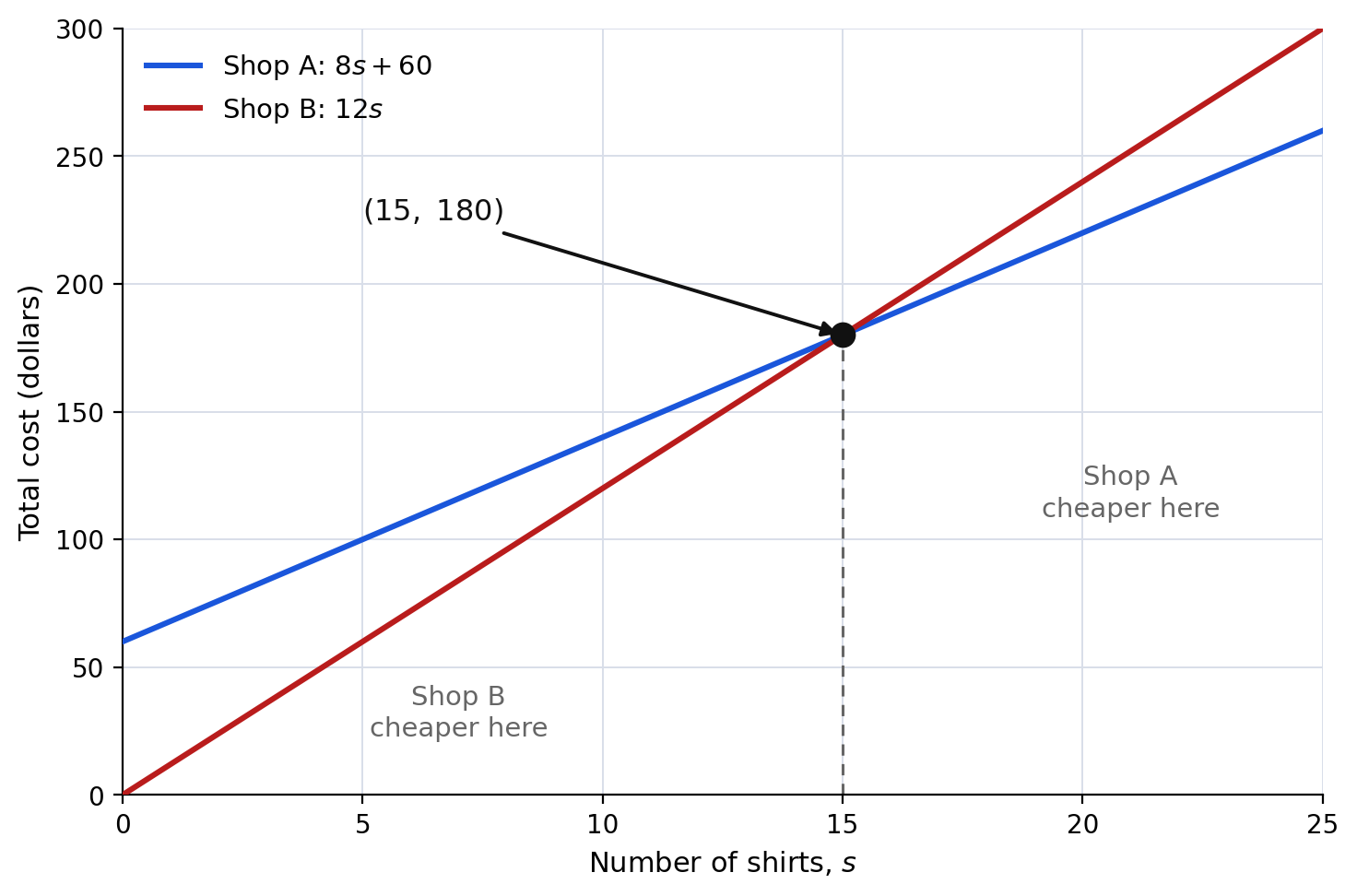
Shop A charges plus per shirt, so its total is . Shop B charges per shirt, so its total is . Solving gives and , and both totals are . The graph says the same thing and adds something the number alone does not: which shop is cheaper on each side of the crossing. Below 15 shirts, shop B's line is lower; above 15, shop A's is.
Worked examples
Example 1 — All three checks on one equation
Solve and verify algebraically, graphically, and with technology.
Algebraically: and . The sides match. Graphically: and meet at , so the solution is and both sides are worth 7. With technology: entering both functions and using the intersect command returns , .
Answer: , confirmed three ways.
Example 2 — The difference-graph check
Solve and verify with a single graph.
Algebraically: and . True. With technology: graph , which simplifies to . Its zero is at .
Answer:
Example 3 — Verifying that there is nothing to verify
Show that has no solution, algebraically and graphically.
Algebraically: subtracting from both sides gives , which is false, so no number works. Graphically: and have the same slope and different -intercepts. The lines are parallel and never meet, so there is no at which the sides agree. A calculator's intersect command reports no intersection — the machine agrees, and it agrees for the same reason.
Answer: No solution.
Example 4 — Verify, then interpret
Print shop A charges plus per shirt; shop B charges per shirt. For how many shirts are the bills equal, and what should a customer do with that fact?
Let = the number of shirts.
Algebraically: and . True. Graphically: the two cost lines meet at . Interpretation: at exactly 15 shirts both shops charge . That is not a recommendation by itself — it is the dividing line. For fewer than 15 shirts, shop B is cheaper; for more than 15, shop A's setup fee has paid for itself and shop A is cheaper.
Answer: The bills are equal at 15 shirts, each; shop B is cheaper below 15 shirts and shop A above.
Example 5 — When the algebra and the graph disagree
A student solves and reports . The grapher shows the two lines meeting at . What happened?
Check the reported answer: but . The sides do not match, so is not a solution and the graph is not the thing that is wrong.
Redo the algebra: by the distributive property, then , then , then .
Verify: and . True, and it matches the graph.
Answer: The student added instead of subtracting when gathering; the solution is .
Guided practice
- Verify algebraically that is the solution of , showing each side separately. Then describe the graph that would confirm it, including the coordinates of the intersection.
- Solve . Verify algebraically, and state the point where the graphs of the two sides meet.
- A grapher shows and meeting at . Write the one-variable equation this picture solves, state its solution, and say what the number 8 represents.
- A taxi charges plus per mile; a rideshare charges plus per mile. Write and solve an equation for the mileage at which the fares are equal, verify it algebraically, and interpret the answer.
Independent practice
- Decide whether the proposed value is a solution, showing both sides separately. a) Is a solution of ? b) Is a solution of ? If not, find the solution.
- Solve . Verify algebraically and give the coordinates where the graphs of the two sides meet.
- Solve . Then write the difference function whose -intercept confirms your answer, and state that intercept.
- A grapher shows and as two lines that never meet. State the equation being solved, the number of solutions, and how the picture tells you.
- Application. Gym A charges a joining fee plus per month; gym B charges per month. Write and solve an equation for when the totals are equal, verify it, and interpret the solution in a sentence that says which gym is cheaper for a two-year membership.
- Application. One drone hovers at 120 meters and descends 8 meters per second. Another is at 40 meters and climbs 2 meters per second. Write and solve an equation for when they are at the same height, verify it, and state that height.
- Reasoning. Your algebra gives , and your grapher shows the two lines crossing at , but when you substitute 7 into the original equation the two sides come out different. Explain what must have happened, and describe the order in which you would check things.
- Error analysis. Solving , a student reports and says the graph confirms it. Substitute to show the answer is wrong, solve correctly with the property named at each step, and give the true intersection point.
Exit ticket 2.6
- Solve and verify algebraically, showing each side separately.
- A grapher shows and meeting at . Write the equation being solved and give its solution.
- Application. Photo lab A charges plus per print; lab B charges per print. Write and solve an equation for when the costs are equal, and state that cost.
- Explain what each of the three verification methods — algebraic, graphical, and technological — catches that the other two might miss.
Chapter 2 Review
Vocabulary. linear equation in one variable · multistep equation · like terms · distributive property · commutative property of addition · associative property of addition · additive inverse property · multiplicative inverse property · multiplicative identity property · properties of equality (addition, subtraction, multiplication, division, substitution) · reciprocal · clearing fractions · clearing decimals · literal equation · formula · rearrange · solution set · identity · one solution · no solution · infinitely many solutions · verify · intersection · -intercept · break-even point · interpret
Part A — Writing an equation for a contextual situation (A.EI.1a)
- A caterer charges per plate plus a room fee, and the bill was . Define the variable, write an equation, and solve for the number of plates.
- Nine less than five times a number is the same as the number increased by 15. Write and solve an equation.
- A rectangle's length is 4 m less than three times its width, and its perimeter is 72 m. Write and solve an equation for the width, then give both dimensions.
- Internet service A charges a installation fee plus per month; service B charges per month with no installation fee. Write and solve an equation for when the totals are equal, and state that total.
Part B — Solving multistep equations with named properties (A.EI.1b)
- Solve and verify. a) b) c) d)
- Solve and verify. a) b)
- Solve and verify:
- Solve and verify:
- Solve and verify:
- Show every step of , naming the property of real numbers or property of equality that authorizes each step, and verify the solution.
Part C — Rearranging a formula or literal equation (A.EI.1d)
- Solve for .
- Solve for .
- Solve for .
- Solve for .
- Solve for .
- Solve for . Then find the rate when , , and , and verify it in the original formula.
Part D — Determining the number of solutions (A.EI.1e)
- Solve and classify as one solution, no solution, or infinitely many. a) b) c)
- Solve and classify:
- Solve and classify:
- Find the value of for which has infinitely many solutions. Then say how many solutions the equation has for every other value of , and name that solution.
- For each of the three solution counts, describe what the graphs of the two sides look like and which feature — slope, -intercept, or both — decides the case.
- Reasoning. A student solving reaches and writes "no solution." Explain the misreading, give the correct classification, and describe the graph that settles it.
Part E — Verifying algebraically, graphically, and with technology, and interpreting (A.EI.1f)
- Verify algebraically whether is the solution of , showing each side separately.
- Solve , verify algebraically, and give the coordinates where the graphs of the two sides meet.
- Solve . Write the difference function whose -intercept confirms the answer, and state that intercept.
- A grapher shows and never meeting. State the equation being solved, the number of solutions, and the algebraic last line that says the same thing.
- Application. Rideshare A charges plus per mile; rideshare B charges plus per mile. Write and solve an equation for the mileage at which the fares are equal, verify it, state the equal fare, and say which service is cheaper for a 12-mile trip.
- Reasoning. Your algebra gives , but the grapher's intersection appears to be at about . Explain why you should not simply pick one, list the three things that could be wrong, and describe how you would find out which.
Standards coverage check — Chapter 2
| Knowledge and Skill | Where it is taught | Where it is practiced |
|---|---|---|
| A.EI.1a — write a linear equation in one variable to represent a contextual situation | 2.1, with context returning in 2.4, 2.5, and 2.6 | Items 1–16; also 26, 42, 58, 73, 74, 84, 89, 90, 95; Review Part A (97–100), 123 |
| A.EI.1b — solve multistep linear equations in one variable, including contextual, by applying the properties of real numbers and/or properties of equality | 2.2, 2.3, with the property named at every step | Items 17–48; also 49–63, 82, 86, 87, 92, 93; Review Part B (101–106) |
| A.EI.1d — rearrange a formula or literal equation to solve for a specified variable | 2.5 | Items 65–80; Review Part C (107–112) |
| A.EI.1e — determine if a linear equation in one variable has one solution, no solution, or an infinite number of solutions | 2.4, with the graphical picture in 2.4 and 2.6 | Items 49–64; also 88; Review Part D (113–118), 122 |
| A.EI.1f — verify solutions algebraically, graphically, and with technology; explain the method and interpret solutions in context | 2.6, with verification required in every lesson from 2.1 onward | Every "and verify" in 1–48 and 81–95; also 64, 74, 76, 80; Review Part E (119–124) |
Bullet A.EI.1c — multistep linear inequalities — is not taught here. It is the whole of Chapter 3, which also revisits A.EI.1f for inequalities.
Answer keys for every set in this chapter are in Appendix A.