Chapter 1 — Translating and Evaluating Algebraic Expressions
Standard: A.EO.1 — The student will represent verbal quantitative situations algebraically and evaluate these expressions for given replacement values of the variables.
Knowledge and Skills, quoted in full:
- a) Translate between verbal quantitative situations and algebraic expressions, including contextual situations.
- b) Evaluate algebraic expressions which include absolute value, square roots, and cube roots for given replacement values to include rational numbers, without rationalizing the denominator.
By the end of this chapter you will be able to:
- Translate a verbal phrase into an algebraic expression, and an algebraic expression back into words (A.EO.1a)
- Recognize the two phrases that reverse the order of the quantities they name (A.EO.1a)
- Define a variable for a contextual situation and write an expression that models it (A.EO.1a)
- Interpret what each number and each variable in a contextual expression means (A.EO.1a)
- Evaluate an algebraic expression for given replacement values, including rational numbers (A.EO.1b)
- Evaluate expressions containing absolute value, square roots, and cube roots (A.EO.1b)
Lessons: 1.1 The Language of Algebra · 1.2 Expressions from Contextual Situations · 1.3 Evaluating Expressions · 1.4 Absolute Value, Square Roots, and Cube Roots in Evaluation
Conventions this chapter fixes.
No rationalizing the denominator. A.EO.1b says so in as many words. If evaluating leaves a radical in a denominator, such as , that is the finished answer in this chapter. Rewriting it as is a legitimate technique, and Chapter 11 teaches it, but it is not asked for here and no answer in this chapter uses it.
Expressions, not equations. An expression is a phrase; an equation is a sentence. Nothing in this chapter has a solution, because nothing in this chapter is a question about an unknown. You will translate, interpret, and evaluate. Solving begins in Chapter 2.
The square root symbol asks for one number. means , never . When a minus sign belongs to the answer, it is written outside the radical: .
Cube roots of negatives are real. , because . There is no such thing as an even root of a negative real number, but odd roots of negatives are perfectly ordinary.
Calculator note. Algebra 1 has no no-calculator standards, and the Desmos Virginia calculator is available for the whole End-of-Course test. A calculator is still no help on the half of this chapter that matters most: it cannot decide whether " less than a number" means or . Use it to check a substitution, not to make one. The perfect squares worth knowing on sight are , and the perfect cubes are .
Numbering note. Item numbers run straight through the chapter, from 1 in Lesson 1.1 to 122 at the end of the review. They do not restart at each lesson.
Lesson 1.1 — The Language of Algebra
The parts of an expression
An algebraic expression is a combination of numbers, variables, and operations that names a quantity. A variable is a letter standing for a number that is unknown or that is allowed to change. A numerical expression has no variable at all: is numerical, and is algebraic.
An expression is built from terms, the pieces separated by and signs. In
there are three terms: , , and . The number multiplying a variable in a term is the coefficient of that term, so the coefficient of is and the coefficient of is . A term with no variable, here , is a constant, because its value never changes no matter what is.
Notice that the sign travels with the term. The middle term is , not . Reading a subtraction as "plus a negative" — — makes that automatic and prevents a sign error later when you evaluate.
Two shorthands are worth stating out loud, because nothing in the notation announces them:
- Multiplication is written without a symbol. means , and means times the whole quantity .
- Division is written as a fraction. "A number divided by " is , not , in almost every algebraic setting.
Turning words into symbols
A verbal quantitative situation is a description in words of a quantity or a relationship between quantities. Translating one is a matter of finding the operation words and the order they impose.
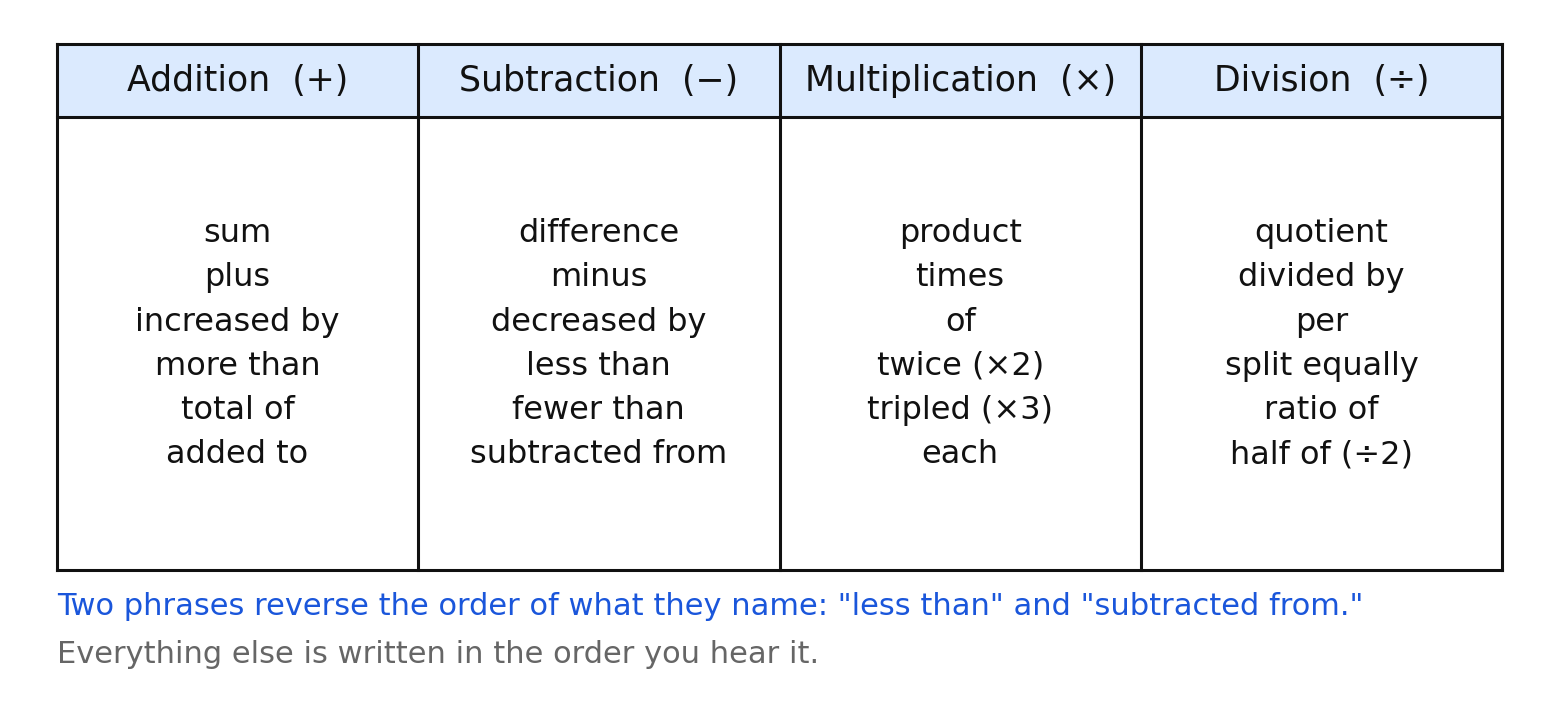
Most phrases are written in the order you hear them. "The sum of a number and " is . "Three times a number" is . "A number divided by " is .
Two phrases are not, and they are the source of most translation errors in Algebra 1.
"Less than" reverses the order. "Five less than twice a number" is , not .
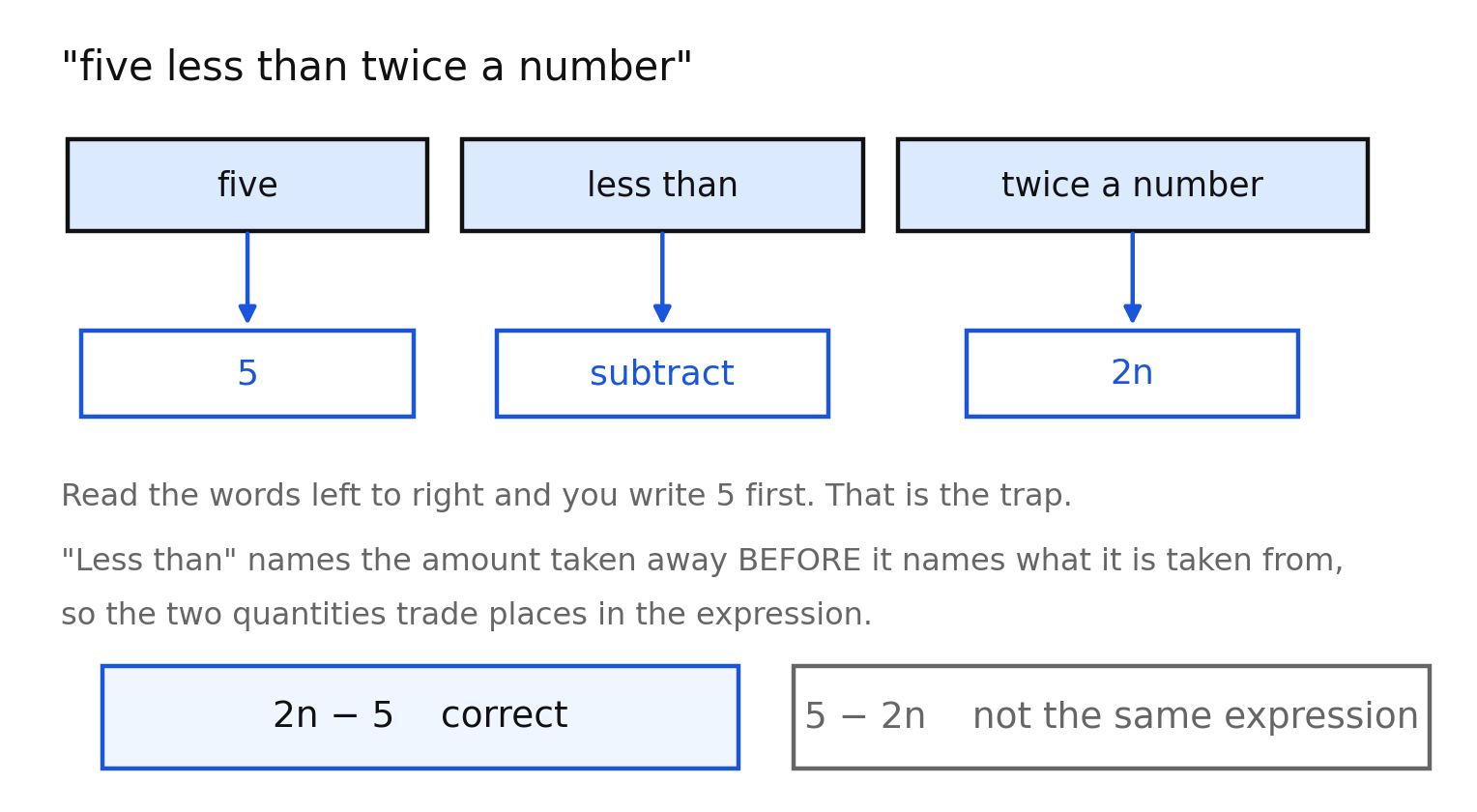
The reason is what the words mean, not a rule to memorize. "Five less than twelve" is : you start at twelve and go down five. Nobody reads that phrase as . Algebra keeps the same meaning, so "five less than twice a number" starts at and goes down five.
"Subtracted from" reverses the order too. "Nine subtracted from a number" is . The thing named right after from is what you start with.
Compare those with "the difference of and a number," which is written in the order you hear: . Subtraction is not commutative, so these are genuinely different expressions, and testing a phrase with an actual number is the fastest way to be sure which you have.
Where the parentheses come from
Parentheses appear when a phrase names an operation on a whole quantity rather than on a single number. The word to watch for is the sum, the difference, the quantity, or a comma.
- "Three times the sum of a number and " — the tripling applies to the whole sum: .
- "Three times a number, plus " — the tripling applies only to the number: .
- "The square of the sum of a number and " — .
- "The sum of the square of a number and " — .
Those four expressions are all different, and the only thing separating them is which quantity the operation is applied to.
Reading an expression back into words
Translation runs both directions, and A.EO.1a asks for both. Given , a correct verbal phrase is "one less than four times a number," or "the product of and a number, decreased by ." More than one phrasing is right, as long as the operations and their order come out the same.
Worked examples
Example 1 — A phrase written in order
Translate "the sum of a number and ."
Sum signals addition, and the phrase names the number first.
Answer:
Example 2 — A phrase that reverses
Translate " less than a number."
Less than means start with the second quantity named and subtract the first. Start at , take away . Check with a real number: less than is , and , so the order is right.
Answer:
Example 3 — Multiplication and a following operation
Translate "twice a number, decreased by ."
Twice is multiplication by , giving . Decreased by is subtraction applied after.
Answer:
Example 4 — A phrase that needs parentheses
Translate "three times the sum of a number and ."
The quantity being tripled is the entire sum , so it must be grouped. Without the parentheses, would triple only the number.
Answer:
Example 5 — Naming the parts
In , name the number of terms, the coefficients, and the constant.
Separate at the and signs, keeping each sign with the term that follows it: , , and .
Answer: three terms; coefficients and ; constant .
Example 6 — Going from symbols to words
Write a verbal phrase for .
The fraction bar groups, so the sum happens first and the division second.
Answer: "the sum of a number and , divided by " — or "half of the sum of a number and ."
Guided practice
Let represent the number in items 1 through 6.
- Translate: the sum of a number and .
- Translate: less than a number.
- Translate: the product of and a number.
- Translate: the quotient of a number and .
- Translate: twice a number, decreased by .
- Translate: more than three times a number.
- Write a verbal phrase for .
- Write a verbal phrase for .
Independent practice
- Translate each phrase. Only two different expressions appear among the five; say which phrases produce each one. a) the difference of a number and b) less than a number c) the difference of and a number d) a number subtracted from e) subtracted from a number
- Translate each phrase. a) one-third of a number b) the quotient of and a number c) a number divided by d) the sum of a number and its square e) the square of the sum of a number and
- Translate each phrase, using parentheses only where the phrase requires them. a) three times the sum of a number and b) three times a number, plus c) the sum of and three times a number d) less than the product of and a number
- Write a verbal phrase for each expression. a) b) c) d) e)
- For the expression : a) how many terms are there? b) what is the coefficient of the first term? c) what is the coefficient of the second term? d) what is the constant?
- Copy and complete the table.
| Verbal phrase | Algebraic expression |
|---|---|
| the sum of a number and | |
| the product of a number and | |
| more than twice a number |
- Which of these expressions matches "ten decreased by the product of and a number"? , , , . Explain how you eliminated the other three.
- Application. A parking garage holds cars at the start of the hour, and cars leave during that hour. Write an expression for the number of cars remaining, and explain why the expression is not .
- Reasoning. Explain why " less than a number" is rather than . Support your explanation by replacing "a number" with and evaluating both.
- Error analysis. A student translates " less than the product of and a number" as . Identify the error, give the correct expression, and describe a check the student could have done in one line.
Exit ticket 1.1
- Translate: less than twice a number.
- Translate: the quotient of a number and , increased by .
- Write a verbal phrase for .
- Explain, in words, the difference between and .
Lesson 1.2 — Expressions from Contextual Situations
Deciding what the variable stands for
A contextual situation is a real setting — a price, a distance, a temperature, a count — described in words. Modeling one algebraically is a three-step habit, and the first step is the one students skip.
- First, define the variable. Write a sentence: "Let = the number of hours worked." A letter with no sentence attached is not yet a variable; it is a mystery.
- Next, find what changes and what does not. A quantity that is the same no matter what happens is a constant. A quantity that depends on the variable is multiplied by it.
- Last, write the expression and read it back against the situation to check it.
Say what the variable measures, not what object it is. "Let = hours" is loose; "let = the number of hours worked" is a number, and only numbers can be multiplied by .
The pattern behind most contextual expressions
An enormous fraction of real situations have the same shape: something charged once, plus something charged per unit.
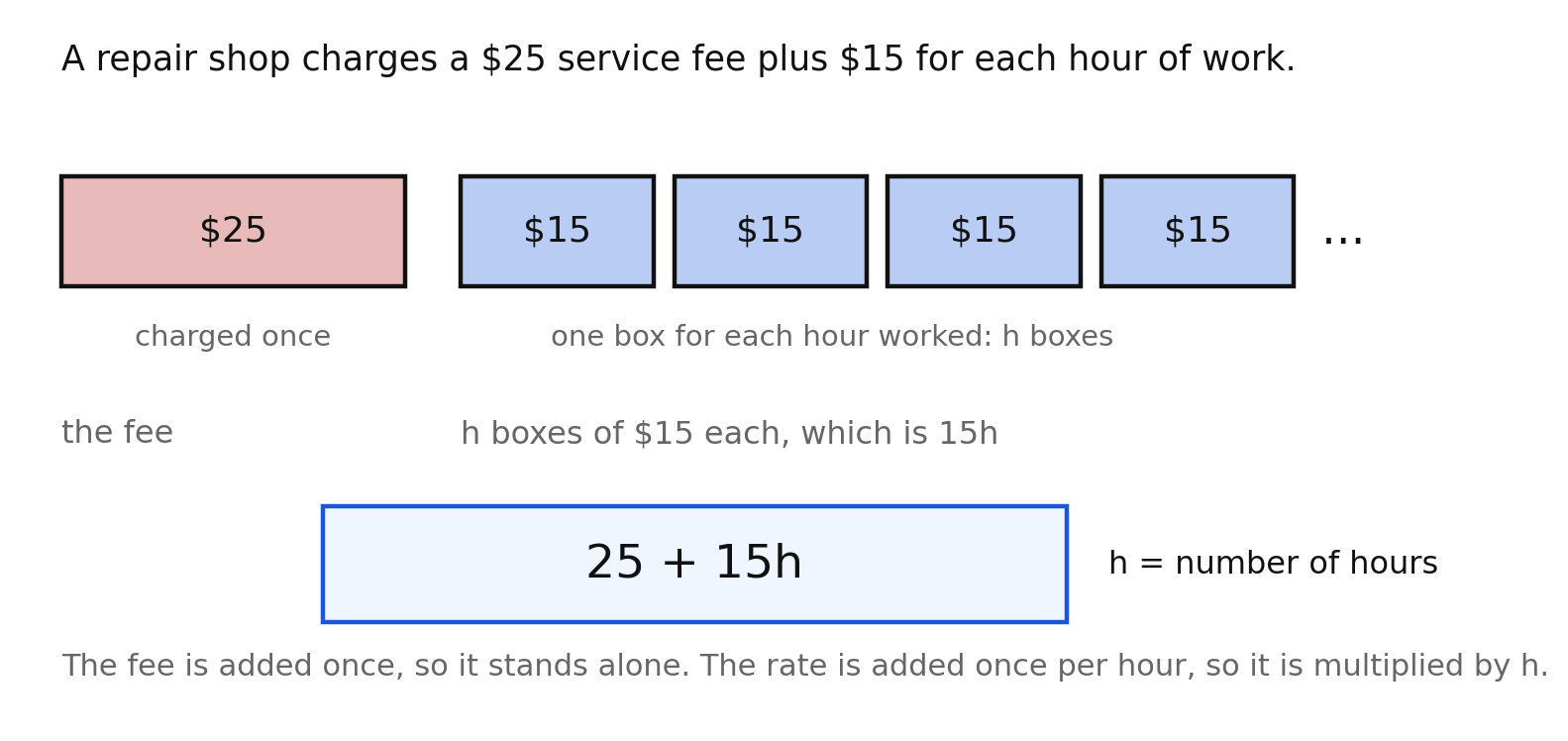
The fee appears once in the picture no matter how many hours are worked, so it appears once in the expression as a constant. The appears once per hour, so it is multiplied by the number of hours. The result is
Read the expression back the other way and you have interpreted it, which A.EO.1a also asks for: in , the is the one-time fee in dollars, the is the hourly rate in dollars per hour, and is the number of hours.
Two variations on the same shape come up constantly.
- A starting amount that decreases. A tank holds gallons and drains gallons per minute: . The rate is subtracted because the quantity is going down.
- Two different rates. quarters and dimes are worth cents. Each count gets its own rate, and the two products are added.
Multiple quantities described in terms of one
When a situation describes two related quantities, choose the variable for the one everything else is described in terms of, then build the others from it.
A rectangle's length is more than its width. Let = the width in centimeters. Then the length is , and the perimeter is
Had you started with the length, you would have had to describe the width as " less than the length," which is correct but does more work.
Worked examples
Example 1 — A single rate
A movie ticket costs . Write an expression for the cost of tickets.
Let = the number of tickets. Each ticket adds , so the cost is multiplied by the count.
Answer: dollars
Example 2 — A constant plus a rate
A pizza costs plus for each topping. Write an expression for the cost with toppings.
Let = the number of toppings. The is charged once; the is charged once per topping.
Answer: dollars
Example 3 — A starting amount that decreases
The temperature is and falls each hour. Write an expression for the temperature after hours.
Let = the number of hours. Falling means the accumulated change is subtracted from the start.
Answer: degrees Fahrenheit
Example 4 — Sharing equally
A class of students is divided into equal groups. Write an expression for the number of students in each group.
Divided into equal groups is division, and the total is what gets divided.
Answer: students
Example 5 — Building a second quantity from the first
A rectangle's length is centimeters more than its width. Write expressions for the length and for the perimeter.
Let = the width in centimeters. The length is . Perimeter is twice the width plus twice the length:
Answer: length cm; perimeter cm
Example 6 — Interpreting an expression someone else wrote
A plumber's charge in dollars is . What does each part of the expression mean?
The is attached to , so it is a rate; the stands alone, so it is charged once.
Answer: is a one-time service charge, is the charge per unit of (per quarter-hour, per hour, or whatever counts), and is the number of those units.
Guided practice
For items 23 through 29, define the variable in a sentence and then write the expression.
- A movie ticket costs . Write an expression for the cost of tickets.
- A pizza costs plus for each topping. Write an expression for the cost with toppings.
- Sara has and spends some of it. Write an expression for the amount she has left.
- A class of students is divided into equal groups. Write an expression for the size of each group.
- A rectangle's length is centimeters more than its width . Write an expression for the length.
- Write an expression for the perimeter of the rectangle in item 27, simplified.
- A gym charges a joining fee plus per month. Write an expression for the total cost after months.
Independent practice
- Notebooks cost each. a) Write an expression for the cost of notebooks. b) Write an expression for the cost of notebooks plus one bag.
- A car travels at miles per hour. a) Write an expression for the distance covered in hours. b) Write an expression for the total distance if the driver had already gone miles before starting the timer.
- A jar holds quarters and dimes. a) Write an expression for the total value in cents. b) Write an expression for the total value in dollars.
- A tank holds gallons and drains at gallons per minute. Write an expression for the number of gallons left after minutes.
- In the expression for a phone bill in dollars, where is the number of gigabytes used beyond the plan limit, explain what the , the , and the each represent.
- Match each situation to its expression: , , , , . a) boxes of pencils b) dollars after spending c) cookies shared equally by people d) dollars plus dollars e) feet of ribbon with feet cut off
- Write an expression for each, defining the variable first. a) the number of days in weeks b) the number of inches in feet c) the age in years of someone years younger than a person who is years old
- Application. A theater has some number of rows with seats in each row, plus balcony seats. Define a variable and write an expression for the total number of seats. Then say what your expression would become if the balcony were closed.
- Reasoning. Explain why and describe the same situation, but and do not. Use the properties of the operations in your explanation.
- Error analysis. A jacket costs dollars, and a shirt costs less than the jacket. A student writes the shirt's cost as . Explain the error, give the correct expression, and explain what the student's expression would describe instead.
Exit ticket 1.2
- A taxi charges plus per mile. Define a variable and write an expression for the fare.
- A bag of marbles is shared equally among friends. Write an expression for each friend's share.
- Describe a real situation that the expression could model. Say what counts and what the and the mean.
- Explain how you decide which quantity in a situation should be represented by the variable.
Lesson 1.3 — Evaluating Expressions
Substitution, then arithmetic
To evaluate an algebraic expression is to replace each variable with a given replacement value and simplify the resulting numerical expression to a single number. There is exactly one thing to get right in the substitution step and one thing to get right afterward.
Substitute inside parentheses, always. Replacing with in gives . Writing instead loses both the multiplication and the sign, and there is no recovering from it.
Then follow the order of operations. Grouping symbols first, then exponents and roots, then multiplication and division left to right, then addition and subtraction left to right.
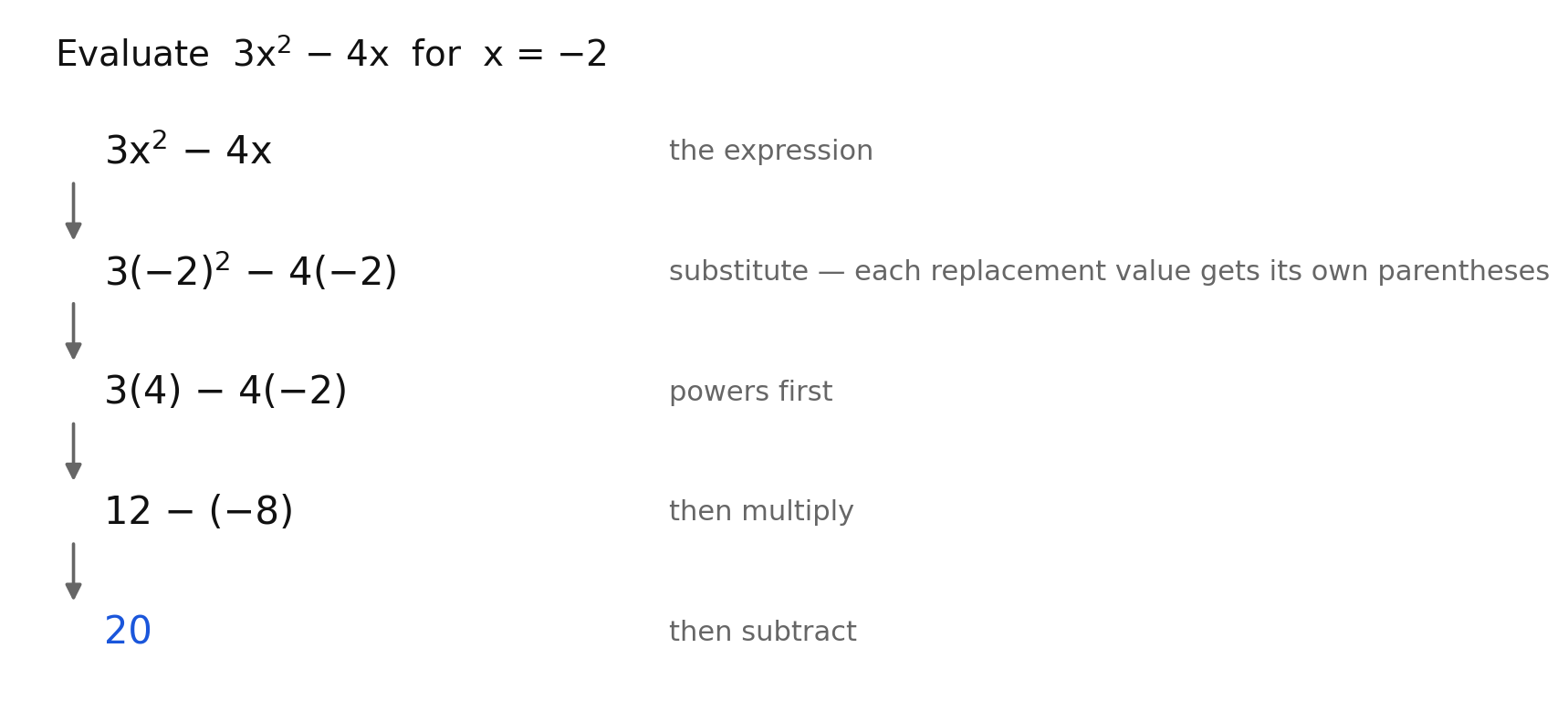
Two sign situations account for most wrong answers on this skill.
and are different expressions. The exponent attaches only to what it sits on. In the exponent sits on the , so you square first and negate second: . In the exponent sits on the whole parenthesized quantity: .
Subtracting a negative. In , the parentheses from the substitution are what let you see that this is a subtraction of a negative, which adds: .
Rational replacement values
A.EO.1b requires replacement values that include rational numbers, which means fractions and decimals, positive and negative. Nothing about the procedure changes; only the arithmetic gets more careful.
Evaluate for and :
A fraction replacement value is often a gift rather than a burden. A coefficient of meeting a replacement value of produces the integer , and problems are frequently built that way on purpose.
Absolute value
The absolute value of a number is its distance from on the number line, written with bars: and .
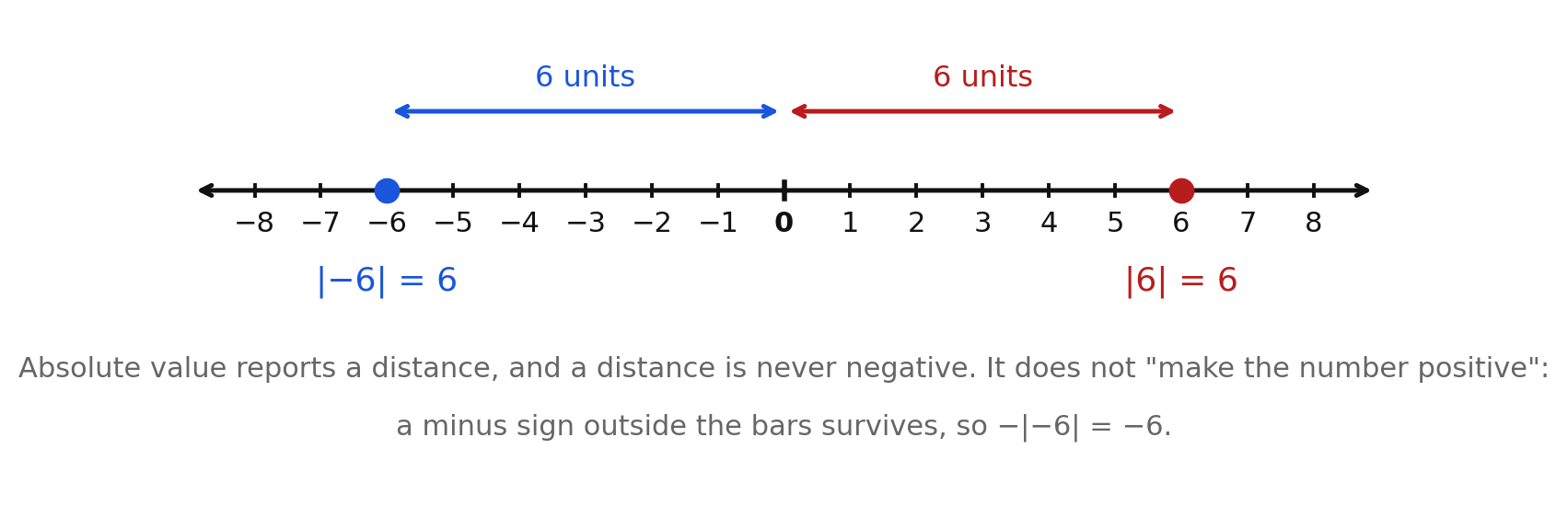
Because a distance is never negative, an absolute value is never negative. But "never negative" is a fact about what is inside the bars, and two consequences follow that students routinely miss.
The bars are grouping symbols. Everything inside gets simplified before the absolute value is taken. In with and , first get , then .
A minus sign outside the bars survives. . The bars turned into ; the minus sign in front then turns it back. Only what is inside the bars is affected.
One more distinction worth practicing, because it appears on tests: , but . Where the bars fall changes the answer.
Worked examples
Example 1 — An integer replacement value
Evaluate for .
Answer:
Example 2 — An exponent and a negative value
Evaluate for .
Answer:
Example 3 — A fraction replacement value inside parentheses
Evaluate for .
Answer:
Example 4 — Absolute value with and without an outside sign
Evaluate and for .
Answer: and
Example 5 — Two rational replacement values
Evaluate for and .
Answer:
Example 6 — Absolute value bars used twice
Evaluate for and .
Answer:
Guided practice
- Evaluate for .
- Evaluate for .
- Evaluate for .
- Evaluate for .
- Evaluate for .
- Evaluate for .
- Evaluate for .
- Evaluate for .
- Evaluate for .
Independent practice
- Evaluate each for and . a) b) c) d) e)
- Evaluate each for and . a) b) c) d)
- Evaluate each for . a) b) c) d)
- Evaluate each for . a) b) c) d)
- Evaluate each. a) b) c) d) e)
- Evaluate for each replacement value. a) b) c) d)
- Evaluate for a) , b) ,
- Evaluate for .
- Application. The change in temperature between two readings and is the number of degrees between them, which is . A morning reading is and the afternoon reading is . Evaluate the expression, and explain why absolute value is the right tool for "how many degrees apart."
- Application. A repair shop's charge in dollars is , where is the number of hours of work. Evaluate the expression for and write the result as an amount of money.
- Reasoning. Evaluate and . Explain why the two results differ even though both expressions contain a , a minus sign, and a square.
- Error analysis. A student evaluates for and writes . Find the step where the error happened, give the correct value, and state the rule the student missed.
Exit ticket 1.3
- Evaluate each for . a) b)
- Evaluate for .
- Evaluate and for .
- Explain why substituting a negative replacement value in parentheses matters. Use an example.
Lesson 1.4 — Absolute Value, Square Roots, and Cube Roots in Evaluation
Two more operations inside the same procedure
Nothing about evaluation changes in this lesson. You still substitute in parentheses and still follow the order of operations. What is new is that A.EO.1b names two operations that can appear in the expression you are evaluating.
The square root of a nonnegative number , written , is the nonnegative number whose square is . So , because .
The cube root of a number , written , is the number whose cube is . So , because .
The difference between them shows up as soon as the number underneath goes negative.
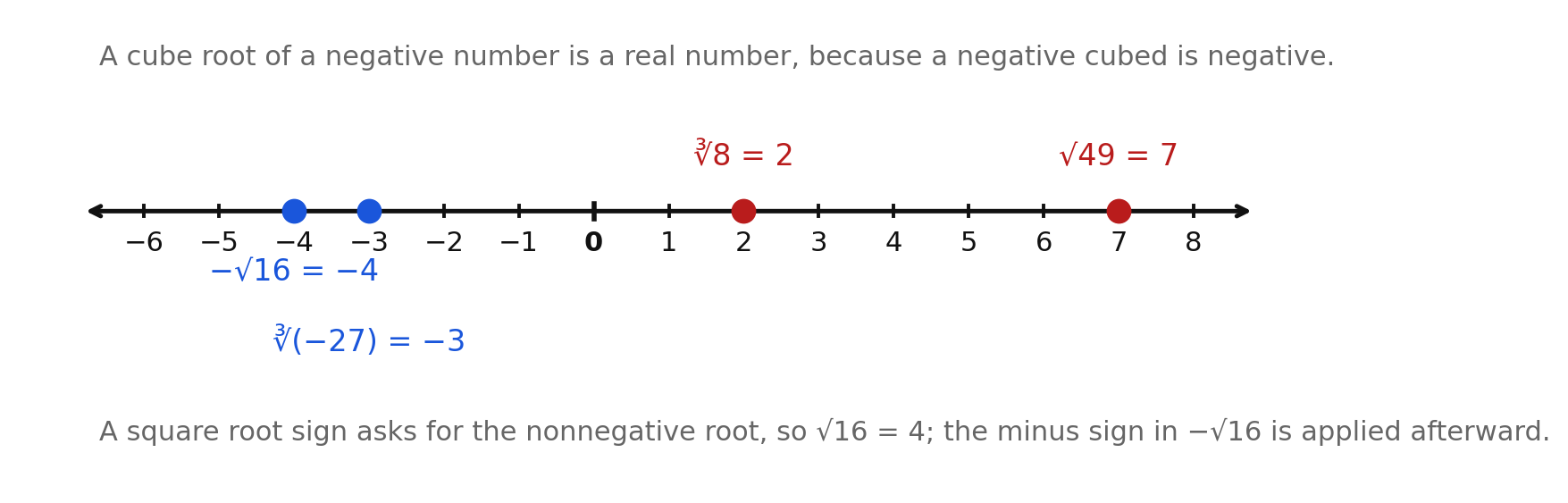
Cube roots of negative numbers are real numbers. , because . Cubing preserves sign, so every real number — positive, negative, or zero — has exactly one real cube root.
Square roots of negative numbers are not real numbers. No real number squares to , because squaring a positive gives a positive and squaring a negative also gives a positive. If a substitution ever lands you at , the expression has no real value for that replacement value, and saying so is the correct answer.
A minus sign in front of a radical is applied last. , because and then the minus sign is applied. That is a different expression from , which is not real at all.
A radical is a grouping symbol. Everything under the bar is simplified before the root is taken. Evaluating at and gives , not . Roots do not distribute over addition, and while is the cleanest proof of it.
Rational numbers under the radical
Perfect squares and perfect cubes do not have to be whole numbers. Because , we get , and the same idea handles decimals: because . For fractions, take the root of the numerator and the root of the denominator separately.
The convention this chapter fixes: no rationalizing
Sometimes a substitution leaves a radical in a denominator. Evaluate at and you get
and in this chapter that is the finished answer. A.EO.1b says "without rationalizing the denominator," so you are not asked to rewrite it. The rewriting is a real technique — it produces , the same number — and Chapter 11 develops it along with the rest of simplest radical form. Here, stop when the arithmetic is done.
If the replacement value happens to make the radical come out even, of course you finish the division: .
Worked examples
Example 1 — A square root of a perfect square
Evaluate for .
, and the square root symbol asks for the nonnegative root.
Answer:
Example 2 — The radical as a grouping symbol
Evaluate for and .
Simplify under the bar first:
Evaluating the roots separately would give , a different number.
Answer:
Example 3 — A cube root of a negative number
Evaluate for .
Ask what number cubed gives . Since and cubing preserves sign, .
Answer:
Example 4 — A root inside a larger expression
Evaluate for .
Roots are evaluated at the same stage as exponents, before the multiplication:
Answer:
Example 5 — Three replacement values under one radical
Evaluate for , , and .
Answer:
Example 6 — A radical left in the denominator
Evaluate for .
Since is not a perfect square, does not simplify to a rational number, and A.EO.1b does not ask you to rationalize the denominator.
Answer:
Guided practice
- Evaluate .
- Evaluate .
- Evaluate .
- Evaluate .
- Evaluate for .
- Evaluate for .
- Evaluate for .
- Evaluate for .
- Evaluate for . Leave the denominator as it is.
Independent practice
- Evaluate each. a) b) c) d) e)
- Evaluate each. a) b) c) d) e)
- Evaluate for each pair. a) , b) , c) ,
- Evaluate for each replacement value. a) b) c)
- Evaluate for a) , , b) , ,
- Evaluate for a) b)
- Evaluate for a) b) . One of these finishes as a rational number and one does not; say which is which and why.
- Evaluate for and .
- Application. A square patio covers square feet, so each side measures feet. A cube-shaped storage bin holds cubic inches, so each edge measures inches. Find the side of a patio with and the edge of a bin with .
- Application. An object dropped from a height of feet falls for seconds before it lands. Evaluate the expression for feet and state the result with its unit.
- Reasoning. Explain why is a real number but is not. Use the effect of squaring and of cubing on the sign of a number.
- Error analysis. A student claims that and uses it to evaluate the expression at , , getting . Evaluate the expression correctly, and explain what the student's shortcut assumes that is false.
Exit ticket 1.4
- Evaluate a) for b) for
- Evaluate for and .
- Evaluate for , and explain why you are finished.
- Explain why has no real value while does.
Chapter 1 Review
Vocabulary. algebraic expression · numerical expression · variable · term · coefficient · constant · verbal quantitative situation · contextual situation · translate · evaluate · replacement value · absolute value · square root · cube root
Part A — Translating between verbal situations and algebraic expressions (A.EO.1a)
- Translate each phrase, using for the number. a) the sum of a number and b) less than a number c) the quotient of a number and d) three times the difference of a number and e) twice a number, increased by
- Write a verbal phrase for each expression. a) b) c)
- Explain the difference between "the difference of and a number" and " less than a number." Write both expressions.
- Application. A cell plan costs per month plus for each text message. Define a variable and write an expression for the monthly bill in dollars.
- Application. A rectangle's length is more than twice its width. Define a variable and write expressions for a) the length and b) the perimeter, simplified.
- Application. Marcus has dollars and spends . Write an expression for what he has left.
- Application. A cash drawer holds nickels and dimes. Write an expression for the total value in cents.
- Application. An auditorium has rows of seats, plus seats on the floor. Define the variable and write an expression for the total number of seats.
- In the expression , name a) the number of terms b) the coefficient of the second term c) the constant.
- Copy and complete the table.
| Verbal phrase | Algebraic expression |
|---|---|
| less than a number | |
| the quotient of and a number | |
- Reasoning. Explain why " less than " is and not . Test both with and report what each gives.
- Error analysis. A student writes "the quotient of and a number" as . Explain the error and give the correct expression.
Part B — Evaluating expressions, including absolute value and roots (A.EO.1b)
- Evaluate each for and . a) b) c) d) e)
- Evaluate each for and . a) b) c) d) e)
- Evaluate each for . a) b) c) d) e)
- Evaluate each. a) b) c) d) e)
- Evaluate for a) b) c) d)
- Evaluate each. a) b) c) d)
- Evaluate each. a) b) c) d)
- Evaluate for a) , b) , c) ,
- Evaluate for and .
- Evaluate for a) b) . Do not rationalize any denominator.
- Evaluate for , , .
- Application. A repair shop's charge in dollars is , where is the number of hours worked. Evaluate for and write the result as an amount of money.
- Application. A square rug covers square meters, so each side is meters. Evaluate.
- Application. A cubical shipping box holds cubic centimeters, so each edge is centimeters. Evaluate.
- Application. Overnight the temperature was and by noon it was . The number of degrees between the two readings is . Evaluate it, and explain why the answer would be the same if the two readings were named in the other order.
- Reasoning. Evaluate and for . Explain why the two results differ, referring to what the exponent is attached to in each expression.
- Error analysis. A student evaluates for , writes , and then says the problem is not finished because the denominator still has a radical. Explain what this chapter's convention says about that, and name the chapter where the technique the student is thinking of is taught.
Standards coverage check — Chapter 1
| Knowledge and Skill | Where it is taught | Where it is practiced |
|---|---|---|
| A.EO.1a — translate between verbal quantitative situations and algebraic expressions, including contextual situations | 1.1 (phrases and expression structure, both directions), 1.2 (contextual situations, defining variables, interpreting the parts of an expression) | Items 1–22; 23–43; Review Part A, items 94–105 |
| A.EO.1b — evaluate algebraic expressions which include absolute value, square roots, and cube roots for given replacement values to include rational numbers, without rationalizing the denominator | 1.3 (substitution, order of operations, rational replacement values, absolute value), 1.4 (square roots and cube roots, and the no-rationalizing convention) | Items 44–68; 69–93; Review Part B, items 106–122 |
Coverage notes. Rational replacement values appear in items 52, 55, 56, 58c, 59b, 66, 67, 70, 78c, 78e, 79e, 80c, 83b, 107, 108, 110c, 111b, 111c, 112c, and 113c. Absolute value appears in items 49–51, 56d, 57, 58, 61, 67, 76, 83, 108c, 108d, 109, 110, and 120. Square roots appear in items 69, 70, 73, 75, 77, 78, 80, 82–87, 89, 90a, 91, 92, 111, 113, 114, 115, 116, and 118. Cube roots appear in items 71, 72, 74, 76, 79, 81, 85, 86, 88, 90b, 91, 93, 112, 114, and 119. Denominators containing radicals are left unrationalized in items 77, 84a, 92, 115a, and 122.
This chapter stays inside A.EO.1. No expression here is set equal to anything, because solving equations is A.EI.1 and belongs to Chapter 2. Simplifying radicals into simplest radical form, including rationalizing denominators, is A.EO.4 and belongs to Chapter 11. Combining like terms and operating on polynomials is A.EO.2 and belongs to Chapter 12.
Answer keys for every set in this chapter are in Appendix A.